.png)
Alex Henderson
In the aftermath of the United States' strike on Iran’s nuclear facilities over the weekend, Christian Zionism took center stage as conservative Texas pastors rallied, framing the military action as a Biblical mandate rather than mere geopolitics, the Houston Chronicle reported Monday.
Pastor Jack Graham of Plano’s Prestonwood Baptist Church led the chorus, praising President Donald Trump’s strike and declaring he was “so grateful for his moral clarity and his commitment to keep America safe and protect it.”
The Chronicle further reported that Graham told his congregation of 50,000 that “peace comes through strength” and warned, “You cannot allow the primary sponsor of terrorism in the world to have a nuclear weapon.”
On Sunday morning, Graham took to social media, writing: "As we gather in churches across America and around the world today, let us pray with thanksgiving that the nuclear threat of Iranian madmen is obliterated."
This support extends beyond national security concerns into a broader evangelist movement rooted in dispensationalist theology — a belief that backing Israel is not only politically sound but fulfills prophecy and hastens the Second Coming of Christ.
Texas pastors have consistently expressed solidarity with Israel, citing U.S. involvement in conflicts with Hamas and Iran as part of a divine script. Their conviction is that partial support won't suffice and unwavering allegiance to Israel is a scriptural imperative.
The Chronicle's report notes that leaders like San Antonio’s Pastor John Hagee have turned Christian Zionist ideology into political power. Hagee founded Christians United for Israel (CUFI), which claims over 10 million members and aggressively lobbies for pro-Israel initiatives, including embassy relocation, settlement backing, and even pre‑emptive strikes against Iran, per the report.
At CUFI gatherings, conflict in the Middle East is reportedly portrayed not as diplomacy gone wrong but as the necessary precursor to the “bloody last battle at Armageddon,” after which believers expect Jesus to return and usher in a thousand-year reign.
For adherents, current Middle Eastern tensions aren’t accidents of history — they’re foretold events coming to life. This worldview has translated into tangible influence: evangelical voters and lobbyists have shaped U.S. policy on Jerusalem, the Golan Heights, and pressure on Iran.
Despite this, criticism comes from within Christian ranks. Historical declarations like La Grange in 1979 and 1981 challenged the theological underpinnings of Christian Zionism, warning that uncritical support for Israel undermines Palestinian rights and complicates interfaith efforts.
Meanwhile, younger evangelicals are increasingly questioning whether scripture mandates backing every Israeli policy or military action, the report noted.
June 25, 2025 |
ALTERNET
Before launching his 2016 presidential campaign, Donald Trump didn't have a lot of contact with evangelical Christian fundamentalism.
Trump was raised Presbyterian/Mainline Protestant — not evangelical — in Queens by a Scottish immigrant mother and an American father. And religion, even non-fundamentalist Protestant Christianity, wasn't a high priority for him.
In 2016, 2020 and 2024, however, white evangelicals were a key part of Trump's MAGA base. And he gets a lot of input from them, often attacking Democrats as anti-religion even though many prominent Democrats — from Sen. Raphael Warnock (D-Georgia) to MSNBC's the Rev. Al Sharpton to Catholic former House Speaker Nancy Pelosi (D-California) — are quite religious and can quote the Bible with much more detail than Trump.
In an article published on June 25, Salon's Amanda Marcotte warns that Trump is getting a lot of input from far-right white Christian nationalists on the Middle East and explains why that is dangerous.
"The wild claims made by leaders of the Christian Right have also been in the mix: that Trump is a prophet sent by God to usher in the End Times, and that attacking Iran is necessary to bring about the end of the world and the return of Jesus Christ," the Philadelphia-based Marcotte explains. "It's this delusion that (Sen. Ted) Cruz was winking at, and it was likely a powerful reason Trump decided to escalate."
White evangelical Christian fundamentalists have a complex relationship with Israel. On one hand, they believe that Jews are damned to eternal hell because they don't accept Jesus Christ as the Messiah; on the other hand, they consider themselves very pro-Israel because of the role they think Israel will play in the End Times.
"Anthea Butler, a religious studies professor at the University of Pennsylvania, told Salon that Cruz was referencing evangelical belief in a Biblical prophecy that war involving Israel and the larger Middle East is 'only one more step in ushering in Jesus' return," Marcotte notes. "As journalist Sarah Posner explained at Talking Points Memo, 'this movement holds that a series of prophesied events, including Jews' return to Israel and invasion by armies of foreign countries including Iran, will culminate in a bloody, victorious battle at Armageddon.'"
Marcotte continues, "As a result, the conflict between Iran and Israel has launched a frenzy within evangelical circles, as they hope the final battle is coming and they will get to witness the End Times…. Family Research Council head Tony Perkins was one of the architects of Project 2025, the far-right plan for a government takeover being implemented by Trump's administration. He's also a big believer in this Biblical prophecy and, as Kyle Mantyla of Right Wing Watch documented, has been using his podcast to frame war with Iran as the key to bringing Jesus back to Earth."
According to Marcotte, the "pressure from Trump's evangelical base" on the Middle East "offers insight into why he is cracking."
"He almost certainly would like to leave his intervention in Iran behind," Marcotte observes. "But he can't say no to evangelicals, because he knows that he’s nothing without them."
Amanda Marcotte's full article for Salon is available at this link.
'So grateful': Pro-Trump Texas pastors view bombings as preamble to 'bloody last battle'
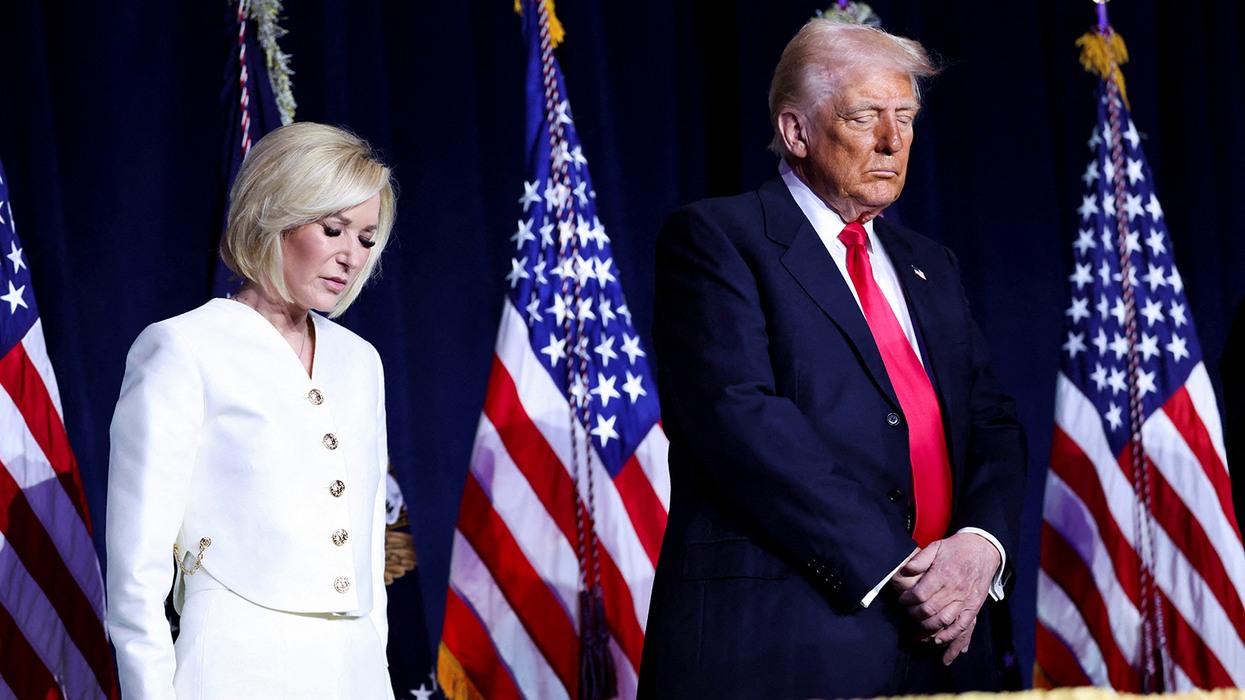
U.S. President Donald Trump and Pastor Paula White attend the annual National Prayer Breakfast at Hilton hotel in Washington, U.S., February 6, 2025. REUTERS/Kevin Lamarque REFILE - QUALITY REPEAT
Trump was raised Presbyterian/Mainline Protestant — not evangelical — in Queens by a Scottish immigrant mother and an American father. And religion, even non-fundamentalist Protestant Christianity, wasn't a high priority for him.
In 2016, 2020 and 2024, however, white evangelicals were a key part of Trump's MAGA base. And he gets a lot of input from them, often attacking Democrats as anti-religion even though many prominent Democrats — from Sen. Raphael Warnock (D-Georgia) to MSNBC's the Rev. Al Sharpton to Catholic former House Speaker Nancy Pelosi (D-California) — are quite religious and can quote the Bible with much more detail than Trump.
In an article published on June 25, Salon's Amanda Marcotte warns that Trump is getting a lot of input from far-right white Christian nationalists on the Middle East and explains why that is dangerous.
"The wild claims made by leaders of the Christian Right have also been in the mix: that Trump is a prophet sent by God to usher in the End Times, and that attacking Iran is necessary to bring about the end of the world and the return of Jesus Christ," the Philadelphia-based Marcotte explains. "It's this delusion that (Sen. Ted) Cruz was winking at, and it was likely a powerful reason Trump decided to escalate."
White evangelical Christian fundamentalists have a complex relationship with Israel. On one hand, they believe that Jews are damned to eternal hell because they don't accept Jesus Christ as the Messiah; on the other hand, they consider themselves very pro-Israel because of the role they think Israel will play in the End Times.
"Anthea Butler, a religious studies professor at the University of Pennsylvania, told Salon that Cruz was referencing evangelical belief in a Biblical prophecy that war involving Israel and the larger Middle East is 'only one more step in ushering in Jesus' return," Marcotte notes. "As journalist Sarah Posner explained at Talking Points Memo, 'this movement holds that a series of prophesied events, including Jews' return to Israel and invasion by armies of foreign countries including Iran, will culminate in a bloody, victorious battle at Armageddon.'"
Marcotte continues, "As a result, the conflict between Iran and Israel has launched a frenzy within evangelical circles, as they hope the final battle is coming and they will get to witness the End Times…. Family Research Council head Tony Perkins was one of the architects of Project 2025, the far-right plan for a government takeover being implemented by Trump's administration. He's also a big believer in this Biblical prophecy and, as Kyle Mantyla of Right Wing Watch documented, has been using his podcast to frame war with Iran as the key to bringing Jesus back to Earth."
According to Marcotte, the "pressure from Trump's evangelical base" on the Middle East "offers insight into why he is cracking."
"He almost certainly would like to leave his intervention in Iran behind," Marcotte observes. "But he can't say no to evangelicals, because he knows that he’s nothing without them."
Amanda Marcotte's full article for Salon is available at this link.
'So grateful': Pro-Trump Texas pastors view bombings as preamble to 'bloody last battle'
U.S. President Donald Trump and Pastor Paula White attend the annual National Prayer Breakfast at Hilton hotel in Washington, U.S., February 6, 2025. REUTERS/Kevin Lamarque REFILE - QUALITY REPEAT
June 23, 2025 |
ALTERNET
In the aftermath of the United States' strike on Iran’s nuclear facilities over the weekend, Christian Zionism took center stage as conservative Texas pastors rallied, framing the military action as a Biblical mandate rather than mere geopolitics, the Houston Chronicle reported Monday.
Pastor Jack Graham of Plano’s Prestonwood Baptist Church led the chorus, praising President Donald Trump’s strike and declaring he was “so grateful for his moral clarity and his commitment to keep America safe and protect it.”
The Chronicle further reported that Graham told his congregation of 50,000 that “peace comes through strength” and warned, “You cannot allow the primary sponsor of terrorism in the world to have a nuclear weapon.”
On Sunday morning, Graham took to social media, writing: "As we gather in churches across America and around the world today, let us pray with thanksgiving that the nuclear threat of Iranian madmen is obliterated."
This support extends beyond national security concerns into a broader evangelist movement rooted in dispensationalist theology — a belief that backing Israel is not only politically sound but fulfills prophecy and hastens the Second Coming of Christ.
Texas pastors have consistently expressed solidarity with Israel, citing U.S. involvement in conflicts with Hamas and Iran as part of a divine script. Their conviction is that partial support won't suffice and unwavering allegiance to Israel is a scriptural imperative.
The Chronicle's report notes that leaders like San Antonio’s Pastor John Hagee have turned Christian Zionist ideology into political power. Hagee founded Christians United for Israel (CUFI), which claims over 10 million members and aggressively lobbies for pro-Israel initiatives, including embassy relocation, settlement backing, and even pre‑emptive strikes against Iran, per the report.
At CUFI gatherings, conflict in the Middle East is reportedly portrayed not as diplomacy gone wrong but as the necessary precursor to the “bloody last battle at Armageddon,” after which believers expect Jesus to return and usher in a thousand-year reign.
For adherents, current Middle Eastern tensions aren’t accidents of history — they’re foretold events coming to life. This worldview has translated into tangible influence: evangelical voters and lobbyists have shaped U.S. policy on Jerusalem, the Golan Heights, and pressure on Iran.
Despite this, criticism comes from within Christian ranks. Historical declarations like La Grange in 1979 and 1981 challenged the theological underpinnings of Christian Zionism, warning that uncritical support for Israel undermines Palestinian rights and complicates interfaith efforts.
Meanwhile, younger evangelicals are increasingly questioning whether scripture mandates backing every Israeli policy or military action, the report noted.

No comments:
Post a Comment