Tuesday, July 22, 2025


Kenya arrests rights activist over ‘terrorist activities’ following anti-government protests

The Kenyan Directorate of Criminal Investigations (DCI) reported on Sunday that the human rights activist Boniface Mwangi was arrested in his residence for “facilitating terrorist activities” allegedly committed during a youth-led protest on June 26. Mwangi, before his arrest, jointly filed a lawsuit in front of the East African Court of Justice against the Tanzanian, Kenyan and Ugandan governments alleging his torture and several human rights violations.

Mwangi was arrested over alleged facilitation of terrorism during his involvement in the youth protests in late June. The International Commission of Jurists in Kenya (ICJ Kenya) issued a statement noting that “stand in unwavering solidarity with Kenya’s youth, human rights defenders, and civil society actors who continue to speak truth to power in the face of intimidation and injustice.”

Just before his arrest on Friday, Mwangi filed a lawsuit against the Tanzanian, Kenyan and Ugandan governments for the torture and deportation he and his colleague incurred in May, in front of the East African Court of Justice. The court has the jurisdiction to enforce violations of the Treaty for the Establishment of the East African Community. However, it does not have jurisdiction over human rights matters, marking future developments of stark significance. Both demanded at least one million US dollars in compensation for the human rights abuses by the authorities.

On May 19, Mwangi, alongside his colleague Agather Atuhaire, attempted to observe the trial of Tanzanian opposition leader and anti-corruption activist Tundu Lissu. On arrival, the two were detained by Tanzanian authorities, reported being tortured and sexually abused, and deported. The Commonwealth Lawyers Association, alongside other NGO’s, condemned these events, alleging a clear breach of the African Charter on Human and Peoples’ Rights. Additionally, the US Department of State called for a full investigation.

Being deported back to Kenya, Mwangi continued his activism efforts and media work. In late June, a mass youth protest broke out across the majority of the country, demonstrating and signalling discontent and disfavour of authoritarian elements in the current administration, spearheaded by President William Ruto. The protests partly escalated in a clash with the authorities, with hundreds being injured and arrested. During the protests, Mwangi repeatedly condemned the police brutality during the events and alleged that politicians were “hiring goons” to deter the peaceful demonstrations.

The Civic Freedom Forum called for the “immediate release” of Mwangi, stating:

Today it is Boniface Mwangi. Tomorrow it could be a student. A teacher. A mother. A me. This moment is a mirror to Kenya’s soul. Do we want a country that fears its citizens or one that listens to them?

Mwangi is a journalist, politician, and human rights activist, first gaining prominence after exhibiting photographs from the 2007 Kenyan post-election violence. He is a known oppositionist to the Kenyan Ruto government and, over a prolonged period, attended and organised protests, such as demonstrations against controversial tax increases targeting underprivileged Kenyans in 2024, leading to a history of previous arrests as a result of his activism.
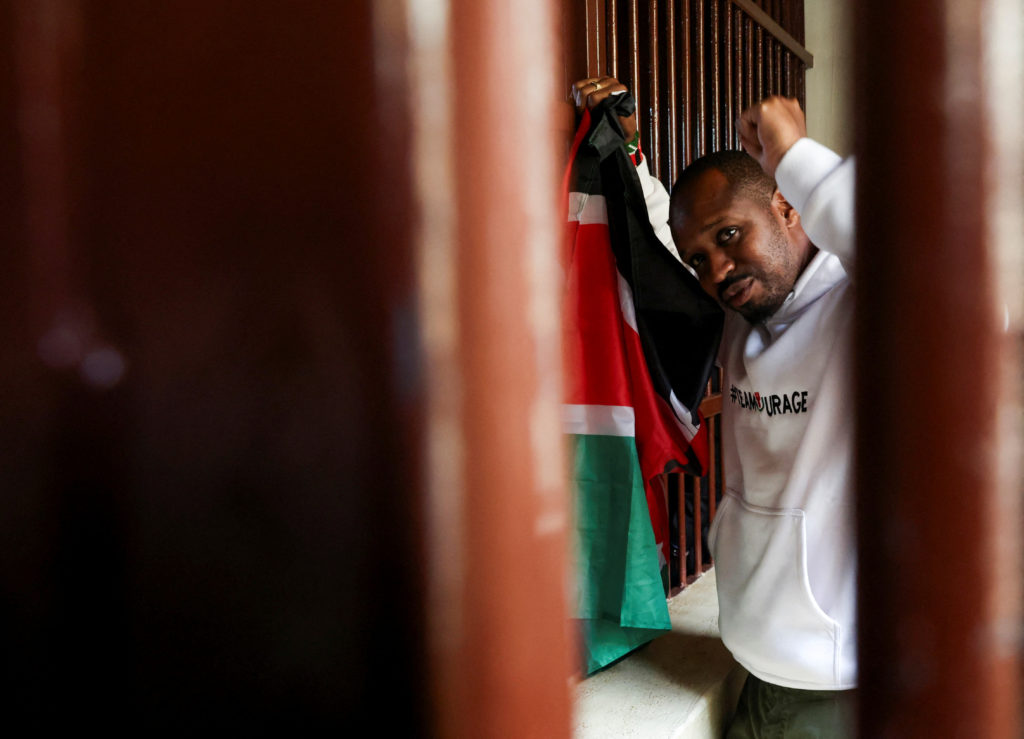
Kenyan pro-democracy activist Boniface Mwangi is charged with alleged possession of ammunition


By —Nicholas Komu, Associated Press
 Jul 21, 2025 

NAIROBI, Kenya (AP) — The prominent Kenyan activist Boniface Mwangi was on Monday charged with unlawful possession of ammunition in a case stemming from his alleged role in street protests against the government.

Opposition leaders and Mwangi’s followers had feared he would be charged with the more serious offense of terrorism.

He was freed on bond immediately after his appearance in court on Monday.

The charge sheet said the suspect possessed three canisters of tear gas without lawful authorization. His attorney, Njanja Maina, told reporters on Sunday that Mwangi never possessed such items.

Mwangi’s wife Njeri, in a post on the social media platform X, said on Saturday that security personnel raided their home and took the activist and his electronic gadgets while “talking of terrorism and arson.” Police said after his arrest on Friday that Mwangi was linked to the facilitation of violent activities in recent street protests. Detectives searched his home and his office.

The Kenya Human Rights Commission described the ammunition charge as a “trumped-up accusation.”

“This pattern of inventing charges to harass and silence activists like Mwangi erodes public confidence in the independence” of the justice system, the civic group said.

The rights group Amnesty International said in a statement Monday that legal action against Mwangi appears to be “part of a broader effort to intimidate lawful dissent and those committed to upholding the rule of law.”

“We are deeply concerned by the continued misuse of the Prevention of Terrorism Act to manage public order in more than 100 other cases,” Amnesty said. “This practice undermines Kenya’s criminal justice system and jeopardizes critical international partnerships aimed at safeguarding national security.”

Mwangi is a well-known pro-democracy activist in Kenya. On X, where he has 2 million followers, he describes himself as “The People’s Watchman.” He has been a critic of successive Kenyan governments.

Protesters who have rocked President William Ruto’s administration say they want to rid his government of corruption, marked by theft of public resources and the seemingly extravagant lifestyles of politicians.

They also say that Ruto, in power since 2022, has broken his own promises to working-class Kenyans. The protests started in mid-2024 when Ruto proposed aggressive new tax measures opposed by many Kenyans.

At least 500 people are facing criminal prosecution following arrests during protests in June and July that resulted in at least 47 deaths.

How Kenyans are using AI during protests

Photo of one of the finance bill protesters.

Photo of one of the finance bill protesters. Image by  on Flickr (CC BY-ND 4.0 Deed).

Over the past year, Kenyan activists have transformed AI from a speculative novelty into a vital civic instrument, democratizing information, amplifying marginalized voices, and building resilient networks under pressure. 

In June 2024, as tear gas and slogans filled Nairobi’s streets, an AI-powered protest surged across WhatsApp, Telegram, TikTok Spaces, and X Live Streams — translating dense legislative text into clear, actionable messages that shaped public debate. This movement was driven largely by Gen Z and millennial protesters who first organized online before taking their fight offline. In a country where reliable information often hinges on digital literacy and network reach, these AI-driven tactics proved both empowering and disruptive.

What unfolded was more than a street march: It was a digital insurrection powered by artificial intelligence and led by a new generation that had cut its teeth on social media mobilization. And now, as the country implements the controversial finance bill passed in June 2025 — marking one year since that landmark uprising — those same AI engines continue to influence public understanding of fiscal policy. 

Coordinated digital pressure

When the finance bill entered public debate in June 2024, grassroots volunteers organized “retweet chains” on X (formerly Twitter) and in WhatsApp groups to propel protest hashtags, such as #RejectFinanceBill2024 and #OccupyParliament, onto nationwide trending lists. NENDO’s analysis of 25 million protest-related posts found that only 2.8 percent were original tweets. In contrast, almost 90 percent were retweets, revealing how a small pool of messages was multiplied at scale by supporters acting in sync. 

Researchers also uncovered coordinated networks of suspicious or paid accounts that boosted rival, pro-government hashtags, often posting duplicate text and AI-generated images within minutes of each other, to drown out anti-bill narratives.

As momentum grew, coordinators even circulated Members of Parliament's (MPs) personal mobile numbers on social media, triggering what Kenya’s Nation Media described as a “week of horror” for legislators whose phones were “bombarded with calls and texts,” with some batteries draining in under 15 minutes. MPs themselves acknowledged being overwhelmed by thousands of identical SMS and WhatsApp messages urging them to oppose the finance bill, effectively turning these direct-message campaigns into a form of digital petitioning. The organized nature of these campaigns gave ordinary citizens, particularly those in rural and marginalized communities, a chance to participate on equal footing with traditional media voices.

Additionally, activists utilized ChatGPT and other large language models (LLMs) to create easy-to-understand Q&A threads, translating complex legislative jargon into concise, clear messages suitable for rapid distribution via WhatsApp and bulk SMS. 

Chatbots and custom GPTs as civic tools

Alongside basic bots, Kenyan developers deployed sophisticated chatbots built on open-source LLM frameworks to unpack the finance bill in real time. In mid-June 2024, a “Finance Bill GPT” appeared on Telegram and X, parsing clause-by-clause questions like “How will the VAT hike affect fuel prices?” and even surfacing MPs’ contact details for direct feedback. As the lead developer, @Ndemokelvin explained on X:

Reading 300 pages is a lot of work — I’ve updated the Finance Bill GPT with the report by the Departmental Committee on Finance and National Planning; it gives answers to your queries plus any recommendations by the said committee. #RejectFinanceBill2024.

This step-by-step process turned complex legal text into clear insights and recommendations overnight. Running on the same chatbot framework, another GPT dubbed “Corrupt Politicians GPT” was built to serve accountability needs. Users simply entered an official’s name and instantly accessed compiled records of corruption allegations, from court filings to auditor reports and credible news citations, equipping protesters with verified, data-driven talking points for rallies and online discussions.

Adaptive outreach

Beyond bots and automated scripts, Kenyan volunteers broke down the finance bill clause by clause into TikTok explainers in different local languages, focusing on provisions that affect daily expenses like fuel levies and income taxes. There are 68 recognized languages in Kenya, with many less-common dialects often being overlooked in information-sharing campaigns.

Separate sign-language interpretation videos were produced by volunteer interpreters and disseminated via WhatsApp and Telegram groups, and other platforms delivering concise, real-time summaries of the bill’s most impactful sections from urban to low-literacy and rural audiences.

And even amid targeted throttling and internet slowdowns around Parliament, protesters adopted resilient over-the-top apps. When mobile data became unreliable, organizers set up private Zello channels, akin to digital walkie-talkies, enabling real-time voice updates on tear-gas deployments and safe corridors. Zello’s low-bandwidth audio ensured that critical information continued flowing even under constrained connectivity.

Power, pushback, and disinformation

On June 25, 2024, just one day after the Communications Authority (CA) of Kenya had pledged on X not to restrict Internet access during the #RejectFinanceBill2024 protests, mobile data speeds in NairobiMombasa, and Kisumu were cut by nearly 40 percent, crippling live streams and encrypted channels, revealing a stark reversal from the CA’s previous assurances. 

Beyond these digital restrictions, security forces stepped up physical repression of online critics. Security agents detained and in some cases tortured online dissidents. In May 2025, student activist Billy Mwangi was abducted and tortured for posting an AI-generated satire of Kenyan President William Ruto, one of at least 82 such incidents documented by human-rights monitors. Pro-government actors weaponized AI to seed disinformation, fabricating protest imagery with foreign flags and deploying deep fake face-swaps to discredit opposition leaders.

Even with digital and physical crackdowns, public pressure still keeps those in power in check. Last year’s unrest not only claimed more than 50 lives but also compelled Ruto to shelve a proposed KES 346 billion (USD 2.67 billion) tax hike — an unmistakable signal of how potent public outrage can be when fiscal measures hit home. In a further check on government reach, Parliament’s 2025 finance committee tossed out a bid to give the Kenya Revenue Authority unfettered access to taxpayers’ data, citing privacy safeguards and existing warrant requirements.

Looking Ahead: Tools for year two

Although this year saw no finance bill protests, tensions flared in June 2025 when blogger Albert Ojwang died in police custody, sparking fresh demonstrations in Nairobi even as thousands rallied in Kenya to mark the first anniversary of the 2024 finance bill protests. Within days, one Kenyan developer unveiled an online panic-button tool that lets protesters share their live location with trusted contacts at the tap of a button — users hailed it as a “game changer” against abductions and police brutality and urged the creator to open-source it on GitHub. Meanwhile, another Kenyan created a real-time movement tracker: “In case you get arrested, share your map and we’ll follow up (‘Hata upelekwe wapi tutajua kwenye uko’),” the X user explains, inviting anyone in custody to drop a pin so volunteers can monitor their whereabouts.

At the same time, software engineer Rose Njeri faced charges under the Cybercrimes Act for building an automated objection email tool aimed at Parliament’s Finance Committee, reigniting debates over digital rights and legal safeguards for civic technologists.

Meanwhile, localization efforts are also underway to ensure AI speaks local languages: the Masakhane initiative is training open‑source NLP models in Swahili and regional dialects, so that explainers and alerts reach rural and urban communities alike in the language they trust. On the policy front, KICTANet, MindHYVE.ai, and DV8 Infosystems unveiled draft National AI Policy proposals on June 12, 2025, calling for a “rights‑based, sovereign AI framework” that mandates transparency for civic bots, human‑in‑the‑loop checks on automated content, and robust data‑consent protocols. And civil‑society groups such as CIPESA are pushing for ethics guidelines to address metadata harvesting, consent norms for group‑chat bots, and accountability mechanisms for deepfake generators.

Together, these initiatives could shift the digital tug‑of‑war toward transparency and civic empowerment, if they are codified before the next bill concerning Kenyans comes

No comments: