Top Russian University Offers a Program in Sanctions Evasion
In a busy week in the world of sanctions - with President Trump threatening 100% tariffs on those evading US sanctions on Russia, the European Union announcing an agreement on its 18th round of anti-Russian sanctions, and the UK launching a further 137 listings of dark fleet entities - Moscow’s Higher School of Economics is offering a new academic program.
The School, one of Moscow’s most respected academic institutions, is offering a new two-year program in sanctions circumvention, equipping students with the skills to "identify and assess the risks of sanctions and other measures imposed by supervisory authorities on companies." The dissident website T-invariant identified another three courses at the School with similar areas of focus, with varying length and cost.
The two-year program is offering 20 seats reserved for Russian citizens and two for international students, with annual tuition of about $6,000.
“Universities are reacting to short-term demand,” Andrey Yakovlev, a former HSE vice rector, told T-invariant. “That doesn't mean this is a stable, long-term direction."
Professor Igor Lipsits from the School told the Moscow Times that the initiative was part of a broader Kremlin program to build long-term resilience under international isolation. “Everyone is seeing how Iran has lived under sanctions for 40 years. We may spend a long time living in this kind of a hostile environment, with all kinds of restrictions, and with increasing regulations over Russia’s business presence abroad. The Russian economy will need to adapt to life under sanctions for a generation," he said.
Report: Tanker Turns Away from Indian Refinery as Sanctions Create Pressure
Media reports are highlighting the likely first impact from the European Union’s move last Friday (July 18) to further expand the sanctions on the Russian energy industry. President of the European Commission Ursula von der Leyen had commented that the goal was to continue to increase the pressure on Russia, and now both Bloomberg and Reuters are reporting that at least one tanker has turned away from an Indian refinery included on the new sanctions list.
India’s Nayara Energy was included in the listing by the EU due to the 49 percent investment stake held by Russia’s Rosneft. The EU reported it was targeting both Russian and international companies managing shadow fleet vessels, traders of Russian crude oil, as well as a major customer of the shadow fleet, a refinery in India with Rosneft as its main shareholder.
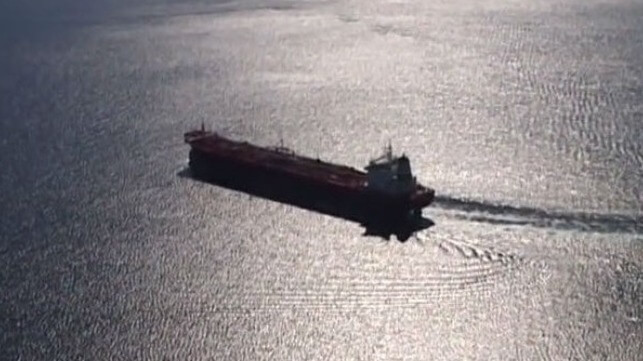
The Marshall Islands-flagged crude oil tanker Talara (73,371 dwt) is reported to have been under charter to BP and inbound to India’s Vadinar port. It is believed, according to Reuters, that it was to load a cargo of ultra-low sulfur diesel fuel on July 21 to be transported to Africa. Both Reuters and Bloomberg are confirming the tanker made an about-face and left the port without loading the cargo. Reuters says the tanker was placed back on the charter market, available for pickups in India or the Middle East.
It is likely the first sign of a “bite” from the sanctions, with Reuters highlighting, however, that several other tankers are scheduled to arrive at the Nayara Energy terminal. It points out that the company, in a statement, called the sanctions “unjust and unilateral.” Bloomberg reports Rosneft called the EU sanctions “unjustified and illegal.”
The EU, however, is highlighting that its actions are having an impact, but they can also be reversed when the ships abide by the restriction. It says as part of the 18th package that “the EU has accepted to remove three vessels from its list of sanctioned vessels following firm commitments that these LNG tankers will no longer engage in the transport of Russian energy to the Russian Yamal and Arctic 2 projects for which they had originally been commissioned.”
The EU in May listed three tankers operated by Japan’s Mitsui O.S.K. Lines. The vessels, North Light, North Moon, and North Ocean, are state-of-the-art carriers completed in late 2024 for the trade. MOL said when the vessels were listed that it was assessing the impact while promising to comply with applicable laws, regulations, and rules.
The Head of the Office of the President of Ukraine, Andriy Yermak, announced yesterday, however, that the Bahamas is also following the lead of the European Union and imposing restrictions on its ship registry.
"The Bahamas are officially depriving the Russian tanker fleet of its flag," Yermak announced on Telegram. “This is a blow not only to the sanction circumvention schemes, but also to the entire Russian economy, which is based on shadow oil and gas flows. The Russian Federation tried to hide its presence in world waters under foreign flags, fictitious owners. But even these loopholes are being closed.”
It is unclear how many tankers were in the Bahamas registry from the shadow fleet. United Against a Nuclear Iran (UANI) listed the Bahamas at the bottom of its ranking of flags for Iranian shadow fleet tankers, and the Bahamas has rarely, if ever, been mentioned for the Russian shadow fleet. Still, it is seen as another step in the efforts to increase pressure on sanction evasion efforts.
UK Sanctions 137 Tankers and Traders for Involvement in Moving Russian Oil
The UK has taken another swipe at Russia's energy exports with a fresh set of sanctions on 135 oil tankers, as well as two companies that enable the "shadow fleet" trade. According to the UK Foreign Office, the vessels on the list have handled $24 billion worth of oil cargoes for Russia since the beginning of the invasion of Ukraine, funneling revenue to the Kremlin and its defense establishment.
"As Putin continues to stall and delay on serious peace talks, we will not stand idly by. We will continue to use the full might of our sanctions regime to ratchet up economic pressure at every turn and stand side by side with Ukraine," said UK Foreign Secretary David Lammy. "New sanctions will further dismantle Putin's shadow fleet and drain Russia's war chest of its critical oil revenues."
The list includes familiar vessel names from the Sovcomflot fleet, once well-regarded for its quality but now relegated to trading in the dark. These ships formerly resided in popular open registries, but most are now flying flags of "extreme convenience" for shadow fleet participants - notably Comoros and Gabon, which have absorbed a large share of sanctions-busting tankers.
The UK also joined the European Union in sanctioning a UAE-based company - Intershipping Services LLC - that markets the Gabon and Comoros registries to customers in the shadow fleet trade. The fleet of Gabon, the fastest-growing flag state, now handles an estimated $10 billion in seaborne trade for Russia per year.
The UK also named Litasco Middle East DMCC (known as LME Trading DMCC), a company with ties to Lukoil, Russia's second-largest crude exporter. According to Russian investigative reporting outlet The Insider, Litasco Middle East was by far the biggest buyer of Russian oil priced above the G7 price cap last year, handling about 170 million barrels in 2024 for Surgutneftegaz and Lukoil - about $2 billion worth of trade. Like the overwhelming majority of participants in Russia's shadowy oil trade, LME is based in the UAE.
In a related action on Friday, the European Union expanded its Russia sanctions list to include dozens of new entities, including Iranian trader Hossein Shamkhani, director of UAE-based Admiral Shipping - another firm linked to the trade. "[Shamkani] uses the company Milavous Group Ltd to blend crude oil with various petroleum products from Russia and to rebrand for exporting purposes, thereby concealing their origin. Additionally, as Director of the company Admiral Shipping, he is involved in transporting and selling Russian crude oil," the European Council asserted in its listing.

No comments:
Post a Comment