Campaigners Confront Plastics Treaty Delegates, Demanding Deal That Stops Pollution 'At Its Source'
"With just days remaining, the dynamic must change," said Break Free From Plastic. "Countries must keep their commitment to end plastic pollution."
"With just days remaining, the dynamic must change," said Break Free From Plastic. "Countries must keep their commitment to end plastic pollution."
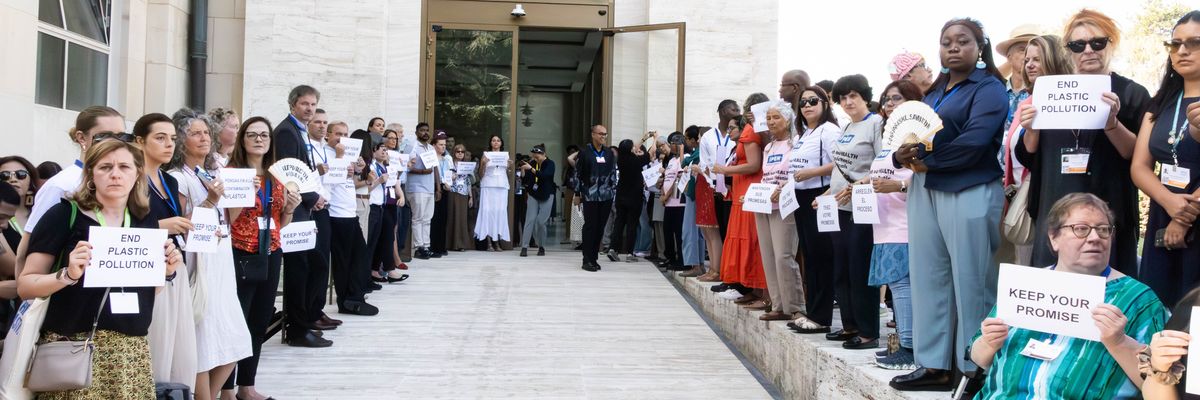
Campaigners demand that negotiators fix the Global Plastics Treaty process in Geneva, Switzerland on August 9, 2025.
(Photo: Trixie Guerrero/Break Free From Plastic)
Julia Conley
Aug 09, 2025
COMMON DREAMS
As the final negotiations for a Global Plastics Treaty reached the halfway point on Saturday, delegates entering the Palais des Nations in Geneva, Switzerland for the day's talks were met by more than 200 campaigners representing civil society groups who stood in silence along the path leading to the United Nations building—but nonetheless sent a clear message.
The civil society observers displayed signs in multiple languages, urging negotiators at the second plenary of the Intergovernmental Negotiating Committee to "fix the process" and keep their promises to drastically reduce plastic waste and toxic chemicals in plastic products.
Achieving goals like banning single-use plastics, capping plastic production, and imposing regulations on harmful additives within the treaty will be impossible, campaigners have warned, if the biggest plastic-producing countries like the United States are permitted to lobby for a weaker treaty and if fossil fuel industry lobbyists continue to overpower anti-pollution advocates at the talks.
"People worldwide have made it clear: They support decisive action to cut plastic production, consumption, and pollution," said the Break Free From Plastic movement in a statement Friday. "A majority of governments have endorsed these demands, yet negotiations are stalling with a small group of petro- and plastic-producing states deploying delay tactics, with no sign that they intend to raise ambition."
"With just days remaining, the dynamic must change," said the group. "Countries must keep their commitment to end plastic pollution. They must use every tool available to deliver a strong treaty—one that includes legally binding rules on production and chemicals, uplifts real solutions, safeguards human rights, and protects frontline communities."
The talks began earlier this week, with negotiators tasked with forging a legally binding treaty to restrict plastic pollution, following a 2022 agreement that was reached as the result of a proposal from Rwandan and Peruvian officials. The first round of talks, which were supposed to end with a treaty, stalled last December after plastic-producing countries refused to cap production. More than 100 countries at the negotiations agreed to a plastic production limit.
As with fossil fuel emissions, many countries in the Global South are not major producers of plastic waste—but the U.S. exports more than 1 billion pounds of plastic waste to low-income countries each year.
The climate action group Greenpeace has warned that fossil fuel and chemical industry lobbyists outnumber experts on the impact of pollution 4-to-1 at the negotiations in Geneva, and are joining oil- and plastic-producing countries in continuing to push for a treaty that focuses on downstream measures they claim will address pollution, such as improving recycling systems.
As Common Dreams reported Thursday, the Trump administration has called on countries participating in the talks to reject "impractical" terms within the treaty, such as plastic production caps, bans, or restrictions on certain additives to plastic products.
Scientists believe that less than 10% of plastic products ever get recycled, despite the efforts of individuals to recycle their products.
Katie Drews, national director of the U.S.-based Alliance for Mission-Based Recycling (AMBR), said Friday that "recycling is essential, but it cannot solve the plastics crisis," which must be stopped "at its source."
"Without binding caps on plastic production, bans on toxic chemicals, and global mandates to design packaging for safety, reuse, and real recyclability, downstream solutions will continue to be overwhelmed and communities will continue to pay the price," said Drews. "AMBR stands with scientists, health professionals, youth, frontline and fenceline communities, Indigenous peoples, waste pickers, and mission-driven allies worldwide in urging governments to act. We need a treaty that truly protects human and environmental health, one that goes beyond words to bold, enforceable action."
Advocates' concerns are backed up by a study published in The Lancet this week, which said that without far-reaching efforts to stop more plastic from being produced, "production is on track to nearly triple by 2060."
As campaigners and scientists have worked towards a Global Plastics Treaty since 2022, companies like Dow, Shell, and ExxonMobil have only been ramping up their production of plastic, expanding their capacity by 1.4 million tons. Just seven petrochemical giants have sent a combined 70 lobbyists to the talks, which are scheduled to wrap up on August 14.
"The more we produce, the more we pollute," said Jules Vagner, president of the French group Objectif Zéro Plastique. "Opposing binding targets to reduce plastic production is, in practice, choosing to let pollution continue and worse, accelerate. We do not want another treaty that manages waste. We want one that ends pollution at the source."
"If some countries are unwilling to rise to this historic moment, they should step aside," said Vagner. "Not block global progress. We want a world free from plastic pollution, not one that adapts to it."
As the final negotiations for a Global Plastics Treaty reached the halfway point on Saturday, delegates entering the Palais des Nations in Geneva, Switzerland for the day's talks were met by more than 200 campaigners representing civil society groups who stood in silence along the path leading to the United Nations building—but nonetheless sent a clear message.
The civil society observers displayed signs in multiple languages, urging negotiators at the second plenary of the Intergovernmental Negotiating Committee to "fix the process" and keep their promises to drastically reduce plastic waste and toxic chemicals in plastic products.
Achieving goals like banning single-use plastics, capping plastic production, and imposing regulations on harmful additives within the treaty will be impossible, campaigners have warned, if the biggest plastic-producing countries like the United States are permitted to lobby for a weaker treaty and if fossil fuel industry lobbyists continue to overpower anti-pollution advocates at the talks.
"People worldwide have made it clear: They support decisive action to cut plastic production, consumption, and pollution," said the Break Free From Plastic movement in a statement Friday. "A majority of governments have endorsed these demands, yet negotiations are stalling with a small group of petro- and plastic-producing states deploying delay tactics, with no sign that they intend to raise ambition."
"With just days remaining, the dynamic must change," said the group. "Countries must keep their commitment to end plastic pollution. They must use every tool available to deliver a strong treaty—one that includes legally binding rules on production and chemicals, uplifts real solutions, safeguards human rights, and protects frontline communities."
The talks began earlier this week, with negotiators tasked with forging a legally binding treaty to restrict plastic pollution, following a 2022 agreement that was reached as the result of a proposal from Rwandan and Peruvian officials. The first round of talks, which were supposed to end with a treaty, stalled last December after plastic-producing countries refused to cap production. More than 100 countries at the negotiations agreed to a plastic production limit.
As with fossil fuel emissions, many countries in the Global South are not major producers of plastic waste—but the U.S. exports more than 1 billion pounds of plastic waste to low-income countries each year.
The climate action group Greenpeace has warned that fossil fuel and chemical industry lobbyists outnumber experts on the impact of pollution 4-to-1 at the negotiations in Geneva, and are joining oil- and plastic-producing countries in continuing to push for a treaty that focuses on downstream measures they claim will address pollution, such as improving recycling systems.
As Common Dreams reported Thursday, the Trump administration has called on countries participating in the talks to reject "impractical" terms within the treaty, such as plastic production caps, bans, or restrictions on certain additives to plastic products.
Scientists believe that less than 10% of plastic products ever get recycled, despite the efforts of individuals to recycle their products.
Katie Drews, national director of the U.S.-based Alliance for Mission-Based Recycling (AMBR), said Friday that "recycling is essential, but it cannot solve the plastics crisis," which must be stopped "at its source."
"Without binding caps on plastic production, bans on toxic chemicals, and global mandates to design packaging for safety, reuse, and real recyclability, downstream solutions will continue to be overwhelmed and communities will continue to pay the price," said Drews. "AMBR stands with scientists, health professionals, youth, frontline and fenceline communities, Indigenous peoples, waste pickers, and mission-driven allies worldwide in urging governments to act. We need a treaty that truly protects human and environmental health, one that goes beyond words to bold, enforceable action."
Advocates' concerns are backed up by a study published in The Lancet this week, which said that without far-reaching efforts to stop more plastic from being produced, "production is on track to nearly triple by 2060."
As campaigners and scientists have worked towards a Global Plastics Treaty since 2022, companies like Dow, Shell, and ExxonMobil have only been ramping up their production of plastic, expanding their capacity by 1.4 million tons. Just seven petrochemical giants have sent a combined 70 lobbyists to the talks, which are scheduled to wrap up on August 14.
"The more we produce, the more we pollute," said Jules Vagner, president of the French group Objectif Zéro Plastique. "Opposing binding targets to reduce plastic production is, in practice, choosing to let pollution continue and worse, accelerate. We do not want another treaty that manages waste. We want one that ends pollution at the source."
"If some countries are unwilling to rise to this historic moment, they should step aside," said Vagner. "Not block global progress. We want a world free from plastic pollution, not one that adapts to it."
By AFP
August 8, 2025

Delegates are meeting in the main assembly hall at the UN Palais des Nations in Geneva - Copyright ${image.metadata.node.credit} ${image.metadata.node.creator}
Isabel MALSANG and Robin MILLARD
Environmental NGOs are raising concerns about the growing presence of petrochemical industry lobbyists at talks to forge a global treaty to combat plastic pollution.
More than 180 countries are meeting at the United Nations in Geneva in a bid to thrash out a landmark agreement aimed at tackling the scourge of plastic pollution — looking at the full life-cycle of plastic, from production to pollution.
The Center for International Environmental Law (CIEL) said it had counted 234 publicly disclosed fossil fuel and chemical industry lobbyists registered to attend the 10-day negotiations, which run until August 14.
Industry lobbyists “should not be able to attend these negotiations,” CIEL’s Rachel Radvany told AFP. They have “direct conflicts of interest with the goal of the treaty.”
“Their interest is in maintaining plastic production — and the industry is set to triple by 2060,” she said.
Dubbed INC5.2, the talks resume the fifth session of the Intergovernmental Negotiating Committee to develop a legally binding international treaty on plastic pollution, continuing negotiations that stalled last year in South Korea.
CIEL, a Washington- and Geneva-based non-governmental organisation which provides legal support to developing countries, scrutinises the lists of accredited participants provided by the UN.
It counted 104 fossil fuel and chemical industry lobbyists at the INC2 session in Paris in 2022; 143 at INC3 in Nairobi in 2023, and 196 at INC4 in Ottawa in April 2024.
There were 220 at the supposedly final INC5.1 in Busan in South Korea in November 2024, which failed to seal a deal.
– ‘Here to listen’ –
The International Council of Chemical Associations (ICCA) confirmed they had 136 delegates at the talks representing the plastic, petrochemical and chemical manufacturing industries.
“While we are significantly outnumbered by the more than 1,500 NGO participants, we recognise and value the UN’s commitment to broad stakeholder participation as vital to achieving our shared goal of ending plastic pollution,” ICCA spokesman Matthew Kastner told AFP.
“Our delegates are here to listen to governments so we can understand the unique challenges they face and bring solutions.”
Radvany recalled that for the World Health Organization’s Framework Convention on Tobacco Control, adopted in 2003, tobacco industry representatives were not allowed in during the negotiations.
Green groups and have also long protested the heavy presence of oil, gas and coal lobbyists at annual UN climate talks. The burning of of fossil fuels is by far the main driver of global warming.
– Hitting the roof –
Beyond the 234 industry lobbyists CIEL has pinpointed in Geneva, INC5.2 has 3,700 registered participants and the NGO believes there are likely many more lobbyists operating more covertly within country delegations.
Some countries have delegates with titles like “third chemical engineer”, which are not included in CIEL’s count.
Their study also does not include representatives from plastic-consuming sectors such as the food and cosmetics industries, which are also heavily represented at the negotiations.
Another NGO, the International Pollutants Elimination Network (IPEN), denounced the limited seating for observers in the rooms where the technical details of the treaty are thrashed out, saying the chairs were “flooded by industry lobbyists” — effectively preventing civil society from participating.
Greenpeace staged a protest on Thursday at the UN’s main entrance gate, scaling up to the roof to unveil banners reading “Big oil polluting inside” and “Plastics treaty not for sale”.
“Each round of negotiations brings more oil and gas lobbyists into the room. Fossil fuel and petrochemical giants are polluting the negotiations from the inside, and we’re calling on the UN to kick them out,” said Greenpeace delegation chief Graham Forbes.
“Corporate polluters that created this problem must not be allowed to stop the world from solving it.”

No comments:
Post a Comment