Japan will work to lead global efforts to bring about 'a world without nuclear war and a world without nuclear weapons,' says Premier Shigeru Ishiba
Saadet Gökce |09.08.2025 - TRT/AA
ISTANBUL
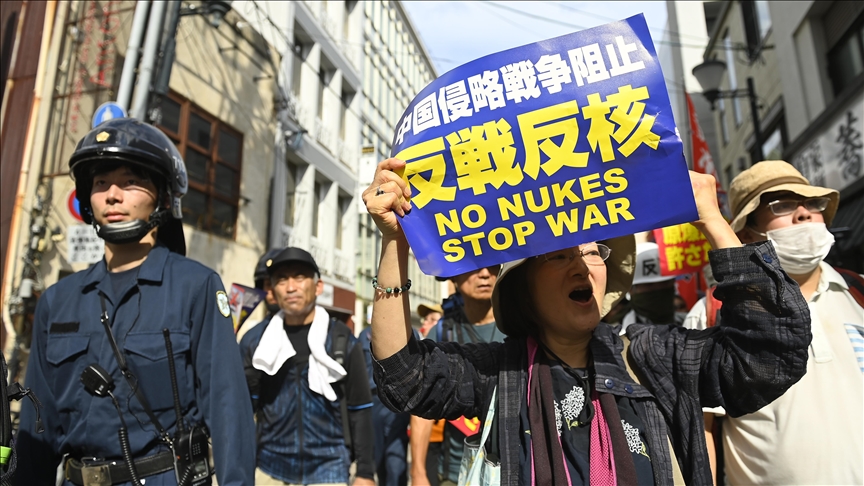
Nagasaki Mayor Shiro Suzuki warned about an escalating threat of nuclear war on Saturday as the 80th anniversary of the US nuclear bombing of the city was commemorated, according to Kyodo News.
"This existential crisis of humanity has become imminent to each and every one of us living on Earth," Shiro Suzuki said in a peace declaration that was read during the annual ceremony.
He laid out a bleak outlook for the world that is plagued with a "vicious cycle of confrontation and fragmentation."
Prime Minister Shigeru Ishiba pledged to continue committing to not possessing, producing or permitting the introduction of nuclear weapons.
Japan will work to lead global efforts to bring about "a world without nuclear war and a world without nuclear weapons," said Ishiba.
The US dropped the plutonium bomb, "Fat Man," onto the port city of Nagasaki at 11.02 am local time (0202GMT) Aug. 9, 1945, after using the nuclear bomb on Hiroshima days earlier.
The bomb killed 74,000 in Nagasaki.
Japan formally surrendered Aug. 15, 1945, marking the end of World War II.
The commemoration event at Nagasaki Peace Park, located near the hypocenter, was attended by 94 countries and regions, unlike last year when a record 100 countries and regions attended the event.
The ceremony last year sparked controversy after the city excluded Israel amid its genocide in the Gaza Strip, prompting the US and other G7 ambassadors to skip the event.
This year, the city sent invitations to all nations with diplomatic missions in Japan.
Nagasaki mayor warns of nuclear war 80 years after atom bomb attack
Shaimaa Khalil
Tokyo Correspondent
Patrick Jackson
BBC News
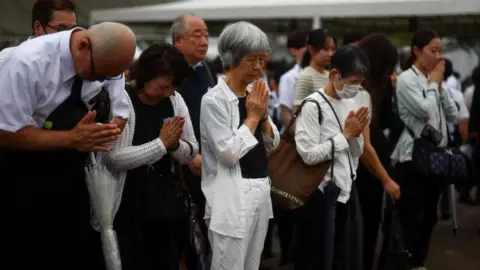
Attendees at Saturday ceremony
The mayor of Nagasaki has appealed for an end to the wars raging in the world on the 80th anniversary of the US atom bomb attack which destroyed the Japanese city.
"Conflicts around the world are intensifying in a vicious cycle of confrontation and fragmentation," Shiro Suzuki said in a Peace Declaration at a solemn ceremony to mark the event.
"If we continue on this trajectory, we will end up thrusting ourselves into a nuclear war."
The attack on 9 August 1945, which analysts say hastened the end of World War Two, killed an estimated 74,000 people.
In the years that followed many survivors suffered from leukaemia or other severe side effects of radiation.
Saturday's ceremony came a few days after the commemoration of the first atomic bombing, which targeted the Japanese city of Hiroshima 80 years ago on 6 August, killing an estimated 140,000 people.
The Nagasaki bomb, bigger and more powerful, wiped out whole communities in seconds.
The commemoration in the rebuilt city began with a moment of silence.
Nagasaki's twin cathedral bells also rang in unison for the first time since the attack, in a message of peace to the world.
As part of Saturday's ceremony, water offerings were made in a moving and symbolic gesture - 80 years ago victims whose skin was burning after the blast had begged for water.
Today participants of different generations including a representative of the survivors offered water in a show of respect to those who perished in nuclear fire.
"On 9 August 1945 an atomic bomb was dropped on this city," Suzuki said in the declaration.
"Now, 80 years since that day, who could have possibly imagined that our world would become like this? Immediately cease from disputes in which 'force is met with force'."BBC visits the Korean survivors of the Hiroshima bombIn pictures: Nagasaki and Hiroshima remembered
Bomb survivor Hiroshi Nishioka, 93, who was just 3km (1.8 miles) from the spot where it exploded, told the ceremony of the horror he had witnessed.
"Even the lucky ones [who were not severely injured] gradually began to bleed from their gums and lose their hair, and one after another they died," he said, as quoted by AFP news agency.
"Even though the war was over, the atomic bomb brought invisible terror."
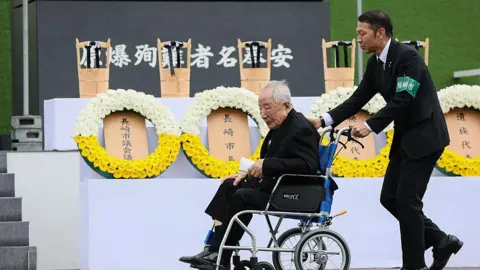
Hiroshi Nishioka was a teenager when the atom bomb landed on Nagasaki
Nagasaki resident Atsuko Higuchi, 50, told AFP it "made her happy" that the city's victims were being remembered.
"Instead of thinking that these events belong to the past, we must remember that these are real events that took place," she added.
Among the bloodiest conflicts currently raging in the world are the war between Russia and Ukraine, and that between Israel and the Gaza-based group Hamas.
There was controversy last year when Nagasaki declined to invite Israel to the annual commemoration, citing security concerns.
This year the mayor said Israel had been invited, as well as Russia and its ally Belarus which had been shunned since Russia's invasion of Ukraine in 2022.
An international agreement banning nuclear weapons, the Treaty on the Prohibition of Nuclear Weapons, came into effect in 2021.
More than 70 countries have ratified the treaty but nuclear powers have opposed it, arguing their nuclear arsenals act as a deterrent.
Japan has also rejected the ban, saying its security is enhanced by US nuclear weapons.
80 Years at the Brink, Time to Change the Narrative
For 80 years, since the atomic bombs were dropped over Hiroshima and Nagasaki, the world has stood at the brink of nuclear war with the potential for catastrophic loss, threatening all of humanity. Former Defense Secretary Robert McNamara said in the years after the Cuban missile crisis that indeed sheer luck was what prevented nuclear war, not superior weapons, brinkmanship, or knowledge. There have been multiple other times where nuclear launch countdowns have begun from misinterpretation, human error, or technological glitch. In the end, like Las Vegas gamblers, the question is how long will our luck hold out? The odds are not in our favor. The only way to prevent nuclear war is by the complete elimination of these weapons.
Fueled by outdated us versus them thinking, we overlook the reality that we are one human family, interdependent and interconnected, on this fragile planet. We have been erroneously captivated by the illusion of deterrence and the misconception that whatever my adversary has, I must have bigger, better, and more.
We move forward in ignorance and/or denial, as though in a trance, ignoring the existential threat posed by nuclear weapons and the fallacy that they make us safer, instead of recognizing them as the greatest threat to our continued survival. We must change the narrative that there are good people versus evil people with nuclear weapons and recognize that nuclear weapons, and ultimately wars themselves, are the enemy.
Conflict is inevitable, war is optional. Currently we see conflict between nuclear nations in multiple hotspots around the globe: the war in Ukraine where threats of nuclear weapons have been suggested, the longstanding and recent fighting between the nuclear nations of India and Pakistan, Israel’s and US bombing of Iran’s nuclear site, the ongoing tensions in the Taiwan Strait between China and Taiwan, and finally Israel’s genocidal campaign in Gaza.
With nuclear states at war, any conflict could escalate to a nuclear war. As long as nuclear weapons exist, all of humanity remains at risk.
There are means other than war to resolve conflict.
Diplomacy and nonviolent communication are critical. To abolish nuclear weapons we must have urgent, parallel tracks of nuclear diplomacy, and arms control leading to a verifiable, complete disarmament simultaneously with diplomacy and negotiations to immediately end the war in Ukraine, demand an end to the genocide in Gaza, secure lasting peace between India and Pakistan and seek a long-standing internationally supported peace accord between China and Taiwan.
The provision of appropriate and immediate foreign aid including food and water to Gaza and other areas of the world facing famine is critical. As long as a single child is lost to preventable starvation and dehydration, all of humanity sustains a loss of who we are.
International cooperation and collaboration are essential to address the dire circumstances of these crises. Examples of this include collective efforts on controlling the AIDs epidemic, to COVID 19, to efforts combating climate change.
Respect for, and adherence to, international law is critical, rather than abiding only by the laws that benefit your country. Courts like the International Court of Justice and the International Criminal Court must be above reproach and under the auspices of the United Nations.
Individually and collectively, we can endorse and support a movement called “Back from the Brink”, bringing communities together to abolish nuclear weapons. This movement calls on the U.S. to lead a global effort to pursue the verifiable elimination of nuclear weapons, renounce first use, end sole presidential launch authority, end hair-trigger launch, and cancel enhanced weapons.
In this 80th year of the nuclear age, it is time for a new narrative and a new way of thinking. We must recognize that we are one interconnected human family on this planet. What affects one of us, affects all of us. This grand experiment of humanity risks great peril from nuclear war to climate change. The choice we make and the direction we follow at this point is very likely the greatest decision of humankind, a chance to move back from the brink and save the world. The time is now and the choice is ours.
Teenage Atomic Spy Ted Hall and Nagasaki Atom Bombing
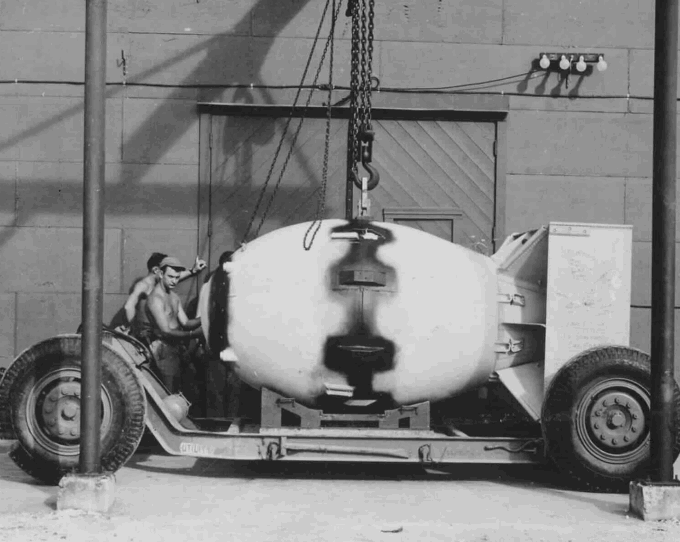
The five-ton ‘Fat Man’ plutonium bombnon tinian Island being moved for loading on a B029 for delivery to Nagasaki on August 8, 1945. (US military photo)
Eighty years ago this week, Manhattan Project workers at the top-secret bomb development lab at Los Alamos, New Mexico were rushing to get the disassembled sections of the five-ton “Fat Man,” plutonium bomb ready to be flown by several planes to remote Tinian Island, a location that had an airfield and was near enough to Japan for a B-29 bomber to deliver the reassembled bomb nonstop to a target city. The “Thin Boy” uranium bomb, a ton lighter, had already been loaded aboard a ship three weeks earlier in San Francisco, had arrived at Tinian, and would soon be loaded into the ‘Enola Gay” B-29, which would deliver it to Hiroshima, where it would be the first atomic bomb to be used in war.
As the date for the dropping of the first atomic bomb drew near and as Japan’s inevitable defeat became just a matter of time, there was increasing concern in the White House and the Pentagon that Japan might surrender before the US could also demonstrate the awful destructive power of the plutonium bomb.
After the “Fat Man” had been successfully reassembled on Tinian, the date for its use was set for just three days after Hiroshima on August 9. That decision was made in August. 7, while Hiroshima was still a smoking ruin, its streets littered with the crisp ashen husks of flash-burned bodies as live bomb victims who, because they had been inside buildings, had survived the initial flash of the explosion but were having the flesh fall off their bodies in sheets and were doomed to certain early death wandered, blinded and deafened from the blast.
The US was always dead set on dropping both bombs. The official US position is that the second bomb was dropped three days after the first because the Japanese government was ‘taking too long” to surrender and the US was dreading a land invasion of the country, which. Allegedly, would happen soon. None of this holds up to scrutiny.
Remember though, that by August, Tokyo, the nation’s capital, had been destroyed by a two-day bombing on March 9-10, 1945, when waves of massive B-29 bombers dropped incendiary bombs, creating a massive firestorm. The raid obliterated sixteen square miles of the mostly wooden city, killing over 100,000 people in what remains the largest air attack (at least before Israel’s current attack on Gaza) by conventional weapons in human history. It left the Japanese government in shambles and chaos. Expecting an answer to its demand for unconditional surrender when civilian and military officials were still dealing with that chaos in the capital, and after Aug. 6 were also trying to discover what had eliminated the city of Hiroshima and to assess the damage there, would have been absurd.
Clearly the unseemly rush to nuke another target was, ironically, made so as not to give the Japanese government time to surrender, as that would have made demonstration of the plutonium bomb impossible.
Ted Hall, who at 19 was the youngest physicist at Los Alamos, had played a key role in role in getting the complicated plutonium bomb successfully detonated in the Trinity test on July 16, 1945. Three weeks before the Hiroshima bombing. His work on the Manhattan Project being done by that point, he was then focusing intently on the preparations for the climactic moment of his ten-month secret work as a volunteer spy for the Soviet Union: the delivery of every bit of information he had about the construction and successful detonation of the highly unstable plutonium-based bomb.
The US shocked nearly the entire world, including the leaders of Japan, with the total destruction of the city of Hiroshima using an atomic bomb made with U-235. The only country whose leader was not surprised by that first use of an atomic bomb was Soviet General Secretary Supreme Commander Joseph Stalin, whose spy agency, the NKVD, had received news of both weapons’ successful construction from Hall and several other spies inside the Manhattan Project.
Now, in the days between the Hiroshima bombing and the bombing of Nagasaki three days later on Aug. 9, Hall had stuffed into an envelope detailed notes on the successful construction of the plutonium bomb with its Rube Goldberg-like implosion system of 32 pieces that had to be blasted together in perfect symmetry within in microseconds to produce a chain reaction of neutrons before proximity melted or vaporized the plutonium core, which would result in a “fizzle” instead of the desired blast equivalent to 21 thousand tons or more of TNT.
Hall placed that envelope in a shopping bag with a fish, leaving the tail sticking out of the bag as a pre-arranged sign for a Soviet spy courier, Lona Cohen. He then took a bus to Albuquerque to meet her on the University of New Mexico campus for the pick-up.
After meeting up, the two young spies avoided suspicion by strolling casually arm-in-arm along he campus sidewalks, acting like young lovers, while Lona made Hall blush by asking, as attractive co-eds passed them, if he’d like to “spend some time” with them.
Russian documents that came to light decades later, after the collapse of the Soviet Union show that it was Hall’s information that allowed Soviet scientists to race ahead on their development of a Soviet atom bomb. Delivered to Moscow just before the surrender of Japan on August 15, when Soviet spy leaders were still suspicious at the way their master spy, German Communist physicist Klaus Fuchs had managed to go from an imprisoned Communist in Britain to a top role in the British bomb project, not lest because they had lost track of him for six months he and his courier missed a planned connection. They worried that he might have been “turned” and that the information they were getting from him about the complex implosion system needed to detonate plutonium might actually be disinformation.
Receiving identical information from Hall, a spy they knew was not known by Fuchs and who himself didn’t know Fuchs was a spy, gave both intelligence chief Lavrentiy Pavlovich Beria and Soviet scientists, who were working with far fewer resources than the US in a country largely destroyed by the German invasion, the courage and confidence go convince Stalin to agree to a plan of putting off work on trying to get sufficient hard-to-refine U-235 to make a bomb. Instead, they advised, he should approve their focusing all resources on using the American plans to make an already proven plutonium bomb. They ultimately accomplished that feat on Aug. 29, 1949.
Uniquely among the spies inside the Manhattan Project, Hall was not a Communist when he spied for the Soviet Union. Nor would he accept payment for his work. Rather, as he explained in several interviews after 1995 when he was identified in one of the first decrypted Soviet spy cables to be publicly released by the National Security Agency (NSA), he had accepted the invitation to join the Manhattan Project, because of the stated urgent need to get the weapon before Hitler’s scientists did
But when, as Germany’s position weakened over 1944, it became increasingly clear that it would never succeed in developing an atom bomb. By the fall of 1944, Germany’s infrastructure and cities were being bombarded round the clock, its once-powerful army was retreating before a revitalized Red Army onslaught in the East and was facing advancing US, British and Canadian troops on the Western Front and in Italy too. And word was no doubt circulating the close Los Alamos community that Gen. Leslie Groves, the director of the Manhattan Project, had made the shocking admission to British scientists as early as March 1944 that the “real goal” of creating the atomic bomb was never to beat the Germans to it, but rather “to subdue the Russians” after the war. All of that hardened his resolve to act.
Hall explained that he feared that a post-war US with a monopoly on the bomb, particularly if a depression and right-wing government followed the end of the war, would pose a threat not only to Russia but to the entire world. He concluded, with support from his Harvard friend, roommate and eventually sometime spy courier Saville Sax, that the only way to prevent such a threat was to ensure that another country — one not under the thumb of the US—also had the bomb. That is, he wanted to enable the same kind of stalemate that germ and chemical warfare had created, which in the case of those weapons resulted in an eventual ban on their manufacture, storage and use.
Hall decided the only way to prevent what he considered would be a catastrophe, should the US emerge from the war with a long monopoly on the atomic bomb, would be to help the Soviets get their own bomb quickly. He believed that with such a stalemate, the two World War II allies would realize the futility of nuclear weapons and would negotiate a ban on them.
It didn’t work out that way, of course, unfortunately. Instead of recognizing the futility of nucler weapons once two sides had them, the US and Soviet Union, began to build to built up nuclear stockpiles, in some cases as particularly in the US, trying to develop delivery systems that might give them the chance to launch a surprise attack that, by eliminating the other side’s ability to mount a significant retaliation, could lead to victory.
So fa,r that has fortunately not happened, but the result has been a hugely costly, wasteful and frightening arms race.
That is a good thing, I’m afraid, because for one nuclear side to be eliminated as a threat would by definition have meant the mass murder of tens or hundreds of millions of innocent civilians both in the target country and many neighboring countries. There would also be many deaths in the country launching such an attack, of course, since such a large nuclear strike would inevitably spread fallout around he world and even lead to a potential nuclear winter.
Even before the war ended, the US had begun trying to develop ways to go from painstaking hand-made atom bombs to mass production, eventually of scores of atom bombs per month, preparing for a massive surprise attack on the Soviet Union set for the early 1950s, only to cancel the horrific plan when the Soviets obtained their own bomb. Those who argue that such an attack should have been ordered despite its illegality and the possibility it could have failed and led to retaliation, it must be noted that without such an attack, it has now been 80 years since Nagasaki— the last time that a nuclear weapon has been used in war. As improbable as that might seem, especially as there have, over those decades, been some very close calls when sometimes only the actions of courageous individual military personnel, either in the US or in the USSR, to put their careers and even their lives on the line by refusing orders to launch, have saved the world, the system set in motion by Hall’s decision to share everything he knew about the plutonium bomb with the Soviets is working.
Even today, when the US and NATO countries like Britain, France and Germany, or Pakistan and India have broken a cardinal unwritten rule of the Cold War — e.g., never directly attack with your military or your non-nuclear weapons the territory or military forces of another nuclear power — the result has not been for the attacked country to respond with nuclear weapons.
As Richard Rhodes wrote in the introduction to the 25th anniversary edition of his ground-breaking book The Making of the Atomic Bomb:
When the Soviet Union exploded a copy of the “Fat Man” plutonium bomb built by plans supplied Klaus Fuchs and Ted Hall and went on to develop a comprehensive arsenal of its own, matching the American arsenal; when the hydrogen bomb increased the already devastating destructiveness of nuclear weapons by several orders of magnitude, when the British, the French, the Chinese, the Israelis and other nations acquired nuclear weapons, the strange new nuclear world emerged.
So cheap, so portable, so holocaustal did nuclear weapons eventually become that even nation states as belligerent as the Soviet Union and the United States preferred to sacrifice a portion of their national sovereignty —preferred to forgo the power to make total war—rather than be destroyed in their fury, Lesser wars continue, and will continue…but world war at least has been revealed to be historical, not universal, a manifestation oF destructive technologies of limited scale.In the long history of human slaughter that is no small achievement.
Hall of course could not have prevented that criminal second atomic bomb from being dropped on the unfortunate residents of Nagasaki, who had the misfortune of being chosen at the last minute as the alternative target of the bomb after the prime target of Kokura, upon the “Bockscar” B-29’s arrival was found to be enshrouded in low cloud cover. This led the pilot and navigator to make the quick decision on selecting a nearby alternative target: Nagasaki.
Just to be clear, Japan was in no position to continue fighting. Already the island nation, its workforce depleted by years of full mobilization, was facing a disastrously small rice harvest, which Japan’s leaders knew would mean widespread famine. The navy and air force were destroyed, leaving the country no way to get food from abroad, Even most of Japan’s army was trapped abroad in China, Korea, Southeast Asia and on islands scattered around the Pacific. All those forces were running out of food, fuel and ammunition.
There was simply no urgency to drop the second bomb, or to launch an invasion. In fact, so many cities in Japan had been hit with incendiary bombs that Pentagon strategists were holding off further attacks to leave some suitable targets and alternative targets for the two atomic bombs.
There was however, a strong desire in the US military to use another bomb quickly to let the Soviets believe that the US had large supply of bombs, when in fact it wouldn’t be until December that Los Alamos would complete another single bomb!
Ted Hall certainly felt guilty, along with many of the other Manhattan Project scientists when the reports started to come in about the massive casualties—over 210,000, mostly civilian women and children who died either instantly or shortly after from their injuries ——especially as they learned that the bombs had been dropped with no timely warning and deliberately in the morning to maximize the number of people out in the street going to work, shopping or bringing children to school. The whole idea was to maximize the destruction and casualties from the bomb to warn the Soviets (who were, remember, technically still America’s ally in the war at the time of the two bombings).
In my view, the US, in its atomic bombings of Japan, as well as in its dedication of Japan’s other cities by use of incendiary bombs and deliberate firestorms, was and remains guilty of a war crime as bad as Hitler’s, But as we know, the winners are never punished or even called to account.
At least we Americans should all know the truth of what our country did instead of just waving flags, having barbecues and beer and watching military parades on Veterans Day and Memorial Day.
That reality is this: The populations of Hiroshima and Nagasaki were sacrificed in a vain effort by the US government to send a warning to the Soviet Union not to challenge the US after the war, but their sacrifice has also saved the World from nuclear war as well as any global war, for 80 years and counting.
This piece first appeared on This Can’t Be Happening.

No comments:
Post a Comment