Alex Henderson,
AlterNet
August 24, 2025
August 24, 2025
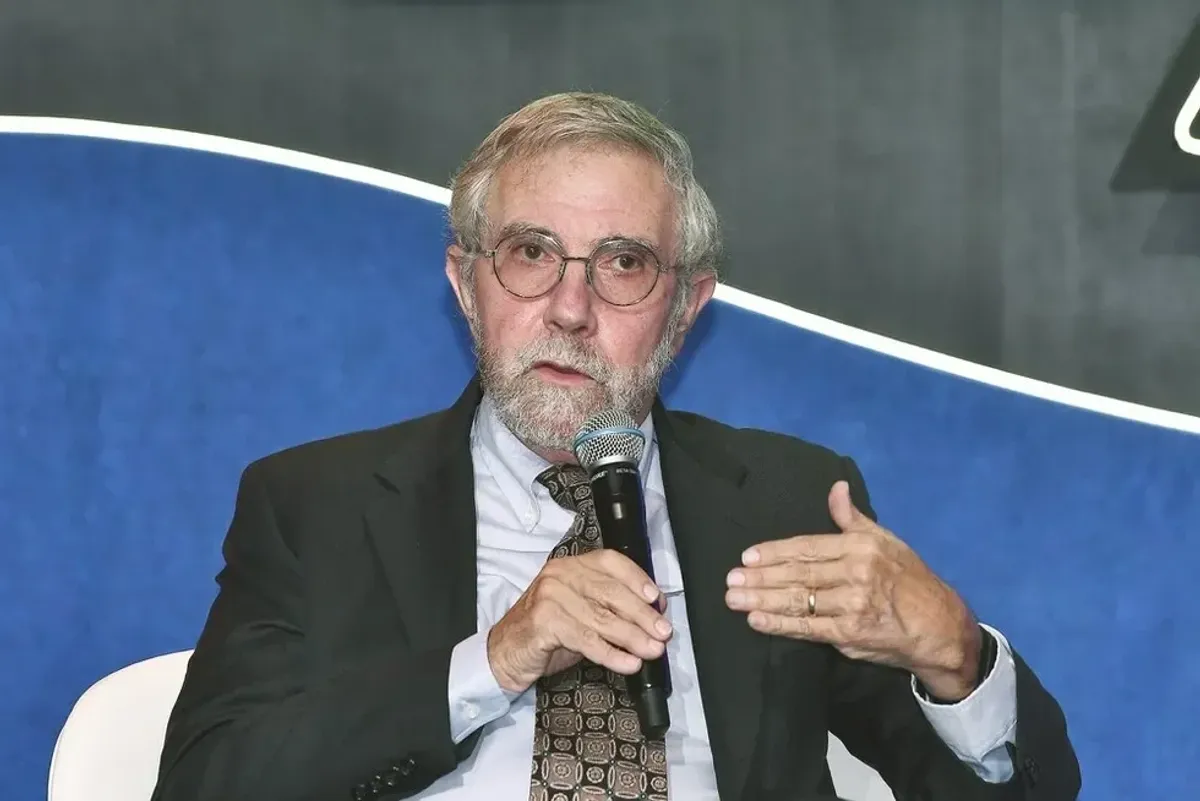
Economist Paul Krugman, economist during FIDES 2023 in Rio de Janeiro, Brazil on September 25, 2023 (A.PAES/ Shutterstock.com)
During his four years as president, Joe Biden worried that if Donald Trump ever returned to the White House, it would pose a major threat to the North Atlantic Treaty Organization (NATO). Trump, during his first term, toyed with the idea of withdrawing the U.S. from NATO — whereas Biden, as president, aggressively championed NATO's expansion when Sweden and Finland opted to join the alliance.
Seven months into Trump's second presidency, the U.S. is still a NATO member. But author/military historian Phillips O'Brien, during an interview with economist Paul Krugman, stressed that Trump's return to the White House marks a dramatic change in U.S./Europe relations.
Krugman, on August 23, posted video of the interview on his SubStack page and also published it as a Q&A article. And O'Brien voiced major concerns about the United States' relationship with Europe.
"The United States is going to great lengths to antagonize its allies," O'Brien told Krugman. "I don't get it. None of this makes any sense to me."
The author/historian said of the Ukraine/Russia War, "I think what happens to Ukraine will determine how Europe deals with this. If Ukraine is sacrificed, I think Europe is going to have a terrible future. Because it's going to be dependent on the U.S., which has basically sacrificed Ukraine to (Russian President Vladimir) Putin's Russia. Europe might even break apart, structurally, such that you'll have the Central Eastern Europeans, the ones who want to stand by Ukraine, the Finns, the Baltics, the Nordics going one way and then the Western Europeans sort of pretending things are OK."
O'Brien added, "So, I think people are underrating the chance of Europe splitting over Ukraine, which is why it's so important, I think, that Ukraine comes out of the war in good shape."
According to O'Brien, U.S. allies in Europe will be paying very close attention to the outcome of the United States' 2026 midterms.
"Well, that's the key thing, isn't it? The 2026 midterms," O'Brien told Krugman. "I don't think people are paying enough attention, because they have to be run fairly. I do think the Democrats have a very good chance of winning them if they are run fairly and happen under normal conditions. But they could also be easily perverted…. I would say that 2026 elections will show not whether America can come back, but whether it has a chance to come back — or whether the period we're going into could be a lot longer and darker than we imagined."
Paul Krugman's full interview with Phillips O'Brien is available on his SubStack page as a video and a Q&A article.
'Danger remains': Nobel-winning economist issues warning about 'drag' of Trump's policies


Robert Davis
August 24, 2025
August 24, 2025
RAW STORY
A Nobel Prize-winning economist issued a dire warning on Sunday about the potential impact of President Donald Trump's signature economic policies.
Paul Krugman, who won the Nobel in 2008 for his work on trade theory, wrote in a new Substack essay that Trump's deportation and tariff policies could create stagflation, or a period characterized by low economic growth, high inflation, and high unemployment.
"Stagflation is very much on people’s minds again, for good reason," Krugman wrote. "The Trump administration’s tariff and deportation policies are creating a significant inflationary shock. They’re also imposing a significant drag on economic growth."
Krugman added that there has been one saving grace to Trump's economy: investments in artificial intelligence. Several AI companies from NVIDIA to Apple and Taiwan Semiconductor Manufacturing Company have made centi-billion-dollar investments in the U.S. during Trump's second term, according to figures from the White House.
However, Krugman warned that any slowdown to the AI space could spell trouble for the U.S. economy.
"Today, it’s likely that the United States would be heading into a recession under the weight of higher prices and slower growth if the economy weren’t being supported by a huge boom in AI-related investment," Krugman added. "And this danger remains: if the AI boom goes bust, the odds are high that the US economy will be plunged into a recession."
Read the entire essay by clicking here.
A Nobel Prize-winning economist issued a dire warning on Sunday about the potential impact of President Donald Trump's signature economic policies.
Paul Krugman, who won the Nobel in 2008 for his work on trade theory, wrote in a new Substack essay that Trump's deportation and tariff policies could create stagflation, or a period characterized by low economic growth, high inflation, and high unemployment.
"Stagflation is very much on people’s minds again, for good reason," Krugman wrote. "The Trump administration’s tariff and deportation policies are creating a significant inflationary shock. They’re also imposing a significant drag on economic growth."
Krugman added that there has been one saving grace to Trump's economy: investments in artificial intelligence. Several AI companies from NVIDIA to Apple and Taiwan Semiconductor Manufacturing Company have made centi-billion-dollar investments in the U.S. during Trump's second term, according to figures from the White House.
However, Krugman warned that any slowdown to the AI space could spell trouble for the U.S. economy.
"Today, it’s likely that the United States would be heading into a recession under the weight of higher prices and slower growth if the economy weren’t being supported by a huge boom in AI-related investment," Krugman added. "And this danger remains: if the AI boom goes bust, the odds are high that the US economy will be plunged into a recession."
Read the entire essay by clicking here.

No comments:
Post a Comment