Analysis
Two recent studies show where thousands of Ukrainian children kidnapped by Russia are taken and the re-education they undergo. The reports are based on open-source intelligence and the accounts of those Ukrainian children who have returned home from Russia.
Issued on: 21/09/2025 -
FRANCE24
By: Sébastian SEIBT
Thousands of children
Evidence has been collected since the start of the invasion of Ukraine about the unlawful transfer of Ukrainian children from occupied areas of Ukraine to Russia. While the full extent of the phenomenon is difficult to quantify, more than 19,000 children from Ukraine have been deported to Russia, according to the Ukrainian organisation Bring Kids Back. Maria Alekseyevna Lvova-Belova, Russia’s presidential commissioner for children's rights, has been accused by the International Criminal Court (ICC) of the “war crime” of “unlawful deportation of population”.
Two recent studies show where thousands of Ukrainian children kidnapped by Russia are taken and the re-education they undergo. The reports are based on open-source intelligence and the accounts of those Ukrainian children who have returned home from Russia.
Issued on: 21/09/2025 -
FRANCE24
By: Sébastian SEIBT
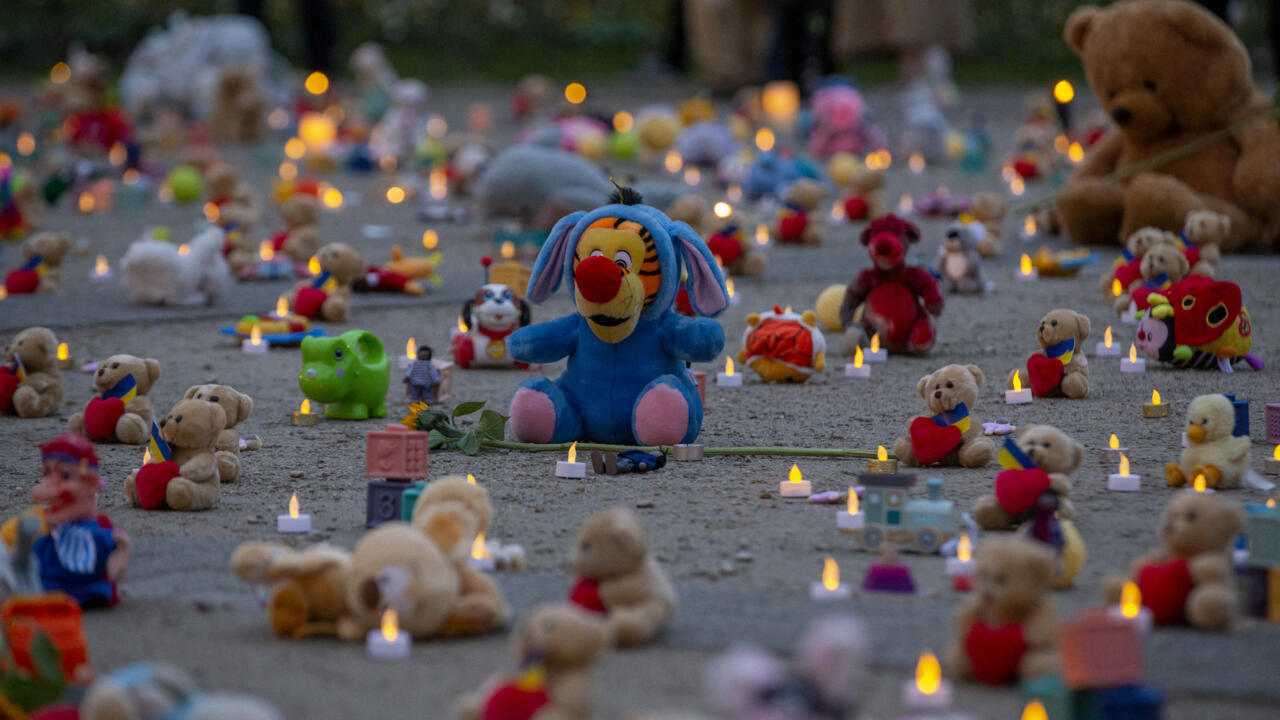
Teddy bears and toys representing children abducted during the war in Ukraine are seen on the ground during an event organised by Avaaz NGO and Ukranian refugees at the Rond-point Schuman in Brussels on February 23, 2023. © Nicolas Maeterlinck, AFP
A hotel in Krasnodar, a monastery in southern Rostov, military schools in Ukraine's Russian-occupied Donetsk and near the city of Volgograd: these are just some of the 210 different facilities across Russia and in occupied territory that have been used to hold Ukrainian children deported or displaced since Russia's invasion, according to a report published on September 16 by the Yale School of Public Health's Humanitarian Research Lab (HRL).
The extensive network of facilities stretches across more than 5,630 kilometres, from the shores of the Black Sea in Crimea to Russia’s Pacific coast. This “unprecedented system of large-scale re-education” of Ukrainian children takes place across “59 regions of temporarily occupied Ukraine and the Russian Federation”, the HRL report reveals. The Yale laboratory has been trying since 2022 to establish the most comprehensive map possible of the sites used or constructed by Russia to hold children separated from their families or homes.
A hotel in Krasnodar, a monastery in southern Rostov, military schools in Ukraine's Russian-occupied Donetsk and near the city of Volgograd: these are just some of the 210 different facilities across Russia and in occupied territory that have been used to hold Ukrainian children deported or displaced since Russia's invasion, according to a report published on September 16 by the Yale School of Public Health's Humanitarian Research Lab (HRL).
The extensive network of facilities stretches across more than 5,630 kilometres, from the shores of the Black Sea in Crimea to Russia’s Pacific coast. This “unprecedented system of large-scale re-education” of Ukrainian children takes place across “59 regions of temporarily occupied Ukraine and the Russian Federation”, the HRL report reveals. The Yale laboratory has been trying since 2022 to establish the most comprehensive map possible of the sites used or constructed by Russia to hold children separated from their families or homes.
Thousands of children
Evidence has been collected since the start of the invasion of Ukraine about the unlawful transfer of Ukrainian children from occupied areas of Ukraine to Russia. While the full extent of the phenomenon is difficult to quantify, more than 19,000 children from Ukraine have been deported to Russia, according to the Ukrainian organisation Bring Kids Back. Maria Alekseyevna Lvova-Belova, Russia’s presidential commissioner for children's rights, has been accused by the International Criminal Court (ICC) of the “war crime” of “unlawful deportation of population”.
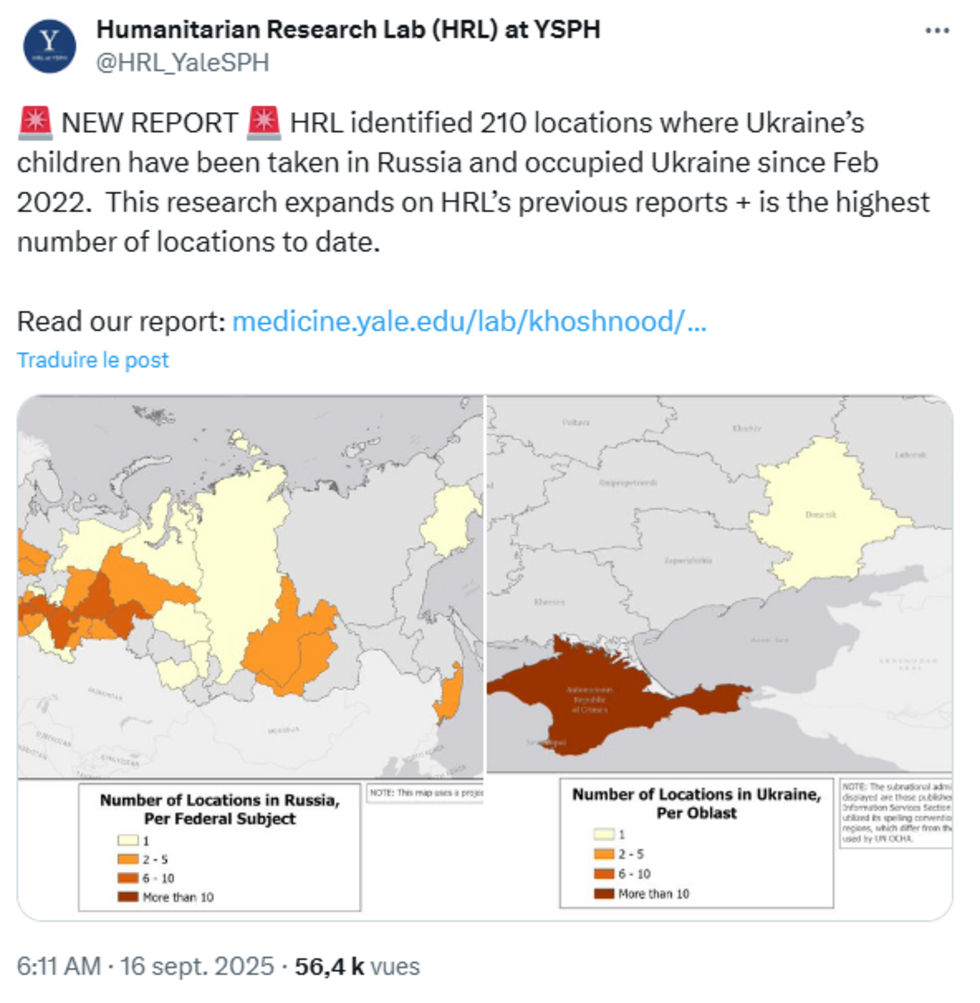
A screen capture of the Humanitarian Research Lab (HRL) at YSPH's post on X from September 16, 2025. © FRANCE 24
Russia has rejected these allegations, denying its involvement in the deportation of citizens of Ukraine. However, it confirms arranging what it describes as “placements for evacuated children” from combat zones in Ukraine.
While the abduction of children began in 2014 with the annexation of Crimea, its intensification since the full-scale invasion of 2022 has fuelled concern and prompted anxious questions about the whereabouts and treatment of kidnapped children. HRL’s study answers some of these questions.
By analysing open-source information such as satellite photos, social media posts and Russian media, experts established that the kidnapped children were taken to eight types of locations: cadet schools, military bases, medical facilities, religious institutions, secondary school and universities, hotels, orphanages and family support centres, and sanatoriums.
There were also places of transit, like orphanages for children who were later placed into adoption programmes, or places where they stayed for longer periods, like military schools.
Ukrainian children were mostly taken to pre-existing organisations which didn’t only hold kidnapped children. This is especially the case for schools. Yet Russia also constructed or expanded certain facilities to accommodate “larger cohorts of children”. This is the case of 23 percent of the facilities analysed, according to the researchers at HRL. They noted that in the Russian-controlled part of the Donbas, two schools for military cadets were built and later enlarged beginning in 2021, most likely to hold “more displaced children”.
Russia’s government directly manages 55 percent of the sites where re-education activities occurred. Private companies were also involved in the vast programme, like the petrol giant Bashneft, which manages a camp for children, and KamAZ, a major constructor of Russian trucks, which operates a large “leisure” camp for children in the Republic of Tatarstan.
Russia has rejected these allegations, denying its involvement in the deportation of citizens of Ukraine. However, it confirms arranging what it describes as “placements for evacuated children” from combat zones in Ukraine.
While the abduction of children began in 2014 with the annexation of Crimea, its intensification since the full-scale invasion of 2022 has fuelled concern and prompted anxious questions about the whereabouts and treatment of kidnapped children. HRL’s study answers some of these questions.
By analysing open-source information such as satellite photos, social media posts and Russian media, experts established that the kidnapped children were taken to eight types of locations: cadet schools, military bases, medical facilities, religious institutions, secondary school and universities, hotels, orphanages and family support centres, and sanatoriums.
There were also places of transit, like orphanages for children who were later placed into adoption programmes, or places where they stayed for longer periods, like military schools.
Ukrainian children were mostly taken to pre-existing organisations which didn’t only hold kidnapped children. This is especially the case for schools. Yet Russia also constructed or expanded certain facilities to accommodate “larger cohorts of children”. This is the case of 23 percent of the facilities analysed, according to the researchers at HRL. They noted that in the Russian-controlled part of the Donbas, two schools for military cadets were built and later enlarged beginning in 2021, most likely to hold “more displaced children”.
Russia’s government directly manages 55 percent of the sites where re-education activities occurred. Private companies were also involved in the vast programme, like the petrol giant Bashneft, which manages a camp for children, and KamAZ, a major constructor of Russian trucks, which operates a large “leisure” camp for children in the Republic of Tatarstan.
Unpublished testimonies from Ukrainian children
Children who end up in these facilities are most often subjected to "re-education" activities. In at least 130 sites identified in the study, children were indoctrinated with Russian propaganda that emphasised patriotic values.
Ukraine-Russia talks overshadowed by child deportations and renewed strikes
© France 24
01:57
01:57
This indoctrination can go to extreme lengths, as illustrated by another report published by the British NGO War Child UK. The organisation gathered first-hand accounts from 200 Ukrainian children who have returned from Russia since 2022. Their statements paint a picture of "a systematic [Russian] program that risks creating a generation of [Ukrainian] children deprived of their identity", wrote the report.
What emerges from their accounts is “a clear pattern of indoctrination”, said Helen Pattinson, CEO of War Child UK. "The children are ripped from their homes, have their passport taken away, and are told they can’t speak their language. They are given new names and new identification documents. They are asked to sing the Russian national anthem and to recite Russian poetry. Everything is done in Russian, and they are required to wear Russian clothing. They may even be adopted into a Russian family," said Pattinson.
This indoctrination can be coupled with rapid militarisation. "Our chief concern is for the 41 percent of children who had been militarised," said Pattinson, adding that most of the young people who came back from Russia suffered from some form of post-traumatic stress disorder.
Children underwent military training in at least 39 of the sites identified by the HRL study. The young people learn how to handle various weapons and may receive very specific training, such as learning how to become a paratrooper. "They’ve been asked or forced to join paramilitary groups, shown how to throw a grenade, dig a trench, hold a gun or handle firearms, clear mines, and essentially trained to fight against their own country," Pattinson said.
Other children may be assigned the task of producing military equipment such as ammunition or drones, to be used by the Russian army on the front lines in Ukraine.
This massive program gives the impression of an almost industrial-scale Russification effort. It is accompanied by several decrees issued by the authorities to facilitate the adoption of these children by Russian families or their naturalisation as Russian citizens.
An example of 'demographic conquest'
“It's certainly a concerted, well-organised effort," said Andreas Umland, an analyst from the Swedish Institute of International Affairs and author of a 2024 report on Russian state-enforced displacement of Ukrainian children.
In Kherson, dozens of children deported to Russia

FOCUS © FRANCE 24
06:29
06:29
Umland spoke of a “demographic conquest unfolding alongside the geographic one”. The Kremlin doesn't simply want to occupy Ukraine, it also wants to transform Ukrainian children into Russians, he explained.
This is meant to “counteract the problem of demographic decline that Russia already had before the large-scale war, which is only partly solved by immigration from Central Asia and the Caucasus”, said Umland, adding that Ukrainians, who are White, and Slavs, are seen by the Russian authorities as easy to assimilate.
In Moscow's view, there is nothing illegal about this operation even though "there are undeniably serious crimes being committed against Ukrainian children”, said Pattinson. In Russia’s interpretation, “there's no Ukrainian nation, and therefore these children are not actually transferred from one ethnic group into another ethnic group”, added Umland. In other words, these children cannot be "Russified"... because they are already Russian.
Umland said the indoctrination of children was reminiscent of the Soviet era, when children were “seen as units to be made to function in a totalitarian society [. . .] and the fate of the individual child was unimportant”. This same logic persists today, he added: “The higher goal used to be communism, now it’s the Russian Empire. It’s therefore the same utilitarian approach toward children."
This article is a translation of the original in French by Sonya Ciesnik.
This is meant to “counteract the problem of demographic decline that Russia already had before the large-scale war, which is only partly solved by immigration from Central Asia and the Caucasus”, said Umland, adding that Ukrainians, who are White, and Slavs, are seen by the Russian authorities as easy to assimilate.
In Moscow's view, there is nothing illegal about this operation even though "there are undeniably serious crimes being committed against Ukrainian children”, said Pattinson. In Russia’s interpretation, “there's no Ukrainian nation, and therefore these children are not actually transferred from one ethnic group into another ethnic group”, added Umland. In other words, these children cannot be "Russified"... because they are already Russian.
Umland said the indoctrination of children was reminiscent of the Soviet era, when children were “seen as units to be made to function in a totalitarian society [. . .] and the fate of the individual child was unimportant”. This same logic persists today, he added: “The higher goal used to be communism, now it’s the Russian Empire. It’s therefore the same utilitarian approach toward children."
This article is a translation of the original in French by Sonya Ciesnik.

No comments:
Post a Comment