France Awards its Largest Offshore Wind Project to TotalEnergies Consortium
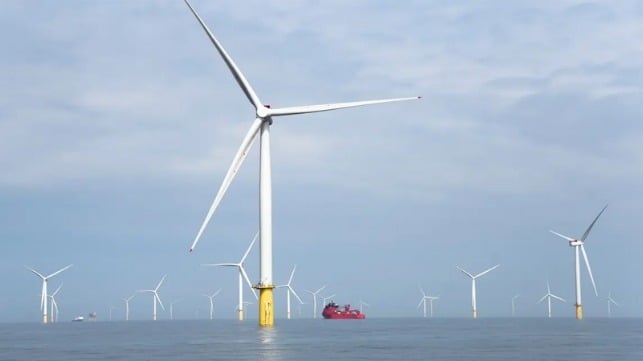
France’s Ministry of Industry and Energy announced the selection of a consortium headed by TotalEnergies for the development and operation of the country’s largest offshore wind farm to date. The massive project, which would be TotalEnergies’ first large project in the country, represents a 50 percent increase in the company’s investment in the French energy sector.
The consortium, which consisted of TotalEnergies and RWE, was one of seven qualified to bid for the Centre Manche 2 project, which will be located approximately 25 miles off the Normandy coast. It calls for 1.5 GW of capacity, more than doubling the renewable energy that would be available in the region. The companies bid the energy price for the project at €66/MWh.
“We are very proud to have won this tender for the construction of the largest renewable energy park in France to date. It embodies Total’s transformation into TotalEnergies in France,” said Patrick Pouyanné, Chairman and CEO of TotalEnergies. The company noted that the project represents a total investment of approximately $5.3 billion, with its current total investment in French renewables at approximately $9.4 billion since 2020.
TotalEnergies highlights that it has a total portfolio of 25 GW of wind energy capacity operating or in development. This includes projects in the United Kingdom, South Korea, Taiwan, the Netherlands, Germany, the United States, and France.
As part of their proposal, the companies committed to a number of unique elements. They say they will include a portion of crowdfunding financing so that local residents and authorities in the Normandy region can invest in the project. They also committed to becoming a leader in designing the wind farm for recycling. They propose that 95 percent of the blades, towers, and nacelles, and 100 percent of generator magnets, will be recycled, reused, or repurposed.
The project, however, is already facing challenges. Partner RWE announced that after a strategic review of its investments, it wishes to exit the consortium. To do that, it will require approval from the French authorities. TotalEnergies says it will still pursue the project, assuming all the commitments. However, it will also propose to bring a new partner into the project.
The auction had been in planning for three years since 2022, but it became the last for the outgoing government. It had offered the Normandy site as well as a second site located in the South Atlantic off the island of Oleron. Nine companies had qualified, but that site has challenges, including water depth, seabed, and wind conditions, and in the end, no bids were received for the project. That is despite the terms that made it possible to bid the energy price up to €100/MWh.
The government highlights that it awarded three floating wind projects in South Brittany and the Mediterranean in 2024 and has new projects in commissioning for 2025. However, France still lags with just 1.5 GW of installed capacity, although the government highlights a cumulative 7.8 GW under construction or under development. Its goal is for 45 GW in service by 2050.
TotalEnergies reports it will proceed with the planning and studies for Centre Manche 2, anticipating a final investment decision by early 2029. Electricity production is expected to begin in 2033.
Cadeler Takes Delivery of WTIV Capable of Handling Foundations and Turbines
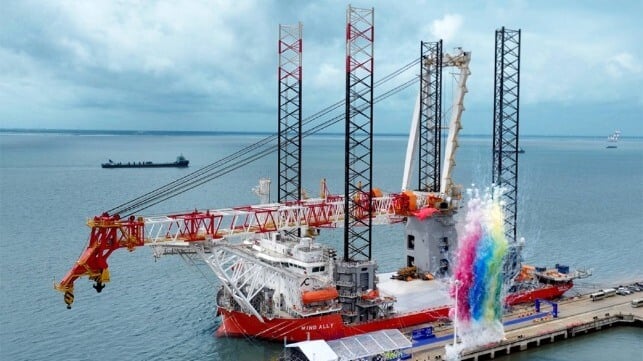
Wind Ally, a massive jack-up installation vessel, was delivered on September 25 to Cadeler as the company expands its capabilities and builds toward the largest fleet of jack-up installation vessels. The new ship, which is the first of three being built for Cadeler, has the ability to transition between foundation installation and wind turbines, creating greater efficiency for the projects.
The naming ceremony took place at the Cosco shipyard in Qidong, China, on September 24, followed by the delivery of the vessel on September 25. The ship will depart shortly bound for the UK, where it is under contract to start the foundation installation for Ørsted’s Hornsea 3 offshore wind farm. When completed, the wind farm will have a generating capacity of 2.9 GW, making it the world’s single largest offshore wind farm to date.
Wind Ally is a massive vessel with 5,600 square meters of deck space and the ability to carry a payload exceeding 18,000 tonnes. The vessel measures 162 meters (531 feet) in length and took more than two years to build. Its main crane is capable of lifting more than 3,300 tonnes at 39 meters. It can accommodate up to 130 crew and installation technicians.
Cadeler highlights that the vessel was designed to meet the increasing size and complexity of offshore wind turbines and foundations. It will be able to transport up to six sets of XXL monopile foundations per load and install them.
The A Class design is the result of close cooperation between Cadeler working with GustoMSC, NOV, Kongsberg, Huisman, and MAN Energy (Everllence).
Wind Ally will be followed by sister ships Wind Ace in 2026 and Wind Apex in 2027. The company is also expanding its M class vessels, which are slightly smaller, dedicated foundation installation jack-up vessels. Wind Mover is due late this year after Wind Maker and Wind Keeper, which were delivered earlier this year. By mid-2027, Cadeler expects to be operating 12 vessels, giving it leadership in serving the offshore wind industry.

No comments:
Post a Comment