Niger, Mali, and Burkina Faso announce International Criminal Court withdrawal
The three members of the Alliance of Sahel States in West Africa issued a joint statement denouncing the International Criminal Court, and their plans to withdraw from it in favour of "indigenous mechanisms for the consolidation of peace and justice."
Issued on: 23/09/2025 -
By: FRANCE 24

The three members of the Alliance of Sahel States in West Africa issued a joint statement denouncing the International Criminal Court, and their plans to withdraw from it in favour of "indigenous mechanisms for the consolidation of peace and justice."
Issued on: 23/09/2025 -
By: FRANCE 24
A general view of the International Criminal Court, in The Hague, Netherlands.
© Wolfgang Rattay, Reuters
The military-led west African nations of Burkina Faso, Mali and Niger on Monday announced their withdrawal from the International Criminal Court, branding it a "neo-colonial" imperialist tool.
The juntas which took over in Bamako, Ouagadougou and Niamey after coups between 2020 and 2023 have since allied themselves in a confederation called the Alliance of Sahel States (AES) and distanced themselves from the West, notably from former colonial ruler France.
Read more Mali junta accuses 'foreign states' of attempted destabilisation plot
The court, based in The Hague, was "an instrument of neo-colonialist repression in the hands of imperialism," the three countries said in a joint statement.
"The ICC has proven itself incapable of handling and prosecuting proven war crimes, crimes against humanity, crimes of genocide, and crimes of aggression," they said.
The three states also said they wanted to create "indigenous mechanisms for the consolidation of peace and justice."
A state's withdrawal only takes effect one year after the official submission of the case to the UN general secretariat.
Burkina Faso, Mali and Niger have notably drawn closer to countries such as Russia, whose President Vladimir Putin has been the subject of an ICC arrest warrant since March 2023 over the war in Ukraine.
Read more Russia steps out from shadows in Africa with state paramilitary
The West African countries are facing deadly violence from jihadist groups linked to Al-Qaeda and the Islamic State, but their armies are also accused of crimes against civilians.
Founded in 2002, the International Criminal Court's mission is to prosecute the perpetrators of the most serious crimes, such as war crimes, when countries lack the will or capacity to do so themselves.
(FRANCE 24 with AFP.)
The military-led west African nations of Burkina Faso, Mali and Niger on Monday announced their withdrawal from the International Criminal Court, branding it a "neo-colonial" imperialist tool.
The juntas which took over in Bamako, Ouagadougou and Niamey after coups between 2020 and 2023 have since allied themselves in a confederation called the Alliance of Sahel States (AES) and distanced themselves from the West, notably from former colonial ruler France.
Read more Mali junta accuses 'foreign states' of attempted destabilisation plot
The court, based in The Hague, was "an instrument of neo-colonialist repression in the hands of imperialism," the three countries said in a joint statement.
"The ICC has proven itself incapable of handling and prosecuting proven war crimes, crimes against humanity, crimes of genocide, and crimes of aggression," they said.
The three states also said they wanted to create "indigenous mechanisms for the consolidation of peace and justice."
A state's withdrawal only takes effect one year after the official submission of the case to the UN general secretariat.
Burkina Faso, Mali and Niger have notably drawn closer to countries such as Russia, whose President Vladimir Putin has been the subject of an ICC arrest warrant since March 2023 over the war in Ukraine.
Read more Russia steps out from shadows in Africa with state paramilitary
The West African countries are facing deadly violence from jihadist groups linked to Al-Qaeda and the Islamic State, but their armies are also accused of crimes against civilians.
Founded in 2002, the International Criminal Court's mission is to prosecute the perpetrators of the most serious crimes, such as war crimes, when countries lack the will or capacity to do so themselves.
(FRANCE 24 with AFP.)
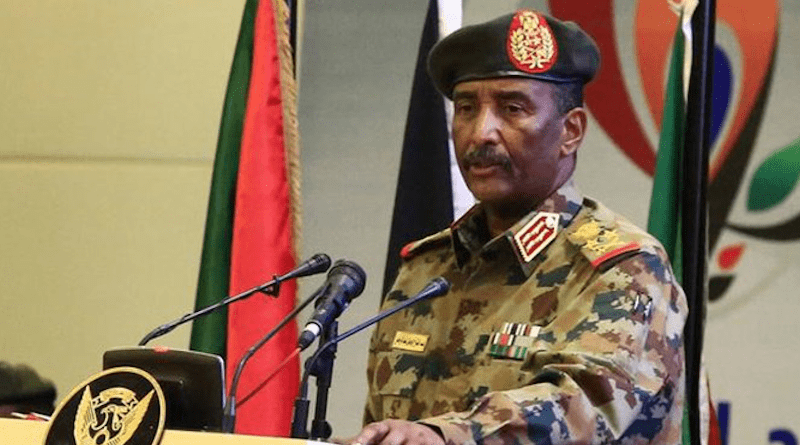
Sudan's General Abdel Fattah al-Burhan. Photo Credit: Fars News Agency
September 23, 2025
By James Wilson
Two of the international community’s leading authorities concerned with finding a solution to the Sudan crisis issued separate pronouncements on the same day,12 September, about Sudan’s civil war, neither of which, for rather different reasons, will be of any comfort to either of the major combatants. But it’s the Sudanese Armed Forces that are in the bigger jam.
The first was a resolution by the Security Council to extend for a year its existing sanctions against Sudan in relation to the Darfur region, this on the advice of its ‘panel of experts’—in relation to which, also, the words, teapot, chocolate and ‘as good as a’ come to mind, given all these experts have accomplished since 2023. What, one might ask, are the Rapid Support Forces to make of this resolution, given that Darfur is their redoubt, and centre of their resistance against an Islamist regime whose army, the SAF, has been waging its war to eliminate them, and democracy, from the future of Sudan?
The second was a statement issued by the US State Department on behalf of The Quad, the US, Egypt, Saudi Arabia and the United Arab Emirates. The statement alone will have required some internal arm-twisting but now that’s there. it puts the Quad’s weight squarely behind the 2020 Jeddah Agreement, a document which, had its terms been implemented, might well have seen Sudan further along to the road to the kind of secular, democratic Sudan for which the Rapid Support Forces have shown support in their own more recent vision statements.
For the Sudanese Armed Forces it’s a different matter. Buried in Principle Four of the Quad’s statement is the proposition that “Sudan’s future governance is for the Sudanese people to decide through an inclusive and transparent transition process, not controlled by any warring party.”
And it goes on to stipulate that “an independent, civilian-led government with broad-based legitimacy and accountability is vital for the long-term stability of Sudan and the preservation of its state Institutions. Sudan’s future cannot be dictated by violent extremist groups part of or evidently linked to the Muslim brotherhood, whose destabilising influence has fuelled violence and instability across the region.”
For the SAF’s Islamists, this is well beyond the pale no matter how SAF commander General Abdel Fattah al-Burhan reshuffles the top brass in his police and armed forces. They still remain deeply embedded in the political and military structures that provide his base, As Reuters has reported, Sudan’s Islamists are set on a constitution based on Islamic law, military oversight ensuring stability, and limited civilian power, with the military and security sector dominating the country’s political development in order to guarantee the settlement.
So this pending Quad statement will have made for some difficult conversation when Burhan met Massad Boulos, President Trump’s senior sdviser on Arab and African Affairs, in Geneva last month. And two days after the Quad statement, SAF foreign minister Eddim Salem’s reaction was decidedly leery, while trying to avoid the impression of intransigence.
As the Sudanese Sunday Tribune reported, Salem said the SAF’s own peace roadmap would serve as the “main reference” for any path forward. The SAF refuses to talk while the RSF siege of El-Fasher continues. It demands that the RSF withdraw from Kordofan and Darfur, and that the RSF disarm withdraw from all civilian areas before any negotiations can begin.
All this suggests that the SAF are resisting efforts by the Quad to establish a peace process leading to secular civilian rule, and that Burhan remains besieged by the demands of the powerful Islamist factions that keep him in power.
Burhan may be hoping that he can persuade the UN to mobilise a parallel negotiating track that runs interference for his own agenda and buys him more time. But the UN is the proverbial chocolate tea pot at this party. It is only the Quad that has the muscle necessary to get Burhan in the room with the RSF’s General Mohamed Dagalo and start talking turkey about the shape of a government that can undo the miserable Islamist legacy of Omar al-Bashir.
James Wilson is the Editor-in-Chief of EU Political Report. He is Correspondent on African Affairs for NE Global Media.

No comments:
Post a Comment