 Copyright AP Photo
By Euronews
Published on 22/09/2025 -
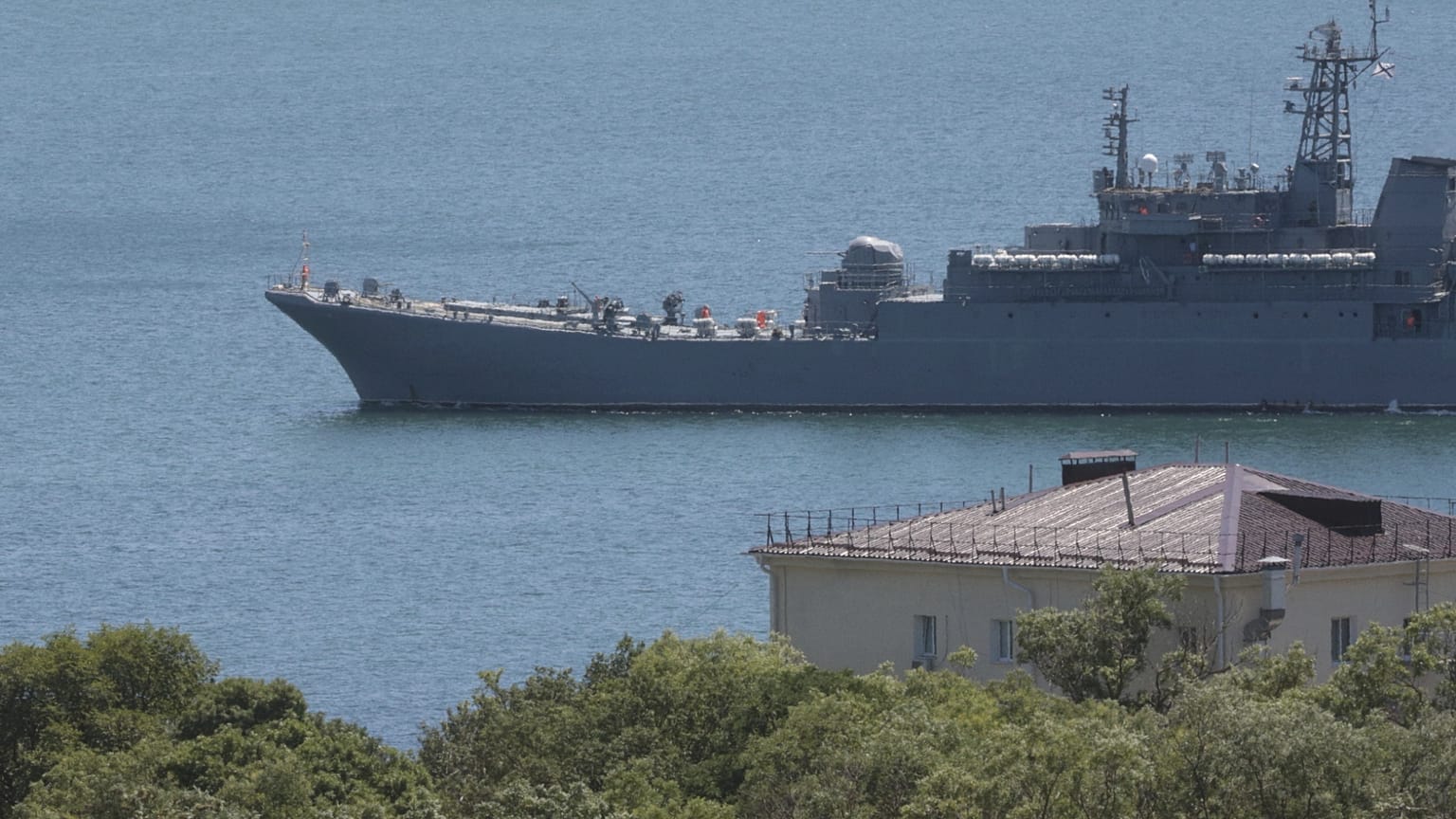
Ukraine’s military intelligence (HUR) claimed that for the first time, Kyiv forces hit two Russian amphibious aircraft in occupied Crimea. Russia-installed occupation authorities say the resort area has been hit.
The Crimean resort area of Foros was hit by Ukrainian drones, causing damage and casualties, the head of the Russia-installed occupation government of Crimea said.
The alleged target of the strike was Foros Sanatorium, a luxury resort located near four Russian state dachas — country homes of Russia's political elite, according to the Kremlin proxies.
Russia-installed head of annexed Crimea said three people were killed and 16 were injured in a reported attack.
According to some Telegram channels, "very important" guests were allegedly staying at the resort at the time of the strike.
Russia’s defence ministry confirmed the attack, but did not comment on who could have been a target or could have been at the resort during the alleged attack.
According to Crimea.Realities, a Crimean project of Radio Liberty's Ukrainian Service, four Russian state summer residencies or dachas are located between Foros — situated in the occupied peninsula's south — and Yalta.
An investigation by the Russian media outlet Project found that Russian President Vladimir Putin had taken over two of the dachas.
The resort website states that on Sunday, the Foros Hall restaurant was closed due to a private event.
Ukraine hits two Russian amphibious aircraft
Ukraine’s military intelligence (HUR) claimed that for the first time, Kyiv forces hit two Russian amphibious aircraft in occupied Crimea.
According to HUR, the targeted aircraft are the Soviet-designed Be-12 Chayka (also known as “Mail” as per NATO reporting name). This is an anti-submarine amphibious aircraft equipped with high-value systems used for detecting and engaging submarines.
Before hitting Russian amphibious aircraft, HUR also reported that it had allegedly destroyed three Russian Mi-8 helicopters and a radar station in Crimea.
In Zaporizhzhia in Ukraine's southeast, Russian forces hit civilian and industrial infrastructure, sparking several fires that destroyed apartment buildings, private residences, and vehicles.
Head of Zaporizhzhia Oblast Military Administration Ivan Fedorov said that “the Russians targeted the city with at least five aerial bombs. They attacked civilian and industrial infrastructure."
Rescue crews from the State Emergency Service remain on site. At least three people were killed in the attack.
In total, 15 apartment buildings, 10 houses and several non-residential facilities were damaged in the city.
Russian forces also attacked the northeastern city of Sumy and the Kyiv region.
Overall, at least eight people were killed and 21 were injured in Russian attacks against Ukraine over the past 24 hours.
Ukrainian forces downed 132 out of the 141 drones launched by Russia overnight, Ukraine’s air defence reported.
How Ukraine keeps society going despite the war
Adaptive governance amidst the war: Overcoming challenges and strengthening collaborative digital service provision in Ukraine
Linköping University
image:
Mariana Gustafsson, docent in political science at the Department of Management and Engineering at Linköping University.
view moreCredit: Jonas Roslund
Despite being at war since February 2022, Ukraine has managed to maintain public services. A new study from Linköping University points to the collaboration between citizens and public authorities as a key factor in this. According to the researchers behind it, there are lessons to be learned for other countries should war or crisis come.
“Everyone, right down to the family and the individual, makes crucial decisions in times of deep crisis. It’s important that all actors are mobilised, pull together and cooperate,” says Mariana Gustafsson, docent in political science at the Department of Management and Engineering at Linköping University.
The study, conducted in the Dnipropetrovsk region in 2023 and 2024, is based on survey responses from 239 public officials and 882 Ukrainian citizens. It has been supplemented with ten in-depth interviews with public officials and active members of civil society. All in all, it gives a picture of how society’s functions were transformed during the war. The results have been published in the journal Government information Quarterly.
The study shows that extensive collaboration has emerged between all levels of society – collaboration that was previously sporadic. Citizens in civil society have been able to identify new needs early on through their local networks and develop relief efforts together with authorities and international organisations. This has made it possible to, for example, quickly create digital services to help war veterans or those who have had to flee their homes. Citizens and organisations have become active co-creators rather than passive recipients, making the efforts robust and credible.
The digital platform Diia, a central location for government services in Ukraine for the past few years, has played a key role in this, as a number of functions, originally developed in civil society, could quickly be connected to it. More than half of all Ukrainians now have the app on their phone.
But the researchers emphasise that the collaboration rests on trust within society – a belief that individuals, organisations and public authorities are actually doing what they are supposed to be doing. This belief was not always evident in Ukraine but has slowly grown since the Orange Revolution in the mid-00s. The war has since brought everything to a head, although serious problems with corruption remain. There are lessons to be learned by other countries about the importance of strengthening citizens' confidence in democracy and its institutions.
Trust is created through authorities being flexible and actively working to include civil society, but also through citizens themselves becoming more active, according to Mariana Gustafsson. This is a challenge in all developed democracies, where engagement and participation in civil society have decreased over time. The conditions for a functioning society, even in times of crisis and war, must be created in advance.
“Don’t forget that trust is a commodity. This is something that public authorities, civil society and all of us have to work on continuously. We have seen many warning signs that civil society must become more dynamic and active,” says Mariana Gustafsson.
The researchers point out that the study does have some limitations. Because of the war, it has been difficult to achieve fully representative survey data. Moreover, the survey was only conducted in one of Ukraine’s regions.
The LiU researchers carried out the study together with colleagues from Dnipro University of Technology in Ukraine. The research was funded by the Swedish Research Council and the Swedish Institute.
Journal
Government Information Quarterly
Method of Research
Survey
Subject of Research
People
Article Title
Adaptive governance amidst the war: Overcoming challenges and strengthening collaborative digital service provision in Ukraine
Article Publication Date
22-Sep-2025

No comments:
Post a Comment