Burned bodies with missing limbs wash ashore after Trump's anti-drug boat strikes
Matthew Chapman
October 23, 2025
RAW STORY
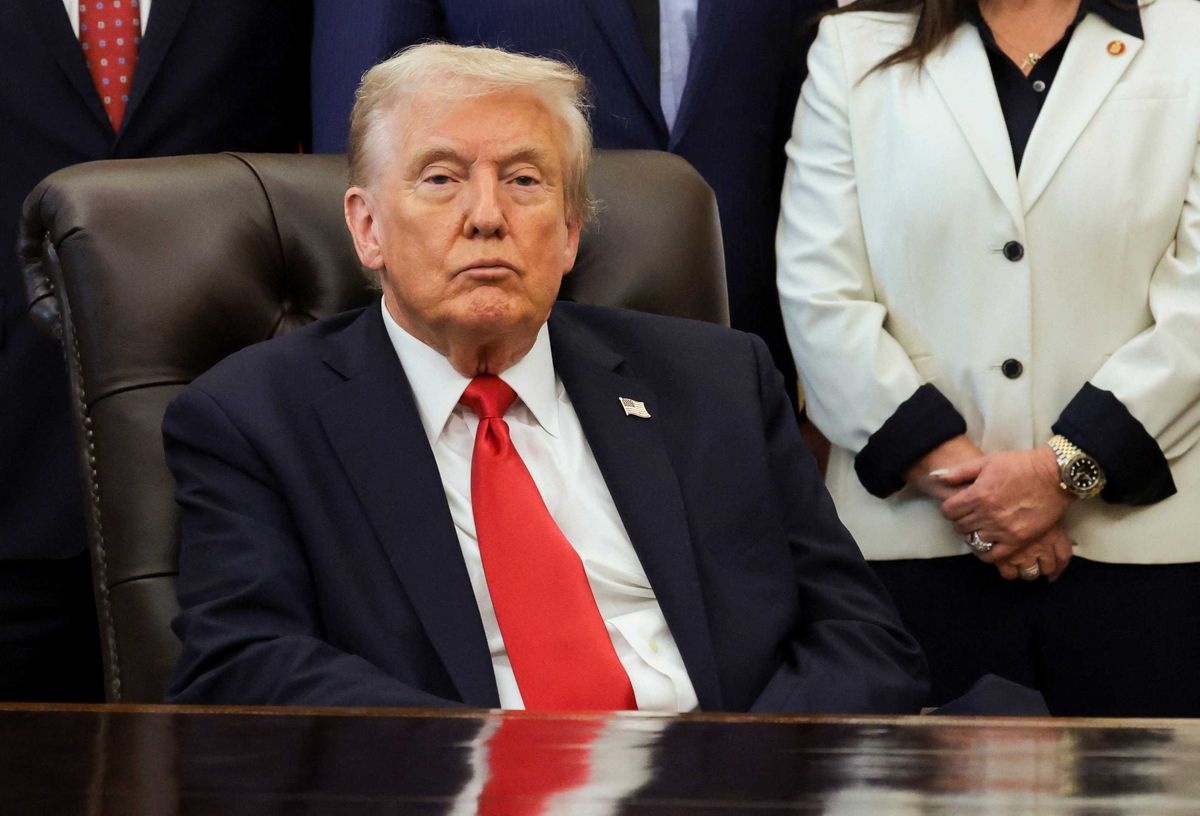
President Donald Trump looks on during an event to make announcements on fertility treatment coverage, in the Oval Office at the White House in Washington, D.C. on Oct. 16, 2025. REUTERS/Jonathan Ernst
A series of dark discoveries in the waters of the Caribbean prompted further questions about President Donald Trump's military strikes on boats alleged to be operated by drug traffickers.
"The first body washed ashore on Trinidad’s northeastern coast soon after the United States carried out its first strike in September on a boat in the Caribbean. Villagers said the corpse had burn marks on its face and was missing limbs, as if it had been mangled by an explosion," reported Simon Romero and Prior Beharry. "The tides deposited another corpse on a nearby beach days later, drawing a wake of vultures. Its face was similarly unrecognizable, and its right leg appeared to have been blown off."
The bodies have not been definitively tied to the U.S. airstrikes on boats, the report noted — but it has heightened tensions in Trinidad itself, where Prime Minister Kamla Persad-Bissessar "is explicitly supporting the strikes on boats that U.S. officials say are carrying drugs" — one of the only politicians in the Caribbean to do so.
“There’s no question in my mind that these men are casualties of war,” local water utilities employee Lincoln Baker told The Times, one of many in Trinidad who fear their government isn't seeking proper answers from the United States about the bodies.
Trump's strikes on boats, which have been going on for weeks, are a radical departure from both international law and longstanding U.S. policy. Typically, suspected drug trafficking vessels are interdicted and their crews arrested, rather than treated as active military combatants.
Even a number of right-wing legal figures are upset over the strikes. John Yoo, the former DOJ lawyer who wrote the George W. Bush administration's infamous memo justifying torture, said, “We can’t just consider anything that harms the country to be a matter for the military. Because that could potentially include every crime.” And former Supreme Court Justice Antonin Scalia's law clerk Ed Whelan proclaimed the strikes are "very likely illegal."
October 23, 2025
RAW STORY
President Donald Trump looks on during an event to make announcements on fertility treatment coverage, in the Oval Office at the White House in Washington, D.C. on Oct. 16, 2025. REUTERS/Jonathan Ernst
A series of dark discoveries in the waters of the Caribbean prompted further questions about President Donald Trump's military strikes on boats alleged to be operated by drug traffickers.
"The first body washed ashore on Trinidad’s northeastern coast soon after the United States carried out its first strike in September on a boat in the Caribbean. Villagers said the corpse had burn marks on its face and was missing limbs, as if it had been mangled by an explosion," reported Simon Romero and Prior Beharry. "The tides deposited another corpse on a nearby beach days later, drawing a wake of vultures. Its face was similarly unrecognizable, and its right leg appeared to have been blown off."
The bodies have not been definitively tied to the U.S. airstrikes on boats, the report noted — but it has heightened tensions in Trinidad itself, where Prime Minister Kamla Persad-Bissessar "is explicitly supporting the strikes on boats that U.S. officials say are carrying drugs" — one of the only politicians in the Caribbean to do so.
“There’s no question in my mind that these men are casualties of war,” local water utilities employee Lincoln Baker told The Times, one of many in Trinidad who fear their government isn't seeking proper answers from the United States about the bodies.
Trump's strikes on boats, which have been going on for weeks, are a radical departure from both international law and longstanding U.S. policy. Typically, suspected drug trafficking vessels are interdicted and their crews arrested, rather than treated as active military combatants.
Even a number of right-wing legal figures are upset over the strikes. John Yoo, the former DOJ lawyer who wrote the George W. Bush administration's infamous memo justifying torture, said, “We can’t just consider anything that harms the country to be a matter for the military. Because that could potentially include every crime.” And former Supreme Court Justice Antonin Scalia's law clerk Ed Whelan proclaimed the strikes are "very likely illegal."
By AFP
October 23, 2025

More Latin American drugs are exported via the Pacific than the Caribbean -- the main focus of US strikes so far - Copyright AFP/File JOAQUIN SARMIENTO
Lina VANEGAS
US military strikes that Washington claims have targeted “narco-terrorists” ferrying drugs to American soil are having little to no impact on Latin America’s bustling narcotics trade, experts say.
The strikes have killed at least 37 people, most of them in Caribbean waters, according to US figures.
Relatives and the home governments of many of the dead deny involvement in drug-running, but experts say the killings are illegal even if they target known narcotics traffickers.
The operations have raised questions in the region about US President Donald Trump’s endgame.
Is this truly another battle in the global war on drugs — and if so, is the United States going after the right people? Or is this something geopolitically broader?
– Wrong target? –
The US administration’s actions in the Caribbean “will have zero impact on drug trafficking,” said Laura Bonilla of the Pares research center in Colombia, the world’s biggest cocaine producer — most of it destined for the United States.
More drugs are exported via the Pacific — from ports in Colombia, Mexico, Peru and Ecuador — than via the Caribbean Sea, where the strikes have been focused thus far.
According to the government in Ecuador, which is plagued by drug gangs, 70 percent of the cocaine destined for the rest of the world leaves from its Pacific ports.
After several strikes in the Caribbean, the United States on Wednesday announced its first attack in the Pacific, with at least two people reported dead.
Experts point out that transnational cartels are the primary buyers and distributors of drugs — not the Venezuelan or Colombian groups blamed by the Trump administration.
Neither Venezuela nor Colombia, whose citizens have been targeted in the strikes, are major exporters in their own right.
Bonilla said she questions the Pentagon’s assertion that guerrilla fighters from Colombia’s leftist National Liberation Army (ELN) were among those killed by US forces.
“A total lie…. The ELN doesn’t take boats out in the Caribbean because the ELN doesn’t own the business,” she said.
– Political goals? –
Leaders, analysts and citizens alike have questioned Washington’s motives.
Some see the campaign as a distraction from Trump’s policy problems at home, while others suspect an attempt to oust leftist Latin American leaders with whom Trump has clashed.
“This is not about Latin America. This is part of his (Trump’s) narrative to justify the destruction of… competitive democracy,” said Bonilla.
Venezuelan President Nicolas Maduro — whose last two reelection victories have been widely disputed — has accused Washington of plotting “regime change,” while Colombia’s Gustavo Petro has suggested the idea of “a coup d’etat against me.”
“Politically, Trump’s actions are clear, as he aims to influence… the 2026 presidential elections in Colombia,” Juana Cabezas, a researcher specializing in armed conflicts at non-governmental organization Indepaz, told AFP.
“But also, he seeks to establish a maximum point of control and exert power over the region in relation to Venezuela. So, clearly, there is an important geopolitical issue here.”
– Counterproductive? –
In the midst of the strikes, Colombian drug traffickers have remained active on TikTok, glorifying their trade in music videos set amid coca leaf crops and drug laboratories.
“There is no perception that people are concerned,” a 45-year-old former coca grower told AFP in the Cauca province, where much of Colombia’s cocaine comes from.
“Those people (the narcos) are indifferent, they see it as an international show (…) that does not really affect the illicit economy.”
Others say the drug lords may even benefit, if the threat of supply problems push up prices.
The strikes “do not affect anything, they continue (to produce drugs) as always,” a person with close ties to an armed drug group told AFP.
“Moreover, they may even benefit as it becomes more expensive.”

No comments:
Post a Comment