Georgian Dream Turning Totalitarian
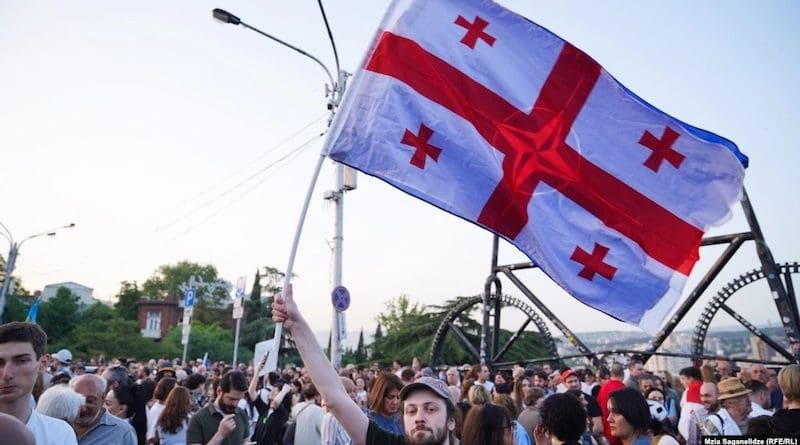
Protest in Georgia. Photo Credit: RFE/RL
October 21, 2025
By Eurasianet
(Eurasianet) — The Georgian Dream-led counter-revolution in Tbilisi seems to be moving rapidly from an authoritarian phase to a totalitarian era.
Over the past few weeks, since claiming a convincing victory in municipal elections that were never competitive, the country’s Georgian Dream leadership has drastically intensified efforts to stifle all forms of dissent. Special forces squads have started conducting late-night security sweeps, bursting into private residences and taking suspected anti-government agitators into custody. Dozens of individuals, arrested in successive waves, now face criminal charges in connection with a protest outside the presidential residence in Tbilisi on October 4.
Meanwhile, the rubber-stamp parliament has adopted legislation significantly tightening criminal penalties covering expressions of dissent. Offenses, such as “illegally blocking a road,” once punishable with fines, now carry a potential jail sentence of up to 15 days, and a repeat offender can face up to a year behind bars.
Among those detained under the tightened criminal code is Vakho Sanaia, lead anchor at Formula TV, a broadcaster critical of the government, who attended a protest on October 18.
Parliament also has adopted a law allowing the Constitutional Court to dissolve political parties and ban individuals from engaging in political activity or founding new parties. Critics view it as part of the ruling party’s ongoing effort to outlaw opposition.
“No Georgian citizen is safe as long as [Bidzina] Ivanishvili holds power,” read a statement issued by the Lelo opposition coalition, referring to Georgian Dream’s founder and financier.
Amid Georgian Dream’s totalitarian turn, some erstwhile party loyalists are finding themselves on the wrong side of the power divide.
On October 18, the State Security Service announced it had raided 24 properties linked to former prime minister Irakli Gharibashvili (who still is GD party chair), former State Security Service head Grigol Liluashvili, former prosecutor general Otar Partskhaladze, and five other figures. Authorities reportedly seized around $7 million in cash, hundreds of pieces of jewelry and watches and several expensive paintings.
Gharibashvili, a longtime Ivanishvili loyalist, had served in a variety of top governmental posts before resigning just last year. Some government critics see Garibashvili’s evident fall from grace as potentially signaling the start of a “purge” period within the ruling party.
Georgia’s Rose Revolution in 2003 was a groundbreaking event in Eurasia’s post-Soviet history, ushering in an era of hope that rule of law could start to take root in a region steeped in traditions of arbitrary rule and grand corruption. Over the ensuring two decades, Georgia made major democratization strides. Georgian Dream’s rejection of liberal values and the restoration of a one-party system has occurred with stunning speed. The European Union offered Tbilisicandidate status less than two years ago. Now, Georgian Dream leaders seem to treat the EU, and Western-oriented institutions in general, as mortal enemies.
On October 16, the ruling party fined the OSCE Chairperson-in-Office, Finnish Foreign Minister Elina Valtonen, 5,000 GEL (around $1,850) for “blocking a road” on Rustaveli Avenue. Meanwhile, on October 19, the German Foreign Ministry announced it was recalling Berlin’s envoy to Tbilisi, citing Georgian Dream’s persistent “agitating against the EU.” Also on October 19, a pro-government television channel, Imedi TV, broadcast a report accusing the EU of violating Georgia law to finance anti-government activity.

Eurasianet
Originally published at Eurasianet. Eurasianet is an independent news organization that covers news from and about the South Caucasus and Central Asia, providing on-the-ground reporting and critical perspectives on the most important developments in the region. A tax-exempt [501(c)3] organization, Eurasianet is based at Columbia University’s Harriman Institute, one of the leading centers in North America of scholarship on Eurasia. Read more at eurasianet.org.

No comments:
Post a Comment