Gaza
'New birth': Palestinians freed from Israeli jails return to loved ones
Khan Yunis (Palestinian Territories) (AFP) – Thousands of Palestinians erupted with joy in the southern Gaza city of Khan Yunis on Monday, as Red Cross buses brought back nearly 1,700 former prisoners.
Issued on: 13/10/2025
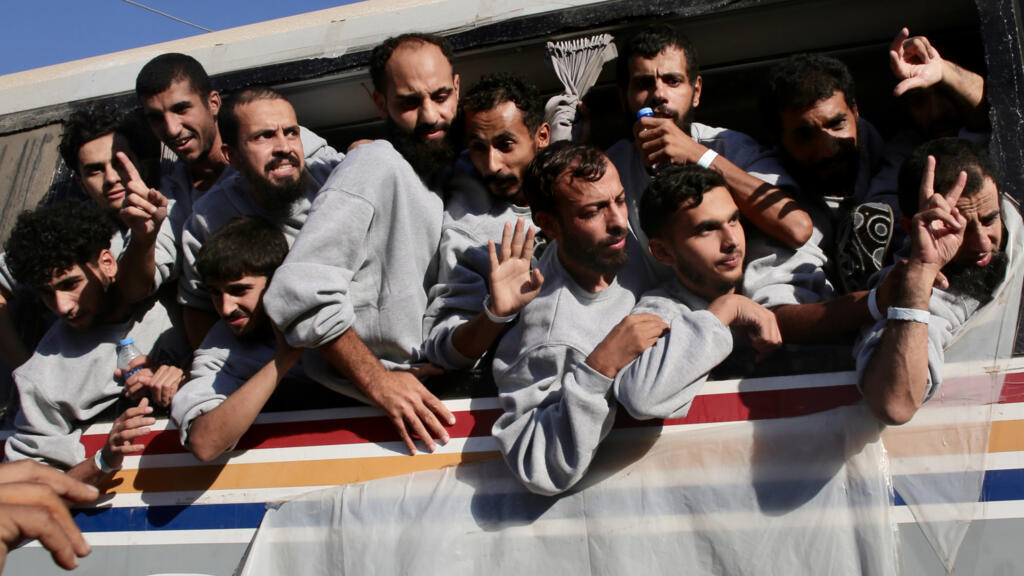
Some climbed the sides of the slowly-moving buses as they weaved their way through the dense crowds gathered at Nasser Hospital, to hug or kiss a loved one they recognised.
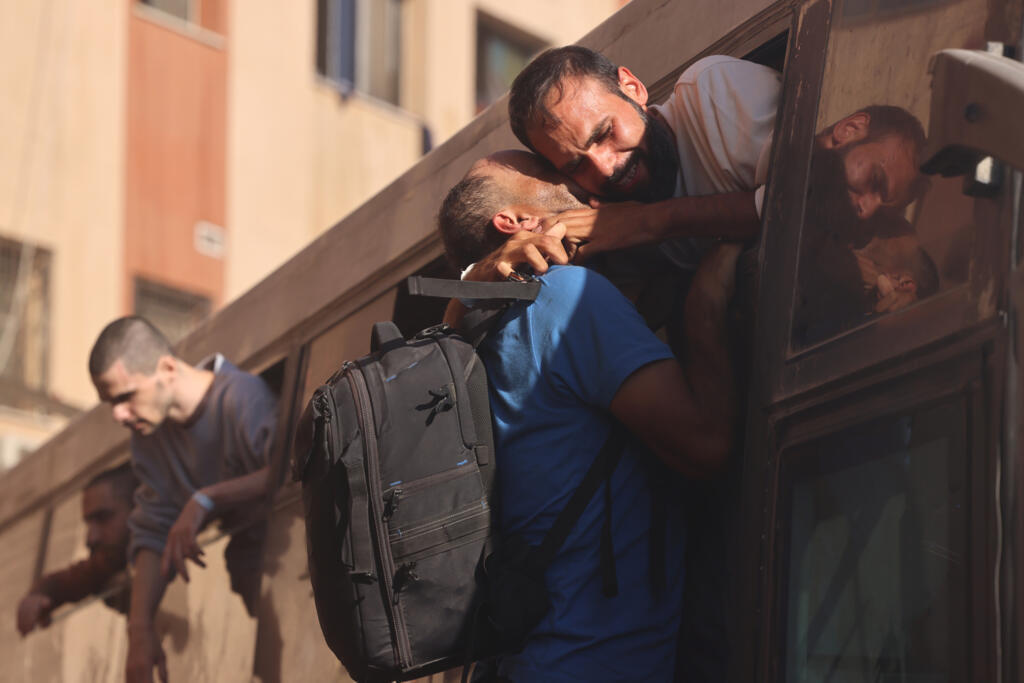
"The greatest joy is seeing my whole family gathered to welcome me," Yusef Afana, a 25-year-old released prisoner from north Gaza, told AFP.
"I spent 10 months in prison -- some of the hardest days I've ever lived. The pain in prison isn't only physical; it's pain in the soul," he said, adding, like many of his comrades, that he hoped for all other prisoners in Israeli jails to be released soon.
At Nasser Hospital, men in military fatigues and black balaclavas struggled to keep order as the prisoners wearing the Israel Prison Service's grey jumpsuits came off the buses.
Patriotic music blared on speakers, while Palestinian flags flew alongside those of Hamas or the Popular Front for the Liberation of Palestine.
'Erase those memories'
Shadi Abu Sidu, a 32-year-old from Gaza City's Rimal neighbourhood, alleged that he and other prisoners were mistreated in jail.
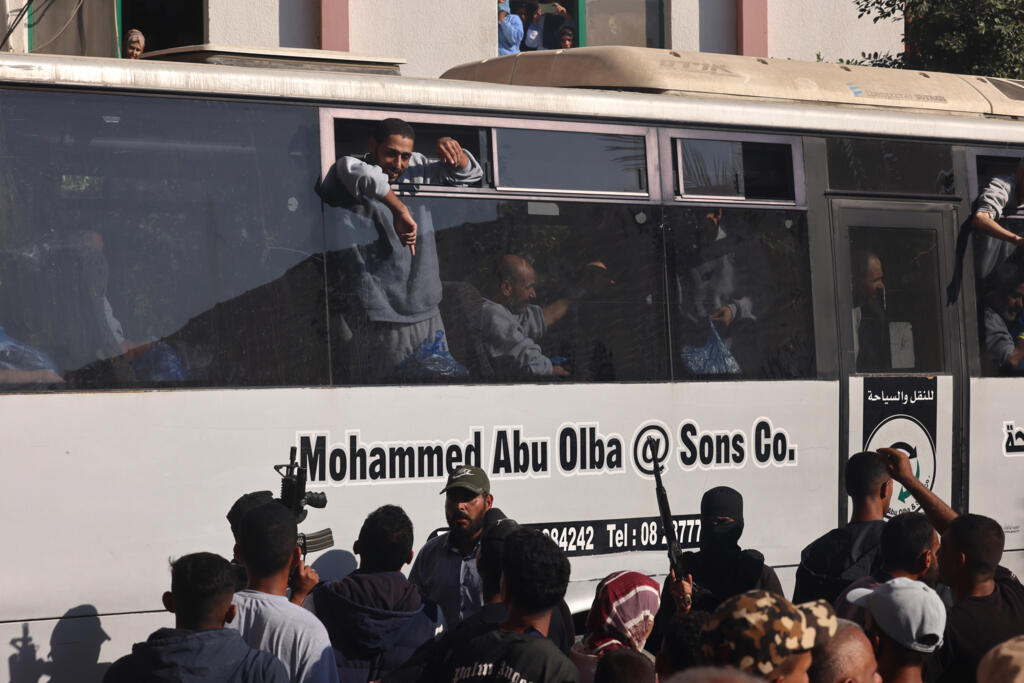
"Even right before our release, they continued to mistreat and humiliate us," he told AFP.
"But now, we hope to erase those painful memories and begin life anew."
Among the Palestinians released under a US-brokered Gaza ceasefire deal, about 1,700 were detained by the Israeli army in Gaza during the war, while 250 are security detainees, including many convicted of killing Israelis.
Israel agreed to free them in exchange for the release of hostages held in Gaza, under the first phase of US President Donald Trump's plan to end a war that was sparked by Hamas's unprecedented attack on Israel on October 7, 2023.
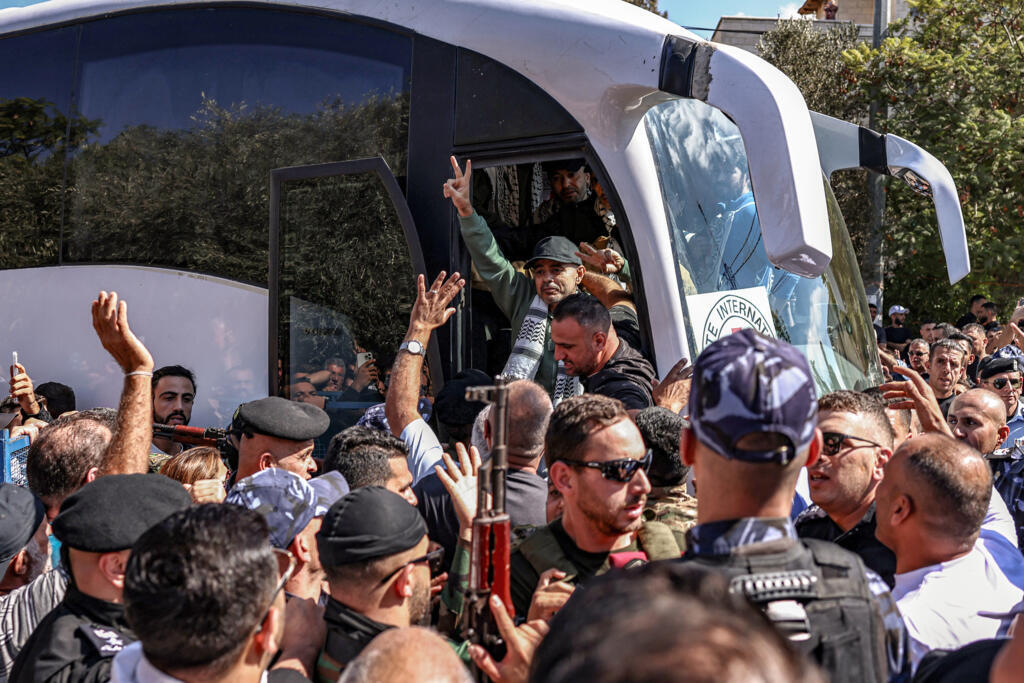
In the occupied West Bank city of Ramallah too, a large crowd had gathered to greet another group of roughly 100 prisoners released under the deal.
Some threw victory signs while others struggled to walk without assistance as they got off the bus and were met by a crowd cheering their return.
"It's an indescribable feeling, a new birth," Mahdi Ramadan told AFP, flanked by his parents with whom he said he would spend his first evening out of jail.
Nearby, relatives exchanged hugs, young men in tears pressed their foreheads against each other -- some even fainting from the emotion of seeing loved ones again after years, and sometimes decades, in jail.
'Beautiful moment'
Nour Soufan, now 27 years old, was due to meet his father Moussa, who was jailed a few months after his birth, outside of jail for the first time.
Soufan and half a dozen relatives came to Ramallah from Nablus, in the north of the West Bank, and spent the night in their vehicle.
"I have never seen my father, and this is the first time I will see him. This is a very beautiful moment," Soufan said.
Like him, many had defied the travel restrictions that punctuate daily life in the Palestinian territory, with Israeli army checkpoints proliferating in two years of war.
Palestinian media reported on Sunday that families of detainees had been contacted by Israeli authorities, asking them not to organise mass celebrations.
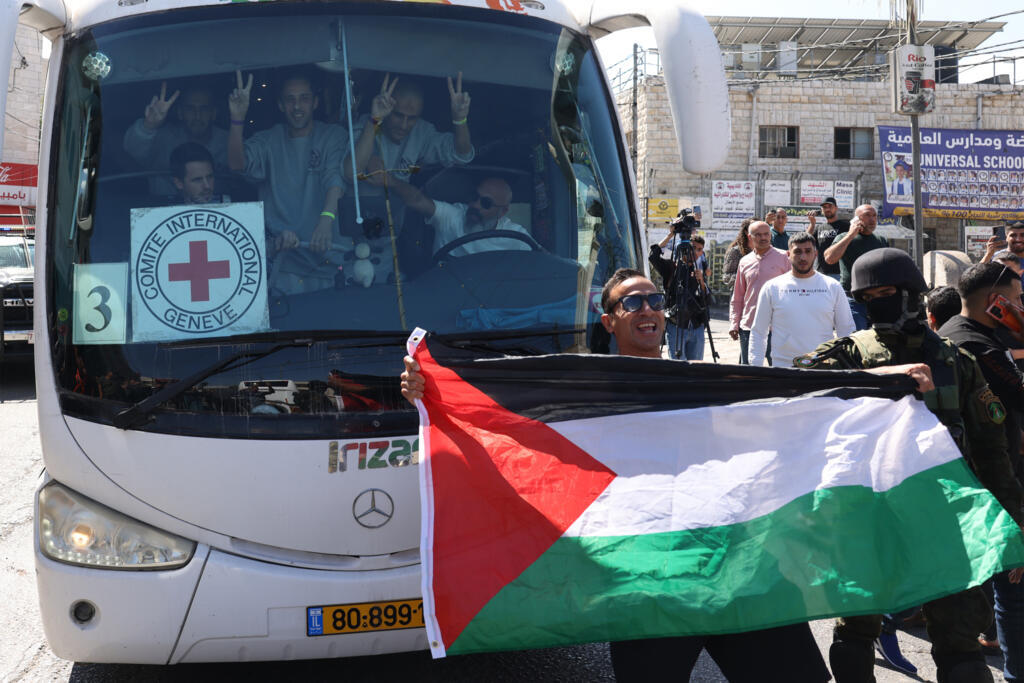
"No reception is allowed, no celebration is allowed, no gatherings," said Alaa Bani Odeh, who came from the northern town of Tammun to find his 20-year-old son who had been jailed for four years.
AFP spoke to several prisoners who said that in their first hours of freedom, they would go home and stay with family.
During previous releases, mass gatherings had flooded entire streets in Ramallah, with people waving Palestinian flags as well as those of political factions including Hamas.
'Live my life'
Many prisoners wore a black-and-white keffiyeh around their necks -- the traditional scarf that has become synonymous with the Palestinian cause.
Some of the newly released prisoners happily let themselves be carried away on relatives' shoulders.
"Prisoners live on hope... Coming home, to our land, is worth all the gold in the world," said one freed detainee, Samer al-Halabiyeh.
"God willing, peace will prevail, and the war on Gaza will stop," Halabiyeh added. "Now I just want to live my life."
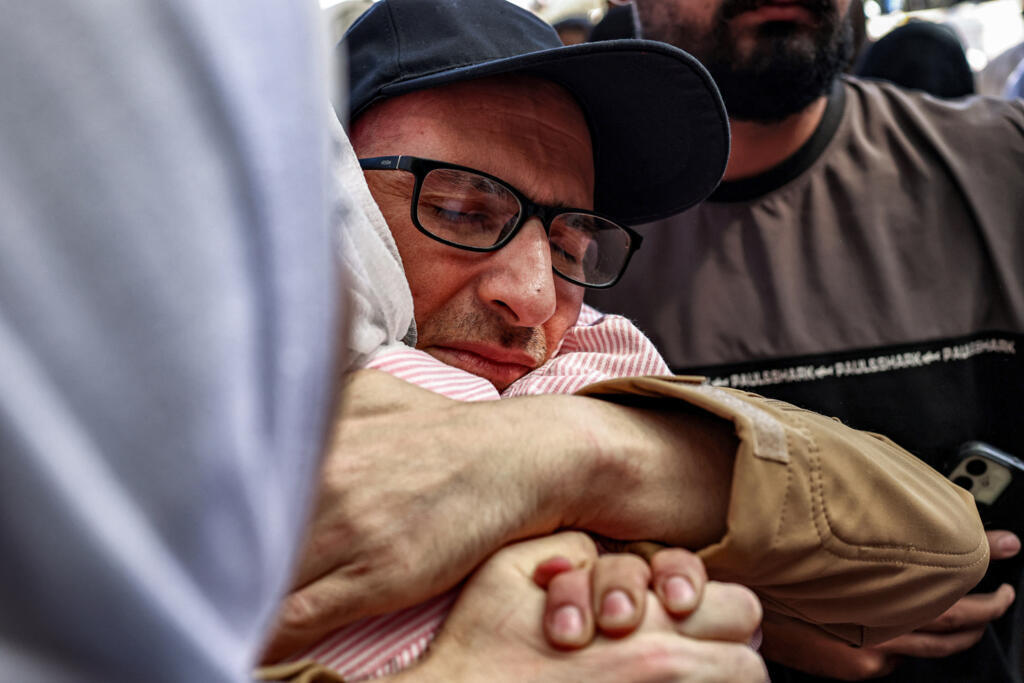
Journalists rushed to talk to the prisoners, but many declined to engage, sometimes explaining that, before their release, they were advised not to speak.
© 2025 AFP
Palestinian Civil Society Reacts to the Trump-Netanyahu Genocidal Plan

In response to the so-called Trump Plan, a scheme primarily designed by Israel’s fascist government to save it from its unprecedented global isolation, in the midst of the ongoing, livestreamed US-Israeli genocide against millions of Palestinians in Gaza, and recognizing the diversity of political positions among Palestinian parties, the Palestinian popular and civil society consensus on the following 5 fundamental points remains solid:
- Our rights are inherent, inviolable, and non-negotiable:The inalienable rights of the Indigenous Palestinian people are inherent and stipulated in international law.1 They cannot be extinguished, taken away, or redefined by any deranged genocidaire wanted by the International Criminal Court (ICC), any self-styled emperor who should in a fairer world be tried by the ICC, or any regional despot or authoritarian regime. Dismantling Israel’s regime of settler-colonalism, apartheid and illegal military occupation is a necessary condition for the Palestinian people to exercise our rights, including self-determination and the right of Palestinian refugees to return home and receive reparations.
The legendary resistance and resilience (sumud) of our people, especially in Gaza, but also in Jerusalem, Jenin, Akka, Haifa, and in refugee camps across historic Palestine and in exile, nourish our hope and boundless determination to safeguard our rights and bury all attempts to undermine them, as our ancestors have done for centuries against all colonial invaders. Palestinians are committed to ensuring that Israel and all complicit entities and individuals are held accountable for their role in the genocide and other crimes perpetrated against our people since the Nakba and throughout the ongoing Nakba. - The Israeli-US plan is coercive, colonial, and patently illegal:International “agreements” concluded by way of coercion are void (without legal validity or effect whatsoever).2 Moreover, this plan violates the UN Charter, as well as the inalienable right of the Palestinian people to self-determination and sovereignty,3 making it akin to the coercive rule imposed by European colonial powers over colonized peoples worldwide many decades ago. Even if implemented, any US-led administration in Gaza would rest on a legally invalid foundation, and its every action would be tainted by that illegitimacy and open to challenge under international law. The invalidity of the Trump plan will remain both a legal and moral basis for continued resistance and advocacy against any imposed authority in Gaza.The International Court of Justice ruled in July 2024 that Israel’s entire presence in the Occupied Palestinian Territory is unlawful, constitutes apartheid, and must be brought to an end. States have an urgent legal obligation to neither recognise nor support this illegal regime, to end their complicity with it, and to act to dismantle it, as subsequently affirmed by the UNGA Resolution on 19 Sep 2024, and as done to South Africa’s apartheid regime.
- International BDS pressure is working like never before and the era of lawful sanctions has begun:The internationally-wanted Israeli Prime Minister has recently admitted Israel’s unprecedented global isolation, so this Israeli-US plan must be understood as his desperate attempt to leverage all of Israel’s dominant influence in the US government to try to save genocidal Israel from this isolation. This isolation and the turning policy tides are also overwhelmingly due to the meaningful, persistent, principled and strategic solidarity of tens of millions worldwide–trade unions, students, farmers, artists, academics, as well as racial, economic, social, gender and climate justice movements. Our collective people power is fast reaching a tipping point in cutting complicity and ending Israel’s total impunity.States from Malaysia to Colombia, from Slovenia to Spain, and from Türkyie to Antigua and Barbuda, and many more are finally heeding their legal duty to end complicity by cutting military, energy, trade, or other ties with Israel’s genocidal regime. Companies and investors are increasingly dumping apartheid Israel or beginning to pay a heavy price for their ongoing criminal complicity, as the campaigns against Microsoft, McDonald’s, Coke and Carrefour, among many others, show. Trade unions and workers are waging general strikes in Italy, work stoppages in Ireland, mass protests against the transit of military cargo in Morocco, among others. “BDS and boycotts have changed Israel’s global trade landscape,” as a senior Israeli trade official has recently admitted. Hundreds of cultural institutions, dozens of universities, and tens of thousands of writers, musicians, visual artists, filmmakers, (including many in Hollywood), are ending complicity and cutting ties.Today, to count as decent, let alone progressive, one must support Palestinian liberation and fight complicity in Israel’s genocidal domination.
- What Palestinians want from the global solidarity movement:Even if a ceasefire is reached, the genocide, the famine, the repercussions of the annihilation of Gaza will not end. Solidarity is more needed than ever, and it begins with ending complicity, which is a moral and legal obligation. The Palestinian consensus asks of the global solidarity movement, particularly trade unions and mass movements, as well as people of conscience to:
- Respect and advocate for the comprehensive rights of the Palestinian people (at the very least the three rights listed in the historic BDS Call of 2005); and
- Isolate Israel’s regime of oppression by ending all state, corporate and institutional complicity with it.
- Urgent solidarity actions now to disrupt complicity: We reiterate the call issued by a consensus of Palestinian trade unions and the rest of civil society for peacefully disrupting complicity, as per the following:4
- Blocking, occupying or otherwise disrupting strategic highways, bridges, ports, and facilities of complicit weapons, tech, media, financial and other corporations;
- Mass protests and peaceful disruptive actions at government offices (ministries of trade, transport, or foreign affairs, for instance) orparliaments, demanding that they comply with their legal obligations under international law, including by:
- Imposing “a full arms embargo on Israel, halting all arms agreements, imports, exports and transfers, including of dual-use items,” as called for by dozens of UN human rights experts.
- Cancelling or suspending “economic relationships, trade agreements and academic relations with Israel that may contribute to its unlawful presence and apartheid regime in the occupied Palestinian territory.”
- Joining the The Hague Group, the most promising inter-state initiative so far that is aimed at promoting concrete sanctions and meaningful, consequential accountability measures, and endorsing and implementing their Bogotá Declaration.
- Expel apartheid Israel from the UN by withdrawing its accreditation to the UN General Assembly and pushing for lawful sanctions against it similar to those imposed on apartheid South Africa.
- Adapt immigration and visa policies aligned with international legal standards, including by ending visa-free agreements with Israel and implementing screening of suspected Israeli war criminals.
- Strikes, where feasible, andconscientious objection to complicity in genocide at institutions and workplaces, including universities, city councils, among others;5
Escalation of boycott campaigns against priority targets of the BDS movement — including peaceful disruption at stores and company offices, as well as social media actions; - Launch broad intersectional campaigns to compel institutions — including city councils, universities, trade unions, hospitals, etc. — to adopt ethical procurement and investment policies, where applicable, that exclude companies knowingly and persistently involved in grave human rights violations, particularly war crimes, crimes against humanity and genocide.
Together, we can and must disrupt all complicity in Israel’s “final solution” for the Indigenous people of Palestine. Together we can dismantle Israeli apartheid just as South African apartheid was dismantled. Anything less would be a failure of humanity. •
Signed:
- Palestinian General Federation of Trade Unions (PGFTU – Gaza)
- Council of National and Islamic Forces in Palestine
- Palestinian BDS National Committee (BNC)
- Global Palestine Right of Return Coalition
- General Union of Palestinian Workers
- Palestinian Federation of New Unions
- General Union of Palestinian Teachers (GUPT)
- Palestinian Federation of Unions of University Professors and Employees (PFUUPE)
- General Union of Palestinian Women
- General Union of Palestinian Writers
- Agriculture Engineers Association – Jerusalem Center
- Palestinian Union of Postal, IT & Telecommunications Workers
- Palestinian National Institute for NGOs
- Federation of Independent Trade Unions
- Veterinarians Syndicate – Jerusalem Center
- Occupied Palestine and Syrian Golan Heights Initiative (OPGAI)
- Union of Palestinian Farmers
- Grassroots Palestinian Anti-Apartheid Wall Campaign (STW)
- Palestinian Campaign for the Academic & Cultural Boycott of Israel (PACBI)
- Popular Struggle Coordination Committee (PSCC)
- Civic Coalition for the Defense of Palestinian Rights in Jerusalem
- Coalition for Jerusalem
- Union of Palestinian Charitable Organizations
- Women’s Campaign to Boycott Israeli Products
- National Committee for Grassroots Resistance
- Southern Electricity Company Employees Union
- Association of Employees of The Financial Sector, Palestine
- Health Services Employees’ Association
- Union of Workers in Kindergartens and Private Schools
- Jawwal Employee Association
- Union of Workers’ Unions in Local Authorities – Hebron
- Palestinian Electricians Union – Hebron
Endnotes
- Art. 1(2), 2(4), 55, UN Charter, Occupation, ICJ (Advisory Opinion), Art. 47, Fourth Geneva Convention; UNGA Declaration on Granting Independence, Res. 1514(XV); the rights to self determination and freedom from colonisation as customary rule of international law in Chagos Islands, ICJ (Advisory Opinion).
- International agreements procured by the threat or use of force contrary to the principles of international law are void. Pact of Paris; Vienna Convention on the Law of Treaties; Vienna Conference Declaration on the Prohibition of Military, Political, Economic Coercion in the Conclusion of Treaties; Fisheries Jurisdiction, ICJ (Judgement).
- See note 1.
- To minimize legal risks, we always call for consulting with movement lawyers first.
- Where a strike could cause significant harm to workers, “call in sick” instead – sick of Israel’s genocide and weaponized starvation and sick of your institution’s complicity in both.
The Palestinian BDS National Committee (BNC) is the largest coalition in Palestinian civil society. It leads and supports the global Boycott, Divestment and Sanctions movement. Visit their website and follow @BDSmovement.
Ceasefire Deal, But Not Peace Agreement: What Will Happen in Gaza After Hostages Are Released?
President Donald Trump says Israel and Hamas have agreed to the “first phase” of a U.S.-backed ceasefire deal for Gaza. The 20-point roadmap includes a swap of captives and a phased Israeli withdrawal from the Gaza Strip, though details on many of the planks remain sketchy. Democracy Now! spoke with Palestinian and Israeli analysts on how to interpret the peace plan.
“We’re now at a fork in the road,” says Mouin Rabbani, a Palestinian Middle East analyst. “While it’s very welcome, of course, that the genocide may be coming to an end … this is a renewed Oslo process with an even lower political ceiling.” He says there are calls around the globe for a “different paradigm … in which Israeli accountability for its actions replaces these meaningless, endless negotiations about nothing.”
Muhammad Shehada, a writer and analyst from Gaza, is critical of the deal, saying that “as soon as a ceasefire deal is signed, nobody bothers with the details. Gaza disappears, and it’s back to this slow, latent, invisible violence of starvation and engaging people in a permanent state of nonlife.”
Ori Goldberg, an Israeli political analyst and scholar, says that the deal was politically advantageous for Prime Minister Benjamin Netanyahu. “Netanyahu can now be the complete package,” says Goldberg. “Netanyahu was the fearless leader who fought the difficult, inevitable war, but he is now the fearless leader who brings the difficult, inevitable deal.”
Transcript
This is a rush transcript. Copy may not be in its final form.
AMY GOODMAN: This is Democracy Now!, democracynow.org. I’m Amy Goodman, with Nermeen Shaikh.
NERMEEN SHAIKH: To talk more about Hamas and Israel agreeing to the first phase of a ceasefire-hostage deal, we’re joined now by three guests.
Mouin Rabbani, Middle East analyst, co-editor of Jadaliyya and a nonresident fellow at the Center for Conflict and Humanitarian Studies, his latest piece is headlined “Key Points and Prospects of the Israeli-Palestinian Agreement.”
And Ori Goldberg is Israeli political analyst and scholar in Tel Aviv. He’s written extensively on Iran, Israel and the relationship between religion and politics in the Middle East.
AMY GOODMAN: But first we go to Copenhagen, where we’re joined by Muhammad Shehada, a writer and analyst from Gaza, visiting fellow at the European Council on Foreign Relations. His latest piece for +972 Magazine is headlined “Two years after October 7, Palestine has become a graveyard of failed strategies.”
We, though, are going to go first to Mouin Rabbani as we fix some connections.
Mouin, can you respond to this hostage-ceasefire deal? What do we know? What has been laid out? What hasn’t?
MOUIN RABBANI: Well, as you may recall, the Trump-Netanyahu proposal announced at the White House last week dealt with three sets of issues: the immediate ones, meaning an exchange of captives, Israeli withdrawal, humanitarian aid and the cessation of hostilities; then, postwar governance, basically Project Blair, putting him in charge as the viceroy of the Gaza Strip; and thirdly, but only very tangentially, political issues, the crisis that produced this crisis, if you will.
The agreement that was signed yesterday in Egypt deals exclusively with the first set of issues. So, Israel and the Palestinians have agreed on an exchange of captives. We don’t yet know the details of that, in terms of which Palestinians will be released from Israel’s prison system, and according to what schedule. There is a cessation of hostilities, and there’s a statement earlier today that Qatar and the United States have guaranteed that hostilities will not resume. I think those are relatively worthless commitments, because with Trump, you can’t trust a word he says about anything, and Qatar is, of course, not in a position to compel this. And in terms of the Israeli withdrawal, there is an agreed line of withdrawal, but that also hasn’t been clarified publicly. And some of these issues may, in fact, still be under discussion.
The additional issues, postwar governance and the political issues, were entirely ignored. And this is seen as an achievement by Hamas, which very much wanted an agreement on the first set of issues, but was essentially being asked to commit political suicide and to accept national capitulation on behalf of the Palestinians with the other aspects of it.
One point, I think we’re now at a fork in the road, a continuation of this process. While it’s very welcome, of course, that the genocide may be coming to an end and is at least now paused, this is a renewed Oslo process with an even lower political ceiling. And the key issue now is there is massive global momentum for a different paradigm, in which Palestinian rights, in which Israeli accountability for its actions replaces these meaningless, endless negotiations about nothing that result in nothing. And I think that momentum also helps explain why we have this agreement finally, one that the Biden administration systematically refused to implement, but that Trump was able to force Israel to accept with a single phone call. And maintaining and intensifying that momentum is absolutely essential to ensure that the genocide does not resume in full force, that ethnic cleansing remains off the agenda, and that the real political issues can finally be addressed in line with international law and Palestinian rights.
NERMEEN SHAIKH: So, we have Muhammad Shehada now. So, Muhammad, if you could respond to this deal and explain what you think made it possible now? What role did the Gulf states play? You were just in Istanbul. What role did Turkey play?
MUHAMMAD SHEHADA: Well, the main thing that explains it is that tomorrow is the day where the Nobel Prize Committee will announce the Nobel Peace Prize winner. So, that’s the main thing that comes to mind. Otherwise, the second thing is Qatar. After Israel bombed Doha so viciously, Qatar has been demanding a price from the Trump administration. And Trump’s security reassurances that he gave in this executive order are practically worth nothing.
So, you saw, basically, Qatar, the United Arab Emirates, Jordan, Egypt, Turkey and other Arab and Muslim countries meeting with Trump on the sidelines of the U.N. General Assembly and trying to create some momentum towards ending the genocide in Gaza. Trump wanted to end it on Israel’s own terms, which were catastrophic. There was an earlier draft of the deal that was somewhat reasonable. Then Netanyahu spent six hours with Jared Kushner and Steve Witkoff and manipulated it out of any meaning or substance and added to it this colonial aspect of the Trump-Blair Board of Peace.
But what you had is Hamas being advised by Qatar, Turkey and Egypt to deliver a response very carefully that said, “Yes, we agree to the withdrawal of the Israelis from Gaza. We agree to the release of Israeli captives and release of Palestinian captives and hostages. And yes, we agree to the end of the war. But the rest of Trump’s ideas will be delayed until a later point, because we do not have the mandate to negotiate all of all those things. It’s a Palestinian decision.” And it was a clever way of sort of, like, saying yes to the parts that are actually doable, and the parts that were so incredibly fantastical, to leave them at a later point that hopefully will never come.
AMY GOODMAN: Can you just explain for one moment what you mean about the announcement of the Nobel Peace Prize and what bearing that has on these negotiations?
MUHAMMAD SHEHADA: Yeah. So, basically, we’ve been told repeatedly over the last year that Trump’s eyes are the Nobel Peace Prize because Obama got one, so he was very determined to get one, as well, because of that, in particular. And it was one of his driving forces in decision-making, whether it is the trying to get an end to the war in Ukraine or trying to get a ceasefire deal in Gaza. The Nobel Committee is about to announce the winner of the Peace Prize tomorrow, around the middle of the day European time. So, in Israeli media, they’ve been very explicit for days that the only — or, the main reason why Netanyahu could not say no to Trump throughout this last week, or even a little bit before, from the U.N. General Assembly, is because he didn’t want to be seen as the one denying Trump the Nobel Peace Prize. And it’s ironic. It’s psychedelic and crazy, but it is basically one of the political motivations playing here.
NERMEEN SHAIKH: And, Mouin Rabbani, you mentioned earlier the question of the Palestinian prisoners who will be released in exchange for the Israeli hostages who remain in captivity in Gaza. Is there — you said, of course, those names have not been released. But is there any indication that either Marwan Barghouti or the general-secretary of the Popular Front for the Liberation of Palestine, Ahmad Sa’adat, will be among those released?
MOUIN RABBANI: Thus far, there isn’t. So far as I can tell, there’s no clarity that they will or will not be released. Clearly, they’re at the very top of Hamas’s list, and that would also allow it to present itself as acting in the Palestinian national interest, rather than only, let’s say, its factional interest. But, you know, Israeli media have reported that Israel is required to make very painful concessions in the context of this agreement. That may be an indication their names are on the list. But as yet, there is no confirmation about this one way or the other.
NERMEEN SHAIKH: And your response, Mouin, to those who say — I mean, you think, in the piece that you wrote overnight, after the deal was reached, that Hamas has not lost all its leverage by agreeing to release the Israeli hostages. Could you explain why you think that’s the case?
MOUIN RABBANI: Yes. I mean, the idea that retaining the Israeli captives was somehow Hamas’s only guarantee for ending the war is not really one I subscribe to. I think the captives serve as leverage only for the purpose of an exchange with Israel and obtaining the freedom of Palestinian captives in Israel’s prison system. Apart from that, they have primarily served as a pretext, as a pretext for genocide, and they most certainly haven’t served the purpose of defending either Hamas leaders or even a single Palestinian child from this unprecedented genocidal Israeli bombing campaign. And it may, in fact, be the case that releasing them in the context of an exchange and not having any more Israeli captives in the Gaza Strip could make it more difficult for Israel to resume its genocidal military campaign.
But again, you know, this is an agreement. It’s not a peace agreement. It’s a ceasefire agreement, and a partial one. And given Israel’s previous conduct, and even more importantly, U.S. indulgence for Israel’s conduct, the indulgence of the West as a whole, this is a situation where Israel, should it so choose — and it will so choose, I suspect — will find a method to abrogate this agreement and ensure it is only of a temporary nature.
AMY GOODMAN: Muhammad Shehada, your family is from Gaza. You are from Gaza. You’re now in Copenhagen. What have you heard from your family on the ground? And also, you’ve said that this deal was just signed — that was just being agreed on, is the clearest admission by Israel and the U.S. that they’ve deliberately been starving Gaza and that Israel’s been holding thousands of Gazans hostage without trial or charges. I mean, over time, over the decades, Israel has held more than a million Palestinians, detained them. And I think at this point — right? — it’s the highest number of Palestinians held at any one time in Israeli jails.
MUHAMMAD SHEHADA: Yes, absolutely, precisely. So, you have, basically, in the written agreement that Trump released, it said explicitly that in return for Hamas releasing the 20 Israeli living captives, that Israel would release 1,700 Palestinian captives that have been taken after October 7th from Gaza. What that means is that those are people that were not in the October 7th attack when it unfolded, that people that were rounded up — basically, every area that Israel invades in Gaza, they would take people at random, process them with racial profiling. Anyone that they think resembles sort of a religious person, they would take them, or anyone that is a doctor or a journalist or a nurse or an academic, they would take them to the Sde Teiman concentration camp, what Israel’s own B’Tselem, a human rights organization, referred to as a torture camp, and hold them there as a bargaining chip without visits by the Red Cross, without legal counsel, without charges, without trial.
So, I have a friend whose brother was taken this way, and he was only allowed to meet with a lawyer one time. And he’s been asking the Israelis, “Why am I here?” The same answer they gave him over and over and over again is that “You are here until a ceasefire deal is signed, and then you will be released.”
Trump, you heard him saying earlier this year that it only takes — it takes a very sick mind for someone to hold a dead body as a hostage. But little did he know that Israel has been holding hundreds of Palestinian dead bodies way before October 7th. One of them is Noura Erakat’s cousin, who was murdered by the Israelis at a checkpoint in the West Bank on his way to his sister’s wedding, on the day of his sister’s wedding. And Israel has been holding his body ever since. You had at least 250 Palestinian dead bodies that Israel was holding as a bargaining chip, and they collected hundreds more of bodies throughout the genocide that they are holding as what they call strategic assets to use as leverage in negotiations.
The other thing about the starvation is you had in the deal written explicitly that Israel would allow more aid to go into Gaza, which means that Israel had the capacity, the ability all along to allow way more aid to go into Gaza, but they had the clear will to not allow any of this in. We’ve seen it in the previous ceasefire. All the problems that Israel keeps citing as the reasons for the famine disappeared — the looting, the gang violence, the chaos. All of it disappeared, and food was coming in, 600 trucks per day. Now in this agreement, you will have 400 trucks coming through five border crossings, and then it will be scaled up to 600.
The last thing, about family and friends in Gaza, I’ve been calling people on the ground since the morning. There’s the — there’s the sentiment that — of they will believe it only when they see it. And even when they see it — because we’ve been here before multiple times, Amy, in November 2023 or in January this year, or I personally lived through 10 Israeli military operations, three wars and two ground invasions. Each of them ended with a ceasefire agreement where Israel would make promises about ending the siege, the draconian siege on Gaza, or at least reducing it, and as soon as a ceasefire deal is signed, nobody bothers with the details. Gaza disappears, and it’s back to this slow, latent, invisible violence of starvation and engaging people in a permanent state of nonlife. It is expected to be the exact same thing. I’ve been talking to people. They don’t feel anything positive about the declaration, until they see it materialize, and they know that there is a lot of devils in the details. They know Israel has a vested interest in sabotaging the deal throughout.
This morning, Israel even intensified the bombing way more than before. It’s like they are in a rush, in a hurry, to kill as many people as possible and destroy much of the urban space as much as possible. They’ve been detonating those robotic suicide vehicles since yesterday. They’ve been bombing Khan Younis, Deir al-Balah, Gaza City, Al-Sabra, Tel al-Hawa, al-Shati camp. I just saw footage where Israeli tanks are literally bombing people alive on television on the beach, the people that were trying to go back to their homes. One of our colleagues, Motasem Dalloul in Gaza, just lost his third son today, that was murdered by the IDF.
So, on the other side, you have people that are so exhausted, that are desperate for any glimmer of hope. I was just talking to a cousin in his late forties in Gaza City last week, and he looked exactly like my grandfather when he died when he was over 100 years old. He was skin and bone. You can literally see his eyes are sunken, his face is wrinkled and darkened. And those people are desperate for the slightest glimmer of hope. So, hopefully, they will get some good news soon.
NERMEEN SHAIKH: Well, let’s bring in Ori Goldberg. We were just sorting out some technical issues. Ori, if you could respond to the deal and tell us how people in Israel are responding? The hostages are expected to be released on Monday. Of course, there will be the living hostages and also the deceased ones.
ORI GOLDBERG: Well, the only issue that matters to the Israeli Jewish public at large is the fate of the hostages. They absolutely don’t care, in any way, shape or form, about the suffering or the plight of the Palestinians. And even the fate of the hostages is more a myth than it is a pressing national security issue.
Israel has resorted back to discourse that’s familiar to every Israeli postwar, and that is, mistakes were made, people are to blame, we will find them, we will force them to bear responsibility, and then we will rise from the ashes, as we always have, because that is what we do. We will rise. We will make Israel better. We will make it a more robust democracy. We owe it — we owe it to our children, and so forth and so forth. But so, even the issue of the hostages, which is, again, the only reason Israelis have called for an end to the, quote-unquote, “war,” is resonating very much in a human interest kind of way or in a “Finally, this nightmare is over. We can wake up and go back to reality.”
There are Israelis who — especially religious ones, who celebrate overtly the killing of Palestinians. And they, of course, are disappointed. They wanted a total victory. They wanted Hamas destroyed. But the great majority of Israelis enable the genocide and support the genocide by not talking about the genocide.
AMY GOODMAN: Ori Goldberg —
ORI GOLDBERG: It is a genocide by — yes.
AMY GOODMAN: You’re an Israeli political analyst. You’re a scholar based in Tel Aviv. What about Ben-Gvir and Smotrich not supporting the ceasefire, but not pulling out of the government, which would bring it down?
ORI GOLDBERG: Ben-Gvir and Smotrich are less powerful than they may appear from the outside. They’re both sectorial leaders, and there’s a real difference between them. Smotrich is an ideologue. He has an ideological movement behind him, the settlers and what is called religious Zionism, which is also the name of his party. Ben-Gvir is an old-fashioned populist, here to simply torch the place and cause as much mayhem and death and destruction as he can. Both would be lost without their membership in Netanyahu’s government. Both would lack for the executive power they prize so dearly, Smotrich in the West Bank, and Ben-Gvir over domestic security in everything from licenses for carrying weapons to not investigating or enforcing Israeli law on crime, which is rampant in Israeli-Palestinian society. They are not leaders meant for the opposition. They are meant for power, and they know it. And they will find excuses. Perhaps Smotrich will leave. But it’s more likely that they will explain to their base that it’s better that they’re on the inside to prevent even worse decisions from being made.
But I think perhaps it’s more important to talk about Netanyahu himself and why this deal is good for him, not bad for him, because Netanyahu can now be the complete package. Netanyahu was the fearless leader who fought the difficult, inevitable war, but he is now the fearless leader who brings the difficult, inevitable deal. And he is the grown-up in the room. Smotrich and Ben-Gvir are the adolescents. You know, they do whatever they want. They’re juvenile. They have no responsibility. Netanyahu knows what’s what. And he was able to bring the hostages back. And should a snap election be called in Israel over the next six months — there’s very good chance that it will — that makes Netanyahu perhaps the most favored candidate to win the prime ministership again.
NERMEEN SHAIKH: And, Ori, if you could respond to what our guests earlier were saying, some understandable skepticism about whether Israel will abide by the agreement, and if so, to what extent?
ORI GOLDBERG: Skepticism is well founded. If I was a Palestinian, I wouldn’t trust an official Israeli farther than I could throw him.
But I think we need to take into consideration the fact that, certainly over the past two months, Israel’s international stature and Israel’s absolute impunity have taken real hits. Israel is not as strong as it was even two months ago. And the notion that Israel always dictates the pace of events, that was the grand prize for which Netanyahu fought. He wanted to demonstrate that Israel can do whatever it wants to whomever it wants, wherever it wants. That is not the case anymore. Despite the reluctance, despite the alliances, the criminal alliances between Israel and global leaders, Israel simply cannot have its way every time. And that, in and of itself, I think, is grounds enough to assume that the situation now is different.
Add to that the fact that the Israeli public considers itself to have undergone the very difficult two years, sees itself as unrightfully victimized by its own government and by every global leader out there, an Israeli public that just wants to get back to normal, which means to repress the fact of the occupation and to return to life as a Jewish and democratic state, effectively an ethnocracy built on Jewish supremacy.
Netanyahu knows this. He knows this very well. Netanyahu is not an aberration. He’s not an anomaly. He’s the quintessential Israeli prime minister. That’s why he keeps winning, not because he’s a magician who pulls cards out of his sleeve, because he knows this, this is what Israelis approve of. And consistent polling shows that he’s right. While Israelis may have protested his government, while certain sectors of Israeli society did not see themselves aligned with his ministers, the great majority of Israeli Jews supported his government’s policies in Gaza. That is not something that can be wished away. That is still true. His would-be competitors, his would-be heirs from the opposition have never said anything that differed significantly from the genocidal policies we’ve seen for the past two years in Gaza. Netanyahu knows this, and he is using this, as any savvy politician would, to situate himself for further battles.
NERMEEN SHAIKH: So, Ori, you said that this signals basically the end of Israeli impunity on the global stage. Do you think that applies to the U.S., as well?
ORI GOLDBERG: I do, because I don’t think Trump is beholden to Israel even remotely — even as remotely when you consider the way Joe Biden was beholden to Israel. I think the American political map is changing. I think public opinion in the United States is changing. I think it’s become very much almost basic principle that America should not be forced to fund foreign wars, especially foreign wars that turn into genocides. I think Trump is hearing that incessantly from his own base. I think Trump is under pressure from that base, not because of the genocide, but because of the Epstein files and because of his behavior within, you know, American politics, because of the government shutdown. I think all of these political interests are converging.
And that is why I am, you know, cautiously optimistic about the potential of this deal, because this isn’t about the Palestinians. None of the major players here care about the Palestinians, except for the people who represent the Palestinians. None of them care about the Palestinians. Everybody has something to gain from this deal, that has to do with their political future, their political survival. And at this time, after two years, when the world ignored the Israeli genocide, perhaps the only thing that can start a process in motion is when the stars align and political interests converge.
AMY GOODMAN: Finally, Ori, if you can talk about the significance of, apparently, President Trump going to Israel, Netanyahu inviting him to address the Knesset, the Israeli parliament, as early as Sunday?
ORI GOLDBERG: All that is political pageantry. We’re used to it in Israel. Having an American president address the Knesset usually is something that goes with the signing of a peace treaty. We have to keep in mind, of course, obviously, as your other guests have said, that this is not a peace treaty. There’s no peace after a genocide. This perhaps, perhaps, signals the end of the beginning. It’s a ceasefire. It is a cessation of death and, hopefully, a cessation of a massacre. And the fact that Trump claims this is his privilege, perhaps that would be a consolation prize when he’s not awarded the Nobel Peace Prize in Oslo.
AMY GOODMAN: Ori Goldberg, we want to thank you for being with us, Israeli political analyst and scholar outside Tel Aviv in Herzliya. We also want to thank Muhammad Shehada, a writer and analyst from Gaza, visiting fellow at the European Council on Foreign Relations, and, finally, Mouin Rabbani, Middle East analyst, co-editor of Jadaliyya, a nonresident fellow at the Center for Conflict and Humanitarian Studies.
Coming up, we go to Paris, where one of the hundreds of Global Sumud Flotilla activists who were abducted by Israel on the high seas and detained is now. We’ll speak with Progressive International’s David Adler and hear comments from Mandla Mandela, the former South African MP and grandson of Nelson Mandela, both just released.
A History of Deception: US-Israeli Pacts and the Gaza Proposal
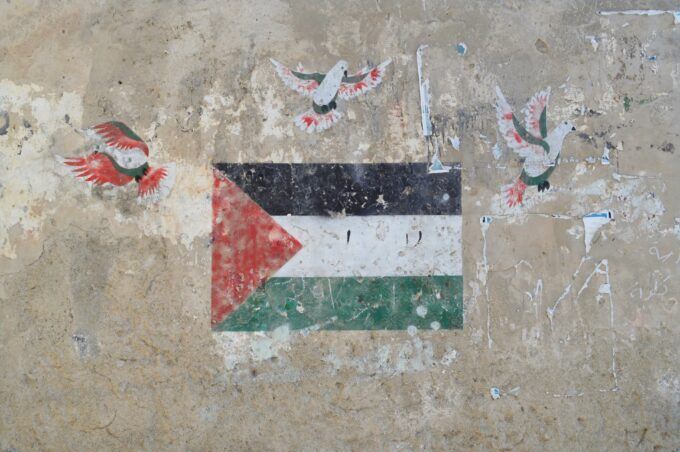
Image by Ash Hayes.
The history of Zionism is fundamentally one of deception. This assertion is critically relevant today, as it contextualizes the so-called ‘Trump Gaza proposal,’ which appears to be little more than a veiled strategy to defeat the Palestinians and facilitate the ethnic cleansing of a significant portion of Gaza’s population.
Since the start of the current conflict, the United States has been Israel’s staunchest ally, going as far as framing the outright slaughter of Palestinian civilians as Israel’s “right to defend itself.” This position is defined by the wholesale criminalization of all Palestinians—civilians and combatants, women, children, and men alike.
Any naive hope that the Trump administration might restrain Israel proved unfounded. Both the Democratic administration of Joe Biden and the Republican administration of his successor have been enthusiastic partners in Israeli Prime Minister Benjamin Netanyahu’s messianic mission. The difference has been primarily rhetorical. While Biden wraps his staunch support in liberal discourse, Trump is more direct, using the language of overt threats.
Both administrations pursued strategies to hand Netanyahu a victory, even when his war failed to achieve its strategic objectives. Biden used his Secretary of State, Antony Blinken, as an emissary to broker a ceasefire fully tailored to Israeli priorities. Similarly, Trump utilized his son-in-law, Jared Kushner, and former British Prime Minister Tony Blair, among others, to concoct a parallel ploy.
Netanyahu deftly exploited both administrations. The Trump era, however, saw the US lobby and Israel seemingly dictating American foreign policy. A clear sign of this dynamic was the famous scene last April, during Netanyahu’s White House visit, when the ‘America First’ President pulled out a chair for him. The summoning of Blair, who once headed the US-controlled Quartet for Peace, to the White House alongside Kushner in August, was another foreboding signal. It was evident that Israel and the US were planning a much larger scheme: one not only to crush Gaza but to prevent any attempt at resurrecting the Palestinian cause altogether.
While ten countries were declaring recognition of the state of Palestine to applause at the UN General Assembly between September 21 and 23, the US and Israel were preparing to reveal their grand strategy, with critical contributions from Ron Dermer, then Israel’s Minister of Strategic Affairs.
The Trump Gaza proposal was announced on September 29. Almost immediately, several countries, including strong supporters of Palestine, declared their backing. This support was given without realizing that the latest iteration of the plan was substantially altered from what had been discussed between Trump and representatives of the Arab and Muslim world in New York on September 24.
Trump announced that the proposal was accepted by Israel and threatened Hamas that, if it does not accept it within “three or four days”, then “ it’s going to be a very sad end.” Still, UN Secretary-General Antonio Guterres, who, along with the UN, has largely failed to hold Israel accountable, declared his support for the Trump proposal, stating that “it is now crucial that all parties commit to an agreement and its implementation.”
Netanyahu felt a newfound elation, believing the weight of international pressure was finally lifting, and the onus was shifting to the Palestinians. He reportedly said that “now the whole world, including the Arab and Muslim world, is pressuring Hamas to accept the conditions.” Comfortable that the pendulum had swung in his favor, he openly restated his objectives in Gaza on September 30: “To release all our hostages, both the living and the deceased, while the IDF remains in most of the Strip.” Even when Arab and Muslim nations protested the amendments to the initial Trump plan, neither Netanyahu nor Trump relented, the former continuing the massacres, while the latter repeating his threats.
The implication is stark: regardless of the Palestinian position, Israel will continue to push for the ethnic cleansing of the Strip using both military and non-military means. The plan envisions Gaza and the West Bank being administered as two separate entities, with the Strip falling under the direct control of Trump’s so-called “Board of Peace”, thus effectively turning Blair and Kushner into the new colonial rulers of Palestine.
History is most critical here, particularly the history of Israeli deception. From its onset, Zionist colonialism justified its rule over Palestine based on a series of fabrications: that European settlers held essential historical links to the land; the erroneous claim that Palestine was a “land without a people”; the assertion that indigenous natives were intruders; and the stereotype that Arabs are inherently anti-Semitic. Consequently, the state of Israel, built on ethnically cleansed Palestinian land, was falsely marketed as a ‘beacon’ of peace and democracy.
This web of falsehoods deepened and became more accentuated after every massacre and war. When Israel faltered in managing its military efforts or its propaganda war, the United States invariably intervened. A prime example is the Israeli invasion of Lebanon in 1982, where a ‘peace deal’ was imposed on the PLO under US pressure. Thanks to US envoy Philip Habib’s efforts, Palestinian fighters left Beirut for exile, on the understanding that this step would spare thousands of civilian lives. Tragically, the opposite occurred, directly paving the way for the Sabra and Shatila massacre and a prolonged Israeli occupation of Lebanon until 2000.
This historical pattern is repeating itself in Gaza today, though the options are now more stark. Palestinians face a choice between the guaranteed defeat of Gaza — accompanied by a non-guaranteed, temporary slowdown of the genocide — and the continuation of mass slaughter. Unlike the Israeli deception in Lebanon four decades ago, however, Netanyahu makes no effort to mask his vile intentions this time. Will the world allow him to get away with this deception and genocide?
Brazil: The Global Sumud Flotilla set an example of courage! We will continue to denounce the genocide in Palestine!
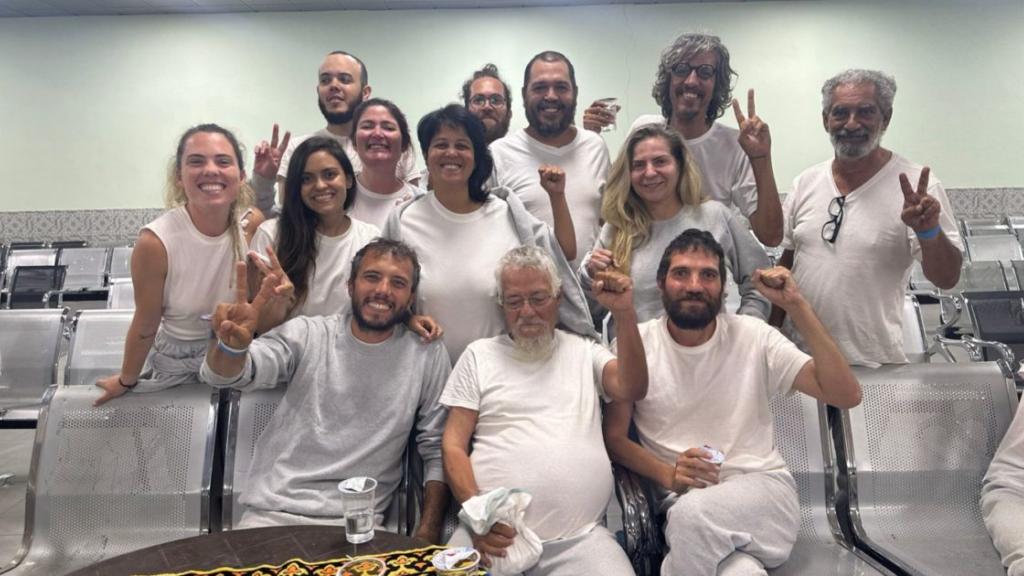
First published at Revista Movimento.
We have just received photos of the Brazilian delegation in the Flotilla, with clenched fists, newly arrived in Jordan and preparing their return. And even though dozens of delegations have already left the dungeons of the genocidal state between yesterday and today, six activists of multiple nationalities remain imprisoned.
Yesterday we welcomed the first member of the Brazilian delegation, Nico Calabrese, an Argentine with an Italian passport and a member of Rede Emancipa, at a combative event at Galeão airport. Nico, along with Campinas councilwoman Mariana Conti and PSOL (Socialism and Liberty Party) Rio Grande do Sul president Gabi Tolotti, are members of MES (Socialist Left Movement) and part of the Brazilian delegation that set an example of struggle, maintaining morale in prison despite the taunts of fascists like Ben Gvir and the mistreatment they were subjected to. MES as a whole highlights the importance and strength of these comrades and so many others in our country’s delegation.
Thiago Ávila and Greta Thunberg led the mission, symbolizing this struggle for the whole world. Greta’s speech yesterday was a manifesto of resistance, worthy of a giant: “We are not heroes, we are here to support the Palestinian people.” And it’s true.
Also present were activists from around the world, members of the European left, South African Mandla Mandela, grandson of the historic leader; Portuguese Left Bloc MP Mariana Mortágua, as well as Argentine MP Celeste Fierro, from the MST (Socialist Workers' Movement) and FITU (Left and Workers' Front-Unity).
The Flotilla was a very important humanitarian and internationalist mission, celebrated with festivities by Palestinian children and fishermen, as we saw in the beautiful images that moved us in recent weeks. It was a catalyst that boosted solidarity with the Palestinian people, a strong point of support amid strikes and mass demonstrations in many European countries (with Italy at the forefront), but also in countries in Asia, Africa, and Oceania. It was an important battle that gathered more strength and determination in the face of the ongoing massacre in Gaza.
And on this date, two years after October 7, peace negotiations are dragging on due to the policy of Netanyahu and Trump, which is to seek a “peace of the graveyards” or a peace of the colonizers. Their proposed agreement was, in fact, an ultimatum to the Palestinian people, worn down by military defeat imposed through genocide.
The resistance of the Palestinian people is incredible. The demoralization of the state of Israel has reached extremely high levels, even in the imperialist countries that most support it, such as the United States and England.
The demonstrations will continue. In Brazil, solidarity with the Flotilla led to significant pressure on the Foreign Ministry and the Lula government, which, albeit belatedly, ended up denouncing the policy of the genocidal state.
The struggle in defense of Palestine will continue to be the dividing line of humanity. The activists returning to Brazil become committed references — such as Greta and Thiago — to continue denouncing the Palestinian holocaust. The families and the impressive support network that has been set up do justice to the bravery of those who spent more than thirty days sailing and almost a week detained in Israeli dungeons.
We hold back our cries, wave our flags more strongly, and feel proud of our people and the members of the Flotilla who broke through the siege and inertia, setting an example of a new internationalism, alive and active, that is just beginning.
Long live the resistance around the world in defense of Palestine! We celebrate the release of our people, but there will only be freedom when Palestine is free. Humanity will only be free when the Palestinians have the right to their land.
We also acknowledge the efforts of all the other members of the Brazilian delegation. Free Palestine from the River to the Sea!
Luizianne Lins – Teacher, federal deputy for the PT (Workers' Party) Ceará and twice mayor of Fortaleza;
Mohamad El Kadri – Brazilian, son of Lebanese immigrants, president of the Latin American-Palestinian Forum, coordinator of the Palestinian Front of São Paulo, and PT activist;
Bruno Gilga Rocha – USP (University of Sao Paulo) worker, active in the University Workers’ Union, MRT activist, and part of the Brazilian coordination of the Global Sumud Flotilla;
Magno Carvalho – Activist with the USP Workers’ Union and CSP-Conlutas. Veteran of international solidarity initiatives with the Palestinian people;
Lucas Farias Gusmão – Activist and internationalist from Bahia;
João Aguiar – Activist with the Global Movement for Gaza and the Palestine Nucleus of the PT/SP;
Ariadne Telles – Human rights lawyer from the Amazon and activist for the Bem Viver Movement;
Lisiane Proença – Popular communicator, traveler, and cultural agitator;
Victor Nascimento Peixoto – Professor and researcher of Islamic history. Activist and popular communicator;
Miguel Viveiros de Castro – One of the founders of the Indymedia Brazil network and the Calafou Cooperative in Catalonia (Spain). He directed the documentaries “Brad, uma noite mais nas barricadas” (Brad, one more night on the barricades) and “Mundurukania, na beira da história” (Mundurukania, on the edge of history).
A Bitter Account, Two Years into the Catastrophe
An account of two years of genocidal war and its potential outcome.
Wednesday 8 October 2025, by Gilbert Achcar
Despite Israel’s strenuous attempts to commemorate the tragic events of 7 October 2023, and the overwhelming Western sympathy it received in the wake of Operation Al-Aqsa Flood, what dominates the global conscience today – two years after the operation – is primarily the far greater tragedy that the Zionist state has since inflicted on the people of Gaza and Palestine.
The recognition that Israel’s actions over the past two years constitute genocide is now widely accepted by experts and ordinary people in Western countries traditionally supportive of Israel. A recent poll shows that nearly 40% of American Jews themselves acknowledge that “Israel has committed genocide” (an additional 10% remain undecided). Today, only a minority in Western countries – along with governments and organizations that remain pro-Israel – deny the reality of this genocide. Every genocide, of course, has its deniers, as seen with the Armenian genocide or the Holocaust.
That the horror of the Zionist army’s genocidal war has generated over time intense global condemnation and growing sympathy for the people of Gaza offers little solace however, compared to the magnitude of the ongoing catastrophe. Worse still, the “peaceful settlement” on the horizon threatens to be far worse than the already disastrous framework established by the 1993 Oslo Accords.
Two years ago, it was easy to predict the catastrophe that would unfold for Gaza (see “Al-Aqsa Flood Risks to Sweep Gaza Away”, Al-Quds al-Arabi, 10 October 2023, in Arabic). Hezbollah’s 2006 operation – crossing the southern border of Lebanon, killing three Israeli soldiers and kidnapping two others – led to a devastating Israeli attack on the party’s civilian strongholds, including Beirut’s southern suburbs, known as Dahiya. Hassan Nasrallah later admitted that had he known the consequences, he would not have ordered the operation. Given the far greater scale of the Hamas-led operation across Gaza’s border on 7 October 2023 – resulting in the deaths of 1,200 and the kidnapping of over 250 on the Israeli side – it was clear that a much greater tragedy would follow.
This is not to mention the fact that the Zionist government at the time, and one that continues to this day, is the most extremist in Israel’s history. Thus, the planners of Operation Al-Aqsa Flood could not say, “If I had known”, as Hezbollah’s leader did (see “The Madness of Zionist Violence from the Dahiya to Gaza”, Al-Quds al-Arabi, 7 November 2023, in Arabic). Indeed, when a few months ago a member of Hamas’s political leadership attempted to express some regret over what had happened, the military wing quickly refuted his statement (see “Mousa Abu Marzook’s ‘If I Had Known’”, Al-Quds al-Arabi, 25 February 2025, in Arabic).
The leaders of Hamas’s military wing, and those within the political wing who share their viewpoint, have consistently maintained that their strategy was justified, despite the catastrophic outcome (see “On the Logic of Hamas’s Maximalist Wing”, Al-Quds al-Arabi, 20 May 2025, in Arabic). Eight months ago, they were still claiming victory as a result of the 7 October operation (see “Hamas: ‘We Are the Flood... We Are the Day After’”, Al-Quds al-Arabi, 11 February 2025, in Arabic). Let us measure this claim of victory in the light of the outcome and consider Hamas’s statement on the plan recently announced by Donald Trump, which was drafted by his son-in-law, Jared Kushner, and the infamous former British Prime Minister, Tony Blair (see an initial comment on the plan in last week’s article).
In its statement issued last Friday, Hamas asserts that it has adopted a “responsible position” toward the U.S. plan and is ready to contribute to a “comprehensive Palestinian national framework” (with the Ramallah Palestinian Authority, that is) “with full responsibility” – as if it wanted to acknowledge that its previous positions were less “responsible”. The statement declares that the movement “appreciates... the efforts of US President Donald Trump, calling for an end to the war on the Gaza Strip, an exchange of prisoners, the immediate entry of aid, the rejection of the occupation of the Strip and the displacement of our Palestinian people from it”. This, despite the fact that Trump, who has proudly boasted about being the most pro-Israel president in U.S. history and has previously approved Israel’s annexation of Arab Jerusalem and the Syrian Golan Heights, is the same person who allowed the Netanyahu government to openly state its intention to displace Gaza’s residents (claiming, of course, to be merely talking about “voluntary” migration, a point reiterated by the latest plan) and transform the Strip into a “Riviera” under U.S. ownership.
The new plan stipulates that Trump himself will chair a quasi-colonial “Board of Peace”, with Tony Blair among its members, that will oversee the “technocratic, apolitical Palestinian committee” in charge of governing Gaza, with the aim of implementing the “Trump Economic Development Plan” (sic). No doubt that, in the U.S. president’s mind, this latter plan is about turning the Strip into a U.S.-controlled “Riviera”. As for “rejection of the occupation of the Strip”, the plan asserts indeed that “Israel will not occupy or annex Gaza”, but it fails to set a timeline for the withdrawal of Israel’s armed forces, rather submitting it to conditions that are quite difficult to achieve. Moreover, the plan allows Israel to remain in control of a “security perimeter” along the Gaza’s borders, including the border with Egypt (the Philadelphi Corridor), for as long as it deems necessary.
The intention here, to be sure, is not to claim that Hamas should have fought on until the last Gazan. Rather, the argument is that the movement could have secured a better outcome and spared Gaza further devastation, had it adopted a more “responsible” approach from the outset. This opportunity remained valid even in recent months (see “Pity the people of Gaza!”, Al-Quds al-Arabi, 3 June 2025), as it became clear that the ceasefire declared earlier this year was only a temporary pause, allowing the Zionist army to regroup and prepare for a new phase of invasion. Meanwhile, Israel deliberately organized the starvation of the people of Gaza in cooperation with the administration of Donald Trump, whose efforts Hamas now “appreciates”.
Hamas has found itself cornered by the Zionist army’s resumption of the genocide, alongside mounting pressure from Arab and Muslim states that have aligned with the Trump administration. The movement thus faced a difficult dilemma: either it rejected the U.S. plan and proclaimed it determination to continue fighting, thereby assuming further responsibility for the ongoing catastrophe in Gaza and exposing itself to the loss of funding from Arab and Muslim sponsors; or it surrendered, which appears to be its current course. Hamas has now offered to give up the last remaining card in its hand by releasing all hostages it detains in exchange for Israel’s release of 250 Palestinian prisoners and the return of 1700 Gazans the Zionist army has taken as hostages over the past two years.
Much like Netanyahu accepted Trump’s initial plan five years ago – knowing that the Palestinians would reject it – he now embraces the new plan. His main objective is the release of the hostages, after which he would be much freer to maintain his grip on Gaza. He knows very well that the terms of the U.S. plan are designed to be so unequal and humiliating that they are likely to be rejected by most Palestinians, possibly including the Ramallah Authority itself.
7 October 2025
Translated from the Arabic original published in Al-Quds al-Arabi for the author’s blog.
Attached documentsa-bitter-account-two-years-into-the-catastrophe_a9208.pdf (PDF - 911.1 KiB)
Extraction PDF [->article9208]
Gilbert Achcar grew up in Lebanon. He is currently Professor of Development Studies and International Relations at the School of Oriental and African Studies (SOAS) in London. A regular and historical contributor to the press of the Fourth International, his books include The Clash of Barbarisms. The Making of the New World Disorder (2006), The Arabs and the Holocaust: The Arab-Israeli War of Narratives (2012), The People Want: A Radical Exploration of the Arab Uprising (2022). His most recent books are The New Cold War: The United States, Russia and China, from Kosovo to Ukraine (2023) and the collection of articles Israel’s War on Gaza (2023). His next book, Gaza, A Genocide Foretold, will come out in 2025. He is a member of AntiCapitalist Resistance in Britain.
International Viewpoint is published under the responsibility of the Bureau of the Fourth International. Signed articles do not necessarily reflect editorial policy. Articles can be reprinted with acknowledgement, and a live link if possible.
FULL TALK | Norman Finkelstein at UMass: Gaza, Truth & the Battle for Free Speech
Media Education Foundation
Oct 8, 2025 UNIVERSITY OF MASSACHUSETTS AMHERST
On September 24, 2025, acclaimed scholar and author Norman Finkelstein delivered a powerful and defiant address at the University of Massachusetts, Amherst. Speaking before a packed audience, Finkelstein tackled Israel's ongoing mass killing of Palestinian civilians in Gaza; the long history of Israel’s brutal occupation, siege, and successive wars and atrocities in the strip; the bipartisan complicity of U.S. political leaders, corporate media, and global institutions; the mounting McCarthyite crackdown on free speech, dissent, and academic freedom in the U.S.; and the need for a resurgent movement led by young people to reclaim free speech and renew democracy.

No comments:
Post a Comment