World Nuclear News
Regulator approves OPG to operate new waste facility
Canada's nuclear regulator has authorised Ontario Power Generation to begin operating a new building, which will store used steam generators, at its Western Waste Management Facility.
_78138.jpg)
The Canadian Nuclear Safety Commission (CNSC) said the commissioning report on Ontario Power Generation's (OPG) new Multi-Purpose Storage Building at the Western Waste Management Facility confirms that the building meets design specifications and is fit for purpose.
OPG is the licensee of the Western Waste Management Facility, which handles low- and intermediate-level waste from the Darlington, Pickering, and Bruce Power nuclear stations, as well as storing all the used fuel from Bruce Power's operations. The new MPSB is a steel-framed structure that will store 64 steam generators from Bruce Power’s Major Component Replacement project.
"The Commission accepts OPG's Commissioning Report for the Multi-Purpose Storage Building (MPSB) at the WWMF," the regulator said in a Commission Decision signed by CNSC President Pierre Tremblay on 9 October. "OPG is authorised to begin the operation of the MPSB."
The review did not require a public hearing under the Nuclear Safety and Control Act as no licensing decision was involved, the CNSC said.
Bruce Power's Major Component Replacement - or MCR - began in 2020 and will see the refurbishment of Bruce units 3-8, including the replacement of key reactor components including steam generators, pressure tubes, calandria tubes and feeder tubes. It will add about 30-35 years of operational life for each unit. The first unit to undergo the process, Bruce unit 6, returned to commercial service in September 2024 after the completion of its MCR ahead of time and on budget. Units 3 and 4 are currently undergoing their MCR outages, and will be followed by units 5, 7 and 8 in overlapping MCR outages until 2033.
OPG is currently refurbishing four Candu units at its Darlington site with completion expected in 2026, and is planning to begin the refurbishment of Pickering units 5-8.
Fuel supply contracts signed for Sizewell C
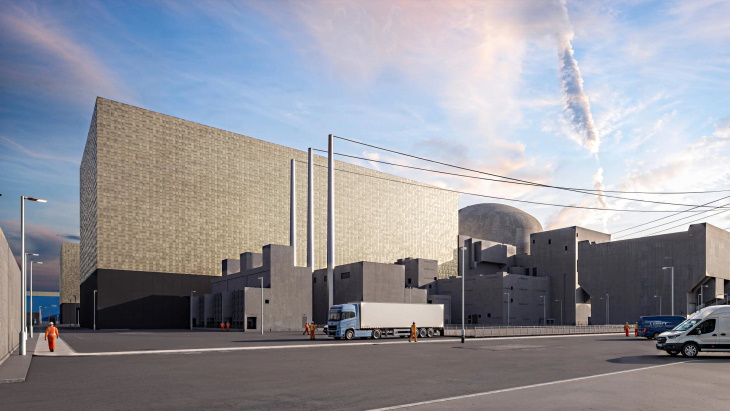
The supply contract with Urenco for enriched uranium services will support the first six years of the two-unit plant's operation, establishing a secure front-end fuel supply. The enrichment services will be provided at Urenco's enrichment site at Capenhurst, near Chester in the north-west of England.
"The importance of Sizewell C in the UK's energy future cannot be underestimated, and Urenco is proud to have been selected as a supplier of choice," said Urenco CEO Boris Schucht. "This will support the millions in economic contributions we make to the UK every year through the enrichment site we have in Cheshire, one of four such sites we have globally, as well as helping to grow skills in the nuclear industry, create jobs and strengthen supply chains."
Sizewell C has also signed a long-term fuel fabrication agreement with Framatome for the first cores and a number of subsequent reloads. The fuel will first be fabricated using the enriched uranium at Framatome's factory in Romans, France, until its new UK facility is available. Sizewell C said the UK factory will create new jobs and reduce reliance on fuel imports, strengthening the security of fuel supply in the UK.
Framatome has previously announced multi-billion pound contracts with Sizewell C, including the delivery of the two nuclear heat production systems for the project.
"Framatome is proud to extend its partnership with Sizewell C through this fuel supply contract," said Lionel Gaiffe, Senior Executive Vice President, Fuel Business Unit at Framatome. "We remain deeply committed to helping the country meet its net zero targets and contribute to strengthen security of fuel supply through a diverse and resilient supply chain."
The plan is for Sizewell C to feature two EPR reactors producing 3.2 GW of electricity, enough to power the equivalent of around six million homes for at least 60 years. It would be a similar design to the two-unit plant being built at Hinkley Point C in Somerset, with the aim of building it more quickly and at lower cost as a result of the experience gained from what is the first new nuclear construction project in the UK for about three decades. A final investment decision for the Sizewell C project was taken in July this year.
Julia Pyke and Nigel Cann, Joint Managing Directors of Sizewell C, said: "These two contracts represent a major moment for Sizewell C and for energy security in the UK – this is about delivering the fuel supply for a project that will power 7% of the UK's energy needs.
"This is also another big moment for nuclear jobs in the UK. The fuel that will go in our reactors will be low-carbon and predominantly sourced from the UK, produced by skilled British workers. We've already pledged to deliver 70% of the project's construction value to UK businesses, and investing in fuel fabrication here in the UK will help us increase that to around 90% across the lifetime of the project. This is what we mean by doing infrastructure differently – and it puts the UK's energy security and our nuclear supply chain in a much stronger place."
Earlier this month, Sizewell C announced it had awarded Arabelle Solutions a contract for the supply and installation of two complete turbine islands for the planned Sizewell C plant. The EDF subsidiary is already supplying turbines for the sister project, Hinkley Point C.
Fuel loading under way at second Zhangzhou unit
(1)_18573.jpg)
China's Ministry of Ecology and Environment issued an operating licence for Zhangzhou Nuclear Power Unit 2 on 11 October. Dong Baotong, Vice Minister of Ecology and Environment and Director of the National Nuclear Safety Administration, issued a licence to Zhangzhou Energy, and Zhang Kai, member of the Party Group and Deputy General Manager of China National Nuclear Corporation (CNNC), attended the event. At 16:13 on the same day, workers began to load the first reactor nuclear fuel into Zhangzhou 2.
CNNC said the milestone marked "that the unit has entered the stage of commissioning the main system with nuclear power, laying a solid foundation for the subsequent unit criticality and grid-connected power generation". It noted the unit was scheduled to be put into operation in the fourth quarter of 2025.
China's Ministry of Ecology and Environment issued construction licences for Zhangzhou units 1 and 2 on 9 October 2019 to CNNC-Guodian Zhangzhou Energy Company, the owner of the Zhangzhou nuclear power project, which was created by CNNC (51%) and China Guodian Corporation (49%) in 2011. Construction of unit 1 began one week after the issuance of the construction licence, with that of unit 2 starting in September 2020.
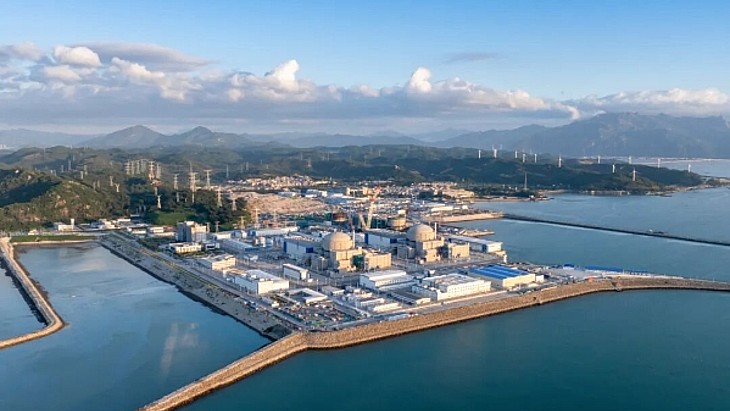
Zhangzhou units 1 and 2 (Image: CNNC)
In September 2022, China's State Council approved the construction of two further Hualong One units as Phase II of the Zhangzhou plant. First concrete for the nuclear island of unit 3 was poured in February last year, with that for unit 4 following in September.
Six Hualong One units are planned for the Zhangzhou site, in China's Fujian province.
IsoEnergy to acquire Toro, creating diversified uranium company
_56525.jpg)
The deal is worth around AUD75 million (CAD68.1 million, USD49 million), and is expected to close in the first half of 2026, subject to satisfaction of all conditions, including receipt of all necessary approvals. Shares in the merged company will continue trading on the Toronto and New York stock markets: Toro will be removed from the official list of the Australian Securities Exchange.
Toro is the 100% owner of Wiluna uranium project in Western Australia, and the combination with IsoEnergy's past-producing mines in the USA, the ultra-high-grade Hurricane deposit in Canada’s Athabasca Basin, and multiple development/exploration assets across Canada, the USA and Australia with Toro’s flagship Wiluna Uranium Project in Western Australia, creates a development-ready platform with significant near-term production potential in stable, mining-friendly jurisdictions, the companies said.
IsoEnergy CEO Philip Williams said the acquisition of Toro Energy is part of IsoEnergy’s strategy to build a globally diversified, development-ready uranium platform. "The Wiluna Uranium Project strengthens our portfolio with a large, previously permitted asset in a top-tier jurisdiction at a time when global nuclear demand is accelerating. This transaction positions IsoEnergy to deliver meaningful scale, optionality, and sustained value creation for shareholders. We look forward to welcoming the Toro team, who have done an admirable job stewarding the company and its projects through often challenging markets, to IsoEnergy and advancing the project together," he said.
Last year, IsoEnergy announced plans to acquire Anfield Energy - owner of the licensed and permitted Shootaring Canyon uranium mill in Utah - but that plan was subsequently terminated in January.
Toro Executive Chairman Richard Homsany said the transaction provides Toro shareholders with the opportunity to be part of a "larger, leading uranium company listed on the TSX and NYSE" with exposure to a "diverse uranium portfolio that has strong growth potential and is located in favourable regulatory jurisdictions, and the ability to attract enhanced access to funding including for the Wiluna Uranium Project".
The pro forma company will hold 55.2 million pounds U3O8 (21,233 tU) of current NI 43-101 compliant uranium resources in the measured and indicated categories, and 4.9 million pounds U3O8 in the inferred category, as well as historic measured and indicated resources of 154.3 million pounds U3O8 and 88.2 million pounds inferred.
Toro's 12.7% owner Mega Uranium Ltd and its associate Mega Redport Pty Ltd have indicated that they intend to vote in favour of the Scheme, subject to no superior proposal emerging and provided that the scheme continues to be "in the best interests" of Toro shareholders.
IsoEnergy owned about 4.99% of Toro's shares as of 12 October.
El Dabaa reactor support ring arrives, reactor vessel shipped
The 20-tonne reactor support ring will be installed at a height of 11 metres in the reactor shaft and will support the weight of the reactor vessel which could reach 1000 tonnes when combined with equipment and fluids.
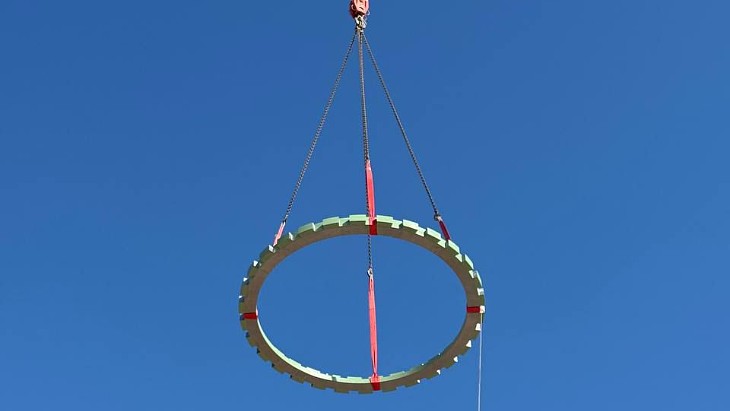
Egypt’s Nuclear Power Plants Authority (NPPA) said the ring, made of high-strength steel alloys resistant to thermal and mechanical stress, was a "key and vital component ... it transfers the entire weight of the vessel, including its equipment, nuclear fuel, and operating fluids, to the concrete base in a balanced and safe manner. It also ensures the reactor's stability during operation and contributes to load distribution and resistance to the effects of internal pressures and earthquakes".
Sherif Helmy, Chairman of Egypt's Nuclear Power Plants Authority, said: "What is happening today … is not merely a technical implementation, but rather a practical expression of Egypt's national vision to build its own strategic capabilities and enhance its leading role regionally and globally in the field of peaceful uses of nuclear energy."
Alexey Kononenko, Vice President of JSC ASE - Director of the El Dabaa NPP, said: "This event is the result of the coordinated work of an international team and a symbol of progressive progress. Every step brings us closer to the moment when Egypt will have its own nuclear power plant for the first time in its history. We are proud to be creating a facility that will become the foundation of the country's energy independence and an example of effective cooperation between Russia and Egypt."
Reactor pressure vessel
Meanwhile the reactor pressure vessel for unit 1 has been shipped from St Petersburg - it is scheduled to arrive at the site in Egypt in November.
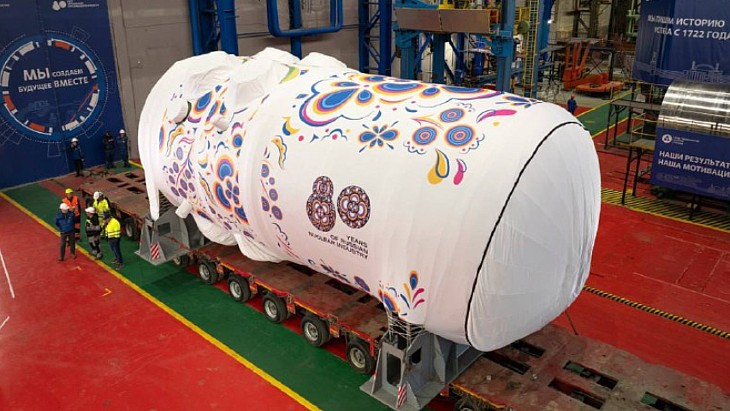
(Image: Rosatom)
Manufacturing of the pressure vessel took 41 months and Helmy said preparations were taking place at El Dabaa’s port to allow for a safe unloading and transport process.
The reactor vessel is about 13 metres long and 4.5 meters in diameter, with a weight of 320 tonnes. The service life is for an initial 60 years, with the possible extension to 80 years.
The ceremony to mark its shipping took place on 26 September at World Atomic Week in Moscow, and coincided with the shipping of the reactor vessel for Turkey's Akkuyu Nuclear Power Plant's fourth unit.
Igor Kotov, head of Rosatom's engineering division, said at that event: "The shipment of the 'heart' of the first power unit of the El Dabaa NPP in Egypt opens a new chapter of our long-term cooperation."
Background
El Dabaa will be Egypt's first nuclear power plant, and the first in Africa since South Africa's Koeberg was built nearly 40 years ago. The Rosatom-led project, about 320 kilometres north-west of Cairo, will comprise four VVER-1200 units, like those already in operation at the Leningrad and Novovoronezh nuclear power plants in Russia, and the Ostrovets plant in Belarus.
Under the 2017 contracts, Rosatom will not only build the plant, but will also supply Russian nuclear fuel for its entire life cycle, including building a storage facility and supplying containers for storing used nuclear fuel. It will also assist Egyptian partners in training personnel and plant maintenance for the first 10 years of its operation. Rosatom said last month that it is aiming for a future service life of 100 years for nuclear power plants.
The four units are being built almost concurrently, with first concrete at unit 1 in July 2022, followed in turn by the others, concluding with first concrete at unit 4 in January 2024. Egypt's aim is for 9% of electricity to be generated by nuclear by 2030, which would be achieved by the commercial operation of the first two units by that time, directly displacing oil and gas.
Consider waste in advanced nuclear initiative, says Deep Isolation

The National Association of State Energy Officials (NASEO) launched the Advanced Nuclear First Mover Initiative in February this year to support states to explore ways to bring down project costs and meet rapidly growing power needs in the USA. The initiative is co-chaired by the states of New York, Indiana, Kentucky, Tennessee, and Wyoming. Louisiana, Maryland, Pennsylvania, Utah, Virginia, and West Virginia are also participating states. The Strategy outlines how the eleven 'First Mover States' are collaborating to accelerate the deployment of advanced nuclear power through an integrated orderbook supported by collaborative pathways for financing, siting, workforce, and supply chains.
Last month, NASEO issued a Request for Information (RFI) in support of the initiative. It said the RFI will "provide the First Mover states and NASEO with information on a potential structure for an advanced nuclear project orderbook strategy, status and use cases for different nuclear technologies, and investment and coordination models".
Deep Isolation announced it has submitted a response to the RIF, noting: "To date, the Strategy makes no mention of the spent nuclear fuel and radioactive waste that will result - though the lack of a safe, permanent waste solution remains one of Americans' top concerns about nuclear power."
Deep Isolation's response sets out how this "missing piece" of the Orderbook Strategy can be filled. It calls for the US Nuclear Industry Council's (USNIC's) recommendations to be integrated into the Orderbook Strategy: working collaboratively with communities to accelerate innovative disposal technologies, launching near-term demonstrations, and mobilising private investment through public-private partnerships and legislative reform. "Together, these efforts strengthen the viability of the orderbook strategy by embedding disposal into the advanced nuclear lifecycle," the company said.
The submission highlights three specific calls to action for participating states. Firstly, they should join the Deep Borehole Demonstration Center, the non-profit at Cameron, Texas where Deep Isolation plans to deliver the world's first full-scale non-radioactive deep borehole disposal pilot with initial canister emplacement, targeted for 2027. In addition, they should support early borehole demonstrations in their states and advocate in Congress for legislative reforms that unlock innovation and public-private partnerships for radioactive waste disposal.
"By embedding disposal into their Orderbook Strategy, First Mover States can reduce financial risk, increase investor confidence, and build public trust that advanced nuclear comes with a complete lifecycle solution," said Deep Isolation CEO Rod Baltzer. "Deep Isolation's technology can play a key role in this. We combine state-of-the-art drilling technology from our suppliers in the oil and gas sector with our proprietary, universal, disposal-ready canister system to provide the first genuinely scalable, flexible, and near-term solution for spent fuel and high-level waste. We stand ready to help First Mover States lead the way in solving the waste challenge at the same time as they pioneer new reactor deployment."
NASEO is an association for energy officials from all US states and territories. State energy officials are appointed by state governors: NASEO aims to facilitate peer learning among state energy officials, as well as providing a resource for and about State Energy Offices, and advocating the interests of the State Energy Offices to Congress and federal agencies. The initiative extends NASEO's existing work with states in support of advanced nuclear energy projects.

No comments:
Post a Comment