Is Venezuela's resource wealth Trump's real target?
.jpg)
The escalating tensions between Washington and Caracas have renewed scrutiny of what some analysts believe may be the true objective behind the Trump administration's aggressive posture: access to Venezuela's extraordinary natural resource wealth, including the world's largest proven oil reserves and substantial deposits of strategic minerals critical to advanced technologies.
In a last-ditch attempt to cling to power, President Nicolás Maduro had offered the United States preferential access to Venezuelan crude and minerals during months of negotiations to forestall military intervention, according to a recent New York Times report.
The proposal involved opening oil and gold projects to American companies with preferential contracts, and redirecting crude oil exports from China to the United States.
The discussions with Venezuelan officials, overseen by Special Presidential Envoy Richard Grenell, ultimately collapsed as President Donald Trump chose military escalation over diplomacy, embracing the hawkish line of Secretary of State Marco Rubio.
The negotiations took place against the ongoing backdrop of a huge US military deployment in the eastern Caribbean, officially targeting what the administration describes as "narco-terrorism".
Trump has branded Maduro as the head of a "narco-terror cartel", though the very existence of the Cartel de Los Soles is widely disputed, and US intelligence data notes Venezuela is not a primary transit route for cocaine and does not produce or export fentanyl, the synthetic opioid responsible for most American overdose deaths.
The hydrocarbon prize
Venezuela holds approximately 303bn barrels of proven oil reserves, representing 17.5% of the global total, according to industry data. The South American nation also possesses the seventh-largest natural gas reserves globally at 221 trillion cubic feet (6.26 trillion cubic metres)—equivalent to nearly 80% of Latin America and the Caribbean's combined reserves.
Yet the country’s oil production has plummeted from its position as one of the world's leading producers in 2008 to just eighteenth globally by 2024, according to research published by EBSCO. Daily output had fallen to 761,000 barrels in 2023, suggesting enormous potential for recovery under different management and with solid investment.
The so-called Orinoco Belt, which runs east-west across the middle of the country and encompasses the Falcón, Apure, and Oriental basins, contains extra-heavy crude, a dense and viscous oil requiring specialised extraction and refining methods. Some of the refineries along the US Gulf Coast are specifically designed to handle these heavy crude varieties, making that region a natural destination for Orinoco oil exports.
State oil company PDVSA, created when Venezuela nationalised its oil industry in 1975-1976 and currently under direct control of the Maduro regime, accounts for approximately 50% of government revenue and 80% of the nation's export earnings. However, poor cash flow stemming from corruption, sanctions and mismanagement has hampered investment in petroleum infrastructure, consequently curbing production capacity.
The Maracaibo basin supplies slightly less than half of Venezuela's oil production, but the increasing depth of remaining reserves requires heavy investment to maintain current capacity. Oil drillers have been forced to reinject natural gas into reservoirs to increase pressure in deeper wells, according to EBSCO research.
The country has managed to sustain shipments through sanctioned and shadow channels, with Chevron and other firms operating under US exemptions continuing production amid the US military buildup off the country’s coast.
Venezuelan output has surpassed 1mn barrels per day, roughly 100,000 more than at the end of 2024, and Vice President and Minister of Hydrocarbons Delcy Rodríguez boasted a 16% increase in activity this year.
Most exports are directed to China, often sold at discounts of 10% to 20% to bypass US restrictions, analysts say. Despite long-standing US pressure, Venezuela’s oil sector remains resilient, with exports and market access adapting to geopolitical and sanction-related constraints.
Energy analysts argue that the Trump administration’s goal is to maintain a US foothold in case of political change, enabling Western oil firms to help quickly revive Venezuelan output and potentially rival Saudi Arabia by the 2030s, according to FT reports.
For now, exports to China remain steady, though experts warn they could be disrupted if Washington moves to seize tankers under fresh sanctions or trafficking claims.
Strategic minerals and industrial metals
Venezuela's mineral wealth extends well beyond hydrocarbons, encompassing resources increasingly vital to global supply chains for advanced technologies, energy transition and manufacturing.
According to EBSCO, the country possesses one of the world's largest bauxite supplies, the ore essential for aluminium production. These deposits are located in the vast Guiana Highlands region, where the bauxite formed through laterisation of tertiary sediments laid horizontally on precambrian rocks. The ore consists of aluminium hydroxide minerals plus various mixtures of alumina-silicates, iron oxide, silica, titanium and trace impurities.
In 2008, six companies operated 14 primary aluminium smelters in Venezuela, placing the country 15th globally in aluminium production and accounting for 2.9% of the world's bauxite and 1.4% of aluminium output. The smelting operations required enormous amounts of electricity, which the country's hydroelectric dams produced relatively cheaply. Venezuela consistently ranked among the top 25 exporters of aluminium, with principal importers including the United States, Mexico, Japan, the Netherlands and Colombia.
Iron ore deposits in the Guiana Highlands have enabled steel production at Ciudad Guayana, the country's industrial heart. Following the Second World War, the enormous iron ore deposits on the northern rim of the plateau attracted US Steel and Bethlehem Steel, which operated large open-pit mines. US Steel's main mine covered the entire summit of Cerro Bolívar mountain.
Iron-ore products—including iron, iron pellets and ingots and flat-rolled sheets—rank second behind petroleum in the country's export value.
Venezuela also holds significant deposits of gold, copper, nickel, coltan and cassiterite. Additional commodities include sulphur (6% of global production), feldspar (2%), silica sand (1%) and lesser amounts of coal, lead, zinc, titanium, diamonds and uranium. Most of these commodities originate from mining activities in the Andes Mountains or Guiana Highlands, though extraction remains primarily at surface level.
Hydroelectric capacity
Venezuela's natural resource portfolio includes substantial hydroelectric generation capacity, ranking ninth globally in per-capita hydroelectricity production among the 149 nations with dams. Hydroelectric energy supplies 77.6% of the country's electricity needs, according to the CIA World Factbook, compared with 5.6% in the United States.
The nation's hydroelectricity comes from dams built on rivers of the Guiana Highlands, particularly the Caroní River, which has four operational dams. The Guri Dam, located just above the Caroní's mouth and operational since 1978, has the third-largest generating capacity among hydroelectric facilities worldwide, behind only China's Three Gorges Dam and the Itaipu Dam on the Brazil-Paraguay border.
This hydroelectric capacity allows Venezuela to export surplus electricity to neighbouring Colombia and Brazil, whilst enabling the production of iron, steel and aluminium for global markets using relatively low-cost power.
Economic collapse and foreign interests
The military build-up occurs as opposition leader María Corina Machado, recently awarded a Nobel Peace Prize “for her struggle to achieve a just and peaceful transition from dictatorship to democracy," presents an alternative economic vision pandering to Washington and American business interests. Machado, who remains in hiding within Venezuela following the disputed July 2024 presidential election, has claimed the country offers a $1.7 trillion opportunity over the next 15 years, contingent upon the current regime's removal and implementation of her reform programme.
Despite its exceptional natural resource endowment, Venezuela is widely considered a failed state. The country's economy, heavily reliant on hydrocarbons for decades, imploded following the untimely passing of former president Hugo Chavez – a controversial but more charismatic and competent leader than Maduro – in 2013 and the subsequent 2014 slump in oil prices from $100 per barrel to $30 by 2016.
The Council on Foreign Relations reported in 2022 that 77% of Venezuela's 28mn citizens lived in extreme poverty, with nearly 8mn having emigrated since 2014.
Corruption, mismanagement and the collapse of private sector businesses have all contributed to the inability to restore oil production levels. Foreign investment, sorely needed to capitalise on Venezuela's resources, has dropped to near zero due to increased risk perceptions.
Sascha Lohmann, a political scientist at the German Institute for International and Security Affairs, suggested to DW that whilst fighting drug trafficking provides the official rationale, the Trump administration likely harbours broader objectives. "Resources certainly play the most important role, both fossil fuels and other raw materials needed to keep accelerating the technology race, particularly where China is concerned," he said.
What’s next?
Speaking to CBS's "60 Minutes" programme on November 2, Trump sent once again mixed signals about American intentions. "I doubt it. I don't think so," he said when asked if the United States were going to war against Venezuela.
But pressed on whether the US was planning any strikes on land, Trump did not rule it out.
Meanwhile the USS Gerald R. Ford, the world's most expensive warship at a value of $13bn, is currently bound for the Caribbean with dozens of fighter jets and helicopters aboard, joining seven other US vessels already in the region. The deployment represents an unprecedented mobilisation of American naval power in the area.
More than 15 US strikes on small boats in the Caribbean and Pacific have killed at least 65 people in recent months, with the latest taking place on November 1. The White House has yet to make public any evidence that its targets were smuggling narcotics or posed a threat to the United States, prompting criticism from US lawmakers, regional governments and UN experts who denounced the attacks as extrajudicial killings.
The Pentagon has also been upgrading a long-abandoned Cold War naval base in Puerto Rico, approximately 500 miles from Venezuela, and expanding facilities at civilian airports across US Caribbean territories, according to a Reuters investigation based on satellite imagery and photographs.
Construction activity at the former Roosevelt Roads naval base, shuttered in 2004, and improvements at airports in Puerto Rico and St Croix offer yet another indication that the US is gearing up for sustained military operations.
“All of these things are, I think, designed to scare the pants off the Maduro regime and the generals around him, with the hope that it will create fissures,” Christopher Hernandez-Roy, a senior fellow at the Center for Strategic and International Studies (CSIS), told Reuters.
For his part, Maduro has accused Washington of fabricating a "new eternal war" and using drug trafficking as a pretext for "imposing regime change" in Caracas to seize Venezuelan oil. According to the Washington Post, the embattled leader has reached out to Russian President Vladimir Putin for help and has mobilised coastal defences, claiming possession of more than 5,000 Russian-manufactured surface-to-air missile systems.
However, the Kremlin, bogged down in its war in Ukraine, would have limited capacity or inclination to provide significant assistance should Washington launch comprehensive operations inside Venezuela.
Additionally, analysts believe Trump’s renewed focus on the Southern Hemisphere may prove beneficial to Putin because it diverts attention away from Ukraine. China’s support appears even more unlikely despite Maduro's flaunting of Chinese solidarity. Whilst Beijing has extended tens of billions in development loans to Caracas over the past two decades, Chinese foreign direct investment turned negative in 2019, and commercial banks have virtually abandoned Venezuela.
“I think the objective of president [Trump] and the administration is that somebody close to Maduro convinces him either to go into exile, they decide to extradite him to the United States, or they remove him from power by other means,” James Story, former US ambassador to Venezuela, told the FT’s “Swamp Notes” podcast.
The crisis remains on a knife-edge as top-tier American military assets continue massing in the Caribbean. Whether the standoff will be resolved through some kind of military intervention, negotiations leading to an interim government without the deeply unpopular autocrat, or the internal disintegration of the Chavista regime remains a trillion-dollar question. But when asked on November 2 if Maduro's days as president were numbered, Trump's answer was bluntly unequivocal: "I would say yeah. I think so, yeah.”
What a U.S. Invasion of Venezuela Would Mean for Global Oil Prices
- The Trump Administration’s military buildup near Venezuela signals potential conflict with major implications for global oil markets and geopolitics.
- Venezuela’s 1–1.1 million barrels per day of heavy-sour output are crucial for U.S. and Asian refineries; any disruption could spike Brent and diesel prices.
- A full-scale regime-change operation would destabilize the region, freeze investment, and trigger ripple effects across energy, insurance, and logistics sectors worldwide.
The risks surrounding Venezuela, the world’s largest oil and gas reserves holder, are clearly skyrocketing. With Venezuela’s president, Maduro, calling upon Russia, China, and Iran to assist in a possible military confrontation with the USA, global oil and gas markets are growing increasingly nervous about a potential conflict. The ongoing military buildup by the Trump Administration around Venezuela, officially set up to confront the country’s perceived pivotal role in the international drug trade, almost looks like the so-called military training activities of Vladimir Putin’s Russia before the invasion of Ukraine. While no decision has officially been taken in Washington, military sources are indicating that military action or even an invasion of Venezuela has received the green light. Trump is clearly preparing for all scenarios, possibly not only reshuffling power structures in Latin America and the Caribbean but also affecting global oil markets in due course, with significant geopolitical implications involving Russia, China, and Iran. While Venezuela holds the largest crude oil reserves in the world — estimated at around 303 billion barrels as of 2023, approximately 17% of global reserves — its total crude oil production is well below expectations. At present, the country produces around 1-1.1 million bpd, indicating a struggling upstream and downstream sector, which has been significantly hindered by factors such as international sanctions, infrastructure constraints, a lack of investment, and technical challenges in extracting and refining heavy crude oil. The country’s potential is gigantic, but reality shows a crude oil giant in despair, struggling not only to produce its heavy-sour barrels but also to export them to global markets. Primary production is currently focused on the Atlantic Basin, much of it tied to Chinese buyers and U.S.-licensed joint ventures. Due to ongoing U.S. sanctions and internal unrest, the country is struggling, showing a significant economic and political crisis, constraining even future developments indefinitely.
While Venezuela’s total production is not of fundamental importance in terms of barrels, the country's central, absolutely pivotal position stems from its slate-critical supply to markets. A U.S. military campaign will always include disruption or destruction of ports, upgraders, and logistics, which would lead to the removal of so much more than “just another million barrels”. At the same time, while Venezuela’s LNG position is almost non-existent, a military action on Venezuela is expected to freeze the so-called Dragon gas tie-in to Trinidad & Tobago (feed Atlantic LNG). The latter would undoubtedly have a psychological effect on global gas markets.
Looking at Europe’s market position or exposure right now, it is mainly linked to prices, not molecules: Brent, diesel cracks, and war risk premia in the Atlantic. The U.S. would be able to cope in headline barrels (primarily through light-sweet growth), but U.S. refineries would definitely feel refinery-slate pain.
After the collapse during the late 2010s, Venezuelan crude output has shown some rebounds. During 2024-25, it increased production again, mainly through selective licensing and Chinese demand. Still, the country produces only 1-1.1 million bpd, of which about 1 million bpd are crude exports. While volumes are low, quality here puts Venezuela in the spotlight. As the prime exporter of heavy-sour grades and extra-heavy Orinoco blends, it provides precisely the feed that high-complexity cokers and hydrocrackers in the U.S. Gulf Coast (USGC) and parts of Asia are built to process. If Venezuelan production slips or breaks down, refiners will be forced to use fuel oil/resid imports as a substitute feedstock. So far in 2025, USGC plants have been calling upon Middle Eastern and other residual streams.
At this point, some form of military action is expected, with the main concerns centering on the approach taken. In a limited strike/naval blockade scenario, the physical effects will mainly affect export terminals (Jose), with some damage to upgraders and storage. Insurance premiums will jump, while risk-averse crews and war-risk underwriters will leave. Immediate effects are apparent: Brent will spike, and markets will see a higher heavy-sour premium vs. light-sweet. Diesel cracks are expected to jump too.
With a sustained campaign (months) targeting industrial sectors, the main damage is expected to be to upgraders (Petropiar/PetroMonagas), while logistics is also constrained. Export volumes are down. In this scenario, markets can expect structural heavy-sour deficits in the Atlantic Basin, but OPEC+ could partially offset headline barrels. The primary concern, however, will be a significant quality mismatch, leading to higher diesel prices in Europe and suboptimal diesel yields at USGC refineries, highlighting the potential for long-term effects of the situation.
The primary concern, however, is that the Trump Administration will pursue a regime-change/occupation scenario. That would result in full-scale destabilization, capex freezes, and a breakdown in diluent and naphtha logistics. In this scenario, restoring the oil sector would take 12-18 months, and billions of dollars would be needed to revamp and upgrade.
The above means a significant risk to markets, even if some believe there is an oil glut or too much oil on the water. Venezuela’s million barrels count for more than only numbers, as refiners don’t run spreadsheets but units. Trump’s advisors should address the fact that heavy sour molecules deliver coker feed and diesel yields that light tight oil cannot perfectly replace. He should also look back over the past few months, as the USGC has witnessed a surge in fuel-oil imports intended to backfill constrained Venezuelan and Russian heavy oil supply.
The results for the U.S. are precise, but some should also be looking at Europe. As Europe buys globally priced barrels, any changes in Venezuela have a direct impact on industry and consumer prices. Since the Russian invasion of Ukraine in 2022, Europe has leaned heavily on U.S. diesel and gasoline, as Russian products were sanctioned. Any change in U.S. refinery output will lead to higher product import bills and diesel premiums in Europe. Yes, Middle Eastern diesel and Indian exports could fill some gaps, at a price, but the outcome of new U.S. and EU sanctions on Russia still needs to be assessed. Trump’s war on 3rd party Russian oil products has just started.
As some have already stated, every slate-specific shock shows that headline global balances matter, but molecule chemistry, geography, and insurance matter more in the first 3–9 months of a conflict. For European parties, it would be a smart move to start diversifying product sourcing, having vast inventories of certain quality, and assessing necessary logistics and insurance issues. As in the case of Ukraine, the signs are on the wall, moves are being made, it seems not to be the case “IF the USA will act on Venezuela, but more WHEN”. Any assessment of these developments should also take military strategy into account. As von Moltke stated, "No plan survives first contact with the enemy," or Dwight D. Eisenhower, "In preparing for battle I have always found that plans are useless, but planning is indispensable", preparation is needed. Still, the outcome of any further action by the U.S. on Venezuela is unclear. A full-scale military operation could easily bring in unwanted 3rd party responses, especially Russia, China, or even Iran.
A removal of the Maduro regime would entirely undermine Russia’s Vladimir Putin’s planning. At the same time, it uproots part of the growing influence-and-power game China is currently playing in Latin America. Iran is a Dark Horse, as the Tehran regime holds strong economic and military ties to Caracas. Looking at news emerging about Russian planes delivering sophisticated weapons and missiles in recent days, a confrontation could have regional and global implications, outside of the energy sphere, too.
By Cyril Widdershoven for Oilprice.com
As US Ratchets Up Pressure On Venezuela, Will (Or Can) Moscow Help Maduro? – Analysis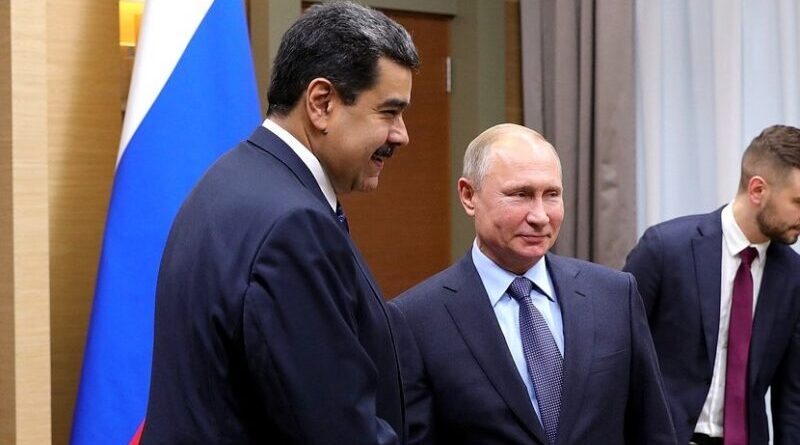
Venezuela's Nicolas Maduro with Russia's Vladimir Putin. Photo Credit: Kremlin.ru
By RFE RL
By Steve Gutterman
It may be happening again.
In 2019, the United States backed an opposition leader seeking to unseat Venezuela’s Nicolas Maduro. Russia opposed the push, providing diplomatic assistance and a modicum of military support for a government that may be Moscow’s most important partner in Latin America.
Maduro survived the crisis when Juan Guaido’s call for a military uprising failed and his bid for power fizzled — a big relief for Russia and a blow to the United States, which considers Maduro illegitimate. Serving his first term at the time, US President Donald Trump had recognized Guaido as interim president of Venezuela in January 2019.
While the circumstances are very different today, the United States is again ratcheting up pressure on Maduro.
It has built up a big military presence in the Caribbean, where it is now sending an aircraft carrier — the USS Gerald R Ford, commonly accepted as the world’s largest warship — and has conducted numerous strikes on alleged drug-trafficking vessels, killing dozens of people.
US officials have been citing a 2020 drug-crimes indictment against Maduro, with Secretary of State Marco Rubio calling him a “fugitive from American justice.” In August the United States doubled a bounty for information leading to his capture to $50 million.
A CBS interview released on November 2 saw Trump play down concerns that the United States would go to war against Venezuela but, asked if Maduro’s days were numbered, said, “I think so, yeah.”
Maduro is reportedly again turning to Russia for support — but analysts say that if Washington makes a concerted effort to oust him, Moscow’s levers to prevent it are limited.
“To put it bluntly, there is nothing much Russia can do, if the USA is determined to try and bring Maduro down, beyond diplomatic overtures,” said Mark Galeotti, an author, Russia analysist, and honorary professor at University College London’s School of Slavonic and East European Studies.
Seeking Support?
In an October 31 report, The Washington Post said documents it obtained show Maduro wrote a letter to Russian President Vladimir Putin asking Moscow to bolster Venezuela’s air defenses by restoring previously purchased Sukhoi warplanes, helping Caracas overhaul engines and radars and acquire missiles, and providing logistical support.
The letter was to be delivered by Venezuela’s transportation minister, whom Russia says traveled to Moscow in mid-October, according to the Post, which also reported that Maduro was seeking support from China and Iran.
It’s not clear whether the letter was delivered to, or received by, the Kremlin. Neither Russian nor Venezuelan officials have commented on the report or made public statements about specific new backing for Maduro’s government.
However, a large Russian Il-76 transport plane arrived in Caracas in late October after flying a circuitous route with several stops, according to the flight tracking site FlightData24. It is unclear what the aircraft was carrying.
‘Ready To React’
On November 1, Russian Foreign Ministry Spokeswoman Maria Zakharova said Moscow denounces “the use of excessive military force in carrying out actions in anti-drug operations” and “confirms our firm support for the Venezuelan leadership in defending its national sovereignty.”
Two days earlier, Zakharova said Russia was “in contact with our partners” and was “ready to continue to react in the appropriate fashion to their requests, taking into account existing and potential threats.”
A new strategic partnership agreement between Russia and Venezuela, discussed during Maduro’s visit to Moscow in May, entered into force after Putin signed it, Russian state media reported on October 27. But such pacts are often short on specifics.
Experts say most of Russia’s military operations in the Western Hemisphere have been largely for show, a reminder to the West that Moscow’s forces are able to venture further afield than they could when the cash-strapped country pulled back in the wake of the 1991 Soviet collapse.
In 2018, two nuclear-capable Russian strategic bombers landed at a military airport outside Caracas. In July 2024, two Russian naval ships docked in Venezuela ahead of an election that extended Maduro’s rule and was denounced by the United States as a sham.
Amid the bid to oust Maduro in 2019, Moscow acknowledged it had military personnel on the ground after photos showed nearly 100 Russian soldiers emerging from two military aircraft.
Levers And Limitations
In a report published by the US-based Kennan Institute’s Wilson Center in 2020, Colombia-based analyst Vladimir Rouvinski wrote that the “first continuous presence of Russian military personnel in the Western Hemisphere” since the withdrawal from Cuba in the early 1990s was “a clear manifestation of the Kremlin’s determination to keep Venezuela within Russia’s orbit.”
“Many other Russian-sponsored or -assisted actions helped keep Maduro in power,” including Moscow’s blockage of a US-backed UN Security Council resolution, Rouvinski wrote. But at the same time, “the crisis in Venezuela laid bare the many limitations of Russian policy,” such as “a shortage of…financial resources to support its policy in Latin America.”
Russia’s resources, financial and military, are more stretched than they were in 2019: That was three years before Putin launched the full-scale invasion of Ukraine, committing the vast majority of the country’s military personnel and assets to a costly war with no end in sight and triggering waves of Western economic sanctions.
Even were it not on the attack in the biggest war in Europe since 1945, Russia’s distance from Venezuela would be a serious limitation to substantial backing if it comes to that.
“I think that if the US is serious about regime change in Venezuela by force, Russia is unlikely to be able to help in any way,” Oleg Ignatov, senior Russia analyst at the Crisis Group, told RFE/RL in an e-mailed comment. “This was impossible both before and after the [start of the] war in Ukraine. Elementary geography and logistics are at play here.”
Trump has sent mixed signals about whether the United States is considering striking drug-related targets inside Venezuela. “The land is going to be next,” he said on October 23 in comments about the strikes on boats. But on October 31, when asked if media reports that he was considering strikes within Venezuela were true, the US president said: “No.”
The fall of Maduro would be a major blow to Moscow, potentially depriving it of a key foothold in Latin America and echoing the ouster in December 2024 of Syria’s Bashar al-Assad, which has weakened the Kremlin’s influence in the Middle East.
In addition to Maduro’s status as an ally in Moscow’s geopolitical confrontation with Washington and the West, Russia has invested heavily in oil production in Venezuela, which has the largest proven oil reserves in the world — though US sanctions mean the two countries are both seeking to sell to some of the same buyers, such as China.
Geopolitical Calculus
While the war against Ukraine has focused Moscow on acquiring arms itself, Caracas in the past, at least, has been a substantial buyer of Russian weapons. Amid the US buildup nearby, Maduro said on October 22 that Venezuela has 5,000 Russian-made Igla-S missiles in “key air defense positions.”
Despite those ties, Moscow may see the growing US pressure on Venezuela as a development that draws Washington’s attention away from Ukraine, lessening the chances of additional pressure on Russia to halt the invasion.
Putin’s Kremlin might even see a silver lining in Maduro’s departure if the United States were to force him from power.
“In a perverse way…Moscow would gain by such an operation, in that it would strengthen its claim that it is the West, not Russia, that is the enemy of the Global South: arrogant, violent and imperialist,” Galeotti wrote in an e-mailed comment to RFE/RL.
“Russia is, after all, still able to find allies and clients in the Global South, whether out of conviction or, more often, pragmatism, and always takes advantage of Western adventurism to hammer home its claim that the liberal global order is simply a scam to bend the world to Western interest,” he wrote.

RFE RL
RFE/RL journalists report the news in 21 countries where a free press is banned by the government or not fully established.

No comments:
Post a Comment