‘Ending homelessness must be Labour’s moral mission — and this time we must finish the job’
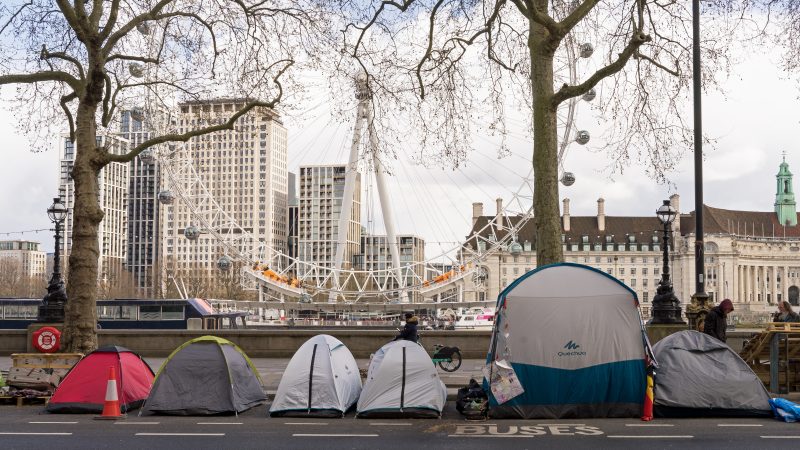
Tackling the scourge of homelessness must be the moral mission of any Labour Government, because having a place to call home, is not just about having a roof over your head, it is about security, stability and better life outcomes.
Prior to entering Parliament, I worked on the frontline of homelessness policy as Director of Policy as St Mungo’s, as well as being a Cabinet Member for Housing & Property at Medway Council. Through this experience, I have seen first-hand how quickly people can fall into crisis when systems fail, and how powerful the right interventions can be when they are properly funded and sustained. I have witnessed the best of what councils, charities and frontline workers can achieve. But I have also seen how fragile the process becomes, when national policy does not keep pace with rising need.
Despite almost being eradicated under Blair and Brown, under the Conservative government, we saw the consequences of a national approach that was neither strategic nor sufficiently funded. With rough sleeping more than doubling between 2010 and its peak, while local authorities faced a significant real terms reduction in core spending power – the very budgets that fund homelessness prevention. The system, as a result, has become crisis led, reactive and structurally incapable of meeting demand. When every available resource is consumed by crisis management, the space for meaningful prevention all but disappears and local authorities are constantly fighting the fires that underfunding has allowed to spread.
Most strikingly, the Everyone In scheme demonstrated with absolute clarity what is possible when homelessness is treated with the urgency it deserves. In the early months of the pandemic, we saw 37,000 people brought in off the streets overnight. The scale of action was unprecedented, but more importantly it exposed a truth that sector has articulated for a long time: rough sleeping is not an unsolvable issue, but a resource issue.
Of course, when we talk about homelessness, we are not only talking about those sleeping rough. We are also talking about the thousands of families placed in temporary accommodation, often miles from their schools, support networks and places of work, because councils simply have nowhere else to put them. The scale of this crisis has grown to the point where temporary accommodation has become a parallel housing system, consuming billions of pounds a year and placing enormous pressure on already-stretched local authorities.
During my time on the Housing, Communities and Local Government Select Committee, I was able to play a part in bringing the full extent of this issue to light. Our inquiry consistently showed that the impact on children’s development, family stability and local budgets was profound, and that without structural intervention the numbers would continue to rise. That work helped expose what many of us in local government already knew: that temporary accommodation is not a safety net anymore. Instead, it is a symptom of a system under acute strain, and it represents one of the clearest arguments for long-term, sustainable funding for homelessness prevention.
That is why I welcome the publication of the government’s National Plan to End Homelessness, a £3.5 billion plan focusing on halving rough sleeping and preventing homelessness through early intervention, better public collaboration and increased housing supply. It is an ambitious plan with the focus rightly on prevention first, so public services can work together to stop people falling into homelessness.
Our commitment to significantly expanding the supply of genuinely affordable and social homes will also help ease the relentless pressure on temporary accommodation, as more families can access stable, long-term housing rather than being trapped in a cycle of emergency placements. These issues are structural, and we cannot shy away from addressing them at their root. But it is also in this spirit, that we should seriously consider a closer review of Local Housing Allowance (LHA) and lifting the freeze on LHA rates. Ensuring it is set at a level that reflects real rental markets is one of the single most effective levers we have, to prevent homelessness at scale, and it must also be part of any credible long-term strategy.
But any strategy is only credible, when measured against delivery and that will be the test we face.
I am proud of being part of a government that is taking homelessness seriously, but this is not a new battle, it is one we have fought before and almost won. This time round we must finish the job.


No comments:
Post a Comment