by Ted Snider | Dec 22, 2025 | ANTIWAR.COM
A key reason that Russia went to war in Ukraine was to prevent Ukraine from ever joining NATO; a key reason that Ukraine went to war with Russia was to defend their right to join NATO. On December 14, Ukrainian President Volodymyr Zelensky gave up Ukraine’s right to join NATO. He presented the concession as a compromise. But it is not really a compromise. Zelensky may intend the non-compromise to leverage concessions from Russia, but it may not really change anything.
That blocking Ukraine accession to NATO was Moscow’s primary motivation has been confirmed by NATO, by Ukraine and by the United States. Jens Stoltenberg, NATO Secretary General at the start of the war, says that “no more NATO enlargement… was a pre-condition for not invade Ukraine… [Putin] went to war to prevent NATO, more NATO, close to his borders.”
Davyd Arakhamiia, who led the Ukrainian negotiating team in Istanbul, says that an assurance that Ukraine would not join NATO was the “key point” for Russia. “It was the most important thing for them… They were prepared to end the war if we agreed to… neutrality, and committed that we would not join NATO.” Zelensky said, in his first interview after the invasion, “As far as I remember, they started the war because of this.”
Amanda Sloat, the former Special assistant to President Biden and Senior Director for Europe at the National Security Council, was recently caught suggesting that a guarantee that Ukraine not join NATO could have prevented the war. “We had some conversations even before the war started about, what if Ukraine comes out and just says to Russia, ‘Fine, you know, we won’t go into NATO, you know, if that stops the war, if that stops the invasion’ – which at that point it may well have done,” she said. “There is certainly a question, three years on now, you know, would that have been better to do before the war started, would that have been better to do in Istanbul talks? It certainly would have prevented the destruction and loss of life… If you wanna do an alternative version of history, you know, one option would have just been for Ukraine to say in January 2022, ‘Fine, you know, we won’t go into NATO, we’ll stay neutral. Ukraine could’ve made a deal, I guess, in, what, March, April 2022 around the time of the Istanbul talks.”
But Ukraine did not make that deal because the United States, the U.K., Poland and their partners pushed them not to. They promised Ukraine whatever they need for as long as they need it to fight Russia in defense of the “core principle” that Ukraine has the right to choose its alliances and that NATO has the right to expand.
Nearly four years and hundreds of thousands of deaths later, Ukraine has surrendered the right to join NATO. On December 14, Zelensky said that he is ready to give up the demand for NATO membership in exchange for “bilateral security guarantees between Ukraine and the United States – namely, Article 5–like guarantees… as well as security guarantees for us from our European partners and from other countries such as Canada, Japan and others.”
Zelensky presented this concession as “a compromise on our part.” But it is not really a compromise for three reasons.
The first is that the retraction of the promise that Ukraine would join NATO was already a done deal. Ukraine’s accession to NATO was never going to happen.
That reality was implicitly stated by Biden and explicitly stated by Trump. It is point number 7 in Trump’s 28-point peace plan. The reality has been recognized by Zelensky who has “understood that NATO is not prepared to accept Ukraine” since the start of the war. He has, since that time, “acknowledged” that Ukraine “cannot enter” the “supposedly open” NATO door and that, though “publicly, the doors remain open,” in reality, Ukraine is “not going to be a NATO member.” Any hope of resuscitating that dream died in the recently released 2025 National Security Strategy of the United States of America that states the policy priority of “Ending the perception, and preventing the reality, of NATO as a perpetually expanding alliance.”
Though dressed up as a “compromise,” Zelensky’s concession has long been a done deal.
The second is that the concession is less of a compromise than a rewording. It is not NATO, but NATO countries; it is not Article 5, but Article 5-like. American officials say that the security guarantee that Ukraine will receive is “similar to those it would receive as part of NATO.”
The most recent round of negotiations between the United States, Europe and Ukraine have arrived at an 800,000 troop strong Ukrainian armed forces with a “European-led ‘multinational force Ukraine’… supported by the U.S.” that will “assist in the regeneration of Ukraine’s forces, in securing Ukraine’s skies, and in supporting safer seas, including through operating inside Ukraine.” The U.S. will lead a ceasefire monitoring and verification mechanism.” The agreement stipulates that there is a “legally binding commitment, subject to national procedures, to take measures to restore peace and security in the case of a future armed attack. These measures may include armed force, intelligence and logistical assistance, economic and diplomatic actions.”
The wording of the agreement has been nuanced and messaged, but the meaning of these security guarantees that are based on NATO membership is essentially the same as the security guarantee that come with NATO membership that has, from the onset, been Russia’s red line.
And that leads to the third reason that the compromise was easy to make and to present as a cooperative “compromise” intended to facilitate and advance negotiations. It is easy to offer what you know will never happen. Russia’s red line has not only been no Ukraine in NATO, but no NATO in Ukraine. To trade NATO membership for a “European-led” force “operating inside Ukraine” is unlikely to assuage the Russian security concerns that led to the war. Russia’s Deputy Foreign Minister Sergei Ryabkov has reiterated that “under no circumstances are we prepared to support, approve, or even tolerate any NATO troop presence on Ukrainian territory.” Would Russia accept European forces outside of the NATO framework but inside of Ukraine? “No, no, and no again,” Ryabkov said.
And it is not just Russia that will be unhappy with the latest offer of security guarantees. There are three reasons why Ukraine might be discontented too.
The first is that the offer reportedly comes with a time limit. U.S. officials say that the security guarantee is “platinum standard” but that it “would not be on the table forever.” The ultimatum seems to be that Ukraine gets the security guarantees if they agree to the larger deal. But that deal seems to include the ceding of unconquered territory in Donbas that Zelensky has been, so far, unwilling to do.
The second is that the U.S. continues to refuse to contribute troops to the Europe-led force, offering only intelligence to verify Russian compliance with the cease-fire and to monitor Russian activity “to provide early warning of any future attack.” Ukraine and Europe both suspect that European forces are incapable of providing adequate security without an American military backstop.
And the third is that, even in its strongest iteration, the agreement falls short of offering Ukraine the security that it wants. The European Joint Statement on Ukraine ends with the promise of a “legally binding commitment… to take measures to restore peace and security in the case of a future armed attack.” But it promises only that “These measures may include armed force.” It does not guarantee it. And given Ukraine’s bitter experience in the current war that the American and European response would be carefully calibrated to avoid directly militarily involved with Russia, they have strong reason to doubt their response in the future.
Ted Snider is a regular columnist on U.S. foreign policy and history at Antiwar.com and The Libertarian Institute. He is also a frequent contributor to Responsible Statecraft and The American Conservative as well as other outlets. To support his work or for media or virtual presentation requests, contact him at tedsnider@bell.net.
Confusion at NATO: Rutte, Russia and Delusions about Trump
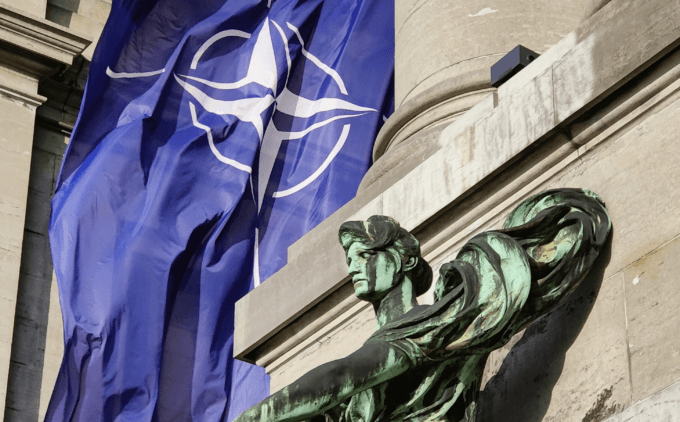
Photo by Jannik
It was a speech unhinged in millenarian zeal. It was unapologetically hysterical in urging war while claiming to protect peace. It was also delivered with a note of profound self-denial: the US administration’s 2025 National Security Strategy had belittled Europe’s efforts in terms of ensuring its own security, not least of all its claims to civilisational supremacy. President Donald Trump has tirelessly insisted that the continent bloat the military industrial complex and confront its demographic problems.
From the opening, NATO Secretary-General Mark Rutte reflects on a piece of the Berlin Wall kept in NATO headquarters. “It was a barrier to keep people in, and ideas out. Now it is a monument to the force of freedom, a reminder of the power of unity, and a lesson that we must stay strong, confident and steadfast.” He might have gone further to explain how the collapse of the Berlin Wall was also a chance to stabilise Europe and temper the tensions with the then ailing Soviet Union. Assurances by NATO members and respective US administrations that eastward expansion toward Russia would be eschewed, were never honoured. NATO became Washington’s spear of hubris, a post-Cold War entity of triumphalism. It would only grow, making Moscow ever more anxious.
The message is one of foaming agitation. Russia and “the dark forces of oppression” again coming to the fore. The mission of the alliance reinvigorated. Claiming that NATO was “to stop a war before it starts”, he proceeded to fan the flames. “We are Russia’s next target, and we are already in harm’s way.” Russia, a country bleeding in war, burdened by sanctions, with an economy hovering in size between Canada and Italy, would seemingly wish to plunge a continent into an infernal maelstrom.
Rutte is wilfully blind to this point, purposely elevating the threat posed by Russia despite its loss of over 1.1 million casualties since the war’s outbreak in February 2022, with a daily average loss of 1,200 troops a day in 2025. “Think about that, more than a million casualties so far, and 1,200 a day, killed or wounded, this year alone.” Think about that, and it makes remarks that Europe had to prepare “for the scale of war our grandparents or great-parents endured” grotesque and misplaced.
In the Rutter strategy, it becomes axiomatic to link Ukraine’s decidedly gloomy fate to that of NATO, a false link one has come to expect in that dubious, often mendacious discipline called international relations. Russia’s ambitions on Ukrainian territory become synonymous with the Kremlin’s feverish designs on Western and Central European capitals. “Allied defence spending and production must rise rapidly, our armed forces must have what they need to keep us safe, and Ukraine must have what it needs to defend itself – now.” He proudly mentions NATO allies agreeing to push defence expenditure to levels of 5% of GDP by 2035, an insular, wasteful measure. “But this is not the time for self-congratulation, I fear that too many are quietly complacent, and too many don’t feel the urgency, too many believe that time is on our side.”
Whether by design or ignorance, Rutte’s smug civilisational rhetoric ignores the threatening shadow of Trump’s National Security Strategy, which takes aim at alleged anti-democratic practices of European states. (The phrasing here, as with much of the document, is conceptually confused and a travesty of language.) “The Trump Administration finds itself at odds with European officials who hold unrealistic expectations for the war perched in unstable minority governments, many of which trample on basic principles of democracy to suppress opposition.” Peace was demanded by the European majority, “yet that desire is not translated into policy, in large measure because of those governments’ subversion of democratic processes.”
The NSS comes close to dismissing Europe as an ailing patient on the verge of expiring, abominating the European Union and those “transnational bodies that undermine political liberty and sovereignty, migration policies that are transforming the continent and creating strife, censorship of free speech and suppression of political opposition, cratering birthrates, and loss of national identities and self-confidence.”
This can hardly sit well with Rutte and NATO’s European component, seeing as the Trump administration envisages an unrecognisable continent in the next two decades, doubting that “certain European countries will have economies strong enough to remain reliable allies.” Rarely has such an explicit statement on abandonment been made.
The howling subtext here is Ukraine’s increasing irrelevance to US foreign policy, evident in the parallel lines of European-Ukrainian negotiations on the war, and US-Russian discussions that sup from a different cup. Washington would support European allies in preserving “freedom and security” and restore “Europe’s civilizational self-confidence and Western identity” but would have its main eyes trained on asserting and enforcing “a ‘Trump Corollary’ to the Monroe Doctrine.” Latin America promises to suffer most, given this brash assertion of hemispheric domination.
Rutte, bless him, is putting on a brave face. In an interview with the BBC following his Berlin address, he remained industriously oblivious. Trump was “good news for collective defence, for NATO and for Ukraine”. Under the US President’s stewardship, NATO was “stronger than it ever was”. Time for a dose of that stiff medication called “reality”.

No comments:
Post a Comment