Showing posts sorted by date for query ANTI-ZIONISM. Sort by relevance Show all posts

Thursday, July 09, 2026

Against Amnesia: The Venezuelan Earthquake, the Historical Moment and the Continental Question

 July 9, 2026

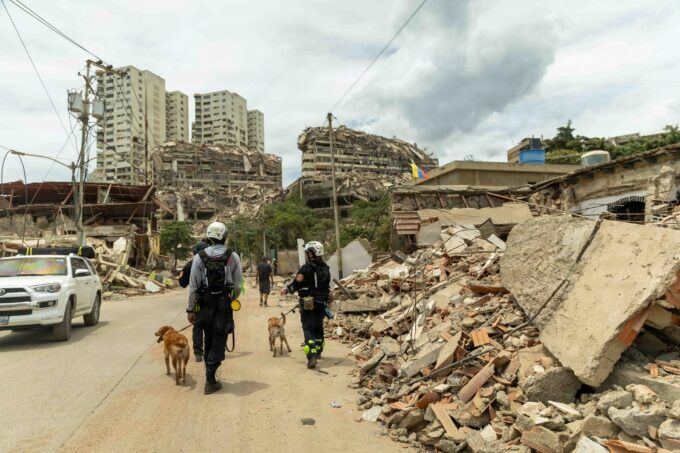
Photograph Source: U.S. Marines 24MEU by Lance Cpl. Allison White – Public Domain

Earthquakes interrupt everyday life, but not history. Nor do they suspend politics. If anything, they compress history into a few dramatic days, revealing social relations, political projects, and geopolitical forces that ordinarily remain beneath the surface. The Venezuelan earthquake is no exception.

As we argued in a recent article, the quake’s impact spread along material and social fractures that were already carved deep by a decade of crippling sanctions and other imperialist aggressions. In its wake came inevitable struggles over sovereignty and meaning. Although centered in Venezuela, these struggles belong to a broader historical picture: the increasingly aggressive attempt to reassert U.S. domination over Latin America.

The ground had hardly stopped shaking before Washington began advancing its agenda. A naive or hopeful observer might have expected the U.S.-led campaign against the Venezuelan government to ease at this point. After all, Caracas had made a series of concessions to the U.S. under extraordinary military and economic pressure in the post–January 3 period. Instead, the opposite happened.

Within hours of the earthquake, an intense information war got going. Even as thousands of firefighters, civil protection personnel, members of the Venezuelan armed forces, health workers, communal organizations, and volunteers were being deployed to the hardest-hit areas, most of the international media moved in lockstep to deny it. Against all evidence, they insisted that the Venezuelan government was absent—that there was no state response, no civil defense, no organized rescue effort.

Of course, no country is ever fully prepared for a disaster of this magnitude, much less one that has endured years of imperialist economic war. Yet the actual response, impressive in both scale and commitment, was systematically erased from public view. Later, corporate media portrayed every government measure—from coordinating rescue operations and organizing shelters to regulating the flow of humanitarian aid—as evidence of “authoritarianism.”

To be clear, these narratives did not emerge only from the pro-imperialist corporate press. They also spread through social media and ostensibly “independent” voices. Yet the remarkable uniformity of these messages points to their being part of an organized campaign. That is the only way to account for their employing the same framing devices, containing the same omissions, and arriving at the same conclusions.

Moreover, the corporate media lost no time in amplifying the most aggressive social media posts as part of its effort to delegitimize the Venezuelan government and sow political discontent amid legitimate grief and mourning, thereby reinforcing the notion that only external intervention could rescue the country.

This reveals that Washington’s objective has never been limited to the extensive economic concessions it obtained after January 3. In fact, it pursues the complete dismantling of Venezuela’s revolutionary project, which integrates state power and organized popular forces. What is ultimately at stake is the unfinished project of recolonizing Venezuela—and, in a broader sense, the Latin American region.

That is why the information war matters. It is not simply about dominating the news cycle. It is about preparing the political ground for further advances in the project of recolonization. The pattern is familiar. Throughout the history of U.S. intervention in Latin America and elsewhere, before it intervenes, a story must first be fabricated: that the state has collapsed and what remains of it is authoritarian, that the government has abandoned its people—in short, that sovereignty itself has become an obstacle to humanitarian relief.

The battle over narratives is therefore not secondary or superficial—it is one of the principal theaters through which imperial power seeks to manufacture political consent for intervention against a Global South nation.

Washington wants the whole nine yards

In 1999, long-time anti-imperialist Muammar Gaddafi started a process of reconciliation with the US and Europe. This came after a long period of cruel sanctions and other imperialist aggressions against the Libyan people. The first step Gaddafi took was handing over the Lockerbie suspects for trial in the Netherlands. Then came the diplomatic normalization that happened in 2002–03 and further rapprochement in the years to come.

The outcome represents an important lesson for anti-imperialist projects ever since. In 2011, Libya—concessions and rapprochement notwithstanding—would be bombed by NATO and Gaddafi murdered by British special forces. This occurred as U.S. Secretary of State Hillary Clinton pronounced, “We came, we saw, and he died!”

The parallels between Libya and Venezuela are many, but it is important to locate the historical moment with precision. As in Libya before 2011, Venezuela has, in recent months, responded to sanctions and other attacks with concessions and rapprochement, but it has not been defeated, and it continues to represent a symbolic and material threat. Washington knows this very well. For its leaders and strategists, the persistence of a Venezuelan revolutionary bloc that connects the leadership and masses remains unacceptable. That is the next target of imperialism, and it is also what we must defend.

There is ample evidence that the Chavista revolutionary bloc still survives in Venezuela today. Despite years of sanctions, financial siege, military threats, the naval blockade, and the traumatic events of January 3, the essential architecture of the Bolivarian Process remains in place. The state has not collapsed. The armed forces have not fractured. The communal movement continues to organize social life and participate in governance all across the country. Thousands of middle-level cadres serve as a conveyor belt between the masses and the leadership. Thus, Chavismo continues to constitute a mass political subject tempered in three decades of revolutionary experience.

This explains why the corporate media offensive following the earthquake has been so relentless. The objective is not simply to criticize the government’s response. It is to weaken the entire Bolivarian Process by driving a wedge between the organized people and the state, while preparing the ground to justify a permanent ground invasion nationally and internationally. For imperialism, it is the people-state relationship—not merely a president, a party, or any particular policy—that constitutes the decisive target.

For all these reasons, people who cry out, “All is lost and Venezuela is a mere US protectorate” are failing to understand the concrete situation and historical moment. All is not lost, and imperialism knows this very well. Our enemies understand the shape of the current battlefield. Too bad so many opinion-makers historically on our side—alleged leftists and anti-imperialists—are helping them destroy the revolutionary bloc by attempting to turn the masses against the leadership.

A continental turning point

The Venezuelan earthquake and the events surrounding it must be understood within a broader continental context: an increasingly rapacious U.S. effort to reassert its hegemony over Latin America through economic coercion, military pressure, and political intervention. The arrival of U.S. Marines under the banner of humanitarian assistance to Venezuela is not an isolated episode. Across the continent, imperialist domination is becoming more direct, more overtly military, and less inclined to hide behind the language of cooperation and development.

It is precisely under these conditions that Latin America must recover Simón Bolívar’s project of continental integration as the Patria Grande and remember José Martí’s warning about “the giant with seven-league boots.” Both understood that true independence could never be secured by fragmented republics confronting imperialist power one by one. Sovereignty required the unity of Nuestra América (Latin America and the Caribbean). That lesson has lost none of its urgency.

What is changing today is not imperialism’s substance but its form. The United States is increasingly abandoning the pretense that hemispheric control can be exercised through trade agreements and soft power. Economic coercion remains central, but it is now accompanied by naval blockades, military deployments, kidnappings, extraterritorial bombings, lawfare, shameless electoral intervention, and an increasingly explicit willingness to project brute force throughout the region.

Venezuela illustrates this with particular clarity, but it is not unique. Cuba is living through a cruel tightening of the already genocidal U.S. blockade and facing new levels of military threat. In Ecuador, the restoration of a U.S. military foothold signals the country’s reintegration into Washington’s regional strategic architecture. Meanwhile, newfangled forms of dictatorship and fascism (Bukele, Milei, de la Espriella) promise complete prostration of their countries before imperialism and Zionism. These developments are pieces of a larger imperialist agenda and speak to Latin America’s urgent need to defend its sovereignty collectively against an aggressive project of de facto recolonization.

Solidarity with awareness

Solidarity with earthquake-stricken Venezuela has taken many forms, and most of it has been valuable both materially and in raising morale. However, friendly nations, organizations, and individuals who wish to help Venezuela in the most effective way should not do so with historical amnesia or political naïveté. In the current context, meaningful solidarity can take material form, but it also requires challenging narratives that erase the work of the Venezuelan government and the organized people, thereby facilitating further imperialist domination.

It is therefore important to emphasize that, even if the earthquake exposed the devastating consequences of the U.S. sanctions regime and other aggressions, it also brought to light the potential of the emerging social metabolism of communal organization. The rapid mobilization of communes, workers, and volunteers did not emerge spontaneously from the disaster itself. It was the product of a long process of political organization whose significance extends well beyond emergency response.

More broadly, defending Venezuela’s sovereignty is not simply a Venezuelan question. It is part of a broader struggle over whether Latin America will remain a collection of isolated republics each confronting imperialist power alone or become, at last, the Patria Grandeenvisioned by Bolívar and defended by Martí, Fidel, Chávez, and so many others.

The earthquake did not interrupt that history. It merely reminded us that, even amid tragedy, the continent’s unfinished struggle continues. The essential task is to ensure that the peoples of Latin America emerge from both the literal and metaphorical rubble of the broader imperialist offensive with their sovereign projects and emancipatory goals intact.

This first appeared on MROnline.


#Venezuela: La Guaira's mass #graves take in unclaimed bodies

Issued on: 08/07/2026 -

With #Venezuela continuing its search for #victims of the twin #earthquakes that hit the country on June 24, people have started burying the #dead. Mass #graves are being dug up to take in those identified bodies who remain unclaimed. France 24's Maxime Pluvinet went to one of them in #LaGuaira, one of the most affected areas.



Tuesday, July 07, 2026

The Challenge in Facing 4 July in the United States

Source: AlterInter

There has been something almost surreal in President Donald Trump’s efforts to both whitewash US history as well as make 4 July a celebration of his own delusional greatness. There is little that can be done about the latter, but for all progressive forces, there is certainly something that must be done regarding the efforts towards the former.

For the purposes of this essay, we shall leave aside Trump’s 3 July speech about the alleged threat of “communism.” Instead, we shall focus on the problem of history.

The challenge in the United States is that we are taught to be suspicious of history, if not hate it. Instead, we are encouraged to embrace myth. Though this may sound strange, if not implausible, it makes perfect sense when one understands the USA as having resulted from a settler-colony. Think about it for a moment. A factually accurate history of the origins of the United States would read something like this:

In 1607, a group of English colonists invaded a territory in what is now known as ‘Virginia,’ a territory occupied for thousands of years by an indigenous population, and began a process of seizing land and people, spreading disease and introducing slavery.

There is nothing in that statement that can be challenged. The problem, of course, is that such a telling is not a wonderful way to start a narrative about the greatness of one’s country. More importantly, the actual history of a settler-colony is one that always questions the moral legitimacy of the state established as a result of the colonization process. This challenge or question acts as a perpetual nightmare for the resulting state and those who support it, whether such support is passive or active.

Thus, “July 4th” is complicated by both the contradictory nature of the 1775-1783 war of independence, as well as due to being a part and parcel of a longer and equally contradictory history of what came to be the United States. It is this that Trump and his MAGA minions wish to suppress and, both literally and figuratively, whitewash.

The reality of US history is the actuality of contradiction. There are really two histories of the United States, each having its own respective subsets. And it is these two histories that are irreconcilable, even when they may agree on certain specific facts. There is the history of the United States from the standpoint of those who have sought to construct a capitalist state, in effect a white supremacist, male supremacist imperial state. Separately, there is the history of the USA from the standpoint of the subaltern classes and groups, a history of class struggle; a history of the struggles against white supremacist national oppression; a history of the struggles against patriarchy/male supremacy; a history of the struggles against the capitalist degradation of the environment; a history of solidarity with oppressed populations in other parts of the planet.

These irreconcilable histories—that of the ruling groups vs those of the subaltern classes—are what we find at stake when we are asked to celebrate 4 July. Do we uphold the rhetoric of the signatories of the Declaration of Independence regarding life, liberty and the pursuit of happiness, or do we dig deeper and unpack their attack on Native Americans and their fury with King George III for the Proclamation of 1763, halting colonial expansion beyond the Appalachian Mountain range? Do we turn a blind eye to the signatories’ repudiation of the British King for attempting to turn the settlers into “slaves,” when the settlers overwhelmingly embraced slavery? Can we, in other words, remove myth, and grasp the facts and currents of history in order to understand the circumstances and actions that have led us to where we find ourselves today, both domestically and internationally? Can we utilize history, to be blunt, in order to grasp the roots of rightwing populism and neofascism in the USA and, perhaps, get a sense how to utilize the history produced by the subaltern classes against the tyrants?

Those are the questions with which I leave the reader on this, the 250th anniversary of the signing of the Declaration of Independence.

Bill Fletcher, Jr. is a longtime socialist, trade unionist and international solidarity activist in the USA. He is a cofounder of standing4democracy.org and can be followed @BillFletcherJr; billfletcherjr.com.


This article was originally published by AlterInter; please consider supporting the original publication, and read the original version at the link above.Email
avatar

Bill Fletcher Jr (born 1954) has been an activist since his teen years. Upon graduating from college he went to work as a welder in a shipyard, thereby entering the labor movement. Over the years he has been active in workplace and community struggles as well as electoral campaigns. He has worked for several labor unions in addition to serving as a senior staffperson in the national AFL-CIO. Fletcher is the former president of TransAfrica Forum; a Senior Scholar with the Institute for Policy Studies; and in the leadership of several other projects. Fletcher is the co-author (with Peter Agard) of “The Indispensable Ally: Black Workers and the Formation of the Congress of Industrial Organizations, 1934-1941”; the co-author (with Dr. Fernando Gapasin) of “Solidarity Divided: The crisis in organized labor and a new path toward social justice“; and the author of “‘They’re Bankrupting Us’ – And Twenty other myths about unions.” Fletcher is a syndicated columnist and a regular media commentator on television, radio and the Web.

No Holiday for the Indentured

Source: Originally published by Z. Feel free to share widely.

Well, the propaganda they sell us like soda water is that ‘ We are a free country and everyone has the opportunities to succeed in life.’ Ok, and since we are immersed as a nation in the quicksand of non unionism ( less than 7 % of private sector workers are in unions) many working stiffs have become 21st Century Indentured Servants. In feudal times the indentured servant had to work for the boss just to stay above water financially. You lose a week or two of work due to illness and you’re up the creek. Gone!

Let’s take one example this writer found by chance today. This is what it means to be an indentured servant on the  250th anniversary of America: The retail clerk with a broken wrist. I will call her ‘ Ms T ‘ working for her 15th year at the place earning $10.50 per hour with no benefits etc. She said she fell at home, the one she rents for her family at $1800 a month in town. Had to rush to the ER, has NO insurance ( she said even ObamaCare wanted $ 300 a month with a one year wait for real coverage. Between the ER and then being admitted as a patient they charged her $20k, with her wrist surgery costing $50k ( believe it or not). Obviously she asked for some charity from the hospital and surgeon’s billing, and they will be getting back to her with an answer. The woman is 59 and to put it bluntly ‘ Up the creek!’ Is this what our founding fathers anticipated or is this simply the way it always was and is?

Imagine if that store clerk belonged to a union and had the same Medicare that I have. She would still owe money, and without a supplemental plan, at least 20% of said bills would be her concern. Is this what we should be celebrating on July 4th? You can take all the fireworks and hot dogs and burgers and stuff em until those in power act like working stiffs and not the indentured servants of the super rich! As my late great union organizing  pal Walt DeYoung put it : ‘Nuff Said’.Email

Philip A Farruggio is a free lance columnist, host of a radio interview show and lifelong Anti War Activist. He is son and grandson of Brooklyn, NYC longshoremen and a graduate of Brooklyn College, Class of '74. He has a blog on the itstheempirestupid.com website produced by Chuck Gregory. You can find Philip's work on many sites such as Countercurrents, Dissident Voice, Nation of Change and Muck Rack.


The Plot to Ruin America


 July 7, 2026

Image by Koshu Kunii.

Nothing encapsulates the decline of the American project quite like the optics of its 250th anniversary. While four hundred masked neo-fascists marched through the capitol in navy-blue button-downs and khakis chanting “Reclaim America!”—entirely unchallenged either by police or antifascists—the official Independence Day parade was canceled because of extreme heat. It’s a disturbing vignette for our era. The country is turning far to the right and becoming too hot to even celebrate its own founding myths, reaching temperatures that climate scientists said would have been “virtually impossible” before human-caused climate change.

So who’s to blame for this current mess? Predictably, the political class has no interest in examining the structural decay. In two back-to-back speeches this weekend, President Trump workshopped a new scapegoat: communism. The tone summoned the anger of his 2017 inauguration speech, “American Carnage,” when he blamed open borders and foreign nations for gutting the American Dream, carefully avoiding the corporations that plundered the working class and spoiled the land. But his second term is less focused on hardening borders and more focused on what he calls the “enemy within,” which has included immigrants and anyone potentially critical of U.S. foreign policy, especially the fanatical, bipartisan worship of genocidal Zionism. Trump has met that “enemy” with violent and deadly force, using the Department of Homeland Security as the main instrument of terror in places like Minnesota. That definition of the enemy has expanded to include antifascism, which he has designated a “domestic terrorist organization,” paving the way for the targeting of any organization or individual supporting actions considered “antifascism,” such as immigrant defense or even the broad set of movements and beliefs under the rubric of “anti-capitalism.” In other words, we’re reaching a moment when it’s illegal to be antifascist.

This rhetorical escalation is no accident; it is a calculated electoral strategy. More and more, as an electoral left movement makes key wins in the lead-up to the November mid-terms, Trump will most likely ratchet up his anti-communist rhetoric, painting even the most rabid, establishment anticommunist Democrats as party to a nefarious communist plot. That has already included targeting more organized formations of the socialist and anti-imperialist left.

Viewed in this light, Trump’s speech last Friday at the so-called Shrine of Democracy was probably his most ironic. Under the shadow of Mount Rushmore, Trump went on a dark tirade naming the enemy as the “communist menace,” a movement made up of “illegal immigrants,” “criminals,” “radicals,” “thieves,” and “lunatics” who “come in and loot [and] pillage our nation.” This isn’t just typical rhetorical theater from one of the world’s greatest confidence men. It is the foundational myth-making required to justify a very real domestic police state.

There is no small irony in those accusations. The very ground beneath the president’s feet is stolen land, and the monument itself is a permanent testament to the exact kind of looting and pillaging he attributes to Marxist agitators.

If you possess even a baseline level of cognitive function and haven’t succumbed to total historical brain rot, Trump’s ultimatum should make you laugh and perhaps cry. He stood beneath the shadow of thieves and men who had looted and pillaged Indigenous land. The shrine had been built at the final destination for what was once known by the Lakotas as the “Thieves Road,” the trail Custer had illegally carved into the Black Hills in 1874 in search of gold. But don’t take my word for it. The Supreme Court declared the ground beneath Trump’s very feet stolen land—that is, pillaged and looted. In fact, it called the settlers and miners who had entered the lands known as He Sapa trespassers, ruling in 1980 that the starvation-driven coercion used to strip the Sioux of the Black Hills was a profound constitutional violation.

The irony is that the only thief present at Mount Rushmore that day was the very country holding the party. Trump’s warnings about a ‘communist menace’ threatening American heritage are just a projection trick—it’s an inversion of reality, where the oppressors have become the oppressed, and the invaders act in self-defense against the very people they have robbed and slaughtered. This projection and inversion is central to the very American identity Trump claims is under attack.

“You can be loyal to Karl Marx or you can be loyal to America,” he said. “You can be a communist or you can be a patriot. You cannot be both.” The ultimatums are spurious but appear to create a loyalty test, forcing a choice between standing with genocidaires and slavers, and their apologists, or with those who tried to overthrow those violent systems of oppression. (I think I know what side we’d all like to be on.)

Those supposedly loyal to the nineteenth-century German political economist spread “lies about our heritage” and “tell our children that we live on stolen land or that our heroes were oppressors.” But one has to wonder about the legacy of Marx as a European when he said of the historical reality of class revolution, “as the American War of Independence initiated a new era of ascendency for the middle class, so the American Antislavery War will do for the working classes.” Or when he described just how the ascendancy of that bourgeoisie was achieved in the first volume of Das Kapital, where he dryly noted that the dawn of capitalist production was “[t]he discovery of gold and silver in America, the extirpation, enslavement and entombment in mines of the aboriginal population” of the Americas.

Understanding that modern capitalism required genocide and plunder is, apparently, quite scary. Trump has met rhetoric with action, and we should take note.

In his second term, Trump has waged an all-out assault on his political opponents, primarily those on the left. Specifically, that includes what he laid out in his National Security Presidential Memorandum 7 (NSPM-7), titled “Countering Domestic Terrorism and Organized Political Violence” and signed on September 25, 2025. The directive fully recalibrates post-9/11 counterterrorism objectives to target domestic political speech, organizing, and funding. I wouldn’t say it is the darkest chapter in U.S. history, but we should take serious stock of how easily the post-9/11 security apparatus—originally built to hunt down and kill “terrorists”—has been seamlessly turned inward to criminalize domestic dissent, freeze the bank accounts of progressive non-profits, and treat local antifascist activists like insurgent cells. It has effectively implemented widespread counterinsurgency in the absence of an actual insurgency.

After all, fascism isn’t new to the United States, and it hasn’t historically had to don the mantle of fascism to operate. Whether it was the genocidal blood quantum laws of federal Indian policy or Jim Crow racial segregation, European fascists took much of their inspiration from the colonial and white supremacist legal regimes of their American counterparts when they drafted documents such as the Nuremberg Laws.

And climate crisis aside, it is worth making a controversial point: our present state of affairs is far from the most repressive or authoritarian era the United States has ever seen. I’m not saying it can’t get worse—it could. But it also could turn out another way, if people are willing to fight for an alternative. That’s not to minimize the real and terrible danger of the current moment and the necessity to confront it and build alternatives. Rather, it serves as a baseline for reality. As a student of history and a historical subject myself, it is humbling to read the stories of our ancestors—how they survived genocide through everything from everyday acts of defiance to organized resistance movements that undoubtedly staved off complete annihilation.

This piece first appeared on Red Scare.

Nick Estes is a citizen of the Lower Brule Sioux Tribe. He is a journalist, historian and co-host of the Red Nation Podcast. He is the author of Our History Is the Future: Standing Rock Versus the Dakota Access Pipeline, and the Long Tradition of Indigenous Resistance (Verso, 2019).