First published at Zabalaza for Socialism.
Every country gets the fascism that it deserves.
The arrival of the uMkhonto weSizwe Party (MKP), March and March and a set of allied organisations on the political stage is not just a matter of new forces emerging within the field of contestation. It is also an ongoing and rapid reconfiguration of the field. This reconfiguration is restructuring the foundations of political life, displacing democratic rules, norms and aspirations and filling the vacuum left by the collapse in social hope with organised cruelty. It does not yet have the power to repeal democratic laws but its acid is dissolving the idea of the people on which democracy, and the laws that institutionalise it, depend.
Elements of this reconfiguration, such as the scapegoating of migrants for social suffering; the normalisation of fascist language; the offer of the exercise of libidinal excess, socially sanctioned sadism and a sense of ethnic or national superiority as compensation for social humiliation; and the ruthless paid-for weaponisation of the corporate monopolies that own and manage the infrastructure for online sociality, follow developments elsewhere in the world. The same is true of the paranoid cast of mind central to this politics which draws lines between unrelated dots with frenzied energy. ‘Myth is’, Benito Mussolini said a few days before the march on Rome, ‘a faith, a passion. It is not necessary that it be a reality’.
This is the playbook that brought Donald Trump and Giorgia Meloni into power, and figures like Nigel Farage, Marine Le Pen and Geert Wilders into national prominence and influence. It may yet bring Farage and Le Pen into power despite their current troubles. But while far-right and fascist politics always require the cultivation of internal enemies the migrant is not the only available option. There are always a range of targets and they always intersect.
In Brazil Jair Bolsonaro built a political project around the racially inflected demonisation of the left and the ‘criminal’, along with feminists, homosexuals, and others. In the Philippines Rodrigo Duterte built a political project around the dehumanisation of impoverished meth users and street dealers. In El Salvador Nayib Bukele rose to power by presenting the criminal as an existential social threat. In India the primary target of fascist politics is the Muslim.
Xenophobia is almost inevitably mediated through class and entangled with racism, and, particularly in Europe, often entwined with Islamophobia. The desire to ‘restore’ the authority of men is seldom innocent of race, caste or other forms of domination. The same is true of paranoia about the left which also often includes hostility to freer thinking about sexuality and gender. The political mobilisation of the figure of the criminal is always tied to a set of potent context-specific prejudices.
In South Africa the ongoing political assault on the constitutional order driven by predatory and at times criminal political and economic interests has strong currents that aim to ‘restore’ the authority of men, some of which have experimented with adding homosexuals as targets, has always included progressive lawyers and NGOs in its line of fire, includes explicit opposition to human rights and the Constitution, and has recently, in the matter of a day, moved to include the Muslim.
Emancipatory nationalism gives way to chauvinism
Precolonial forms of popular politics in what is now South Africa were organised through hybridity and movement. Affiliation to particular polities was not reducible to ethnicity. It was colonialism that sought to fix Africans into ‘tribes’.
Apartheid, following earlier colonial forms of governance, assigned every African person an ethnicity (a ‘tribe’ in colonial terms), every ethnicity a territory, and limited rights, primarily the right to land, to that territory. The ultimate aim was to strip Africans of South African citizenship and remake them as ‘foreigners’ in most of the country.
From its beginning the African National Congress (ANC) opposed this and affirmed a national identity. Pixley ka Isaka Seme’s 1911 call for its founding conference demanded that the divisions between African peoples ‘be buried and forgotten’, and declared: ‘We are one people’. As the struggles against colonialism and apartheid developed, wider identities were affirmed, beginning with Ethiopianism’s assertion of African self-governance in the church. The Industrial and Commercial Workers’ Union (ICU), the mass movement of the 1920s, organised the worker and the peasant as a single political subject through a syncretic politics that carried Garveyism’s affirmation of a universal African dignity and its promise of redemption alongside Christian millenarianism and trade unionism. The movement spread far beyond South Africa, with branches in what are now Namibia, Zimbabwe and Zambia.
The Africanism of Anton Lembede’s generation in the 1940s was renewed in the Pan Africanist Congress (PAC), founded under the leadership of Robert Sobukwe in 1959 in the wider ferment of decolonisation, whose emancipatory horizon was a united Africa. Fifty years after Garveyism electrified people across the region through the ICU, Steve Biko’s Black Consciousness affirmed an inclusive black identity, embracing everyone not counted as white by the system of oppression.
The trade unions built from the Durban strikes of 1973 organised workers as workers. The United Democratic Front, formed in 1983 and largely grounded in communities where people were organised as residents, affirmed a non-racialism rooted in the Freedom Charter’s declaration that South Africa belongs to all who live in it. At many points in this history people born outside what is now South Africa were part of these struggles, including in positions of leadership. The ICU was led by Clements Kadalie, a migrant from what is now Malawi, and the National Union of Mineworkers (NUM), the largest union in the country’s history, was built under the leadership of James Motlatsi, a migrant worker from Lesotho.
These struggles always included contending currents, some of which carried chauvinisms of various kinds, but the insurgent idea of an inclusive nation, along with still more capacious forms of political identity, was built in struggle. As the political drama moved towards a denouement in the 1980s the enemies of that struggle came to include a reactionary and violent form of Zulu nationalism articulated to white supremacy.
In 1961 Frantz Fanon had cautioned that anti-colonial nationalism, while essential, was not, on its own, enough. He warned that ‘a rapid step must be taken from national consciousness to political and social consciousness’, and that if the idea of the nation is not given meaningful social content, nationalism can pass ‘to ultra-nationalism, to chauvinism, and finally to racism’.
In South Africa the signs of that degeneration arrived quickly. The first major xenophobic violence after apartheid was in Alexandra, Johannesburg, in December 1994. Michael Neocosmos shows that from the outset of the democratic experiment the repeated association of migrants by politicians with crime, unemployment, disease and illegality created the political conditions in which xenophobic violence could fester. He also notes that during the xenophobic attacks in Zandspruit in 2001, officials from the departments of home affairs and labour joined residents in what they called ‘Operation Clean Up’, an ‘operation’ aiming to ‘root out illegal immigrants’. The state has been deputising the mob to act against migrants for a quarter of a century.
The killing begins
The May 2008 pogroms began in Alexandra with armed men from the Madala Hostel singing Umshini Wami, a song associated with Jacob Zuma. When the killing stopped 62 lives had been taken, including those of 21 South Africans, mostly of minority ethnicities. Around 670 people were injured and 100,000 displaced. When the death toll is disaggregated by nationality for migrants and ethnicity for South Africans it becomes clear that South Africans of Tsonga ethnicity were the largest single group of people killed.
When the violence began in Johannesburg Abahlali baseMjondolo, a multi-ethnic movement of impoverished people, met in Durban to discuss the situation. The meeting concluded that ‘A person is a person wherever they may find themselves’ and the movement has opposed xenophobia, in principle and in practice, ever since.
Xenophobia is always the politics of xenophobes, never the people, or a particular class among the people, as a whole. It is always an ethical and political choice and is, globally, a fundamental line dividing the left from the right. In South Africa today it is also opposed by the Economic Freedom Fighters (EFF), the South African Federation of Trade Unions (Saftu) and a range of smaller progressive organisations, some of which are linked together in the new Siyafana Sonke Action Campaign.
The mob that began killing in May 2008 acted in the political space opened by Jacob Zuma’s insurgent challenge to both Thabo Mbeki’s personal leadership of the ANC and the wider norms of the ANC and the constitutional order. That challenge, which summoned ‘the people’ into a reactionary project, began with the grim scenes at the start of Zuma’s rape trial in March 2006 and culminated in his victory at the ANC’s national conference in Polokwane in December 2007. Echoing the speed of Silvio Berlusconi’s ascent to power in Italy, and foreshadowing the velocity of later authoritarian populist breakthroughs, such as the election of Trump and Bolsonaro, it transformed South African politics in less than two years, opening a new political drama that is still far from its final act.
The mob was also following the logic of the state. At around midnight on 30 January 2008 police and immigration officials had stormed the Johannesburg Central Methodist Church which had become a sanctuary for around 1,500 people, mostly Zimbabweans fleeing political repression and economic collapse. No search warrant was produced. Refugees, including children and pregnant women, were beaten, pepper-sprayed and dragged from the church. Around 300 people were arrested, including documented asylum seekers and people attempting to regularise their status.
Lawyers and medical personnel were initially denied access to detainees who were assaulted, threatened with deportation and held in degrading conditions. In court they encountered a prosecution unable to explain the charges and magistrate Du Pisani’s conduct was so egregious that when the matter was taken to the Johannesburg High Court Justice Sutherland apologised on behalf of the judiciary. He described the proceedings as recalling ‘grotesque obscenities’ that South Africans had hoped had been buried with apartheid, condemned the ‘brutal, indifferent and, indeed, cruel treatment of human beings’, and concluded that: ‘There is no point in liberation if this is the case.’
Prior to the raid the state had systematically dismantled access to the asylum system. The Johannesburg Refugee Reception Office had remained closed to new applicants despite repeated High Court orders requiring it to reopen, making it impossible for many asylum seekers to obtain the documentation that the law required. The state manufactured illegality through administrative exclusion and then used that manufactured illegality to present people as ‘criminal’ and justify violence, coercion, detention and deportation.
This has continued into the current crisis, and does not only result in asylum seekers and refugees being rendered undocumented by the state. All categories of migrants, including the children of documented migrants who have grown up in South Africa, are at risk of being made undocumented by home affairs and then treated as criminal. This is not just a result of inefficiency and incompetence. It is also a direct result of active xenophobic hostility by officials who, like the police, frequently act in violation of the law.
The political project that cohered around Zuma had introduced an openly ethnic politics into the ANC and legitimated it in wider society. It did not take long for mob violence to be ethnically constituted, articulated to elements in the ruling party, protected by the local state, including the police, and directed against people organised outside of the ANC.
In September 2009 armed men identifying as Zulu and widely understood to be acting with the sanction of John Mchunu, then the chairperson of the ANC in Durban, attacked Abahlali baseMjondolo in the Kennedy Road shack settlement, accusing the movement of ‘selling out’ to Mpondo people because it included all residents in the settlements where it organised irrespective of ethnicity. In the years to come it became increasingly common at the local and regional level for politicians and the state to try and tie rights to origin and ethnicity. In Durban impoverished communities were often told that appalling material conditions were due to the presence of ‘people from the Eastern Cape’. Mpondo people were often told to ‘go back to Lusikisiki’.
In 2009 attacks in De Doorns, a farming town in the Hex River Valley in the Western Cape, displaced around 3,000 Zimbabweans. From 2010 onwards, there were repeated attacks on Somali, Ethiopian, Pakistani and Bangladeshi shopkeepers in different parts of the country, typically involving looting, along with, in some instances, arson and murder. In 2013, two Zimbabwean men were killed in Diepsloot in Johannesburg after an anti-migrant mobilisation. Attacks on migrant-owned businesses continued in 2014, particularly in KwaZulu-Natal.
Clean out the rubbish
The immediate trigger for the April 2015 xenophobic attacks in KwaZulu-Natal that took seven lives and displaced 7,000 people, was a speech given by King Goodwill Zwelithini kaBhekuzulu the previous month. Speaking in Zulu the king had said, ‘Let us pop our head lice. We must remove ticks and place them outside in the sun. We ask foreign nationals to pack their belongings and be sent back.’
When the killing started the state sent in the army to enforce a limit on the actions of the mob. But when Abahlali baseMjondolo organised a legal march in Durban against the xenophobic violence, it was violently suppressed by the police. The state then immediately ramped up Operation Fiela, a nationwide campaign against ‘crime’ and ‘lawlessness’. Fiela means ‘to sweep clean’, a term that echoed Robert Mugabe’s 2005 Operation Murambatsvina, ‘Clean Out the Rubbish’, an attack on the urban poor across Zimbabwe in which armed state evictions and demolitions displaced around 700,000 people.
The government insisted that Fiela was directed at ‘crime’ rather than migrants, yet in practice ‘illegal foreigners’ were treated as part of a general concept of criminality that included drugs, possession of unlicensed firearms, sex work, buildings said to be ‘hijacked’ and other forms of perceived urban disorder such as street trading. More than 12,000 people were arrested under the operation, which included unlawful late-night raids, and another raid on Johannesburg’s Central Methodist Church. Inevitably documented migrants and migrants rendered undocumented by home affairs were also targeted.
In October that year while students in the Fees Must Fall movement protested at the top of the High Street in Makhanda, then still known as Grahamstown, xenophobes linked to local ANC structures and the taxi industry gathered at the bottom of the street, appropriating some of the students’ language and displaying posters with slogans such as ‘Foreigners Must Burn’. They then attacked migrant shopkeepers, most of them documented and most of them with South African wives and children. More than 500 people were driven from the town in a systematic attack on migrants strongly inflected with Islamophobia. Municipal councillors openly expressed xenophobic views in the first days of the looting, and the taxi associations carried looters at no cost. The police mostly stood down, sometimes laughed at people whose shops were being looted and, on occasion, participated in the looting, even helping to organise the distribution of stolen goods.
The attacks were bravely contested by members of the Unemployed Peoples’ Movement (UPM), the EFF, and some unorganised local residents, most of them women who, along with their common decency, appreciated the lower prices and access to credit offered by the migrant shopkeepers. The police claimed their ‘restoration of order’ in the town as a success for Operation Fiela.
In 2008 the mob followed the state. In 2015 the state followed the mob.
In 2016 xenophobia started to become central to the new political players beginning to build a project to the right of the ANC. The entrance of Herman Mashaba into national politics marked a significant degeneration in our politics and, via an often uncritical media, the wider public sphere.
Beginning soon after he became the Democratic Alliance (DA) Mayor of Johannesburg in August 2016, Mashaba made xenophobia a defining feature of his politics, repeatedly blaming migrants for crime, urban decay and failing public services. In November 2018, after personally confronting an informal trader in downtown Johannesburg, he tweeted ‘We are [not] going to sit back and allow people like you to bring us Ebolas’.
While the ANC was often complicit with the mob and police abuses against migrants at the local level and its senior leaders routinely conflated migrants and criminals they didn’t typically use such crudely far-right rhetoric. Mashaba was the first politician with access to the national stage to adopt Trumpian style xenophobic populism, including elements of fascist rhetoric. His primary funder is Martin Moshal, the billionaire who grew up in Durban and made his money in online gambling. Mashaba has also been funded by four members of the Oppenheimer family, inheritors of the wealth of what used to be called ‘the commanding heights’ of white monopoly capital.
Murder on the highways
The decisive moment in which xenophobic violence began to take an organised form is when the All Truck Drivers Foundation (ATDF), which enters the public record in March 2018, was founded by Sipho Zungu in Durban. The fact that it was formed in Durban should not be overlooked.
After its 2007 national conference in Polokwane the ANC had its central power base in KwaZulu-Natal. When state capture, a form of the predatory politics described in such scathing terms by Fanon, started becoming systemic around 2010, key administrative and political decisions were being made in the Johannesburg home of the Gupta brothers, around whom the massive theft of public wealth was centralised. The political base that allowed this was effectively in Durban rather than Pretoria or Cape Town. Although its economy is much smaller than Johannesburg or Cape Town, Durban soon became the city with the most rapidly growing number of dollar millionaires.
Zuma’s kleptocratic regime had started to try and legitimate itself in the name of ‘radical economic transformation’ in 2014 but when, under massive pressure, Zuma folded and walked back the attempted appointment of Des van Rooyen as finance minister in December 2015, it became the central ideological strategy. It is crucial to understand that the development and legitimation of predatory relations to public wealth ran throughout the ANC, from the top to the bottom. In KwaZulu-Natal it included violent local extortion networks run by ward councillors, their committees and local party Branch Executive Committees. Local political actors were also increasingly extorting money directly from impoverished and working-class people through mechanisms such as selling government-built public housing and renting and selling land and shacks.
Abahlali baseMjondolo suffered its first assassination in Durban in 2013, and, in that year, David Bruce, a former political prisoner now working as a researcher, showed that the growing problems of political assassinations were concentrated in KwaZulu-Natal and Mpumalanga. They have since expanded into the rest of the country from, in particular, KwaZulu-Natal.
The construction mafia, which began with the formation of the Delangokubona Business Forum in KwaZulu-Natal in 2014, also moved into the rest of the country from KwaZulu-Natal. It justified armed extortion in the name of ‘radical economic transformation’, and was publicly aligned to Zuma. In some instances powerful figures in the rapidly growing extortion economy operated with the open use of armed force more like local militias than the covert force typically used by mafias. This was possible because the police allowed it, and because this kind of extortion had high level political legitimation. Shortly after becoming the mayor of Durban Zandile Gumede moved to incorporate the ‘business forums’ into municipal procurement policies. She is currently on trial for corruption, fraud and money laundering, and has recently announced that she has joined the MKP.
The political repertoire developed by armed groups in the name of ‘radical economic transformation’ was later adopted by groups organised around hostility to ‘foreigners’. This repertoire included claims to represent ‘the community’ without any democratic mandate and disruptive and violent action outside formal institutions. It was enabled by political legitimation from sections of the ANC and the state, weak or inconsistent law enforcement, and often outright official complicity. It also presented coercion and extortion as legitimate means of economic redistribution and in the general interest although, of course, it was in the interests of politically connected counter-elites at the direct expense of the general interest. Every million rand stolen from a public budget was a million rand less to spend on social projects, such as healthcare, schools, housing, etc.
When extortion and expropriation were extended beyond the capture of public resources to include people deemed ‘foreign’ it broadened the political and social base for coercive accumulation justified in the name of nationalism. This was essential for predatory political elites to sustain a political machinery.
In Durban there has been a significant shift away from manufacturing and towards logistics — imported goods taken from the harbour to warehouses and then, because predatory political forces destroyed the state rail system, moved on via the trucking industry. In the city in which the trade union movement was rebuilt after the 1973 strikes the ATDF, which has no democratic structures, spurned trade unionism in favour of murderous extortion. When asked how the organisation raised its funds, Zungu answered that it did not need money and said that he did not know its membership numbers but nonetheless insisted that it spoke for all South African drivers. This kind of claim to representivity without any democratic mandate to speak for a constituency, or any organised systems of accountability to a constituency, remains typical of xenophobic organisations.
The ATDF’s demands included the immediate dismissal of all ‘foreign nationals’ employed by transport companies, the immediate employment of workers supplied by the organisation, and the payment to the ATDF of a monthly fee for every person supplied. From the beginning this was a project that fused xenophobic mobilisation with extortion, something that is now endemic. The people removing migrants from their businesses and jobs frequently assume or demand the right to decide who will replace them.
The violence that followed the formation of the ATDF was sustained, coordinated and openly murderous. Trucks were petrol bombed and drivers deemed ‘foreign’ harassed, stoned, stabbed, shot and burnt. In three weeks in May 2019 more than 60 trucks were petrol bombed. By mid-2019 the Road Freight Association estimated that more than 200 drivers had been killed since March 2018, with damage to vehicles and cargo put at R1.2 billion.
The violence soon moved out of KwaZulu-Natal. In Witbank about sixty people claiming affiliation with the ATDF blocked the R544, stopped every passing truck and ordered drivers to produce their documents. More than 300 trucks were seized in a single day. In Ermelo eight men, some armed with handguns and identifying themselves as ATDF members, threatened to kill five drivers unless they abandoned their vehicles. The assumption of the authority to demand documents was pioneered, at gunpoint, on the roads.
ATDF leaders denied responsibility in public while inciting and organising violence via private channels. When the Positive Freight Solutions Forum, representing truck owners, obtained an interdict from the Pietermaritzburg High Court in May 2019 against Zungu and three other ATDF leaders for a series of lootings and burnings of trucks along the N3, the ATDF responded by rallying outside the court. Men in ATDF-labelled military fatigues demanded that ‘foreign’ drivers — referred to with the highly pejorative term ‘makwerekwere’ — must be wholly excluded from the industry and, in a perverse appropriation of a slogan originally developed in the 2015 student movement, held banners reading ‘Foreign Drivers Must Fall’.
As the attacks on ‘foreign’ truck drivers continued a driver said to researchers that burning trucks was insufficient because companies had insurance and could replace them, so the drivers themselves had to be attacked and burnt.
In a pattern that was first seen in 1994 and continues today the complicity of the police was brazen. Tinei Takawira, a Zimbabwean driver, was pulled from his truck and stabbed on the South Coast Road in Durban in March 2019 while the police looked on, neither apprehending the attackers nor helping him get medical care. Another Zimbabwean driver described being forced to hand over his documents to a group of men on the N3 in front of police officers who sat watching from their vehicle. When the police did act, they did not act seriously. Then police minister Bheki Cele announced 91 arrests in June 2019, but those arrested were only charged with minor traffic offences.
This continues to be how the state typically responds when pressures mount for it to be seen to be acting against xenophobic violence. The police arrest a few people here and there, almost always minor players with little social power, while failing to act against the people organising the violence, even when they openly violate the law. Hate speech, something that requires no complicated investigation, is not prosecuted.
In another development that endures into the present the ANC adopted much of the ATDF’s framing. At an inter-ministerial meeting in Durban in June 2019, held at the height of the killing, the ministers of home affairs, transport and labour resolved to end the employment of undocumented drivers, and then transport minister Fikile Mbalula declared that the root cause of the crisis was the ‘oversupply’ of ‘foreign drivers’ in the industry. The cause of a campaign of murder was ascribed to its victims. The department of employment and labour then inspected sixty companies, including forty-seven flagged by the ATDF itself, the state deploying its inspectorate against a list drawn up by a violently criminal organisation.
The ATDF has claimed that eighty per cent of drivers were ‘foreign’. Of the 3,047 drivers at the inspected companies, 2,244 were South African born, and the bargaining council confirmed that by far the majority of drivers under its jurisdiction were citizens. Nonetheless, in July 2020 an ATDF spokesperson claimed that if South Africans took the jobs held by ‘foreigners, all South Africans would be employed’. The facts were irrelevant. They never are in this politics, which runs on myth in precisely the sense Mussolini intended and contemporary far-right and fascist politicians like Trump, Bolsonaro and Modi understand all too well, as does Zuma and the grim collection of opportunists, many of whom lie with psychopathic fluency, that surrounds him.
There are very few countries that have ceded this kind of space to armed violence on this scale outside of civil wars. Where it has happened, such as with the cartels in Mexico, it is understood as a national crisis. In South Africa the organised murder of more than two hundred people was not treated as a major threat to society and the state. The state acceded to much of the logic and demands of this murderous campaign, and even collaborated with it. This too is a pattern that continues into the present.
Building an organised online mob
The velocity with which astutely managed paid-for social media campaigns can simulate the appearance of mass popular outrage means that decades of social progress can appear to be thrown into question within hours.
In much of the world the decisive change in the nature of the public sphere means that new political actors can storm the political stage, sometimes within a matter of months. There is no longer a need to build, capture or work through the mediating institutions once required for political success such as newspapers, mass parties, trade unions, churches and civic organisations, or undertake the slow work of door-to-door canvassing and arranging public meetings.
This is not just a matter of using what Richard Seymour terms the ‘social industries’ to undertake the work of persuasion at previously unimaginable scale and velocity, and without editorial oversight or responsibility. As Seymour shows the social industries are not ‘platforms’. They are designed to actively cultivate and activate ‘our mobbishness, our demand for conformity, our sadism, our crankish preoccupation with being right on all subjects’, while encouraging disagreement to be settled through ‘group humiliation, sudden orchestrations of mob fury’. He warns that what was once celebrated as the democratic ‘swarm’ may instead become ‘the twenty-first century equivalent of fascist street gangs’.
Individual users may conduct themselves in a rational way and with democratic commitments but, even when this is sincere rather than merely performative, the social industries are structurally incapable of serving as a substitute for the meeting, which, as Alain Badiou observes, is ‘the central activity of politics’. Badiou gives philosophical expression to what everyone who has been part of an emancipatory political project knows: emancipatory politics is centred on the meeting, an organised space in which all are expected to think, to think together, to test propositions against experience, and arrive at collective judgements, often via the kinds of dialogical processes in which people learn from each other, and from the flow of the conversation. Frantz Fanon makes a very similar point, describing political meetings ‘as privileged occasions given to a human being to listen and to speak’. The social industries enable a wholly different mode of sociality, one that rewards speed, spectacle, conformity, sadism, conspiracy theory, outright lying, contagious outrage and the performance of domination as opposed to the practice of listening that is central to the kinds of political meetings that enable enduring movements to be built.
Sustained and successful contemporary left projects use the social industries as tools to communicate their events, work and ideas but do not allow them to replace the meeting, the embodied meeting — whether in a local form or a large assembly — or to become sites of collective decision-making. A progressive movement is, as much as anything else, a collection of meetings organised across space and time. These kinds of movements are also often grounded in specific places – neighbourhoods, or the rural and urban communes built by movements such as the Movimento dos Trabalhadores Rurais Sem Terra (MST) and Movimento dos Trabalhadores Sem Teto (MTST) in Brazil, or Abahlali baseMjondolo in South Africa.
Understanding the political moment requires a clear apprehension of how much of the public sphere is now controlled by the corporations that manage the online public sphere, how easily it can be gamed by astute players with a large budget, and how closely what’s left of the media as we once knew it often uncritically follows what happens online.
In South Africa we know much of this from the Bell Pottinger operation ten years ago. But using ‘white monopoly capital’ for misdirection required taking on very powerful forces, forces with the support of the Western powers, domestic media and NGOs along, of course, with white capital itself. Bell Pottinger, and their clients, were dealt a swift defeat and the predatory authoritarian nationalism that had cohered around Zuma was beaten back in the ANC and scattered into other parties, most significantly the MKP.
Taking on vulnerable people such as African and Asian migrants, mostly people living outside the spatial zones of privilege and working in the informal economy or as precarious labour, is a vastly less risky target selection, one that has won the active support or complicity of much of our media, along with a range of other elite actors.
The range of forces that have invested in building political projects around the cultivation of xenophobia radically reduces the risk of breaking from democratic rules and norms through a widening breach in what was, until Zuma’s rape trial in 2006, a fairly entrenched consensus in support of Constitutional democracy. These forces range from actors within extortion networks to traditional authority, the state, political parties, and white capital.
Apart from Mashaba’s Trumpian grotesqueries the first attempt to build a national project around xenophobia was developed through a sophisticated and paid-for digital infrastructure that has been built over the last six years, beginning with the emergence of #PutSouthAfricansFirst in April 2020. As recent analysis by Kyle Findlay, building on earlier research, has shown, this infrastructure links influencers, pseudo-journalistic websites, political actors and coordinated amplification networks able to transform emotionally charged incidents into national anti-migrant campaigns. Networks of anonymous and fake accounts, often coordinated through WhatsApp groups, played a significant role in driving this process.
Its first phase was built around digital organisers such as former soldier Sifiso Gwala, operating through anonymous accounts and ‘radical economic transformation’ aligned organisations. The African Transformation Movement (ATM) — a tiny pro-Zuma party — the ATDF and the uMkhonto weSizwe Military Veterans Association (MKMVA) were central to the initial development of this ecosystem, alongside Mario Khumalo’s South African First party and, later, Operation Dudula, which organised its first public event in 2021.
A key tactic was to move fast to incorporate missing-person cases, crime reports, anti-drug operations, rumours and conspiracy theories of various kinds, such as the claim that certain kinds of voluntary migration are a result of ‘human trafficking’, into wider narratives that attribute crime, social decline and state failure to migrants. The discourse was and is relentlessly crude, aggressive and frequently threatening. The public sphere has been debased, death threats are commonplace, and organisations and individuals that challenge xenophobia are subjected to sustained and coordinated online mobbing, including character assassination and open threats of rape and murder. Irrationalism, dishonesty and conspiracy theory are systemic, a consistent feature of far-right and fascist politics that corrodes democratic norms and practices.
What began as a paid-for campaign largely driven by a few individuals soon acquired genuine traction. As the online mob gathered momentum after 2022, it was joined by growing numbers of genuine users.
X Corp and Meta have been systemically complicit in allowing content that is, in legal terms, hate speech, crimen injuria, criminal intimidation, harassment and incitement. Video showing criminal actions is routinely shared. This complicity includes routine failure to take down posts or block accounts — genuine and fake — after formal complaints have been made.
The South African police have been equally complicit, and while organisations like the Human Rights Commission have made some valuable interventions here and there the human rights infrastructure of the Constitutional order has failed to act against the routine and widespread use of abusive and unlawful forms of online speech, including death threats, in any meaningful way. The ground has been ceded to anti-democratic forces.
Building an organised street mob
We cannot understand the political moment without drawing a clear analytical distinction between the mob — the mob on the street — and democratic and democratising forms of popular power. The mob claims to act in the name of the people without securing any sort of mandate. It is organised around horizontal antagonism, directing hostility towards other subordinated groups rather than the structures of power. It is organised around intimidation, exclusion, extortion and appropriation, and operates in an authoritarian mode. It claims the authority to decide who belongs; whose dignity, safety and place in society will be respected; and who can be placed outside of moral recognition. Insult, slander, threat and violence are central to its power, a power energised by collective sadism.
The fleeting sense of the coherence and value of the self achieved via participation in the mob is built through the humiliation of the other. When the mob seizes material gains through extortion or appropriation, it does so within the logic of a zero-sum game. The mob is fundamentally cowardly, its moral stature lower than that of the high school bully. Aware of this at some level, its claims to moral authority, as being the guardian of the nation, as restoring the standing of men, as taking its place in a long history of courage, are so brittle that it inevitably has a paranoid underside. This is part of why the speech of its leaders is so often marked by an hysterical tone and why they so often seek to mask their ugliness with conspiracy theories and fabrication.
Democratic and democratising forms of popular power are organised around solidarity. Their legitimacy is often grounded in both the democratic processes through which their power is constituted and their struggle for shared gains. At their best they enlarge the sphere of collective agency, enabling ordinary people to deliberate, organise, think and act together in pursuit of shared interests and principles. They build a sense of the value of the self grounded in the affirmation of forms of dignity and solidarity constituted through reciprocity, in the expansion of the count of the human. The gains they secure, whether concrete advances such as access to land or broader transformations in recognition expand the field of political possibility and enable shared social progress.
In the 1920s and 1930s European fascism developed a capacity for organised street violence to break the existing constitutional order. Once the state had been captured, political violence was progressively brought under state control. The mob both delegitimated the existing order and prepared the ground for authoritarian rule by allowing the state to present itself as the guarantor of order in a situation of breakdown.
Today the relationship between the mob — now almost invariably first constituted online before being summoned onto the streets — and the party and the state takes different forms. In the United Kingdom racist violence against migrants has been episodic and local. The mobs that were called to attack the Capitol in the United States and the Praça dos Três Poderes in Brazil were quite different in that they sought to make a sudden and decisive intervention in national political power.
In India the mob has become a permanent part of political life, articulated to both the ruling party and the state. While elections continue, Hindu nationalist organisations, some well described as fascist, patrol neighbourhoods, intervene in disputes over land and housing, police interfaith relationships, attack Muslims and other minorities, and seek to decide who belongs, who may trade, who may worship and who may remain.
The possibility of violence, together with the knowledge that it is unlikely to be punished, shapes everyday conduct. When beatings and murders are shared on WhatsApp they become a pedagogy of domination and fear that rapidly moves across the country. Citizenship remains guaranteed in law, but in practice becomes conditional and precarious. Muslims have increasingly been reduced to a condition of second-class citizenship.
In South Africa the construction and legitimation of the mob is an ongoing process, and the full range of political uses to which it will be put is still to be determined. Nonetheless, it seems clear that we are moving towards a situation analogous in some respects to that in India.
Although it had a media strategy of sorts the ATDF was not able to mobilise street protests at any significant scale and its actions were largely covert, making them more like the operation of a clandestine armed group than a street mob. It took two years to begin to generate street mobs from online mobs.
The transition from the unorganised mob to a paid-for social media campaign and then a small, criminal and violent organisation first took form on 16 June 2021 when Operation Dudula, fronted by the minor but mediagenic celebrity Nhlanhla ‘Lux’ Dlamini, held its first mobilisation in Soweto. From the outset it appropriated the symbolic repertoire of the liberation struggle to legitimate a project that inverted its ethical content. It was crude but had the basic elements of an astroturfed pseudo-movement. Like March and March its funding has never been adequately explained.
Operation Dudula supporters, often dressed in military-style uniforms, organised what they called ‘clean-up’ operations that combined intimidation with direct coercion. Migrant-owned businesses were extorted and shut down, families were driven from their homes, progressive lawyers representing migrants were threatened and harassed, and migrants were insulted, intimidated and assaulted in public.
The first attempts to spark upheaval before and immediately after Zuma’s incarceration on 7 July 2021 echoed what Operation Dudula was doing in Johannesburg. Small unformed groups of men claiming to be uMkhonto weSizwe (MK) veterans attacked migrant stalls in central Durban while the police stood down. These actions did not succeed in igniting any turmoil. That changed after 9 July when trucks were looted and burnt on the N3 at the Mooi River Toll Plaza, and the country’s principal freight artery was closed. Police had been deployed in advance but, for reasons that have not been explained, left their posts. It was here that the state’s loss of control became publicly visible.
This dramatic breakdown in the enforcement of the law opened the way for food riots carried out in a carnival atmosphere, mostly by people making no attempt to support Zuma, in which supermarkets rather than migrant shops were targeted, and migrants were welcomed as participants. The organised mass looting that followed was used as cover for an attempted insurrection by men acting as a covert military force within the tumult and backed with an online strategy in which Zuma’s daughter, Duduzile Zuma-Sambudla, was a key actor along with people like Bonginkosi Khanyile, a former Fees Must Fall activist, and Ngizwe Mchunu, a music promoter and former radio DJ. The police continued to stand down as the situation escalated.
The attempted insurrection was a direct attack on the democratic order but neither the ANC nor the state were willing or able to act against it with any kind of seriousness. It only failed because it ran out of steam and, while it did spark mass looting, it was unable to develop sufficient popular support for its political goals.
Despite all this the state’s accommodation with the ATDF continued. After migrant drivers struck in January 2022 against the dangers they faced the government’s response was to concede to the ATDF and announce a review of the Immigration Act, the Citizenship Act and the Refugee Act. The state has continued to make its migration policies and practices more coercive and brutal when challenged by xenophobic organisations. In May 2024 the ATDF threatened a national shutdown days before the general election, demanding that government rid the trucking industry of ‘foreigners’, and in a now common move aimed at ensuring some plausible deniability by saying that it could not guarantee that others would not resort to violence.
Open violence in the lead-up to elections — as in Jamaica from the 1960s into the 1980s, and in countries such as India, Kenya, Mexico, Nigeria and Pakistan today — is becoming a standard feature of South African political life. The situation is rapidly worsening as political assassinations become more common and xenophobic mob violence is increasingly well organised, and organised at a rapidly escalating scale.
Cultures of cruelty
In societies where the pleasures of sadism have come to compensate for powerlessness, violence can be rewarded at the polls. Aijaz Ahmad recorded the arithmetic of the Gujarat pogrom of 2002, in which more than a thousand people, most of them Muslims, were killed while Modi was the state’s chief minister. In the election that followed, Modi’s party, the Bharatiya Janata Party (BJP), won 52 of the 65 constituencies in which the killing had been concentrated. In the two decades before the pogrom, communal riots in the year before an election reliably lifted the BJP’s vote, and in Gujarat the killing was worst in the areas of the most intense electoral competition.
Operation Dudula became even more brazen after the July 2021 riots. Hospitals, clinics and schools were blockaded while its members demanded identity documents and, in open violation of the law, prevented people they deemed ‘foreign’ from entering. There were instances where people were physically removed from hospitals while undergoing treatment. In Johannesburg Operation Dudula issued eviction notices before returning with weapons, including whips, to drive residents from their homes and repeatedly attacked informal traders and migrant-owned businesses.
Mashaba offered public support to Operation Dudula, as did some currents within the ANC, the police and home affairs. There was also significant media legitimation. An organisation that would have been termed fascist and described and treated as criminal and as a threat to democracy in many other societies was often described and engaged as a ‘civil society organisation’ or ‘citizen’s movement’.
This marked a significant further degeneration of our public sphere. There is a strong resonance with what Ahmad called the ‘cultures of cruelty’ that animate Indian fascism. He stresses that he means ‘something more than professional politicians, more than agencies of the state on the ground, more even than organized communalism; I mean a much wider web of social sanctions…[for]…violence’.
In February 2022 Operation Dudula, led by Dlamini and accompanied by police officers, ‘raided’ the Tsietsi Mashinini Centre, a church-run shelter for refugees and asylum seekers in Soweto. They demanded identity documents from residents, harassed, intimidated and assaulted people and damaged their belongings. Two months later, after Dlamini addressed a gathering in Diepsloot at which he blamed migrants for crime, Elvis Nyathi, a Zimbabwean man, was beaten and burnt alive by a mob that went door to door demanding documents.
The ANC followed the mob. At its National Policy Conference in July that year, delegates proposed ‘a well-coordinated strategy for tracking down illegal foreigners’, including the recommendation that ‘ANC branches must take the lead in this regard’. The following month Pule Mabe, then the ANC’s national spokesperson, said that ‘We can no longer allow criminals, illegal immigrants and rapists to roam around our streets’. A few days later, he declared ‘open season on all illegal foreign nationals’, adding that ‘we can no longer guarantee their safety’. This is, of course, fascist language.
In August, Limpopo Health MEC Phophi Ramathuba publicly berated a Zimbabwean patient in a provincial hospital, telling her, ‘You are killing my health system’. The spectacle marked another step in the normalisation of xenophobic scapegoating by senior ANC leaders, this time taking it into the realm of personal confrontation and humiliation. While outside of Johannesburg and Gauteng far-right populists do not dominate the ANC the party has never acted to discipline or expel them, including Gauteng premier Panyaza Lesufi whom Jacinta Ngobese-Zuma has repeatedly counted as a ‘supporter’ of March and March.
Two weeks after Ramathuba’s public performance of sadism Gayton McKenzie, leader of the far-right Patriotic Alliance (PA), told a public meeting that he would ‘switch off’ the oxygen of a ‘foreign national’ to save a South African patient. He was speaking in Eldorado Park, Johannesburg, at the unveiling of a tombstone for Nathaniel Julies, a sixteen-year-old boy with Down syndrome shot dead by the police. McKenzie’s response to the state murder of a child was to propose the murder of migrants, a threat he later repeated in a television interview.
The Progressive Health Forum called for criminal sanctions describing McKenzie’s threat as an incitement to murder. In a context in which staff at public hospitals routinely deny treatment to people they deem ‘foreign’ in violation of law and policy this was not an overblown claim. McKenzie faced no sanction and has since moved from the margins to the centre of political and public life.
In May 2023 the Socio-Economic Rights Institute (Seri), a movement-driven public interest legal centre acting on behalf of Kopanang Africa Against Xenophobia, the South African Informal Traders Forum, the Inner City Federation and Abahlali baseMjondolo, brought proceedings to interdict Operation Dudula’s campaign of harassment, unlawful document inspections, interference with healthcare and education, and collaboration with elements of the state.
Evidence placed before the court showed that the police had escorted some Operation Dudula marches and ‘missions’, that the department of home affairs had communicated and met with the organisation, and that the SAPS and home affairs had undertaken joint operations in areas Operation Dudula had targeted. There were also numerous accounts of police officers simply failing to intervene when Operation Dudula acted unlawfully. The police not only routinely refuse to intervene against xenophobic violence and often participate in it, but also routinely refuse to open criminal cases when migrants seek to lay charges against their attackers, whether in the police or the mob.
In January 2024 McKenzie first popularised the fascist slogan ‘Abahambe!’ that is now central to the xenophobic mob, online and on the street, during a vigilante media spectacle at the Musina border. His inclusion in the cabinet when the ‘Government of National Unity’ was formed in June has made his extreme xenophobia appear to be a legitimate position within our politics. Once again the ANC tried to take on and include the xenophobia of forces to its right rather than opposing it.
In April, on the eve of the elections to be held in May, a White Paper on Citizenship, Immigration and Refugee Protection was published. It aimed to implement resolutions adopted at the ANC’s 55th National Conference in 2022. It marked a hard turn to the right, proposing to make it much more difficult to claim asylum and to become a citizen, moving refugee reception centres to the borders and keeping asylum seekers at the country’s edge, far from lawyers, supportive NGOs and established migrant communities, enabling the state to deny asylum to people who had passed through another country on their way to South Africa and, in an extraordinary move, withdrawing from the 1951 Refugee Convention and its 1967 Protocol before rejoining with reservations.
When the election came the following month, Zuma’s new party, the MKP, with a rogues’ gallery of disgraced figures in its leadership, won the largest share of the vote in KwaZulu-Natal. Its programme mixed economic nationalism with a hostility to the constitution, a militarised posture, authoritarianism, patriarchal and socially conservative values, and a marked ethnic inflection. It included xenophobic positions, such as the promise to militarise the country’s borders, but xenophobia was neither central to the party nor unusually extreme by South African standards. In Trumpian fashion, it falsely claimed that the election had been rigged.
Zuma’s return to politics, albeit now as the leader of a largely regional party, escalated the debasement of the public sphere, the growing support for authoritarianism and renewed the misrepresentation of private enrichment from public wealth as ‘radical economic transformation’.
In July that year McKenzie incited the online mob against Chidimma Adetshina, a young woman born and raised in South Africa whose Nigerian name and paternal ancestry became the pretext for a vicious xenophobic campaign after she entered the Miss South Africa competition. As usual, much of the media gleefully followed the sadism of the online mob, and a young woman was subjected to appalling public cruelty. If something like this had happened in the United States or Europe it would have been widely understood as grotesquely xenophobic and racist. In South Africa we are so far gone that there was little opposition and, of course, the state scrambled to follow the mob. It is currently trying to deport her.
This is not isolated cruelty. Fola Kester-Akinpelumi came to South Africa from Nigeria at the age of four. He entered the country legally with his father, an IT specialist, who is a documented migrant. His step-mother, who raised him from the age of six, is a South African. He was Deputy-Head Boy at his school, and then began studying chemical engineering at Wits. He had to abandon his studies at the end of his second year after home affairs refused to grant him citizenship or a study permit and he left South Africa for Nigeria, a country he had visited once, on one of the ‘repatriation’ flights recently organised in response to the current crisis. He is not allowed to return to South Africa for five years.
When middle-class people are treated like this it is inevitable that the horrors visited on ordinary people, and especially impoverished people, will be even more grim.
State murder
What Friedrich Engels called ‘social murder’ is a structural feature of South African society. People die in shack fires, from hunger and interpersonal violence, and from the general pressures of impoverishment and inadequate public services. These deaths are not inevitable. They could be prevented, or substantially reduced, if there were sufficient political will. This is, of course, intensely racialised. We should recall that Ruth Wilson Gilmore defines racism as ‘the state-sanctioned or extralegal production and exploitation of group-differentiated vulnerability to premature death’.
The state also commits direct murder. Along with the massacre of striking miners at Marikana in 2012 large numbers of unarmed people have been killed on street protests. People are regularly killed in police custody.
In August 2024 the police sealed the shafts of the abandoned Buffelsfontein mine at Stilfontein in the North West and cut off the supply of food, water and medicine to the men working underground. Mining in South Africa has always sucked men from across the region into the shafts and it is hardly a surprise that the men were from Mozambique, Zimbabwe and Lesotho as well as South Africa.
In November, with families gathered at the mine and men underground already starving, Khumbudzo Ntshavheni, the Minister in the Presidency, announced that ‘We are not sending help to criminals. We are going to smoke them out.’ No party in the ‘GNU’ opposed the coming mass murder by the state, which much of the media legitimated. Dehumanising people by rendering them as ‘criminal’ or ‘illegal foreigners’ in the public imagination legitimates state murder. State murder legitimates mob murder.
Community organisations had to go to court to win the right to send food down the shafts, and went back to court in January 2025 to compel a rescue operation. In the end 246 emaciated survivors were brought to the surface and immediately arrested. Seventy-eight bodies came up with them. The men had died of starvation and dehydration as a direct result of the police blockade. Together with the bodies that community rescue efforts had already carried out during the siege, the number of confirmed deaths reached 93. More bodies are thought to remain in the tunnels.
While the state was deliberately starving the miners to death and, to a significant degree, doing so on the basis that many of them were ‘illegal foreigners’, a massive panic erupted around false claims that migrants were deliberately murdering South African children. In the first days of October 2024 five children in Naledi, Soweto, died within days of each other. A sixth died after a week in intensive care, on the morning of the mass funeral for the other five. Before any post-mortem results were available, before anything at all was known about the cause of the deaths, an intense moral panic moved through online networks following claims that the children had been poisoned by snacks bought from a migrant-owned shop or shops. As the hysteria escalated a widely shared video declared that Pakistani shopkeepers were deliberately poisoning the water supply. Within days migrant shops in Naledi had been invaded, looted and shut down, and shopkeepers had fled the area. Forced closures and looting spread across Gauteng.
In a moment in which reason and evidence were needed McKenzie charged in to call for mass deportations, describing migrant shop owners as ‘terrorists and killers’. Mashaba demanded a state of emergency, called for the army to be deployed to raid spaza shops across the country, and set his party to campaign under the banner of #Spaza4Locals. Inevitably much of the media uncritically followed the hysteria.
This marked a serious escalation in the terms of xenophobic politics. Migrants had long been presented as criminals and competitors for work, housing, services and women. They were now presented as people engaged in the deliberate murder of South African children.
In reality the deaths were the result of both the failure of the state to regulate highly toxic pesticides, and to collect refuse, resulting in people buying these dangerous pesticides to deal with rat infestations. All six children had died from contact with terbufos, a pesticide that is particularly dangerous to children. It has been banned in the European Union since 2009 but continues to be manufactured there and exported to countries like South Africa, a trade that Marcos Orellana, the United Nations special rapporteur on toxics, described as reproducing ‘racist and colonial patterns of exploitation’.
Terbufos is registered in South Africa for agricultural use alone, but widely sold illegally on the streets, at taxi ranks and pension payout points, on trains and in shops. It is not sold by people with any particular national origin and many of the people who sell it are people whose South Africanness is never in question. Of the 84 spaza shops sampled in Naledi, three showed traces of the chemical, and no particular shop could be linked to the deaths of the children.
On 15 November Cyril Ramaphosa said that ‘the investigations that have taken place do not suggest any deliberate campaign to poison children in our country’, and that there was no evidence that the problem was confined to shops owned by migrants. This was a welcome turn to reason in public discourse but although the state disavowed the xenophobic conspiracy theory it quickly acted to institutionalise its logic and moved to check migrant shop owners’ papers and shut down migrant-owned shops. Children continued to die, and by the end of November there had been 23 deaths in three months.
A study of ten years of child deaths at a large Cape Town mortuary, published in 2023, found terbufos to be the cause of death in more than half the cases in which pesticide poisoning was suspected. Children had been dying from terbufos poisoning for years. Two had died in Naledi itself the previous year in near identical circumstances. It is striking that it was only when the deaths of children were falsely ascribed to ‘foreigners’ that they were taken seriously.
When, on 17 July this year, the Public Protector, Kholeka Gcaleka, released preliminary findings into the deaths of 23 children from poisoning in Gauteng she correctly concluded that the deaths were the result of systemic governance and regulatory failures. But although reason had formally displaced myth this was not absolute and her response to a crisis that, by her own findings, was about government failures nonetheless returned to xenophobic language and tropes, implicitly nodding to the mob. In a matter that had nothing to do with migration, and had been misused to incite xenophobic paranoia, she noted that although the shop that had been said to be the source of poison was registered to a South African it was being run by a ‘foreign national’ and recommended police investigations into South Africans ‘aiding or abetting foreign nationals to conduct business unlawfully’.
The report on the public protector’s preliminary findings in the Sunday Times was headlined “Spazas’ fronting exposed in food safety probe” and its first sentence declared that ‘South Africans are colluding with foreigners in running spaza shops’. The word ‘foreigners’ was hyperlinked to an article headlined ‘Over 53,000 foreigners deported or repatriated in less than a month’. A casual reader would understand the crisis of children dying from poisons to be due to ‘foreigners’. Not for the first time the newspaper followed the logic of the mob rather than the facts.
The case against Operation Dudula was heard in June 2025 and Operation Dudula announced that it would march on Seri’s offices in Braamfontein, along with the offices of the South African Human Rights Commission and the Helen Suzman Foundation, in July. Abahlali baseMjondolo responded by mobilising members from its occupations across Gauteng to defend the Seri offices. They were joined by people from a number of smaller organisations. Operation Dudula arrived in military uniform accompanied by MKP supporters. They hurled crude insults and threats, along with bottles, stones and pepper spray but were unable to break through the disciplined line of people defending Seri and eventually retreated.
Abahlali baseMjondolo and Seri were swiftly subjected to a paid-for online campaign of abuse largely driven by fake accounts. Operation Dudula never recovered from this public humiliation and was overtaken by the more media-savvy and widely backed March and March. It is no longer a significant force. In November the Johannesburg High Court ruled that Operation Dudula’s activities were unlawful and unconstitutional, interdicted it from demanding identity documents, engaging in harassment or intimidation, making xenophobic hate speech, interfering with access to healthcare and education, or unlawfully evicting or disrupting the work of migrants.
The judgment was significant, and resulted in some actors in the media, government and the state, including the police, making it clear that vigilante groups had no legal rights to demand documents, make ‘citizens’ arrests’ or prevent access to hospitals and schools. Nonetheless these practices were never stopped and they often continue to be allowed or supported by the police, along with other parts of government, such as home affairs. It is politically necessary but not sufficient to appeal to the courts to affirm and enforce the law against the xenophobic mob.
March and March
March and March, a well-funded astroturfed project, was formed in Durban in early 2025, under the leadership of Jacinta Ngobese-Zuma, a local media celebrity. It was a major advance in the development of xenophobic politics drawing media and professional networks, street mobs, nodes of ethnically constituted power, predatory nationalism and an increasingly organic online mob into a fluid and fast moving formation.
This rapid advance was initially powered by a slick comms strategy that won over significant parts of the media. Ngobese-Zuma became an instant national media celebrity and was never held to account for her gross xenophobic stereotyping and wildly untrue statements, such as claiming that a Nigerian king had been crowned in South Africa and, in a recent interview, saying that there are between 15 million and 30 million ‘illegal immigrants’ in the country. The best available statistics put the total number of people born in other countries, documented and undocumented, at between 2.5 million and 3.2 million.
Ngobese-Zuma’s claim that March and March is a ‘grassroots citizen’s organisation’ simply advocating for the enforcement of migration law was widely taken as credible. In practice there was no clear distinction between undocumented migrants and ‘foreigners’. Documented migrants, including refugees, have frequently been targeted, as have people who have been rendered undocumented by home affairs. The language of legality repeatedly became the prelude to and cover for unlawful and criminal behaviour, spectacles of cruelty including intimidation, vigilantism and violence.
The warm embrace often extended to Ngobese-Zuma in the media was not an aberration. The media had become generally xenophobic. Perhaps the most gross example is Moja Love, a popular television channel on DStv. In May 2025 it launched X-Deport, presented by Zandile Dabula, a former leader of Operation Dudula. The programme follows Dabula as she confronts people suspected of being ‘illegal foreigners’, inspects their identity documents and summons the police. The channel had already achieved considerable commercial success with Sizok’thola, in which presenter Xolani Khumalo confronted people alleged to be drug dealers in ‘operations’ that culminated in the death of Robert Varrie in 2023. Khumalo is ActionSA’s mayoral candidate for Ekurhuleni.
Another aspect of March and March’s qualitative break with earlier forms of xenophobic politics, one less widely recognised than the effectiveness of its online mobilisation and media strategy, is that it has built a cross-class coalition behind a project that, in most of the world, would be understood as an extreme, criminal and, in some forms of analysis, fascist form of xenophobic politics. It is carried forward by a network of political parties, powerful figures within traditional authority, extortion networks, senior professionals, local business interests, grassroots organisations, some with a militarised character, local groups of thugs, men mobilised from hostels, pseudo-journalistic websites and a network of social media influencers.
They connect at multiple points, form temporary assemblages, separate, reconnect, reinforce one another, and circulate people, narratives and legitimacy across the network. This means that each organisation can speak to particular constituencies and that each retains a degree of plausible deniability about the other’s actions while contributing to the same wider political project. Some of the protagonists in this network openly engage in extortion and organised violence. Responsibility for particular acts of murder and arson is denied, but the repeated proximity of some of these actors to this violence cannot be denied.
From April last year March and March, joined by the MKP and remnants of Operation Dudula, unlawfully prevented people from accessing hospitals and schools. When it moved to holding marches in central Durban, and then smaller towns in KwaZulu-Natal, as well as cities elsewhere in the country, it was backed by ActionSA and the Patriotic Alliance, both right-wing populist parties, along with the Inkatha Freedom Party and the MKP, both parties with a strong ethnic dimension. In August last year it was reported that the MKP was considering Ngobese-Zuma as its mayoral candidate for the eThekwini municipality.
ActionSA, the Patriotic Alliance and the MKP have never held elective conferences and Mashaba, McKenzie and Zuma all preside over parties that they founded and control, with subordinate leaders appointed from above. While none of these parties is internally democratic the MKP is, while seeking power through elections, also explicitly hostile to democracy.
Ethnic politics returns to the national stage
The ethnic dimension of the coalition built around March and March has been reinforced by traditional authority, including the Zulu king. In late January this year, days after March and March, Operation Dudula and the MKP had descended on Addington Primary School in Durban to bar the children of migrants, many of whom were children of documented refugees, Misuzulu kaZwelithini addressed the Zulu nation at Isandlwana, on the ground where his ancestors had defeated the invading British forces in 1879. He said that ‘We will speak to the kwerekweres and tell them to leave’ and that ‘We must now sit down and discuss this because even if my nephew’s father is a kwerekwere, the kwerekwere must leave, only the child will remain.’
A little over a week before 30 June, the ‘deadline’ given by the xenophobic forces for migrants to leave the country, a government delegation was sent to the Zulu royal house to seek its help in reducing what was understood to be the risk of something like the 2021 riots. It was received by Thulasizwe Buthelezi, a senior IFP figure and the KwaZulu-Natal MEC for cooperative governance, in his capacity as uNdunankulu, the traditional prime minister of the Zulu nation, an office previously held by Mangosuthu Buthelezi. After the meeting the royal house committed itself to peace, the rule of law and the discouragement of violence, intimidation and criminality.
On 14 July the king dismissed Buthelezi and replaced him with Inkosi Phathisizwe Chiliza, the leader of the MKP in the provincial legislature. The IFP and the MKP are, in different ways, both ethnic projects, and both are grimly xenophobic. Although Inkatha was historically the most violent and dangerous black opposition to the national liberation struggle, today the MKP is by far the more dangerous of the two. This is an ominous development.
March and March was also very effective at building alliances with right-wing projects with more grassroots support, the most significant of them organised around masculinist assertions of ethnic identity and politics. Much of its capacity to mobilise people in the streets was due to support by Ngizwe Mchunu, leader of the Amabhinca Nation, and Nkosikhona Ndabandaba, leader of the Insizwa Nobunsizwa Development Foundation (INDF). Both men are major online influencers.
The term amabhinca was originally an insult directed against people seen as rural, backward and out of step with modern life. The amabhinca subculture has reclaimed the term and uses it to affirm a contemporary expression of Zulu masculinity expressed through ethnically marked forms of clothing and music, along with expensive branded clothing.
Mchunu is close to Zuma, who was frequently in court to support him when he was tried for incitement after the 2021 riots. Like Zuma he is also deeply conservative on social issues. Last year he made a series of extreme homophobic comments which, along with denouncing same-sex marriage, demanded that queer people leave South Africa. Shortly after this Malusi Zondi, a leading figure in the construction mafia, publicly presented him with a car worth around R680,000. Zondi, who was close to Zandile Gumede while she was Mayor of Durban, has recently been appointed as Iso leSilo for King Misuzulu kaZwelithini, with authority over izinduna zamabutho in the hostels, responsibility for economic development in areas under traditional authority and cities, including Durban and Johannesburg, and overseeing the annual calendar of public events run by the king’s office, such as the commemoration of the Battle of Isandlwana and the Umkhosi Womhlanga ceremony.
Ndabandaba, a former journalist, came to national attention in 2023 when he led amabutho at the funeral of Mangosuthu Buthelezi, and went on to act in the hugely successful television drama Shaka iLembe. He explains that his organisation, which also calls itself the University of Ubunsizwa, teaches respect and manhood, along with stick fighting, to boys who need to be ‘taught by someone who lives that life of being a real man’. It presents itself as restoring what it calls South Africa’s ‘lost moral fabric’, arguing that the country has suffered ‘the systematic emasculation of men’ and that ‘a nation cannot rise when its fathers are brought low’.
It was Ndabandaba who, on 7 December 2025, first issued the ultimatum demanding that migrants leave the country by 30 June 2026. He did so to his 1.7 million followers on Facebook and March and March subsequently adopted the deadline as the focus of its national mobilisation, a ‘deadline’ that Lesufi, the ANC premier of Gauteng and a right-wing populist as crude as Mashaba and McKenzie, later endorsed. In April this year Ndabandaba was presented with an expensive car by Mchunu on behalf of ‘anonymous businesspeople’. Mchunu said that the donors were businesspeople mentored by Malusi Zondi and Ndabandaba thanked ‘Inkosi Zondi for encouraging the businesspeople to donate this car’.
The founding statement of the INDF ascribes the emasculation that it places at the centre of its politics to colonialism, apartheid and the migrant labour system, which it describes as having stripped black men of their roles as providers and heads of families. But instead of targeting capital, the state and enduring white power it targets African and Asian migrants, almost all highly vulnerable people with very little social power. It is implied that expelling migrants from ‘the nation’ will enable South African men to recover their lost power, with the nation itself then being rescued through the reassertion of patriarchal power.
Ndabandaba and his organisation have been primarily responsible for bringing the amabutho back into the streets and producing an atmosphere in which the threat of violence is permanently present. The unlawful carrying of weapons on marches takes us back to the 1980s and early 1990s when Inkatha mobilised the amabutho to wage war on the progressive movement. Once again attempts are made to legitimate the carrying of weapons on political marches in the name of culture.
In the early 1990s the ANC made the prohibition of what Inkatha called ‘cultural weapons’ a condition for negotiating the democracy itself, winning the ban in the Record of Understanding of 1992, which Buthelezi vowed to defy and the old regime never enforced. Today the ANC allows the amabutho to bring the same kinds of weapons back to the streets.
Women only appear in the Foundation’s statements as possessions to be defended, alongside ‘our children and our families’, while men are addressed as ‘warriors’ standing in the lineage of Shaka, Cetshwayo, Sekhukhune and Hintsa. Cetshwayo’s regiments fought the British Empire in the Anglo-Zulu War of 1879, inflicting a world-historic defeat on British forces at the Battle of Isandlwana. Sekhukhune led the Pedi kingdom in wars against the Transvaal Republic from 1876 and the British Empire from 1879, while Hintsa led the Gcaleka Xhosa against the British during the Sixth Frontier War of 1834–1835.
Ndabandaba’s men take to the streets in service of a politics that has driven tens of thousands of mostly impoverished people, already rendered less than fully human by years of vilification, and largely treated as though they were beneath the protection of the law by the state and most of the public sphere, from their homes and out of the country. The contrast between the grand claims to take a place in a history of martial power and courage and the wholly cowardly politics of attacking vulnerable people could hardly be more crude.
Insizwa Nobunsizwa has also joined calls for the revision of the Constitution and said that it will organise the ‘taking back’ of the spaza shop economy through a South African traders’ association. Xenophobic groups have been seizing and ‘reallocating’ migrant-owned businesses around the country for months via local thugs, sometimes linked to MKP structures, but Ndabandaba is proposing a more organised form of articulation between the seizure of businesses and developing forms of anti-democratic power.
The attempt to change the Constitution is expressed in the same language as South Africans for Constitutional Reform (SACR), a lobby group co-founded by Princess Mthombeni and Refilwe Matenche, two professional women with serious social power. Mthombeni, a communications officer at the state nuclear corporation, spent years as a spin doctor for Zuma’s failed attempt at a R1 trillion nuclear deal. Matenche is a chartered accountant who has held a string of board positions, including at the state arms procurement company Armscor, and heads the African Women’s Movement, a professional women’s networking organisation that has received funding from Investec. Investec also funds BizNews, a right-wing media project known for veering into conspiracy theory.
SACR has an effective online comms strategy and, like March and March, has been given media platforms to make wildly untrue statements without challenge, and to do so as if it were a credible organisation. It is very good at raising money online, including via BackaBuddy. Its petition to Parliament’s Constitutional Review Committee calls for the preamble of the Constitution to be amended so that South Africa belongs to ‘all its citizens’; for the word ‘everyone’ to be replaced with ‘citizens’ in the clauses guaranteeing rights to housing, healthcare, food, water, social security and education; for grounds to revoke citizenship; for the restoration of capital punishment and for state ‘oversight of NGOs and NPOs to ensure alignment with national development’.
As the alliance led by March and March drove the escalation of xenophobic rhetoric and action, the mob was further normalised within electoral politics, most directly by the authoritarian populist parties, but including the authoritarian populists in the ANC. In January this year the ANC Youth League president Collen Malatji said, using straightforwardly fascist language, that the youth would ‘clean out’ communities and ‘take up arms’ against people he described as ‘illegal foreign nationals’.
The marches led by Ngobese-Zuma included armed men in martial formation and, on occasion, balaclava-clad men carrying whips. The carrying of weapons on political marches is unlawful but the police did not intervene. The marches routinely included hate speech and wildly untrue claims. There was rank intimidation, shops were shuttered along the routes, and the marches frequently resulted in assaults. The police sometimes attempted to prevent assaults but at other times they stood down or accompanied the marches and detained people identified as ‘foreign’ by the mob.
At the end of March Ngobese-Zuma took her xenophobic intimidation out of KwaZulu-Natal and into KuGompo City in the Eastern Cape. Men organised into ethnically constituted martial formation were bused in from the hostels in KwaZulu-Natal and were joined by the MKP and ActionSA. This time the central fabrication — myth in Mussolini’s terms — deployed to incite the mob was the ludicrous claim that a Nigerian king had been crowned in the city. The city’s small Igbo community had merely recognised a local Eze Ndi Igbo, a customary community leader whose role is to mediate disputes and lead cultural ceremonies within the diaspora. As a memorandum was being handed over at City Hall, marchers broke away and attacked migrant-owned businesses, looted shops and torched more than ten vehicles. The formal march dissolved into a series of attacks that the organisers could disavow although they had created the conditions in which they were more or less inevitable.
The state was moving just as fast. In April DA home affairs minister Leon Schreiber announced that more than 100,000 people had been deported in two years and advised undocumented people to ‘self-deport now before we find you’. The DA itself gushed that more than half a million people had been turned back at the borders over the same period.
The ‘deadline’
Things escalated significantly during May as the 30 June ‘deadline’ approached. Local thugs, some more organised than others, began to systematically work through neighbourhoods threatening and assaulting people, and driving huge numbers of people from their homes. Employers and landlords were also threatened and many summarily dismissed or evicted migrants. Inevitably there was no real regard for whether or not people were documented, let alone the circumstances that had led people without papers to be in that situation. By early May people were already fleeing the country in large numbers.
The constant public claims that the xenophobic forces were only interested in having the law enforced, and were only demanding that ‘illegal foreigners’ be removed in accordance with the law, functioned as cover for systemic criminality. Media reporting was largely complicit with this, as were most of the statements from government and the ANC. The informal nature of the links between the organisations in the wider xenophobic forces, and the fact that the local thugs forcing people out and seizing their property and businesses were often acting autonomously and without formal organisational affiliation meant that there was a cascading system of plausible deniability.
On 19 May, hundreds of documented refugees who had been driven from their homes gathered outside the central police station in Durban seeking protection. The police attacked them with batons, tear gas, pepper spray and rubber bullets. They then fled to the Diakonia Centre — a church centre that has long been home to progressive organisations in Durban — where supporters of the MKP and March and March repeatedly attempted to attack them. This time the police tried to prevent the attacks and were mostly, although not wholly, successful.
The state’s response was to ‘verify’ the refugees’ legal status rather than acting against the people carrying out the violence or finding secure housing for the displaced people. The refugees were then taken to the Refugee Reception Centre on Che Guevara Road, where home affairs confirmed that all but two of around 400 people had valid documentation. Instead of acting to ensure their safety the government offered them two choices: they could ‘reintegrate’ into the communities from which they had been driven out, or they could be taken to the notorious Lindela migrant detention centre to begin the process of deportation. When five families attempted to return home, they were threatened, abused and forced back to Che Guevara Road. Two months later more than 400 people are still living on the road.
A few days after the refugees were attacked by the police in Durban ActionSA announced Zandile Dabula, Dlamini’s successor as president of Operation Dudula, as its candidate for the mayoral committee post responsible for human settlements in Johannesburg. In the same week Mashaba said that if Ngobese-Zuma could be persuaded to stand as ActionSA’s mayoral candidate for eThekwini the party would ‘embrace it with both hands’.
At the end of May three people, including a young South African Tsonga man, were murdered in Mossel Bay and 55 homes burnt. The number of people who were killed across the country is disputed as the police claim that some murders said to be xenophobic by migrant communities and other governments — Mozambique, Ghana and Nigeria — were ‘ordinary crime’, but the police lie as a matter of course and cannot be assumed to be credible.
On 8 June it was reported that the ANC’s regional leadership in Johannesburg was considering Nhlanhla ‘Lux’ Dlamini for the shortlist of mayoral candidates to be submitted to Luthuli House. The nomination process was later voided, but the fact remains that the founding leader of Operation Dudula was seriously considered by a faction in the ANC for the mayoralty of the country’s largest city.
At the same time, as the speed and scale of displacement escalated, desperate people began to take refuge at a park in Durban. By the middle of the month there were more than ten thousand people in the park. ‘We came here’, one man told a journalist, ‘because they came in the middle of the night with sticks.’
Along with the rapid escalation of the thuggery driving people from their homes and livelihoods, extreme xenophobia was being normalised online with equal rapidity. Fake accounts were still being deployed online in July last year when Abahlali baseMjondolo, joined by other organisations, confronted and humiliated Operation Dudula in Johannesburg. The mobbing of the Abahlali baseMjondolo Facebook page — which included numerous and often gruesome death threats — was largely driven by hundreds of fake accounts along with a few influencers. But when the movement’s page was mobbed after it, accompanied by migrant leaders, made a very strong statement against xenophobia in April this year, and then marched in Durban and Johannesburg in June, most of the accounts joining the attack were genuine.
On 19 June at the close of another grim festival of armed public intimidation by March and March, this time in Pietermaritzburg, Ngobese-Zuma handed the microphone to a young woman who told the crowd that her brother had been killed by Malawians. She offered no evidence, and none was asked for. An armed mob then left the March and March event and entered the Jika Joe shack settlement, named for the local gangster who, via his sister, extorted rent from residents for years. Migrants were hunted, beaten and chased towards the river. Mishack Banda, a twenty-nine-year-old Malawian and the father of a four-year-old girl born to a South African mother, was pursued and killed. Hundreds of Malawians fled their homes in Pietermaritzburg. A local ward councillor reported that some were refused treatment at government health facilities after being injured.
Ngobese-Zuma distanced herself and her organisation from the mob killing, but we all know that in South Africa calling an anti-migrant march is highly likely to result in violence, and that murder is always a possibility. Her sociopathic disregard for the risk borne by the targets of the hatred she incites and organises makes her complicit.
Less than a month after the public murder, Jika Joe was rent by a catastrophic fire that consumed more than 400 homes and took two lives. Shack fires, of course, are a result of what Gilmore calls ‘organised abandonment’ — abandonment by the state. Displacing people’s pain onto migrants, and forgoing the politics of solidarity for the politics of murderous sadism, can only function to sustain that abandonment.
As more and more people fled their homes in Durban the people in the park were moved to the abandoned drive-in in downtown Durban, through which more than 20,000 people passed.
In Pietermaritzburg more than a thousand people sheltered in an abandoned government building. In Johannesburg the Malawian consulate closed in the days before the ‘deadline’ and its parking lot became a refugee camp in the middle of the city. People arrived overnight, fifty or sixty by morning, and on some days as many as 700, among them pregnant women, small children and people needing chronic medication, sleeping in the open. Some people arrived with serious injuries. A woman holding her one-month-old baby said that people had come to her home in Germiston and told her that she was ‘no longer wanted’. A man who had worked for a Somali shopkeeper left after a threatening mob arrived at the shop.
Women gave birth outside the consulate. Portable toilets brought in by volunteers were removed on the orders of government officials, who said they were drawing more people to the site. People are still arriving at the consulate.
As fears were raised by government and media that the 30 June ‘deadline’ could result in the kind of social disorder that wracked KwaZulu-Natal in July 2021 the media began to take what was happening more seriously, including the ‘deadline’, which the English-language media had largely ignored for months.
Four days before the ‘deadline’, with at least four people already dead and tens of thousands of people forced out of their homes, Ramaphosa told the National Council of Provinces that South Africans ‘are not xenophobic, they are not Afrophobic as well, and they want peace’. It’s certainly true that not all South Africans are xenophobic, and that the organisations of the genuine left — a category that must now exclude organisations like the National Union of Metalworkers of South Africa (Numsa) and the South African Communist Party (SACP) given their complicity — have proved their commitment to oppose xenophobia. But that is not what Ramaphosa said.
The government engaged the Zulu royal house twice in June, after which the king’s rhetoric was moderated. On the eve of the ‘deadline’ Ramaphosa met Ndabandaba and Mchunu at the Union Buildings. His office released a photograph of Ramaphosa grinning as he clasped hands with the two men. In Durban Lieutenant-General Nhlanhla Mkhwanazi and other senior police officers met with Ndabandaba and Malusi Zondi, who is now both a very rich man and powerful political figure.
The forces of the left ran an intense schedule of meetings building support for a politics of solidarity and working out neighbourhood by neighbourhood strategies to hold the line.
On the day of the ‘deadline’ around 120 marches were held, with most being small. Durban was the key exception. March and March had wanted to proceed to the drive-in where thousands of displaced people were still gathered but were not allowed to do so and settled instead on the Point neighbourhood, known for its migrant population, and handed a memorandum to the police station there. Reports on the Durban march said that while the ‘Mabahambe!’ slogan was used the loudest chant was ‘Zulu! Zulu! Zulu!’ Ngobese-Zuma announced that the movement was giving the government six months to rid South Africa of all undocumented migrants, converting the ultimatum into a rolling ‘deadline’ timed to sustain political intensity into the election in November.
As the day came to an end the police declared themselves satisfied, saying that around 108 marches were peaceful and that 900 people were arrested, with around 300 of these being people suspected of being undocumented. The next day Ndabandaba announced that the departure of migrants had opened 15,000 jobs at a single supermarket chain. This was a simple fabrication.
The left held the line. There were no attacks in any settlements where Abahlali baseMjondolo has branches, many smaller organisations also did well and the Siyafana Sonke Action Campaign did impressive work.
By the end of June thousands of people had been bused from the old Durban drive-in to a new ‘repatriation centre’ — a refugee camp — at Musina with a capacity for 20,000 people. The drive-in site was ‘decommissioned’, with around 300 people still waiting outside its gate on the morning it shut. Weeks later hundreds of Malawians, most of them men, remained camped outside. The road home has taken its own toll. Fifteen people died when a bus crashed near the Nyamapanda border post in Zimbabwe.
More than 2,000 people were processed through the Musina ‘repatriation centre’ in a single day. The home affairs minister celebrated the camp’s completion as proof of ‘the excellence that exists within the department’. The justice minister assured the country that the centre provided shelter, water, sanitation, food, dignity packs and child protection. A former resident of the camp described it differently: ‘No food, no toilet, no water.’
The Lindela ‘Repatriation Centre’ outside Krugersdorp, long condemned by human rights organisations, filled beyond capacity. Buses of Malawians were turned away at its gates and people inside went hungry. People processed through Lindela are permitted two bags. Their passports are stamped with a five-year prohibition on re-entry, and the fingerprints of undocumented people are recorded so that they can be detected if they try to return.
By mid-July humanitarian workers reported that the state had run out of money to hire buses. Médecins Sans Frontières, an organisation that ordinarily works in war zones and famines, launched an emergency response across Gauteng, KwaZulu-Natal, the Western Cape, and at the border. It reported people sheltering in parks, churches and consulates, warned of interrupted treatment for HIV, TB and diabetes, of survivors of violence, and of women with unhealed caesarean wounds sleeping in the open, and cautioned that the situation was still escalating. Presented with all this the justice minister described the government’s approach as ‘both firm and humane’.
Zimbabwe reported that more than 100,000 of its citizens returned between 28 May and the second week of July, more than seventy per cent of them women and children. The government said that it is preparing for the return of up to 1.4 million people.
The South African government reported that it had moved more than 44,000 people to Malawi between 14 June and 8 July. Mozambicans mostly made their own way home and there’s no real sense of how many people fled back to that country. Nigerians, Ghanaians and Kenyans were flown to safety by their governments. Official figures show that at least 150,000 people were driven out of the country in under eight weeks but the real number must be significantly higher.
The mass expulsions were a combined project by the mob and the state, with the state effectively deputising the mob. The state built the infrastructure for the mass expulsion with remarkable speed and efficiency, something it has never managed for land reform, housing, refuse removal, the regulation of poisons or any other number of urgent social issues.
Armed men, sometimes in military uniform, continue to threaten to attack people they identify as ‘amakwerekwere’ and ‘amashangaan’. People continue to be driven out of their homes and have their businesses destroyed or expropriated. The pressures on employers and landlords to fire and evict migrants continue. When the locally organised thugs force employers to remove migrants or appropriate businesses they assume the right to ‘reallocate’ the jobs and businesses. The police continue to sometimes stand down, sometimes get involved and sometimes make arrests, although never of key figures.
March and March has moved through Alexandra, Johannesburg, every Thursday since 30 June, entering homes and businesses and demanding identity documents. At the briefing before the most recent march the organisers stated plainly that the intention was to ‘remove’ foreigners from the area. The police convoy that accompanied the procession was outnumbered, then ignored, and as the crowd grew hostile the police withdrew altogether, leaving masked men, many from the hostels, with sticks, bats, metal rods and, in one case, a hacksaw to do as they saw fit. Venda and Tsonga South Africans were also targeted and people presumed to be undocumented were driven to police vehicles by the crowd.
On 14 July six documented refugees working as barbers around the Warwick Street Market in Durban were attacked. Two were hospitalised. Samuel Nyandwi, an asylum seeker from Burundi who has lived in South Africa for 24 years, was beaten until he lost consciousness. One of his attackers threatened to throw him from the first floor. His papers were in his pocket. ‘They asked my name, and then they started beating me,’ he said. He had been attacked in the same place in February and had stayed away but returned to work because he needed to buy food and pay his two children’s school fees, and had received an eviction notice. A Congolese man attacked alongside him said that they had told the men they had papers and that the men did not care.
Last Friday Mashaba, accompanied by Zandile Dabula, led ActionSA members on a made-for-media ‘raid’ in Cosmo City in Johannesburg looking for ‘hijacked’ houses. A Zimbabwean woman involved in an ordinary family conflict, an inheritance dispute, was targeted.
The mass arrests continue. On 19 July it was reported that just under 9,000 people, all said to be undocumented, had been arrested in the previous two weeks.
The field reconfigured
Speaking in an interview on Al Jazeera on 30 June Nomvula Mokonyane, the Deputy Secretary-General of the ANC, said that it was a ‘far-fetched insinuation to allege that South Africans are xenophobic’ and that ‘South Africans are raising valid points’. Using words like ‘diversity’ and ‘tolerance’ she claimed that the marches showed ‘the maturity of our democracy’. She also said that the state’s willingness to engage their organisers was evidence of ‘participatory democracy’ in action and thanked the marchers for ‘assisting the police to apprehend drug lords’.
This is not only an Orwellian denial of the virulent and violent xenophobia in South Africa. It is also a denial of the fact that the political project built through the cultivation, organisation and mobilisation of xenophobia is an authoritarian challenge to the democratic order rather than an expression of it, and that refusing to contest that challenge can only entrench it.
No country in which more than 150,000 people — and quite possibly well more — have, in a few weeks, been forced across its borders by an alliance between the state and the mob can claim to be committed to democracy or human rights. No state that deputises the mob and surrenders significant aspects of its policing function to it can claim to be fully in control. No society in which armed men parade through the streets threatening acutely vulnerable people with violence can claim that disputation is always undertaken through democratic means, that it is fully at peace, or that it does not harbour organised cruelty.
By debasing the public sphere, deflecting attention from the real causes of our problems, scapegoating vulnerable minorities for problems they did not create, rebuilding ethnic politics, summoning the mob into political life, allowing it to collaborate with the police and local extortion rackets as it drives people from their homes and destroys or expropriates their businesses, and bringing major extortion rackets and traditional authority into the centre of political life, this politics can only make society less rational, less democratic, more violent and increasingly susceptible to predatory forms of politics. It can only pose a serious risk to popular forms of democratic politics organised around solidarity rather than exclusion, and grind the already shattered possibilities for social hope from shards to dust.
The fact that the political parties summoning the mob onto the national political stage are seeking power through electoral means does not mean that they are democratic actors. Along with making no pretence of being internally democratic they also support and participate in forms of speech and conduct that are both authoritarian and calibrated to move away from democratic norms and towards cultures of cruelty. They aim to turn social pain into organised hatred, and to direct that hatred at other suffering people.
Rights are not always destroyed by decree. They are more often destroyed by the production of categories of people to whom they no longer apply. Once built the exception is put to wider forms of work. The machinery assembled in the name of targeting the ‘illegal foreigner’ is already being used against documented migrants, refugees and people from minority ethnicities. It already includes currents that target homosexuals and Muslims and aim to restore the authority of men. It already targets the organisations, from progressive lawyers to grassroots activists, who refuse the cultures and politics of cruelty. It already aims to move on human rights and the Constitution from the right.
As Ahmad explained in his study of fascism in India, in a parliamentary democracy the far right does not mount a frontal seizure of the state and then impose its authoritarianism and cruelty on society. It prepares what he called a ‘hurricane from below’, led by an elite and largely carried by desperate people, to make democratic values ‘crumble from the inside’. He stresses that this work depends on wide social sanction, including from sections of the elite. The state, the media and other nodes of formal power are staffed by people formed within the society they govern and are as shaped by its cultures of cruelty as anyone else. Communal violence can be tolerated all the more easily because so much else is tolerated anyway: violence against women, vigilante killings and routine police brutality. Together all this produces what Ahmad called a generalised ethical numbness towards cruelty. Seymour would add that for some there is also sadistic pleasure taken in cruelty, a pleasure that provides temporary relief from a wider social numbness.
Any political system, including a constitutional democracy, that meets millions of people with contempt and pulverises their hopes has no right to demand that things continue as they are. No electoral project that proposes to keep things as they are has any future. South Africa must change, and it must change radically. But an authoritarian challenge to democracy powered by social sadism, enabled by dehumanisation and driven by predatory interests can only compound our pain.
Writing a year after Hindu nationalist mobs destroyed the Babri Masjid in Ayodhya, Ahmad argued that each form of fascism — a politics of primordial belonging and organised horizontal dehumanisation and violence — follows the social physiognomy of a particular country: ‘every country gets the fascism that it deserves’.
The political character of the authoritarian forces emerging to the right in South Africa is mixed and fluid but as the kaleidoscope of cruelty moves into more ominous configuration the fascist fragments are undeniable: the fetish of belonging, the normalisation and organisation of cruelty, the mutual certification of politicians and mobs, the return of martial forms of mobilisation into politics, the erosion of democratic norms carried out in advance of any bid for state power.
The hammer of the new politics will fall quickest and hardest in KwaZulu-Natal. Durban, the city where the Black Consciousness Movement was built in the late 1960s, the trade union movement began to be rebuilt following the 1973 strikes and Abahlali baseMjondolo was formed in 2005, is now the central base for the construction of a new and violently predatory form of authoritarian politics. This base will be hugely strengthened when the MKP takes control of the city, and its R75 billion budget, after the election on 4 November.
With a national government too craven to stand on principle and a repertoire of repression that now includes assassinations, organised mob violence, reactivated amabutho, traditional authority, a formidable online propaganda machine, a media unfit for a democratic vocation, an established set of scapegoats, ready recourse to wrapping predation and authoritarianism in the cloak of culture and a police force often more aligned to political power than the law, democracy, already absent or partial for certain categories of people, will be deterred rather than deferred. And what happens in Durban never stays in Durban.
When the Indian National Congress, the party that had led the struggle for independence, ran a diluted Hindu chauvinism against Modi’s murderous variety it only legitimated the far right and fuelled its growth. The French centre right spent two decades adopting the themes of the far-right Front National, and Le Pen now stands at the gates of the Élysée. The British Conservatives conceded a referendum to see off a challenge from the far right and were eventually devoured by it. The Democrats in the United States and Labour in Britain have hardened their language along with their borders, with the result that Trump returned to office and Farage leads the polls.
Around the world, attempt after attempt to appease the far right by adopting parts of its world view and programme has only strengthened it. The ANC’s xenophobia, which, along with proposing brutish new legislation to regulate migration, now also runs to intensified workplace raids, specialised immigration courts, expanded biometric surveillance, militarised border enforcement, mass deportations, the establishment of a refugee camp on the border with Zimbabwe, and the ongoing although uneven deputisation of the mob, is already a politics of the hard right. Nonetheless, as it feeds the more extreme forces to its right in the hope of containing them it legitimates and strengthens them.
Constitutional equality is an historic achievement that must be defended, and extended into growing material equality. But when a constitutional democracy is run by an often corrupt political class, fails to address the accumulation of injustice that began with colonial conquest, subjects millions of people to impoverishment and abandonment along with terrifying rates of interpersonal violence, and presides over the decay of infrastructure and institutions, it cannot be defended by promising more of the same, or by conceding ground to the forces growing and gathering to its right. It can only be defended by working to translate legal affirmations of dignity and equality into real movement towards their material, political and social realisation. The answer to the far right is never to move further to the right or to try and hold the centre. It is always the left.
The appearance of fascist elements in a political project does not make it a fully fascist politics and a fascist politics is not a fascist order. But fascism, as Seymour shows, is a force that discloses itself in full only when it holds power. The work of denying it that power cannot wait for the disclosure.
Books mentioned
Aijaz Ahmad — On Communalism and Globalization: Offensives of the Far Right (Three Essays Collective, 2002)
Alain Badiou — Metapolitics (Verso, 2005)
Friedrich Engels — The Condition of the Working Class in England (Penguin, 2009)
Frantz Fanon — The Wretched of the Earth (Penguin, 1976)
Ruth Wilson Gilmore — Abolition Geography: Essays Towards Liberation (Verso, 2022)
Michael Neocosmos –— From ‘Foreign Natives’ to ‘Native Foreigners’: Explaining Xenophobia in Post-apartheid South Africa (CODESRIA, 2010)
Richard Seymour — Disaster Nationalism: The Downfall of Liberal Civilization (Verso, 2024)
Richard Seymour — The Twittering Machine (The Indigo Press, 2019)
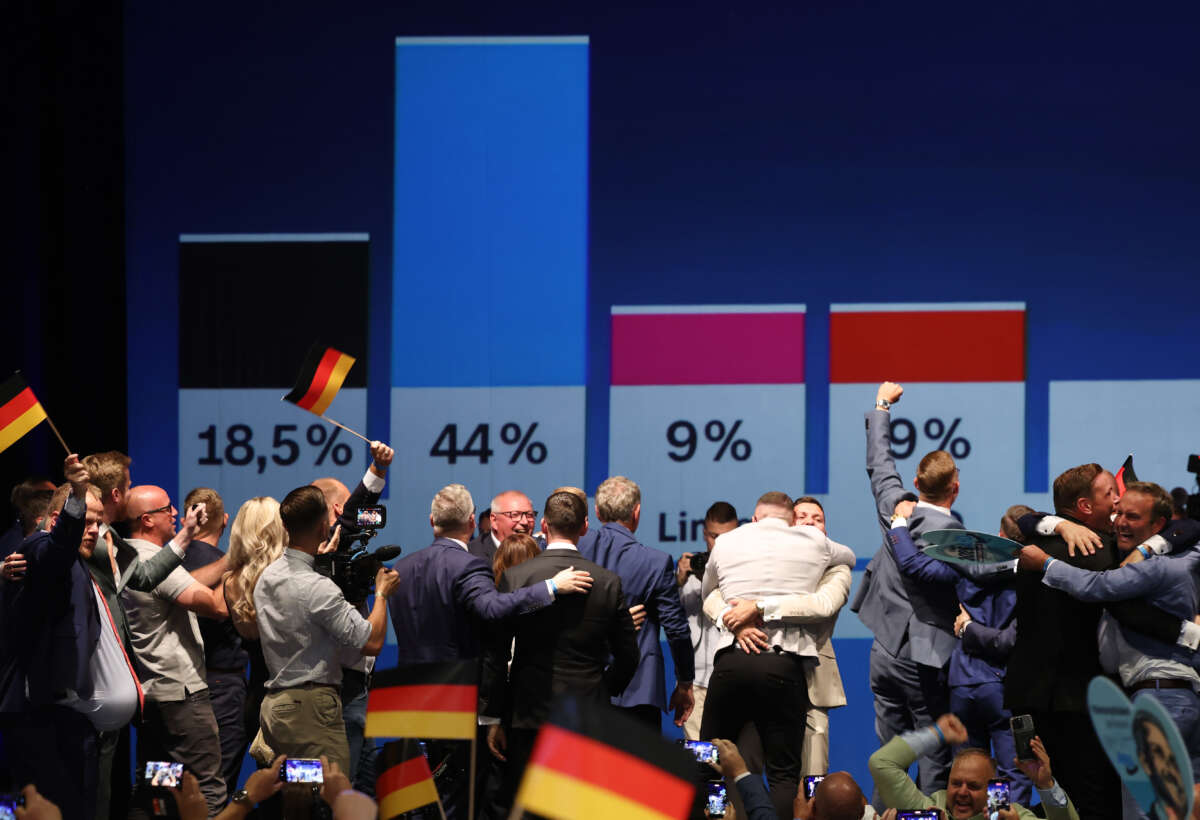

.png)
.png)