Showing posts sorted by date for query UAP. Sort by relevance Show all posts

Monday, August 10, 2026

14,000 UFO sightings in Germany: Reporting centre in Hesse investigates

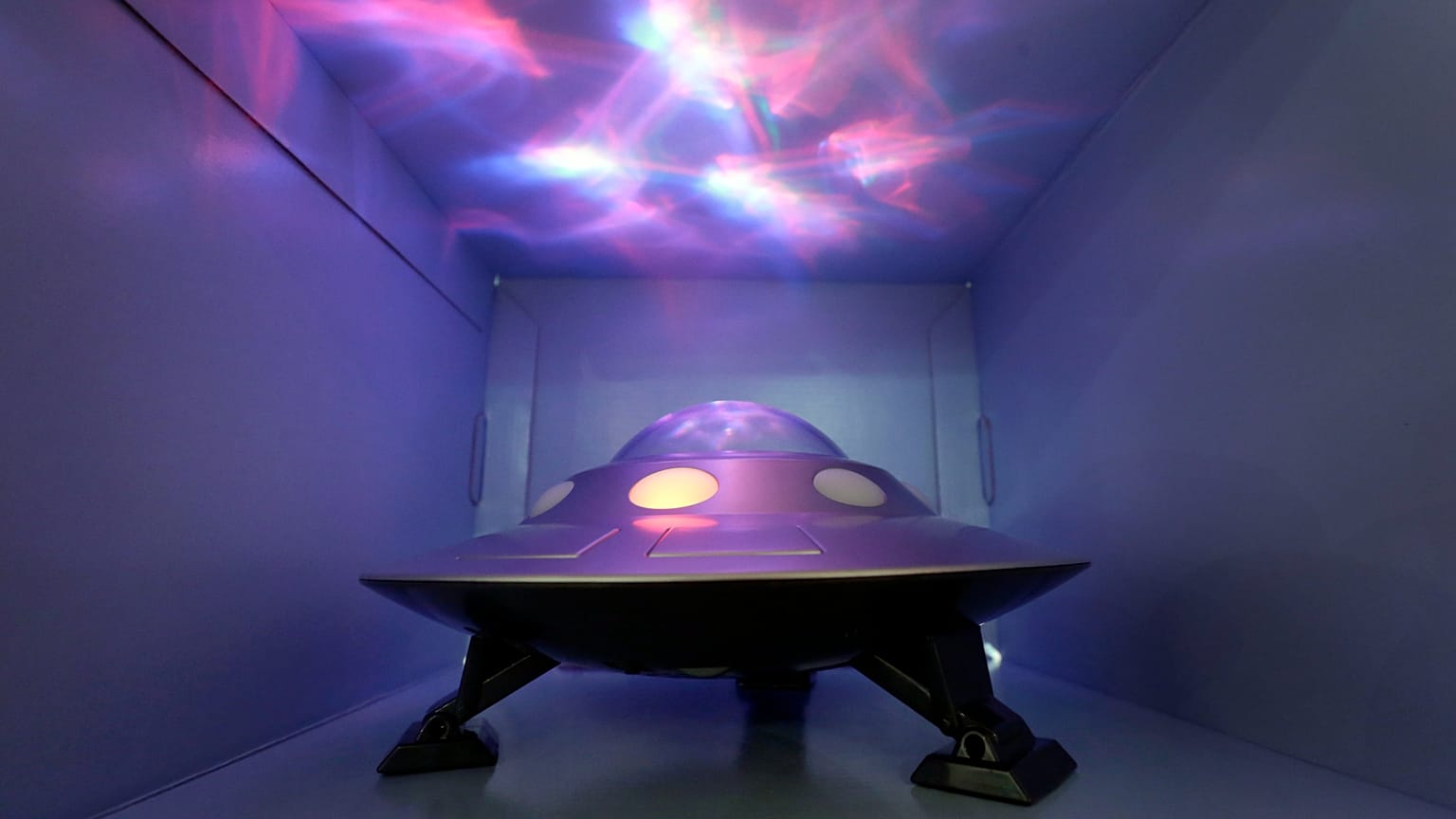
The "Cosmic UFO" projector from Cloud b will be unveiled at the TTPM Holiday Showcase in New York on 1 October 2014.
Copyright AP Photo

By Nela Heidner
Published on

Glowing spheres and mysterious lights are generating a wave of reports in Germany. As Pentagon files reignite debate, CENAP in Lützelbach has long sought to explain the sightings.

The Central Research Network for Extraordinary Celestial Phenomena (CENAP) is a point of contact for people in Germany who are looking for a scientific explanation for what they observe in the sky.

CENAP director Hansjürgen Köhler says they have never received as many reports as they do at the moment: "We receive between three and six report's a day. Without question, we're the busiest reporting centre in the German-speaking world." By August 2026 he and his team had cleared up some 14,000 cases.

Köhler is an amateur astronomer; it all started "with youthful recklessness."

"We were working at the observatory and expanding our knowledge there. Back then, lots of calls were coming in and the observatory was getting fed up with it. That prompted us to take a closer look at the whole UFO subject."

As an 11-year-old he watched the moon landing on television. It left a deep impression on him and laid the foundations for his interest. "If I'd known back then what was coming, I wouldn't have done it; there really were a few annoying years, but these days I enjoy it because we can give people a sensible explanation."

"In 1973, at the beginning, when we were young men starting to grapple with this subject, we obtained microfilms from the USA from the Second World War era showing flying objects that were considered inexplicable phenomena."

"We realised that even back then, during the war, there were repeated natural phenomena," says Köhler. "Some of the images were quite striking – not least because of the pilots' reactions, as they asked themselves in astonishment what might just have flown past them."

Pentagon files put UFOs back in the spotlight

Today, with the Pentagon in Washington having released the so-called UFO files, the topic is gaining momentum again.

After the US Navy had already released videos showing unidentified flying objects – now officially mostly referred to as "Unidentified Anomalous Phenomena" (UAP) – the Pentagon in April 2020 for the first time formally confirmed the authenticity of three recordings from 2004 and 2015. The videos show encounters between US military pilots and flying objects whose origin could not initially be clearly determined.

In December 2022 the "All-domain Anomaly Resolution Office" (AARO) was even set up within the US Department of Defense. The office is tasked with systematically investigating UAP reports, assessing any potential threats to national security and reviewing past cases.

For Köhler, that's old hat: "We already know the archives anyway; there was nothing in them that was new to me. For the younger generation, though, it is something new. We can only yawn when we see the old footage."

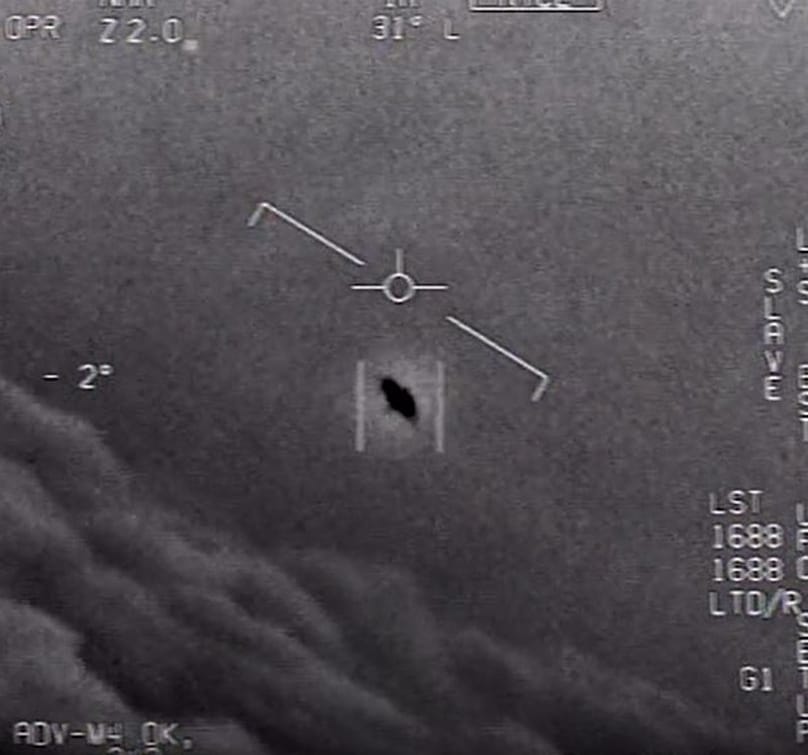
One of the recordings, the so-called "Gimbal" video, was made in January 2015 during a training flight by a US Navy F/A-18 off the coast of California. The infrared footage shows an unidentified object that appears to rotate on its own axis and is commented on in astonishment by the pilots. The Pentagon itself has confirmed the authenticity of the recording but, by its own account, has so far been unable to clearly establish the object's exact identity.

Köhler is convinced that the video shows nothing more than a balloon. He explains its apparently rapid movement as a relative motion between the aircraft and the balloon: because of the jet's high speed, it creates the impression that the object is racing past at enormous pace.

He also has something to add on the F/A-18 itself: "Ever since it was introduced by the US Navy it has had issues with its electronic tracking systems. It has received nine updates to get that under control, and there are still misreadings, including in the speed indications."

But, as Köhler says with some frustration, "all of that simply gets lost. The film is shown again and again, and the debunking is like a drop in the ocean, it too just disappears. Above all on social media and on X, the kind of tall tales that are told there are so absurd. I don't even watch it any more because it annoys me; it runs counter to my work."

I do not deny that there is life out there.
 Hansjürgen Köhler 
Founder of Germany's only UFO reporting centre CENAP

Köhler boils down the reports that reach him to one core idea: "Supposedly, visitors from far out there drop by every day to see what we're up to here. I do not deny that there is life out there. But are we really to believe that they travel across galaxies with highly advanced technology to our blue planet and then crash of all places here above the desert?"

Critics of CENAP occasionally complain that the organisation assesses many UFO sightings very sceptically and places a strong emphasis on conventional explanations. Supporters see that as precisely the organisation's strength: CENAP seeks to classify observations in scientific terms and distinguish between genuinely unexplained phenomena and misinterpretations.

The differing assessments mainly stem from the question of how open one should remain to explanations that are still unknown.

"I understand that people start puzzling over it; I can end up in that situation too," says expert Köhler. "Some people call the police at 2:00 in the morning and say they can see something flashing in the sky. Then the officers call us because the people insist so strongly that there is something there. So you have two police officers standing there, looking up at the sky together with the caller, unable to explain it either and phoning us."

Köhler has a recommendation for such cases: "Members of the public can find out what they are observing – there are free astronomy apps. You can point your phone at the sky and the name of the celestial body then appears."

What has he been able to identify so far?

Aircraft, helicopters, rocket stages, satellites, astronomical causes such as meteors, bright fireballs (daytime meteors), planets, bright stars, balloons of all kinds (weather, atmospheric, hot-air) and decorative foil balloons in XXL format from children's birthday parties and weddings, as well as lasers used by event organisers that sometimes shine over distances of several kilometres.

There are, however, also cases that Köhler has not been able to resolve. Anyone hoping to see them as proof of extraterrestrial visitors will be disappointed: "These were not alien visits. The cases have simply remained unexplained because we lack key information. For a serious investigation we need the date, time, place, direction in the sky and, if possible, visual material. Only then can we start our research."

Sunday, August 02, 2026


Pentagon UFO files: what role Germany plays

On Friday, 8 May 2026, Pentagon-released files on UFOs will be photographed in Washington.
Copyright AP Photo

By Nela Heidner
Published on

For years, The New York Times has followed the release of US UFO files. The newly accessible documents go beyond sightings, tracing back to World War II and repeatedly mentioning Germany.

Glowing objects in the sky, mysterious military reports and files kept under lock and key for decades: newly released UFO documents offer a glimpse into some of the most baffling cases of recent decades.

A key focus of these historical files are reports by Allied pilots from the final months of the Second World War. They described glowing flying objects moving at high speed that accompanied their aircraft over Germany. These phenomena later became known as "Foo Fighters".

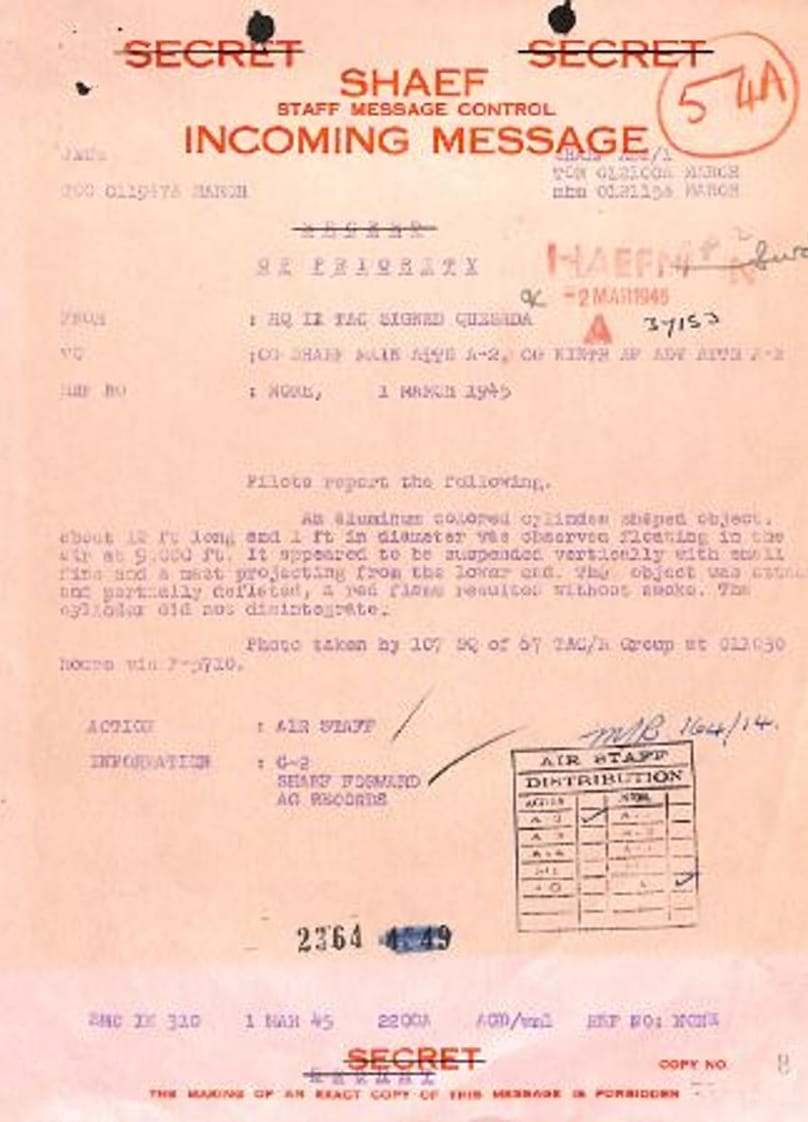
In the file (source in German) (source in English), it literally states:

On the night of 22 December 1944, two lights rose from the ground near an aircraft of the 415th Night Fighter Squadron, climbed to its altitude, took up position behind its tail for about two minutes and then 'peeled away again' – according to the crew, always under 'complete control'. Ground radar confirmed that there were no enemy aircraft in the vicinity.

Such encounters were reported repeatedly. Over a period of six weeks, crews of the 415th over Germany and France spoke of red, green, orange and amber-coloured lights that flew in formation with their aircraft, carried out evasive manoeuvres and came as close as around 30 metres. The pilots called these phenomena "Foo Fighters".

The British Air Ministry examined the reports and concluded in a memorandum classified as secret in March 1945 that 'the whole matter still remains something of an enigma'.

Independently of this, pilots also reported sighting an aluminium cylinder roughly 3.6 metres long at an altitude of around 2,700 metres. When fired upon by the aircraft, the object partially lost its shape and showed a red luminous effect, but did not break apart. Intelligence classified it as probably a German 'flak bomb'.

No one was able to provide a clear explanation for the mysterious lights. The file remained classified for 80 years.

1945: A file containing reports from combat pilots Department of War

The military examined several possible explanations. One idea was that they could be previously unknown German secret weapons or experimental aircraft with novel rocket or jet propulsion systems. However, the investigations found no conclusive evidence for this.

Declassified FBI reports, "Nazi UFOs"

The released material also includes historical FBI documents from the 1940s and 1950s, in which reports appear of alleged German developments of disc-shaped flying devices. Some of these references relate to possible secret research projects in the Berlin area and in regions near the Austrian border.

However, these reports do not come from technical investigations or confirmed military files, but are based mainly on statements from informants, rumours and intelligence tips from the immediate post-war period. They therefore primarily reflect which leads the authorities chose to follow at the time.

The documents do not provide evidence that Nazi Germany actually developed operational "flying discs" with extraordinary flight performance. Historians place many of these stories in the context of speculation about German secret weapons, psychological warfare and the Allies' search for advanced German technology.

In the SHAEF and Air Ministry memoranda of 1944/45, there are repeated descriptions of, among other things, red, green, orange and amber-coloured lights that appeared to move in a controlled way, flew in formation with aircraft and in some cases came within short range of them.

Some observers report arrowhead-shaped objects. Despite this variety, certain patterns recur: many of the described craft seem to have no visible wings, rotors or conventional propulsion. They are also said to possess unusual characteristics – such as apparently motionless hovering in the air, sudden bursts of acceleration or flight manoeuvres that are difficult to explain using known technologies.

Glowing shapes, unknown flight manoeuvres

Later investigations such as the US Air Force programme Project Blue Book (1947–1969) also documented a wide range of sighting reports. Observers described, among other things, glowing geometric shapes, disc-shaped or arrow-like objects, as well as phenomena without visible wings, rotors or conventional propulsion systems. Some reports spoke of objects that appeared to hover motionless in the air, accelerate abruptly or perform flight manoeuvres that were hard to reconcile with the aviation technologies known at the time.

Alongside the historical documents, the archives contain numerous files from more recent years. Since the public revelation of the Pentagon programme AATIP (Advanced Aerospace Threat Identification Program) in 2017, the United States has expanded its investigations into so-called UAP (Unidentified Anomalous Phenomena).

The Department of Defense has created new structures for recording and assessing unusual observations by military personnel. The Pentagon has also released several previously classified recordings of unknown flying objects, including videos taken by Navy pilots in 2004 and 2015, whose phenomena could not initially be clearly identified.

In some documents, military personnel also report physical complaints after close encounters, such as nausea, headaches, skin irritation or neurological symptoms. What lies behind these unexplained observations remains disputed to this day. Explanations range from known technological phenomena and misperceptions to far more far-reaching hypotheses.

Recorded by an F/A-18 on 21/01/2015 off the coast of California. The video shows an elongated object flying at high speed against the wind. Navy UAP

This new transparency in the handling of Pentagon files is being closely watched in Europe as well. Security and defence experts are following the US initiatives, as unusual phenomena in airspace are increasingly viewed as a potential security and intelligence issue.

Between history and speculation

The newly released files highlight above all one thing: interest in unusual aerial phenomena goes back a long way and is closely linked to historical events such as the Second World War. Germany does feature in the documents, but the files provide no proof of extraterrestrial spacecraft or secret German "flying discs".

Rather, they document how armed forces and intelligence services have spent decades trying to explain unusual observations – and how enduring myths have grown out of them right up to the present day.

Thursday, July 02, 2026

'Like a kid in a candy story': Trump appoints polarizing UFO scientist to top committee


Dr. Avi Loeb (Wiki Commons)
June 30, 2026 
ALTERNET


On Tuesday President Donald Trump appointed a famous and controversial Harvard theoretical physicist, cosmologist and astronomer to lead a group of scientists to investigate UFOs and whether they pose a national security threat.


Dr. Avi Loeb, who led Harvard’s astronomy department until 2020 and is widely respected for his research into black holes, was publicly tapped by the Trump administration on Tuesday, according to a report by the Associated Press. In 2022, Dr. Ethan Siegel, an astrophysicist and science writer who frequently criticized Loeb’s work, told this journalist for Salon that Loeb’s research into a mysterious space object that crashed into the ocean, ‘Oumuamua, was a “travesty.” By contrast, Loeb is very popular among the lay UFO fan community, and more than three dozen scientists co-authored a 2023 paper with him in the scientific publication Journal of Astronomical Instrumentation advocating his recommended methods for learning more about UFOs (unidentified flying objects) and UAPS (unidentified anomalous phenomena).

Speaking to AlterNet about his recent appointment, Loeb broke down how he learned about his appointment and what he believes it could mean for American politics.


“I was contacted by the office of the Director of National Intelligence and was asked to lead a council that will advise that office, the ODNI, the White House, the FBI, and the intelligence community, and of course the All-domain Anomaly Resolution Office in the Pentagon, providing scientific advice to figure out the nature of unidentified anomalous phenomena, UAP,” Loeb told AlterNet. “And it looks like, if they were sure that they're dealing with human-made objects, they would have a classified memo exchange within the Pentagon or the intelligence agencies. But the fact that they're reaching out to the scientific community for help implies that they cannot really tell that some of these things are definitely human-made. And obviously, if they're human-made, there would be concern for national security, given that these objects are found near strategic assets.”

Because the Trump administration reached out to Loeb, he believes this means that “they really need advice.” He continued by explaining how he will apply the scientific method to his directives.


“First we have to review any information that they can share with us, with the council,” Loeb told AlterNet. “So I first assembled a team of 15 scientists who are exceptional, who have expertise in the physics of oceanography, statistics, and psychology, because these objects are interacting with humans. And we need all these aspects to understand the reported events. And we already submitted, since I assembled this team — and it's really an exceptional team, people who have a fresh mind with respect to the phenomena, I deliberately did not select people with an agenda or baggage regarding their views on the subject, because we need to provide scientific advice — and we already submitted a request for more than 50 items of information on specific incidents, and perhaps materials that the US government might have, and we should see what we hear in response.”

Because Loeb and his scientific team will only analyze unclassified information, they will be able to share their findings with the public, guaranteeing transparency about a subject that is often contentious. Coincidentally, he noted that he recently examined materials released on June 12th of this year, the same day as the Steven Spielberg movie “Disclosure Day,” which explicitly discusses how humanity could be brought together by the revelation that extraterrestrial life exists.

While Loeb admitted that he is not a fan of science fiction “because very often it violates the laws of physics,” he admitted that he feels the sense of wonder and hope captured by Spielberg’s motion picture.


“I feel like a kid in a candy store, in a way, as long as we receive sufficient information that is substantive — because the quality of our deliberations, our analysis, will reflect the quality of the data that we receive,” Loeb told AlterNet. “Science is guided by data. So what I say is, let's keep our eyes on the orbs, not on social media. It's not a matter of opinions — we just need the data, the evidence, just like a detective. So it's a great privilege for me to be involved in figuring things out.”

He added, “Of course, if we find a non-human-made technological object, the implications would be huge for our future. Because, first, we might learn about new science, new technologies. Second, it might imply that we're not at the top of the food chain, cosmologically speaking.

And my hope is that it'll be just like a knock on the door — when all family members in the house hear a knock on the door by a neighbor, all the loud arguments quiet down. So it'll change our priorities from conflicts, which you find every day in the news, to cooperation and response to this neighbor that we just found. It's sort of akin to finding a sibling in our family of intelligent civilizations. And for those people who have religious beliefs, they should not necessarily assume that God is a parent who can attend to only one child.”


Also like “Disclosure Day,” Loeb believes that the discovery of alien organisms could help humanity overcome the differences that sharply divide us. When asked about whether he has yet met President Trump (he said has not), he pivoted to that subject.

“The interesting aspect of this is that both Republican and Democrat members of the House and the Senate are working together on this subject of disclosure, and everyone is excited,” Loeb told AlterNet while laughing. “It's a reminder that science is better than politics. What do I mean by science is better than politics? It brings people together rather than separating them. So in an age where you have a lot of polarization as a result of social media, as a result of political upheaval and so forth, it's really refreshing to find a subject where everyone comes together.”

He then observed, “I was in the US Senate on Thursday for the UAP Disclosure Forum, and there were members of Congress there — you could see half of them were Republicans, half were Democrats, and they were all rooting for it. I find that very refreshing. And I think that is a reflection of what will happen if we do find that we are being visited, because then the mindset will change. People will stop arguing with each other on relatively mundane matters when they realize something cosmologically important — that we are not alone. And it'll change everything.”

Responding to a question from AlterNet about Loeb’s appointment, Siegel reiterated the disdain for Loeb he first expressed to this journalist four years ago.


“This is extremely typical and to be expected of the Trump Administration,” Siegel told AlterNet. “Legitimate science conducted by those who value truth, facts, and the common good of humanity has repeatedly been rejected by this Presidential Administration in favor of sensationalism, grift, and self-enrichment. On those metrics, there is no better qualified astronomer in the country than Avi Loeb, who will no doubt find himself surrounded by like-minded individuals like Dr. Oz, Lee Zeldin, and RFK Jr. in the quest to destroy what remains of the American scientific enterprise entirely, and to replace it with Lysenko-esque policies that will lead to both long-term and short-term harm to all.”

Unlike Siegel, Dr. Franck Marchis — the CEO of and an astronomer at the SETI Institute (Search for Extra-Terrestrial Intelligence) — had a mixture of praise and criticism for Loeb.

“I also think Avi too often starts with the exciting explanation before the data are strong enough to support it,” Marchis told AlterNet. “That is not how science works. Science is not about making a bold assumption first and then looking for evidence to confirm it. Science is about collecting calibrated data, sharing it, letting other teams verify it, and being ready to change your mind.”

He added, “I also disagree with the idea that scientists are somehow hiding the truth. Most scientists, including my colleagues at the SETI Institute, I know are open, curious, imaginative, and very happy to be surprised. We just know that extraordinary claims need extraordinary evidence. Check our recent discussion with Jill Tarter [a fellow SETI astronomer] for instance. This is exactly why we are building SkyMapper and SkySphere. The goal is to observe the sky all the time, from many places, with instruments that can produce time-stamped and verifiable data.”


Religious groups are more prepared for aliens than you think


(RNS) — Rep. Tim Burchett of Tennessee told RNS that he sees evidence of UFOs in the Bible.
Actors Emily Blunt and Josh O'Connor in "Disclosure Day."  (Photo by Niko Tavernise / Universal Pictures and Amblin Entertainment)

(RNS) — Roughly a third of the way into Steven Spielberg’s new blockbuster film “Disclosure Day,” which focuses on the theoretical release of evidence documenting the existence of alien life, a conversation between the two main characters takes a sudden turn toward the spiritual.

One of the characters, who is Catholic, begins fretting over what the release of such information would mean for religious people, worrying many will “stop believing in God.” People who believe in “superior beings,” she says, will balk at news of “actual” superior beings — namely, technologically advanced aliens.

“People can’t handle both,” she concludes.

Her implicit question is left hanging, like a flying saucer hovering over the horizon, for most of the film: If intelligent life were to be discovered beyond Earth, would it shatter religious traditions?

But for all the profound implications of intelligent extraterrestrial life, experts say the possibility is far less bracing for many religious practitioners across the globe. In fact, scholars argue many major faith groups have not only been thinking about the prospect of aliens for some time, some have even outlined extensive theological answers to the question of extraterrestrial life — or even fully embraced the idea.

“That question is packed with drama, but it doesn’t correspond to the lived realities of people,” said Diana Pasulka, a religious studies professor at University of North Carolina Wilmington and author of the book “American Cosmic: UFOs, Religion, Technology.”

Diana Pasulka on a podcast in 2025. (Video screen grab)

Pasulka, who has also published a book focused on Catholic theology and history, noted that despite the framing of Spielberg’s film, Catholics in particular have long been interested in extraterrestrial life. The idea was already showing up in the 15th century, when a German Catholic cardinal insisted on the prospect of life on other stars. What’s more, she noted that multiple heads of the Vatican observatory have openly discussed the prospect of intelligent life elsewhere in the universe, with one saying he would baptize an alien “if she asks.”

When it comes to Catholics, she argued, aliens are simply “not a problem for them.”

Paul Gutjahr, a professor at Indiana University Bloomington and author of the forthcoming book “Faith in Space: American Religious Belief in Extraterrestrial Life,” said the situation is similar for other religious traditions. He noted that in the early 1700s, prominent Puritan clergyman Cotton Mather — a major figure in Colonial-era Massachusetts — was already opining about life on other worlds: Mather, Gutjahr explained, believed that God was “so capacious, so big” that life elsewhere was seemingly inevitable.

“It’s a sign of his greatness, his omnipotence, his ubiquity,” Gutjahr said. “There has to be life on all these stars.”

There was also a surge of discourse about aliens in the 20th century, particularly during the space race. In the 1960s, at least one rabbi wrote and extensive academic article on the topic, pointing to Jewish texts some argue have long pointed to the existence of other worlds.


Pasulka said religion also often comes up when she interviews people who claim to have seen Unidentified Flying Objects, or UFOs, also known as or UAPs.

“I’ve met Orthodox Jewish people who had those experiences, and they’re fascinated by the public conversation, but it doesn’t shake their faith,” she said.

(Image by Albert Antony/Unsplash/Creative Commons)

Pasulka added that many religious people interpret the prospect of aliens through their own religious beliefs. She said that includes Muslims she has met who say they have encountered UFOs, some of whom have described their experiences by referencing jinn — supernatural beings in Islam and some other religious traditions.

Others have claimed that UFOs may be evidence of demons or “preternatural” beings such as angels, Pasulka said. It’s a belief that has garnered attention in recent months, with Vice President JD Vance referencing the idea in a March interview. But it has also proven controversial: on June 3, Catholic authorities announced the removal of an exorcist from his post in the Archdiocese of Washington, with church leaders justifying the move by citing the monsignor’s claim that UFOs are demons. Cardinal Robert McElroy, who oversees the archdiocese, said such statements “gravely undermine” church teachings.

“That belief has been around since the early twentieth century,” Pasulka said, referring to the association of UFOs with demons.

But while the spectrum of views about religion and aliens is wide, belief in their existence is fairly common among religious Americans. A 2021 Pew Research poll found that while religious people in the U.S. are less likely than others to believe intelligent aliens exist on other planets, most Protestants and Catholics still said their best guess is that intelligent life is out there. Among the groups polled, the only outlier was white evangelicals, with only around 40% assuming intelligent life exists.

And even then, there are prominent exceptions. In Congress, among the more vocal believers in aliens and UFOs is Rep. Tim Burchett of Tennessee, who is an evangelical Christian. Speaking to Religion News Service in December 2024, he said he saw evidence of UFOs in a passage from the biblical book of Ezekiel that describes a “wheel within a wheel.”

Military pilots have encountered unidentified aerial phenomena (UAP). (Image courtesy DOD/U.S. Navy)

“He saw the wheel, and the wheel at that time was the most technologically advanced mechanized item that they had,” Burchett said, referring to the prophet Ezekiel. “He described basically what I would say (is) a traditional flying saucer.”


Debate over aliens can be especially intense within Christianity, as one of the big questions surrounding the prospect of intelligent life on other planets is what that revelation means for Jesus Christ. Christians typically see Jesus as having died for the forgiveness of human sins, which raises a question: If aliens are real, did Jesus die for their sins too? Or do aliens have their own alien version of Jesus who dies for their sins?

By at least the 1880s, some Christian groups already had their answers. Gutjahr noted that Ellen G. White, the co-founder of the Seventh-day Adventist tradition, wrote extensively about alien life at the time, including the question of what it means for salvation.

“One of her takes was the Earth is the only fallen planet,” said Gutjahr, referring to the Christian concept of humanity being sinful. “There is life elsewhere, but none of it fell — only Earth, so Earth was the only planet Jesus needed to die on to redeem humanity.”

According to White, Gutjahr said, the result is that life elsewhere in the universe observes Earth as a sort of “giant amphitheater” to witness “God’s saving action.”

Paul Gutjahr. (Photo courtesy of Indiana University)

He added: “We become like a visual aid to the entire universe that you know about God’s mercy.”

For his part, when Burchett was asked whether extraterrestrials would have their own alien versions of Jesus who died for their sins, he didn’t hesitate.

“The Bible’s pretty clear about there being one (Jesus),” he said. “Jesus died for them just like everybody else.”

As for Spielberg’s film, it ultimately showcases a more multifaceted vision for what the existence of aliens would mean for religion than its early lines would suggest. Gutjahr found that unsurprising: He recalled that when he first started his book on religion and aliens, he expected documented moments of religious discourse regarding the prospect of aliens to be few and far between.

But as he began researching, he said, he was suddenly overwhelmed by the sheer volume of examples.

“It turns out that the whole freaking world has thought about life on other planets,” Gutjahr said, laughing.