Saturday, December 21, 2024

Despite censorship and intimidation we continue to demand: no more research for genocide at MIT

An MIT lab is collaborating with the Israeli military to develop AI surveillance algorithms and the university censored a campus publication that tried to expose it. We refuse to be intimidated and continue to demand: No More Research for Genocide.
December 21, 2024 2
MONDOWEISS

A picture taken on May 15, 2018 shows an Israeli quadcopter drone dropping tear gas canisters over Palestinians, in Khan Younis in the southern Gaza Strip on May 15, 2018. (Photo: Ashraf Amra/APA Images)


On November 7th, we published an op-ed titled “Daniela Rus, The People Demand: No More Research for Genocide” in the MIT Tech. Our piece detailed how Prof. Daniela Rus, director of MIT’s Computer Science and Artificial Intelligence Laboratory, uses Israeli Ministry of Defense money to develop algorithms with applications in “multirobot security defense and surveillance.” Rather than engage with these publicly verifiable facts, the Tech’s editorial board (under the guidance of Prof. Rus) retracted our op-ed.

MIT sent several of us “no contact” and “no harassment” orders for Prof. Rus, disciplining one student for simply writing our Op-Ed’s title on a public chalkboard! As if this naked intimidation wasn’t enough, the Tech indefinitely halted all Op-Eds after retracting our piece. This comes directly after the suspension and effective expulsion of MIT PhD student Prahlad Iyengar, in part due to an email he sent Professor Rus’ students “offering support” and a “safe space” to discuss her research.

We refuse to be intimidated by MIT. Professor Rus takes money from a genocidal army to do research with military applications (stated in her own papers here, here and here). Retractions and suspensions cannot change these simple facts. Here, we republish our article in full:
Daniela Rus, The People Demand: No More Research for Genocide

Today, MIT’s Computer Science and Artificial Intelligence Laboratory (CSAIL) conducts research funded by the Israeli Ministry of Defense (IMoD), with direct applications to the ongoing genocide in Gaza. We, the MIT Coalition for Palestine, whose tuition and labor support CSAIL, call on CSAIL Director Daniela Rus to lead by example and end her IMoD-sponsored research.

Rus currently leads the project “Coreset Compression Algorithms,” which has received $425,000 in direct sponsorship from the IMoD since 2021, according to MIT’s 2024 Brown Books. This project develops AI algorithms for applications like “city-scale observation systems” and “surveillance and vigilance”. Many of these lightweight algorithms are ideal for teaching small unmanned vehicles, including drones, to track and pursue targets with increased autonomy. Notably, navigating human environments is central: “a human may provide the global path… and the robots will adapt their configuration automatically”.

Many of us have friends and family surveilled and killed by the Israel Defense Forces (IDF) drones streamlined by Rus’s research. These quadrotor drones are used extensively to monitor, injure, and kill Palestinian civilians at close range. Last Wednesday, October 30, 2024, Palestinian poet Mosab Abu Toha shared videos showing Israeli bombs destroying his home, including footage of a quadrotor drone with a mounted machine gun just meters away. He described how Israel’s relentless indiscriminate bombardment in Gaza has wiped out entire families he knew. Stories like his have become the norm for families in Gaza.

As we write this piece, Jabalia has been under constant siege for a month. The Israeli military is targeting hospitals and burning patients alive. The government blocks access to life-saving humanitarian supplies, worsening Gaza’s already severe health crisis, all while threatening, targeting, and killing journalists attempting to report on these war crimes. At this time, it is our moral responsibility to do everything in our power to disrupt and dismantle all which enable the continuing of this genocide.

There has been a long-standing demand for Rus’s IMoD-sponsored projects to end.

The MIT Coalition for Palestine (C4P) is a group of MIT students, staff, faculty, community members, and campus organizations who refuse to devote their labor to companies complicit in Israeli apartheid, occupation, and the violation of Palestinian human rights. Daniela Rus was first contacted by the C4P on March 8th, 2024 by email where she was informed of how her IMoD-sponsored projects made her complicit in the ongoing genocide in Gaza.

Without response, we then emailed out to the graduate students in her lab informing them of these ties and of potential alternative funding arrangements. In April, we launched the Scientists Against Genocide Encampment, where we consistently highlighted her lab’s IMoD ties to the school and community.

Over a year of accelerating genocide has now since passed, seven months since we first contacted Rus, and she continues her research, violating MIT’s own rules for research sponsorship. On Tuesday October 22, 2024, the Coalition Against Apartheid, a member organization of C4P, delivered a second letter in-person to her CSAIL office, chanting and flyering in the process.

We are committed to engaging in continuing action because it works. For instance, The U.S. arm of Israeli defense contractor Elbit Systems recently ended its lease of office space in Cambridge after months of demonstrations by pro-Palestinian protestors. This win reinforces our resolve, and reminds us of a crucial lesson: the only way to make material disruptions for these inhumane systems is to continuously raise the cost for conducting research for genocide.

MIT’s police and disciplinary response against peaceful demonstrators was swift and unjust.

Within fifteen minutes, MIT escalated the situation with police force by violently arresting student protestors and detaining others for merely chanting and passing out flyers. At one point, there were four to six cops pinning down one person. Even those who were simply filming the arrests were detained, pushed around, and groped. There was no warning or attempt by faculty or administrators to engage with the students in order to understand their actions. Three days after the protest, eight students received interim sanction letters from the MIT Committee on Discipline (COD).

This interim letter did not indicate what charges students were being prosecuted for. Rather, they prohibited the students from entering common student spaces in CSAIL, where some of these students work. They also issued three no-contact orders to students: one for Rus, one for her collaborator on IMoD-funded projects Eytan Modiano, and one for Jack Costanza, a CSAIL employee who physically assaulted students in an attempt to unlawfully aid police in their arrests. None of the students were given the chance to review or respond to the charges. Once again, the COD demonstrates it operates primarily on the premise of treating political dissidents as “guilty until proven innocent.”

One week later, students received their alleged charges from the COD. All eight of them, whether they were chanting, putting a flyer up on a wall with painter’s tape, or simply video-taping the protest, received the same charges: assault, disorderly conduct, harassment, and threats/intimidation. COD Chair Tamar Schapiro later verbally admitted to one student in a meeting that she was aware none of the protestors assaulted anyone. Yet she still sent the letters accusing all eight of the students of assault. The COD systematically criminalizes the Coalition for Palestine as a community for protesting genocide. By indiscriminately instating a blanket no-contact order against all individuals who received a discipline letter, the COD draws a direct parallel between the acts of collective punishment MIT inflicts on pro-Palestinian advocates on its campus, and the collective punishment that Israel has long been inflicting on Palestinians themselves.

Discipline against pro-Palestinian students reinforces systemic racism at MIT.

Over the past year, MIT’s administration’s response to protests against genocide continues to be reflective of MIT’s longstanding racist and xenophobic systems. Students have attempted time and time again to address these issues, as described in this article by the Black Graduate Students Association. Despite the manufactured facade of an MIT community that is safe for students of minoritized backgrounds, racism at MIT has persisted over the last year at an institutional level.

At an institutional level, the MIT administration has been emboldened to continue to weaponize the police and inconsistent “academic” disciplinary proceedings in order to disproportionately target Black and Brown students. In the past year, 87% of the people MIT has disciplined, relating broadly to protest activity, have been people of color. Just consider MIT’s response to the letter delivery protest of Rus’ lab: people of color made up 8 out 13 student protestors present, yet 7 out of 8 people who received letters from the CoD were people of color. In addition to the disciplinary discrimination we face, many of us on campus feel incredibly unsafe, as the Institute of Discrimination Harassment and Reporting (IDHR) has failed to follow up on at least thirty reports of harassment against us. Simultaneously, IDHR selectively applies sanctions against us without evidence. To MIT, we are solely perceived as threats, never as victims. When Tamar Schapiro was asked to clarify the discipline, she told one female student that as a woman, she should understand that Daniela Rus felt unsafe by the demonstration, even though she was not even present in the lab at the time. What about the women in Gaza who fear being killed by the very technology Daniela Rus’s work contributes to? What about the women of color on campus who fear being unjustly brutalized by the frequent displays of disproportionate police violence? Tamar Schapiro, and MIT as a whole, fail to acknowledge the tangible fears of marginalized women, yet prioritize the theoretical fears of white women. This twisted, victim-blaming, racist logic matches the insinuation of Provost Barnhart in the previous Spring semester, wherein she justified the interim suspensions and eviction threats of 27 people by suggesting that MIT apply the same disciplinary measures previously reserved for when individuals are immediately at risk of sexual assault. As long as we have a broken reporting system, rapists and sexual offenders continue to freely walk on campus while students of color are treated as criminals for protesting a genocide.

To Daniela Rus and the world: no more labor for apartheid and genocide!

At the end of the day, MIT’s racism and racist discipline cannot counteract one fact: Daniela Rus is complicit in doing research for genocide. She has been complicit since 2012 when the sponsorship was first established through her then-postdoc, Dan Feldman, who currently works at University of Haifa in occupied Palestine. Professor Rus continues to deny her evident, present-day connections to the IMoD while flaunting her other morally dubious connections, such as her recent public statement of admiration, at her October book talk, for Marvin Minsky, alleged co-perpetrator of notorious pedophile Jeffrey Epstein.

As students of conscience, we cannot stand for this. The time to take action is now. We therefore call on Daniela Rus to immediately terminate all IMOD-funded projects and for MIT to provide transitional funding to all affected graduate students, in line with how MIT terminated financial ties with the Skoltech Institute in Russia the day after the Russian invasion of Ukraine.

Why are we here at MIT? What purpose is there to any of the science and research being done on this campus when we know that ultimately our work will be used for mass murder and exploitation? It is the current leadership at MIT that is ensuring that the great potential of this community is being abused to oppress individuals globally. Therefore, it will take all people of conscience at this institution to change the course we are currently on to force MIT to embody the values it claims to have. We cannot rest until MIT completely cuts ties and divests from all entities that support genocide and colonialism.

Every human on this planet, especially those of us at MIT, is morally obligated to use their voice, body, and labor to make an immediate material impact toward ending the ongoing genocide.
SLAVA UKRAINA

Usyk beats Fury in heavyweight championship rematch

Sulafa Alkhunaizi
December 21, 2024


RIYADH: Ukrainian heavyweight boxer Oleksandr Usyk takes the crown again in a rematch with British heavyweight boxer Tyson Fury, retaining the “undisputed” title.

The rematch took place at Riyadh’s Kingdom Arena on Saturday evening.

Usyk was awarded the fight 116-112 in favor by all three judges, handing Fury his second loss.

Usyk’s win takes him to 23-0 with 14 knockouts and extends one of the all-time best careers that includes Olympic gold and undisputed champion at cruiserweight.


On the sidelines of the much-anticipated rematch, the first ever artificial intelligence judge was used as an experiment and did not decide the fight, according to Turki bin Abdulmohsen Alalshikh, Chairman of the General Entertainment Authority.

During the media press conference, Fury told Arab News about the positive seven months he spent training and prepping for the rematch.

“I’ve had a good life, it's been good times, and I have had good training.”

Usyk told Arab News that he is happy that he won.


"I'm not a proud man, I'm just happy that I won. I like to motivate people to give them the incentive to do something."

As part of the undercard matches, Rhys Edwards, the Welsh featherweight boxer was overcome by the Peter Mcgrail British featherweight, who claimed his 11th professional win.

The fight was initially scheduled to be Mcgrail and Dennis McCann, who failed a drug test, causing him to be disqualified. Edwards stepped in with a five-day notice and accepted the challenge.

In an interview with Arab News, Edwards expressed his sentiments but remained optimistic given the short notice.

“ I'm a bit gutted I didn't get the win, but the whole week has absolutely been fantastic. And I've loved every moment of it…. I have learned a lot about myself. I took the fight (with) four days' notice, and a lot of people didn't give me enough credit or a chance coming into this fight. It was a very close (and) hard fight for both of us. So, I'm sure my profile and stocks have risen and I'm happy.

”I'm a very good fighter and I will fight anyone. I'm looking forward to a very big 2025.”

Tyson superfan Molly Chapman shared her predictions on which heavyweight will take the crown.


“I think Tyson Fury is going to win. I think his attitude is completely different this time. He seems more focused. He's been training hard. He looks in good shape and I think he's going to win.”

She told Arab News that her first time visiting the Kingdom has been amazing and has already begun planning her next visit.

“Saudi Arabia is just beautiful. The culture, the people, everyone's so friendly. And yeah, we're actually going to come back in February for the next fight.”

Daria Pyliukhno attended the boxing night rocking a “Ukraine” shirt, a true testament to her support towards Usyk.

“So today, of course I have to be here supporting my country. I'm from Ukraine, and I support Usyk. And I think he will win because Ukrainians mentality are strong enough to fight…I think that Usyk should bring Ukraine again the title of “The heavyweight champion.”


Riyadh Season’s wonderful surprises did not end there. A member of the audience was selected to win a Mercedes-Benz S-Class, presented by Alsheikh, during the opening ceremony.

Riyadh’s newly built Kingdom Arena played host to the boxing event, dubbed ‘Ring of Fire’, with a sellout crowd including several sports and entertainment figures in attendance at the 22,000-capacity venue.


1 / 11
(Credit for embeded images: Action Images via Reuters/AP)

2 / 11
(AN photo by Abdulrahman Alshalhoub)

3 / 11
(AN photo by Abdulrahman Alshalhoub)

4 / 11
(AN photo by Abdulrahman Alshalhoub)

5 / 11
(AN photo by Abdulrahman Alshalhoub)

6 / 11
(AN photo by Abdulrahman Alshalhoub)

7 / 11
(AN photo by Abdulrahman Alshalhoub)

8 / 11
(AN photo by Abdulrahman Alshalhoub)

9 / 11
(AN photo by Abdulrahman Alshalhoub)

10 / 11
(AN photo by Abdulrahman Alshalhoub)

11 / 11
(AN photo by Abdulrahman Alshalhoub)Next


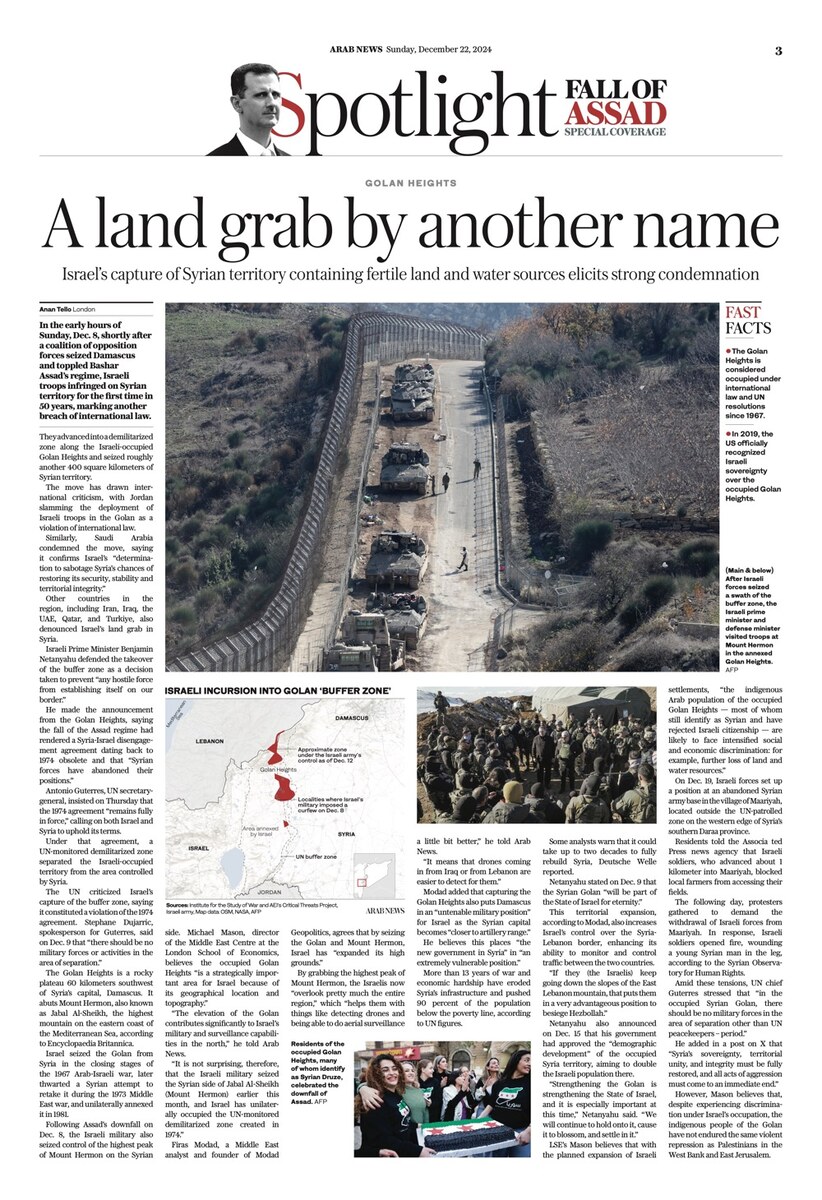
What Israel’s capture of Syrian territory as Assad fell signifies for the Middle East

Analysis


ANAN TELLO
December 21, 2024
ARAB NEWS

Israeli government’s action viewed as taking advantage of a neighbor at a time of distraction and weakness

Takeover of demilitarized buffer zone deprives Syria of more fertile land and water resources of Golan


LONDON: In the early hours of Sunday, Dec. 8, shortly after a coalition of opposition forces seized Damascus and toppled Bashar Assad’s regime, Israeli troops infringed on Syrian territory for the first time in 50 years, marking another breach of international law.

They advanced into a demilitarized zone along the Israeli-occupied Golan Heights and seized roughly another 400 square kilometers of Syrian territory.

The move has drawn international criticism, with Jordan slamming the deployment of Israeli troops in the Golan as a violation of international law.

Similarly, Saudi Arabia condemned the move, saying it confirms Israel’s “determination to sabotage Syria’s chances of restoring its security, stability and territorial integrity.”

Other countries in the region, including Iran, Iraq, the UAE, Qatar, and Turkiye, also denounced Israel’s land grab in Syria. Qatar described it as “a dangerous development and a blatant attack on Syria’s sovereignty and unity.”


Israel’s foreign ministry responded with a statement accusing Turkiye of taking control of about 15 percent of Syria’s territory through three military operations from 2016 onward, and establishing armed proxy groups to control this territory, where “Turkish currency is in use, and Turkish bank branches and postal services have been operating.”

Prime Minister Benjamin Netanyahu defended the takeover of the buffer zone as a decision taken to prevent “any hostile force from establishing itself on our border.”

He made the announcement from the Golan Heights, saying the fall of the Assad regime had rendered a Syria-Israel disengagement agreement dating back to 1974 obsolete and that “Syrian forces have abandoned their positions.”

Media reports, as well as the UK-based Syrian Observatory for Human Rights (SOHR), noted that Syrian forces abandoned their positions in Quneitra province — part of which lies within the buffer zone — just hours before Assad’s fall.

Antonio Guterres, UN secretary-general, insisted on Thursday that the 1974 agreement “remains fully in force,” calling on both Israel and Syria to uphold its terms.

Under that agreement, a UN-monitored demilitarized zone separated the Israeli-occupied territory from the area controlled by Syria.


The UN criticized Israel’s capture of the buffer zone, saying it constituted a violation of the 1974 agreement. Stephane Dujarric, spokesperson for Guterres, said on Dec. 9 that “there should be no military forces or activities in the area of separation.”

The Golan Heights is a rocky plateau 60 kilometers southwest of Syria’s capital, Damascus. It abuts Mount Hermon, also known as Jabal Al-Sheikh, the highest mountain on the eastern coast of the Mediterranean Sea, according to Encyclopaedia Britannica.

Israel seized the Golan from Syria in the closing stages of the 1967 Arab-Israeli war, later thwarted a Syrian attempt to retake it during the 1973 Middle East war, and unilaterally annexed it in 1981 — a move that was not recognized by the international community.

Following Assad’s downfall on Dec. 8, the Israeli military also seized control of the highest peak of Mount Hermon on the Syrian side.

Opinion
Dr. Dania Koleilat Khatib
Israel is making a big mistake in Syria

This strategic summit, located just over 35 kilometers from Damascus and straddling the border between Syria and Lebanon, offers a commanding vantage point and firing range over the surrounding ridges, making it a crucial asset for observation and defense.

Michael Mason, director of the Middle East Centre at the London School of Economics (LSE), believes the occupied Golan Heights “is a strategically important area for Israel because of its geographical location and topography.”


“The elevation of the Golan contributes significantly to Israel’s military and surveillance capabilities in the north,” he told Arab News.

“It is not surprising, therefore, that the Israeli military seized the Syrian side of Jabal Al-Shaykh (Mount Hermon) earlier this month, and Israel has unilaterally occupied the UN-monitored demilitarized zone created in 1974.”

He added: “Politically, occupation of the Golan feeds the ultra-nationalist agenda of a Greater Israel and will encourage claims for further territorial expansion.”

Firas Modad, a Middle East analyst and founder of Modad Geopolitics, agrees that by seizing the Golan and Mount Hermon, Israel has “expanded its high grounds.”

By grabbing the highest peak of Mount Hermon, the Israelis now “overlook pretty much the entire region,” which “helps them with things like detecting drones and being able to do aerial surveillance a little bit better,” he told Arab News.

“It means that drones coming in from Iraq or from Lebanon are easier to detect for them.”

FASTFACTS


• The Golan Heights is considered occupied under international law and UN resolutions since 1967.

• In 2019, the US officially recognized Israeli sovereignty over the occupied Golan Heights.

• Syria’s attempt to retake the Golan in the 1973 Arab-Israeli war was thwarted. • There are more than 30 Israeli settlements in the occupied Golan Heights.


Modad added that capturing the Golan Heights also puts Damascus in an “untenable military position” for Israel as the Syrian capital becomes “closer to artillery range.”

He believes this places “the new government in Syria” in “an extremely vulnerable position.”

Ahmed Al-Sharaa, head of the new Syrian administration, said in an interview with The Times on Monday that war-weary Syria remains “committed to the 1974 agreement and we are prepared to return the UN (monitors).”

“We do not want any conflict whether with Israel or anyone else and we will not let Syria be used as a launchpad for attacks,” he added. “The Syrian people need a break, and the strikes must end, and Israel has to pull back to its previous positions.”

According to media reports, the Israeli military launched about 600 strikes across Syria in roughly eight days following the ousting of Assad. The Times of Israel news website reported that the Israeli military estimated it had destroyed 80 percent of the former regime’s strategic military capabilities.


More than 13 years of war and economic hardship have eroded Syria’s infrastructure and pushed 90 percent of the population below the poverty line, according to UN figures.

Some analysts warn that it could take 10 years for Syria to return to its 2011 GDP level and up to two decades to fully rebuild, Deutsche Welle reported.

The Golan Heights area is also known for its fertile land and vital water sources, including the Yarmouk River, which feeds the Jordan River.

Modad, the Middle East analyst, said Israel’s occupation of the area ensures its control over critical waterways.

“The key story is the Israelis gaining full control over the Yarmouk,” he said. “Yarmouk feeds into the Jordan River — it essentially becomes the Jordan River. It’s the river’s main tributary.”

He added: “And so, what the Israelis have done is that they’ve seized a very important water resource from the Syrians and placed it completely under their control,” giving them “leverage over Jordan by being able to cut off the water supply.”

Netanyahu stated on Dec. 9 that the Syrian Golan “will be part of the State of Israel for eternity,” despite initially describing his army’s presence in the buffer zone as “a temporary defensive position until a suitable arrangement is found.”

This territorial expansion, according to Modad, also increases Israel’s control over the Syria-Lebanon border, enhancing its ability to monitor and control traffic between the two countries.

“If they (the Israelis) keep going down the slopes of the East Lebanon mountain, that puts them in a very advantageous position to besiege Hezbollah,” the Lebanese militant group that has been fighting Israel since the 1980s.

“And the expanded territory that they’ve taken means they are much higher than Hezbollah in parts of Lebanon, including Shebaa, Rashaya and Hasbaya, all the way to the western Bekaa.”


This, he added, enhances the Israelis’ “ability to survey Hezbollah’s weapons transfers as part of their more aggressive enforcement of (Resolution) 1701 and of the ceasefire agreement,” which was signed on Nov. 27 to end the Israel-Hezbollah conflict that began on Oct. 8, 2023, and escalated into a deadly Israeli bombing campaign across Lebanon.

On Dec. 15, Netanyahu announced that his government had approved the “demographic development” of the occupied Syria territory, aiming to double the Israeli population there.

About 31,000 Israeli settlers live in dozens of illegal settlements in the Golan, alongside Syrian minority groups, including some 24,000 Druze, according to a Foreign Policy report.

A 2010 research by the Israeli daily Haaretz found that during the 1967 Arab-Israeli war and in the aftermath, some 130,000 Syrians fled or were expelled from the Golan by the Israeli army.

“Strengthening the Golan is strengthening the State of Israel, and it is especially important at this time,” Netanyahu said. “We will continue to hold onto it, cause it to blossom, and settle in it.”

LSE’s Mason believes that with the planned expansion of Israeli settlements, “the indigenous Arab population of the occupied Golan Heights — most of whom still identify as Syrian and have rejected Israeli citizenship — are likely to face intensified social and economic discrimination; for example, further loss of land and water resources.”

On Dec. 19, Israeli forces set up a position at an abandoned Syrian army base in the village of Maariyah, located outside the UN-patrolled zone on the western edge of Syria’s southern Daraa province.


Residents told the Associated Press news agency that Israeli soldiers, who advanced about 1 kilometer into Maariyah, blocked local farmers from accessing their fields.

The following day, protesters gathered to demand the withdrawal of Israeli forces from Maariyah. In response, Israeli soldiers opened fire, wounding a young Syrian man in the leg, according to the SOHR.

Amid these tensions, UN chief Guterres stressed that “in the occupied Syrian Golan, there should be no military forces in the area of separation other than ‌UN peacekeepers – period.”

He added in a post on X that “Syria’s sovereignty, territorial unity, and integrity must be fully restored, and all acts of aggression must come to an immediate end.”

However, Mason believes that, despite experiencing discrimination under Israel’s occupation, the indigenous people of the Golan have not endured the same violent repression as Palestinians in the West Bank and East Jerusalem.

He said that while the Druze and Christian communities in the Golan Heights are “subject to discriminatory treatment compared to Jewish settlers,” they “have not yet faced the sustained level of systematic human rights abuses and violent repression suffered by Palestinians in the West Bank.”


In Israeli-occupied south Syria, villagers feel abandoned

People look on as Israeli soldiers patrol in the Syrian town of Jubata Al-Khashab, in the UN-patrolled buffer zone in the Israeli-annexed Golan Heights, on December 20, 2024. 

AFP
December 21, 2024

Most villagers have cloistered themselves inside their homes since the troops arrived. A few look on through windows and from rooftops


QUNEITRA, Syria: In the towns and villages of southern Syria that Israel has occupied since the overthrow of longtime strongman Bashar Assad, soldiers and residents size each other up from a distance.

The main street of the village of Jabata Al-Khashab is largely deserted as a foot patrol of Israeli troops passes through it.

Most villagers have cloistered themselves inside their homes since the troops arrived. A few look on through windows and from rooftops.

It is the same story in nearby Baath City, named for the now suspended political party that ran Syria for more than 60 years until Assad’s ouster by Islamist-led rebels earlier this month.

The town’s main street has been heavily damaged by the passage of a column of Israeli tanks.

The street furniture has been reduced to mangled metal, aand broken off branches from roadside trees litter the highway.

“Look at all the destruction the Israeli tanks have caused to our streets and road signs,” said 51-year-old doctor Arsan Arsan.

“People around here are very angry about the Israeli incursion. We are for peace, but on condition that Israel pulls back to the armistice line.”

Israel announced on December 8 that its troops were crossing the armistice line and were occupying the UN-patrolled buffer zone that has separated Israeli and Syrian forces on the strategic Golan Heights since 1974.

The announcement, which was swiftly condemned by the United Nations, came the same day that the rebels entered Damascus.

Israel said it was a defensive measure prompted by the security vacuum created by the Assad government’s abrupt collapse.

Israeli troops swiftly occupied much of the buffer zone, including the summit of Syria’s highest peak, Mount Hermon.

The Israeli military has since confirmed that its troops have also been operating beyond the buffer zone in other parts of southwest Syria.

At a security briefing on Mount Hermon on Tuesday, Israeli Defense Minister Israel Katz spoke of the importance of “completing preparations... for the possibility of a prolonged presence” in the buffer zone.

He added that the 2,814-meter (9,232-foot) peak provided “observation and deterrence” against both Hezbollah in Lebanon and the new authorities in Damascus who “claim to present a moderate front but are affiliated with the most extreme Islamist factions.”

Hayat Tahrir Al-Sham (HTS), the Islamist group that led the rebel overthrow of Assad, has its roots in Al-Qaeda and remains proscribed as a terrorist organization by several Western governments, even though it has sought to moderate its image in recent years.

On the road south from Damascus to the provincial capital Quneitra, an AFP correspondent saw no sign of the transitional government or its fighters. All of the checkpoints that had controlled access to the province for decades lay abandoned.
Quneitra’s streets too were largely deserted as residents stayed indoors, peeking out only occasionally at passing Israeli patrols.

Israeli soldiers have raised the Star of David on several hilltops overlooking the town.
HTS leader Ahmed Al-Sharaa has said that Israel’s crossing of the armistice line on the Golan “threatens a new unjustified escalation in the region.”

But he added in a statement late last week that “the general exhaustion in Syria after years of war and conflict does not allow us to enter new conflicts.”

That position has left many in the south feeling abandoned to fend for themselves.
“We are just 400 meters (yards) from the Israeli tanks... the children are scared by the incursion,” said Yassin Al-Ali, who lives on the edge of the village of Al-Hamidiyah, not far from Baath City.

He said that instead of celebrating their victory in Damascus, the transitional government and its fighters should come to the aid of Quneitra province.

“What’s happening here really should make those celebrating in Umayyad Square pause for a moment... and come here to support us in the face of the Israeli occupation,” Ali said.


Syrian soldiers distance themselves from Assad in return for promised amnesty


Updated 22 December 2024

AP
December 22, 202401:13

Lt. Col. Walid Abd Rabbo, who works with the new Interior Ministry, said the army has been dissolved and the interim government has not decided yet on whether those “whose hands are not tainted in blood” can apply to join the military again

DAMASCUS, Syria: Hundreds of former Syrian soldiers on Saturday reported to the country’s new rulers for the first time since Bashar Assad was ousted to answer questions about whether they may have been involved in crimes against civilians in exchange for a promised amnesty and return to civilian life.

The former soldiers trooped to what used to be the head office in Damascus of Assad’s Baath party that had ruled Syria for six decades. They were met with interrogators, former insurgents who stormed Damascus on Dec. 8, and given a list of questions and a registration number. They were free to leave.

Some members of the defunct military and security services waiting outside the building told The Associated Press that they had joined Assad’s forces because it meant a stable monthly income and free medical care.

The fall of Assad took many by surprise as tens of thousands of soldiers and members of security services failed to stop the advancing insurgents. Now in control of the country, and Assad in exile in Russia, the new authorities are investigating atrocities by Assad’s forces, mass graves and an array of prisons run by the military, intelligence and security agencies notorious for systematic torture, mass executions and brutal conditions.

Lt. Col. Walid Abd Rabbo, who works with the new Interior Ministry, said the army has been dissolved and the interim government has not decided yet on whether those “whose hands are not tainted in blood” can apply to join the military again. The new leaders have vowed to punish those responsible for crimes against Syrians under Assad.

Several locations for the interrogation and registration of former soldiers were opened in other parts of Syria in recent days.

“Today I am coming for the reconciliation and don’t know what will happen next,” said Abdul-Rahman Ali, 43, who last served in the northern city of Aleppo until it was captured by insurgents in early December.

“We received orders to leave everything and withdraw,” he said. “I dropped my weapon and put on civilian clothes,” he said, adding that he walked 14 hours until he reached the central town of Salamiyeh, from where he took a bus to Damascus.
Ali, who was making 700,000 pounds ($45) a month in Assad’s army, said he would serve his country again.
Inside the building, men stood in short lines in front of four rooms where interrogators asked each a list of questions on a paper.

“I see regret in their eyes,” an interrogator told AP as he questioned a soldier who now works at a shawarma restaurant in the Damascus suburb of Harasta. He spoke on condition of anonymity because he was not allowed to talk to media.

The interrogator asked the soldier where his rifle is and the man responded that he left it at the base where he served. He then asked for and was handed the soldier’s military ID.
“He has become a civilian,” the interrogator said, adding that the authorities will carry out their own investigation before questioning the same soldier again within weeks to make sure there are no changes in the answers that he gave on Saturday.

The interrogator said after nearly two hours that he had quizzed 20 soldiers and the numbers are expected to increase in the coming days.


Saudi Arabia had warned Germany about attacker’s extremist views, condemns Magdeburg violence


Police investigation teams arrive in the area where a car crashed into a crowd at a Christmas market injuring more than 60 people on December 20, 2024 in Magdeburg, eastern Germany (AFP)

Arab News
December 21, 2024

Saudi authorities had sent several tips in 2023 and 2024

Kingdom also reiterated firm stance against all forms of violence

The Muslim World League similarly condemned the attack

RIYADH: Saudi Arabia had warned German authorities about a man involved in a car-ramming attack on Friday evening, a Saudi source told Reuters.

A German security source said Saudi authorities had sent several tips in 2023 and 2024 and that these had been passed on to the relevant security authorities.

The attacker, who plowed into a Christmas crowd in the German city of Magdeburg, had posted extremist views on his personal X account that threatened peace and security.

The Kingdom condemned the attack on Saturday, which left at least five people dead and over 200 others injured. The driver was arrested at the scene shortly after the incident.


The Saudi Ministry of Foreign Affairs, in a statement on Saturday, expressed its condolences and sympathy to the families of the victims and to the government, wishing those injured a swift recovery.

Saudi Arabia also reiterated its firm stance against all forms of violence.

The Muslim World League similarly condemned the attack, with the group reaffirming its stance against violence and all forms of terrorism.

In a statement, it also expressed ‘solidarity, heartfelt condolences, and sympathy to the families of the victims and the injured, as well as to the German community.’

German authorities are investigating the 50-year-old attacker who has lived in Germany for almost two decades in connection with the car-ramming.

The driver was arrested at the scene shortly after the incident. Police searched his home overnight.

The motive remained unclear and police have not yet named the suspect.

“What a terrible act it is to injure and kill so many people there with such brutality,” Chancellor Olaf Scholz said in the central city, where he laid a white rose at a church in honor of the victims.

Far-right in Germany goes into damage control mode after car-ramming attack

Officials say the suspect held anti-Islam views and was angry with Germany's migrant and asylum policy.


Reuters

Police officers line up as far-right demonstrators hold a sign and flags during a protest after a car drove into a crowd at a Christmas market, in Magdeburg / Photo: Reuters

The suspect in Germany's deadly car-ramming attack on a Christmas market held strongly anti-Islam views and was angry with Germany's migrant and asylum policy, officials said, prompting the far-right to go into damage control mode.

Interior Minister Nancy Fraser said on Saturday he held "Islamophobic" views.

Initially, the attack drew comparisons on social media to an immigrant's deadly attack on a Berlin Christmas market in 2016.

Later, it emerged that the Saudi suspect, a psychiatrist who had lived in Germany for 18 years, had criticised Islam and expressed sympathy for the far right in past social media posts.

This prompted damage control by the far-right.

Martin Sellner, an Austrian popular with Germany's far-right, posted on social media that the suspect's motives "seemed to have been complex", adding that the suspect "hated Islam, but he hated the Germans more".

'Sad and shocked'

The leader of the far-right Alternative for Germany (AfD), Alice Weidel, wrote on X: "When will this madness stop?"

"What happened today affects a lot of people. It affects us a lot," Fael Kelion, a 27-year-old Cameroonian living in the city, told the AFP news agency.

"I think that since (the suspect) is a foreigner, the population will be unhappy, less welcoming."

Michael Raarig, 67 and an engineer, said: "I am sad, I am shocked. I never would have believed this could happen here in an East German provincial town."

He added that he believed the attack "will play into the hands of the AfD", which has had its strongest support in the formerly communist eastern Germany.

The car-ramming attack killed five people and left over 200 injured.

Security was stepped up Saturday at Christmas markets elsewhere in Germany, with more police seen in Hamburg, Leipzig and other cities.
How Assad's inner circle fled Syria after his fall

Following the fall of the Assad regime, many of his allies were left behind, with many who sought refuge in neighbouring countries.


The New Arab Staff & Agencies
21 December, 2024

President Bashar al-Assad fled to Russia on December 8, leaving behind many of his collaborators, some of whom sought refuge in neighbouring countries [GETTY]

A lightning rebel offensive early this month caught Syria's ruling clan off guard.

President Bashar al-Assad fled to Russia on 8 December, leaving behind many of his collaborators, some of whom sought refuge in neighbouring countries.

According to two sources, the ousted president, who fled to Moscow via the Russian military airfield in Hmeimim on Syria's coast, was accompanied by only a handful of confidants.

Among them were his closest ally, the secretary-general of presidential affairs, Mansour Azzam, and his economic adviser, Yassar Ibrahim, who oversees the financial empire of Assad and his wife, Asma.

"He left with his secretary and his treasurer," an insider who requested anonymity said, mockingly.


Bashar's brother, Maher al-Assad, commander of the elite Fourth Division tasked with defending Damascus, did not know about his sibling's plans.

Leaving his men stranded, Maher took a separate route, fleeing by helicopter to Iraq before travelling to Russia, according to a Syrian military source.

An Iraqi security source told AFP that Maher arrived in Iraq by plane on 7 December and stayed there for five days.

Maher's wife, Manal al-Jadaan and his son briefly entered Lebanon before departing through Beirut airport, said Lebanese Interior Minister Bassam Mawlawi, without disclosing their final destination.

Another Assad government heavyweight, Ali Mamlouk, the former chief of Syria's security apparatus, fled to Russia via Iraq, said a Syrian military source.

His son passed through Lebanon before leaving for another destination, according to a Lebanese security source.

'Wanted'

The Iraqi Interior Ministry denied on Monday the presence of either Maher al-Assad or Mamlouk in Iraq. Both are wanted men.

Maher and Bashar al-Assad are wanted by France for alleged complicity in war crimes over chemical attacks in Syria in August 2013.

The French courts have already sentenced Mamlouk and Jamil Hassan, former head of Syria's Air Force Intelligence, in absentia to life imprisonment for complicity in crimes against humanity and war crimes.


On Friday, the Lebanese authorities received an Interpol alert relaying a US request to arrest Hassan and hand him over to the US authorities should he enter the country.

The United States accuses Hassan of "war crimes", including overseeing barrel bomb attacks on Syrian people that killed thousands of civilians.

A Lebanese judicial source told AFP they had no confirmation of Hassan's presence in Lebanon but assured that he would be detained if found.

Last-minute escapes

Other prominent figures also made hasty escapes.

Bouthaina Shaaban, a former translator for Hafez al-Assad, Bashar's father who founded the brutal system of government his son inherited, fled to Lebanon on the night of 7 – 8 December.

Shaaban, Bashar al-Assad's long-time political adviser, then travelled to Abu Dhabi, according to a friend in Beirut.

Kifah Mujahid, head of the Baath Brigades, the military wing of Syria's former ruling party, escaped to Lebanon by boat, a party source told AFP.

Other officials took refuge in their hometowns in the Alawite region, and some of them told the AFP. Assad hailed from Syria's Alawite minority.

Not all escape attempts were successful.


Ihab Makhlouf, Bashar al-Assad's cousin and a prominent businessman, was killed on 7 December while trying to flee Damascus.

His twin brother, Iyad, was injured in the same incident, said a military official from the former government.

Their elder sibling, Rami Makhlouf, once considered Syria's richest man and a symbol of the regime's corruption, managed to survive. Rami, who fell out of favour with the Assad regime years ago, is believed to be in the United Arab Emirates.

Several other figures close to Assad's government crossed into Lebanon, according to a security source and a source in the business world. These included Ghassan Belal, head of Maher's office, and businessmen Mohammed Hamsho, Khalid Qaddur, Samer Debs and Samir Hassan.

A former Lebanese minister with close ties to Syria said that several senior Syrian military officers were granted safe passage by the Russians to the Hmeimim airbase.

They were rewarded for instructing their troops not to resist the rebel offensive to avoid further bloodshed, he said.
Reform UK’s hypocrisy on foreign donations exposed

Yesterday
LEFT FOOT FORWARD

Fast-forward six years and both Farage and Tice have embraced foreign donations from another billionaire, Elon Musk.


In 2018, Hungarian American billionaire investor George Soros donated £400,000 to the pro-EU campaign, Best for Britain, through his Open Society Foundation (OSF). Soros had also funded several other anti-Brexit groups, including £182,000 for the European Movement UK and £35,000 for Scientists for EU.

Soros, a former refugee from communist Hungary, argued that leaving the EU would be a tragic mistake, weakening Britain’s global influence, and preoccupying Britain and Europe for years ahead.

The donation sparked criticism, especially from the UK right-wing media. The Daily Telegraph accused Soros of a secret plot to stop Brexit, describing him as “a rich gambler … accused of meddling in nation’s affairs.”

The Daily Mail labelled the donation “tainted.”

Prominent pro-Brexit figures Nigel Farage and Richard Tice voiced their opposition. Farage claimed Soros was trying to influence Western politics and undermine democracy. In multiple interviews, he denounced the involvement of a foreign national in Britain’s democratic process, describing it as a plot to reverse the Brexit result.

“US money is flooding into Europe in a huge way. It has been for many years. Indeed, the campaign in Britain to try and force a second referendum is funded by Mr George Soros who has been a US citizen for many, many decades,” he said in a 2018 interview with LBC.

Tice, too, criticised Soros, stating that, as a non-resident, he had no right to interfere with UK politics. “He [Soros] doesn’t live here, he doesn’t pay taxes here, what right has he got to interfere with our democracy and try and overthrow the government. He has no right at all and he should withdraw,” said the then co-chair of the Leave Means Leave campaign.

Fast-forward six years and both Farage and Tice have embraced foreign donations from another billionaire, Elon Musk. Reports suggest Musk is considering a $100 million donation to Reform, despite residing in the US.

Tice defended the potential donation, stating that if Musk legally donates, Reform would be “delighted” to accept. “It will be a fantastic endorsement of our policies to save Britain and get Britain growing again,” said Reform UK’s deputy in a recent interview.

The blatant shift in position didn’t go unnoticed. Political commentator Adam Schwarz pointed out the hypocrisy. On X, he posted Tice’s past criticism of Soros while now welcoming Musk’s involvement. Schwarz also criticised Farage, recalling his earlier comments condemning Soros’s donations to UK and European groups, which he described as an attempt to “undermine democracy.”

Adding to the hypocrisy is the fact that Farage recently met with Musk at Donald Trump’s Mar-A-Lago resort in Florida, alongside property developer Nick Candy, a former Conservative Party donor now backing Reform. Candy, who recently became Reform’s treasurer, has promised to raise big money to fight the next general election and will donate a “seven figure sum” of his own cash as well.

Following their meeting, Farage and Candy thanked Trump for allowing them to meet at Mar-A-Lago, calling it a “historic” moment.

“We learned a great deal about the Trump ground game and will have ongoing discussions on other areas. We only have one more chance left to save the West and we can do great things together,” they said.

Image credit: X screen grab – Adam Shwarz
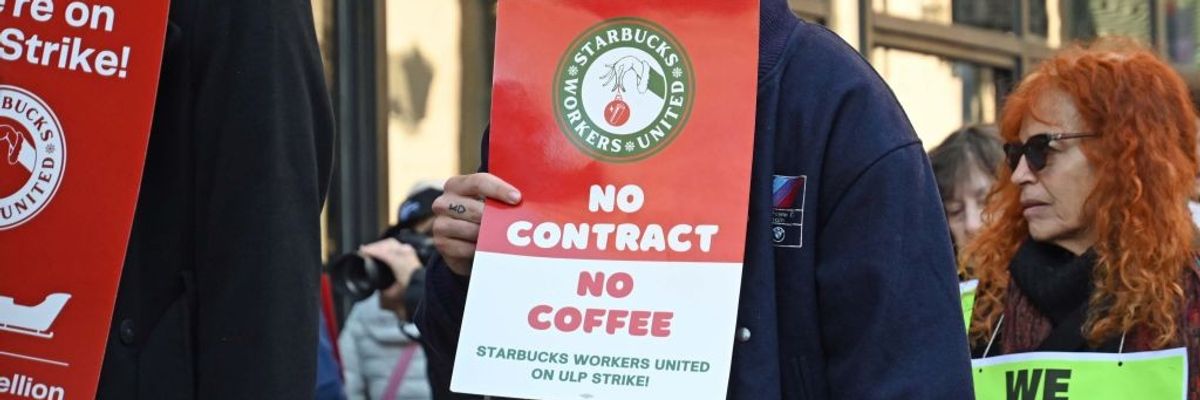
'No Contract, No Coffee': US Starbucks Workers Launch Five Days of Strikes

Starbucks Workers United accused the company of "backtracking on our promised path forward" and failing to present a "serious economic proposal" to unionized baristas.


Starbucks workers were pictured at a picket line in New York on November 16, 2023.
(Photo: Victor M. Matos/Thenews2/NurPhoto via Getty Images)

Jake Johnson
Dec 20, 2024
COMMON DREAMS

Starbucks workers launched five days of escalating strikes across the United States on Friday, accusing the coffee giant of reneging on its commitment to engage in productive bargaining talks with the union that now represents more than 11,000 baristas at over 500 stores nationwide.

The walkouts will start in Los Angeles, Chicago, and Seattle on Friday before expanding "coast to coast" amid the holiday rush, Starbucks Workers United (SBWU) said in a statement announcing the strikes.

SBWU said the strikes are a response to Starbucks "backtracking on our promised path forward." In February, the two sides agreed to "begin discussions on a foundational framework designed to achieve both collective bargaining agreements for represented stores and partners."

But SBWU said late Thursday that the company—which repeatedly violated labor law in its bid to crush a union movement that has spread widely since 2021—has "yet to present workers with a serious economic proposal."

"This week, less than two weeks before their end-of-year deadline," SBWU said, "Starbucks proposed no immediate wage increase for union baristas, and a guarantee of only 1.5% wage increases in future years."

The strikes are expected to ramp up daily through Christmas Eve unless Starbucks "honors our commitment to work towards a foundational framework," SBWU said.

Striking baristas are also asking allies to help bolster organizing efforts at Starbucks by "hosting small flyering events at not-yet- union stores" during the five days of walkouts.


Friday's walkouts come as Amazon workers are also striking at multiple delivery hubs across the country over the e-commerce giant's refusal to engage in contract negotiations.

Earlier this week, unionized Starbucks workers voted overwhelmingly in support of authorizing a strike to protest the company's alleged unfair labor practices and to set the stage for a strong contract.

"It's time to finalize a foundational framework that includes meaningful investments in baristas and to resolve unfair labor practice charges," Silvia Baldwin, a Philadelphia barista and bargaining delegate, said in a statement. "Starbucks can't get back on track as a company until it finalizes a fair contract that invests in its workforce."

"Right now, I'm making $16.50 an hour," she added. "Meanwhile, [new Starbucks CEO] Brian Niccol's compensation package is worth $57,000 an hour. The company just announced I'm only getting a 2.5% raise next year, $0.40 an hour, which is hardly anything. It's one Starbucks drink per week. Starbucks needs to invest in the baristas who make Starbucks run."

Starbucks workers to strike in three US cities, threaten nationwide action


Starbucks employees will strike on Friday in Los Angeles, Chicago, and Seattle, escalating labor tensions during the pre-Christmas rush. The strike, organized by Starbucks Workers United, targets improved pay and conditions following stalled negotiations. The action coincides with an Amazon walkout, amplifying holiday season disruptions.


Issued on: 20/12/2024 - 
By: NEWS WIRES

Unionized workers at Starbucks in the United States are walking off the job Friday in a strike that is set to spread over the following days © David Ryder, AFP

Workers at Starbucks will walk off the job Friday in three US cities in a strike their union threatened could spread around the country in the busy run-up to Christmas.

The announcement, which will initially affect stores in Los Angeles, Chicago and the firm's home city of Seattle, comes as online giant Amazon was also hit by a walkout in the crucial final shopping days of the festive period.

Starbucks Workers United, which says it represents baristas at hundreds of outlets around the country, said its action was aimed at forcing the company to improve pay and conditions after months of negotiations that it said have gone nowhere.

"Nobody wants to strike. It's a last resort, but Starbucks has broken its promise to thousands of baristas and left us with no choice," a union press release quoted Texas barista Fatemeh Alhadjaboodi as saying.

The strike, which the union says will hit more outlets every day until Tuesday, comes as Starbucks grapples with stagnating sales in key markets.

Former Chipotle boss Brian Niccol was brought on board this year with a mandate to staunch a decline that saw quarterly revenue worldwide fall three percent to $9 billion.

"In September, Brian Niccol became CEO with a compensation package worth at least $113 million," thousands of times the wage of the average barista, said union member Michelle Eisen in the statement.

The union said Starbucks had not engaged fruitfully for several months, and threatened it was ready to "show the company the consequences."

"We refuse to accept zero immediate investment in baristas' wages and no resolution of the hundreds of outstanding unfair labor practices," said Lynne Fox, president of Workers United.

"Union baristas know their value, and they're not going to accept a proposal that doesn't treat them as true partners."

Starbucks did not immediately respond to an AFP request for comment.

(AFP)


US Teamsters tackle union-busting Amazon


DECEMBER 21, 2024

By George Binette

In an unprecedented move, thousands of members of the Teamsters union launched co-ordinated strike action on 19th December at seven facilities operated by global logistics giant Amazon in the states of California, Georgia, Illinois and New York. While the potentially indefinite strikes will directly impact a tiny proportion of Amazon’s operations, the action is by far the most significant collective challenge the notoriously anti-union corporation has so far faced.

In US parlance, the action springs from “unfair labor practices” with roots dating from the start of the decade. An independent workers’ organisation, the nucleus of what became the Amazon Labor Union (ALU), sprung up against the backdrop of the Covid pandemic at the company’s JFK8 warehouse in the New York City borough of Staten Island. By early 2022, the ALU had recruited a substantial part of the nearly 8,000-strong workforce before its shock win in an official union recognition ballot that March.

The ALU win contrasted sharply with the narrow defeat of an established union that had sought recognition at Amazon’s Bessemer, Alabama complex. A judge from the National Labor Relations Board (NLRB) has, however, ordered a third ballot in a ruling that found Amazon had unduly interfered with the ballot.

Despite the NLRB certifying the ALU’s victory, Amazon has stubbornly refused to negotiate with the union for two-and-a-half years, fuelling internal tensions among ALU activists. In June this year, ALU members at JFK8 voted to affiliate to the Teamsters, the fourth largest union in the US with some 1.3 million members. In August a so-called reform slate went on to sweep local leadership elections.

While union members at the Staten Island complex are not yet part of the action, they looked likely to join the strike this weekend (21st-22nd December). Teamsters at Amazon’s DBK4 in nearby Queens did walk off the job before dawn on Thursday with scores forming a vibrant picket line. Officers from the New York Police Department (NYPD) also turned up in force at DBK4.

The cops proceeded to arrest a van driver, who had refused to cross the picket line, before attacking the line itself and arresting one of the Teamster organisers, who had previously been a key activist at the strongly unionised UPS. The NYPD reportedly had officers waiting near the JFK8 site in anticipation of picketing at the site. In the words of Jacobin contributor, Alex Press, “Perhaps the NYPD should be considered a third-party contractor for Amazon as well.”

And the gross exploitation of so-called third-party contractors is central to the current confrontation between the Teamsters and the corporation, which has also defied an instruction from the NLRB to enter negotiations with the union concerning pay and conditions more generally. Amazon has adamantly refused to recognise any responsibility as an employer to sub-contracted delivery drivers. Tens of thousands of these drivers ostensibly work for “Delivery Service Providers” (DSPs), but Amazon actually dictates virtually all their terms and conditions.

Coincidentally (or otherwise), Amazon’s founder and former CEO, Jeff Bezos, generally regarded as the world’s second richest man, dined at Donald Trump’s Mar-a-Lago, Florida estate the night before the walkouts began. Among the other dinner guests was the one individual richer than Bezos – Elon Musk. The two multi-billionaires have a shared interest not only in more corporate tax cuts, but also in deregulation and the potential gutting, if not complete abolition, of the NLRB, which has taken a modest pro-union tilt during the Biden years.

Trouble brewing at Starbucks

 The day after Amazon workers launched their action, baristas belonging to the Starbucks Workers United (SBU) union started a rolling programme of action initially across three cities – Chicago, Los Angeles and the coffee giant’s birthplace, Seattle, Washington. The action has spread over the weekend to stores in Columbus, Ohio, Denver and Pittsburgh.

Backed by resources from the Service Employees International Union, the SBU has won recognition elections at more than 500 Starbucks’ shops over the last three years and has been engaged for much of 2024 in contract negotiations on behalf of more than 10,500 members. Starbucks’ management appears to have reneged on earlier promises and the union is pursuing the largely symbolic action across five days with the aim of gaining leverage over the hectic holiday season.

George Binette, a Massachusetts native, is a retired union activist, vice-chair of Camden Trades Council and former Trade Union Liaison Officer of Hackney North & Stoke Newington CLP.

Image: Union supporters including MP Diane Abbott rally outside Amazon’s UK headquarters in Shoreditch, East London as part of an international day of action on “Black Friday” 2023. Credit: Global Justice Now.


Source: Labor Notes

Amazon warehouse workers and delivery drivers at seven facilities in the metro areas of San Francisco, Chicago, Atlanta, Southern California, and New York City are out on strike today, in what the union says is the largest strike against Amazon in U.S. history. Unionized workers at Staten Island’s JFK8 fulfillment center have also authorized a strike and could soon follow.

Workers in all these locations—five delivery stations and two fulfillment centers—have already shown majority support and demanded union recognition. The Teamsters set Amazon an ultimatum: recognize the unions and agree to bargaining by December 15, or face strikes. Amazon hasn’t moved.

“They are skirting their responsibility as our employer to bargain with us on higher pay and safer working conditions,” said Riley Holzworth, a driver who makes deliveries from the DIL7 delivery station in Skokie, Illinois.

At the DBK4 delivery station in Queens, New York, cops swarmed and arrested an Amazon driver who stopped his van in support of the strike. Then they forcibly broke the picket line. In anticipation of a possible strike at JFK8, police had camped out by the facility in advance.

The Teamsters have made organizing Amazon a priority; the New York Times reported that the union has committed $8 million to the project, plus access to its $300 million strike fund.

‘ALL YOU CAN THINK OF IS SLEEP’

The strike’s timing is strategic: package volumes balloon around the holidays, known as “peak season,” so it’s no easy feat for Amazon to cope with disruption. During the 2023 holiday season, Amazon netted 29 percent of all global online orders.

To keep up with the surge in demand, many workers are forced to work mandatory overtime—childcare and other obligations be damned. “They give us one day extra, plus one hour extra a day,” said Wajdy Bzezi, a shift lead steward who has worked at JFK8 since 2018. “I barely see my son.”

“Whan you think of the holidays you think of spending time with your family, you think of reconnecting,” said Ken Coates, a packer who has worked at JFK8 for five years. “And during peak, all you can think of is sleep.”

To help meet the increased demand the company has hired 250,000 seasonal workers across the country. This influx could also dilute strike power, though seasonal workers face the same stressors and often support the union push.

PEAK SEASON, INJURY SEASON

Rushed training for the seasonal hires has knock-on effects that leaves everyone less safe.

“Just this past month I think I ran into half a dozen new employees that didn’t know how to do the job,” Coates said. “Not due to any fault of their own, due entirely to the fault of their trainer not giving them adequate time.”

For instance, Coates says, new workers assigned to rebin duties (moving items from the conveyor belt to a designated shelf so packers can package and ship them) can unintentionally push items too far across the shelf, where they fall off the other side and hit packers.

Peak season at Amazon means peak injuries for workers. A July interim report from the Senate’s Health, Education, Labor and Pensions Committee found that injury rates skyrocket during Prime Day and the holiday season.

During the week of Prime Day 2019, the report found, Amazon’s rate of recordable injuries would correspond to more than 10 annual injuries per 100 workers—more than double the industry average. During that same period, Amazon’s total rate of injuries (including those that do not need to be reported to the Occupational Safety and Health Administration, OSHA) would correspond to almost 45 injuries per 100 full-time workers. That is to say, if they kept up the Prime Day pace, nearly half the workers would be injured in a year.

“There hasn’t been a year that I’ve worked at Amazon where we haven’t broken a record in the number of packages we’ve handled,” said Coates.

Even outside the busy season, the work is grueling. Amazon’s relentless productivity quotas are nearly impossible to meet safely, forcing workers to barter their backs and knees for $18 an hour.

new report from the same Senate committee has found that Amazon’s injury rate is having a “significant and growing impact on the average injury rate for the entire warehouse sector.”

Amazon is a corporation that transports goods and breaks down bodies. And why wouldn’t it, when this level of exploitation is incentivized at every turn? Reporting requirements are easily bypassed; the company appears to be using its on-site health facilities to obscure the true number of injuries sustained by workers on the job, or to shift the blame to workers for using improper technique.

“I couldn’t tell you how many times I’ve been injured on the job,” said Coates. “In our bathroom there’s a mirror that says, ‘You’re looking at the person who is most responsible for your safety.’ It pisses me off every time I have to see it. That’s just them passing off the buck.”

The OSHA penalties for instances that do get reported are capped at around $16,000 for each serious violation, the report notes. For a company making $70,000 in profits per minute, that’s just the cost of doing business.

“It doesn’t feel like a job that should be legal,” Holzworth said. “I’ve had a lot of different jobs in this industry, and this one by far feels like my employer is really getting away with a lot.”

A GLOBAL FIGHT

Workers organizing at key chokepoints in the supply chain have managed to extract a few concessions from Amazon, including increased pay for Chicago-area delivery station workers and the reinstatement of a suspended air hub employee in San Bernardino and another in Queens.

But Amazon has made significant investments that reduce its vulnerability. The expansion of its fulfillment network allows the company to reroute orders within its network of warehouses and reduces its reliance on any one location in the event of strikes or disruptions. Building sufficient power to tip the scales will require organizing across the global supply chain.

Around the world, the company has fiercely opposed organizing efforts, leaning on anti-union tactics like delaying elections, holding captive-audience meetings, and going on a hiring spree ahead of a union election to dilute the vote.

Between 2022 and 2023, Amazon spent more than $17 million on union avoidance consultants. And where other companies are content to bring in these swindlers to train management, Amazon is sometimes cutting out the middleman and hiring them directly as managers.

‘TAKE SOME ACCOUNTABILITY’

For delivery drivers, there’s another wrinkle: The drivers officially work for third-party contractors known as delivery service partners (DSPs), allowing Amazon to skirt responsibility.

When drivers unionized last year at a DSP in California called Battle-Tested Strategies, Amazon ended its contract and cut ties with the contractor, effectively firing the 84 drivers (Amazon was the company’s only client, and the company hasn’t operated since.)

This year, Amazon pulled the same stunt when drivers organized at a DSP in Illinois, Four Star Express Delivery.

Amazon maintains that since drivers are employed by DSPs, it has no duty to bargain with the workers. But drivers call bullshit, insisting that Amazon meets the legal standard for a joint employer: “We drive your branded van, we wear your uniform,” said Rubie Wiggins, a delivery driver at Amazon’s DAX5 facility in Southern California. “Take some accountability.”

‘WE CAN BRING THEIR STANDARDS HERE’

Safety is a central concern—and a key organizing issue. Delivery vans are packed to the brim, forcing some drivers to jam packages behind seats and behind any available crevice.

“It looks like a crypt in your van,” said Andrew Wiggins, Rubie’s husband, who works for the same DSP. “A lot of drivers put packages on the dash, wherever they can. It’s very unsafe, but people are just doing what they have to do.”

Rubie and Andrew talk regularly with UPS delivery drivers about the benefits of a strong union contract. “It’s amazing what you hear that they have,” Rubie said. “They have mechanics on site, they can watch their vehicles on site, we don’t have any of that. When you see that UPS is less profitable than Amazon and they’re able to do that for their drivers, you really want to tell Amazon, ‘Please take care of me like that.’”

“At Amazon it’s like, in order to perform, you have to think in your head a complete system of exact steps,” Holzworth said. “I’m gonna organize my packages in this way and as soon as I stop, I’m gonna engage the brake, pull out the keys, take off my seatbelt, in this order every single time so that you’re wasting as few seconds as possible.”

“If Amazon can have this as their business model, what’s the future working conditions gonna look like for other corporations?” Rubie Wiggins said. “We have nieces and nephews, I have younger brothers. What’s the workforce gonna look like for them in a couple years?

“You get a lot of ‘Why don’t you work for UPS?’” she said. “We’re drivers already. We can bring their standards here. We can start making the working conditions better here.”


Amazon Workers Launch Historic Strike to Demand New Contracts & End Unsafe Labor Practices

Source: Democracy Now!


Thousands of Amazon workers on Thursday launched the largest strike against the retail giant in U.S. history, pressuring the company at the height of the holiday period to follow the law and bargain with those who have organized with the Teamsters union. The strike includes warehouse workers and drivers at seven distribution centers in some of Amazon’s largest markets, including New York, Atlanta and San Francisco; Teamsters have also set up picket lines at many other warehouses nationwide. “We’re engaging in a coordinated action to try to put the pressure on Amazon to stop breaking the law, come to the table,” says Connor Spence, president of Amazon Labor Union-IBT Local 1, which represents workers in New York. “This is an unfair labor practice strike over their refusal to bargain.” We also speak with Ronald Sewell, an Amazon associate in Georgia, who says workplace safety is a major driver of worker discontent, including insufficient access to water and overheating. “The danger is real. It’s not something that we’re making up,” says Sewell.


Transcript

This is a rush transcript. Copy may not be in its final form.

AMY GOODMAN: Thousands of Amazon workers organizing with the Teamsters union have launched the largest strike against Amazon in U.S. history. In the midst of peak holiday shopping season, drivers and workers at seven facilities in New York, Georgia, Illinois and California went on strike Thursday to pressure Amazon to come to the negotiating table as workers demand better benefits, higher wages and safer working conditions.

The strike comes days after the Senate Labor Committee, led by Senator Bernie Sanders, published a report that found Amazon systematically ignores and rejects recommended worker safety measures and deliberately misrepresents workplace injury data.

This is a video from the Teamsters with workers explaining why they’re joining the strike.

AMAZON WORKER 1: I believe a strike is definitely going to make Amazon realize that we’re not playing. We’re serious.

AMAZON WORKER 2: DBK4 has started a revolution, and I believe that Amazon will wilter under the pressure and cave in and pay us.

AMAZON WORKER 1: Amazon is not respecting us. We’ve been trying to get Amazon to recognize us as Teamsters, and they’re not coming to the table.

AMAZON WORKER 3: And that’s why now we are ready to strike and to actually show them what exactly we are fighting for.

AMY GOODMAN: On Wednesday night, just before the strike began, Amazon founder Jeff Bezos dined with President-elect Donald Trump and billionaire Elon Musk at Mar-a-Lago. Bezos also committed to donate $1 million to Trump’s inauguration fund through Amazon.

As workers continue to join picket lines at hundreds of Amazon fulfillment centers across the country, Amazon spokesperson Kelly Nantel claimed in a statement most of the workers on strike are, quote, “almost entirely outsiders, not Amazon employees or partners, and the suggestion otherwise is just another lie from the Teamsters,” unquote.

The $2 trillion company employs more than one-and-a-half million people. The Teamsters represent about 10,000 workers. Teamsters President Sean O’Brien said in a statement, quote, “If your package is delayed during the holidays, you can blame Amazon’s insatiable greed. We gave Amazon a clear deadline to come to the table and do right by our members. They ignored it,” unquote.

For more, we’re joined by two guests. Ron Sewell is with us, an Amazon associate at an Amazon facility in East Point, Georgia. He’s joining us from Fort Worth, Texas. And here in New York, we’re joined by Connor Spence, the president of the only Amazon local, ALU-IBT Local 1, at the Staten Island Amazon warehouse, the first Amazon facility to unionize.

We welcome you both to Democracy Now! Connor, let’s begin with you. Explain this strike and respond to Amazon saying these are all outsiders who are striking.

CONNOR SPENCE: Yeah, so, for more than two years at our facility, JFK and Staten Island, Amazon has been refusing to come to the table and negotiate a strong union contract with the workers. This is obviously in violation of federal law. Now, across the country, they have the same obligation with bargaining units, over 20 of them across 10 states. We are all joined together as part of the International Brotherhood of Teamsters national Amazon Division, and we’re engaging in a coordinated action to try to put the pressure on Amazon to stop breaking the law, come to the table. This is an unfair labor practice strike over their refusal to bargain.

AMY GOODMAN: And can you talk more about the significance of this largest strike against Amazon in history?

CONNOR SPENCE: Well, in the U.S., there hasn’t been large coordinated action like this. And actually, I do want to comment on the point Amazon is trying to make that this is somehow just an outsider action. You can go to any one of these picket lines where the workers have walked off the job, and see that’s not the case. Last time I was on the show, I talked about how Amazon has 150% turnover in their warehouses nationwide. Something like this, organized on this scale, has to be internal, has to be worker to worker. It has to come from the inside. The idea that this could be done by outsiders is just ridiculous on Amazon’s part. It’s really a narrative I think they want to push so that other workers who are not yet organizing don’t see this and become inspired that they can also fight to change their conditions.

AMY GOODMAN: At the Amazon picket line in Queens here in New York Thursday, police arrested, then released Teamsters organizer Anthony Rosario, as well as Jogernsyn Cardenas, one of the striking Amazon workers. NYPD agents also threatened the crowd with mass arrests. Journalist Luis Feliz Leon of Labor Notes captured the moment of Cardenas’s arrest. New York police officers swarmed Cardenas and blocked him in the cab of his van.

STRIKING WORKER: I already know, we’re good. We good. You’re going to get out. We good. You good. Yo, you good. You good. Here unite! Here unite!

POLICE OFFICER: Step back!

STRIKING WORKERS: Let him go! Let him go! Let him go!

POLICE OFFICER: Step back!

STRIKING WORKERS: Let him go!

POLICE OFFICER: Step back!

STRIKING WORKERS: Let him go! Let him go! Let him go!

AMY GOODMAN: So, if you can describe the scene and the scene around the country, Connor?

CONNOR SPENCE: I would say there’s a lot of energy, a lot of activity. I mean, I don’t think it’s like — I think it’s very significant to point out to people that it’s the dead of winter. We’re nearing the holidays. People would rather walk off the job than spend another day in the warehouse under those conditions. And I think you can really — when you go to these picket lines, you can feel that energy. The workers are — they’re tired. They feel exploited. They feel abused. And the only thing stopping more workers from taking action is just the time it takes to organize in these conditions. And it’s going to keep building, and you can sense that when you’re on the line.

AMY GOODMAN: I wanted to also bring in Ron Sewell, Amazon associate working in East Point, Georgia, also an Amazon learning ambassador, helps train new hires and other associates, punished by Amazon for organizing on safety issues. He filed an unfair labor practice against Amazon, and Amazon settled. He’s usually in Georgia but now in Fort Worth, Texas. Talk about the issues that you face and other workers face.

RONALD SEWELL: Thank you for having me.

Yes, the issues that we face there is the common safety issues, such as clean water, cool air in the South, overheating building, people passing out. And no — when I say no response from management to even speak with us or talk with us, and therefore that’s why we are in strong support of the New York picketers, and we’re doing the same thing here in the location East Point.

AMY GOODMAN: Can you talk about the dangers that workers face, the level of injury on the job? Talk about what Senator Sanders talked about in the Senate.

RONALD SEWELL: Well, the dangers in the job, what Senator Sanders talked about, is real. We have employees — just recently, last week, I had to assist an employee who passed out, that was working the early morning. And he was trying to get to a place where he can sit down, either in the break room or in the restroom. But before he even reached that area, he passed out on the floor in front of me, hitting his head, hitting his face.

So, the danger is real. It’s not something that we’re making up. We have an older population, as well as a younger population. And that’s something health-wise, safe-wise, that we submitted a request to OSHA, and we got a visit by them, and they went through the whole facility.

AMY GOODMAN: Has ATL6 in Atlanta, in East Point, unionized?

RONALD SEWELL: No, we have not unionized, but we do have the full support of the Teamsters and what have you. And we are fighting for our individual rights. And we will continue doing that and continue supporting the Teamsters and all others in getting Amazon to come, at least management, talk with us, listen to our demands, listen to our concerns.

AMY GOODMAN: If you can explain who’s unionized and who hasn’t, Connor? And explain your position. You’re the only president of a local Amazon Teamsters unit.

CONNOR SPENCE: So, in 2022, we were the first warehouse to win an actual NLRB election. Since then, many other warehouses across the country have gone through the NLRB process, not quite the same way we did. Instead, they signed a majority of their co-workers on union cards, demonstrated that majority to the company. The company, under a newer NLRB ruling, had about two weeks to contest that majority, file elections with the NLRB. They refused to do so. So, in doing so, it was a tacit recognition that those majorities exist, and therefore, that has happened at over 20 bargaining units across the country. And that number continues to grow as the movement expands and we organize more workers.

AMY GOODMAN: The Teamsters President O’Brien spoke, controversially, at the Republican convention. Do you think unions will do better under Trump?

CONNOR SPENCE: I mean, I think it remains to be seen. I’m very much a fan of the current NLRB general counsel, Jennifer Abruzzo. But I think that, ultimately, what we’ve learned, even in the past four years under Biden, is that the NLRB is not the main instrument of change here. It’s building worker power. And we have to do that under any administration, under any NLRB.

AMY GOODMAN: And are you calling for people not to use Amazon, to boycott Amazon?

CONNOR SPENCE: I think a better thing for me to say is, if you choose to shop on Amazon this holiday, a good thing to do would be to meet with your driver, have a conversation with them when they drop off your package, ask them about their working conditions. If there are things they would want to change, tell them that you’ve seen Amazon workers organizing on TV, that they should consider joining the Teamsters, and they have the full support of you and the community if they choose to do that.

AMY GOODMAN: Well, I want to thank you very much for being with us. Connor Spence is president of Amazon Labor Union-IBT Local 1. And I want to thank Ron Sewell for joining us, Amazon associate working in the ATL6 facility in East Point, Georgia, talking to us from Texas.