Five years after George Floyd’s murder, church leaders say race relations face retrenchment
(RNS) — ‘We are honest about the conditions that we're facing, but we are not hopeless about what we're facing,' said Bishop W. Darin Moore of the African Methodist Episcopal Zion Church.
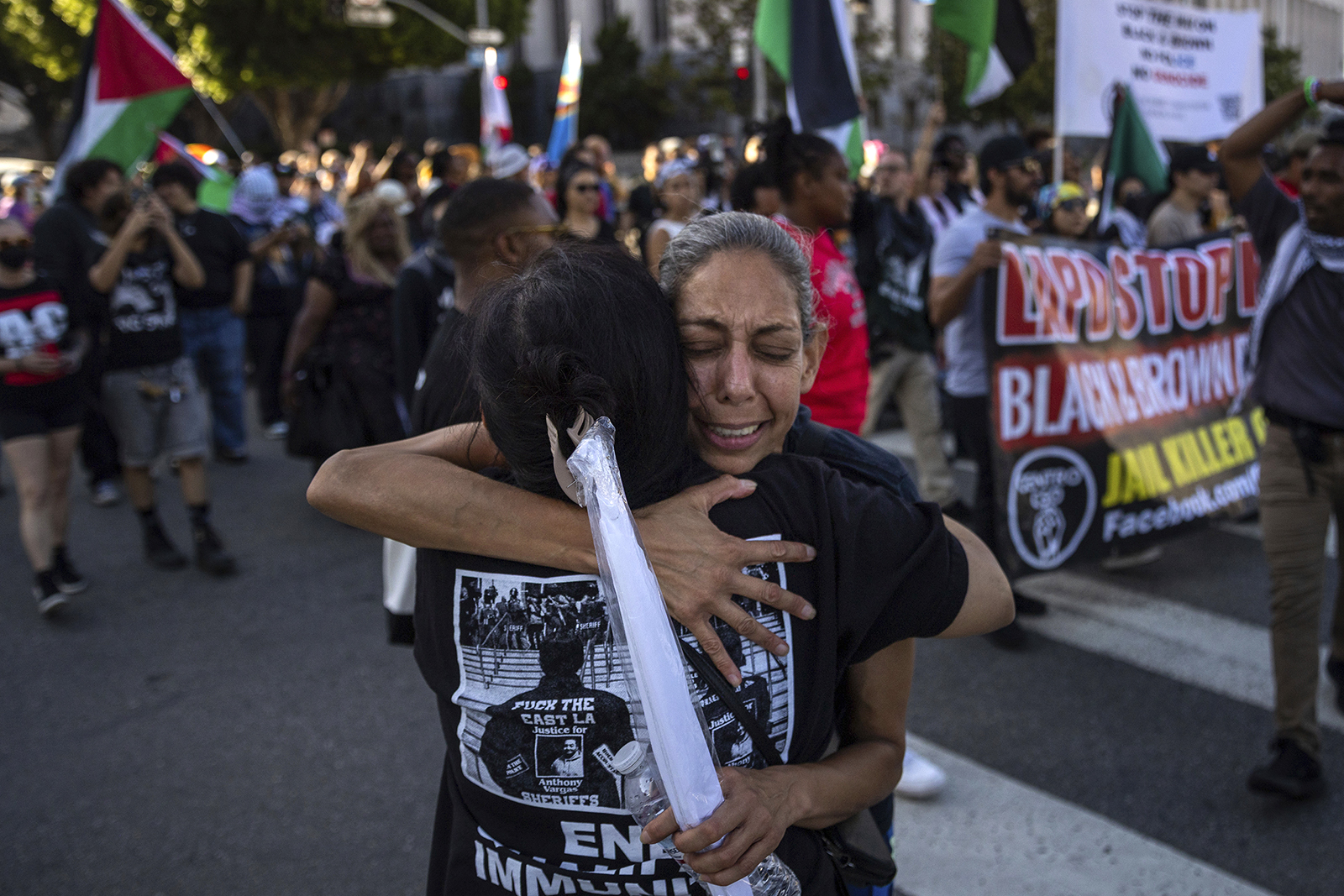
People embrace while attending a march remembering George Floyd on Wednesday, May 21, 2025, in Los Angeles. (AP Photo/Ethan Swope)
Adelle M. Banks
May 26, 2025
(RNS) — Bishop W. Darin Moore of the African Methodist Episcopal Zion Church remembers what it was like in the days after the 2020 murder of George Floyd.
“You saw initiatives being taken by churches, by governmental entities or by corporations to acknowledge first, and then to confront and then to improve racial relations,” he recalled.
Now, said Moore, the leader of eastern North Carolina churches of his historically Black denomination, most of the work to ensure Black history is taught appears to be happening in Black churches. That’s in part due to backlash against what he termed the “bogeyman” critics created as they opposed diversity, equity and inclusion efforts and critical race theory — two concepts that have become politically polarizing terms in recent years.
A new Pew Research Center study found that 27% of Americans surveyed in February 2025 said the increased focus on issues of race and race inequality led to changes that improved the lives of Black people after the death of Floyd, a Black man from Minneapolis. He died when white police officer Derek Chauvin held his knee on Floyd’s neck for more than nine minutes. Chauvin was convicted in 2021 of Floyd’s murder, and three other officers were found guilty of other related charges.
However, almost three-quarters (72%) said the newfound focus on racial matters did not have a great influence on improving Black lives. Back in 2020, 52% thought it would, according to Pew.
RELATED: Black church leader says Target boycott won’t ease until DEI programs return
Across denominations and races, clergy are noticing the emphasis shifting away from race relations that occurred in the wake of Floyd’s death. They’ve seen temporary improvements and then retrenchment but say efforts nevertheless continue to foster understanding and bridge divides.

Participants hold hands during a National Unity Weekend event in June 2024. (Courtesy photo)
“Right after George Floyd and Breonna Taylor and others were murdered, there was this swell of people of all different skin hues that came together and marched and made statements,” said the Rev. Jean Hawxhurst, a white United Methodist ecumenist who is president of Churches Uniting in Christ. “Right now, we’re kind of in a complacency,” noting what she views as racist attitudes of the current Trump administration “welcoming in Afrikaners and not welcoming in people with darker colored skin.”
The CUIC committed in 2023 to a three-year period focused on anti-racism, has had quarterly dialogues and may have related book studies in the future. Asked if she sees a change in the relationships between predominantly white and mostly Black churches in her circles, Hawxhurst said, “I wish I could say I had definite examples of yes. I think what I see is the hope. I’m not sure I see yet the living out.”
Walter Kim, the National Association of Evangelicals president, said after an initial “incredible jump in engagement and participation” in racial justice and multiethnic ministries, there was a realization of how complicated the issues are. He said there is a “recalibration” occurring regarding how there are not merely Black and white dimensions to reconciliation, but the need to also involve a range of ethnic groups, including Asian, Hispanic and Native American communities.
For instance, Kim said the NAE found that recent opportunities for in-person interaction were more effective than the online “Racial Justice Assessment Tool” it created in 2023 to provide suggestions of books and online courses based on individual Christians’ answers to a brief survey.
For the last two years, the NAE has held a spiritual retreat with evangelical leaders of color, who often work in predominantly white spaces, for “encouragement and swapping of best practices to stay involved in the long-term labor.”
And in 2024, the NAE gathered dozens of leaders, about 40% white, 40% Black and 20% of other backgrounds, for a forum and tour of The Legacy Museum and other Montgomery, Alabama, properties of the Equal Justice Initiative, including the National Memorial for Peace and Justice, created to remember thousands of lynching victims. Some of the Black participants discovered the names of their forbears, prompting collective lament, Kim said.
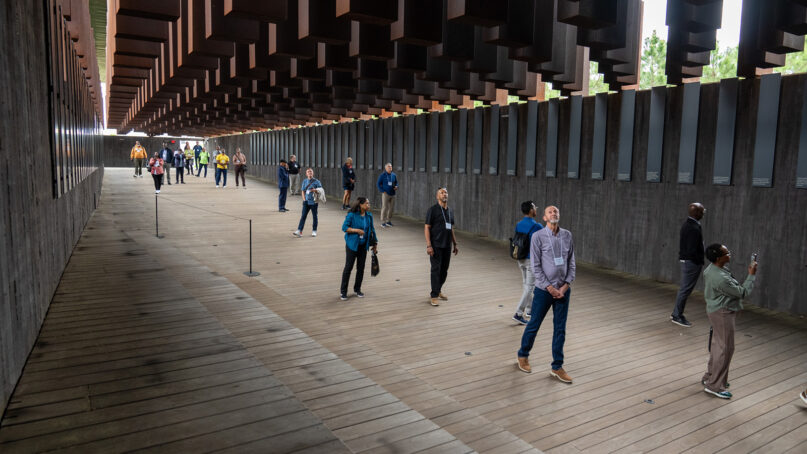
People tour The Legacy Museum in Montgomery, Ala., as part of an event organized by the National Association of Evangelicals in 2024. (Courtesy photo)
“We’re entering deeply into each other’s story and finding some deep points of resonance,” said Kim, who is Asian American, recalling a small-group discussion he had with Native American, African American and Jamaican American leaders that has led to greater attention and activism on policy issues such as water rights and deportation threats.
Bishop Derek Grier, the founder of the upcoming third annual National Unity Weekend — a Christian event aimed to facilitate unity among different races and ethnicities — said “only time will tell” if religious efforts focused on intentional interactions between evangelical leaders of different racial and ethnic groups will lead to a lasting solution.
More than 100 churches across two dozen states have signed up for the events of the weekend from June 7-8, which will feature churches distributing food in predominantly minority communities with the help of charities such as the faith-based Convoy of Hope. A similar number of churches took part in 2023 and 2024, he said.
“Last year, we distributed over 100,000 pounds of food,” said Grier, who is Black. “This year, we hope to do almost as much, however, we’ve expanded it to include shoes and haircuts.”
But the organization’s related “Let’s Talk” Zoom discussions that began in 2022, with Asian, African American, Hispanic and white evangelical leaders discussing personal experiences, have lost participation over time, Grier said. They used to attract around 60 people and now have about half that many logging in to the regular sessions.
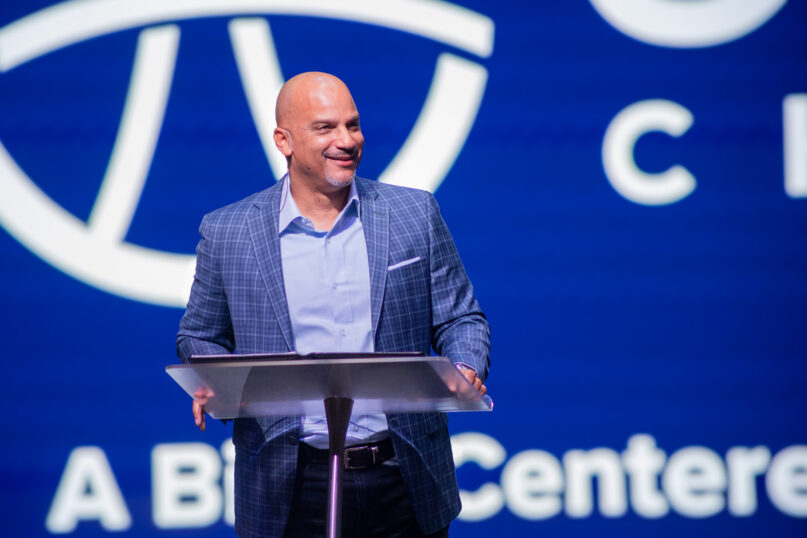
Bishop Derek Grier at Grace Church in Dumfries, Va. (Photo by Katajh Marshall)
Marshall Blalock, a member of the steering council of Unify Project, a racial reconciliation initiative started by two former Southern Baptist Convention presidents, said he is concerned it may be difficult for some clergy to broach topics related to race relations due to the current political climate.
“Some of the politics of our country right now have labeled certain efforts toward racial reconciliation in political terms, and that’s made pastors more reticent to help push toward the racial reconciliation for fear of being labeled in some way,” Blalock said.
He has pastored First Baptist Church of Charleston, South Carolina, for 28 years and said his congregation is used to his preaching about bridging divides.
“It’s not always easy to take this path, but it’s also true that I believe the gospel requires us to take this path,” he said.
Unify Project focuses on building relations between local pastors of different races, encouraging them to meet over meals and build trust as they determine ways to help their communities by gathering their congregations together at least once a year and working on joint service projects at least annually.
“Unify doesn’t make statements that would polarize anybody,” Blalock said, adding he and other project leaders are working to help restart some reconciliation efforts that have stalled.

Marshall Blalock in a Unify Project video. (Video screen grab)
Well before 2020, religious groups had taken steps toward reconciling among races and protesting racism. The Southern Baptist Convention adopted a landmark racial reconciliation resolution on its 150th anniversary in 1995, and the National Council of Churches held the A.C.T. to End Racism Rally, seeking to “awaken, confront and transform” on Washington’s National Mall in 2018, on the 50th anniversary of the assassination of the Rev. Martin Luther King Jr.
Religious leaders now plan to take part in events marking the fifth anniversary of Floyd’s death on May 25, including the Rev. Al Sharpton at a private memorial service at Floyd’s gravesite; vigils in Washington and Springfield, Massachusetts, with moments of silence for nine minutes and 46 seconds; and a “George Floyd Angel-versary event” at an Evangelical Lutheran Church in America-affiliated congregation in Minneapolis.
Moore, the AME Zion bishop who spoke at the 2018 rally as the NCC’s chair, said the regression now seen after advancements in race relations and calls for improvements for Black Americans is not new. It also happened, he noted, when Jim Crow laws followed the post-slavery Reconstruction period, and when Donald Trump was elected president after Barack Obama was voted in as the first Black president.
“There’s going to come progress out of all of this anti-DEI and -CRT, all of this resentment that has been infecting this country,” he said. “We’re going to resist, persist and we’re going to advance and come out in a better place. So we are honest about the conditions that we’re facing, but we are not hopeless about what we’re facing.”
George Floyd’s Family Speaks: ‘I Just Want My Brother’
By Philonise Floyd, Keeta Floyd , Maximillian Alvarez
By Philonise Floyd, Keeta Floyd , Maximillian Alvarez
May 26, 2025
Source: The Real News Network
May 25 is the five-year anniversary of the death of George Floyd. In 2023, George’s brother, Philonise Floyd, and his sister-in-law, Keeta Floyd, joined The Real News for an exclusive interview looking back on George’s life three years since his death at the hands of convicted former Minneapolis police officer Derek Chauvin.
May 25 is the five-year anniversary of the death of George Floyd. In 2023, George’s brother, Philonise Floyd, and his sister-in-law, Keeta Floyd, joined The Real News for an exclusive interview looking back on George’s life three years since his death at the hands of convicted former Minneapolis police officer Derek Chauvin.
Agence France-Presse
May 25, 2025

Courtesy Patriot Front
by Ben Turner
Kenda Zellner-Smith hauled up a corrugated metal door to reveal hundreds of wooden boards covered with graffiti, each telling a story of the protests that followed George Floyd's killing by a US police officer.
The 28-year-old has collected and archived the panels that once protected businesses from rioting in Minneapolis, aiming to preserve the legacy of the 2020 murder that shocked the United States.
Five years on, Zellner-Smith said the boards -- kept in a storage unit by an industrial site two miles (three kilometers) from where Floyd died -- still evoke powerful emotions.
They range from blank plywood with text reading "I can't breathe" -- the final words Floyd said as Derek Chauvin, a white police officer, knelt on his neck -- to colorful murals depicting rainbows and love hearts.
"Every time I look at them there's something different I notice," she told AFP. "They reignite an energy or a fire that was felt years ago during the uprising."
Then a university graduate in Minneapolis, Zellner-Smith was among millions of Americans who joined the Black Lives Matter rallies in 2020 that swept US cities.
The threat of vandalism saw many businesses protect themselves with wooden boards -- which became canvases for protesters' slogans and drawings demanding justice.
- 'Resistance' -Zellner-Smith said she decided to start collecting the boards after seeing one taken down after the protests and thinking "'Oh my god, these are going to disappear just as fast as they showed up.'"
"Every single day after work, I'd grab my dad's pickup truck and I would just drive around searching for boards," said Zellner-Smith, who searched alleyways and dumpsters.
Today, her project called "Save the Boards" counts over 600 in its collection, with each stacked vertically in a pair of storage units measuring 10 by 30 feet (three by nine meters).
But with Floyd's legacy under the spotlight on the fifth anniversary of his death as many hoped-for reforms to address racism have not been met, she said the boards are crucial to sustaining the protest movement.
"Art serves as a form of resistance and storytelling, and it speaks to real, lived experiences, and that's what these are," Zellner-Smith said.
Her next challenge is finding a long-term home for the boards as grants that covered storage costs are running dry.
A handful are already being exhibited -- including in a building restored after it was damaged by arson during the 2020 protests -- and most have been photographed to be archived online.
"My biggest push is just to make sure they're still seen. The stories they have to tell are still heard, and that people understand there's still a lot of work to be done," Zellner-Smith said.
- 'Murals gave me hope' -
Her initiative is similar to another, more expansive one in Minneapolis called Memorialize the Movement.
That nonprofit exhibited around 50 boards during a memorial event held Sunday on a recreation ground near George Floyd Square, the name given to the area where the 46-year-old was killed.
With Afrobeat music booming from speakers, dozens of people scanned the display that included one piece with squares of black and brown, each filled with phrases like "We matter" and "Protect us."
Another mostly bare wooden board had just a black love heart with "No justice, no peace" written in the middle.
"I think it is absolutely vital that these murals and this story that they tell are preserved for future generations," said Leesa Kelly, who has collected over 1,000 pieces while running Memorialize the Movement.
Asked what drove her to start the project, the 32-year-old replied: "I didn't do this because I was motivated or inspired, I did it because I was experiencing trauma."
"A Black man was killed. The murals gave me hope," said Kelly, who also collected many of the boards herself during the 2020 protests.
Darnella Thompson, 43, was one of those looking at the boards on a warm, sunny day, stopping to take a photo in front of one saying "Speak up" and "Hope."
"It's overwhelming," she told AFP. "As a person of color who has experienced quite a bit here in this country, it definitely resonates very much with me."
"It brings up more so sadness than anything because this is continuous," Thompson added.
bjt/des
© Agence France-Presse

No comments:
Post a Comment