Maersk Cites “Increasingly Volatile Environment” Lowering Volume Forecast
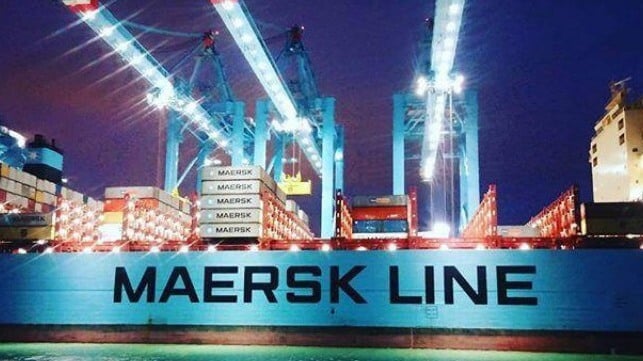
Maersk, the largest publicly-traded container carrier and logistics company, cited the “increasingly volatile environment,” telling investors that it expects volume growth in the global container market will slow and possibly even be negative in 2025. The carrier reported, however, a strong start for the first quarter of 2025, which it expects to carry into the second quarter as customers build inventories before the full effect of the tariff war overtakes the market.
“With trade tensions flaring up and uncertainty on the rise, global supply chains are once again in the spotlight,” said CEO Vincent Clerc. He believes Maersk is well-positioned because of its integrated shipping and logistics offering, which could help customers make the best business decisions in the face of current uncertainties.
First quarter container volumes the company reported were stable versus a year ago, while it benefited from higher freight rates in Q1 2025. Profits for its ocean segment soared to $1.9 billion this quarter versus just under $1 billion a year ago. Costs have stabilized after last year when diversions around South Africa began due to the security issues in the Red Sea. Maersk said today it expects the disruption in the Red Sea will continue through the rest of the year.
Despite the looming tariffs and volatility, Maersk said it expects market growth in the second quarter. While admitting that volumes on routes from China to the U.S. plunged 30 to 40 percent in April, Maersk said it believes customers are building inventories, which supported the second quarter, while pointing to uncertainty and the risk of contractions in the second half of the year if the tariffs are not rolled back.
Maersk’s remarks came as Donald Trump heralded the U.S.’s first trade deal, which came from long-time ally the United Kingdom. Trump, however, told reporters that he recognized the tariffs on China would be lowered while still predicting a trade deal would be reached.
Due to the unpredictability, Maersk, however, revised its outlook for the global container market saying growth would be lower than the previous four percent prediction. Its revised estimate set the low end of the range at a one percent contraction, “given the increased macroeconomic and geopolitical uncertainty.”
Maersk said the sequential declines it reported today were expected while it called Q1 “solid results.” Clerc told investors the company would be “doubling down on the work underway on automation and cost management to remain fit for what lies ahead.”
Despite the increased uncertainty leading to a more cautious container volume growth outlook, Maersk reconfirmed its full-year guidance provided in February. It is still projecting earnings (EBITDA) of $6 to $9 billion but said its free cashflow would be negative by at least $3 billion.
Near-term, Maersk said it was able to reallocate some capacity to other markets, which it said still had strong demand. Clerc said so far the trade war has mostly impacted the flow between China and the U.S. telling CNBC it has “not yet contaminated any of the other trade lanes.”
Clerc told Reuters that they were confident the supply chain would stabilize. He said “the dream of producing locally” for all the needs is not possible. While the trade war casts a shadow over the U.S. economy, he called the current tariffs prohibitive, predicting volatility ahead before the market stabilize.
First Drop for Inbound Containers Forecast After Surge Ahead of Tariffs
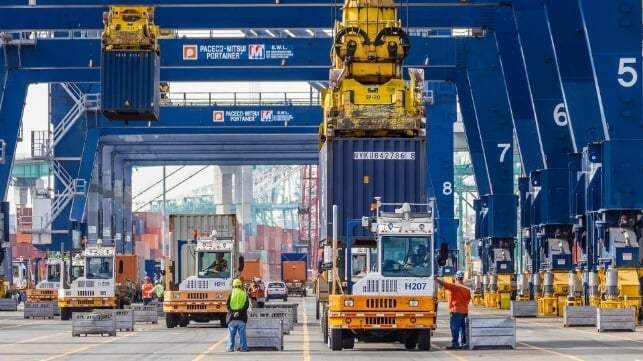
U.S. retailers and the logistics tracking services for shippers are sounding the alarm on the expected dramatic declines coming for import containers as the Trump tariffs go into effect. The National Retail Federation (NRF) released data predicting the first year-over-year decline in imports in 19 months, noting the tariff uncertainties were coming at an important time of the year in the buying cycle. Data software company Descartes says the data suggests sourcing patterns, tariffs, and trade risks are continuing to evolve.
Descartes released data from its global trade software yet again highlighting that importers have been rushing to get goods into the United States ahead of the imposition of the tariffs. It reports that container imports were up 1.2 percent over March and better than 9 percent year-over-year, surpassing 2.4 million TEU. Descartes notes it was one of the strongest Aprils on record.
The data highlights the efforts to frontload shipments, especially from Asia where Descartes says imports from China were up 5.4 percent from March to April. They note that Chinese-sourced commodities included furniture, plastics, and machinery, all of which were targeted with the tariffs. Dramatic year-over-year gains emerged from countries such as Vietnam (32.5 percent) and Thailand (13.4 percent).
Descartes believes it was having a direct impact on ports as well with it forecasting strong gains in volumes at Los Angeles (13.9 percent) and Long Beach (12 percent). It, however, notes volumes incoming at Savannah and Charleston were down as shippers focused on the faster trans-Pacific routes.
“While container import growth remained strong in April, it may be, in part, because U.S. importers are continuing to pull shipments forward ahead of new U.S. tariffs, in particular the 145% tariff on Chinese goods implemented on April 9,” said Jackson Wood, Director, Industry Strategy at Descartes. “Since the new elevated tariffs do not apply to goods already in transit when the tariffs were implemented, the tariff impact may be reflected more significantly in May container import volumes.”
It believes this has been a factor in the 8.6 percent increase for U.S. imports in the first four months of 2025. Descartes highlights that China accounted for 33.4 percent of total U.S. inbound container volume in April.
“We are starting to see the true impact of the tariffs on the supply chain,” predicts NRF Vice President for Supply Chain and Customs Policy Jonathan Gold. He notes the tariffs “come at the most important time in the buying process” for retailers. Many retailers are pausing or canceling orders as a result, and small retailers, in particular, “are concerned about what to expect in the coming months and how to order for the future.”
The retailer’s trade association is forecasting a dramatic decline in imports starting in May down to 1.81 million TEU. The NRF predicts volumes will plateau during the summer between 1.7 and 1.8 million TEU per month, a decline of greater than 20 percent per month versus 2024 levels.
The NRF notes that imports have been elevated since last summer, first as retailers brought in cargo ahead of an October strike at East Coast and Gulf Coast ports, and then in anticipation of an escalation of tariffs after the November elections.
Trump: Port Traffic Slowdown "A Good Thing"
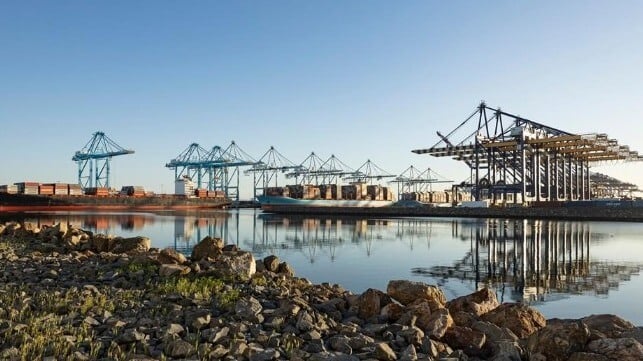
This week, after major container ports on the West Coast reported less ship traffic due to falling imports, U.S. President Donald Trump told reporters that a drop in boxship volume is a win for the American economy.
"That means we lose less money . . . when you say it slowed down, that's a good thing, not a bad thing," Trump said in response to a reporter's questions at a press conference Thursday.
After the imposition of 145 percent tariffs on Chinese goods last month, buying activity for goods for export from China to the U.S. plummeted, followed by a sharp drop in container bookings. "Carriers reacted to the drop in exports out of China in the immediate aftermath of reciprocal tariff announcements by the US Government at the start of April by increasing blanked sailings," explained Xeneta's Peter Sand in a recent customer note.
The number of ships departing China for the U.S. West Coast has dropped sharply: the Port of Long Beach reports 30 blanked sailings in May and June, and the Port of Long Beach reports another 30. Port of Long Beach CEO Mario Cordero confirmed to local NBC LA that volume is already down, and said that traffic hasn't been this slow since the pandemic.
The number of vessels isn't the full picture. Based on AIS, the boxships that are under way from China to the U.S. this week are riding an average of about two feet higher in the water than normal, says Flexport CEO Ryan Peterson - indicating that they are carrying less cargo.
The slowdown may not last long. The U.S. and China have begun much-anticipated negotiations on a new trade agreement, and this will eventually result in lower tariffs on Chinese goods, Trump confirmed Thursday. "Right now you can’t get any higher. It’s at 145 percent so we know it’s coming down," Trump told Bloomberg TV.

No comments:
Post a Comment