How the US and Israel Used Rafael Grossi to Hijack the IAEA and Start a War on Iran

Rafael Grossi, Director General of the International Atomic Energy Agency (IAEA), allowed the IAEA to be used by the United States and Israel—an undeclared nuclear weapons state in long-term violation of IAEA rules—to manufacture a pretext for war on Iran, despite his agency’s own conclusion that Iran had no nuclear weapons program.
On June 12, based on a damning report by Grossi, a slim majority of the IAEA Board of Governors voted to find Iran in non-compliance with its obligations as an IAEA member. Of the 35 countries represented on the Board, only 19 voted for the resolution, while 3 voted against it, 11 abstained and 2 did not vote.
The United States contacted eight board member governments on June 10 to persuade them to either vote for the resolution or not to vote. Israeli officials said they saw the U.S. arm-twisting for the IAEA resolution as a significant signal of U.S. support for Israel’s war plans, revealing how much Israel valued the IAEA resolution as diplomatic cover for the war.
The IAEA board meeting was timed for the final day of President Trump’s 60-day ultimatum to Iran to negotiate a new nuclear agreement. Even as the IAEA board voted, Israel was loading weapons, fuel and drop-tanks on its warplanes for the long flight to Iran and briefing its aircrews on their targets. The first Israeli air strikes hit Iran at 3 a.m. that night.
On June 20, Iran filed a formal complaint against Director General Grossi with the UN Secretary General and the UN Security Council for undermining his agency’s impartiality, both by his failure to mention the illegality of Israel’s threats and uses of force against Iran in his public statements and by his singular focus on Iran’s alleged violations.
The source of the IAEA investigation that led to this resolution was a 2018 Israeli intelligence report that its agents had identified three previously undisclosed sites in Iran where Iran had conducted uranium enrichment prior to 2003. In 2019, Grossi opened an investigation, and the IAEA eventually gained access to the sites and detected traces of enriched uranium.
Despite the fateful consequences of his actions, Grossi has never explained publicly how the IAEA can be sure that Israel’s Mossad intelligence agency or its Iranian collaborators, such as the Mojahedin-e-Khalq (or MEK), did not put the enriched uranium in those sites themselves, as Iranian officials have suggested.
While the IAEA resolution that triggered this war dealt only with Iran’s enrichment activities prior to 2003, U.S. and Israeli politicians quickly pivoted to unsubstantiated claims that Iran was on the verge of making a nuclear weapon. U.S. intelligence agencies had previously reported that such a complex process would take up to three years, even before Israel and the United States began bombing and degrading Iran’s existing civilian nuclear facilities.
The IAEA’s previous investigations into unreported nuclear activities in Iran were officially completed in December 2015, when IAEA Director General Yukiya Amano published its “Final Assessment on Past and Present Outstanding Issues regarding Iran’s Nuclear Program.”
The IAEA assessed that, while some of Iran’s past activities might have been relevant to nuclear weapons, they “did not advance beyond feasibility and scientific studies, and the acquisition of certain relevant technical competences and capabilities.” The IAEA “found no credible indications of the diversion of nuclear material in connection with the possible military dimensions to Iran’s nuclear program.”
When Yukiya Amano died before the end of his term in 2019, Argentinian diplomat Rafael Grossi was appointed IAEA Director General. Grossi had served as Deputy Director General under Amano and, before that, as Chief of Staff under Director General Mohamed ElBaradei.
The Israelis have a long record of fabricating false evidence about Iran’s nuclear activities, like the notorious “laptop documents” given to the CIA by the MEK in 2004 and believed to have been created by the Mossad. Douglas Frantz, who wrote a report on Iran’s nuclear program for the Senate Foreign Relations Committee in 2009, revealed that the Mossad created a special unit in 2003 to provide secret briefings on Iran’s nuclear program, using “documents from inside Iran and elsewhere.”
And yet Grossi collaborated with Israel to pursue its latest allegations. After several years of meetings in Israel and negotiations and inspections in Iran, he wrote his report to the IAEA Board of Governors and scheduled a board meeting to coincide with the planned start date for Israel’s war.
Israel made its final war preparations in full view of the satellites and intelligence agencies of the western countries that drafted and voted for the resolution. It is no wonder that 13 countries abstained or did not vote, but it is tragic that more neutral countries could not find the wisdom and courage to vote against this insidious resolution.
The official purpose of the International Atomic Energy Agency, or IAEA, is “to promote the safe, secure and peaceful use of nuclear technologies.” Since 1965, all of its 180 member countries have been subject to IAEA safeguards to ensure that their nuclear programs are “not used in such a way as to further any military purpose.”
The IAEA’s work is obviously compromised in dealing with countries that already have nuclear weapons. North Korea withdrew from the IAEA in 1994, and from all safeguards in 2009. The United States, Russia, the United Kingdom, France and China have IAEA safeguard agreements that are based only on “voluntary offers” for “selected” non-military sites. India has a 2009 safeguard agreement that requires it to keep its military and civilian nuclear programs separate, and Pakistan has 10 separate safeguard agreements, but only for civilian nuclear projects, the latest being from 2017 to cover two Chinese-built power stations.
Israel, however, has only a limited 1975 safeguards agreement for a 1955 civilian nuclear cooperation agreement with the United States. An addendum in 1977 extended the IAEA safeguards agreement indefinitely, even though the cooperation agreement with the U.S. that it covered expired four days later. So, by a parody of compliance that the United States and the IAEA have played along with for half a century, Israel has escaped the scrutiny of IAEA safeguards just as effectively as North Korea.
Israel began working on a nuclear weapon in the 1950s, with substantial help from Western countries, including France, Britain and Argentina, and made its first weapons in 1966 or 1967. By 2015, when Iran signed the JCPOA nuclear agreement, former Secretary of State Colin Powell wrote in a leaked email that a nuclear weapon would be useless to Iran because “Israel has 200, all targeted on Tehran.” Powell quoted former Iranian President Mahmoud Ahmadinejad asking, “What would we do with a nuclear weapon? Polish it?”
In 2003, while Powell tried but failed to make a case for war on Iraq to the UN Security Council, President Bush smeared Iran, Iraq and North Korea as an “axis of evil,” based on their alleged pursuit of “weapons of mass destruction.” The Egyptian IAEA Director, Mohamed ElBaradei, repeatedly assured the Security Council that the IAEA could find no evidence that Iraq was developing a nuclear weapon.
When the CIA produced a document that showed Iraq importing yellowcake uranium from Niger, just as Israel had secretly imported it from Argentina in the 1960s, the IAEA only took a few hours to recognize the document as a forgery, which ElBaradei immediately reported to the Security Council.
Bush kept repeating the lie about yellowcake from Niger, and other flagrant lies about Iraq, and the United States invaded and destroyed Iraq based on his lies, a war crime of historic proportions. Most of the world knew that ElBaradei and the IAEA were right all along, and, in 2005, they were awarded the Nobel Peace Prize, for exposing Bush’s lies, speaking truth to power and strengthening nuclear non-proliferation.
In 2007, a U.S. National Intelligence Estimate (NIE) by all 16 U.S. intelligence agencies agreed with the IAEA’s finding that Iran, like Iraq, had no nuclear weapons program. As Bush wrote in his memoirs, “…after the NIE, how could I possibly explain using the military to destroy the nuclear facilities of a country the intelligence community said had no active nuclear weapons program?” Even Bush couldn’t believe he would get away with recycling the same lies to destroy Iran as well as Iraq, and Trump is playing with fire by doing so now.
ElBaradei wrote in his own memoir, The Age of Deception: Nuclear Diplomacy in Treacherous Times, that if Iran did do some preliminary research on nuclear weapons, it probably began during the Iran-Iraq War in the 1980s, after the US and its allies helped Iraq to manufacture chemical weapons that killed up to 100,000 Iranians.
The neocons who dominate U.S. post-Cold War foreign policy viewed the Nobel Prize winner ElBaradei as an obstacle to their regime change ambitions around the world, and conducted a covert campaign to find a more compliant new IAEA Director General when his term expired in 2009.
After Japanese diplomat Yukiya Amano was appointed as the new Director General, U.S. diplomatic cables published by WikiLeaks revealed details of his extensive vetting by U.S. diplomats, who reported back to Washington that Amano “was solidly in the U.S. court on every key strategic decision, from high-level personnel appointments to the handling of Iran’s alleged nuclear weapons program.”
After becoming IAEA Director General in 2019, Rafael Grossi not only continued the IAEA’s subservience to U.S. and Western interests and its practice of turning a blind eye to Israel’s nuclear weapons, but also ensured that the IAEA played a critical role in Israel’s march to war on Iran.
Even as he publicly acknowledged that Iran had no nuclear weapons program and that diplomacy was the only way to resolve the West’s concerns about Iran, Grossi helped Israel to set the stage for war by reopening the IAEA’s investigation into Iran’s past activities. Then, on the very day that Israeli warplanes were being loaded with weapons to bomb Iran, he made sure that the IAEA Board of Governors passed a resolution to give Israel and the U.S. the pretext for war that they wanted.
In his last year as IAEA Director, Mohamed ElBaradei faced a similar dilemma to the one that Grossi has faced since 2019. In 2008, U.S. and Israeli intelligence agencies gave the IAEA copies of documents that appeared to show Iran conducting four distinct types of nuclear weapons research.
Whereas, in 2003, Bush’s yellowcake document from Niger was clearly a forgery, the IAEA could not establish whether the Israeli documents were authentic or not. So ElBaradei refused to act on them or to make them public, despite considerable political pressure, because, as he wrote in The Age of Deception, he knew the U.S. and Israel “wanted to create the impression that Iran presented an imminent threat, perhaps preparing the grounds for the use of force.” ElBaradei retired in 2009, and those allegations were among the “outstanding issues” that he left to be resolved by Yukiya Amano in 2015.
If Rafael Grossi had exercised the same caution, impartiality and wisdom as Mohamed ElBaradei did in 2009, it is very possible that the United States and Israel would not be at war with Iran today.
Mohamed ElBaradei wrote in a tweet on June 17, 2025, “To rely on force and not negotiations is a sure way to destroy the NPT and the nuclear non-proliferation regime (imperfect as it is), and sends a clear message to many countries that their “ultimate security” is to develop nuclear weapons!!!”
Despite Grossi’s role in U.S.-Israeli war plans as IAEA Director General, or maybe because of it, he has been touted as a Western-backed candidate to succeed Antonio Guterres as UN Secretary General in 2026. That would be a disaster for the world. Fortunately, there are many more qualified candidates to lead the world out of the crisis that Rafael Grossi has helped the U.S. and Israel to plunge it into.
Rafael Grossi should resign as IAEA Director before he further undermines nuclear non-proliferation and drags the world any closer to nuclear war. And he should also withdraw his name from consideration as a candidate for UN Secretary General.
Bombs Away
“Iran, the bully of the Middle East, must now make peace. If they do not, future attacks will be far greater and a lot easier,” said President Trump as he addressed the American people shortly after announcing he was bombing Iran. I was too young to watch my political leaders spiral themselves into the war in Iraq – I was only old enough to be able to comprehend the final toll: one million Iraqis died because my country couldn’t help itself from another power grab in the Middle East. I can’t help but feel that the same thing is happening all over again.
Myself, and countless other Americans, are ashamed at how many people have been killed in our name or with our tax dollars. The comfy politicians in Washington condescend to us — that our concern for human life actually goes against our own interests — as if Palestinians and Iranians do more to hurt Americans than the politicians and billionaires who gutted out industry, automated our jobs, privatized education, and cut social services. In our daily life, the people who actually hate us only become more obvious.
Last week before it was absolutely clear that the US would formally enter the war, public opinion polls came out that a vast majority of Americans did not want the US to go to war. This was not the case in the lead up to the war in Iraq. Times and opinions have changed amongst the masses, but that didn’t seem to matter to anyone in the White House yesterday.
In the aftermath of 9/11, our leaders were awfully good at convincing Americans that they needed revenge for what happened. Even if it wasn’t logical, even if it didn’t make sense — we invaded two countries that had nothing to do with 9/11. Revenge is often carried out in a blind rage, and I would say that characterized US actions in Iraq, given the barbaric nature of how the war was carried out, how many civilians died, and with a fallout that’s done very little for “strategic security interests”. I would say that it was a “blind rage” if its violence wasn’t so calculated — specifically to enrich a handful of Americans. It did succeed in that endeavor, and American families had their sons and daughters sent home in body bags so Haliburton’s stock could skyrocket. The Iraqi people, with unsolicited promises to be “liberated” from Saddam, got nothing but grief and trauma that continues twenty years later. It was perhaps hard to justify all of that to the public; American public opinion has changed a lot, and so has US-led warfare as a result of that shift.
So, Donald Trump has made it obvious (in case it wasn’t before) that the consent of the governed doesn’t hold any weight in the United States of America. However, it’s still an interesting thing to examine in our current context. Despite a barrage of lies about nuclear weapons (like Saddam’s WMDs) and images of scary, oppressive mullahs (like the ‘dictator Saddam’) Americans still opposed a US war on Iran. If Americans were to leverage this public opinion against war in a meaningful way, by taking some sort of step past having a stance in their heads, what would it challenge? What would it look like? Will Americans oppose – at a large enough scale, US warfare that looks slightly different than it did in 2003?
US warmaking is more subtle to the American public, but not less deadly to the countries we impose it on. Trump insisted in his address to the nation that he has no plans to keep attacking Iran as long as they “negotiate”. This is after Israel killed Iranian negotiators with US approval, and after Iran had made clear their terms of negotiating that the US just couldn’t accept. There’s no definition about what Iranian compliance would look like, setting the stage for further bombing campaigns whenever Trump decides. There might not be troops on the ground or a US military occupation, but a war they refuse to call one is still functionally a war. It still kills people. It still destabilizes countries.
The US fights wars with money, private contractors, and “offensive support”. Only pouring into the streets to oppose sending troops to fight on behalf of Israel against Iran might not be the demand that becomes most pressing in the coming days and weeks. For example, will Americans oppose a war with Iran if it’s primarily conducted from the air?
There’s also a large sector of the American public that still morally supports Israel’s military in one way or another, whether it be overtly or with silence on the subject. Some of them might also make up the large portion of society that opposes the US going to war. For the last two years, as Israel has carried out its genocide campaign against Palestinians in Gaza, the US has been building up Israel’s military, sending off billions of our tax dollars to make sure Israel was perfectly poised for the moment it decided to kill Iranians. Whether the public who opposes war with Iran likes it or not, their support for Israel as a military ally will directly contradict their opinion opposing war with Iran. You can’t have your cake and eat it too, if we want to put it simply.
On the other side, Israel’s war crimes in Gaza also might have something to do with why opposition to the war on Iran is so prevalent. Because the back-up justification for attacking Iran, made by the ruling class, in case the nuke lies didn’t work, was portraying Iran’s leaders as scary, irrational, and evil boogeymen. The ruling class, decrying an evil Hitler-esque foreign leader in Iran, is now the boy crying wolf. We were told the same things about the leaders in Libya and Iraq to justify our country bombing of theirs. The result was Libyan, Iraqi, and to a lesser extent, American blood pooling in the streets. On top of that collective memory, we’ve seen our government entrench itself with Netanyahu — a commander of a military that’s killed countless Palestinians and a handful of Americans without any condemnation from our government. If there are murderous and unjust dictators in the Middle East, one of them is named Benjamin Netanyahu, and we are told he’s our greatest ally, and acting on behalf of Israel is acting in the best interest of Americans. Now, even if the US wanted the war on Iran all along, it appears to the world that Israel pulled us into the war – people do not like that, rightfully so.
If Americans who are against the war can reject these new forms of hybrid warfare as much as they reject the traditional forms of warfare, and the sectors of the public still sympathetic to Israel see the blatant contradictions in front of their eyes — then perhaps this public opinion could mean something real. Furthermore, it’s been made clear that the American ruling class will not change course solely because the people they “serve” oppose what they are doing. They’ve also demonstrated that they are willing to jail and deport people who disagree with them and their foreign policy escapades. The genocide in Gaza has made it clear that Americans standing against the actions of their government do so at great personal risk. Do Americans disagree with US involvement in the war enough? Do they disagree to the point where they are willing to experience threats, jail time, repression, physical harm, or other forms of violence? In the case of a war that could turn nuclear with an untethered Israel and Trump Administration at the helm, I sincerely hope so.
US Bombs Have Impacted Foundation of Global Security Order
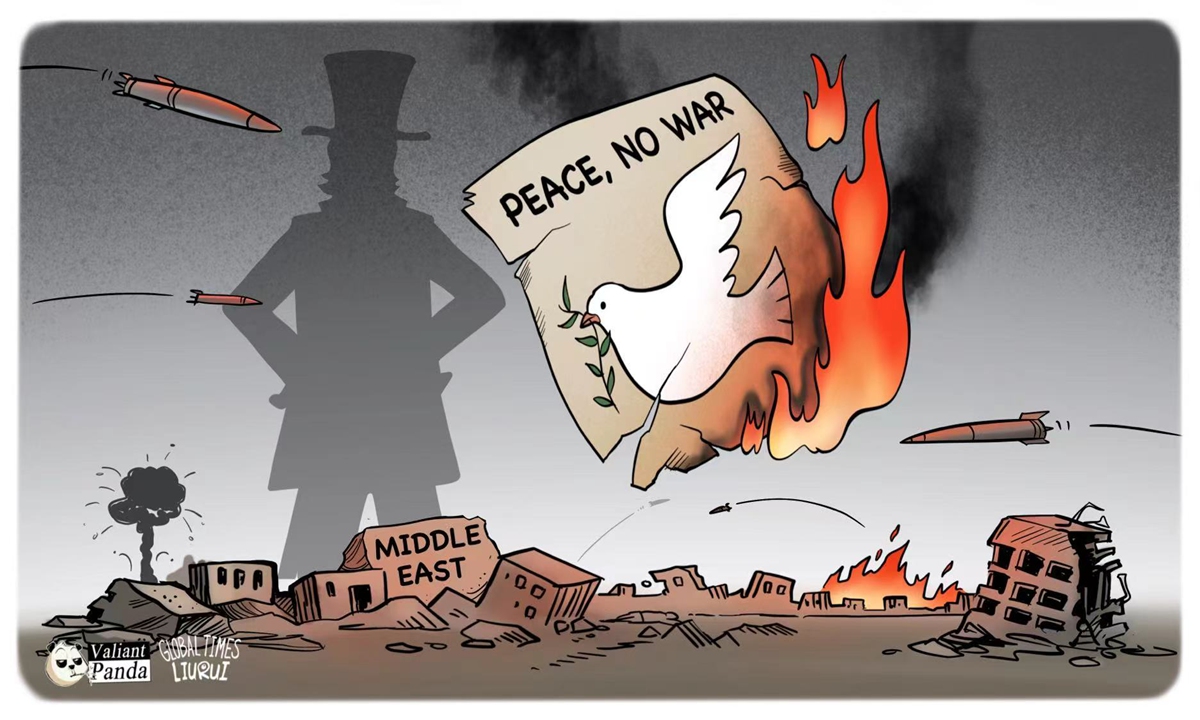 Destroying peace. Illustration: Liu Rui/GT
On Saturday local time, the US announced that it had launched airstrikes on three nuclear facilities in Iran. This marks the first time the US has officially intervened militarily in this round of the Iran-Israel conflict, drawing widespread shock from the international community. UN Secretary-General António Guterres said on social media that the move was “a dangerous escalation in a region already on the edge – and a direct threat to international peace and security.” China’s Foreign Ministry also strongly condemned the US attacks on Iran. US action, which seriously violates the purposes and principles of the UN Charter and international law, not only heightens tensions in the Middle East but also risks triggering a wider crisis.
Attacking nuclear facilities is extremely dangerous. Due to their unique nature, damage to such sites could lead to severe nuclear leaks, potentially resulting in humanitarian disasters and posing grave risks to regional safety. The tragic past lessons of the Chernobyl and Fukushima nuclear accidents already showed that the consequences of nuclear leaks don’t pose a threat to a single country – they impact neighboring nations and the global security environment.
By using “bunker-buster” bombs to “accomplish what Israel could not,” the US has deliberately escalated the level of weaponry used, pouring fuel on the flames of war and pushing the Iran-Israel conflict closer toward an uncontrollable state.
What the US bombs have impacted is the foundation of the international security order. By attacking nuclear facilities under the safeguards of the International Atomic Energy Agency (IAEA), Washington has set a dangerous precedent. This action, in essence, bypasses both the UN Security Council and the IAEA framework, attempting to unilaterally “resolve” the Iranian nuclear issue through force. This is a serious violation of the purposes and principles of the UN Charter and international law, as well as a rejection of the principled position of the international community, including China and the European Union, which has dealt with the Iranian nuclear issue through multilateral negotiations for many years. Washington’s boast of close cooperation with Israel “as a team” confirms its nature of dragging its ally against international morality and multilateralism.
For Iran, the strike is a blatant provocation. After responding that it “reserves all options to defend its sovereignty, interests and people,” Tehran on Sunday launched the powerful Kheibar Shekan missile targeting Israel for the first time. According to media reports, Ismail Kowsari, a member of the National Security Commission of the Parliament in Iran, said the country’s parliament voted to approve the closure of the Strait of Hormuz. Iran’s Supreme National Security Council is expected to weigh in and make a final decision on the matter. Iran is located in the choke point of the Strait of Hormuz, which around one-fifth of the world’s total oil and gas consumption transits through. Once this channel is blocked by the war, international oil prices are bound to fluctuate dramatically, while global shipping security and economic stability will face serious challenges.
The US military’s “direct involvement” has further complicated and destabilized the Middle East situation, drawing more countries and innocent civilians into the conflict and forcing them to face a loss. Even the Associated Press called the airstrikes on Iran’s nuclear facilities a “perilous decision,” while the New York Times warned that US military action against Iran would “bring risks at every turn.” What is also receiving a lot of attention is that due to US strike on Iran, Yemen’s Houthis announced it would resume attacks on US ships in the Red Sea. The region is already entangled in a complex web of sectarian divisions, proxy wars and external interventions. The facts show that US involvement is causing the Iran-Israel conflict to spill over. Within just one day, international investors rushed to sell off risk assets, and discussions of a “sixth Middle East war” surged across media platforms, reflecting the global community’s growing anxiety over the region’s spiraling instability.
China has consistently opposed the threat and abuse of using force. It advocates resolving crises through political and diplomatic means. In a recent phone call with Russian President Vladimir Putin, Chinese President Xi Jinping put forward a “four-point proposal” regarding the Middle East situation: promoting a cease-fire and ending the hostilities is an urgent priority; ensuring the safety of civilians is of paramount importance; opening dialogue and negotiation is the fundamental way forward; and efforts by the international community to promote peace are indispensable. This proposal reflects China’s long-standing and farsighted security vision. History in the Middle East has repeatedly shown that external military intervention never brings peace – it only deepens regional hatred and trauma. The false logic behind US coercion by force runs counter to peace. Hopefully, the parties involved, especially Israel, will implement an immediate cease-fire, ensure the safety of civilians and open dialogue and negotiation to restore peace and stability in the region.
Monday 23 June 2025, by Dan La Botz
The United States has joined Israel in its war on Iran, increasing the chances for a wider regional war, one that could become a forever-war quagmire as the Iraq War did. President Donald Trump sent B-2 bombers to drop bunker-buster bombs on nuclear facilities in Fordo and Natanz while a submarine launched Tomahawk missiles at another facility in Istfahan. Democrats condemned Trump for violating the Constitution which says that only Congress can declare war, and Alexandria Ocasio Cortez suggested that he should be impeached for that, though it is not clear how many Democrats actually oppose the bombing or joining the war.
While the U.S. is now at war with Iran, the United States has been deeply implicated in Israel’s war on Iran for some time. Trump has been a staunch ally of Benjamin Netanyahu in his recent wars on Palestine and Israel’s attacks on Lebanon, Yemen, and Syria. Trump approved Israel’s attack on the Islamic Republic, and may have given it the green light before it occurred. The United States provides Israel with about $3.5 billion dollars in military aid each year, hundreds of billion since the country’s founding, money used to buy U.S.-made planes, bombs, missiles, tanks, and guns.
Trump campaigned for president and built his Make America Great Again (MAGA) movement, promising that he would end U.S. involvement in foreign wars. He suggested he would use the threat of America’s military might to maintain order around the globe. He put himself forward as a peacemaker, arguing he could end the war between Russia and Ukraine and between Israel and Gaza in short order. He called upon Iran to negotiate with Israel to reach a peaceful settlement. His MAGA advisors like Steve Bannon and Tucker Carlson have been fiercely opposed to America entering the war, as is the movement’s base. Trump has now called for regime change, a taboo until now among his MAGA followers. But so far, they seem to be sticking with him.
Trump has warned Iran that if it responds by attacking U.S. troops in the Middle East, it will face even more devastating strikes. The United States has 40,000 troops in 19 bases in the region, most in eight permanent bases in Bahrain, Egypt, Iraq, Jordan, Kuwait, Qatar, Saudi Arabia and the United Arab Emirates. The Bahrain base, for example, home to the U.S. Navy’s Fifth Fleet, has 9,000 military and civilian personnel. Iran and its allies have the ability to target these facilities, to damage them, and to take the lives of U.S. fighters. If that were to happen, Trump’s MAGA base might rebel against him.
It is not clear what will happen in Iran now. Just as when the United States launched its war on Iraq in 2003—one of the “forever wars,” lasting until 2011—the war in Iran could become an inextricable quagmire. The U.S war on Iraq, which led to a civil war estimated to have killed between 100,000 and one million people. Iran is a theocratic state ruled by Ayatollah Ali Khamenei, head of the executive, legislative, and judicial branches of government and of the state religion. His Islamic regime has killed thousands and imprisoned tens of thousands who participated in several anti-government protests since 1999. Now weakened by war, the regime could collapse, possibly leading to a civil war between the powerful Islamic Revolutionary Guard and the Iranian people who want change.
In the United States, there have already been anti-war protests in a number of cities from San Jose, California, to Milwaukee, Wisconsin, to New York City. Following the U.S. bombing on June 21, groups such as 50501, an organizer of anti-Trump demonstrations, called for nationwide protests on Sunday June 22, but that was short notice and temperatures at 100 F and thunderstorms inhibited protests. But anti-war demonstrations are sure to come. We on the left will be in them.
21 June 2025 - updated 22 June 2025
Attached documentsthe-united-states-at-war-in-the-middle-east-again_a9064-2.pdf (PDF - 900.1 KiB)
Extraction PDF [->article9064]
the-united-states-at-war-in-the-middle-east-again_a9064.pdf (PDF - 900.1 KiB)
Extraction PDF [->article9064]
Dan La Botz was a founding member of Teamsters for a Democratic Union (TDU). He is the author of Rank-and-File Rebellion: Teamsters for a Democratic Union (1991). He is also a co-editor of New Politics and editor of Mexican Labor News and Analysis.
International Viewpoint is published under the responsibility of the Bureau of the Fourth International. Signed articles do not necessarily reflect editorial policy. Articles can be reprinted with acknowledgement, and a live link if possible.

No comments:
Post a Comment