NATO’s 5% Pledge: An Obscene Betrayal of Global Needs
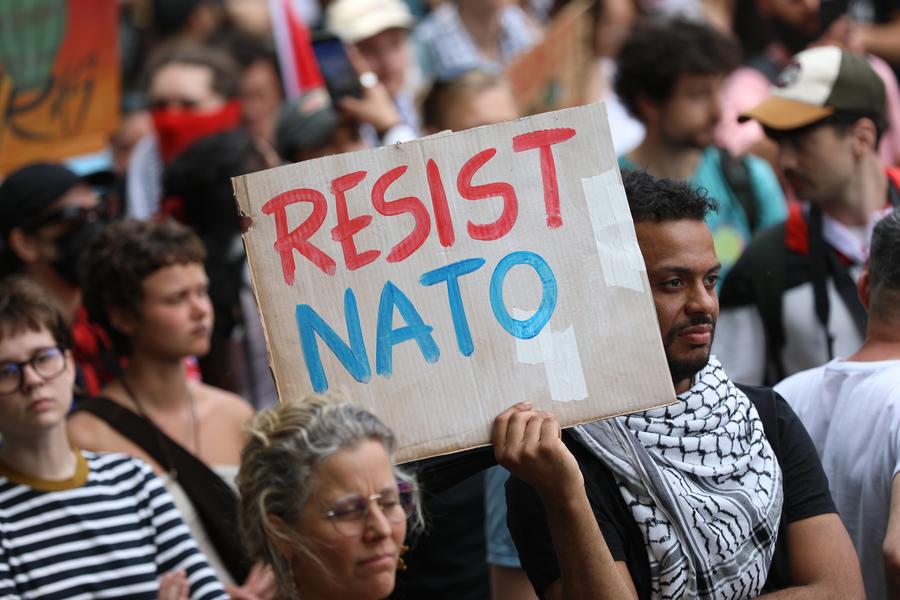
No to NATO protest at The Hague, June 22, 2025. Photo credit: Xinhua News
At this week’s NATO summit in The Hague, leaders announced an alarming new goal: push military spending to 5% of nations’ GDP by 2035. Framed as a response to rising global threats, particularly from Russia and terrorism, the declaration was hailed as a historic step. But in truth, it represents a major step backward—away from addressing the urgent needs of people and the planet, and toward an arms race that will impoverish societies while enriching weapons contractors.
This outrageous 5% spending target didn’t come out of nowhere—it’s the direct result of years of bullying by Donald Trump. During his first term, Trump repeatedly berated NATO members for not spending enough on their militaries, pressuring them to meet a 2% GDP threshold that was already controversial and so excessive that nine NATO countries still fall below that “target”.
Now, with Trump back in the White House, NATO leaders are falling in line, setting a staggering 5% target that even the United States—already spending over $1 trillion a year on its military—doesn’t reach. This is not defense; it’s extortion on a global scale, pushed by a president who views diplomacy as a shakedown and war as good business.
Countries across Europe and North America are already slashing public services, yet they are now expected to divert even more taxpayer money into war preparations. Currently, no NATO country spends more on the military than on health or education. But if they all meet the new 5% military spending goal, 21 of them would spend more on weapons than on schools.
Spain was one of the few to reject this escalation, with Prime Minister Pedro Sánchez making clear that his government would not sacrifice pensions and social programs to meet a militarized spending target. Other governments, including those of Belgium and Slovakia, quietly pushed back as well.
Still, NATO leaders pressed on, cheered by Secretary-General Mark Rutte, who fawned over Donald Trump’s demand that Europe boost defense spending. Rutte even referred to Trump as “Daddy,” a comment that—while dismissed as a joke—spoke volumes about NATO’s subservience to U.S. militarism. Under Trump’s influence, the alliance is shedding even the pretense of being a defensive pact, embracing instead the language and logic of perpetual war.
Just before NATO leaders were gathering at the Hague, protesters took to the streets under the banner “No to NATO.” And back in their home countries, civic groups are demanding a redirection of resources toward climate justice, healthcare, and peace. Polls show that majorities in the U.S. oppose increased military spending, but NATO is not accountable to the people. It’s accountable to political elites, arms manufacturers, and a Cold War logic that sees every global development through the lens of threat and domination.
NATO’s expansion, both in terms of war spending and size (it has grown from 12 founding members to 32 countries today), has not brought peace. On the contrary. The alliance’s promise that Ukraine would one day join its ranks was one of the triggers for Russia’s brutal war, and instead of de-escalating, the alliance has doubled down with weapons, not diplomacy. In Gaza, Israel continues its U.S.-backed war with impunity, while NATO nations send more arms and offer no serious push for peace. Now the alliance wants to drain public coffers to sustain these wars indefinitely. NATO is also surrounding its adversaries, particularly Russia, with ever more bases and troops.
All of this demands a radical rethink. As the world burns—literally—NATO is stocking up on kindling. When healthcare systems are crumbling, schools are underfunded, and blazing temperatures are making large swaths of the planet uninhabitable, the idea that governments should commit billions more to weapons and war is obscene. Real security doesn’t come from tanks and missiles—it comes from strong communities, global cooperation, and urgent action on our shared crises.
We need to flip the script. That means cutting military budgets, withdrawing from endless wars, and beginning a serious conversation about dismantling NATO. The alliance, born of the Cold War, is now a stumbling block to global peace and an active participant in war-making. Its latest summit only reinforces that reality.
This is not just about NATO’s budget—it’s about our future. Every euro or dollar spent on weapons is one not spent on confronting the climate crisis, lifting people out of poverty, or building a peaceful world. For the future of our planet, we must reject NATO and the war economy.
LONG READ: NATO summit in The Hague is all about the money, not about Ukraine

The collected membership of Nato meets in The Hague on June 25 for a cutdown version of the annual gathering, where Ukraine has been dropped from the agenda and the only thing that will be discussed is increasing defence spending to 5% of GDP, at US insistence.
Three months ago, Secretary of State Marco Rubio attended a ministerial meeting in Brussels with a clear message: the 5% demand was not a joke. After some initial pushback, desperate to keep the US security umbrella open, every one of the 32 members has agreed to the increase that must be met by 2035, except Spain and Slovakia.
The White House is dominating the agenda at the meeting and has forced several compromises. The increase will be divided into 3.5% for "hard defence, 1.5% for infrastructure/cybersecurity, with the US hoping the bulk of the hard spending will go on US-made weapons. Participants at the ministerial meeting later revealed, off the record, that Rubio had warned the partners: either they accept the US demand or Trump will reduce the American military presence in Europe.
In 2024, European Nato members together spent nearly $500bn on defence, or 2% of their combined GDP. An increase to 3% would mean an additional $250bn annually. Up to half of that could go directly towards weapons and ammunition.
In addition to the cash infusion, the Alliance has prepared a classified document on "capability targets", which also calls for large increases in the number of brigades and key weapon systems each Nato member must possess for effective collective defence.
The new strategy outlines the requirements for core defence capacities, including the scale of air and missile defence systems, the number of long-range weapons held by allies, an increase from the 80 brigades Nato currently maintains and key logistics parameters. Currently, Nato operates under capability targets approved in 2021, prior to Russia’s full-scale invasion of Ukraine.
For instance, Germany currently has 20% fewer brigades than its 2021 requirement. The new document presented to ministers in June now proposes a much larger increase in European armies – the target may rise to 130 brigades. European Nato armies may need to nearly double in size.
Another major challenge is the limited capacity of Europe’s defence industry. As bne IntelliNews reported, despite the outbreak of a major traditional large-scale war in its backyard, Europe have failed to sign off on the long-term contracts defence companies need to invest into new production. Despite entering the fourth year of full-scale war on its borders, Europe still hasn’t scaled up enough to meet demand from European defence ministries. European Commission President Ursula von der Leyen admitted in her ReArm speech (video) earlier this year that Russia is now outproducing all of the EU and Ukraine combined.
Article 5
Trump once again refused to give a clear US commitment to Nato’s Article 5 — the alliance’s collective defence clause — as he departed for the meeting in The Hague on June 24.
Pressed by reporters as he boarded Air Force One on whether the US would come to Nato members’ defence if they were attacked, he replied, “It depends on your definition of Article 5,” adding, "There’s numerous definitions of Article 5. You know that, right? But I’m committed to being their friends, you know, I’ve become friends with many of those leaders, and I’m committed to helping them."
Trump has previously expressed scepticism about honouring the collective defence commitment, linking it to how much member states had spent on defence and suggesting those that the US would not protect those who had spent less than 2$ of GDP on defence.
"I’m committed to saving lives. I care about life and safety," he added saying he would explain his position in full once at the summit: "I’ll give you an exact definition when I get there — I just don’t want to do it from the back of a plane,” The Kyiv Independent reports.
Ukraine’s downgrade
The meeting will be much reduced compared to previous summits after all the events other than the welcome dinner in the castle of the Dutch royal family and a single two-hour discussion on spending the next day. In particular, the Ukraine-Nato council meeting to discuss the conflict with Russia has been cancelled and Ukrainian President Zelenskiy has only been invited to the dinner, not the plenary session, Ukrainska Pravda reports.
In place of the Ukraine-Nato council meeting, Zelenskiy is due to have a meeting with Rutte and the leaders of the so-called European Five (E5) countries – France, Germany, Italy, Poland and the United Kingdom. Italy is a new addition to the top four leaders of the coalition of the willing (CoW4) that has taken the lead in Europe in supporting Ukraine.
Initially, Ukraine was not invited to attend the summit at all, but was reinstated at the instance of European Commission President Ursula von der Leyen and Nato Secretary-General Mark Rutte. Some uncertainty surrounded the participation of Zelenskiy, who is now due to attend, but it remains unclear whether he will meet with US President Donald Trump, who is also due to attend. The two presidents were scheduled to meet at the recent G7 summit in Canada, but Trump skipped out early, cancelling his meeting with Zelenskiy.
The members have also decided to forego the traditional joint statement and will only release a single paged statement after the meeting. While the US is insisting on an increase in spending to 5% of GDP, up from the previous 2% commitment adopted in 2014 at the Welsh Nato summit, nominally to meet a growing threat of attack by Russia, all mentions of Russia have been downgraded in the draft version of the final statement. The draft does label Russia as a "threat" to Euro-Atlantic security but refrains from designating it as an "aggressor" for waging a war in Ukraine – language the White House has shown itself particularly adverse to.
Responding to the Russian threat
While the White House is playing down any threat from Russia, Rutte has put the growing threat from Russia and China at the heart of the rationale for increasing spending on defence.
“Russia has brought war back to Europe and has teamed up with China, North Korea and Iran to reshape the global order. Together, they are expanding their militaries and their capabilities,” Rutte said in an opinion piece for Foreign Policy calling for a stronger Nato. “Russia is reconstituting its forces with Chinese technology and producing weapons faster than we thought it could.”
European Commission President Ursula von der Leyen is also pushing for more spending to meet the same threat. She warned in her ReArm speech (video) that Russia is currently outproducing all the EU and Ukraine combined and that Europe needs to re-equip itself urgently. This year alone Russia will roll out 1,500 tanks, 3,000 armoured vehicles and 200 Iskander missiles and could be able to challenge Nato directly within five years, says Rutte. Europe will need to boost its weapons production by 400% to effectively deter Russia, analysts say.
The Nato boss also singled out China as a threat, which he accused of becoming “decisive in enabling Russia’s war against Ukraine and supporting Russia’s defence industrial base,” even as it “with no transparency, modernises and expands its own military at breakneck speed.”
China has already overtaken the US and now possesses the world’s largest navy and is adding the equivalent of the entire French navy every four years. It will soon also overtake the US submarine fleet; one of the reasons why China is so fixated on taking control of Taiwan is that its own territorial waters in the Taiwanese Straits are very shallow, making it easy for US spy satellites to see Chinese subs come and go, whereas the waters on the eastern side of Taiwan drop off precipitously and would allow China to deploy its submarine fleet undetected.
China is rearming and will also be able to challenge Nato directly. Its overall battle force is expected to grow to 395 ships this year, and to 435 by 2030, says Rutte. China also aims to have more than 1,000 operational nuclear warheads by 2030. “China’s ambitions and coercive policies challenge our interests, security and values,” said Rutte.
“We cannot afford to hope for the best; we must prepare for the worst. It is clear that those who stand against freedom are readying themselves for long-term confrontation with Nato,” Rutte added.
Seoul has withdrawn from the upcoming Nato summit in The Hague in protest of the US attack on Iran.
5% GDP target except for Spain, Slovakia
Rutte is on board with the US call for member states to up their spending to 5% of GDP by 2037. All allies will spend at least 2% of GDP on defence this year, as promised at the Wales summit in 2014. However, most members have undershot: by 2021, only six members had reached the benchmark. At The Hague summit members are expected to make a new pledge to increase their country’s spend to 5% and Washington is insisting this time round there be no cheating, the US Ambassador to Nato Matthew Whitaker said earlier this month.
"Five per cent spending will be necessary to have the forces and capabilities to implement our defence plans in full and protect the Euro-Atlantic. This will mark a quantum leap in our collective defence," says Rutte.
Germany’s Bundeswehr warned in an internal strategy paper that Russia poses “existential risk” to both Germany and Europe as a whole, Spiegel reported last week. The Bundeswehr says the modernisation of the Russian Armed Forces is progressing rapidly and they could have 1.5mn soldiers by 2026. The Kremlin is mobilising industry and power "specifically to meet the requirements for a large-scale conflict against Nato by the end of this decade," the document said, but added an attack could come as soon as in the next two years.
Going into the summit almost all the member states have agreed to increase spending to 5% of GDP by 2035, but not everyone is on board. Nato gave Spain a calve out that allows it to spend less, Politico reported on June 22.
Likewise, on the eve of the summit, Slovak Prime Minister Robert Fico issued a statement saying that Slovakia had better things to spend its money on than defence and would make up its own mind how much to dedicate to defence. Last year it spent 2.1% on defence and the Finance Minister said earlier that there were no plans to increase sending, except for an incremental increase on dual-use projects such as military related infrastructure investments.
“Today, extensive armament and the possible global military conflict are being discussed significantly more than peace or the improvement of people’s living standards,” Fico said in the statement posted on social media. “In a period of restoring public finances and catching up with the average living standard in the EU, the Slovak Republic has other priorities in the coming years than armament.”
Countries closer to Russia are much keener on increasing spending. Poland has allocated the most to defence this year, 4.12% of GDP called for a much faster schedule to reach 5% by 2030. Nato’s Rutte also wants to go fast and reach the threshold by 2032.
Estonia is spending more than anyone else in Nato on defence: military spending hit 5.4% of GDP this year. The army has also doubled its forces on the Russian border and built a new Nato base with US-made high precision HIMARS missiles.
Prime Minister Pedro Sánchez demanded an exemption from the new target saying that Madrid would struggle to meet the 5% spending target. The language of the draft deal on the table was changed from "we commit" to "allies commit" to spend 5% on defence, which allows Spain more flexibility as long as it meets Nato's updated capability targets approved by alliance defence ministers on June 5. Spain also intends to spend only 2.1% of its GDP on defence this year which it says is enough to meet its obligations.
The US has also exempted itself from spending 5% of GDP on defence and its contributions to funding Ukraine have fallen to nothing since the start of this year, with no new money in the pipeline either.
Separately, Ukraine is asking Nato allies to earmark some of their spending to support Kyiv’s struggle against Russia and allocate 0.25% of their GDP to boosting Kyiv's defence production, Zelenskiy said on June 20 at a press briefing.
"Ukraine is part of Europe's security, and we want 0.25% of the GDP of a particular partner country to be allocated to our defence industry and domestic production," Zelenskiy said at the briefing.
Ukraine is currently in talks with Denmark, Norway, Germany, the United Kingdom and Lithuania on weapons development partnerships, Zelenskiy said.
Most of the biggest powers still have a lot of catching up to do. Poland and the frontline states in the Baltics are the only countries anywhere near to spending 5%. Indeed, Poland is the current leader as it aspires to build the largest conversional army in Europe in the next few years. Big countries like Germany, Spain, France and Italy all spent less than 2% last year.
Canada has even bigger difficulties. As a country that shares its only land border with the United States it has not, until recently, faced a direct military threat. Its spending remains far below the 2% defence spending benchmark: Canada allocated just 1.37% of GDP to defence in 2024 – the fifth-lowest level among Nato members.
Luxembourg currently spends 1.29% of GDP on defence, the third-lowest level in the alliance, but as it is so small it simply lacks the capacity to raise its military spending to the levels Nato demands.
These Nato states may seek to "compensate" for their own shortfalls by increasing their Ukraine-related spending, part of which counts towards the 5% of spending benchmark. Ukraine has welcomed this investment into its military production by other countries – the so-called Danish model.
Nato countries spending, 2024 percentage of GDP | ||||
Rank | Country | Spending %GDP (2024) | Spending $bn (2024) | Notes |
1 | Poland | 4.12% | $38bn | Highest in Nato, 31% spending surge in 2024, likely ~4.2% in 2025. |
2 | Estonia | 3.43% | $1.3bn | Pledged 5% by 2035, driven by Russian threat. |
3 | United States | 3.38% | $971bn | ~66% of total Nato spending, ~$997B projected for 2025. |
4 | Latvia | 3.15% | $1.1bn | Increased spending due to regional security concerns. |
5 | Greece | 3.08% | $7.6bn | Consistently above 2%, driven by tensions with Turkey. |
6 | Lithuania | 2.85% | $2.1bn | Committed to 5% by 2035, near Russian border. |
7 | United Kingdom | 2.50% | $81bn | Pledged 2.5% by 2027, ~$85B in 2025, aiming for 3% later. |
8 | Finland | 2.45% | $7.2bn | New Nato member, spending rose post-2022 Ukraine invasion. |
9 | Romania | 2.44% | $7.8bn | Increased post-2022, near Ukraine, aiming for 2.5% in 2025. |
10 | Hungary | 2.43% | $5.1bn | Reached 2% in 2023, significant rise from prior years. |
11 | Denmark | 2.33% | $9.5bn | Surpassed 2% in 2024, plans to maintain or increase in 2025. |
12 | Norway | 2.07% | $11bn | Exceeded 2% in 2024, driven by Arctic security concerns. |
13 | Slovakia | 2.03% | $2.8bn | Just above 2%, increased post-Ukraine invasion. |
14 | Montenegro | 2.03% | $0.2bn | Small economy, met 2% target in 2024. |
15 | North Macedonia | 2.01% | $0.3bn | Reached 2% in 2024, steady increase in recent years. |
16 | France | 1.96% | $66bn | Below 2% in 2024, plans 3.5% by 2025, ~$70B projected. |
17 | Germany | 1.94% | $88.5bn | Below 2% in 2024, ~$100B in 2025 with special defence fund. |
18 | Italy | 1.50% | $35bn | Below 2% in 2024, aiming for 2% in 2025, ~$35B. |
19 | Canada | 1.40% | $30bn | Below 2% in 2024, slow progress to 2%, ~$30B. |
20 | Spain | 1.30% | $20bn | Below 2% in 2024, pledged 2.1% in 2025, ~$20B. |
Source: Nato, bne IntelliNews | ||||
Ukraine disappointment
Bankova (Ukraine’s equivalent of the Kremlin) will be sorely disappointed by Ukraine’s downgraded role. Since Trump took office, the US has steadily pulled back from supporting Kyiv. The White House has imposed no new sanctions on Russia at all under Trump, while the EU voted through a seventeenth sanctions package last month and is currently working on an eighteenth. The White House also did not allocate any new weapons deliveries, which is a problem, as Ukraine is reported to be running low on air defence ammunition in particular, and could run out completely by this summer, analysts say.
Zelenskiy caused considerable embarrassment at the Vilnius Nato summit in 2023 by aggressively demanding accelerated Nato membership for Ukraine – demands that were met with a deafening silence by the Nato members.
At the Washington Nato summit in 2024, hosted by the Biden administration. Zelenskiy was told explicitly not to bring up the question of Ukraine’ Nato membership up at all, according to reports, as no one wanted to address the issue. Instead, the Nato members watered down their commitment to the empty rhetorical phrase of “Ukraine’s irreversible path” to eventual Nato membership, without committing to a timeline.
This year even the phrase “irreversible path” for the Washington Declaration has been dropped from the final communiqué, which will only be one page long. For comparison, the Washington summit’s final declaration – including its section on Ukraine – had over 40 points. The Vilnius declaration had 90. The Hague summit statement is expected to only contain five points.
Condemnation of Russia was also excluded from the G7 meeting and no joint communiqué was issued there either, due to US objections. Trump will not hold the conventional joint press conference with Nato Secretary General Mark Rutte after the meetings in the Hague.
Lots of money, but no soldiers
In the Hague the talk will focus almost exclusively on hardware, but it ignores the elephant in the room: what is the point of having lots of tanks if there is no one to drive them, or plenty of guns if there is no one to shoot them?
With just a few days left before Nato’s 2025 summit, The Economist editors wondered in the headline of their June 19 leader: "Europe wants to show it’s ready for war. Would anyone show up to fight?”
A 2024 poll by Gallup asked citizens in 45 countries how willing they would be to take up arms in case of war. “Four of the five places with the least enthusiastic fighters globally were in Europe, including Spain, Germany and notably Italy, where just 14% of respondents said they were up for taking on a foreign foe,” according to this analysis of the poll.
Still, Europe does not lack men and women in uniform. Despite a scything in the number of troops since 1990, to less than half the previous figure in many countries, the continent still has more soldiers than America, and roughly as many as a share of its overall population.
Yet the proposal to send peacekeepers to Ukraine to patrol a potential DMZ if a ceasefire deal had been agreed, proposed by France and the UK, was abandoned as unworkable. The Western allies suggested a force of 30,000 be sent, when military experts said at least 120,000 would be needed to man the 1,200-km long line of contact. That number was downgraded to 10,000 when it became clear European forces simply didn’t have the manpower available, before the idea was abandoned entirely in the face of stringent threats of retaliation by the Kremlin if Nato-back troops appeared on Ukrainian soil.
“The bloc’s citizens list Russia’s invasion of Ukraine and matters of defence as the biggest threats facing the EU as a whole. Well over half think that fighting within the union’s borders is likely in coming years,” The Economist reports. “But asked what issues affect them personally and Europeans forget about Russia altogether, worrying more about inflation, taxes, pensions and climate change than they do about potential invaders. It is not that Europeans don’t see the looming threat. It is that they think it is somebody else’s problem.”

Nato leaders agreed to raise defence spending to 5% of GDP by 2035 and renewed their commitment to collective defence at the Nato summit held in the Hague on June 26.
The recommended spending level has been increased from 2% of GDP that was agreed at the Nato summit in Wales in 2014. Member countries are now supposed to submit “realistic” action plans to Nato and their spending will be reviewed in 2029 to see if they are hitting their targets.
As bne IntelliNews reported, this Nato summit was all about the money. While Ukrainian President Volodymyr Zelenskiy attended the meeting, a planned meeting of the Ukraine-Nato Council, an advisory body, was cancelled.
Zelenskiy also met briefly with US President Donald Trump, although conflicting reports emerged from the substance of their conversation. Zelenskiy claimed that he held a “substantial” conversation with the US president. However, Trump said in comments to the press that he did not mention the proposed ceasefire negotiations and only wanted to know “how he was doing.”
Later at a press conference when asked whether the US would send Ukraine desperately needed Patriot missiles for its air defence, Trump said he would “see what we can do.” He added that “we need them too” and explained that the US was sending more Patriot missiles to Israel, which has been under bombardment by Iran until recently.
The increase in spending to 5% represents an escalation in tensions in Europe. Leaders such as European Commission President Ursula von der Leyen and Nato General Secretary Mark Rutte have warned that Russia is rearming and could attack Nato members in Europe. The frontline states Poland and Estonia with borders close to Russia lead the way in spending on defence and are already at, or close to, spending 5%. However, member states far from Russia are more reluctant. Both Spain and Slovakia have said they don’t want to spend 5%. Slovak Prime Minister Robert Fico said on the eve of the summit that Slovakia has “better things to spend our money on.”
While all 32 members nominally committed to spending 5% of GDP on defence, there is no formal enforcement mechanism in the Nato treaty. Previously, following the Welsh declaration of a commitment to 2% of GDP spending, six years later only six members had complied. The US has explicitly exempted itself from the need to spend 5% of GDP on defence, although its spending is already more than the next six members combined in nominal terms.
Indeed, even today eleven out of the 32 members still have not reached the 2% of GDP benchmark, with Canada, Spain, Italy, Slovakia, Czechia and Turkey all spending under the requirement. Many of the other members have only hit 2% in the last few years, following the Russian invasion of Ukraine in 2022.
The spending agreement, endorsed by all 32 Nato member states on June 25, comes after the Trump administration exerted tremendous pressure to hike spending. Moreover, conscious of the lax compliance to spending pledges in the past, the US Ambassador to Nato said during the meeting: “We don’t want another Wales.”
The new target includes 3.5% for “core” defence spending and 1.5% for related investments such as infrastructure and cybersecurity. Under the rules contributions to Ukraine’s defence can be counted towards the 5% total, which will allow nations like Luxembourg and Canada that have very low security needs to make up the tally. Nato said the decision reflects “profound security threats and challenges, in particular the long-term threat posed by Russia to Euro-Atlantic security and the persistent threat of terrorism.”
However, the White House's own commitment to forcing Russia into peace talks or supporting European Nato allies remains confused. The Trump administration has imposed no sanctions on Russia and Trump was vague about the US commitment to the Article 5 collective security clause in the treaty.
The US President had doubts about absolute guarantees on the way to The Hague, but changed his mind at the summit. "I'm leaving it in a different mood," he said at the final press conference. "This is not robbery, and we will be here to help them defend their countries."
Secretary of State Marco Rubio also made conflicting comments on the US commitment to increasing the pressure on the Kremlin with more sanctions, talking tough with allies during the formal dinner on June 24, but then toning down the aggressive stance in an interview with Politico.
“If we did what everybody here wants us to do, and that is come in and crush them with more sanctions, we probably lose our ability to talk to them about the ceasefire, and then who’s talking to them?” Rubio told Politico, adding that Trump will know the “time and place” for changing tack.
Nato Secretary Rutte warned that Russia could be capable of launching an attack on Nato territory “within five years,” lending urgency to the alliance’s pledge. The increase, he added, followed months of negotiations and would trigger defence spending in the trillions of dollars through 2035.
Rutte got into trouble by calling Trump “Daddy” in a joint session in relation to the US attack on Iranian nuclear facilities. "It was so shameful," Politico quotes one European official saying. "Yes, the summit can be considered a success overall. But groveling like this is too much."
But the fracas was overblown as Rutte was making a joke at Trump’s expense after the US president used the word “fuck” in comments live to camera after Israel broke the ceasefire Trump declared on June 24.
After a ceasefire deal, Trump had raised eyebrows by saying Israel and Iran had been fighting "so long and so hard that they don't know what the fuck they're doing".
During the panel with Trump, Rutte laughed and said: "And then daddy has to sometimes use strong language to get (them to) stop."
The joint declaration reaffirmed Nato’s support for Ukraine, though it notably omitted last year’s language of Ukraine’s “irreversible” path to Nato membership. It also downgraded comments on Russia from “aggressor” to merely a “threat” under US pressure for more restrained language.
The summit, dominated by questions about the United States’ future role in the alliance, follows remarks from Trump suggesting ambivalence towards Article 5 – the cornerstone clause requiring members to defend one another in case of attack.
German Chancellor Friedrich Merz, addressing the closed-door session, said the summit was about “putting our money where our mouth is.” The message to the Kremlin, he added, was clear: “Don’t pick a fight with Nato.”

No comments:
Post a Comment