(RNS) — As critics revive anti-Shariah talk, Muslim advocates fear consequences for communities across the country.
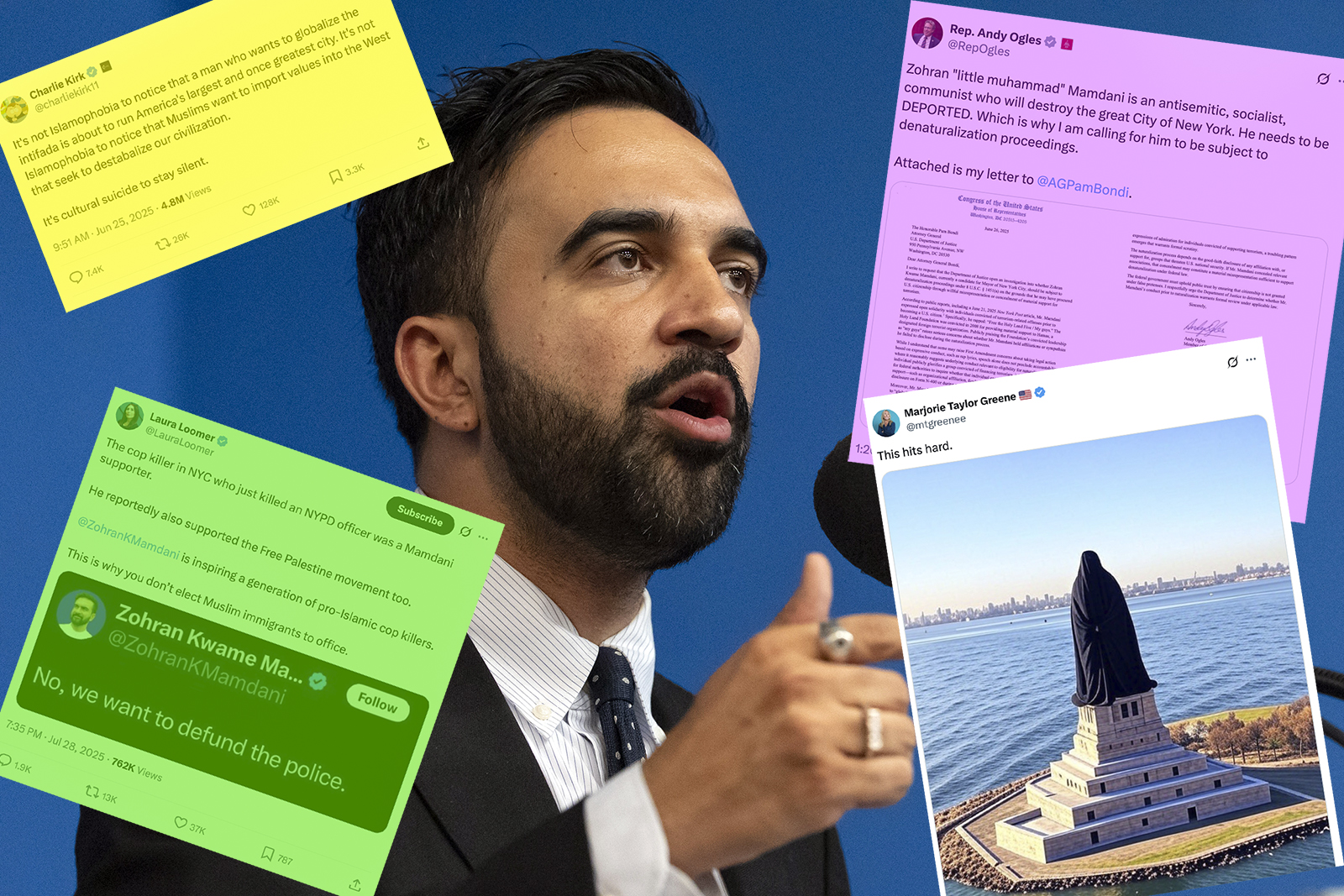
Social media posts about New York City Democratic mayoral candidate Zohran Mamdani, center.
(AP Photo/Yuki Iwamura; RNS illustration)
Fiona André
August 6, 2025
RNS
(RNS) — Since Zohran Mamdani’s victory in the New York City Democratic mayoral primary in June, conspiracy theories involving his Muslim faith have ranged from highly questionable to bizarre.
One theory was that he plans to introduce radical Islam to the city. A stranger one was that he was culpable in the shooting deaths of four people in a Park Avenue office building on July 28. Neither theory has been supported by evidence.
“The cop killer in NYC who just killed an NYPD officer was a Mamdani supporter,” Laura Loomer, the far-right commentator and adviser to President Donald Trump, posted on X. “@ZohranKMamdani is inspiring a generation of pro-Islamic cop killers. This is why you don’t elect Muslim immigrants to office.”
Charlie Kirk, CEO of Turning Point USA, a conservative Christian organization, said Mamdani’s victory signaled a takeover of Western values by Muslims.
“It’s not Islamophobia to notice that Muslims want to import values into the West that seek to destabalize our civilization. It’s cultural suicide to stay silent,” Kirk wrote in a June 25 X post.
The same day, U.S. Rep. Marjorie Taylor Greene, R-Ga., posted on X a picture of the Statue of Liberty covered in a black burqa. Her colleague Rep. Andy Ogles, a Republican from Tennessee, called Mamdani “Zohran ‘little muhammad’ Mamdani” in an X post questioning his path to citizenship and calling for his deportation.
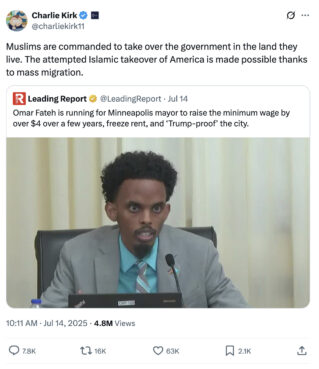
A Charlie Kirk post on X about Minneapolis mayoral candidate Omar Fateh. (Screen grab)
Such attacks mirror those aimed at Omar Fateh, a democratic socialist candidate running for mayor in Minneapolis. After the city’s Democratic Farmer-Labor Party convention endorsed Fateh — who, like Mamdani, is Muslim — Kirk said on X that Muslims were “commanded to take over the government in the land they live,” adding, “the attempted Islamic takeover of America is made possible thanks to mass immigration.” Fateh was born in Washington, D.C., and is the son of Somali immigrants.
In North Texas, the East Plano Islamic Center, known as EPIC, a mosque seeking to establish a Muslim-centric community, has faced accusations claiming the group seeks to impose Shariah, or Islamic religious law, in the state.
Unsupported claims attributing a radical religious agenda to prominent Muslims are an attempt to discredit their political ambitions, said author Wajahat Ali, who is Muslim and writes about Islamophobia. Such accusations trace back to post-9/11 Islamophobic tropes, presenting Muslim beliefs as a threat to America, he said.
These kinds of claims are now seeing a resurgence as public Islamophobic statements and incidents have increased after the Oct. 7, 2023, Hamas attacks on Israel and the ensuing Israel-Hamas war. As anti-Shariah rhetoric gains ground in a more online way than in the past, Muslim advocates fear consequences for their communities across the country. Muslim activist groups are also alarmed by decreased hate speech moderation on platforms such as X, which facilitates the spread of such claims.
“This is a reboot of a fearmongering story that was mainstream in 2010. … Now, they have rebooted it because of Zohran Mamdani, Rashida Tlaib, Ilhan Omar and also the Minnesota state senator, Omar Fateh,” Ali said. “It’s an age-old playbook to do a divide and conquer, to have Americans fear.”
RELATED: Zohran Mamdani is running to be New York mayor. How his Muslim faith stirred the race
Shariah, which translates to “way” or “path” in Arabic, is understood to reflect how God expects Muslims to live their lives, said Asifa Quraishi-Landes, a law professor at the University of Wisconsin-Madison who specializes in the comparative study of U.S. constitutional law and Islamic law.
Anti-Shariah campaigns flatten what Shariah represents for Muslims, said Khaled Beydoun, a law professor at Arizona State University, who called it a complex religious concept that can’t be reduced to a set of laws.
“Shariah law, like American constitutional law, is very heterogeneous,” he said. “It’s very complex. It’s very layered. There’s a lot of conflict and competing ideas as to what Shariah law is among Muslims.”
Election cycles have long coincided with a surge of inflammatory anti-Muslim speech, said Saher Selod, director of research at the Institute for Social Policy and Understanding in Dearborn, Michigan, which researches American Muslims.
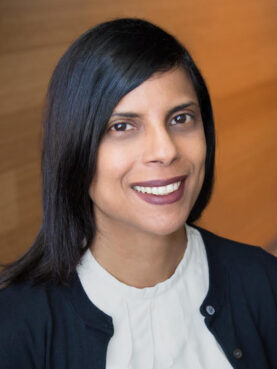
Saher Selod. (Photo courtesy ISPU)
“Muslims definitely are cognizant of this increased rhetoric that comes along with any election cycle and what it means for their safety,” she said.
The often conservative voices crusading against Shariah typically depict Islam as an ideology that seeks to control all aspects of social life, rather than a religion.
“The stereotype is that Muslims are a threat,” Selod said. “It keeps a population fearful that Muslims are coming, and they’re going to change American law. They’re going to change the way Americans live their life through taking over our laws and policies.”
The discourse is also grounded in assuming Muslims hide their intentions. For example, in an early July post, Loomer warned her followers about Taqiyya, a concept from the medieval Islamic era referring to concealing one’s beliefs to avoid danger. She said it “permits Muslims to lie about everything for the sake of advancing Islam.”
“They mystified Taqiyya as religiously mandated lying — that Muslim Americans are commanded to lie,” Ali said of critics. “So, even the moderate Muslims couldn’t be trusted because their goal is to implement Shariah.”
Legal efforts to ban Shariah gained traction after Park51, an Islamic community center and mosque, was proposed to open in lower Manhattan in 2010. Referred to as the “Ground Zero mosque” by opponents due to its proximity to the Twin Towers terrorist attack, it was the site of many protests led by anti-Muslim activist Pamela Geller. The mosque became a hot-button issue in the 2010 midterm elections, with many candidates pledging to combat alleged Shariah in the U.S.
In 2012, unsupported theories that President Barack Obama was secretly Muslim and born in Kenya took over discussions during his second presidential election, prompting him to present his long-form birth certificate.
According to a 2018 Southern Poverty Law Center report, 201 anti-Shariah bills have been introduced in 43 states since 2010. The texts usually defined Shariah as a “legal-political-military” doctrine.
The anti-Shariah movement gained prominence after 9/11, but such rhetoric dates back to the 1990s.
“When 9/11 came along … (there) was already a baseline of anti-Muslim sentiment in the U.S., and this obviously coalesced everything,” said Lawrence Pintak, a Washington State University professor in the communications department and author of the 2019 book “America & Islam: Soundbites, Suicide Bombs and the Road to Donald Trump.”
The Investigative Project on Terrorism, a nonprofit research group created by Steven Emerson in 1995, researched links between American Muslims and Islamist terrorism. It fueled Islamophobic campaigns through the 2010s, as a network of anti-Muslim organizations began to emerge.
In 2009, IPT members organized a campaign against the opening of the Islamic Center of Murfreesboro in Tennessee. The mosque drew opposition from such figures as Pat Robertson, the Christian Broadcasting Network founder, and Frank Gaffney, founder of the Center for Security Policy, which led anti-Shariah legislation efforts in the 2010s.
RELATED: Murfreesboro mosque fight laid to rest after Supreme Court ruling
In those years, the anti-Shariah movement mostly singled out local mosques.
“The argument was that it was a threat to Christianity — it was a threat to American values,” Pintak said. “After 9/11 and really through the ’10s and right up to Trump’s first election, you had the terrorism narrative. But right now, we don’t really have a terrorism narrative the way we had it before. … It’s back to being ‘They are the other, they are anti-Christian.’”
These organizations aren’t the face of the anti-Shariah movement anymore, Pintak noted. Internet figures such as Loomer now shape mostly online discussions. They tend to focus on Muslim American politicians, who increasingly became visible in left-wing politics after the 2018 midterm elections.
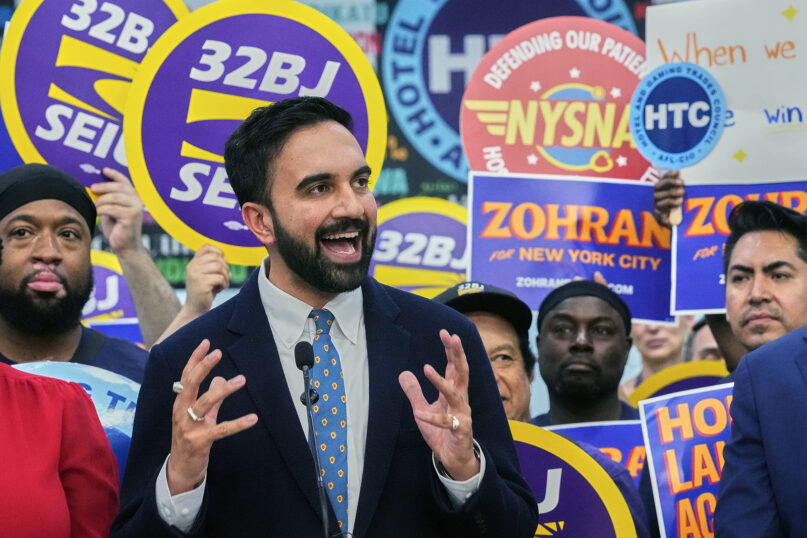
Democrat mayoral candidate Zohran Mamdani speaks during a rally at the Hotel & Gaming Trades Council headquarters in New York, July 2, 2025. (AP Photo/Richard Drew)
“It has shifted, and it has diversified,” Pintak said. “Social media dramatically changed the way the narrative is spread.”
On her X account, which boasts 1.7 million followers, Loomer frequently comments on Mamdani’s campaign, claiming seemingly without proof that he would impose his religious beliefs if elected mayor of New York.
“Muslims only use political power to advance the cause of Islam. They are single issue voters: Islam,” she posted July 31.
After Mamdani’s win in New York’s primary election, Loomer called him a “jihadist Muslim with ties to Iran” who wants “sharia and communism in NYC.”
Recent internet attacks against Muslims running for office, claiming they seek to advance an Islamist agenda, have frustrated advocates. Jaylani Hussein, executive director of the Council on American-Islamic Relations’ Minnesota chapter, denounced Islamophobic comments against Fateh as “factually inaccurate, dangerously inflammatory, and reflective of a broader trend of Islamophobic fearmongering nationwide.”
RELATED: Mamdani’s win unleashed a surge of Islamophobia — and showed how to beat it
Fateh, a 35-year-old Minnesota state senator, and Jacob Frey, the incumbent mayor running for reelection, both condemned comments affiliating Fateh with radical Islam.
False social media allegations also have gained momentum as many platforms have backtracked on long-standing content moderation practices. Such conditions help Islamophobic tropes circulate faster, said Haris Tarin, vice president of policy and programming for the Muslim Public Affairs Council. Tarin said he worries platforms could also become a hotbed for antisemitic, white supremacist and Hindutva (Hindu nationalism) hate speech.
Concerns over EPIC City, the proposed Texas Muslim-centric development, gained traction on X, he said.
A February post by Amy Mekelburg, known online as Amy Mek, drew attention to the EPIC project, seemingly resulting in state and federal authorities launching investigations into EPIC. In her post, Mekelburg, founder and editor of RAIR Foundation, a conservative organization focused on immigration and Islam, called EPIC “Texas’s First Sharia City.”

A rendering of the proposed EPIC City community near Josephine, Texas.
Fiona André
August 6, 2025
RNS
(RNS) — Since Zohran Mamdani’s victory in the New York City Democratic mayoral primary in June, conspiracy theories involving his Muslim faith have ranged from highly questionable to bizarre.
One theory was that he plans to introduce radical Islam to the city. A stranger one was that he was culpable in the shooting deaths of four people in a Park Avenue office building on July 28. Neither theory has been supported by evidence.
“The cop killer in NYC who just killed an NYPD officer was a Mamdani supporter,” Laura Loomer, the far-right commentator and adviser to President Donald Trump, posted on X. “@ZohranKMamdani is inspiring a generation of pro-Islamic cop killers. This is why you don’t elect Muslim immigrants to office.”
Charlie Kirk, CEO of Turning Point USA, a conservative Christian organization, said Mamdani’s victory signaled a takeover of Western values by Muslims.
“It’s not Islamophobia to notice that Muslims want to import values into the West that seek to destabalize our civilization. It’s cultural suicide to stay silent,” Kirk wrote in a June 25 X post.
The same day, U.S. Rep. Marjorie Taylor Greene, R-Ga., posted on X a picture of the Statue of Liberty covered in a black burqa. Her colleague Rep. Andy Ogles, a Republican from Tennessee, called Mamdani “Zohran ‘little muhammad’ Mamdani” in an X post questioning his path to citizenship and calling for his deportation.
A Charlie Kirk post on X about Minneapolis mayoral candidate Omar Fateh. (Screen grab)
Such attacks mirror those aimed at Omar Fateh, a democratic socialist candidate running for mayor in Minneapolis. After the city’s Democratic Farmer-Labor Party convention endorsed Fateh — who, like Mamdani, is Muslim — Kirk said on X that Muslims were “commanded to take over the government in the land they live,” adding, “the attempted Islamic takeover of America is made possible thanks to mass immigration.” Fateh was born in Washington, D.C., and is the son of Somali immigrants.
In North Texas, the East Plano Islamic Center, known as EPIC, a mosque seeking to establish a Muslim-centric community, has faced accusations claiming the group seeks to impose Shariah, or Islamic religious law, in the state.
Unsupported claims attributing a radical religious agenda to prominent Muslims are an attempt to discredit their political ambitions, said author Wajahat Ali, who is Muslim and writes about Islamophobia. Such accusations trace back to post-9/11 Islamophobic tropes, presenting Muslim beliefs as a threat to America, he said.
These kinds of claims are now seeing a resurgence as public Islamophobic statements and incidents have increased after the Oct. 7, 2023, Hamas attacks on Israel and the ensuing Israel-Hamas war. As anti-Shariah rhetoric gains ground in a more online way than in the past, Muslim advocates fear consequences for their communities across the country. Muslim activist groups are also alarmed by decreased hate speech moderation on platforms such as X, which facilitates the spread of such claims.
“This is a reboot of a fearmongering story that was mainstream in 2010. … Now, they have rebooted it because of Zohran Mamdani, Rashida Tlaib, Ilhan Omar and also the Minnesota state senator, Omar Fateh,” Ali said. “It’s an age-old playbook to do a divide and conquer, to have Americans fear.”
RELATED: Zohran Mamdani is running to be New York mayor. How his Muslim faith stirred the race
Shariah, which translates to “way” or “path” in Arabic, is understood to reflect how God expects Muslims to live their lives, said Asifa Quraishi-Landes, a law professor at the University of Wisconsin-Madison who specializes in the comparative study of U.S. constitutional law and Islamic law.
Anti-Shariah campaigns flatten what Shariah represents for Muslims, said Khaled Beydoun, a law professor at Arizona State University, who called it a complex religious concept that can’t be reduced to a set of laws.
“Shariah law, like American constitutional law, is very heterogeneous,” he said. “It’s very complex. It’s very layered. There’s a lot of conflict and competing ideas as to what Shariah law is among Muslims.”
Election cycles have long coincided with a surge of inflammatory anti-Muslim speech, said Saher Selod, director of research at the Institute for Social Policy and Understanding in Dearborn, Michigan, which researches American Muslims.
Saher Selod. (Photo courtesy ISPU)
“Muslims definitely are cognizant of this increased rhetoric that comes along with any election cycle and what it means for their safety,” she said.
The often conservative voices crusading against Shariah typically depict Islam as an ideology that seeks to control all aspects of social life, rather than a religion.
“The stereotype is that Muslims are a threat,” Selod said. “It keeps a population fearful that Muslims are coming, and they’re going to change American law. They’re going to change the way Americans live their life through taking over our laws and policies.”
The discourse is also grounded in assuming Muslims hide their intentions. For example, in an early July post, Loomer warned her followers about Taqiyya, a concept from the medieval Islamic era referring to concealing one’s beliefs to avoid danger. She said it “permits Muslims to lie about everything for the sake of advancing Islam.”
“They mystified Taqiyya as religiously mandated lying — that Muslim Americans are commanded to lie,” Ali said of critics. “So, even the moderate Muslims couldn’t be trusted because their goal is to implement Shariah.”
Legal efforts to ban Shariah gained traction after Park51, an Islamic community center and mosque, was proposed to open in lower Manhattan in 2010. Referred to as the “Ground Zero mosque” by opponents due to its proximity to the Twin Towers terrorist attack, it was the site of many protests led by anti-Muslim activist Pamela Geller. The mosque became a hot-button issue in the 2010 midterm elections, with many candidates pledging to combat alleged Shariah in the U.S.
In 2012, unsupported theories that President Barack Obama was secretly Muslim and born in Kenya took over discussions during his second presidential election, prompting him to present his long-form birth certificate.
According to a 2018 Southern Poverty Law Center report, 201 anti-Shariah bills have been introduced in 43 states since 2010. The texts usually defined Shariah as a “legal-political-military” doctrine.
The anti-Shariah movement gained prominence after 9/11, but such rhetoric dates back to the 1990s.
“When 9/11 came along … (there) was already a baseline of anti-Muslim sentiment in the U.S., and this obviously coalesced everything,” said Lawrence Pintak, a Washington State University professor in the communications department and author of the 2019 book “America & Islam: Soundbites, Suicide Bombs and the Road to Donald Trump.”
The Investigative Project on Terrorism, a nonprofit research group created by Steven Emerson in 1995, researched links between American Muslims and Islamist terrorism. It fueled Islamophobic campaigns through the 2010s, as a network of anti-Muslim organizations began to emerge.
In 2009, IPT members organized a campaign against the opening of the Islamic Center of Murfreesboro in Tennessee. The mosque drew opposition from such figures as Pat Robertson, the Christian Broadcasting Network founder, and Frank Gaffney, founder of the Center for Security Policy, which led anti-Shariah legislation efforts in the 2010s.
RELATED: Murfreesboro mosque fight laid to rest after Supreme Court ruling
In those years, the anti-Shariah movement mostly singled out local mosques.
“The argument was that it was a threat to Christianity — it was a threat to American values,” Pintak said. “After 9/11 and really through the ’10s and right up to Trump’s first election, you had the terrorism narrative. But right now, we don’t really have a terrorism narrative the way we had it before. … It’s back to being ‘They are the other, they are anti-Christian.’”
These organizations aren’t the face of the anti-Shariah movement anymore, Pintak noted. Internet figures such as Loomer now shape mostly online discussions. They tend to focus on Muslim American politicians, who increasingly became visible in left-wing politics after the 2018 midterm elections.
Democrat mayoral candidate Zohran Mamdani speaks during a rally at the Hotel & Gaming Trades Council headquarters in New York, July 2, 2025. (AP Photo/Richard Drew)
“It has shifted, and it has diversified,” Pintak said. “Social media dramatically changed the way the narrative is spread.”
On her X account, which boasts 1.7 million followers, Loomer frequently comments on Mamdani’s campaign, claiming seemingly without proof that he would impose his religious beliefs if elected mayor of New York.
“Muslims only use political power to advance the cause of Islam. They are single issue voters: Islam,” she posted July 31.
After Mamdani’s win in New York’s primary election, Loomer called him a “jihadist Muslim with ties to Iran” who wants “sharia and communism in NYC.”
Recent internet attacks against Muslims running for office, claiming they seek to advance an Islamist agenda, have frustrated advocates. Jaylani Hussein, executive director of the Council on American-Islamic Relations’ Minnesota chapter, denounced Islamophobic comments against Fateh as “factually inaccurate, dangerously inflammatory, and reflective of a broader trend of Islamophobic fearmongering nationwide.”
RELATED: Mamdani’s win unleashed a surge of Islamophobia — and showed how to beat it
Fateh, a 35-year-old Minnesota state senator, and Jacob Frey, the incumbent mayor running for reelection, both condemned comments affiliating Fateh with radical Islam.
False social media allegations also have gained momentum as many platforms have backtracked on long-standing content moderation practices. Such conditions help Islamophobic tropes circulate faster, said Haris Tarin, vice president of policy and programming for the Muslim Public Affairs Council. Tarin said he worries platforms could also become a hotbed for antisemitic, white supremacist and Hindutva (Hindu nationalism) hate speech.
Concerns over EPIC City, the proposed Texas Muslim-centric development, gained traction on X, he said.
A February post by Amy Mekelburg, known online as Amy Mek, drew attention to the EPIC project, seemingly resulting in state and federal authorities launching investigations into EPIC. In her post, Mekelburg, founder and editor of RAIR Foundation, a conservative organization focused on immigration and Islam, called EPIC “Texas’s First Sharia City.”
A rendering of the proposed EPIC City community near Josephine, Texas.
(Image courtesy of Community Capital Partners)
The project, she wrote, “isn’t just a housing development — it’s the expansion of a sharia-controlled society … ” The religious school included in the development would serve as “a pipeline for a parallel Islamic society, enforcing sharia from childhood,” Mek wrote.
Reposts and responses from Texas Gov. Greg Abbott and Sen. John Cornyn, R-Texas, helped amplify the outrage against the project, Tarin explained.
“It was not a local community issue — it wasn’t people in North Dallas saying ‘We don’t want this mosque, or we don’t want this development,'” Tarin said. ” … It started on X.”
The mosque, which said in promotional materials the community would welcome residents of all faiths, planned to offer 1,000 housing units, senior living, commercial spaces, a faith-based school and a community college. A promotional clip described EPIC City as being “more than just a neighborhood, it’s a way of life. A meticulously designed community that brings Islam to the forefront.”
RELATED: In Texas’ pushback against a Muslim planned community, a retread of old fears
In March, the Texas State Securities Board launched an investigation into EPIC for alleged “failures to comply with applicable state and federal securities requirements, including protections against fraud,” Abbott announced in a statement claiming the mosque misled investors.
“All entities in Texas must follow state law, not sharia law,” he wrote in the statement.
In April, Cornyn demanded that U.S. Attorney General Pam Bondi open an investigation into EPIC City, claiming the community would discriminate against non-Muslim residents.
EPIC, wrote Cornyn in a letter to Bondi, “is designed as an exclusive religious settlement where Islamic principles govern not only daily life and education, but commerce.”
The Department of Justice dropped its investigation of EPIC in late June, but Abbott signed a property law designed to challenge its development. During the monthslong controversy, the Muslim Public Affairs Council advised the mosque, helping it obtain legal representation and become aware of the discourse on social media. The mosque was forced to shut down its funeral services amid the backlash, Tarin said.
While anti-Shariah discussion is on the rise, more people of diverse backgrounds seem ready to denounce it, Ali said, pointing at memes mocking such comments after Mamdani’s win in New York’s primary.
“I’ve been covering this for 15 years,” he said. “It used to be always the Muslims who had to call it out.”
The project, she wrote, “isn’t just a housing development — it’s the expansion of a sharia-controlled society … ” The religious school included in the development would serve as “a pipeline for a parallel Islamic society, enforcing sharia from childhood,” Mek wrote.
Reposts and responses from Texas Gov. Greg Abbott and Sen. John Cornyn, R-Texas, helped amplify the outrage against the project, Tarin explained.
“It was not a local community issue — it wasn’t people in North Dallas saying ‘We don’t want this mosque, or we don’t want this development,'” Tarin said. ” … It started on X.”
The mosque, which said in promotional materials the community would welcome residents of all faiths, planned to offer 1,000 housing units, senior living, commercial spaces, a faith-based school and a community college. A promotional clip described EPIC City as being “more than just a neighborhood, it’s a way of life. A meticulously designed community that brings Islam to the forefront.”
RELATED: In Texas’ pushback against a Muslim planned community, a retread of old fears
In March, the Texas State Securities Board launched an investigation into EPIC for alleged “failures to comply with applicable state and federal securities requirements, including protections against fraud,” Abbott announced in a statement claiming the mosque misled investors.
“All entities in Texas must follow state law, not sharia law,” he wrote in the statement.
In April, Cornyn demanded that U.S. Attorney General Pam Bondi open an investigation into EPIC City, claiming the community would discriminate against non-Muslim residents.
EPIC, wrote Cornyn in a letter to Bondi, “is designed as an exclusive religious settlement where Islamic principles govern not only daily life and education, but commerce.”
The Department of Justice dropped its investigation of EPIC in late June, but Abbott signed a property law designed to challenge its development. During the monthslong controversy, the Muslim Public Affairs Council advised the mosque, helping it obtain legal representation and become aware of the discourse on social media. The mosque was forced to shut down its funeral services amid the backlash, Tarin said.
While anti-Shariah discussion is on the rise, more people of diverse backgrounds seem ready to denounce it, Ali said, pointing at memes mocking such comments after Mamdani’s win in New York’s primary.
“I’ve been covering this for 15 years,” he said. “It used to be always the Muslims who had to call it out.”
Sen. Cotton urges IRS to review CAIR's nonprofit status, alleges ties with terror groups
(RNS) — Cotton’s letter is the latest in a series of accusations claiming CAIR has ties to terror organizations and denouncing the group’s pro-Palestinian activism.
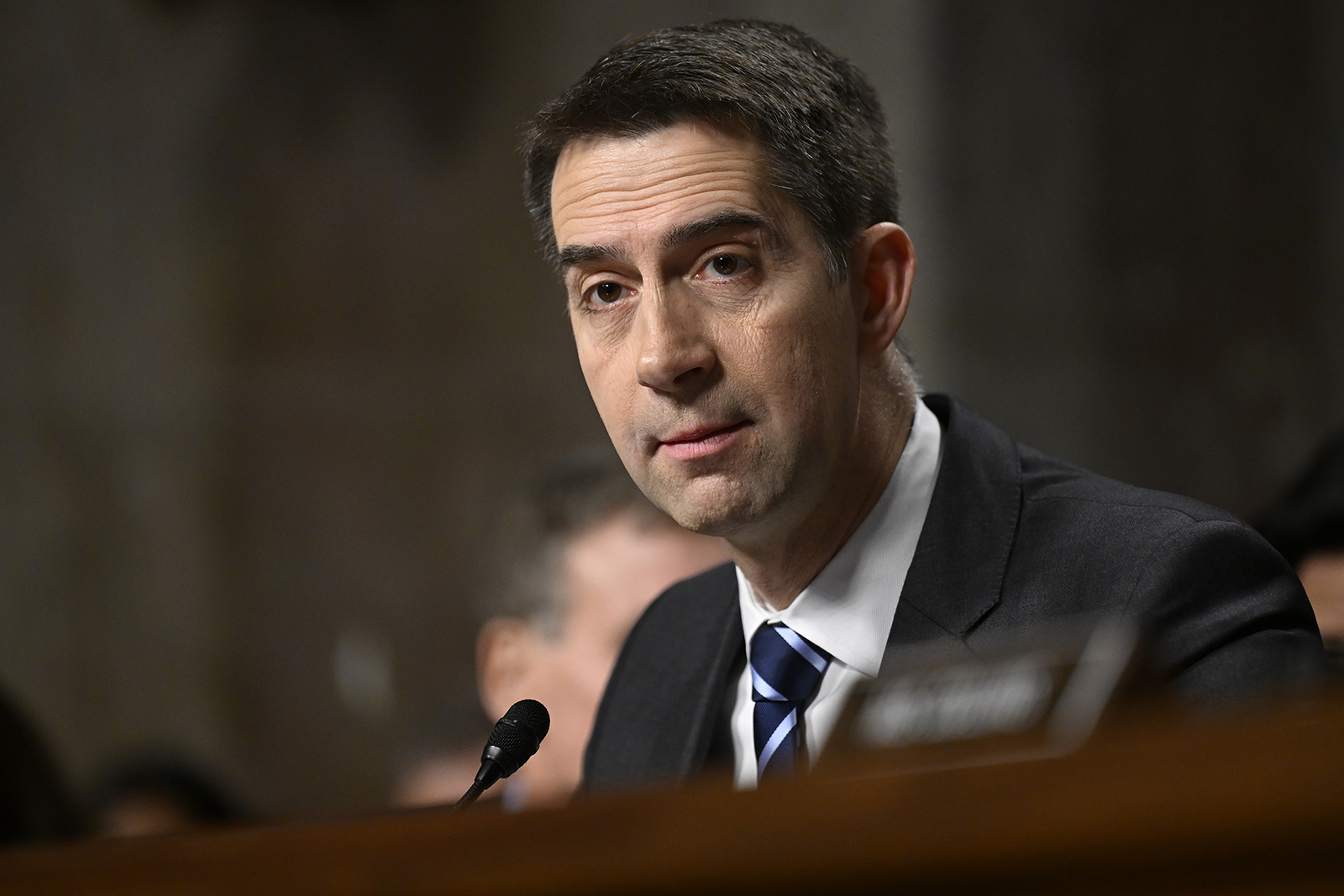
Chairman of the Senate Intelligence Committee Sen. Tom Cotton, R-Ark., speaks at the Capitol in Washington, Jan. 15, 2025. (AP Photo/John McDonnell, File)
Fiona André and Bob Smietana
August 6, 2025
(RNS) — Republican Sen. Tom Cotton of Arkansas has urged the IRS to open an investigation into the Council on American-Islamic Relations’ nonprofit status over its alleged “deep ties to terrorist organizations.”
In a letter addressed to IRS Commissioner Billy Long on Monday (Aug. 4), Cotton claimed CAIR worked to “advance the Islamist agenda in America while concealing their true affiliations.”
One of the country’s largest Muslim advocacy groups, CAIR was founded in 1994 and works to empower and support Muslim Americans.
“Recent news and longstanding evidence demonstrate CAIR’s ties to terrorist organizations, including Hamas and the Muslim Brotherhood, and their activities,” wrote Cotton in his letter.
Cotton’s letter repeats allegations made about CAIR by conservative critics since the mid-2000s, citing evidence presented during a federal investigation of the Holy Land Foundation, a prominent Muslim charity that was shut down in 2001. At the time, the group had been one of the largest Muslim charities in the country. Leaders of the Holy Land Foundation were accused of diverting funds to Palestinian groups with ties to Hamas. In 2008, five leaders of the group, who claimed they were involved in humanitarian work, were convicted of supporting Hamas.
For years, federal law enforcement had been monitoring officials from Hamas, even before it was classified as a terrorist group in 1997, and had wiretapped meetings between those officials and Palestinian American leaders in the early 1990s. In 1993, the founders of CAIR were part of one of those meetings in Philadelphia, and transcripts from the meetings were later introduced into evidence during the Holy Land Foundation trial. Cotton cites that 1993 meeting as evidence that CAIR has ties to terrorists.

Nihad Awad, executive director and co-founder of the Council on American-Islamic Relations, speaks outside the White House, Aug. 25, 2021, in Washington. (AP Photo/Amanda Andrade-Rhoades)
Cotton’s letter is the latest in a series of accusations claiming CAIR has ties to terror organizations, amid the group’s vocal pro-Palestinian activism. Since the start of the Israel-Hamas war, CAIR has repeatedly called for a ceasefire and denounced the humanitarian situation in Gaza.
Cotton’s letter points to CAIR’s pro-Palestinian activism, citing a November 2023 speech by CAIR’s executive director, Nihad Awad, at the American Muslims for Palestine convention in Chicago.
“I was happy to see people breaking the siege and throwing down the shackles of their own land and walk free into their land, which they were not allowed to walk in,” said Awad, referring to the Oct. 7, 2023, Hamas attacks on Israel, at the convention.
The White House condemned Awad’s comments, denouncing them as “shocking, antisemitic,” according to a statement of then-White House spokesman Andrew Bates shared with CNN at the time. After the controversy, Awad issued a statement condemning the Oct. 7 attacks.
Cotton’s letter urges the IRS to “immediately investigate CAIR’s compliance with section 501(c)(3), including a review of its financial records, affiliations, and activities.”
“Tax-exempt status is a privilege, not a right, and it should not subsidize organizations with links to terrorism,” reads the document.

CAIR logo. (Image courtesy of CAIR)
An IRS spokesperson told Religion News Service that “federal employees are barred by law from disclosing tax return information, including whether the agency is investigating or examining the return of any taxpayer.”
“Tom Cotton’s baseless demand that the IRS target a nonprofit organization based on debunked conspiracy theories is an un-American political stunt straight from the McCarthy era,” wrote CAIR in an email statement to RNS. “It’s motivated by the senator’s desire to protect the genocidal Israeli government from criticism.”
The group said it condemned both the Hamas attacks on Israel and the “ongoing genocide in Gaza,” adding, “this is called moral consistency. Senator Cotton should try it.”
CAIR has clashed with Cotton in the past. In 2020, the group called on the senator to resign after he made controversial comments about slavery in American history. In 2023, CAIR criticized Cotton after he questioned Adeel Manji, who is Muslim, about antisemitism during a Senate hearing. Manji had been nominated as a federal judge by then-President Joe Biden. His nomination eventually failed. The group also criticized Cotton and other senators for supporting the sale of weapons to Israel.
CAIR has run into issues with its tax exemption in the past. In 2011, the IRS automatically revoked the group’s exemption for failing to file annual Form 990 tax disclosures for several years. CAIR’s leaders at the time stated that a paperwork mix-up led to the loss of tax-exempt status. The exemption was restored in 2012.
RELATED: Muslim group, CAIR, regains tax-exempt status
“We are obviously pleased that all the paperwork issues have been resolved and our tax-exempt status has been restored,” Ibrahim Hooper, communications director for CAIR, told The Tennessean newspaper at the time.
In June, Republican Rep. Randall Fine of Florida introduced a bill urging Secretary of State Marco Rubio to designate CAIR a foreign terrorist organization. In January 2024, Fine sponsored a bill barring local and state agencies in Florida from working with CAIR.
“This takes long-overdue action to confront the terrorist threat posed by CAIR, a Trojan horse for terrorism operating inside our own borders,” Fine said in a recent statement announcing the bill.
In July, Texas Republicans issued a statement calling on the state’s elected officials to cut ties with CAIR. The letter denounces CAIR’s alleged “anti-constitutional agenda, its documented terrorist affiliations, and its efforts to undermine American values, laws, and civic institutions.”
(RNS) — Cotton’s letter is the latest in a series of accusations claiming CAIR has ties to terror organizations and denouncing the group’s pro-Palestinian activism.
Chairman of the Senate Intelligence Committee Sen. Tom Cotton, R-Ark., speaks at the Capitol in Washington, Jan. 15, 2025. (AP Photo/John McDonnell, File)
Fiona André and Bob Smietana
August 6, 2025
(RNS) — Republican Sen. Tom Cotton of Arkansas has urged the IRS to open an investigation into the Council on American-Islamic Relations’ nonprofit status over its alleged “deep ties to terrorist organizations.”
In a letter addressed to IRS Commissioner Billy Long on Monday (Aug. 4), Cotton claimed CAIR worked to “advance the Islamist agenda in America while concealing their true affiliations.”
One of the country’s largest Muslim advocacy groups, CAIR was founded in 1994 and works to empower and support Muslim Americans.
“Recent news and longstanding evidence demonstrate CAIR’s ties to terrorist organizations, including Hamas and the Muslim Brotherhood, and their activities,” wrote Cotton in his letter.
Cotton’s letter repeats allegations made about CAIR by conservative critics since the mid-2000s, citing evidence presented during a federal investigation of the Holy Land Foundation, a prominent Muslim charity that was shut down in 2001. At the time, the group had been one of the largest Muslim charities in the country. Leaders of the Holy Land Foundation were accused of diverting funds to Palestinian groups with ties to Hamas. In 2008, five leaders of the group, who claimed they were involved in humanitarian work, were convicted of supporting Hamas.
For years, federal law enforcement had been monitoring officials from Hamas, even before it was classified as a terrorist group in 1997, and had wiretapped meetings between those officials and Palestinian American leaders in the early 1990s. In 1993, the founders of CAIR were part of one of those meetings in Philadelphia, and transcripts from the meetings were later introduced into evidence during the Holy Land Foundation trial. Cotton cites that 1993 meeting as evidence that CAIR has ties to terrorists.
Nihad Awad, executive director and co-founder of the Council on American-Islamic Relations, speaks outside the White House, Aug. 25, 2021, in Washington. (AP Photo/Amanda Andrade-Rhoades)
Cotton’s letter is the latest in a series of accusations claiming CAIR has ties to terror organizations, amid the group’s vocal pro-Palestinian activism. Since the start of the Israel-Hamas war, CAIR has repeatedly called for a ceasefire and denounced the humanitarian situation in Gaza.
Cotton’s letter points to CAIR’s pro-Palestinian activism, citing a November 2023 speech by CAIR’s executive director, Nihad Awad, at the American Muslims for Palestine convention in Chicago.
“I was happy to see people breaking the siege and throwing down the shackles of their own land and walk free into their land, which they were not allowed to walk in,” said Awad, referring to the Oct. 7, 2023, Hamas attacks on Israel, at the convention.
The White House condemned Awad’s comments, denouncing them as “shocking, antisemitic,” according to a statement of then-White House spokesman Andrew Bates shared with CNN at the time. After the controversy, Awad issued a statement condemning the Oct. 7 attacks.
Cotton’s letter urges the IRS to “immediately investigate CAIR’s compliance with section 501(c)(3), including a review of its financial records, affiliations, and activities.”
“Tax-exempt status is a privilege, not a right, and it should not subsidize organizations with links to terrorism,” reads the document.
CAIR logo. (Image courtesy of CAIR)
An IRS spokesperson told Religion News Service that “federal employees are barred by law from disclosing tax return information, including whether the agency is investigating or examining the return of any taxpayer.”
“Tom Cotton’s baseless demand that the IRS target a nonprofit organization based on debunked conspiracy theories is an un-American political stunt straight from the McCarthy era,” wrote CAIR in an email statement to RNS. “It’s motivated by the senator’s desire to protect the genocidal Israeli government from criticism.”
The group said it condemned both the Hamas attacks on Israel and the “ongoing genocide in Gaza,” adding, “this is called moral consistency. Senator Cotton should try it.”
CAIR has clashed with Cotton in the past. In 2020, the group called on the senator to resign after he made controversial comments about slavery in American history. In 2023, CAIR criticized Cotton after he questioned Adeel Manji, who is Muslim, about antisemitism during a Senate hearing. Manji had been nominated as a federal judge by then-President Joe Biden. His nomination eventually failed. The group also criticized Cotton and other senators for supporting the sale of weapons to Israel.
CAIR has run into issues with its tax exemption in the past. In 2011, the IRS automatically revoked the group’s exemption for failing to file annual Form 990 tax disclosures for several years. CAIR’s leaders at the time stated that a paperwork mix-up led to the loss of tax-exempt status. The exemption was restored in 2012.
RELATED: Muslim group, CAIR, regains tax-exempt status
“We are obviously pleased that all the paperwork issues have been resolved and our tax-exempt status has been restored,” Ibrahim Hooper, communications director for CAIR, told The Tennessean newspaper at the time.
In June, Republican Rep. Randall Fine of Florida introduced a bill urging Secretary of State Marco Rubio to designate CAIR a foreign terrorist organization. In January 2024, Fine sponsored a bill barring local and state agencies in Florida from working with CAIR.
“This takes long-overdue action to confront the terrorist threat posed by CAIR, a Trojan horse for terrorism operating inside our own borders,” Fine said in a recent statement announcing the bill.
In July, Texas Republicans issued a statement calling on the state’s elected officials to cut ties with CAIR. The letter denounces CAIR’s alleged “anti-constitutional agenda, its documented terrorist affiliations, and its efforts to undermine American values, laws, and civic institutions.”

No comments:
Post a Comment