(RNS) — The fear of raids has pushed some congregations back to pandemic-era worship strategies.
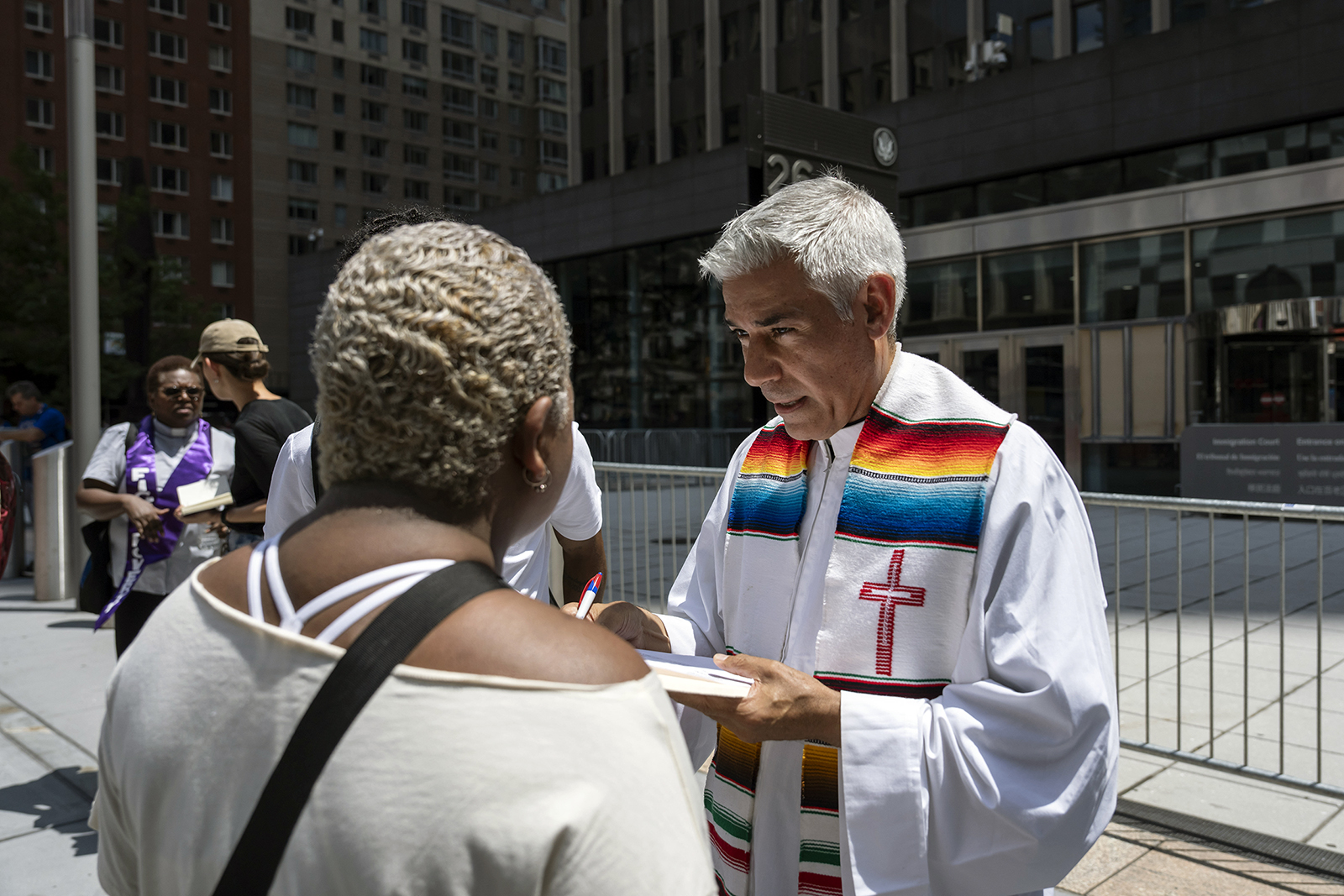
The Rev. Fabián Arias, right, assists an immigrant family outside the Jacob K. Javits federal building, Thursday, July 17, 2025, in New York. (AP Photo/Yuki Iwamura)
Jack Jenkins
August 4, 2025
(RNS) — When the Rev. Tanya Lopez talks about the day in June when she had to confront masked agents in her church parking lot, she focuses on the man they detained. As the pastor of Downey Memorial Christian Church near Los Angeles, California, she said her primary concern was the person being taken away by the apparent federal immigration agents, though they declined to identify what agency they worked for.
But the fact that agents felt comfortable apprehending a man on church property — and were willing, Lopez says, to raise a weapon at her even after she identified herself as a pastor — left her shaken.
“This is domestic terror, in my opinion,” Lopez told Religion News Service in June. “I don’t feel safe. I still have to show up at church on Sunday. I still have to lead worship.”
It’s a sentiment shared by a growing number of faith leaders and the communities they serve, as President Donald Trump has enacted a massive immigration crackdown over the past few months, resulting in thousands of detentions and deportations across the country. For many immigrant-heavy congregations, the risk has been amplified by the administration’s decision to rescind a long-standing internal government policy of avoiding immigration raids at “sensitive locations” such as houses of worship.
RNS has identified at least 10 instances of apparent immigration enforcement activity conducted by ICE or other federal agents on or immediately near church grounds since Trump’s inauguration. DHS officials have repeatedly declined to confirm whether many such incidents — enacted by uniformed men in masks who sometimes do not identify which agency they work for — were government-sanctioned operations. The episodes are spread across five states and Puerto Rico and, so far, have impacted Christian communities — namely, Catholic, evangelical, Cooperative Baptist and mainline Christian churches.
RELATED: Fourth group of religious organizations sues US over ICE raids at churches
The episodes have occurred despite four separate lawsuits involving dozens of religious denominations and groups that have been filed against the Trump administration, arguing that any enforcement on church grounds violates the right to freely worship and hinders their ability to serve those in need.
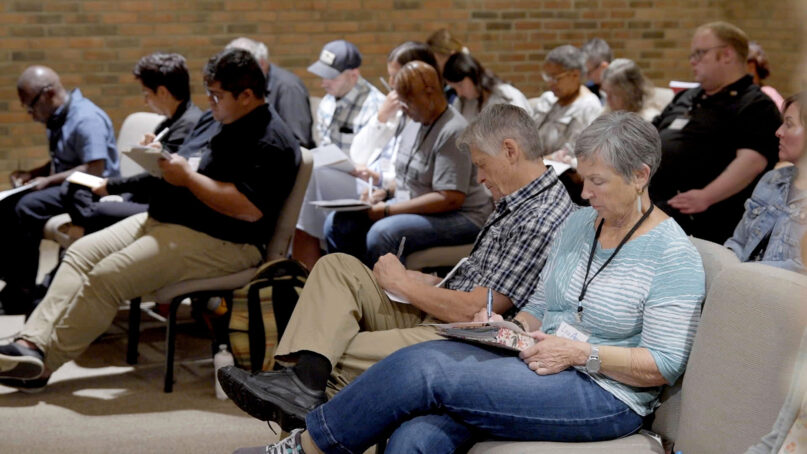
In this image taken from video, participants take notes during a training hosted by Undivided at Central Christian Church in Springfield, Ohio, aimed at teaching community and church leaders how to support and shelter immigrants facing deportation, Tuesday, July 29, 2025. (AP Photo/Obed Lamy)
Trump administration officials initially denied ICE raids were happening at houses of worship at all. But last week DHS Assistant Secretary Tricia McLaughlin acknowledged to RNS that incidents have occurred, while insisting officers need “secondary supervisor approval before any action can be taken in locations such as a church or a school.”
McLaughlin added: “We expect these to be extremely rare.”
Faith leaders aren’t finding them rare enough. The Catholic Diocese of San Bernardino reported at least two instances in June alone where ICE detained people on parish property: one in which agents chased men into the parking lot of St. Adelaide Parish and detained them, and another where a parishioner at Our Lady of Lourdes was apprehended on church property while doing landscaping.
A similar situation unfolded in Washington state in March, when a man was reportedly arrested in a church parking lot while leaving worship with his family.
RELATED: Faith groups say House Republicans’ probe into immigration work violates their religious freedom
Agents are sometimes confronted by clergy, but faith leaders say officers are often unmoved by their appeals. Lopez, the Downey Memorial Christian Church pastor who filmed the masked men in a clip that received national media attention, said that one agent allegedly told an administrative pastor: “The whole country is our property.”

Immigration agents, who failed to identify themselves, detain an individual in the parking lot of Downey Memorial Christian Church, Wednesday, June 11, 2025, in Downey, California. (Photo by Tanya Lopez)
Federal agents have also used religious facilities as a staging ground. In May, ICE agents staged an operation on United Methodist church property in Charlotte during preschool pickup, disrupting families and instilling fear among staff and children, according to a statement from the Western North Carolina Conference.
“ICE enforcement activity on our church property interferes with our ability to welcome the stranger, serve our neighbors, and carry out the ministries that are central to our faith,” the statement read. “Churches should not be staging grounds for law enforcement. They are sacred spaces where the hurting find healing, the hungry are fed, and families — regardless of immigration status — come seeking peace.”
Two months earlier, immigration officials reportedly attempted to conduct a stakeout on the grounds of a North Carolina Cooperative Baptist Fellowship church that offered English as a Second Language classes to immigrants and refugees. The officers eventually left, but the incident became a legal flashpoint: the CBF is a plaintiff in one of the lawsuits challenging the Trump administration’s decision to rescind the sensitive locations policy, raising questions as to whether the incident violated a judge’s injunction in their case.
Immigration officials have also conducted raids in close proximity to churches, a trend faith leaders say can have an equally chilling effect on people in the pews. In January, ICE agents reportedly approached an evangelical church in Georgia during worship. When people inside locked the doors, an asylum seeker’s ankle monitor began buzzing. The congregant exited to the parking lot, where he was promptly detained by agents.
Similar scenes played out in June when one man was detained on the sidewalk outside a Catholic church in Downey and, days later, in Newberg, Oregon, when another man was apprehended on the sidewalk just outside St. Michael’s Episcopal Church, sparking backlash from congregants who knew the man and his family.
For some churches, the fear of raids has forced fundamental changes in how they operate. The bishop of San Bernardino has formally lifted the obligation to attend Mass for Catholics concerned about ICE raids, for example, an unusual shift that follows a similar, albeit less formalized move by the Diocese of Nashville.
Rodrigo Cruz, the executive assistant to the United Methodist Church’s North and South Georgia annual conferences, said widespread ICE activity in his state has pushed congregations back to pandemic-era worship strategies — online services or small gatherings — as at-risk families prioritize safety over communal worship.
“We want to gather with people, especially when we are going through some distress as a society, while also acknowledging that the safety and the well being of our individuals and our families are a priority,” said Cruz, who noted the North Georgia conference is a plaintiff in one of the four lawsuits challenging the policy change.
RELATED: California pastor says apparent immigration agents waved a weapon at her in church parking lot
Bishop Brenda Bos, who leads the Southwest California Synod of the Evangelical Lutheran Church in America, told RNS that church attendance in the region sank in the weeks during which Los Angeles — which is within her synod — became the epicenter of Trump’s recent immigration crackdown.
Bos, who is also a plaintiff in the most recent lawsuit, said the drop-off impacts more than just the numbers in the pews. Community ministries are also suffering, she said, in part because immigrants make up a significant percentage of church volunteers in the region.
“It’s not just ‘Oh, I’m a hungry person who doesn’t dare leave my home,’” Bos said. “Some of these people also drive the trucks to go get food, or cook the meals or care for the children. So ministries are stopped also.”
In Puerto Rico, the Rev. Nilka Marrero has watched several families at Iglesia Metodista in San Pablo skip worship out of fear of being detained while en route. In response, the congregation has worked to arrange transportation to help people feel safe. When agents appear near her church, she barricades worshippers inside.
“When they are that close, we shut the church and we lock the (door), enclose ourselves inside, and we can be very happy for two, three, four, five, six hours until I know that they’re not there,” the Methodist pastor said.
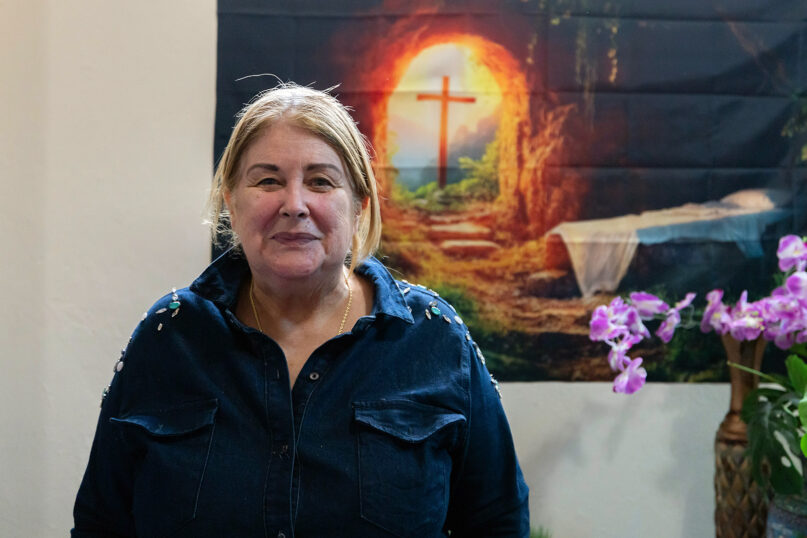
Pastor Nilka Marrero poses for a photo at Barrio Obrero’s San Pablo Methodist Church, where she has been helping undocumented immigrants prepare for the threat of arrest, in San Juan, Puerto Rico, Friday, March 14, 2025. (AP Photo/Alejandro Granadillo)
Rebecca González-Ramos, the special agent in charge of Homeland Security Investigations in San Juan, has said she doesn’t intend to raid churches, but Marrero said many in her congregation don’t trust authorities.
“They’ve arrested people in front of the church,” Marrero said, noting that hundreds of people have been detained in her part of Puerto Rico over the past few months.
The fear permeating her community, the pastor argued, is well-founded: One of the first major immigration raids in Puerto Rico under the new Trump administration happened on a Sunday morning, when many are on their way to worship.
“I’m sorry, I’m old school: Sunday, for me, is the day of the Lord, and it was very, very disrespectful,” Marrero said. “People from my church and other churches saw that as a transgression of what we had been taught all our life: that Sunday is a day when you go out to adore the Lord.”
Aleja Hertzler-McCain contributed to this report.
Fourth group of religious organizations sues US over ICE raids at churches
(RNS) — “As people of faith, we cannot abide losing the basic right to provide care and compassion,” Bishop Brenda Bos of the ELCA’s Southwest California Synod, a plaintiff in the case, said in a statement.
FILE - Several faith groups have joined together to sue the U.S. government after a recent removal of a bill that discouraged ICE from targeting faith-based locations for raids. (RNS file photo/Amanda Koehn)
Jack Jenkins
July 28, 2025
RNS
(RNS) — A group of Christian denominations and organizations filed a lawsuit on Monday (July 28) against Secretary of Homeland Security Kristi Noem over the Trump administration’s decision to rescind a policy discouraging immigration raids at houses of worship, the fourth such suit to be brought on the question of arrests made at so-called “sensitive locations.”
In the past, immigration enforcement actions at churches were discouraged by a 2011 internal government memo that advised against raids at sensitive locations, such as houses of worship, schools and hospitals. But Trump did away with the policy shortly after taking office, which faith groups argue in their suit “is not just harmful and un-American” but also “violates federal law,” citing both freedom of assembly guaranteed under the First Amendment as well as rights outlined by the Religious Freedom Restoration Act and the Administrative Procedure Act.
“For Plaintiffs and their members, the present threat of surveillance, interrogation, or arrest at their houses of worship means, among other things, fewer congregants participating in communal worship; a diminished ability to provide or participate in religious ministries; and interference with their ability to fulfill their religious mandates, including their obligations to welcome all comers to worship and not to put any person in harm’s way,” the complaint reads.
The plaintiffs include five regional synods of the Evangelical Lutheran Church in America and three regional Quaker groups. Three Christian denominations are also listed: American Baptist Churches USA, Alliance of Baptists and Metropolitan Community Churches. They are represented by progressive legal groups Democracy Forward, Washington Lawyers’ Committee for Civil Rights and Urban Affairs and the Washington law firm Gilbert LLP.
“As people of faith, we cannot abide losing the basic right to provide care and compassion,” Bishop Brenda Bos of the ELCA’s Southwest California Synod said in a statement. “Not only are our spaces no longer guaranteed safety, but our worship services, educational events and social services have all been harmed by the rescission of sensitive space protection. Our call is love our neighbor, and we have been denied the ability to live out that call.”
Asked about the lawsuit, Assistant Homeland Security Secretary Tricia McLaughlin told Religion News Service in a statement: “We are protecting our schools, places of worship by preventing criminal aliens and gang members from exploiting these locations and taking safe haven there because these criminals knew law enforcement couldn’t go inside under the Biden Administration.”
DHS did not immediately respond to a followup question asking to specify an example of a gang member taking refuge in a church under the previous administration, but the initial statement insisted raids on sensitive locations require special protocols before being carried out.
“Officers would need secondary supervisor approval before any action can be taken in locations such as a church or a school,” McLaughlin said in the statement, adding, “We expect these to be extremely rare.”
In a separate interview with RNS, Bos rejected McLaughlin’s characterization of those targeted by recent immigration enforcement actions, which the government’s own data has indicated are often — and in some cases, mostly — people without criminal convictions.
“What we’re looking at is folks that have been deeply embedded in the communities and in their congregations, real people of faith and service who are being harmed,” Bos said. “I don’t have a lot of patience for this administration painting everybody with a criminal brush.”
Even acknowledging enforcement actions at churches is a shift for the Trump administration, which has repeatedly insisted immigration raids haven’t taken place at any houses of worship. McLaughlin told The Washington Post earlier this month, “Immigration enforcement operations haven’t been conducted at churches or places of worship.” In addition, conservative outlet Daily Wire quoted Trump border czar Tom Homan on July 9 saying he did “not know of a single incident of a church arrest.”
A month earlier, according to the complaint, federal agents detained a man in the parking lot of a Disciples of Christ church in Downey, California, a scene that was filmed as the agents were confronted by a pastor. Asked about the incident by RNS in July, DHS officials responded with a statement that instead referred to a separate incident near a different church.
The complaint also describes officers detaining parishioners at two churches in the Catholic Diocese of San Bernardino, including a man who was doing landscaping for one of the churches.

Bishop Alberto Rojas of the Diocese of San Bernardino. Photo courtesy of the Diocese of San Bernardino
San Bernardino Bishop Alberto Rojas has formally lifted the obligation to attend Mass for Catholics who are concerned about ICE raids, following a similar statement by the Diocese of Nashville issued in May that concluded, “no Catholic is obligated to attend Mass on Sunday if doing so puts their safety at risk.”
Monday’s filing also detailed incidents that occurred near churches, including at least one incident on a sidewalk outside a Catholic church in Downey the same day the video was made at the Disciples of Christ church. Arrests near a church, the suit said, can have a chilling effect on attendance. (The Los Angeles Catholic Archdiocese has disputed that the person apprehended was connected to the church or the parish school, as was initially reported.)
The new complaint joins at least three other separate lawsuits filed by faith groups alone or with other plaintiffs on roughly the same grounds since Trump took office. The plaintiffs in the cases include a broad spectrum of religious organizations, from entire denominations, such as the African Methodist Episcopal Zion Church, the Episcopal Church USA and the Union for Reform Judaism, to an individual Catholic parish and a Sikh temple in California.
The Evangelical Lutheran Church in America, which has several representatives in the new filing, was not a party in the previous sensitive location lawsuits, an omission that frustrated some members of the denomination. But the ELCA’s presiding bishop, Elizabeth Eaton, said in a video statement in February that the group’s absence was due to the belief that the denomination’s polity wouldn’t allow it to have standing as a collective and urged individual congregations and bodies to join if they could prove standing.
The administration is also facing at least two other lawsuits related to its almost complete ban on refugees and its cancellation of contracts with faith-based groups that resettle refugees for the federal government. One suit was filed by the U.S. Conference of Catholic Bishops and another by a trio of religious organizations that work with refugees, HIAS, Church World Service and Lutheran Community Services Northwest.
Aleja Hertzler-McCain contributed to this report.


No comments:
Post a Comment