Debris From China, Argentina, Ethiopia Found In Brazilian Waters
Credit: INEA
By ABr
By Rafael Cardoso
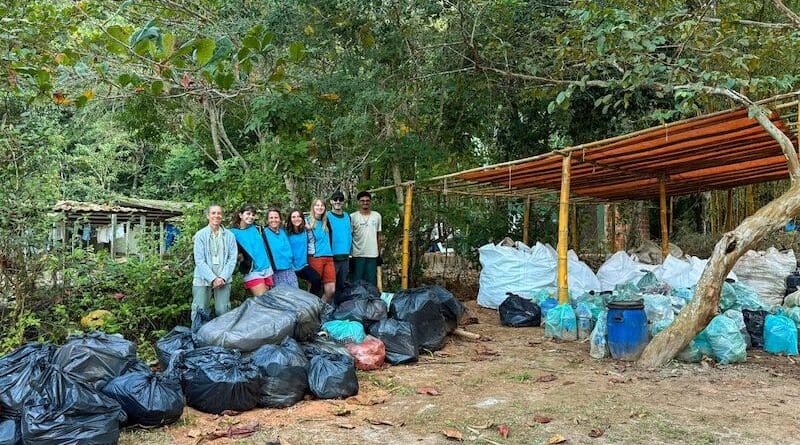
A joint effort led by the Rio de Janeiro State Environmental Institute (Inea), in partnership with the NGO Somos Natureza, identified solid waste in the Praia do Sul State Biological Reserve on Ilha Grande. Packaging from China, Argentina, and Ethiopia was found.

According to Cleber Ferreira, environmental engineer and director of Biodiversity, Protected Areas, and Ecosystems at Inea, this is yet another indication of a globally scaled problem with major local impacts.
“This waste is improperly disposed of and ends up in our water bodies—whether it’s a river, the sea, or a lagoon. This happens all over the world. We have real islands of solid waste in the ocean. Often, parts of this waste break away from those islands and wash up on our beaches and along much of the country’s coastline,” said the engineer.
Between July 13 and 16, 242 kg of recyclable materials carried to the beaches by ocean currents were removed. The work was done manually, using tools such as mechanical grabbers and eco-sifters. The team sorted the materials and delivered them to recycling cooperatives in the city of Angra dos Reis.
Waste such as plastic and glass poses risks to local biodiversity. Plastic can be ingested by turtles and seabirds, leading to suffocation and death. Glass waste can take over 4,000 years to decompose in the environment.
“The sense we have is that this type of waste is becoming increasingly common and causing greater harm to our fauna. We’re seeing a clear rise in waste. I can carry out as many cleanup operations as needed, and in each one, I’ll remove at least one ton—or 500 kg—of waste, depending on the size of the team,” said Ferreira.
The partnership between Inea and Somos Natureza includes monthly joint cleanup efforts on the beaches of Ilha Grande. The goal is to encourage volunteers to take an active role in the initiatives. In the most recent cleanup, participants included tourists from São Paulo, Spain, Argentina, and Iceland.
They received information about Inea’s conservation units and shared experiences in combating marine pollution in their home countries.
The Rio Secretary for the Environment and Sustainability, Bernardo Rossi, believes that all international actors must advance policies for the control and proper disposal of waste.
“We have no control over what arrives in Rio de Janeiro from other countries, but we act directly in the collection and disposal of waste that appears in our conservation units. It is also gratifying to see visitors from outside joining our conservation mission,” said Rossi.
Conservation Unit
The Praia do Sul State Biological Reserve is a conservation unit covering 3,309.63 hectares. Its mission is to preserve biodiversity and archaeological sites. According to Inea, it is the only reserve in the state of Rio de Janeiro that contains all coastal ecosystems. As a biological reserve, recreational visits are not allowed; only scientific research and environmental education activities are authorized.
Agência Brasil (ABr) is the national public news agency, run by the Brazilian government. It is a part of the public media corporation Empresa Brasil de Comunicação (EBC), created in 2007 to unite two government media enterprises Radiobrás and TVE (Televisão Educativa).

No comments:
Post a Comment