Banned Russian media sites 'still accessible' across EU: report
London (AFP) – Websites of banned Russian media outlets can still be easily accessed across the EU in the "overwhelming majority" of cases, experts said Tuesday, denouncing the bloc's "failure" to publish full lists of the websites involved.
Issued on: 05/08/2025 -

Russia Today )RT) is among the media sites banned in the EU over Moscow's invasion of Ukraine © Kirill KUDRYAVTSEV / AFP
After Russia invaded Ukraine in February 2022, EU authorities banned Kremlin-controlled media from broadcasting in the bloc, including online, to counter "disinformation".
But more than three years on, "sanctioned outlets are largely still active and accessible" across member states, said a report released by the Institute for Strategic Dialogue (ISD), a London-based think tank.
"Russian state media continues to maintain a strong online presence, posing a persistent challenge to Western democracies," the report said, with blocks by internet service providers "largely ineffective".
EU sanctions banned RT, previously known as Russia Today, and Sputnik media organisations as well as other state-controlled media accused of "information warfare".
The ISD report covered Germany, France, Italy, Poland, the Czech Republic and Slovakia, testing the top three internet service providers in each.
It identified 26 media under sanctions and tried to view 58 associated domains. In 76 percent of tests, providers failed to block access.
EU member states are responsible for ensuring blocks are applied by internet service providers.
But the ISD report criticised the European Commission for its "failure" to maintain a "definitive list of different domain iterations" -- or website addresses -- associated with each media outlet.
It said this left countries and internet service providers "without the guidance needed for effective and targeted implementation".
"The issue is when they sanction Russian state media, they mention the outlet that they are sanctioning -- so Russia Today, Sputnik, etc -- but what they don't list is what domain falls under this entity," said the report's author, Pablo Maristany de las Casas.
"If the European Commission were to list the different domains that are known to be linked to these entities, that would make it much easier for member states and the internet service providers in those member states to enforce these blocks," he said.
The report urged the EC to post a "continuously updated and publicly accessible list" and include it in sanctions packages and on its online sanctions dashboard.
A commission spokesperson told AFP: "It is up to the relevant providers to block access to websites of outlets covered by the sanctions, including subdomains or newly created domains."
After Russia invaded Ukraine in February 2022, EU authorities banned Kremlin-controlled media from broadcasting in the bloc, including online, to counter "disinformation".
But more than three years on, "sanctioned outlets are largely still active and accessible" across member states, said a report released by the Institute for Strategic Dialogue (ISD), a London-based think tank.
"Russian state media continues to maintain a strong online presence, posing a persistent challenge to Western democracies," the report said, with blocks by internet service providers "largely ineffective".
EU sanctions banned RT, previously known as Russia Today, and Sputnik media organisations as well as other state-controlled media accused of "information warfare".
The ISD report covered Germany, France, Italy, Poland, the Czech Republic and Slovakia, testing the top three internet service providers in each.
It identified 26 media under sanctions and tried to view 58 associated domains. In 76 percent of tests, providers failed to block access.
EU member states are responsible for ensuring blocks are applied by internet service providers.
But the ISD report criticised the European Commission for its "failure" to maintain a "definitive list of different domain iterations" -- or website addresses -- associated with each media outlet.
It said this left countries and internet service providers "without the guidance needed for effective and targeted implementation".
"The issue is when they sanction Russian state media, they mention the outlet that they are sanctioning -- so Russia Today, Sputnik, etc -- but what they don't list is what domain falls under this entity," said the report's author, Pablo Maristany de las Casas.
"If the European Commission were to list the different domains that are known to be linked to these entities, that would make it much easier for member states and the internet service providers in those member states to enforce these blocks," he said.
The report urged the EC to post a "continuously updated and publicly accessible list" and include it in sanctions packages and on its online sanctions dashboard.
A commission spokesperson told AFP: "It is up to the relevant providers to block access to websites of outlets covered by the sanctions, including subdomains or newly created domains."
Grey zone and mirrors
Enforcement needs to be more agile because Russia has sought to circumvent sanctions, the report's author said.
"Some outlets, for example, RT, use so-called mirror domains" where they "simply copy the contents of the blocked site into a new URL -- a new link -- to circumvent those sanctions," he said.
The report found that Slovakia, whose Prime Minister Robert Fico is known for his pro-Russia positions, performed the worst on enforcement, with no blocks at all.
Slovakia's legal mandates to block pro-Russian websites expired in 2022 after lawmakers failed to extend them.
Poland was the second worst, while France and Germany were most effective overall.
Most sanctioned domains had little traction in the bloc, with under 1,000 monthly views, but Germany, with its large Russian diaspora, was the exception: three domains including RT had over 100,000 monthly visitors from there.
The report's author spotted another "loophole": numerous accounts on X posting links to banned media, mainly aimed at French and German speakers.
In May, such accounts posted almost 50 thousand links, almost all to RT-affiliated sites, the report found.
X largely blocks official media accounts, the author said, but "with these anonymous accounts that only repost this kind of content, there seems to be a grey zone and it seems not be withheld in the EU."
© 2025 AFP
Meta says working to thwart WhatsApp scammers
San Francisco (United States) (AFP) – Meta on Tuesday said it shut nearly seven million WhatsApp accounts linked to scammers in the first half of this year and is ramping up safeguards against such schemes.
Issued on: 05/08/2025 -

San Francisco (United States) (AFP) – Meta on Tuesday said it shut nearly seven million WhatsApp accounts linked to scammers in the first half of this year and is ramping up safeguards against such schemes.
Issued on: 05/08/2025 -
WhatsApp hopes to stymy scams by providing users with information about unrecognized groups or people who draw them into exchanges on the Meta-owned messaging service © Kirill KUDRYAVTSEV / AFP
"Our team identified the accounts and disabled them before the criminal organizations that created them could use them," WhatsApp external affairs director Clair Deevy said.
Often run by organized gangs, the scams range from bogus cryptocurrency investments to get-rich-quick pyramid schemes, WhatsApp executives said in a briefing.
"There is always a catch and it should be a red flag for everyone: you have to pay upfront to get promised returns or earnings," Meta-owned WhatsApp said in a blog post.
WhatsApp detected and banned more than 6.8 million accounts linked to scam centers, most of them in Southeast Asia, according to Meta.
WhatsApp and Meta worked with OpenAI to disrupt a scam traced to Cambodia that used ChatGPT to generate text messages containing a link to a WhatsApp chat to hook victims, according to the tech firms.
Meta on Tuesday began prompting WhatsApp users to be wary when added to unfamiliar chat groups by people they don't know.
New "safety overviews" provide information about the group and tips on spotting scams, along with the option of making a quick exit.
"We've all been there: someone you don’t know attempting to message you, or add you to a group chat, promising low-risk investment opportunities or easy money, or saying you have an unpaid bill that's overdue," Meta said in a blog post.
"The reality is, these are often scammers trying to prey on people's kindness, trust and willingness to help -- or, their fears that they could be in trouble if they don't send money fast."
"Our team identified the accounts and disabled them before the criminal organizations that created them could use them," WhatsApp external affairs director Clair Deevy said.
Often run by organized gangs, the scams range from bogus cryptocurrency investments to get-rich-quick pyramid schemes, WhatsApp executives said in a briefing.
"There is always a catch and it should be a red flag for everyone: you have to pay upfront to get promised returns or earnings," Meta-owned WhatsApp said in a blog post.
WhatsApp detected and banned more than 6.8 million accounts linked to scam centers, most of them in Southeast Asia, according to Meta.
WhatsApp and Meta worked with OpenAI to disrupt a scam traced to Cambodia that used ChatGPT to generate text messages containing a link to a WhatsApp chat to hook victims, according to the tech firms.
Meta on Tuesday began prompting WhatsApp users to be wary when added to unfamiliar chat groups by people they don't know.
New "safety overviews" provide information about the group and tips on spotting scams, along with the option of making a quick exit.
"We've all been there: someone you don’t know attempting to message you, or add you to a group chat, promising low-risk investment opportunities or easy money, or saying you have an unpaid bill that's overdue," Meta said in a blog post.
"The reality is, these are often scammers trying to prey on people's kindness, trust and willingness to help -- or, their fears that they could be in trouble if they don't send money fast."
Vatican embraces social media 'digital missionaries'
Vatican City (AFP) – Sister Albertine, a youthful French Catholic nun, stood outside the Vatican, phone in hand, ready to shoot more videos for her hundreds of thousands of followers online.
Issued on: 31/07/2025

'The great influencer is God'
Sister Albertine has 320,000 followers on Instagram and some of her TikTok videos get more than a million views.
She shares a mix of prayers with episodes from daily religious life, often from French abbeys.
"You feel alone and I suggest that we can pray together," she said in one video, crossing herself.
But, as religious content spreads online in the social media and AI era, one of the reasons behind the Vatican's summit was for it to express its position on the trend.
"You are not only influencers, you are missionaries," influential Cardinal Luis Antonio Tagle -- one of the few Vatican officials active on social media - told those attending mass.
The "great influencer is God", he added.
'Jesus not a digital programme'
But Tagle also warned that "Jesus is not a voice generated by a digital programme".
Pope Leo called on his online followers to strike a balance at a time when society is "hyperconnected" and "bombarded with images, sometimes false or distorted".
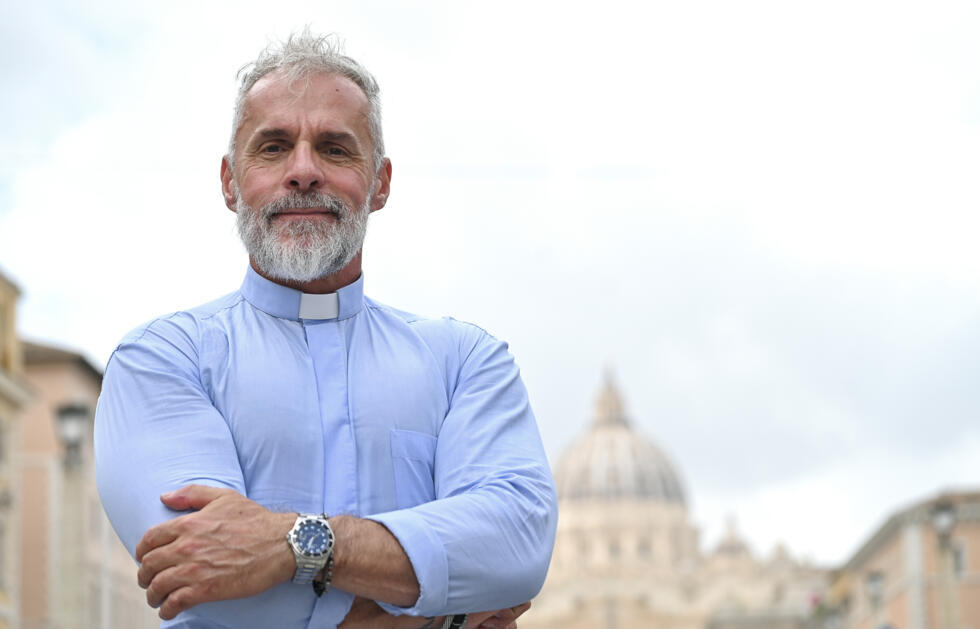
'Important we're online too'
Fusari told AFP there is no reason Catholic clerics should not embrace the world of online videos.
"Everyone uses social media, so it's important that we're there too," said Fusari, who came to Rome for the influencer event from the northern city of Brescia.
Fusari said his goal was to reach as many people as possible online, sharing the "word of God" with them.
This also takes the form of sharing videos of his chihuahua eating spaghetti.
But priests and nuns are not the only ones trying to attract people to the Church online, with regular believers spreading the faith too.
Francesca Parisi, a 31-year-old Italian teacher, joined the Catholic Church later in life.
She now has some 20,000 followers on TikTok, where she tries to make the Catholic faith look trendy.
Her target audience? People who have "drifted away" from the church.
It's possible, she said, to lure them back through their smartphones.
"If God did it with me, rest assured, he can also do it with you."
© 2025 AFP
Vatican City (AFP) – Sister Albertine, a youthful French Catholic nun, stood outside the Vatican, phone in hand, ready to shoot more videos for her hundreds of thousands of followers online.
Issued on: 31/07/2025
Pope Leo XIV led the Vatican's first mass for Catholic social media influencers © Alberto PIZZOLI / AFP
The 29-year-old nun, whose secular name is Albertine Debacker, is one of hundreds of Catholic influencers in Rome for a Vatican-organised social media summit this week.
The Vatican calls them "digital missionaries" and -- in an unprecedented move for the centuries-old institution -- Pope Leo XIV led a mass dedicated to them at St Peter's Basilica, calling on them to create content for those who "need to know the Lord".
Long wary of social media, the Catholic Church now sees it as a vital tool to spread the faith amid dwindling church attendance.
For Sister Albertine, this is the ideal "missionary terrain".
Inside the Baroque basilica, she was one of a swarm of religious influencers who surrounded the new pope, live streaming the meeting on their smartphones within one of Christianity's most sacred spots.
She said it was highly symbolic that the Vatican organised the event bringing together its Instagramming-disciples.
"It tells us: 'it's important, go for it, we're with you and we'll search together how we can take this new evangelisation forward," she told AFP.
The influencer summit was held as part of the Vatican's "Jubilee of Youth", as young believers flooded Rome this week.
The 29-year-old nun, whose secular name is Albertine Debacker, is one of hundreds of Catholic influencers in Rome for a Vatican-organised social media summit this week.
The Vatican calls them "digital missionaries" and -- in an unprecedented move for the centuries-old institution -- Pope Leo XIV led a mass dedicated to them at St Peter's Basilica, calling on them to create content for those who "need to know the Lord".
Long wary of social media, the Catholic Church now sees it as a vital tool to spread the faith amid dwindling church attendance.
For Sister Albertine, this is the ideal "missionary terrain".
Inside the Baroque basilica, she was one of a swarm of religious influencers who surrounded the new pope, live streaming the meeting on their smartphones within one of Christianity's most sacred spots.
She said it was highly symbolic that the Vatican organised the event bringing together its Instagramming-disciples.
"It tells us: 'it's important, go for it, we're with you and we'll search together how we can take this new evangelisation forward," she told AFP.
The influencer summit was held as part of the Vatican's "Jubilee of Youth", as young believers flooded Rome this week.
'The great influencer is God'
Sister Albertine has 320,000 followers on Instagram and some of her TikTok videos get more than a million views.
She shares a mix of prayers with episodes from daily religious life, often from French abbeys.
"You feel alone and I suggest that we can pray together," she said in one video, crossing herself.
But, as religious content spreads online in the social media and AI era, one of the reasons behind the Vatican's summit was for it to express its position on the trend.
"You are not only influencers, you are missionaries," influential Cardinal Luis Antonio Tagle -- one of the few Vatican officials active on social media - told those attending mass.
The "great influencer is God", he added.
'Jesus not a digital programme'
But Tagle also warned that "Jesus is not a voice generated by a digital programme".
Pope Leo called on his online followers to strike a balance at a time when society is "hyperconnected" and "bombarded with images, sometimes false or distorted".
Father Giuseppe Fusari does not look like a regular priest © Alberto PIZZOLI / AFP
"It is not simply a matter of generating content, but of creating an encounter between hearts," said the American pope, 69.
It is this balance that has been hard to strike, with some Catholic clerics themselves embracing a social media presence.
Father Giuseppe Fusari does not look like a regular priest: wearing tight shirts exposing his arm tattoos.
To his 63,000 followers on Instagram, he mixes content about Italian church architecture and preaching.
"It is not simply a matter of generating content, but of creating an encounter between hearts," said the American pope, 69.
It is this balance that has been hard to strike, with some Catholic clerics themselves embracing a social media presence.
Father Giuseppe Fusari does not look like a regular priest: wearing tight shirts exposing his arm tattoos.
To his 63,000 followers on Instagram, he mixes content about Italian church architecture and preaching.
'Important we're online too'
Fusari told AFP there is no reason Catholic clerics should not embrace the world of online videos.
"Everyone uses social media, so it's important that we're there too," said Fusari, who came to Rome for the influencer event from the northern city of Brescia.
Fusari said his goal was to reach as many people as possible online, sharing the "word of God" with them.
This also takes the form of sharing videos of his chihuahua eating spaghetti.
But priests and nuns are not the only ones trying to attract people to the Church online, with regular believers spreading the faith too.
Francesca Parisi, a 31-year-old Italian teacher, joined the Catholic Church later in life.
She now has some 20,000 followers on TikTok, where she tries to make the Catholic faith look trendy.
Her target audience? People who have "drifted away" from the church.
It's possible, she said, to lure them back through their smartphones.
"If God did it with me, rest assured, he can also do it with you."
© 2025 AFP
Australia widens teen social media ban to YouTube, scraps exemption
Issued on: 30/07/2025 -
Australia said on Wednesday it will add YouTube to sites covered by its world-first ban on social media for teenagers, reversing an earlier decision to exempt the Alphabet-owned video-sharing site and potentially setting up a legal challenge.
Video by: Oliver FARRY
Issued on: 30/07/2025 -
Australia said on Wednesday it will add YouTube to sites covered by its world-first ban on social media for teenagers, reversing an earlier decision to exempt the Alphabet-owned video-sharing site and potentially setting up a legal challenge.
Video by: Oliver FARRY
TikTok launches crowd-sourced debunking tool in US
Washington (AFP) – TikTok on Wednesday rolled out a crowd-sourced debunking system in the United States, becoming the latest tech platform to adopt a community-driven approach to combating online misinformation.
Issued on: 30/07/2025 -

Washington (AFP) – TikTok on Wednesday rolled out a crowd-sourced debunking system in the United States, becoming the latest tech platform to adopt a community-driven approach to combating online misinformation.
Issued on: 30/07/2025 -
Tech platforms increasingly view the community-driven moderation model as an alternative to professional fact-checking, which many conservative advocates have long accused of a liberal bias. © Kirill KUDRYAVTSEV / AFP
Footnotes, a feature that the popular video-sharing app began testing in April, allows vetted users to suggest written context for content that might be wrong or misleading -- similar to Community Notes on Meta and X.
"Footnotes draws on the collective knowledge of the TikTok community by allowing people to add relevant information to content," Adam Presser, the platform's head of operations and trust and safety, said in a blog post.
"Starting today, US users in the Footnotes pilot program can start to write and rate footnotes on short videos, and our US community will begin to see the ones rated as helpful -- and rate them, too," he added.
TikTok said nearly 80,000 US-based users, who have maintained an account for at least six months, have qualified as Footnotes contributors. The video-sharing app has some 170 million US users.
TikTok said the feature will augment the platform's existing integrity measures such as labeling content that cannot be verified and partnering with fact-checking organizations, such as AFP, to assess the accuracy of posts on the platform.
The crowd-sourced verification system was popularized by Elon Musk's platform X, but researchers have repeatedly questioned its effectiveness in combating falsehoods.
Earlier this month, a study found more than 90 percent of X's Community Notes are never published, highlighting major limits in efficacy.
The Digital Democracy Institute of the Americas (DDIA) study analyzed the entire public dataset of 1.76 million notes published by X between January 2021 and March 2025.
TikTok cautioned it may take some time for a footnote to become public, as contributors get started and become more familiar with the feature.
"The more footnotes get written and rated on different topics, the smarter and more effective the system becomes," Presser said.
Tech platforms increasingly view the community-driven model as an alternative to professional fact-checking.
Earlier this year, Meta ended its third-party fact-checking program in the United States, with chief executive Mark Zuckerberg saying it had led to "too much censorship."
The decision was widely seen as an attempt to appease President Donald Trump, whose conservative base has long complained that fact-checking on tech platforms serves to curtail free speech and censor right-wing content.
Professional fact-checkers vehemently reject the claim.
As an alternative, Zuckerberg said Meta's platforms, Facebook and Instagram, would use "Community Notes."
Studies have shown Community Notes can work to dispel some falsehoods, like vaccine misinformation, but researchers have long cautioned that it works best for topics where there is broad consensus.
Some researchers have also cautioned that Community Notes users can be motivated to target political opponents by partisan beliefs.
© 2025 AFP
Footnotes, a feature that the popular video-sharing app began testing in April, allows vetted users to suggest written context for content that might be wrong or misleading -- similar to Community Notes on Meta and X.
"Footnotes draws on the collective knowledge of the TikTok community by allowing people to add relevant information to content," Adam Presser, the platform's head of operations and trust and safety, said in a blog post.
"Starting today, US users in the Footnotes pilot program can start to write and rate footnotes on short videos, and our US community will begin to see the ones rated as helpful -- and rate them, too," he added.
TikTok said nearly 80,000 US-based users, who have maintained an account for at least six months, have qualified as Footnotes contributors. The video-sharing app has some 170 million US users.
TikTok said the feature will augment the platform's existing integrity measures such as labeling content that cannot be verified and partnering with fact-checking organizations, such as AFP, to assess the accuracy of posts on the platform.
The crowd-sourced verification system was popularized by Elon Musk's platform X, but researchers have repeatedly questioned its effectiveness in combating falsehoods.
Earlier this month, a study found more than 90 percent of X's Community Notes are never published, highlighting major limits in efficacy.
The Digital Democracy Institute of the Americas (DDIA) study analyzed the entire public dataset of 1.76 million notes published by X between January 2021 and March 2025.
TikTok cautioned it may take some time for a footnote to become public, as contributors get started and become more familiar with the feature.
"The more footnotes get written and rated on different topics, the smarter and more effective the system becomes," Presser said.
Tech platforms increasingly view the community-driven model as an alternative to professional fact-checking.
Earlier this year, Meta ended its third-party fact-checking program in the United States, with chief executive Mark Zuckerberg saying it had led to "too much censorship."
The decision was widely seen as an attempt to appease President Donald Trump, whose conservative base has long complained that fact-checking on tech platforms serves to curtail free speech and censor right-wing content.
Professional fact-checkers vehemently reject the claim.
As an alternative, Zuckerberg said Meta's platforms, Facebook and Instagram, would use "Community Notes."
Studies have shown Community Notes can work to dispel some falsehoods, like vaccine misinformation, but researchers have long cautioned that it works best for topics where there is broad consensus.
Some researchers have also cautioned that Community Notes users can be motivated to target political opponents by partisan beliefs.
© 2025 AFP

No comments:
Post a Comment