Trump Admin to Withhold Disaster Aid from Any State or City That Boycotts Israeli Products
One international relations expert called it "the diametric opposite of America First."
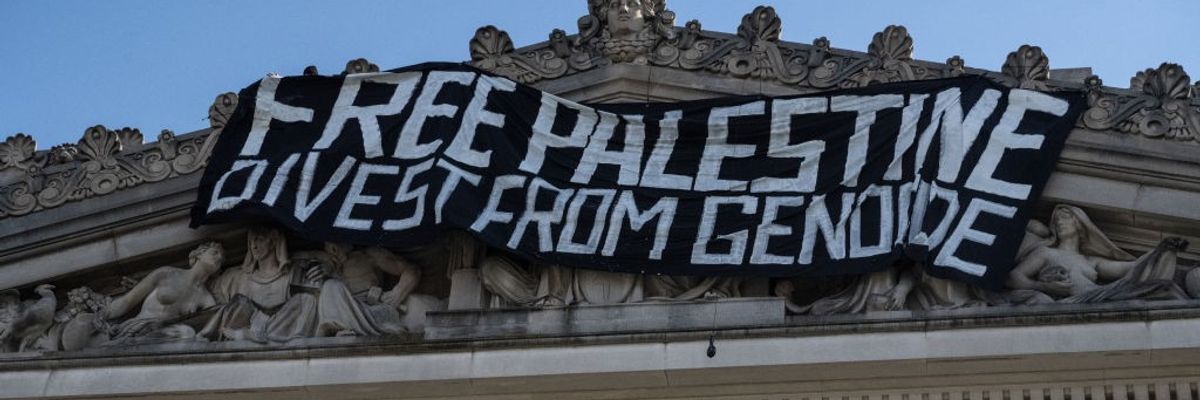
Pro-Palestinian demonstrators associated with the Within Our Lifetime protest group drop a banner at the Brooklyn Museum on May 31, 2024 in New York City.
(Photo: Stephanie Keith/Getty Images)
One international relations expert called it "the diametric opposite of America First."
Pro-Palestinian demonstrators associated with the Within Our Lifetime protest group drop a banner at the Brooklyn Museum on May 31, 2024 in New York City.
(Photo: Stephanie Keith/Getty Images)
Stephen Prager
Aug 04, 2025
COMMON DREAMS
The Trump administration announced Monday that it will cut off federal natural disaster preparation funding to any state or city that boycotts Israeli products.
According to Reuters, which quoted a statement from the Federal Emergency Management Agency (FEMA):
States must certify that they will not cut off "commercial relations specifically with Israeli companies" to receive the money from the Federal Emergency Management Agency according to the agency's terms for grantees.
The condition applies to at least $1.9 billion that states rely on to cover search and rescue equipment, emergency manager salaries, and backup power systems, among other expenses.
The Boycott, Divestment, and Sanctions (BDS) movement is an international attempt to use economic means—including refusing to support Israeli companies—to put pressure on the nation's government to stop human rights abuses toward Palestinians.
BDS has gained momentum in the wake of Israel's current genocidal onslaught against Gaza, which began in 2023. However, it long predates the most recent assault as a method of nonviolent resistance to Israel's occupation of the Palestinian territories, which is recognized as illegal under international law.
It is not immediately clear which states would lose disaster funding under the new policy, since none actively boycott Israel. In fact, since 2015, 34 U.S. states have passed anti-BDS laws that take multiple different forms.
Many of these states require public employees and contractors to sign pledges that they will not boycott Israeli products during the term of their contract. Others steer state investments away from funds that do not invest in Israeli companies, stocks, or government bonds.
These laws have been frequently challenged in courts as violations of the First Amendment rights to freedom of speech, assembly, association, and petition. Though some have been struck down in federal courts, the U.S. Supreme Court has continuously declined to rule on their legality.
Though no states actively boycott Israel, some U.S. city councils, including in Portland, Maine; Hamtramck, Michigan; and two California cities, Hayward and Richmond, have passed resolutions divesting from Israeli companies considered "complicit" in the country's attacks on Palestinian rights.
According to FEMA's new policy, these cities and others that may consider adopting similar policies may now lose out on federal funds to prepare for natural disasters.
Critics have noted the irony of the "America First" Trump administration jeopardizing the safety of American citizens on behalf of a foreign country.
Stephen Wertheim, a foreign policy expert at the Carnegie Endowment, described it as "the diametric opposite of America first."
Krystal Ball of the political talk show Breaking Points said, "denying American victims of natural disasters aid if they are insufficiently supportive of Israel" was "absolute insanity."
Gillian Branstetter, a communications director for the American Civil Liberties Union (ACLU)—a leading opponent of anti-BDS laws—joked that the government's policy was now: "If you don't buy Sabra hummus, we will drown your family."
Aug 04, 2025
COMMON DREAMS
The Trump administration announced Monday that it will cut off federal natural disaster preparation funding to any state or city that boycotts Israeli products.
According to Reuters, which quoted a statement from the Federal Emergency Management Agency (FEMA):
States must certify that they will not cut off "commercial relations specifically with Israeli companies" to receive the money from the Federal Emergency Management Agency according to the agency's terms for grantees.
The condition applies to at least $1.9 billion that states rely on to cover search and rescue equipment, emergency manager salaries, and backup power systems, among other expenses.
The Boycott, Divestment, and Sanctions (BDS) movement is an international attempt to use economic means—including refusing to support Israeli companies—to put pressure on the nation's government to stop human rights abuses toward Palestinians.
BDS has gained momentum in the wake of Israel's current genocidal onslaught against Gaza, which began in 2023. However, it long predates the most recent assault as a method of nonviolent resistance to Israel's occupation of the Palestinian territories, which is recognized as illegal under international law.
It is not immediately clear which states would lose disaster funding under the new policy, since none actively boycott Israel. In fact, since 2015, 34 U.S. states have passed anti-BDS laws that take multiple different forms.
Many of these states require public employees and contractors to sign pledges that they will not boycott Israeli products during the term of their contract. Others steer state investments away from funds that do not invest in Israeli companies, stocks, or government bonds.
These laws have been frequently challenged in courts as violations of the First Amendment rights to freedom of speech, assembly, association, and petition. Though some have been struck down in federal courts, the U.S. Supreme Court has continuously declined to rule on their legality.
Though no states actively boycott Israel, some U.S. city councils, including in Portland, Maine; Hamtramck, Michigan; and two California cities, Hayward and Richmond, have passed resolutions divesting from Israeli companies considered "complicit" in the country's attacks on Palestinian rights.
According to FEMA's new policy, these cities and others that may consider adopting similar policies may now lose out on federal funds to prepare for natural disasters.
Critics have noted the irony of the "America First" Trump administration jeopardizing the safety of American citizens on behalf of a foreign country.
Stephen Wertheim, a foreign policy expert at the Carnegie Endowment, described it as "the diametric opposite of America first."
Krystal Ball of the political talk show Breaking Points said, "denying American victims of natural disasters aid if they are insufficiently supportive of Israel" was "absolute insanity."
Gillian Branstetter, a communications director for the American Civil Liberties Union (ACLU)—a leading opponent of anti-BDS laws—joked that the government's policy was now: "If you don't buy Sabra hummus, we will drown your family."
"The war in Gaza is contrary to international law and is causing terrible suffering," said Norway's finance minister
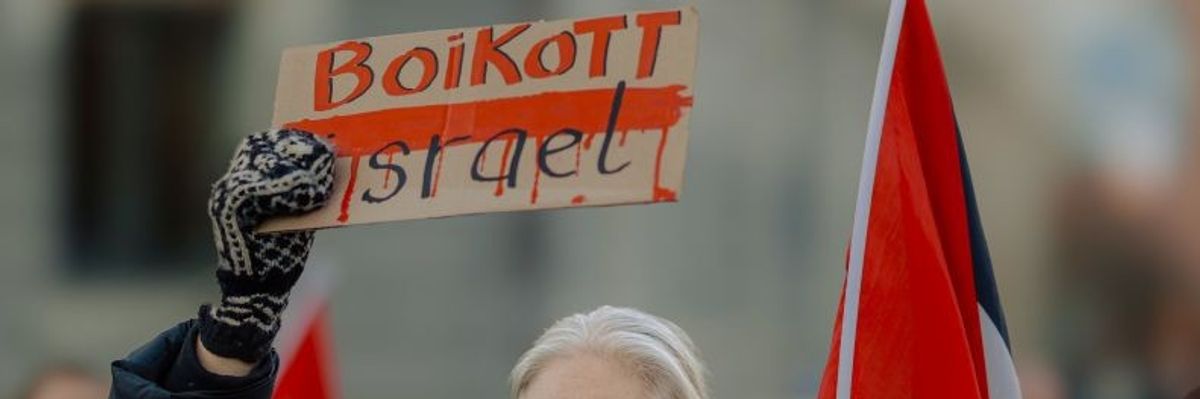
Pro-Palestinian demonstrators, wearing keffiyehs and carrying Palestinian flags, stage a protest against Israel's recent attacks on Gaza, outside the Israeli Embassy in Oslo, Norway on March 18, 2025.
(Photo: Eyad Al Zaro/Anadolu via Getty Images)
Stephen Prager
Aug 05, 2025
COMMON DREAMS
The Norwegian government may seek to divest its state investment fund from Israeli companies participating in the illegal occupation of the West Bank or the genocide in Gaza.
Norway's Government Pension Fund Global is worth $2 trillion and is considered the largest sovereign wealth fund in the world.
On Tuesday, following the latest reports on the "worsened situation" in Gaza—which includes mass starvation as a result of Israel's blockade of humanitarian aid—Norway's finance minister, Jens Stoltenberg, ordered the fund's ethics council to review the fund's investments in Israeli companies.
The fund came under renewed scrutiny from activists and trade unions this week after the Norwegian newspaper Aftenposten reported on the fund's investments in the Israeli company Bet Shemesh Engines Holdings, which maintains the engines of fighter jets and attack helicopters that have been used to carry out devastating attacks on Gaza.
Although Norway's center-left government had determined in November 2023 that Israel's warfare in the Gaza Strip was violating international law, it only continued to increase its shares in Bet Shemesh throughout 2024, resulting in more than $15 million invested—a 2.1% stake—in the company.
Norwegian Prime Minister Jonas Gahr Støre said he was "very concerned" by the report and ordered Stoltenberg to contact the country's central bank to investigate.
"The war in Gaza is contrary to international law and is causing terrible suffering, so it is understandable that questions are being raised about the fund's investments in Bet Shemesh Engines," Stoltenberg said.
Norway's sovereign wealth fund has been described by Amnesty International as "an international leader in the environmental, social, and governance investment field."
Its ethics policy has strict guidelines against investing in companies that cause "serious violations of fundamental ethical norms," including "systematic human rights violations" and "violations of the rights of individuals in situations of war or conflict."
Following these guidelines, it has divested from some companies involved in the illegal Israeli occupation of Palestine.
In 2009, it dropped Israel's largest arms company, Elbit Systems, due to its supplying of surveillance technology used to patrol the separation wall—commonly called the "apartheid wall"—fencing off the West Bank from Israel-proper.
And in 2024, following the International Court of Justice's advisory opinion that Israel was committing the crime of apartheid, it also cut off Bezeq, Israel's largest telecommunications company, which supplies telecommunications equipment to illegal West Bank settlements. It later did the same for the Israeli energy company Paz Retail and Energy Ltd.
However, as Amnesty described in May, the fund remains "invested in several companies listed in the U.N. database of businesses involved in the unlawful occupation of Palestine."
Last month, a report by Francesca Albanese, the U.N. special rapporteur on human rights in the occupied Palestinian territories, revealed that Norway's sovereign wealth fund had increased its investments in Israeli companies by 32% since October 2023.
Albanese found that 6.9% of its pension fund's total value was directed towards companies "involved in supporting or enabling egregious violations of international law in the occupied Palestinian territory."
In a letter to the Norwegian government sent in April, she listed dozens of investments: including Caterpillar, whose bulldozers have been used to destroy houses in the West Bank and attack Palestinians in Gaza; several Israeli banks that fund illegal settlements; and other military and technology firms like Hewlett-Packard and Motorola, whose technologies have been used for the purposes of surveillance and torture.
"I found Norwegian politicians, trade unions, media, and civil society to be generally more educated, aware, and principled about Palestine-Israel than many of their peers in Europe," Albanese wrote on X earlier this year. "That is why I can't believe the Norwegian Oil Fund and Pension Fund is still so involved in Israel's unlawful occupation. This must end, totally and unconditionally, like Israel's occupation itself—no more excuses."

No comments:
Post a Comment