Google and NextEra to Restart Iowa’s Duane Arnold Nuclear Plant to Power AI Era
NextEra Energy, Inc. (NYSE: NEE) and Google have announced a landmark agreement to restart the Duane Arnold Energy Center in Iowa—the state’s only nuclear facility—to help meet soaring U.S. electricity demand driven by artificial intelligence (AI) and data center growth. The 615-MW plant, located near Cedar Rapids, is scheduled to return to full operation by the first quarter of 2029, pending regulatory approval.
Under the 25-year agreement, Google will purchase a significant portion of the plant’s output as a 24/7 carbon-free energy source to power its cloud and AI infrastructure. The remaining capacity will be bought by Central Iowa Power Cooperative (CIPCO) on equivalent terms. NextEra Energy will assume full ownership of the facility after acquiring CIPCO and Corn Belt Power Cooperative’s combined 30% stake.
The Duane Arnold restart—shut down in 2020 after nearly five decades of service—marks a major return of nuclear generation to Iowa and underscores the growing convergence between Big Tech and clean baseload power. NextEra said the project will create around 400 permanent jobs and generate more than $9 billion in total economic benefits for Iowa, including $3 million annually in new tax revenue.
“This partnership with Google not only brings nuclear energy back to Iowa—it accelerates the development of next-generation nuclear technology,” said NextEra CEO John Ketchum, highlighting the collaboration’s role in strengthening U.S. grid reliability and advancing national energy independence.
Google, which has invested more than $7 billion in Iowa since 2007, framed the deal as essential to its AI-driven growth strategy. “Reopening Duane Arnold delivers reliable, clean power and hundreds of new jobs in the Hawkeye State,” said Ruth Porat, president and CFO of Alphabet and Google, calling it a model for similar clean energy investments across the country.
The companies also announced a strategic agreement to explore new nuclear generation projects nationwide, positioning nuclear power as a cornerstone of the AI and data economy. This comes amid growing concern that U.S. electricity demand—expected to rise sharply through 2035 due to AI, electrification, and manufacturing—will outpace renewable and grid expansion without firm, low-carbon generation sources.
Iowa officials hailed the move as a major milestone in the state’s energy evolution. Governor Kim Reynolds praised the project as “a fusion of nuclear and AI innovation that will drive economic growth, strengthen communities, and keep America competitive.”
Economic studies suggest that the restart will add over 1,600 jobs during construction, with $340 million in annual output statewide once operational. In Linn County, where the plant is located, the project is expected to sustain 400 high-paying, full-time positions and generate $127 million in long-term local earnings.
The Duane Arnold revival follows comprehensive engineering evaluations and coordination with the Nuclear Regulatory Commission (NRC). NextEra Energy emphasized that the restart will not raise costs for Iowa ratepayers, as Google’s long-term power purchase agreement (PPA) covers all production expenses.
The announcement further deepens NextEra and Google’s long-standing energy partnership, which already spans nearly 3 GW of clean energy projects across the U.S., including wind, solar, and battery assets.
The deal also signals a broader renaissance for U.S. nuclear power, as utilities and tech giants alike revisit the technology’s potential to provide round-the-clock carbon-free power amid tightening climate goals and unprecedented data center growth.
By Charles Kennedy for Oilprice.com
Joint venture selected to deliver Cascade SMR facility
Energy Northwest has selected a joint venture of Aecon, Kiewit Nuclear Solutions Co and Black & Veatch to design and build the first phase of the Cascade Advanced Energy Facility near Richland, Washington.
_12363.jpg)
The public power agency said it is in negotiations with the Cascade Nuclear Partners joint venture to collaboratively complete the planning, design, and construction of the first four out of 12 Xe-100 advanced small modular reactors (SMRs) under a progressive design-build (PDB) model. This development phase will help define the project's scope, schedule, and cost parameters before advancing to full execution, it said.
It was just a year ago - in October 2024 - that Energy Northwest announced a multi-year agreement with Amazon focused on comprehensive environmental, safety, permitting, licensing and risk analyses for the SMR project, with Amazon to fund the initial feasibility phase for a plant to be sited near Energy Northwest's Columbia Generating Station nuclear energy facility in Richland after which it expects to submit a construction permit application to the US Nuclear Regulatory Commission. Construction is anticipated to begin by the end of the decade, with operations targeted for the 2030s.
Earlier this month, the name of the new facility was announced and Amazon released a series of images of how its planned X-energy small modular reactor plant is expected to look. It will feature X-energy's Xe-100, a Generation IV advanced high temperature gas-cooled reactor design using tri-structural isotropic - or TRISO - particle fuel.
Energy Northwest CEO Bob Schuetz said the selection of Cascade Nuclear Partners is a "strategic milestone" which reflects the continued momentum for the project. "Their specialised knowledge in nuclear construction, collaborative approach, and strong alignment with Energy Northwest's values gives us confidence in their ability to help deliver this critical project successfully," he said.
Santee Cooper selects Brookfield to take on VC Summer
Eight years after construction of two AP1000 reactors at the VC Summer site in South Carolina was abandoned, Santee Cooper has announced it is in negotiations with Brookfield Asset Management about the potential completion of the units.
_83725.jpg)
"Final, exclusive negotiations" concerning the two partially built units are being guided by a Letter of Intent between the two companies, with a six-week initial project feasibility period during which the parties will jointly select a project manager and evaluate construction providers that would be used in resuming construction of the two nuclear units. The six weeks would also allow for advanced discussions with entities interested in buying nuclear power generated by the units and facilitate additional due diligence, leading to execution of a Memorandum of Understanding, Santee Cooper said.
Construction of two AP1000 units began at VC Summer in 2013. However, the owners of the Summer project - Scana subsidiary South Carolina Electric & Gas Company (SCE&G) and Santee Cooper - decided in August 2017 to abandon construction of the units following reactor vendor Westinghouse's filing for bankruptcy in March that year. Majority owner SCE&G (now Dominion Energy South Carolina) transferred its interest in the assets to Santee Cooper in 2018.
Earlier this year, Santee Cooper launched a competitive bidding process for the potential sale of the VC Summer assets to a third party who would complete the unfinished nuclear units. Initial expressions of interest were received from over 70 potential bidders, with 15 formal proposals submitted.
"Our goals include completing these reactors with private money and no ratepayer or taxpayer expense, delivering financial relief to our customers and gaining significant additional power capacity for South Carolina," Santee Cooper Board Chairman Peter McCoy said. "Brookfield’s proposal would do just that, and the company has the financial capability to stand behind its proposal."
"As we move closer to a final deal, our goal remains the same: to enable completion of these two units and thus provide 2,200 MW of carbon-free, reliable nuclear power that delivers energy security for South Carolina and specific benefits to Santee Cooper customers who are paying our initial investment," Santee Cooper President and CEO Jimmy Staton said, thanking Governor of South Carolina Henry McMaster and the South Carolina General Assembly members, who he said had been instrumental in encouraging Santee Cooper to conduct the bidding process.
The two-unit Vogtle plant in Georgia was at a similar stage of construction to Summer at the time the South Carolina project was abandoned. Vogtle's owners - Southern Company's Georgia Power, Oglethorpe Power, MEAG Power and Dalton Utilities - opted to continue with the project which saw Vogtle 3 and 4 become the first new nuclear units to be constructed in the USA in more than 30 years, with unit 3 entering commercial operation in 2023 and unit 4 in 2024.
A strategic decision to maintain the equipment after the project was abandoned now meant for a less costly path to completion, Staton said: "The state of the units, and the fact that they use the same Westinghouse AP1000 technology that is now operating in Georgia and overseas, make these assets very attractive to the nuclear power industry," he said. Brookfield is 51%-owner of Westinghouse, a fact which "added to Brookfield's proposal," he said.
According to Santee Cooper, completion of the two VC Summer units could generate thousands of temporary construction jobs and hundreds of highly skilled, permanent operational jobs, as well as strengthening and diversifying South Carolina’s energy portfolio, enhancing grid reliability, and helping attract new industries, bringing more jobs and other economic benefits.
The US Nuclear Regulatory Commission approved SCE&G's request to terminate the combined construction and operating licences for the units in 2019.
Singapore 'seriously' considering nuclear energy
_57354.jpg)
"Rising geopolitical uncertainties have led to countries reassessing their climate ambitions, placing renewed emphasis on economic resilience and self-sufficiency, at the expense of decarbonisation efforts," Tan said. "Yet, nature will wait for no man. Climate change continues to accelerate, and its impact will profoundly affect how we live, work, and thrive. For Singapore - a small low-lying island and an alternative-energy disadvantaged city-state - these challenges are far more acute. To secure a low-carbon energy future for generations to come, we must plan smarter and work harder."
He said Singapore "must pursue a diversified portfolio of sustainable energy pathways to build the future we envision. It is unlikely that any single solution will suffice, just as there is no one-size-fits-all solution to decarbonisation."
Tan said nuclear energy has the potential to be "a safe, reliable, and cost-competitive option for Singapore". He noted that Prime Minister Lawrence Wong announced earlier this year that the government would reorganise itself to place greater emphasis on capability building.
"We have since formed dedicated nuclear energy teams within key agencies to lead these efforts - namely, the Nuclear Energy Office within the Energy Market Authority (EMA) and the Nuclear Safety Division within the National Environment Agency (NEA). These teams will focus solely on nuclear energy issues, and I hear they are hiring actively." Tan said Singapore is "also actively collaborating with international partners".
"We understand that the public has many queries about our plans," he said. "We will engage the public regularly as we progress on this journey together. For a start, we are releasing a Background Paper on Building Singapore's Capabilities to Assess Nuclear Energy today to provide an overview of our interests, and the government's work on capability building thus far."
The 16-page background paper outlines Singapore's approach to studying the potential for domestic nuclear energy deployment. It explains the factors to consider in this endeavour, including the safety, reliability, affordability, and environmental sustainability of nuclear technology in Singapore's context. The paper has been produced by the Ministry of Trade and Industry, the Ministry of Sustainability and the Environment, EMA and NEA.
The paper stresses that Singapore has not made any decision on the deployment of nuclear energy. "We will continue our efforts to build up domestic capabilities, supported by international partners. We will engage the public regularly on the latest developments in nuclear energy, to build an informed understanding of the benefits and risks surrounding nuclear energy," it says.
In 2012, the Singapore government conducted a pre-feasibility study on nuclear energy. While the study concluded that nuclear power plants of the time were not suited for a small and densely populated city-state, it recommended that Singapore continue to monitor the progress of new nuclear energy technologies.
In March 2022, EMA released a report that concluded nuclear energy could supply around 10% of Singapore's energy needs, helping its power sector achieve net-zero carbon emissions by 2050.
In October 2024, EMA signed a memorandum of understanding with the UAE's Emirates Nuclear Energy Company to develop capabilities in nuclear energy. Through the MoU, both parties will work together to strengthen capabilities in nuclear science and technology, and identify activities of mutual interest in areas such as the assessment of emerging nuclear technologies and human resource development. The parties will facilitate information sharing through workshops, technical exchanges, and/or staff attachments.
Delivering his Budget 2025 speech in February this year, Wong - who is also Finance Minister - said the government will study the potential deployment of nuclear power in Singapore and take further steps to systematically build up capabilities in this area. "We will need new capabilities to evaluate options, and to consider if there is a solution that Singapore can deploy in a safe and cost-effective way," he said.
In September, the Energy Market Authority appointed UK-headquartered engineering firm Mott MacDonald to conduct a study on the safety and technical feasibility of advanced nuclear energy technologies. The study will evaluate the safety performance and technical feasibility of advanced nuclear energy technologies, such as small modular reactors, based on their safety features, technology maturity, and commercial readiness.
Cooling towers brought down at German plant
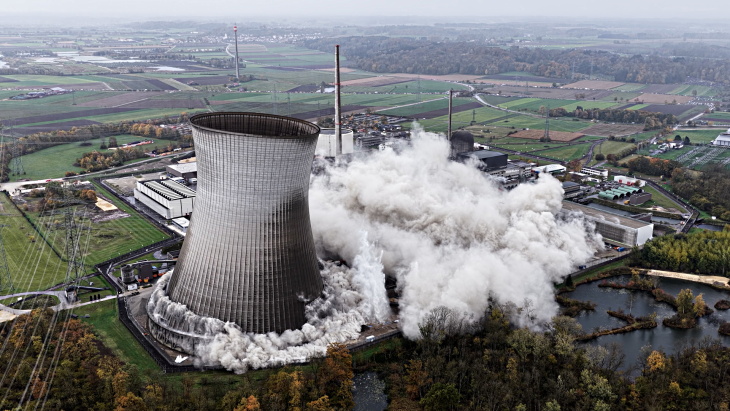
On 25 October, the towers were inspected by specialists from a renowned German blasting company and successfully demolished one after the other. In the weeks prior to the demolition, so-called drop and vertical slots had already been inserted into the cooling tower shell. During operation, the cooling towers ensured that the Danube River was not exposed to excessive waste heat.
About 600 kilograms of explosives in a total of 1,800 boreholes were required to demolish the two cooling towers. The approximately 56,000 tonnes of material will be processed into recycled gravel, a sought-after construction material.
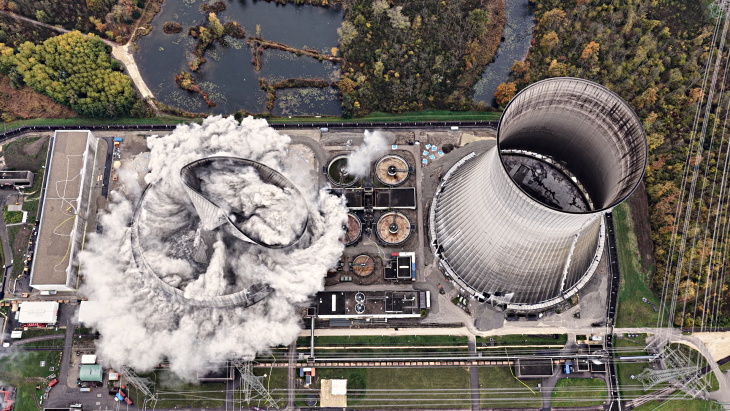
(Image: RWE)
Around 30,000 spectators watched the demolition from a safe distance. At 1.24 pm, the demolition was officially declared complete, allowing authorities to lift the previously established exclusion zone. Surrounding buildings of the dismantling facility, as well as the interim storage facility and neighbouring high-voltage lines, were not affected.
"We have been intensively preparing for the demolition of the cooling towers for many months in close coordination with the Günzburg district and the municipality of Gundremmingen, thus reaching an important milestone for the site," said Gundremmingen Plant Manager Heiko Ringel. "My special thanks go to the representatives of the district and municipality for their trusting and constructive cooperation over the past few weeks. The successful outcome underscores that the dismantling is proceeding safely and responsibly."
The 1284 MWe Gundremmingen B boiling water reactor (BWR) in Bavaria, southern Germany was disconnected from the grid on 31 December 2017 after 33 years of operation. Gundremmingen C - a 1288 MWe BWR - permanently shut down on 31 December 2021. The licence for dismantling unit B according to the Atomic Energy Act was granted by the Bavarian State Ministry of the Environment and Consumer Protection in March 2019; the licence for dismantling unit C in May 2021.
In December 2021, RWE awarded a contract to Westinghouse to dismantle the two reactors at the Gundremmingen plant. Under the contract, Westinghouse will dismantle and pack the reactor pressure vessels, including the associated internals, the fuel element storage racks and adjacent concrete shielding structures in units B and C of the Gundremmingen plant. The work is expected to be completed in 2030.
"We have been fulfilling our legal mandate to rapidly dismantle the Gundremmingen plant since January 2018 in Block B and since January 2022 in Block C," said Steffen Kanitz, member of the Executive Board of RWE Power AG responsible for the Nuclear Energy division. "The successful demolition of the two cooling towers is now also visible to the outside world that we are consistently implementing the politically agreed nuclear phase-out."

No comments:
Post a Comment