Members of Moroccan online youth collective GenZ 212 protested for the eighth consecutive day on Saturday, demanding better public health and education services. The online group, which has more than 180,000 members on Discord, insists on the nonviolent nature of its protests, and the gatherings since then have been largely peaceful.
Issued on: 05/10/2025 -
By: FRANCE 24
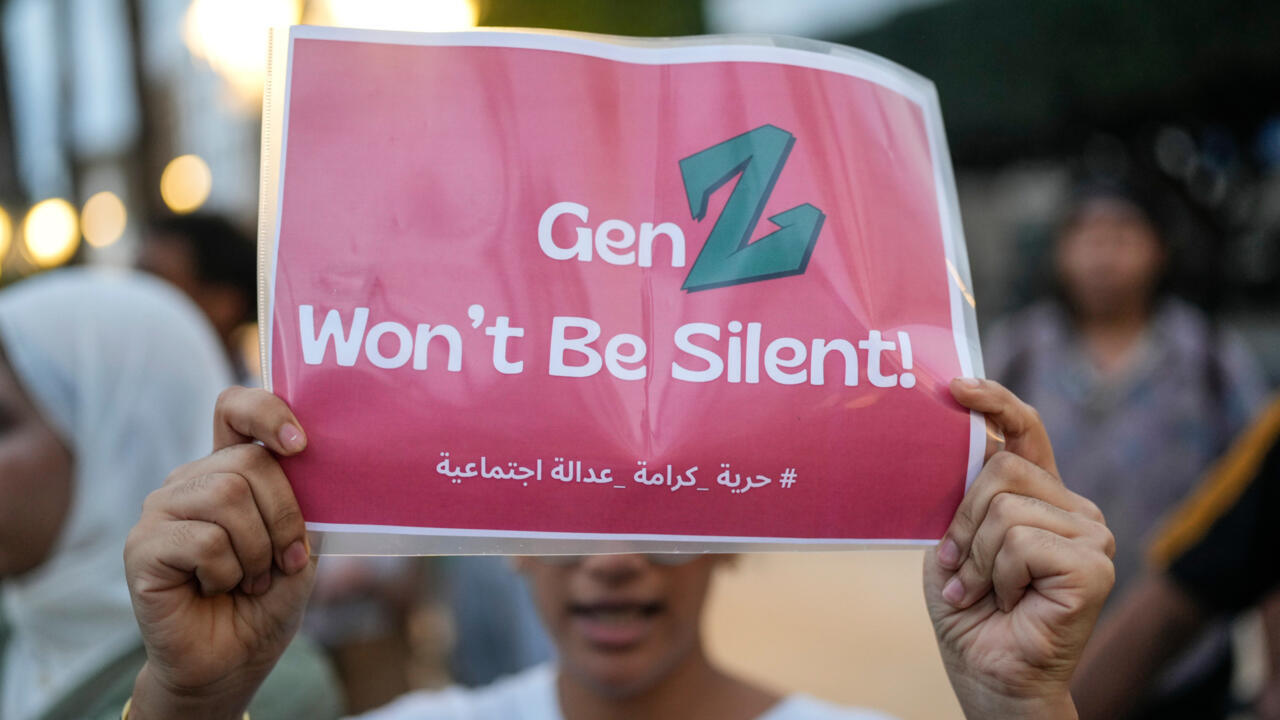
People take part in a youth led protest against corruption and calling for healthcare and education reform, in Rabat, Morocco, Saturday, Oct. 4, 2025. © Mosa'ab Elshamy, AP
Members of a Moroccan online youth collective protested for the eighth consecutive day on Saturday, demanding better public health and education services.
The demonstrations in the usually stable North African kingdom have bucked the perception of young Moroccans as being politically disengaged, and have been organised since last Saturday by GenZ 212, a group active on the web platform Discord.
In Tetouan, in the north of the country, hundreds of people gathered, chanting slogans such as "The people want an end to corruption" and "Freedom, dignity and social justice", local media reported.
Read more
Members of a Moroccan online youth collective protested for the eighth consecutive day on Saturday, demanding better public health and education services.
The demonstrations in the usually stable North African kingdom have bucked the perception of young Moroccans as being politically disengaged, and have been organised since last Saturday by GenZ 212, a group active on the web platform Discord.
In Tetouan, in the north of the country, hundreds of people gathered, chanting slogans such as "The people want an end to corruption" and "Freedom, dignity and social justice", local media reported.
Read more
Unlike Arab Spring, today’s Moroccan youth are demanding dignity, justice, and accountability
In the western city of Casablanca, protesters shouted "The people want education and health", while in the capital, Rabat, a dozen people gathered in front of parliament, an AFP photographer said.
GenZ 212, whose founders remain anonymous, earlier on Discord called for protests in 14 cities between 6:00 pm (1700 GMT) and 9:00 pm.
They want reforms to social services, particularly healthcare and education, as well as an end to corruption and the resignation of Prime Minister Aziz Akhannouch, whose tenure ends next year.
On Friday evening, hundreds of people rallied in numerous cities, including Rabat and Agadir.
In the western city of Casablanca, protesters shouted "The people want education and health", while in the capital, Rabat, a dozen people gathered in front of parliament, an AFP photographer said.
GenZ 212, whose founders remain anonymous, earlier on Discord called for protests in 14 cities between 6:00 pm (1700 GMT) and 9:00 pm.
They want reforms to social services, particularly healthcare and education, as well as an end to corruption and the resignation of Prime Minister Aziz Akhannouch, whose tenure ends next year.
On Friday evening, hundreds of people rallied in numerous cities, including Rabat and Agadir.
Two days earlier, there were reports of violence in several smaller towns, with three people killed by police "in legitimate defence" after they allegedly tried to storm a station in the village of Lqliaa, near Agadir, the authorities said.
GenZ 212, which has more than 180,000 members on Discord, insists on the nonviolent nature of its protests, and the gatherings since then have been largely peaceful.
The rallies follow on from isolated protests that broke out in mid-September in several cities after reports of the deaths of eight pregnant women at the public hospital in Agadir who had been admitted for cesarean sections.
Demonstrators have seized on the deaths as evidence of the public health sector's shortcomings, feeding wider discontent over social inequalities.
(FRANCE 24 with AFP)
We need hospitals more than football stadiums, say Morocco's young protesters
Hajar Chaffag -
Sat, October 4, 2025
BBC

[Anadolu via Getty Images]
Morocco is currently building what will be the globe's largest football stadium in preparation for co-hosting the 2030 World Cup.
But for the demonstrators who have taken to the streets each night across the country since last Saturday, this 115,000-capacity showpiece and all the other football infrastructure in development, costing a reported $5bn (£3.7bn), are an affront - an example of a government that has got its priorities wrong.
"I am protesting because I want my country to be better. I don't want to leave Morocco, and I don't want to resent my country for choosing to stay," says Hajar Belhassan, a 25-year-old communications manager from Settat, 80km (50 miles) south of Casablanca.
A group called Gen Z 212 - the number is a reference to the country's international dialling code - has been coordinating the demonstrations through the gaming and streaming platform Discord, as well as TikTok and Instagram.
Apparently taking inspiration from Nepal's recent Gen Z protests, the young Moroccans want the authorities to act with the same urgency and passion when it comes to addressing these issues as with hosting one of the world's premier sporting events.
Starting on 27 September with protests across 10 cities, the crowds have been building through the week, chanting slogans such as: "No World Cup, health comes first" and "We want hospitals not football stadiums".
The police have responded with seemingly arbitrary mass arrests and in certain places things have turned violent, leading to the death of three protesters.
Prime Minister Aziz Akhannouch said on Thursday that he was open to dialogue, but the leaderless movement has vowed to keep going until there is concrete change.
A list of their demands has been shared on social media. They include:
Free and quality education for all
Accessible public healthcare for everyone
Decent and affordable housing
Better public transport
Lower prices and subsidise basic goods
Improve wages and pensions
Provide job opportunities for youth and reduce unemployment
Adopt English as the second language instead of French (after Arabic)
Anger had been growing, but what galvanised the movement was the death over a number of days in mid-September of eight women in a maternity ward of a hospital in the southern city of Agadir. There were some reports that the deaths could have been prevented if there had been better care, proper equipment and enough medical staff.
In 2023, it was estimated that there were 7.8 doctors per 10,000 Moroccans, way below the World Health Organization recommendation of 23 per 10,000.

Hundreds of people have been arrested [AFP via Getty Images]
Then, her friend called to say her brother had been arrested. He was not released until the early hours of the following morning. This, Ms Belhassan says, is what pushed her to go out on to the streets.
"We are making reasonable, basic demands. Health and education are necessities that should already be prioritised," she tells the BBC in a passionate voice.
"It breaks my heart to see young, educated and peaceful people faced with arbitrary arrests."
When Ms Belhassan went out she noticed that the police were trying to stop people gathering and were making arrests.
She says she was scared of making eye contact with officers in case she attracted their attention.
"I was afraid for my safety but I still went out," she says.
On Wednesday, interior ministry spokesman Rachid El Khalfi said that 409 people had been detained up to that point.
He also announced in a press release that 260 police officers and 20 protesters had been injured and 40 police vehicles and 20 private cars were torched in violent clashes.
Twenty-three-year-old Hakim (not his real name) was one of those arrested.
He says he went out onto the streets of Casablanca to protest peacefully but ended up in a police cell with around 40 people.
"This government has been abusing their power too much," Hakim says. "My father had a stroke a little while ago. If we didn't have some savings to get him treated in a private hospital he would've died. What am I gaining from a country that is not providing healthcare for my ageing parents or educating me?"
He describes the state-funded education system as being "far behind" what is available in the private sector.
"We deserve a dignified life," says Hakim. "We want to host the Fifa World Cup, but we want to do that with our heads up high, not while hiding behind a façade."

The protest organisers have distanced themselves from the violence [AFP via Getty Images]
The police response has been heavily criticised by several Moroccan human rights organisations, protesters and the opposition.
The Gen Z 212 protests are not the first time that young Moroccans have taken to the streets.
Many commenters online have been drawing parallels with the country's violent 1981 riots, where those who died became known as the Bread Martyrs as they were protesting against the soaring price of basic foods. A 2004 commission appointed by the king to investigate the country's past human rights abuses verified 114 deaths but did not disclose how exactly they died. Reparations were then made to victims of human rights abuses and families of deceased ones.
The country has seen other youth-led movements, notably in 2011 and 2016.
The events of 2011 were part of the larger Arab Spring and led to reform of the constitution through a national referendum called by King Mohamed VI.
For the first time in Moroccan history, the monarch strengthened the role of the government by ceding executive power to the prime minister and parliament. The king remains the legitimate head of state, military and religious affairs, holding the power to appoint and remove ministers if necessary.
What makes Gen Z 212 different is that those demonstrating say they are not tied to a political party and do not appear to have a formal structure.
"We are not a political movement. We have no leader," Ms Belhassan says.
"Maybe that's why the police were arresting people, and why the government kept silent – because, in their eyes, we didn't follow the traditional path of organisations and political parties."
But there is some disquiet about the violence.
On the night of 1 October, three protesters died in the town of Lqliaa after people attempted to storm a police station. The local authorities said security forces opened fire after protesters tried to start a fire and steal weapons from the station, then subsequently released supporting CCTV footage to disprove emerging false narratives online.
Protesters have condemned the rioting and looting that have happened in certain areas and have organised clean-up groups. They have also repeatedly called for peace and dialogue, but it seems they are not convinced by the prime minister's apparent willingness to talk.
On Friday, calls began to emerge for the king to dissolve the government. That may be a step too far, but the protesters do not seem to be in the mood to pull back.
Looking ahead to 2030, protester Ms Belhassan says that "of course" Moroccans are "excited to host the World Cup".
"We love football, it is in our blood. But we are missing the foundations. Sure, let's build stadiums, but let's also build our education and health systems. Let's take care of our people."
More about Gen Z protests around the world:
Behind the Gen Z protesters who want to force Madagascar's president from power
The Gen Z uprising in Asia shows social media is a double-edged sword
Politicians get rich while we suffer - so I helped bring down our government in 48 hours
Madagascar police fire tear gas as president fails to placate protesters

[Getty Images/BBC]
Go to BBCAfrica.com for more news from the African continent.
Gen Z protests are shaking Morocco. Here's what to know
SAM METZ and AKRAM OUBACHIR
Sat, October 4, 2025

People take part in a youth-led protest against corruption and calling for healthcare and education reform in Rabat, Morocco, Friday, Oct. 3, 2025. The sign reads, "Dignity before stadiums." (AP Photo/Mosa'ab Elshamy)(ASSOCIATED PRESS)

People observe as security forces detain a man taking part in a youth led protest calling for education and health reforms, in Casablanca, Morocco, Monday, Sept. 29, 2025. (AP Photo/Mosa'ab Elshamy)(ASSOCIATED PRESS)

A boy is detained as youth led protests calling for healthcare and education reforms turned violent, in Sale, Morocco, Wednesday, Oct. 1, 2025. (AP Photo/Mosa'ab Elshamy)(ASSOCIATED PRESS)
RABAT, Morocco (AP) — Demonstrations in more than a dozen cities have jolted Morocco for a week straight, with the young people behind them showing they can translate digital discontent into a real-world movement that authorities can’t ignore.
The North African nation is the latest to be rocked by “Gen Z” protests against corruption, lack of opportunity and business as usual.
Similar movements have risen in countries such as Madagascar, Kenya, Peru, and Nepal. They differ in origin but share in common a refusal to go through institutions like political parties or unions to be heard.
In Morocco, anger has boiled over contrasts between government spending on stadiums in the lead-up to the 2030 FIFA World Cup and a subpar health system that lags behind countries with similarly sized economies.
Here’s what to know:
Meet the protesters
A leaderless collective called Gen Z 212 — named after Morocco’s dialing code — is the engine behind the protests. Members debate strategy on Discord, a chat app popular with gamers and teens. The core group has about 180,000 members, but spinoffs have also sprouted, organizing demonstrations in towns independently.
Like other nations swept by Gen Z protests, Morocco is experiencing a youth bulge, with more than half of the population under 35. Yet as the country pours billions into infrastructure and tourism, unemployment for Moroccans ages 15-24 has climbed to 36%. And with opportunity lacking, more than half of Moroccans under 35 say they have considered emigrating, according to a June survey from Afrobarometer.
When midweek demonstrations turned violent, officials said most participants were minors and rights groups say many detained were under 18.
What they are protesting
Morocco is Africa’s most visited country, appealing to tourists from around the world with its medieval palaces, bustling markets, and sweeping mountain and desert landscapes. But not far from tourist routes, the daily reality for most of Morocco’s 37 million people includes soaring costs of living and stagnating wages.
The North African Kingdom has made significant strides in lifting standards of living, but development has been uneven and critics say it has even exacerbated inequities.
Morocco boasts Africa’s only high-speed rail line and is constructing seven new stadiums and renovating seven others in preparation for the 2030 FIFA World Cup. It plans to spend more than $5 billion on infrastructure for the event, some from the private sector. Yet with a monthly minimum wage of around $300, many languish in poverty in areas where roads are unpaved, hospitals lack doctors and classrooms are underfunded and overcrowded.
Morocco has only 7.7 medical professionals per 10,000 inhabitants and far fewer in parts of the south and east where protests have become most heated. The public health system provides more than 80% of care, but accounts for only 40% of spending, with the rest coming from private or out-of-pocket costs.
Before Gen Z 212, localized protests against regional inequities and government priorities erupted, including in Al Haouz, where many remain in tents more than two years after a deadly 2023 earthquake. Anger boiled over in September after eight women died giving birth in a public hospital in the coastal city of Agadir. Despite its renovated airport and reputation as a destination for tourists, the city is the capital of one of Morocco’s poorest provinces, Sousse-Massa, where residents have decried a lack of doctors and quality medical care.
Protesters, angry over corruption, have likened the government to a mafia and targeted Prime Minister Aziz Akhannouch and Health Minister Amine Tahraoui, his former business associate. Akhannouch, one of Morocco’s richest men, controls most of the country’s gas stations, and one of his companies recently won controversial government contracts for new desalination projects.
Morocco’s business interests, including the royal family’s investment fund Al Mada, have also projected substantial profits from World Cup-related developments, including new stadiums, train lines and hotels, according to the magazine Jeune Afrique.
Gen Z's key chants
“Stadiums are here, but where are the hospitals?" A jab at Morocco’s spending on spectacle projects for the World Cup and what many see as the government's blindness to everyday hardship.
“Freedom, dignity and social justice" is a slogan carried over from past movements denouncing limited political freedoms and economic exclusion, without offering specific demands for reform.
The protesters' demands
After officials called on Gen Z 212 to clarify its demands, the group on Thursday published a letter addressed to King Mohammed VI, asking him to dismiss the government and corrupt political parties, release detainees and convene a government forum to hold officials accountable.
The series of political demands diverged from the nebulous calls for dignity and social justice, reflecting a broad sentiment of how Morocco has not made serious strides to overcome what King Mohamed VI described as the “paradoxes” of living conditions during the 2017 mass demonstrations. At the time, he acknowledged development had not adequately trickled down to benefit all and promised progress was underway.
Though the king is the country’s highest authority, Gez Z protesters directed their ire at government officials and called on him to oversee reforms. Many on the streets shouted: “The people want the King to intervene,” underscoring his image among Moroccans as an anchor of stability.
How the government has responded
Security forces have alternated between crackdown and retreat.
Riot police and plainclothes officers arrested demonstrators en masse on the weekend of Sept. 27 and 28. Police in a small town outside of Agadir fired on demonstrators they claimed were storming one of their posts on Wednesday, killing three, and a police van rammed into protesters in the eastern city of Oujda, injuring one, the night before. But elsewhere, security forces eased their presence, standing aside as rioters and looters set cars ablaze and smashed storefronts.
After days of protests, Akhannouch and several of his Cabinet members said the government was open to dialogue with protesters and suggested fortifying existing hospitals with additional staff and opening new medical facilities.
“The government launched a comprehensive plan from the beginning, and today we are accelerating its pace so that citizens can feel the improvements more clearly,” Tahraoui told the outlet Hespress on Friday.
But as Moroccans watch stadiums built in a matter of months, promised changes have rung hollow to many demonstrators, for until now, no official has proposed redirecting stadium funds to social services.
“The government is taking patchwork measures to ease the pressure," Youssef, a 27-year-old demonstrator, said. "Their reforms will take years.”
How football mega tournaments became a lightning rod for Morocco protesters
Paul Myers
Sun, October 5, 2025

Mainly young demonstrators have been on the streets of towns and cities in Morocco calling on the government to spend as lavishly on schools and hospitals as it does on stadiums for the 2030 World Cup.
Two years on from Morocco's selection as one of the co-hosts for the 2030 football World Cup, the government's multi-billion-euro investment in the tournament has become a focal point for protesters now leading their second weekend of demonstrations to demand better public services.
Rallied by online collectives including GenZ 212 and Morocco Youth Voices, thousands of mainly young Moroccans took to the streets in a dozen towns and cities last weekend waving placards and shouting slogans including: "Stadiums are here, but where are the hospitals?"
Although the estimated €6 billion costs of building and revamping stadiums and roads for the World Cup appear to be the main conductor for their anger, the month-long Africa Cup of Nations that starts on 20 December could bear the brunt.
"Football is much more than entertainment or sport," said Abderrahim Boukira, professor of the sociology of sport at Hassan 1 University in Settat.
"It’s a vehicle for national pride and identity and a perfect tool for social cohesion and inclusion – if it is used in the right way.
"But also football exposes structural weaknesses such as inequality, lack of spaces and social exclusion."
Double hosting duties
The Confederation of African Football (Caf), which organises the biennial Cup of Nations, declined to comment about the protests which, according to the Moroccan Interior Ministry, have left at least 589 police officers as well as 50 civilians injured and led to nearly 500 arrests.
The 35th Africa Cup of Nations was handed to Morocco in September 2023, a year after Guinea was stripped of hosting duties due to its lack of progress on revamping stadiums and roads.
A week later, Morocco's football administrators were celebrating anew. The bosses at Fifa, world football's governing body, awarded them co-hosting duties with Portugal and Spain for the centenary edition of the World Cup in 2030.
Two years on, with protests in their second week and GenZ 212 calling for the resignation of Prime Minister Aziz Akhannouch, a poser has emerged for Moroccan politicians and football tournament organisers.
Now that they have been questioned, how can they effectively appease the disaffection to ensure a friction-free Cup of Nations and show the demonstrators that they are responding?
Young and angry
Tahani Brahma, a researcher and secretary general at the Moroccan Association for Human Rights, told RFI: "Moroccan youth are taking to the streets to call for functioning hospitals, quality schools and decent jobs.
"They're rejecting the reality of billions being spent on stadiums for the World Cup while basic services are collapsing.
"Most importantly, Moroccan youth do not want promises, they want their rights."
People born between 1995 and 2010 make up a fifth of Morocco's population of 38 million. In August, Morocco's national statistics office reported unemployment rates of 35.8 percent for 15- to 24-year-olds and 21.9 percent for the 25 to 34 cohort.
The demographic's ability to mobilise swiftly and vocally on the streets via online platforms such as TikTok and Discord has transformed them into an unpredictable mass with palpable reasons for anger – such as a string of deaths on a maternity ward in Agadir that they say are evidence of the public health sector's shortcomings
Akhannouch, who is also mayor of Agadir, responded to protests outside that hospital in early September by acknowledging that the centre had been facing problems for decades.
The billionaire fuel and media tycoon insisted that the government was in the process of building and upgrading hospitals across all the country's regions.
Data from the World Health Organisation suggests that quest could be long.
In 2023, WHO statistics showed Morocco having 7.7 medical professionals per 10,000 inhabitants and far fewer in certain regions, including Agadir, with 4.4 per 10,000. The WHO recommends 25 per 10,000.
Spending priorities
The government has also been accused of failing to adequately help victims of the earthquake that struck Morocco's Atlas Mountains on 8 September 2023.
More than 2,900 people were killed and 5,500 people injured during the 6.8-magnitude tremor and its aftershocks.
Just over two years on, Crown Prince Moulay El Hassan inaugurated the 68,000-seat Prince Moulay Abdellah Stadium in Rabat. Amid the pomp and ceremony for the heir to the throne, officials cooed over how the old stadium was demolished and replaced within two years with a state-of-the art venue that will host the first match at the Cup of Nations as well as the final.
A few days later, dozens of quake survivors congregated in front of Morocco's parliament as part of a public plea to the government to take reconstruction aid as seriously as the World Cup projects.
Brandishing banners with the names of villages destroyed during the earthquake, they chanted: "Quake money, where did it go? To festivals and stadiums."
Tourism concerns
While GenZ 212 and other organisers are urging peaceful protests, there have been reports of violence in several smaller towns over the past week, including three deaths in the village of Lqliaa near Agadir on Wednesday night.
Officers fired on protesters "in legitimate defence" after they allegedly tried to storm a police station, the authorities said.
In Sale, near Rabat, groups of young men hurled stones at police, looted shops, set banks ablaze and torched police vehicles. Security forces in Tangier faced a barrage of stones, and in Sidi Bibi, masked youths burned the commune headquarters and blocked a main road.
Gatherings since then have been largely peaceful, but the shadow of unrest may be enough to worry tourism chiefs.
Tourism contributes significantly to Morocco's economy, accounting for 7 percent of its GDP. Between January and the end of August 2025, Morocco welcomed 13.5 million visitors, a 15 percent rise on a similar period in 2024, said the Ministry of Tourism.
The 2025 Cup of Nations is expected to improve those figures. But the numbers arriving in Rabat, Agadir, Casablanca, Fez, Marrakech and Tangier for the tournament could be affected if a threat of protests and violence were to stalk the nine venues.
Sports sociologist Boukira suggested it was the opposite of the image the Moroccan administration hopes to project.
"Football is also a tool of soft power," he said. "Hosting big tournaments, improving infrastructure and attracting global attention shows that football functions beyond sport: it’s a way to project a modern image and to engage internationally."
He also pointed out the potential benefits at home: "Events like the Cup of Nations and the World Cup also create employment, bring in more tourists and investments. And all that helps in our socio-economic development."
But with young protesters demanding fundamental reform, there is no guarantee that logic will convince them.
"Young people in Morocco have been suffering for a long time, and not only young people, but the entire population," said human rights campaigner Brahma.
Hajar Chaffag -
Sat, October 4, 2025
BBC
[Anadolu via Getty Images]
Morocco is currently building what will be the globe's largest football stadium in preparation for co-hosting the 2030 World Cup.
But for the demonstrators who have taken to the streets each night across the country since last Saturday, this 115,000-capacity showpiece and all the other football infrastructure in development, costing a reported $5bn (£3.7bn), are an affront - an example of a government that has got its priorities wrong.
"I am protesting because I want my country to be better. I don't want to leave Morocco, and I don't want to resent my country for choosing to stay," says Hajar Belhassan, a 25-year-old communications manager from Settat, 80km (50 miles) south of Casablanca.
A group called Gen Z 212 - the number is a reference to the country's international dialling code - has been coordinating the demonstrations through the gaming and streaming platform Discord, as well as TikTok and Instagram.
Apparently taking inspiration from Nepal's recent Gen Z protests, the young Moroccans want the authorities to act with the same urgency and passion when it comes to addressing these issues as with hosting one of the world's premier sporting events.
Starting on 27 September with protests across 10 cities, the crowds have been building through the week, chanting slogans such as: "No World Cup, health comes first" and "We want hospitals not football stadiums".
The police have responded with seemingly arbitrary mass arrests and in certain places things have turned violent, leading to the death of three protesters.
Prime Minister Aziz Akhannouch said on Thursday that he was open to dialogue, but the leaderless movement has vowed to keep going until there is concrete change.
A list of their demands has been shared on social media. They include:
Free and quality education for all
Accessible public healthcare for everyone
Decent and affordable housing
Better public transport
Lower prices and subsidise basic goods
Improve wages and pensions
Provide job opportunities for youth and reduce unemployment
Adopt English as the second language instead of French (after Arabic)
Anger had been growing, but what galvanised the movement was the death over a number of days in mid-September of eight women in a maternity ward of a hospital in the southern city of Agadir. There were some reports that the deaths could have been prevented if there had been better care, proper equipment and enough medical staff.
In 2023, it was estimated that there were 7.8 doctors per 10,000 Moroccans, way below the World Health Organization recommendation of 23 per 10,000.
Having read about the protests on social media and inspired by a friend, Ms Belhassan decided to join on Monday.
The day before, that friend had been sending her videos from a demonstration in Casablanca that she was taking part in and Ms Belhassan was immediately uploading them onto her social media accounts.
The day before, that friend had been sending her videos from a demonstration in Casablanca that she was taking part in and Ms Belhassan was immediately uploading them onto her social media accounts.
Hundreds of people have been arrested [AFP via Getty Images]
Then, her friend called to say her brother had been arrested. He was not released until the early hours of the following morning. This, Ms Belhassan says, is what pushed her to go out on to the streets.
"We are making reasonable, basic demands. Health and education are necessities that should already be prioritised," she tells the BBC in a passionate voice.
"It breaks my heart to see young, educated and peaceful people faced with arbitrary arrests."
When Ms Belhassan went out she noticed that the police were trying to stop people gathering and were making arrests.
She says she was scared of making eye contact with officers in case she attracted their attention.
"I was afraid for my safety but I still went out," she says.
On Wednesday, interior ministry spokesman Rachid El Khalfi said that 409 people had been detained up to that point.
He also announced in a press release that 260 police officers and 20 protesters had been injured and 40 police vehicles and 20 private cars were torched in violent clashes.
Twenty-three-year-old Hakim (not his real name) was one of those arrested.
He says he went out onto the streets of Casablanca to protest peacefully but ended up in a police cell with around 40 people.
"This government has been abusing their power too much," Hakim says. "My father had a stroke a little while ago. If we didn't have some savings to get him treated in a private hospital he would've died. What am I gaining from a country that is not providing healthcare for my ageing parents or educating me?"
He describes the state-funded education system as being "far behind" what is available in the private sector.
"We deserve a dignified life," says Hakim. "We want to host the Fifa World Cup, but we want to do that with our heads up high, not while hiding behind a façade."
The protest organisers have distanced themselves from the violence [AFP via Getty Images]
The police response has been heavily criticised by several Moroccan human rights organisations, protesters and the opposition.
The Gen Z 212 protests are not the first time that young Moroccans have taken to the streets.
Many commenters online have been drawing parallels with the country's violent 1981 riots, where those who died became known as the Bread Martyrs as they were protesting against the soaring price of basic foods. A 2004 commission appointed by the king to investigate the country's past human rights abuses verified 114 deaths but did not disclose how exactly they died. Reparations were then made to victims of human rights abuses and families of deceased ones.
The country has seen other youth-led movements, notably in 2011 and 2016.
The events of 2011 were part of the larger Arab Spring and led to reform of the constitution through a national referendum called by King Mohamed VI.
For the first time in Moroccan history, the monarch strengthened the role of the government by ceding executive power to the prime minister and parliament. The king remains the legitimate head of state, military and religious affairs, holding the power to appoint and remove ministers if necessary.
What makes Gen Z 212 different is that those demonstrating say they are not tied to a political party and do not appear to have a formal structure.
"We are not a political movement. We have no leader," Ms Belhassan says.
"Maybe that's why the police were arresting people, and why the government kept silent – because, in their eyes, we didn't follow the traditional path of organisations and political parties."
But there is some disquiet about the violence.
On the night of 1 October, three protesters died in the town of Lqliaa after people attempted to storm a police station. The local authorities said security forces opened fire after protesters tried to start a fire and steal weapons from the station, then subsequently released supporting CCTV footage to disprove emerging false narratives online.
Protesters have condemned the rioting and looting that have happened in certain areas and have organised clean-up groups. They have also repeatedly called for peace and dialogue, but it seems they are not convinced by the prime minister's apparent willingness to talk.
On Friday, calls began to emerge for the king to dissolve the government. That may be a step too far, but the protesters do not seem to be in the mood to pull back.
Looking ahead to 2030, protester Ms Belhassan says that "of course" Moroccans are "excited to host the World Cup".
"We love football, it is in our blood. But we are missing the foundations. Sure, let's build stadiums, but let's also build our education and health systems. Let's take care of our people."
More about Gen Z protests around the world:
Behind the Gen Z protesters who want to force Madagascar's president from power
The Gen Z uprising in Asia shows social media is a double-edged sword
Politicians get rich while we suffer - so I helped bring down our government in 48 hours
Madagascar police fire tear gas as president fails to placate protesters
[Getty Images/BBC]
Go to BBCAfrica.com for more news from the African continent.
Gen Z protests are shaking Morocco. Here's what to know
SAM METZ and AKRAM OUBACHIR
Sat, October 4, 2025
People take part in a youth-led protest against corruption and calling for healthcare and education reform in Rabat, Morocco, Friday, Oct. 3, 2025. The sign reads, "Dignity before stadiums." (AP Photo/Mosa'ab Elshamy)(ASSOCIATED PRESS)
People observe as security forces detain a man taking part in a youth led protest calling for education and health reforms, in Casablanca, Morocco, Monday, Sept. 29, 2025. (AP Photo/Mosa'ab Elshamy)(ASSOCIATED PRESS)
A boy is detained as youth led protests calling for healthcare and education reforms turned violent, in Sale, Morocco, Wednesday, Oct. 1, 2025. (AP Photo/Mosa'ab Elshamy)(ASSOCIATED PRESS)
RABAT, Morocco (AP) — Demonstrations in more than a dozen cities have jolted Morocco for a week straight, with the young people behind them showing they can translate digital discontent into a real-world movement that authorities can’t ignore.
The North African nation is the latest to be rocked by “Gen Z” protests against corruption, lack of opportunity and business as usual.
Similar movements have risen in countries such as Madagascar, Kenya, Peru, and Nepal. They differ in origin but share in common a refusal to go through institutions like political parties or unions to be heard.
In Morocco, anger has boiled over contrasts between government spending on stadiums in the lead-up to the 2030 FIFA World Cup and a subpar health system that lags behind countries with similarly sized economies.
Here’s what to know:
Meet the protesters
A leaderless collective called Gen Z 212 — named after Morocco’s dialing code — is the engine behind the protests. Members debate strategy on Discord, a chat app popular with gamers and teens. The core group has about 180,000 members, but spinoffs have also sprouted, organizing demonstrations in towns independently.
Like other nations swept by Gen Z protests, Morocco is experiencing a youth bulge, with more than half of the population under 35. Yet as the country pours billions into infrastructure and tourism, unemployment for Moroccans ages 15-24 has climbed to 36%. And with opportunity lacking, more than half of Moroccans under 35 say they have considered emigrating, according to a June survey from Afrobarometer.
When midweek demonstrations turned violent, officials said most participants were minors and rights groups say many detained were under 18.
What they are protesting
Morocco is Africa’s most visited country, appealing to tourists from around the world with its medieval palaces, bustling markets, and sweeping mountain and desert landscapes. But not far from tourist routes, the daily reality for most of Morocco’s 37 million people includes soaring costs of living and stagnating wages.
The North African Kingdom has made significant strides in lifting standards of living, but development has been uneven and critics say it has even exacerbated inequities.
Morocco boasts Africa’s only high-speed rail line and is constructing seven new stadiums and renovating seven others in preparation for the 2030 FIFA World Cup. It plans to spend more than $5 billion on infrastructure for the event, some from the private sector. Yet with a monthly minimum wage of around $300, many languish in poverty in areas where roads are unpaved, hospitals lack doctors and classrooms are underfunded and overcrowded.
Morocco has only 7.7 medical professionals per 10,000 inhabitants and far fewer in parts of the south and east where protests have become most heated. The public health system provides more than 80% of care, but accounts for only 40% of spending, with the rest coming from private or out-of-pocket costs.
Before Gen Z 212, localized protests against regional inequities and government priorities erupted, including in Al Haouz, where many remain in tents more than two years after a deadly 2023 earthquake. Anger boiled over in September after eight women died giving birth in a public hospital in the coastal city of Agadir. Despite its renovated airport and reputation as a destination for tourists, the city is the capital of one of Morocco’s poorest provinces, Sousse-Massa, where residents have decried a lack of doctors and quality medical care.
Protesters, angry over corruption, have likened the government to a mafia and targeted Prime Minister Aziz Akhannouch and Health Minister Amine Tahraoui, his former business associate. Akhannouch, one of Morocco’s richest men, controls most of the country’s gas stations, and one of his companies recently won controversial government contracts for new desalination projects.
Morocco’s business interests, including the royal family’s investment fund Al Mada, have also projected substantial profits from World Cup-related developments, including new stadiums, train lines and hotels, according to the magazine Jeune Afrique.
Gen Z's key chants
“Stadiums are here, but where are the hospitals?" A jab at Morocco’s spending on spectacle projects for the World Cup and what many see as the government's blindness to everyday hardship.
“Freedom, dignity and social justice" is a slogan carried over from past movements denouncing limited political freedoms and economic exclusion, without offering specific demands for reform.
The protesters' demands
After officials called on Gen Z 212 to clarify its demands, the group on Thursday published a letter addressed to King Mohammed VI, asking him to dismiss the government and corrupt political parties, release detainees and convene a government forum to hold officials accountable.
The series of political demands diverged from the nebulous calls for dignity and social justice, reflecting a broad sentiment of how Morocco has not made serious strides to overcome what King Mohamed VI described as the “paradoxes” of living conditions during the 2017 mass demonstrations. At the time, he acknowledged development had not adequately trickled down to benefit all and promised progress was underway.
Though the king is the country’s highest authority, Gez Z protesters directed their ire at government officials and called on him to oversee reforms. Many on the streets shouted: “The people want the King to intervene,” underscoring his image among Moroccans as an anchor of stability.
How the government has responded
Security forces have alternated between crackdown and retreat.
Riot police and plainclothes officers arrested demonstrators en masse on the weekend of Sept. 27 and 28. Police in a small town outside of Agadir fired on demonstrators they claimed were storming one of their posts on Wednesday, killing three, and a police van rammed into protesters in the eastern city of Oujda, injuring one, the night before. But elsewhere, security forces eased their presence, standing aside as rioters and looters set cars ablaze and smashed storefronts.
After days of protests, Akhannouch and several of his Cabinet members said the government was open to dialogue with protesters and suggested fortifying existing hospitals with additional staff and opening new medical facilities.
“The government launched a comprehensive plan from the beginning, and today we are accelerating its pace so that citizens can feel the improvements more clearly,” Tahraoui told the outlet Hespress on Friday.
But as Moroccans watch stadiums built in a matter of months, promised changes have rung hollow to many demonstrators, for until now, no official has proposed redirecting stadium funds to social services.
“The government is taking patchwork measures to ease the pressure," Youssef, a 27-year-old demonstrator, said. "Their reforms will take years.”
How football mega tournaments became a lightning rod for Morocco protesters
Paul Myers
Sun, October 5, 2025
Mainly young demonstrators have been on the streets of towns and cities in Morocco calling on the government to spend as lavishly on schools and hospitals as it does on stadiums for the 2030 World Cup.
Two years on from Morocco's selection as one of the co-hosts for the 2030 football World Cup, the government's multi-billion-euro investment in the tournament has become a focal point for protesters now leading their second weekend of demonstrations to demand better public services.
Rallied by online collectives including GenZ 212 and Morocco Youth Voices, thousands of mainly young Moroccans took to the streets in a dozen towns and cities last weekend waving placards and shouting slogans including: "Stadiums are here, but where are the hospitals?"
Although the estimated €6 billion costs of building and revamping stadiums and roads for the World Cup appear to be the main conductor for their anger, the month-long Africa Cup of Nations that starts on 20 December could bear the brunt.
"Football is much more than entertainment or sport," said Abderrahim Boukira, professor of the sociology of sport at Hassan 1 University in Settat.
"It’s a vehicle for national pride and identity and a perfect tool for social cohesion and inclusion – if it is used in the right way.
"But also football exposes structural weaknesses such as inequality, lack of spaces and social exclusion."
Double hosting duties
The Confederation of African Football (Caf), which organises the biennial Cup of Nations, declined to comment about the protests which, according to the Moroccan Interior Ministry, have left at least 589 police officers as well as 50 civilians injured and led to nearly 500 arrests.
The 35th Africa Cup of Nations was handed to Morocco in September 2023, a year after Guinea was stripped of hosting duties due to its lack of progress on revamping stadiums and roads.
A week later, Morocco's football administrators were celebrating anew. The bosses at Fifa, world football's governing body, awarded them co-hosting duties with Portugal and Spain for the centenary edition of the World Cup in 2030.
Two years on, with protests in their second week and GenZ 212 calling for the resignation of Prime Minister Aziz Akhannouch, a poser has emerged for Moroccan politicians and football tournament organisers.
Now that they have been questioned, how can they effectively appease the disaffection to ensure a friction-free Cup of Nations and show the demonstrators that they are responding?
Young and angry
Tahani Brahma, a researcher and secretary general at the Moroccan Association for Human Rights, told RFI: "Moroccan youth are taking to the streets to call for functioning hospitals, quality schools and decent jobs.
"They're rejecting the reality of billions being spent on stadiums for the World Cup while basic services are collapsing.
"Most importantly, Moroccan youth do not want promises, they want their rights."
People born between 1995 and 2010 make up a fifth of Morocco's population of 38 million. In August, Morocco's national statistics office reported unemployment rates of 35.8 percent for 15- to 24-year-olds and 21.9 percent for the 25 to 34 cohort.
The demographic's ability to mobilise swiftly and vocally on the streets via online platforms such as TikTok and Discord has transformed them into an unpredictable mass with palpable reasons for anger – such as a string of deaths on a maternity ward in Agadir that they say are evidence of the public health sector's shortcomings
Akhannouch, who is also mayor of Agadir, responded to protests outside that hospital in early September by acknowledging that the centre had been facing problems for decades.
The billionaire fuel and media tycoon insisted that the government was in the process of building and upgrading hospitals across all the country's regions.
Data from the World Health Organisation suggests that quest could be long.
In 2023, WHO statistics showed Morocco having 7.7 medical professionals per 10,000 inhabitants and far fewer in certain regions, including Agadir, with 4.4 per 10,000. The WHO recommends 25 per 10,000.
Spending priorities
The government has also been accused of failing to adequately help victims of the earthquake that struck Morocco's Atlas Mountains on 8 September 2023.
More than 2,900 people were killed and 5,500 people injured during the 6.8-magnitude tremor and its aftershocks.
Just over two years on, Crown Prince Moulay El Hassan inaugurated the 68,000-seat Prince Moulay Abdellah Stadium in Rabat. Amid the pomp and ceremony for the heir to the throne, officials cooed over how the old stadium was demolished and replaced within two years with a state-of-the art venue that will host the first match at the Cup of Nations as well as the final.
A few days later, dozens of quake survivors congregated in front of Morocco's parliament as part of a public plea to the government to take reconstruction aid as seriously as the World Cup projects.
Brandishing banners with the names of villages destroyed during the earthquake, they chanted: "Quake money, where did it go? To festivals and stadiums."
Tourism concerns
While GenZ 212 and other organisers are urging peaceful protests, there have been reports of violence in several smaller towns over the past week, including three deaths in the village of Lqliaa near Agadir on Wednesday night.
Officers fired on protesters "in legitimate defence" after they allegedly tried to storm a police station, the authorities said.
In Sale, near Rabat, groups of young men hurled stones at police, looted shops, set banks ablaze and torched police vehicles. Security forces in Tangier faced a barrage of stones, and in Sidi Bibi, masked youths burned the commune headquarters and blocked a main road.
Gatherings since then have been largely peaceful, but the shadow of unrest may be enough to worry tourism chiefs.
Tourism contributes significantly to Morocco's economy, accounting for 7 percent of its GDP. Between January and the end of August 2025, Morocco welcomed 13.5 million visitors, a 15 percent rise on a similar period in 2024, said the Ministry of Tourism.
The 2025 Cup of Nations is expected to improve those figures. But the numbers arriving in Rabat, Agadir, Casablanca, Fez, Marrakech and Tangier for the tournament could be affected if a threat of protests and violence were to stalk the nine venues.
Sports sociologist Boukira suggested it was the opposite of the image the Moroccan administration hopes to project.
"Football is also a tool of soft power," he said. "Hosting big tournaments, improving infrastructure and attracting global attention shows that football functions beyond sport: it’s a way to project a modern image and to engage internationally."
He also pointed out the potential benefits at home: "Events like the Cup of Nations and the World Cup also create employment, bring in more tourists and investments. And all that helps in our socio-economic development."
But with young protesters demanding fundamental reform, there is no guarantee that logic will convince them.
"Young people in Morocco have been suffering for a long time, and not only young people, but the entire population," said human rights campaigner Brahma.

No comments:
Post a Comment