Syria: In Raqqa, fear of new episode of violence looms
Syria to select members of first post-Assad parliament in indirect vote
Syrian electors will select members of its first post-Assad parliament on Sunday in a process criticised as undemocratic, with a third of the members appointed by interim leader Ahmed al-Sharaa. According to the organising committee, more than 1,500 candidates -- just 14 percent of them women -- are running for the assembly, which will have a renewable 30-month mandate.
Issued on: 05/10/2025
By: FRANCE 24
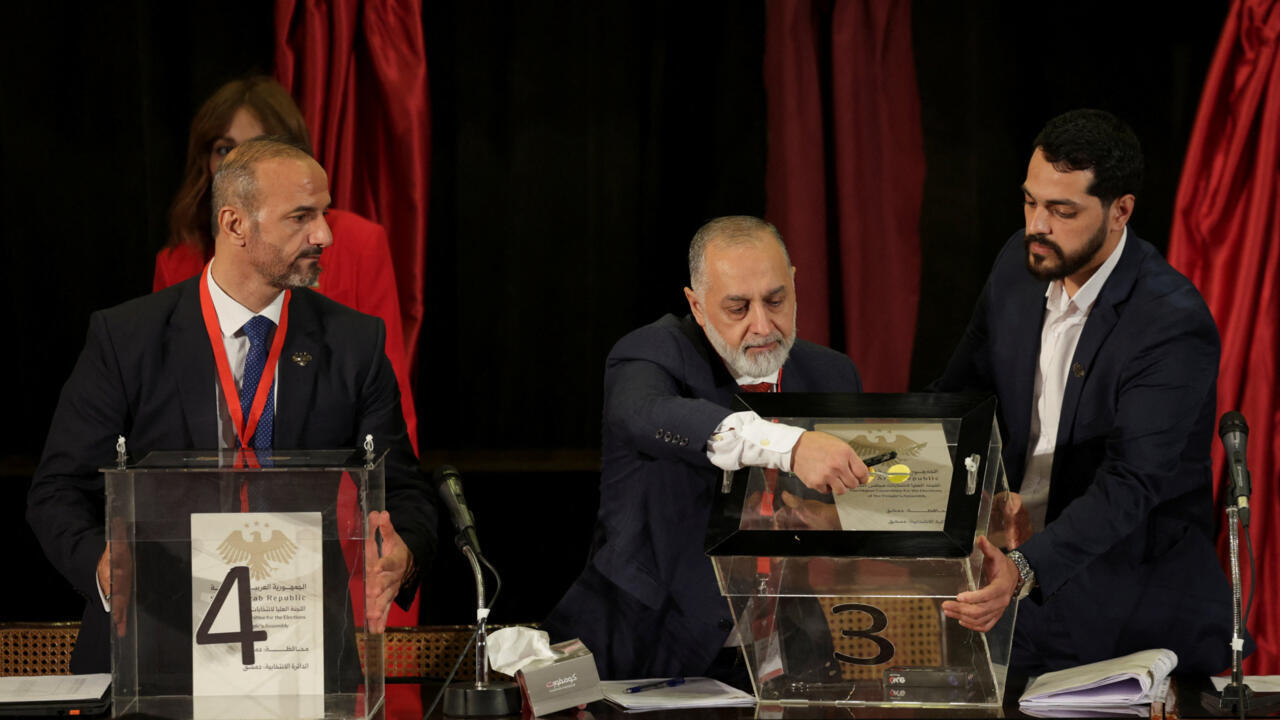 A member of electoral colleges votes to select his candidate for the new Syrian Parliament since Bashar al-Assad's government was toppled, in Damascus, Syria, October 5, 2025. © Khalil Ashawi, Reuters
Syria will select members of its first post-Assad parliament on Sunday in a process criticised as undemocratic, with a third of the members appointed by interim leader Ahmed al-Sharaa.
The assembly's formation is set to consolidate the power of Sharaa, whose Islamist forces led a coalition that toppled longtime ruler Bashar al-Assad in December after more than 13 years of civil war and five decades of one-family rule.
According to the organising committee, more than 1,500 candidates -- just 14 percent of them women -- are running for the assembly, which will have a renewable 30-month mandate.
Sharaa is to appoint 70 representatives out of the 210-member body.
In UN debut, new Syria leader warns on Israel but backs dialogue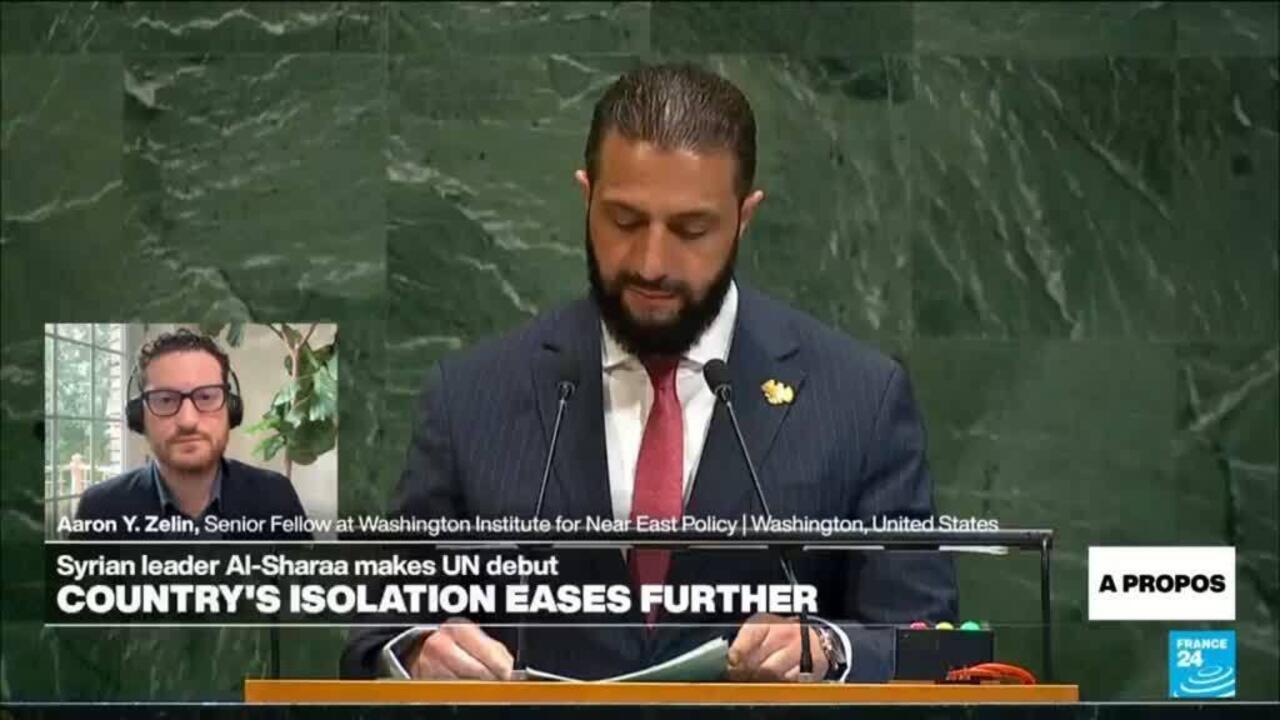 A PROPOS © FRANCE 24
11:40
The other two-thirds will be selected by local committees appointed by the electoral commission, which itself was appointed by Sharaa.
But southern Syria's Druze-majority Sweida province, which suffered sectarian bloodshed in July, and the country's Kurdish-held northeast are excluded from the process for now as they are outside Damascus's control, and their 32 seats will remain empty.
"I support the authorities and I'm ready to defend them, but these aren't real elections," said Louay al-Arfi, 77, a retired civil servant sitting with friends at a Damascus cafe.
"It's a necessity in the transitional phase, but we want direct elections" to follow, he told AFP.
The new authorities dissolved Syria's rubber-stamp legislature after taking power.
Under a temporary constitution announced in March, the incoming parliament will exercise legislative functions until a permanent constitution is adopted and new elections are held.
Sharaa has said it would be impossible to organise direct elections now, noting the large number of Syrians who lack documentation after millions fled abroad or were displaced internally during the country's civil war.
'Not elections'
Around 6,000 people are taking part in Sunday's selection process.
Preliminary results are expected to emerge after it ends, with the final list of names to be announced on Monday.
Under the rules, candidates must not be "supporters of the former regime" and must not promote secession or partition.
Those running include Syrian-American Henry Hamra, the first Jewish candidate since the 1940s.
Rights groups have criticised the selection process, saying it concentrates power in Sharaa's hands and lacks representation for the country's ethnic and religious minorities.
In a joint statement last month, more than a dozen non-governmental organisations said the process means Sharaa "can effectively shape a parliamentary majority composed of individuals he selected or ensured loyalty from", which risked "undermining the principle of pluralism essential to any genuine democratic process".
Watch more NGO Handicap International on the dangers of landmines in post-Assad Syria
"You can call the process what you like, but not elections," said Bassam Alahmad, executive director of the France-based Syrians for Truth and Justice, among the groups that signed the statement.
At a meeting in Damascus this week, candidate Mayssa Halwani, 48, said criticism was normal.
"The government is new to power and freedom is new for us," she said.
Nishan Ismail, 40, a teacher in the Kurdish-controlled northeast, said "elections could have been a new political start" after Assad's fall, but "the marginalisation of numerous regions shows that the standards of political participation are not respected".
Negotiations on integrating the Kurds' civil and military institutions into the new central government have stalled, with Damascus rejecting calls for decentralisation.
In southern Syria's Druze-held city of Sweida, activist Burhan Azzam, 48, expressed a similar sentiment.
The authorities "have ended political life" in Syria, he said, adding that the selection process "doesn't respect the basic rules of democracy".
(FRANCE 24 with AFP)
Syria will select members of its first post-Assad parliament on Sunday in a process criticised as undemocratic, with a third of the members appointed by interim leader Ahmed al-Sharaa.
The assembly's formation is set to consolidate the power of Sharaa, whose Islamist forces led a coalition that toppled longtime ruler Bashar al-Assad in December after more than 13 years of civil war and five decades of one-family rule.
According to the organising committee, more than 1,500 candidates -- just 14 percent of them women -- are running for the assembly, which will have a renewable 30-month mandate.
Sharaa is to appoint 70 representatives out of the 210-member body.
In UN debut, new Syria leader warns on Israel but backs dialogue
11:40
The other two-thirds will be selected by local committees appointed by the electoral commission, which itself was appointed by Sharaa.
But southern Syria's Druze-majority Sweida province, which suffered sectarian bloodshed in July, and the country's Kurdish-held northeast are excluded from the process for now as they are outside Damascus's control, and their 32 seats will remain empty.
"I support the authorities and I'm ready to defend them, but these aren't real elections," said Louay al-Arfi, 77, a retired civil servant sitting with friends at a Damascus cafe.
"It's a necessity in the transitional phase, but we want direct elections" to follow, he told AFP.
The new authorities dissolved Syria's rubber-stamp legislature after taking power.
Under a temporary constitution announced in March, the incoming parliament will exercise legislative functions until a permanent constitution is adopted and new elections are held.
Sharaa has said it would be impossible to organise direct elections now, noting the large number of Syrians who lack documentation after millions fled abroad or were displaced internally during the country's civil war.
'Not elections'
Around 6,000 people are taking part in Sunday's selection process.
Preliminary results are expected to emerge after it ends, with the final list of names to be announced on Monday.
Under the rules, candidates must not be "supporters of the former regime" and must not promote secession or partition.
Those running include Syrian-American Henry Hamra, the first Jewish candidate since the 1940s.
Rights groups have criticised the selection process, saying it concentrates power in Sharaa's hands and lacks representation for the country's ethnic and religious minorities.
In a joint statement last month, more than a dozen non-governmental organisations said the process means Sharaa "can effectively shape a parliamentary majority composed of individuals he selected or ensured loyalty from", which risked "undermining the principle of pluralism essential to any genuine democratic process".
Watch more NGO Handicap International on the dangers of landmines in post-Assad Syria
"You can call the process what you like, but not elections," said Bassam Alahmad, executive director of the France-based Syrians for Truth and Justice, among the groups that signed the statement.
At a meeting in Damascus this week, candidate Mayssa Halwani, 48, said criticism was normal.
"The government is new to power and freedom is new for us," she said.
Nishan Ismail, 40, a teacher in the Kurdish-controlled northeast, said "elections could have been a new political start" after Assad's fall, but "the marginalisation of numerous regions shows that the standards of political participation are not respected".
Negotiations on integrating the Kurds' civil and military institutions into the new central government have stalled, with Damascus rejecting calls for decentralisation.
In southern Syria's Druze-held city of Sweida, activist Burhan Azzam, 48, expressed a similar sentiment.
The authorities "have ended political life" in Syria, he said, adding that the selection process "doesn't respect the basic rules of democracy".
(FRANCE 24 with AFP)
Syria: Al-Shaara’s Recent Diplomatic Wins Emboldens Him To Monopolize Power – OpEd
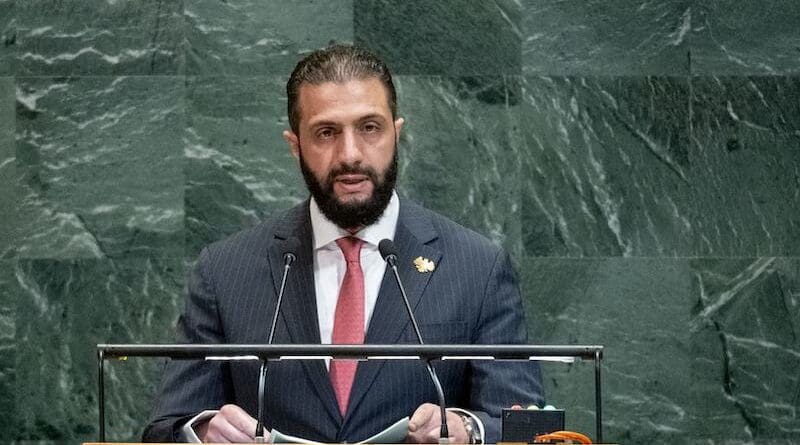
President Ahmad Al-Sharaa of the Syrian Arab Republic addresses the general debate of the General Assembly’s eightieth session. Photo Credit: UN Photo/Manuel Elías
By Manish Rai
In his maiden speech in the United Nations General Assembly, Syria’s interim president, Ahmed al-Sharaa, called for lifting of international sanctions on Syria, becoming the first head of state from Syria to address the gathering in nearly 60 years.
This signifies the first appearance of a Syrian president since Nureddin al-Atassi took office in 1967. Syrian President Sharra engaged in a series of bilateral discussions with global leaders during the General Assembly sessions, framing it as Syria’s revitalized diplomatic drive. Since assuming office in December last year, Ahmad Al-Shaara has been conducting a diplomatic campaign. He successfully garnered substantial diplomatic backing from almost all principal stakeholders in the region.
In July of this year, the United States removed Hayat Tahrir al-Sham (HTS), the organization commanded by Al-Shaara, from its designation as a “foreign terrorist organization.” In May, he journeyed to Paris to confer with French President Emmanuel Macron and engage in discussions with senior Saudi Arabian officials. The Arab League warmly welcomes the current Syrian regime.
These initiatives illustrate the Al-Sharaa regime’s revitalized foreign efforts to reintegrate Syria into the global diplomatic framework. Nonetheless, the description is inaccurate; the aim of this diplomatic initiative is to validate Al-Sharaa as the exclusive leader of the nation. The regime’s objective is to solidify its dominance over a divided Syria by obtaining external recognition and legitimacy.
The regime seeks to persuade all ethnic and religious factions in Syria of its permanence and that it is advantageous for them to accept Al-Sharaa’s supremacy by securing the approval of foreign authorities. International recognition empowers the prevailing regime to monopolize and centralize power. Recent significant decisions clearly demonstrate this. Al-Sharaa recently announced parliamentary “elections,” in which committees he designated will elect two-thirds of the parliament members.
The current administration has dismantled the former police force. Instead, it has expanded Idlib’s General Security apparatus, with recruitment proceeding at breakneck speed. Priority is being given to young men from the three northern provinces (Idlib, Hama, Aleppo) where HTS sustains its support base. Anas Khatab, the former administrative director of Jabhat al-Nusra, the antecedent of HTS, has been designated as the new head of Syria’s General Intelligence Directorate (GID). Syrian citizenship is being conferred upon foreign militants affiliated with HTS, who constitute around 20 to 30% of its forces. They have been integrated into the military and are currently holding positions within the administration.
The termination of countless judges, especially women, has not resulted from professional wrongdoing but rather from their affiliation with minority ethnic groups. The appointment of ministers is now executed via a non-transparent process. Ahmed al-Sharaa’s brother, Maher, has been designated as the Minister of Health. Key positions in defense, foreign affairs, and interior have been conferred upon close colleagues of Ahmed al-Sharaa, like Murhaf Abu Kasra, Asaad al-Shaibani, and Alem Kiddie. The hyper-centralization of Syria’s governance confines decision-making to a small group of five or six individuals around Al-Sharaa.
Moreover, Damasus is utilizing sectarianism as a tool to create a “homogeneous popular support base” within the Arab Sunni community, rallying portions of the populace around sectarian dynamics. The “Mazlumiya Sunniya” (Sunni victimhood) narrative has been extensively utilized to consolidate a substantial segment of the Arab Sunni community in support of Al Sharaa’s government, notwithstanding the myriad political, social, and regional divides present among their ranks.
The new ruling authorities have swiftly acknowledged that sectarianism serves as an effective political tool for consolidating their grip over territories with ongoing resistance to their authority. The escalation of sectarian rhetoric and violence by the current regime and its supporting armed forces has initially targeted the Alawite population and subsequently extended to encompass the Druze communities within the country.
The military forces, ostensibly under government command, consistently display insubordinate and militia-like conduct, especially towards minorities. When intimidation fails, as seen with the Kurds, the Al-Shaara dictatorship resorts to blatant blackmail. Al-Sharaa consistently condemns Israeli military actions in southern Syria as infringements on the nation’s sovereignty.
Such denunciations typically seem authentic and valid. However, Al-Sharaa’s denunciations are insincere because his actions and statements contradict each other. The Syrian leader indicated that a Turkish military operation against the Kurdish-led Syrian Democratic Forces may be contemplated if they fail to completely assimilate into the Syrian military by December, as outlined in a March agreement between Damascus and the Syrian Democratic Forces, during an interview with Turkey’s Milliyet newspaper on September 19, 2025.
Al-Sharaa intimidates the Syrian Kurds with the prospect of a Turkish military incursion, instead of denouncing Turkish involvement in what is evidently an internal Syrian issue. A de facto president who advocates for foreign intervention against his own citizens forfeits the moral authority to address the territorial sovereignty of a nation. The Syrian government characterizes it as a matter of national security for Ankara when Turkey is the actor. Violations of sovereignty are only recognized when Israel is implicated. This double standard is both hypocritical and futile. The Bashar al-Assad dictatorship utilized the same strategy for years, ultimately leading to Assad’s exile in Moscow.
The marginalization of ethnic and religious minority groups, including Christians, Druze, and Kurds, would ultimately lead to long-term instability and a lack of legitimacy for the new regime. An inclusive governance approach that incorporates a wider range of political perspectives is vital to maintaining national unity. This administration is currently implementing a singular plan to consolidate its authority, leading to the neglect and subversion of the democratic aspirations and interests of the public.
The international community should refrain from endorsing the regime of Ahmad Al-Sharra, which is indistinguishable from the prior regime of Basha Al-Assad, unless it implements a comprehensive course correction.
Manish Rai
Manish Rai is a geopolitical analyst and columnist for the Middle East and Af-Pak region and the editor of geopolitical news agency ViewsAround (VA). He has done reporting from Jordon, Yemen, Iraqi Kurdistan, Egypt, Oman, UAE, Iran, and Afghanistan. His work has been quoted in the House of Commons, British Parliament and in leading think tanks like RAND Corporation and FDD.

No comments:
Post a Comment