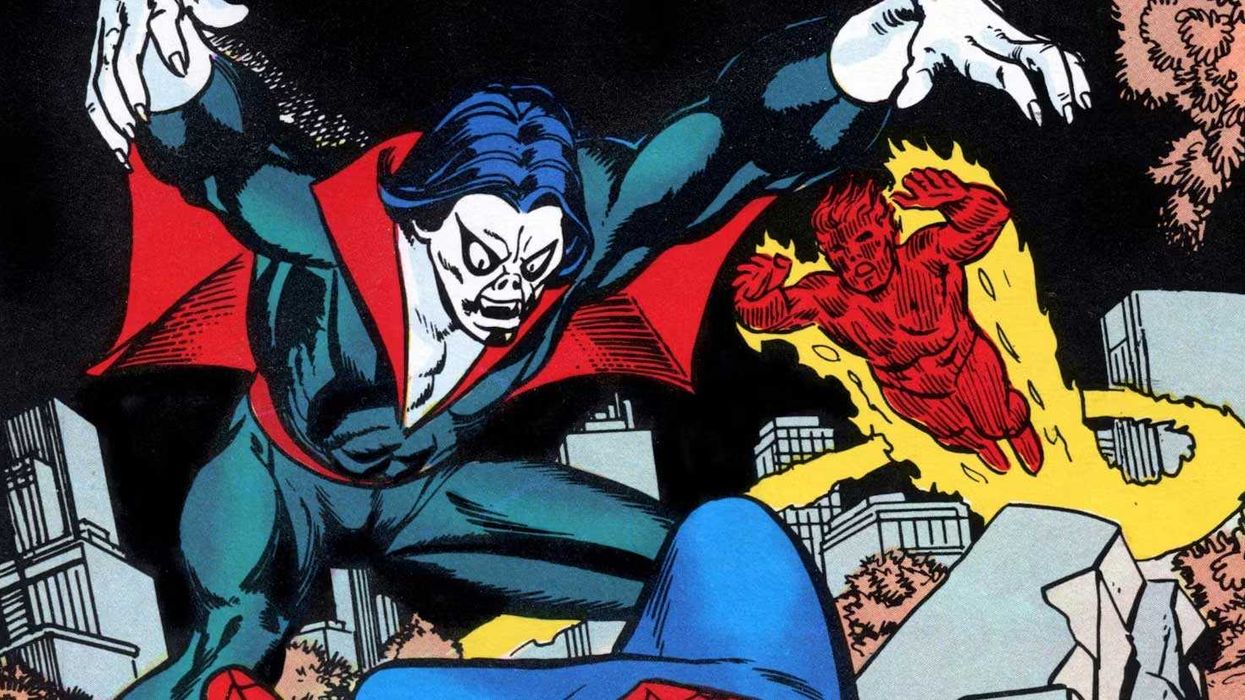
In Bram Stoker’s novel Dracula (1887), an English solicitor (Jonathan Harker) is sent to Transylvania to assist Count Dracula, an aristocrat, in his move to England. When Harker discovers Dracula lying in a coffin after feeding on blood, he understands the threat that Dracula poses to England.
Vampires have long represented our political and social attitudes to race, immigration and the threat of foreign invasion – reflecting the prejudices of their times.
My research explores how comic books and graphic novels interrogate political, social and cultural issues. Dracula became a 20th-century pop culture phenomenon, appearing in several films and TV programs. But American comic books were relatively slow to feature vampires.
In 1954, the US Senate Subcommittee on Juvenile Delinquency investigated the comic book industry. Hearings were held to testify about the perceived harm caused by crime and horror comics. To allay threats to their business, publishers banded together to form the Comics Magazine Association of America and established The Comics Code of 1954, which banned crime and horror content, including stories featuring vampires. A revision and relaxation of the code in 1971 enabled vampires to be used when “handled in the classic tradition” of novels such as Dracula “and other high calibre literary works written by Edgar Allen Poe, Saki, Conan Doyle and other respected authors whose works are read in schools around the world”.
This led to the creation of the character Morbius the Living Vampire, who debuted in Amazing Spider-Man #101 in July 1971. Morbius was a scientist with a blood disease whose experimental cure using vampire bats led to his transformation.
Soon after, Dracula himself joined the Marvel comic universe in Tomb of Dracula #1 (November 1971), a series that ran until 1979. Writer Marv Wolfman and artist Gene Colan had to work within the limitations of the code by ensuring that they adhered to a traditional depiction of Dracula in line with Stoker’s original version. This could have limited the style and content of their stories, which were set in the modern era, but the inclusion of a newly created supporting cast kept the narrative fresh and engaging.
Vampires in American comic books retained this outsider status – invariably they were European immigrants like Morbius, who was born in Nafplio, Greece. In this way, comic vampires continue the literary vampire tradition of tapping into the fear of foreigners.
Doctor Doom: anti-immigrant populist politician
Comic book writer Ryan North explored a variation of this theme with Doctor Doom, the Marvel Comics’ super-villain, in issues of Fantastic Four released this year. Doom will be played by Robert Downey Jr. in the new film Avengers: Doomsday, due in 2026.
Doom rules Latveria, a fictional European country. He has recently declared himself Emperor of the World, supported by leaders of nations across the globe. Doom also uses Trump-style populism by propagating prejudice and fear-mongering against vampires.
In Fantastic Four #29 (February, 2025) Susan Storm, Ben Grimm and Jennifer Walters (also known as the Invisible Woman, the Thing and She-Hulk respectively) meet for lunch in a New York diner. They discuss Doom’s recent activities, which their waitress agrees are wrong before asserting that “at least he’s doing something about those horrid vampires”.
Outside, sat on the sidewalk, is a dishevelled, slumped vampire holding a sign that reads: “Anything Helps.” Apart from slightly elongated nails and subtly pointed canine teeth, there is nothing to distinguish him from any other normal person begging on a street.
Sue, Ben and Jen then leave the diner and encounter a terrified family of four being chased by an angry crowd. The father exclaims “Please! Leave us alone!!” and “Please don’t kill us” as they try to outrun the mob. The family, dressed in normal casual clothes, are vampires.
Protected by the heroes, the parents explain that they are starving. Having been turned away from a blood bank, and not wanting to harm people, they had resorted to eating a pigeon, which prompted the chase. Members of the crowd scream “Vampires!”, “Kill them!” and call them “monsters”. The parents are killed by a member of the mob, but the vampire children are saved by the Fantastic Four. This leads to Reed Richards (Mr. Fantastic) creating a synthetic food substance that quenches vampires’ bloodlust, before ensuring the children are re-homed with their aunt.
Thinking that solving vampires’ hunger for blood will render Doom’s propaganda impotent, the story ends on a foreboding scene: a normal suburban house in America, with parents waving off their children to school. However, their house is bedecked with Maga-style pro-Doctor Doom flags and signs. It seems that Doctor Doom is still winning the hearts and minds of many Americans.
In One World Under Doom #3 (April, 2025) a group of superheroes and super-villains team up against their common enemy and find out how Doom has manipulated the world’s leaders. Using their own powers, they discover that he has not used magic, telepathy or mind control. He has merely negotiated with other leaders to become World Emperor. His populist policies have been embraced by the public.
This, along with the anti-vampire rhetoric and misinformation, creates a powerful allegory of the far-right ideologies that are currently being propagated by politicians across our own world. This current portrayal of Dr Doom as a proxy for public figures and politicians who use anti-immigrant rhetoric, harmful stereotypes and egregious misinformation, strongly suggests that they are the real monsters. Not the immigrants – or vampires for that matter.
This article features references to books that have been included for editorial reasons, and may contain links to bookshop.org. If you click on one of the links and go on to buy something from bookshop.org The Conversation UK may earn a commission.
Andrew Edwards, Student Learning Developer, The University of Law
This article is republished from The Conversation under a Creative Commons license. Read the original article.
Spiritual Politics
Scary demons? Only if you harbor a little evil yourself.
(RNS) — Possession wasn't as spooky in the Middle Ages as it is in 'The Exorcist.'
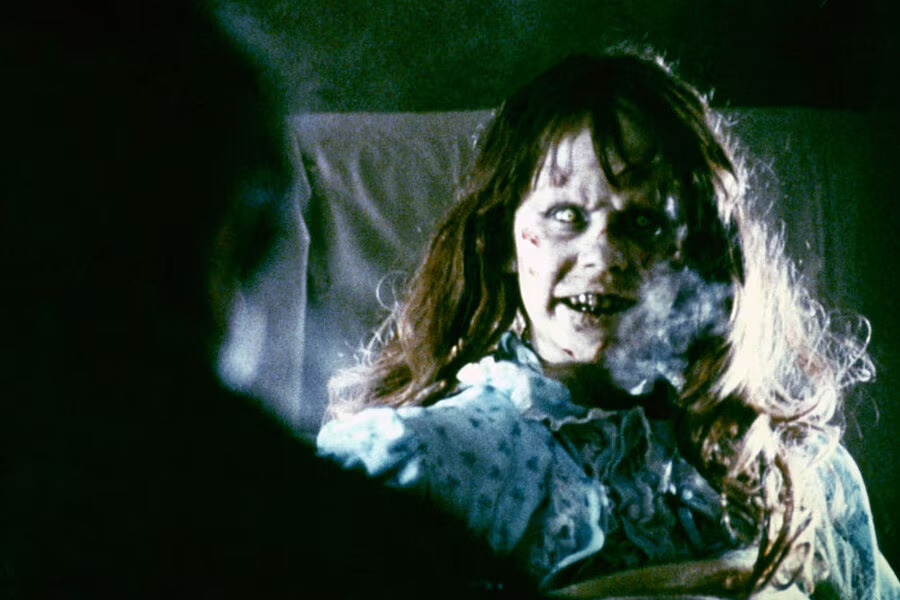
Actress Linda Blair as the possessed girl in "The Exorcist."
Mark Silk
October 31, 2025
(RNS) — On Thursday evening, my wife and I went to Trinity College’s splendid Cinestudio for a special pre-Halloween screening of “The Exorcist,” which neither of us had ever seen when it was released in 1973, or since. William Peter Blatty’s screen adaptation of his best-selling 1971 novel is about (in case you don’t know) a case of demonic possession that takes place in and around a tony Washington townhouse.
Pazuzu, the demon in question, seems to have been let loose unknowingly by archeologists at a dig in Iraq run by a Catholic priest, played by Max von Sydow. It takes possession of the pubescent daughter (Linda Blair) of a single mom Hollywood star (Ellen Burstyn) who’s acting in a movie about a student anti-war protest that’s being filmed on the Georgetown University campus.
RELATED: From exorcist to monster: How Hollywood has recast Catholicism
The heavy demonic action takes place in the girl’s bedroom. No question about it, Pazuzu is evil incarnate and — spoiler alert — will be responsible for the deaths of the movie’s director and the two priests who do the exorcism.
A half-century on, “The Exorcist” feels like an anti-Vatican II protest. His four marriages notwithstanding, Blatty was a conservative Catholic who, in 2012, filed a canon law petition against Georgetown (his alma mater) for violating church teaching by inviting abortion rights advocates to speak. “There are demons running all over that campus,” he told an interviewer.
The movie’s heartthrob priest (Jason Miller) is a psychiatrist who studied at Harvard and Oxford, disbelieves in demonic possession and has lost his faith — though before he dies he presumably regains it as a result of confronting Pazuzu. In other words, Blatty wants that old-time Catholicism back. Supernaturalism Sí! Aggiornamento No!
In fact, that old-time Catholicism took a less harrowing view of demonic possession than “The Exorcist.” The cases I’m familiar with (from books written in the 12th and 13th centuries, I hasten to add) involve much more community-minded demons than Pazuzu.
In written accounts by the likes of Parisian master Peter the Chanter, Cistercian abbot Caesarius of Heisterbach and Cardinal James of Vitry, demoniacs are distinguished particularly by the fact that they publicize people’s hidden sins. If you’ve secretly sinned and happen to be in his or her presence, the demoniac will let the cat out of the bag — unless you’ve managed to confess the sin yourself.

St Guthlac, left, performs a medieval exorcism. (Image courtesy of British Library/Creative Commons)
Caesarius, for example, tells the story of a priest who has been having an affair with a knight’s wife. Suspicious, the knight arranges to go with the priest to a nearby village where a demoniac is holding forth on the sins that “had not been concealed through true confession” of those who came into his presence. On the way, the priest, realizing what was afoot and fearing for his life, pretended a call of nature and hurried into a stable where he begged one of the knight’s servants to hear his confession.
With a new sense of security, the priest returned to the knight and together they entered the church where the demoniac was. When the knight asked about the priest, the demoniac said in German, “I know nothing of him,” adding in Latin (which the knight didn’t understand), “He was justified in the stable.”
Examples of this sort were told in order to encourage lay people to go to Confession, which in those days was so rare an occurrence that in 1215, the Fourth Lateran Council issued a mandate that all Christians had to do so once a year. The demoniacs, or at least the stories about them, thus served to spur this ecclesiastical project.
We also have examples of demons going so far as to warn people away from sin. Caesarius tells another story about a priest’s concubine who, repenting her sins, became a recluse. When a local (married) knight pays court to her and she agrees to an assignation, a possessed woman who lives nearby comes to her cell and berates her for what she is about to do. The demoniac then goes to the knight and berates him as well, thereby preventing the adultery.
Caesarius himself seems somewhat perplexed by the story, which was told to him by a monk who testified that he’d heard it from the recluse herself. The abbot sums it up by averring that the two would-be sinners were saved “through the grace of Christ and the ministry of the devil.”
RELATED: The real priest behind ‘The Pope’s Exorcist’ was a fan of Hollywood horror films
Then there’s the story passed on by the Welsh chronicler Walter Map, from a clerk named John of Platena. It seems that John was annoyed at hearing some Cistercian abbots on a visit to Archbishop of Canterbury Thomas Becket praising “to the stars” their order’s hero, St. Bernard of Clairvaux. So John recounted the “miracle” of a demoniac who was brought to Bernard to be exorcized. Unbound, the demoniac hurled stones at the saint and chased him through the town until subdued.
“So this is your miracle?” asked the archbishop, displeased. “Certainly,” replied John. “Those present said that this was a noteworthy miracle, because the possessed man was mild and friendly to everyone, and troublesome only to the hypocrite, and therefore this was in my view a punishment of presumptuousness.”
Happy Halloween!

No comments:
Post a Comment