Study: South Africa-Europe Shipping Route Could Run on Ammonia by 2029

Despite the existing uncertainty in global regulations for clean shipping, some decarbonization initiatives are setting ambitious targets for transitioning to alternative fuels. One such example is the South Africa-Europe iron ore shipping route, which could feasibly deploy ammonia-fueled bulk carriers as soon as 2029 and scale toward full decarbonization by 2035. These findings are contained in a feasibility study by the Global Maritime Forum, produced in partnership with a consortium formed in 2023 to develop a green shipping corridor on the South Africa-Europe iron ore trade route.
The consortium includes Anglo American, CMB.TECH, Freeport Saldanha, Vuka Marine and Engie. The green shipping corridor being developed will link Saldanha Bay in South Africa’s Western Cape to the Port of Rotterdam in Netherlands. It will become one of the first Global South-to-North green shipping routes.
With South Africa advancing a national green hydrogen market, the maritime sector is seen to play a key offtake role. As a result, some major ports in the country are at different stages of developing green shipping fuel infrastructure. Saldanha Bay is one of the ports, offering a significant opportunity to cut emissions in the shipping sector as South Africa’s primary iron-ore export terminal.
Recently, the port appointed the Council for Scientific and Industrial Research (CSIR) to coordinate phase 1 of its Green Hydrogen Master Plan. The initiative is aimed at positioning Saldanha Bay port as a green hydrogen production and export hub. The project has been shown to be cost-competitive, especially with the conversion of green hydrogen to ammonia fuel.
According to the Global Maritime Forum study, the green hydrogen projects already underway near the ports of Boegoebaai, Saldanha and Walvis Bay are enough to meet the green corridor’s fuel demand. This includes the corridor’s high-demand scenario of 22 bulk carriers per annum by 2035. However, the study predicts that in the initial years of the green corridor operation, ammonia-fueled vessels will likely bunker in Rotterdam. As a major global fuels hub, Rotterdam is currently one of the most mature ports in terms of ammonia bunkering and safety frameworks.
In the meantime, Saldanha Bay has an opportunity to finalize infrastructure for green ammonia production. Based on its strategic location and significance in bulk shipping, Saldanha Bay by 2035 is poised to become an important global bunkering hub for green ammonia.
“However, to help Saldanha Bay transition quickly, blending public and private funding can unlock investment in infrastructure and reduce the risks of early projects,” said Shannon Neumann, Associate, Investment Facilitation at Freeport Saldanha.
Top image: Harbor and iron ore pier at Saldanha Bay, South Africa (Hp.Baumeler / CC BY SA 4.0)
South Africa Halts Plans for Establishing a Shipping Line
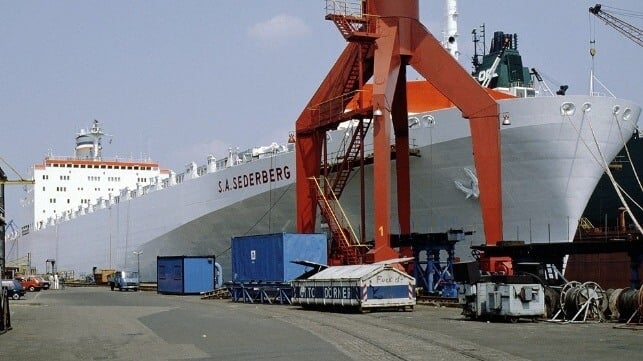
South Africa has temporarily shelved plans for establishing a shipping line to allow for further consultations. Early last month, the Cabinet approved the withdrawal of the Merchant Shipping Bill, which was tabled in parliament in May 2023. The Bill contained provisions for reviving South Africa’s maritime sector, including cabotage regulations to develop the country’s merchant fleet. This would be operated under a state-owned entity referred as the South African Shipping Company (SASCO).
In approving the withdrawal of the bill, the cabinet said that the Department of Transport will now have time to finalize consultations with different stakeholders. The discussions will be carried out under the National Economic Development & Labor Council (NEDLAC). The body is mandated to facilitate public participation for government bills in cooperation with trade groups and community organizations.
Early this year, major industry groups in the South African maritime sector voiced their opposition to the Merchant Shipping Bill. The lobbyists including Exporters Western Cape (EWC) argued that the bill skipped the NEDLAC process, hence lacking industry input. A Parliamentary Monitoring Group (PMG) report dated 20 May 2025 also indicated that the Bill was not submitted to NEDLAC, which is against parliamentary procedures.
The bill’s proposal to establish SASCO also proved contentious with different stakeholders. For instance, the South African Association of Freight Forwarders (Saaff) said that the existing port infrastructure could easily be overwhelmed by cabotage regulations. The hub and spoke port model requires well-developed and efficient terminals to avoid backlogs along the transport chain. In the case of South Africa, a port such as Durban handles over 60% of the country’s containerized cargo. This means the port could be easily overwhelmed in a scenario where it is made as a hub port under the cabotage regulations proposed by the bill.
“While the development of a national shipping capability is broadly supported, implementing a restrictive cabotage regime without understanding its full economic impact risks unintended consequences,” added Saaff.
In addition, some observers doubted the government’s ability to run a national shipping line, recalling the era of the previously state-owned Safmarine. Formed in 1946, Safmarine was acquired by the Danish ocean carrier Maersk in 1999, at a time when the global shipping industry was undergoing massive consolidation.
Top image: SA Sederberg, seen here in Hamburg circa 1986 (Wolfgang Fricke / CC BY SA 3.0)


No comments:
Post a Comment