KASHMIR IS INDIA'S GAZA
Ajoy Ashirwad Mahaprashasta
20/Dec/2025
THE WIRE
Nearly all speakers, including Mani Shankar Aiyar, Mirwaiz Umar Farooq (who sent a message), Aga Syed Ruhullah Mehdi, Kapil Kak and others spoke about the sense of disempowerment and anger among Kashmiri youth after the reading down of Article 370 and urged the Union government to fulfill its promise of restoring statehood.
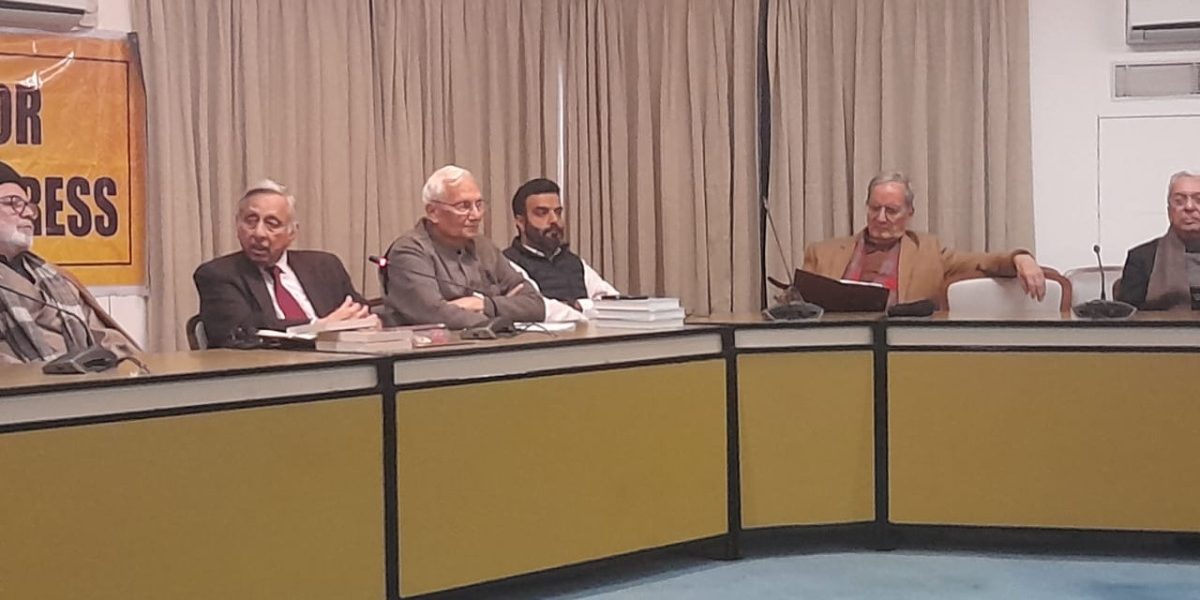
Congress leader Mani Shankar Aiyar, peace activist O.P. Shah and other speakers and attendees at the peace conference held in New Delhi on December 20, 2025. Photo: By arrangement.
New Delhi: With no national political party, including the Congress, demanding the restoration of Article 370 in Jammu and Kashmir, senior Congress leader Mani Shankar Aiyar on Saturday suggested that stakeholders invoke “special provisions” under Article 371 to press the Union government to grant the Union Territory some degree of autonomy.
Speaking at a conference organised by Centre for Peace and Progress in New Delhi, Aiyar said that he favoured restoring statehood “as promised by the Centre” while reading down Article 370, and granting special status to Jammu and Kashmir. But since no political party “including my own party, the Indian National Congress” is making such a demand, “then please negotiate on special provisions under Article 371, like you have done in Gujarat and Maharashtra” and other states, and provide “temporary, transitional and special provisions” to the Union Territory, he said.
Aiyar said that the logic advanced by the Union government to read down Article 370 was that it would substantively fix the problem of terrorism, but the Pahalgam attack and the recent war with Pakistan contradict such a claim. Moreover, he said, Operation Sindoor and the decision to take away the constitutional autonomy of Jammu and Kashmir have weakened India’s diplomatic power vis-a-vis Pakistan and China – an indication that reading down Article 370 has done more harm than good.
The conference, an initiative by the former editor of monthly journal Parlance O.P. Shah, a well-known peace activist, brought together a range of leaders and analysts who have been playing crucial roles in improving relations between New delhi and Kashmir. Interestingly, all speakers, except former NCERT director J.S. Rajput were in favour of restoring Jammu and Kashmir’s statehood and Article 370, even while advocating that negotiations with the Union were the only way forward.
The Chairman of All Parties Hurriyat Conference Mirwaiz Umar Farooq, who was scheduled to be present but wasn’t cleared by the government to travel from Srinagar, sent a message to be read at the conference.
“I was genuinely looking forward to being part of this important conversation. Unfortunately, due to circumstances beyond my control, I am unable to attend, much to my regret,” Farooq’s letter to Shah said.
The once-hardline separatist leader who advocated a non-violent way to demand independence before 2019 appeared a toned-down version of himself in the letter.
“Engagement and dialogue are the bedrock of a humane and dignified process of resolution and reconciliation. Understanding of each other’s concerns and their redressal is best achieved when we talk and listen to each other. My view has always been that every act of violence is to be unequivocally condemned. It only leads to pain and is self-defeating. And such condemnation must not be allowed to transform into collective punishment or blanket suspicion of an entire people or community,” he said.
The Hurriyat chairman had recently strongly condemned the terrorist attack in Delhi, in which a explosion in a car in Old Delhi killed 20 people and injured over 30.
However, Farooq reminded that the post-Article 370 period in Kashmir is far from normal, and indicated that resentment in the Valley has grown.
“…peace cannot be built through demolitions, harassment of families, shrinking civic space, or measures that deepen fear and alienation. These practices do not resolve conflict; rather they aggravate resentment and despair, particularly among youth,” he said.
“A key concern I have consistently highlighted is the growing sense of disempowerment among the people, especially young Kashmiris. When avenues for peaceful political expression narrow, civil liberties are curtailed, employment prospects shrink and individuals live under constant fear of surveillance, arbitrary action or loss of livelihood, a deep feeling of suffocation sets in… Disempowerment, if left unaddressed, becomes fertile ground for alienation and unrest.”
Farooq also demanded a dialogue process “rooted in compassion and mutual respect – not force or coercion.
“I have consistently urged young people to reject violence and extremism , which are morally wrong, religiously impermissible, and ultimately self-defeating. At the same time, security measures alone may suppress symptoms, but only justice, redressal and genuine inclusion can heal wounds and make reconciliation possible,” he said.
The Jammu and Kashmir National Conference MP from Srinagar Aga Syed Ruhullah Mehdi’s intervention was more blunt. “Anyone who thinks that we don’t need to negotiate with Kashmir lives in a fool’s paradise. Anyone who thinks people can reconcile with Kashmir’s degraded status is deeply mistaken,” he said, identifying himself as a representative of a party that has consistently sworn allegiance to the Indian Constitution and the Union of India.
He said that while “power is decentralised in other states”, it is “controlled in Kashmir”. “They want to reshape the identity of Kashmir. They think Kashmir is the homeland of Hindus,” he said, adding that all such political aspirations of the Union government will only embolden the sections within Kashmiri society that have consistently opposed negotiations.
Those in Kashmir who believe negotiation is “betrayal” have strengthened, and pro-India voices have weakened because of the Union government’s actions, Mehdi said.
“If you want to realise the truth, the situation [in Kashmir] is worse than pre-2019 [when Article 370 was read down],” Mehdi said, adding:
“People of Kashmir have not reconciled with the reading down of Article 370. They feel why should they give up their sovereign right… What happened was bulldozing of the Constitutional arrangement.”
Mehdi said that Kashmiri’s elected the National Conference leadership hoping it would get Article 370 restored. “I see a future India where not only J&K but every state will negotiate with the Centre to have something like [Article] 370 or some form of autonomy,” Mehdi said.
Former Air Vice Marshal Kapil Kak, too, was scathing in his criticism of the government in New Delhi. “People’s mood in Kashmir is one of sullen silence. There is a volcano of anger and frustration that is bordering on hate, which can assume dangerous proportions,” he said.
Kak said “resentment and anger against the central government is growing exponentially”.
“Reality in Kashmir is far removed from what is being told by New Delhi or is shown by the media,” Kak, who had also challenged the reading down of Article 370 in the Supreme Court, said. The media has been “muzzled completely”, he said.
Such have been repercussions of reading down Article 370, Kak said, that there is an alarming growth in “uncertainties, alienation, substance abuse and new spaces of radicalisation”.
Other speakers agreed with the central contention that alienation has grown as a result of the Union’s “excesses” in Kashmir in the years following the reading down of Article 370. A Hindu Dogra representative from Samba and peace activist, I.D. Khajuria, said that people from Jammu and Kashmir haven’t been given full citizenship by the Union government, and Kashmiris are being denied even education as they are constantly seen with suspicion in the rest of India.
Khajuria said that political polarisation has been given such a fillip by the government in New Delhi that “one fears” that people from Jammu and those from Kashmir may clash with each other in the future. Echoing a point also emphasised by Aiyar earlier, he said:
“There is no federalism now. The chief minister and other ministers have been rendered powerless. They have become subservient to even a sub-inspector at a police station.”
Leader of Awami National Conference Muzaffar Shah was even more emphatic about restoration of Article 370. He said such conferences must bring together representatives of the Bharatiya Janata Party and the Rashtriya Swayamsevak Sangh too, so that they understand the pain of Kashmiris.
“We can talk about reconciliation, shared peace and negotiation with people from the establishment but there can be no compromise on our demand to restore Article 370,” he said.
“If you want federalism in this country, you need [Article] 370 in every state,” he said. He added that the diverse people of Jammu and Kashmir – the Kashmiri Shias and Sunnis, Hindu Dogras, Ladakhi people – will first have to reconcile with each other and build bridges while also negotiating with the Union government.
Nearly all speakers expressed the view that any possible solution to the Kashmir unrest can only be found when the Union government begins negotiating with “both Srinagar and Islamabad”. There can be no peace without getting Pakistan involved, Aiyar said.
Only Rajput, who was NCERT director during prime minister Atal Bihari Vajpayee’s tenure, did not speak about Article 370, but insisted on “looking for solutions instead of talking about problems”. He said New Delhi could gain Kashmir’s trust by investing heavily in primary education and upskilling the local population.
However, Aiyar and Khajuria refuted Rajput’s views, saying that literacy rates and educational standards in Jammu and Kashmir were comparable to those in Kerala and Tamil Nadu, which are at the top of India’s human development pyramid. They argued that the root cause of Kashmir’s lack of confidence in New Delhi was political in nature – not an outcome of social backwardness.
Ajoy Ashirwad Mahaprashasta
20/Dec/2025
THE WIRE
Nearly all speakers, including Mani Shankar Aiyar, Mirwaiz Umar Farooq (who sent a message), Aga Syed Ruhullah Mehdi, Kapil Kak and others spoke about the sense of disempowerment and anger among Kashmiri youth after the reading down of Article 370 and urged the Union government to fulfill its promise of restoring statehood.
Congress leader Mani Shankar Aiyar, peace activist O.P. Shah and other speakers and attendees at the peace conference held in New Delhi on December 20, 2025. Photo: By arrangement.
New Delhi: With no national political party, including the Congress, demanding the restoration of Article 370 in Jammu and Kashmir, senior Congress leader Mani Shankar Aiyar on Saturday suggested that stakeholders invoke “special provisions” under Article 371 to press the Union government to grant the Union Territory some degree of autonomy.
Speaking at a conference organised by Centre for Peace and Progress in New Delhi, Aiyar said that he favoured restoring statehood “as promised by the Centre” while reading down Article 370, and granting special status to Jammu and Kashmir. But since no political party “including my own party, the Indian National Congress” is making such a demand, “then please negotiate on special provisions under Article 371, like you have done in Gujarat and Maharashtra” and other states, and provide “temporary, transitional and special provisions” to the Union Territory, he said.
Aiyar said that the logic advanced by the Union government to read down Article 370 was that it would substantively fix the problem of terrorism, but the Pahalgam attack and the recent war with Pakistan contradict such a claim. Moreover, he said, Operation Sindoor and the decision to take away the constitutional autonomy of Jammu and Kashmir have weakened India’s diplomatic power vis-a-vis Pakistan and China – an indication that reading down Article 370 has done more harm than good.
The conference, an initiative by the former editor of monthly journal Parlance O.P. Shah, a well-known peace activist, brought together a range of leaders and analysts who have been playing crucial roles in improving relations between New delhi and Kashmir. Interestingly, all speakers, except former NCERT director J.S. Rajput were in favour of restoring Jammu and Kashmir’s statehood and Article 370, even while advocating that negotiations with the Union were the only way forward.
The Chairman of All Parties Hurriyat Conference Mirwaiz Umar Farooq, who was scheduled to be present but wasn’t cleared by the government to travel from Srinagar, sent a message to be read at the conference.
“I was genuinely looking forward to being part of this important conversation. Unfortunately, due to circumstances beyond my control, I am unable to attend, much to my regret,” Farooq’s letter to Shah said.
The once-hardline separatist leader who advocated a non-violent way to demand independence before 2019 appeared a toned-down version of himself in the letter.
“Engagement and dialogue are the bedrock of a humane and dignified process of resolution and reconciliation. Understanding of each other’s concerns and their redressal is best achieved when we talk and listen to each other. My view has always been that every act of violence is to be unequivocally condemned. It only leads to pain and is self-defeating. And such condemnation must not be allowed to transform into collective punishment or blanket suspicion of an entire people or community,” he said.
The Hurriyat chairman had recently strongly condemned the terrorist attack in Delhi, in which a explosion in a car in Old Delhi killed 20 people and injured over 30.
However, Farooq reminded that the post-Article 370 period in Kashmir is far from normal, and indicated that resentment in the Valley has grown.
“…peace cannot be built through demolitions, harassment of families, shrinking civic space, or measures that deepen fear and alienation. These practices do not resolve conflict; rather they aggravate resentment and despair, particularly among youth,” he said.
“A key concern I have consistently highlighted is the growing sense of disempowerment among the people, especially young Kashmiris. When avenues for peaceful political expression narrow, civil liberties are curtailed, employment prospects shrink and individuals live under constant fear of surveillance, arbitrary action or loss of livelihood, a deep feeling of suffocation sets in… Disempowerment, if left unaddressed, becomes fertile ground for alienation and unrest.”
Farooq also demanded a dialogue process “rooted in compassion and mutual respect – not force or coercion.
“I have consistently urged young people to reject violence and extremism , which are morally wrong, religiously impermissible, and ultimately self-defeating. At the same time, security measures alone may suppress symptoms, but only justice, redressal and genuine inclusion can heal wounds and make reconciliation possible,” he said.
The Jammu and Kashmir National Conference MP from Srinagar Aga Syed Ruhullah Mehdi’s intervention was more blunt. “Anyone who thinks that we don’t need to negotiate with Kashmir lives in a fool’s paradise. Anyone who thinks people can reconcile with Kashmir’s degraded status is deeply mistaken,” he said, identifying himself as a representative of a party that has consistently sworn allegiance to the Indian Constitution and the Union of India.
He said that while “power is decentralised in other states”, it is “controlled in Kashmir”. “They want to reshape the identity of Kashmir. They think Kashmir is the homeland of Hindus,” he said, adding that all such political aspirations of the Union government will only embolden the sections within Kashmiri society that have consistently opposed negotiations.
Those in Kashmir who believe negotiation is “betrayal” have strengthened, and pro-India voices have weakened because of the Union government’s actions, Mehdi said.
“If you want to realise the truth, the situation [in Kashmir] is worse than pre-2019 [when Article 370 was read down],” Mehdi said, adding:
“People of Kashmir have not reconciled with the reading down of Article 370. They feel why should they give up their sovereign right… What happened was bulldozing of the Constitutional arrangement.”
Mehdi said that Kashmiri’s elected the National Conference leadership hoping it would get Article 370 restored. “I see a future India where not only J&K but every state will negotiate with the Centre to have something like [Article] 370 or some form of autonomy,” Mehdi said.
Former Air Vice Marshal Kapil Kak, too, was scathing in his criticism of the government in New Delhi. “People’s mood in Kashmir is one of sullen silence. There is a volcano of anger and frustration that is bordering on hate, which can assume dangerous proportions,” he said.
Kak said “resentment and anger against the central government is growing exponentially”.
“Reality in Kashmir is far removed from what is being told by New Delhi or is shown by the media,” Kak, who had also challenged the reading down of Article 370 in the Supreme Court, said. The media has been “muzzled completely”, he said.
Such have been repercussions of reading down Article 370, Kak said, that there is an alarming growth in “uncertainties, alienation, substance abuse and new spaces of radicalisation”.
Other speakers agreed with the central contention that alienation has grown as a result of the Union’s “excesses” in Kashmir in the years following the reading down of Article 370. A Hindu Dogra representative from Samba and peace activist, I.D. Khajuria, said that people from Jammu and Kashmir haven’t been given full citizenship by the Union government, and Kashmiris are being denied even education as they are constantly seen with suspicion in the rest of India.
Khajuria said that political polarisation has been given such a fillip by the government in New Delhi that “one fears” that people from Jammu and those from Kashmir may clash with each other in the future. Echoing a point also emphasised by Aiyar earlier, he said:
“There is no federalism now. The chief minister and other ministers have been rendered powerless. They have become subservient to even a sub-inspector at a police station.”
Leader of Awami National Conference Muzaffar Shah was even more emphatic about restoration of Article 370. He said such conferences must bring together representatives of the Bharatiya Janata Party and the Rashtriya Swayamsevak Sangh too, so that they understand the pain of Kashmiris.
“We can talk about reconciliation, shared peace and negotiation with people from the establishment but there can be no compromise on our demand to restore Article 370,” he said.
“If you want federalism in this country, you need [Article] 370 in every state,” he said. He added that the diverse people of Jammu and Kashmir – the Kashmiri Shias and Sunnis, Hindu Dogras, Ladakhi people – will first have to reconcile with each other and build bridges while also negotiating with the Union government.
Nearly all speakers expressed the view that any possible solution to the Kashmir unrest can only be found when the Union government begins negotiating with “both Srinagar and Islamabad”. There can be no peace without getting Pakistan involved, Aiyar said.
Only Rajput, who was NCERT director during prime minister Atal Bihari Vajpayee’s tenure, did not speak about Article 370, but insisted on “looking for solutions instead of talking about problems”. He said New Delhi could gain Kashmir’s trust by investing heavily in primary education and upskilling the local population.
However, Aiyar and Khajuria refuted Rajput’s views, saying that literacy rates and educational standards in Jammu and Kashmir were comparable to those in Kerala and Tamil Nadu, which are at the top of India’s human development pyramid. They argued that the root cause of Kashmir’s lack of confidence in New Delhi was political in nature – not an outcome of social backwardness.

No comments:
Post a Comment