(RNS) — 'I take very seriously every single dollar entrusted to us,' said Pimentel in a statement responding to the DHS accusations, which included providing migrant services beyond the federal limit.
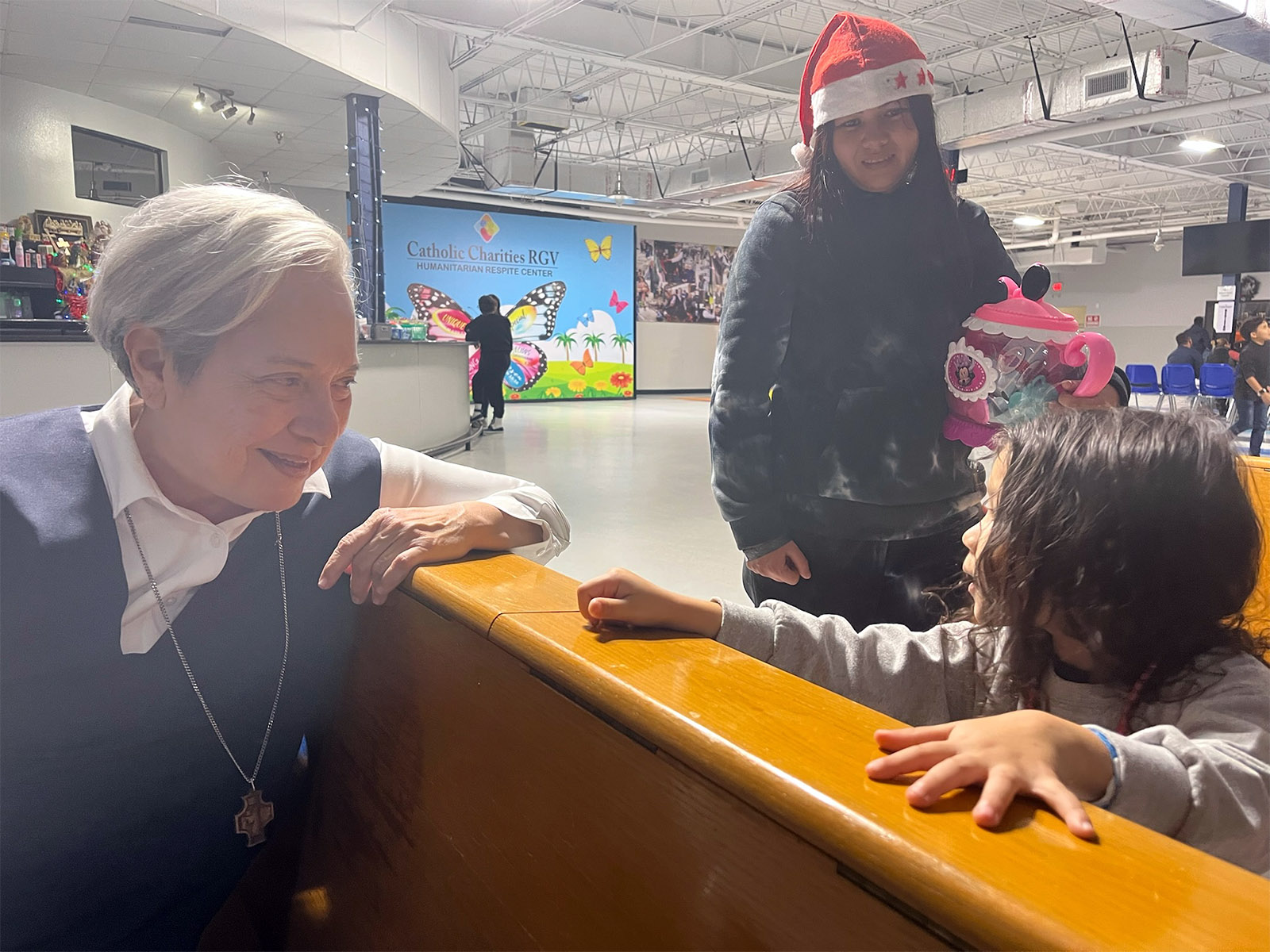
FILE - Sister Norma Pimentel, left, speaks with a child at the Catholic Charities of the Rio Grande Valley Humanitarian Respite Center in McAllen, Texas, Dec. 12, 2024. (RNS photo/Aleja Hertzler-McCain)
Aleja Hertzler-McCain
December 12, 2025
RNS
(RNS) — The Department of Homeland Security has moved to bar Catholic Charities of the Rio Grande Valley from receiving federal funds for six years, targeting one of the nation’s most prominent Catholic Charities affiliates and its internationally known executive director, Sister Norma Pimentel, a Missionaries of Jesus sister named one of Time magazine’s 100 most influential people of 2020 and dubbed by media outlets as Pope Francis’ favorite nun.
DHS is accusing the Brownsville, Texas-based nonprofit of submitting inconsistent migrant data and billing the government for services provided to migrants beyond the federal 45-day limit, according to reporting by Fox News Digital on Nov. 27, citing exclusive DHS documents shared with the outlet.
In a Nov. 28 statement, Catholic Charities of the Rio Grande Valley confirmed they are facing a temporary suspension of federal funding and said, “all funding provided by DHS was used to care for individuals who were brought to CCRGV by U.S. Customs and Border Protection.”
The DHS documents reported by Fox show that the agency is seeking to bar Catholic Charities of the Rio Grande Valley from federal funds for six years, significantly beyond the standard three years. They also say that Catholic Charities of the Rio Grande Valley has 30 days to respond to the proposed debarment from receiving federal funds.
“CCRGV is committed to compliance with federal grant requirements and will work expeditiously with DHS to resolve this matter,” the organization wrote. “CCRGV also remains committed to serve each person who comes seeking our help with respect and compassion.”

FILE – Migrants seeking asylum in the United States wait for humanitarian assistance and relief at Catholic Charities in McAllen, Texas, Jan. 18, 2025. (AP Photo/Eric Gay, file)
RELATED: Threats to Catholic Charities staffers increase amid far-right anti-migrant campaign
The DHS letters to Catholic Charities of the Rio Grande Valley, as shared by Fox, accuse Pimentel of breaking the trust the government had placed in her to manage large amounts of federal money. The letter also invokes language specific to Catholic social teaching to defend the Trump administration’s approach to immigration policy.
“Illegal mass migration is itself offensive to human dignity and it dramatically increases human and drug trafficking,” wrote acting general counsel Joseph Mazzara. “It, in fact, breaks the bonds of subsidiarity, wherein a nation must first serve those closest: its own citizens.”
While “human dignity” and “subsidiarity” are common terms within Catholic social teaching, the letter appears to be signaling an argument made by Vice President JD Vance in defense of the administration’s immigration policy. “Ordo amoris,” Vance said, is a Catholic teaching that offers a model of tiered care, placing in descending order the love of family, then neighbor, community and then citizens of one’s own nation before the rest of the world — a definition Francis quickly refuted.
“Christian love is not a concentric expansion of interests that little by little extend to other persons and groups,” wrote Francis in a letter to U.S. bishops in February. “The act of deporting people who in many cases have left their own land for reasons of extreme poverty, insecurity, exploitation, persecution or serious deterioration of the environment, damages the dignity of many men and women, and of entire families, and places them in a state of particular vulnerability and defenselessness.”
Earlier this year, DHS sent a letter to local governments and nonprofits that had received Federal Emergency Management Agency grants for work with migrants, saying they “may be guilty of encouraging or inducing an alien to come to, enter, or reside in the United States,” and asking them to provide a list of the immigrants they had served and to sign an affidavit they had not violated human smuggling laws.
Those types of allegations prompted the U.S. Conference of Catholic Bishops to identify “the targeting of faith-based immigration services” as the first issue of five areas of critical concern in their religious liberty report released in January. And in November, the USCCB elected Brownsville, Texas, Bishop Daniel Flores, Pimentel’s boss and a strong advocate for migrant rights, as the conference’s vice president.
Catholic Charities’ migrant work, in particular, has long been a target by some Republicans and among fringe Catholic groups.
In 2021, Texas Rep. Lance Gooden accused nonprofits at the border of secrecy and framed their work with migrants as nefarious. In 2022, CatholicVote, a conservative advocacy group that has gained recent prominence after co-founder Brian Burch was named ambassador to the Holy See by President Donald Trump, filed a lawsuit seeking communication between the Biden administration and Catholic Charities of the Rio Grande Valley, accusing Catholic charities of “facilitating a record surge in illegal immigration.”
More recently in 2024, Texas Attorney General Ken Paxton, a Republican, cited similar accusations in seeking to depose Pimentel as part of a broader investigation into Catholic migrant shelters before a Hidalgo County judge denied the request.
Catholic Charities across the country said these types of accusations by politicians and far-right influencers have led to staffers receiving a flood of threatening phone calls.
Catholic Charities of the Rio Grande Valley is most well-known for their work with recently arrived migrants, but in a 2024 interview with RNS, Pimentel said the local Catholic Charities also does significant work responding to food insecurity and people struggling to pay rent and utility bills in the Diocese of Brownsville, which has a poverty rate of about 25%, more than twice the national average (11%).
The Diocese of Brownsville did not immediately respond to a request for comment about whether the proposed federal funding cuts would impact its work on poverty in the Rio Grande Valley. DHS also did not immediately respond to a request for comment, including a question about whether the agency would take action against other nonprofits.
In the Nov. 28 CCRGV statement, Pimentel said, “Those on the front lines of our humanitarian outreach know the work we do truly helps to restore human dignity.” She continued, “I take very seriously every single dollar entrusted to us.”

No comments:
Post a Comment