Donald Trump’s tariffs intensify strain on US farmers, Deere warns
Farming equipment giant is scaling back production at flagship tractor plant in Iowa
Deere is planning further job cuts in 2026, a company executive has said
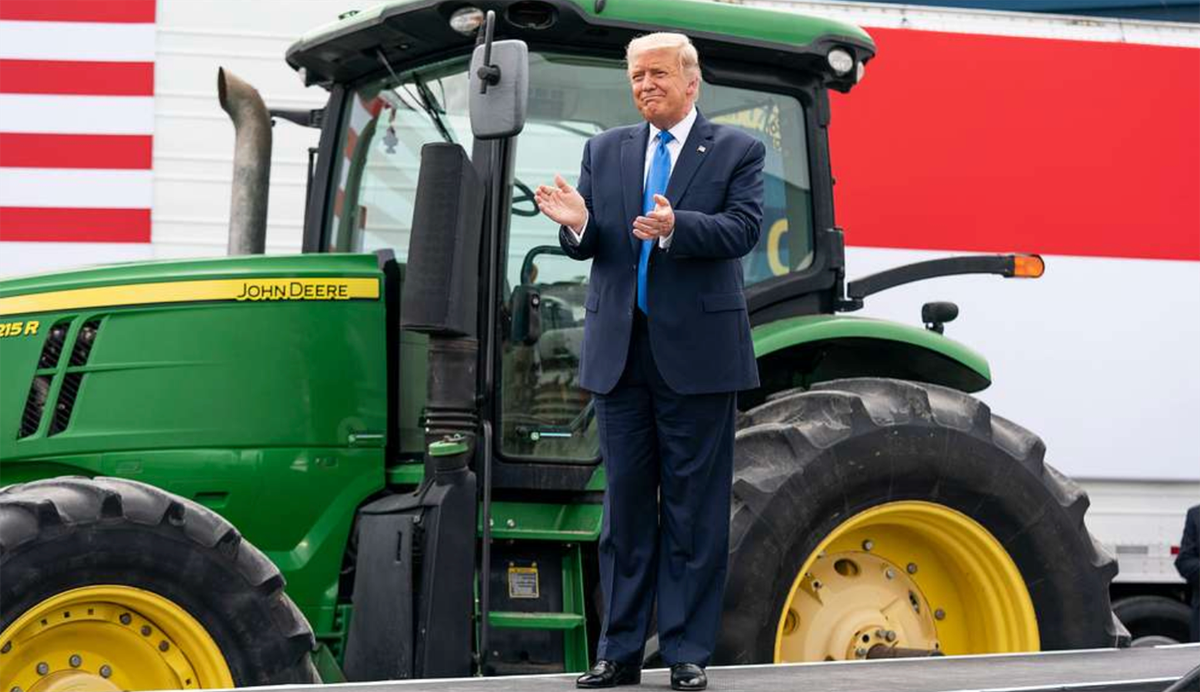
President Donald J. Trump applauds the crowd prior to delivering remarks in support of the Farmers to Families Food Box distribution program Monday, Aug. 24, 2020, at Flavor First Growers and Packers in Mills River, N.C.
(Official White House Photo by Shealah Craighead)
Deere warns on x (opens in a new window) Donald Trump’s tariffs intensify strain on US farmers, Tractor maker Deere has warned that US President Donald Trump’s tariffs are backfiring on American farmers, prompting cash-strapped producers to delay replacing ageing equipment.
Cory Reed, president of the company’s agriculture and turf division, told the Financial Times that demand for expensive farm equipment in the US is faltering as growers contend with weak crop prices, higher input costs and persistent trade uncertainty.
“The large ag business has seen the most pressure, and that’s largely in the North American market,” he said in an interview in New York, referring to its unit that sells high-horsepower tractors, combines and sprayers, along with its precision agriculture technology.
“Most of that downturn was our home market, here in the US. It wasn’t the European market and it wasn’t the South American market.”
The strains have pushed Deere to slash production at its flagship tractor plant in Waterloo, Iowa, with the group “building half as many tractors this year as we did two years ago”,
Reed said. Reed added that the world’s biggest farming equipment maker is anticipating further job cuts in 2026 after several rounds of lay-offs in recent years. He said: “Our US market has been the one under the most pressure . . . based on what’s happened with trade flows, what’s happened with tariffs and what’s happened with the escalating cost structure internally, as we’ve seen that market cycle down.”
The pressure stems from the disruption to agricultural trade. China, traditionally the largest buyer of US soyabeans, only resumed purchases of American beans last month after retaliating against new tariffs on Chinese goods. The pause created a supply glut that has weighed on farmer sentiment and pushed prices lower: US soyabeans are down about 40 per cent from their mid-2022 highs and corn almost 50 per cent.
The Trump administration on Monday announced a $12bn aid package for farmers — including $11bn in one-off payments to crop growers — after soyabean producers reported heavy losses and farm bankruptcies rose nearly 50 per cent over the first nine months of 2025.
While the White House said the assistance would provide “much-needed certainty”, growers warned it would not fully offset months of depressed prices and disrupted trade.
Reed reiterated guidance that sales in Deere’s large agricultural machinery business are expected to fall 15 to 20 per cent in its 2026 fiscal year. Deere’s overall net income fell 29 per cent to $5bn in the year to November 2, and it expects profits to weaken further to between $4bn and $4.75bn in 2026. Stress across the farm belt is deepening.
The Federal Reserve Bank of Chicago said loan-repayment rates in the Midwest fell for the eighth consecutive quarter in the three months to September, while nearly half of surveyed agricultural lenders expect more forced sales or liquidations of farm assets this winter.
With crop prices down, many growers are unwilling to commit to six-figure machinery purchases, opting instead to extend the life of existing equipment. Reed said used inventories, which had swelled over the past two years, had only recently begun to clear. “Customer uncertainty” had led to muted demand, said Reed.
“If you’re a farmer and you’re trying to make a capital equipment decision, and you’re not sure what exactly your export market is, [you’re less likely to buy].” Tariffs have also pushed up manufacturing costs.
Duties on steel and aluminium have lifted US steel prices, even for manufacturers sourcing materials domestically. Deere expects tariffs to impose a $1.2bn pre-tax hit in 2026, double the $600mn absorbed this year, with the burden running at roughly $300mn a quarter, according to its latest guidance.
Trump singled out Deere’s Mexico business during his presidential campaign in 2024, threatening a 200 per cent tariff on equipment brought into the US if production moved south. Reed said the episode highlighted how closely Deere’s US and Mexican plants were tied and forced a rethink of its manufacturing footprint.
The company is still investing on both sides of the border, including more than $20bn in the US. Recommended The Big Read The controversial return of Brazil’s billionaire beef barons Tariffs have also undermined the competitiveness of US-built equipment overseas.
“One in four of our large tractors we build in the US get exported to places like Europe or Canada,” Reed said. “That’s put pressure on the competitiveness of our cost structure going into those parts of the world. So we’ve had to aggressively go after cost.” Reed said he expected the downturn to bottom out in early 2026 “as some of that certainty returns”
. Trump’s bailout package, lower interest rates, a new bioethanol policy and signs of improving agricultural trade flows — including more grain exports and firmer domestic consumption — were “positive indicators”, he said. But restoring predictable market access through trade deals would be decisive: “Getting the free flow of commodities back out of the US into the global market.”
'Pathetic': Farmer unloads on 'Republican sycophants' in blistering op-ed
Adam Lynch
December 11, 2025
RAW STORY
Ben Palen — a Kansas native and a fifth-generation farmer and agriculture consultant — blasted President Donald Trump’s repeated tactic of putting farmers in distress and then dangling tax-funded salvation before them and hungry developers.
“[T]he Trump administration will provide several billion dollars in bailouts to farmers, with an emphasis on corn and soybean growers,” Palen wrote in the Kansas Reflector. “... Predictably, political dances followed the announcement, with various farm groups issuing statements supporting release of this money.”
“It’s pathetic,” Palen wrote. “It’s especially so when the Republican sycophants who represent Kansas farmers fall all over themselves to pay homage to Trump. How about some honest conversations about what this regime has done to American farmers via a patchwork of actions that show little understanding of international trade and so many other issues?”
Palen said there is no Republican “representative” from Kansas who is speaking the truth about the “folly from Washington D.C.,” like the damage Trump does to rural hospitals or the fact that people are going hungry because of the administration's policies. Meanwhile, farmers “are receiving just a few breadcrumbs."
"The fundamental challenges of trade policy remain unsolved, and our competitors are gleeful as they take market share from U.S. farmers," he wrote.
“The peril in farm country is real,” Palen warned. “In less than 12 months, damage done to Kansas farmers and their peers across the nation is only just beginning to be felt. This latest bailout completely fails to address the underlying issues. Again, I will ask Kansas politicians: When are you going to do your job for the people who voted for you?”
Palen lamented that those same politicians are eager to spend millions of dollars and expend state resources to woo the Kansas City Chiefs to a new stadium and the development of "entertainment districts."
“Let’s not kid ourselves,” said Palen. “Regardless of whether these deals are funded with grants, contributions from donors, tax incentives or other methods, there are adverse economic and social consequences often overlooked. … These large sums of money could be better spent. How about fixing crumbling infrastructure? How about encouraging companies to bring good-paying manufacturing jobs to the area? In the case of [Kansas University], how about big money donors helping students afford the high cost of an education, instead of being so focused on having one’s name on a sports venue?”
“Our society has some strange priorities. Maybe it’s time to focus on taking care of what we have instead of pouring enormous sums into brand new, shiny buildings,” Palen added.
Read Palen's column in the Kansas Reflector here.

No comments:
Post a Comment