By Ethan Woolf
Published 11 December, 2025
First published at ROAPE.
On the 31st of October 2025, a fifty-year struggle for the self-determination of Western Sahara was quietly buried under UN Security Council Resolution 2797 (2025). By endorsing Morocco’s “autonomy plan,” granting limited self-rule under Moroccan sovereignty, the United Nations legitimised an occupation that began when decolonisation was still part of its own moral vocabulary.
The autonomy plan proposed by Morocco in 2007 grants administrative powers to local Saharawi institutions but keeps control of defence, security, natural resources, and foreign policy firmly in Rabat’s hands. In effect, it transforms a decolonisation question into a matter of internal governance. By recognising this framework as “realistic,” the UN has sidelined the referendum it once promised and accepted a model where the occupied administer themselves under the occupier’s flag.
Only a year earlier, UN envoy Staffan de Mistura had proposed partitioning Western Sahara, a sign of how far the peace process had drifted from its original promise. His warning that a continued stalemate might make the UN irrelevant came just as Washington was scaling back funding for peacekeeping. Since the second Trump Administration, the United States has treated the UN as a service provider, paying only for what fits its agenda and shelving anything that requires time, conviction, or principle.
The Saharawi people have been waiting for a referendum since 1975, when a UN visiting mission confirmed “overwhelming support for self-determination.” That same year Morocco and Mauritania filed territorial claims, which the ICJ ruled that no sovereignty existed between them and the land. Days later, ignoring both the UN and ICJ, King Hassan II sent 350,000 settlers south in what became the Green March. Spain, collapsing under Franco’s illness, signed the Madrid Accords, abandoning its colony without decolonising it. What followed was a sixteen-year war that pushed nearly 200,000 Saharawi into exile in the camps of Tindouf, while Morocco entrenched its rule over the west.
The 1991 ceasefire brokered by the UN resurrected a fragile hope through the creation of MINURSO (Mission for the Referendum in Western Sahara). Its name promised what its structure denied. Unlike the UN missions in Namibia, East Timor, or Kosovo, MINURSO had no authority to build institutions or monitor rights. It was never meant to prepare a state, only to preserve a stalemate. By the time it deployed, most of Western Sahara was already sealed off behind the berm, a 2,700-kilometre wall of sand, mines, drones, separating the occupied, resource-rich west from the barren “liberated zone.” Three decades of UN inaction has allowed Morocco to turn Western Sahara into one of the most securitised regions in the world. With many western economies, notably Security Council members like France investing in multibillion projects.
Over time the language of decolonisation was replaced by the language of convenience. “Self-determination” became “a mutually acceptable solution.” “Occupation” became “dispute.” The UN learned to repeated its promise of self-determination but never delivered.
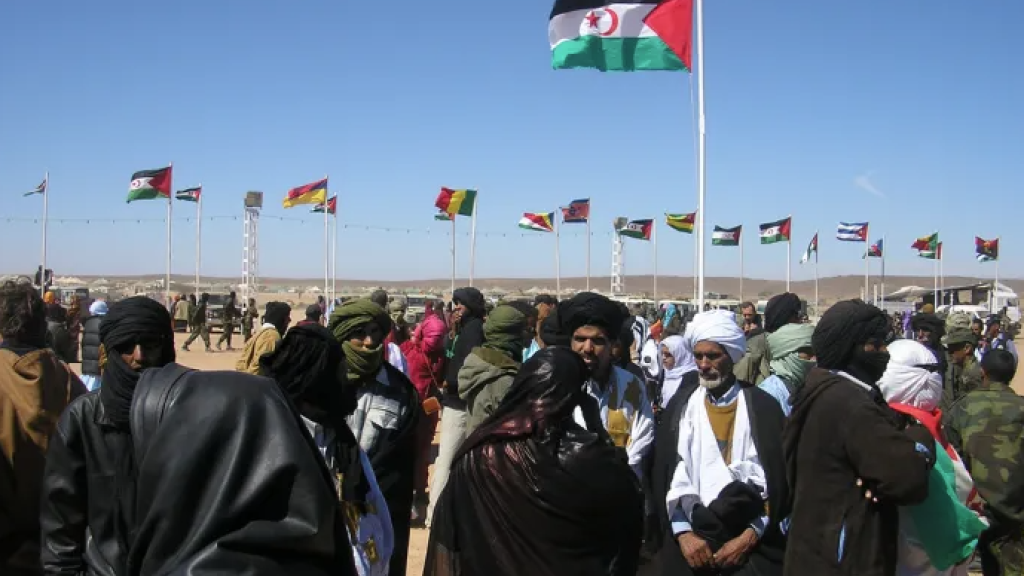
Meanwhile, the Polisario Front, born out of nomadic kinship and socialist ideals, built a functioning state-in-exile. In the camps, women lead local assemblies and organise distribution networks; teachers and medics sustain a society in suspension. The Saharawi offered the UN the rarest thing in peace-building: Readiness and a committed local population, yet their example was ignored.
Resolution 2797 follows the same logic that has come to define the new diplomacy: the quick fix disguised as peace. It mirrors the Trump administration’s habit of declaring conflicts “solved” through signatures rather than substance. The recent “peace” agreements on Gaza followed the same script: transactional arrangements negotiated without the participation of those being victims of genocide. Private U.S. and Israeli companies were granted control of reconstruction and aid distribution, turning humanitarian relief into a profit-sharing scheme. Western Sahara now faces the same hollow model: an autonomy plan designed not to resolve a colonial question but to stabilise a market. In both cases, the language of peace masks the outsourcing of responsibility, which has reduced the UN’s role is to mere certification.
In addition to the United Nations betraying its commitment to decolonisation, the endorsement of Morocco’s sovereignty over Western Sahara risks unsettling a fragile balance across the Maghreb. Algeria, which hosts the Saharawi government-in-exile and the Polisario Front, interprets the resolution as an affront to international. By validating Morocco’s territorial claims, the UN could indirectly revive the notion of “Greater Morocco,” an irredentist idea that historically included parts of Mauritania, Mali, and western Algeria, over which both countries already went to war in 1963. In a region already strained by arms races, energy competition, and the collapse of Sahelian security structures, such validation is can act as kindling for further conflcits. The Sahara, once treated as a remote question of decolonisation, could quickly become a continental one, where European energy deals, Moroccan militarisation, and Algerian sovereignty intersect. What the UN calls “stability” may in fact be the prelude to another borderless conflict.
What remains most troubling is that it will never be truly known what was lost. MINURSO was the only peacekeeping mission in recent history without a human rights mandate. No systematic monitoring was ever carried out in the occupied territories; no record exists of disappearances, repression, or cultural erasure. Reports from NGOs and exiles show clear indicators of censorship, arbitrary detentions, and the destruction of nomadic livelihoods, but there is no official memory of what occupation has meant. When the UN now endorses Morocco’s “autonomy plan,” it does so blindfolded, enforcing a silence it helped create. The Saharawi identity that survives in exile may one day fade from the landscape it once defined. The tragedy is that the world’s longest unresolved decolonisation case will end without evidence of what was taken. In refusing to look, the UN has made forgetting a condition of peace.
Western Sahara is not an anomaly; it is the logical outcome of a diplomacy that values speed over substance. The UN’s endorsement of Morocco’s plan marks a shift from the patient pursuit of justice to the management of appearances. What was once a promise of decolonisation has been replaced by crisis administration while peace has been reduced to paperwork. The Saharawi have endured half a century of waiting, not because their cause was unclear, but because it was inconvenient. Each new resolution repeats the same vocabulary of “realism” and “stability,” words that now mean little more than surrender. Western Sahara’s fate reveals what diplomacy has become a choreography of quick fixes that seeks closure without repair, and silence where accountability should stand. If the UN’s purpose was once to end empire, its legacy here is to manage its remains.
Ethan Woolf is an independent researcher and writer affiliated with King’s College London where he earned his Masters in Conflict, Security and Development. He currently collaborates with Global Weekly as OSINT analyst for the East Africa Desk.
Western Sahara Morocco Africa

No comments:
Post a Comment