Putin orders building of North Pole ice base
The Artur Chilingarov Ice Base will be located on an ice floe and house researchers and tourists who are ready to pay a minimum of €40,000 for a five-day visit.
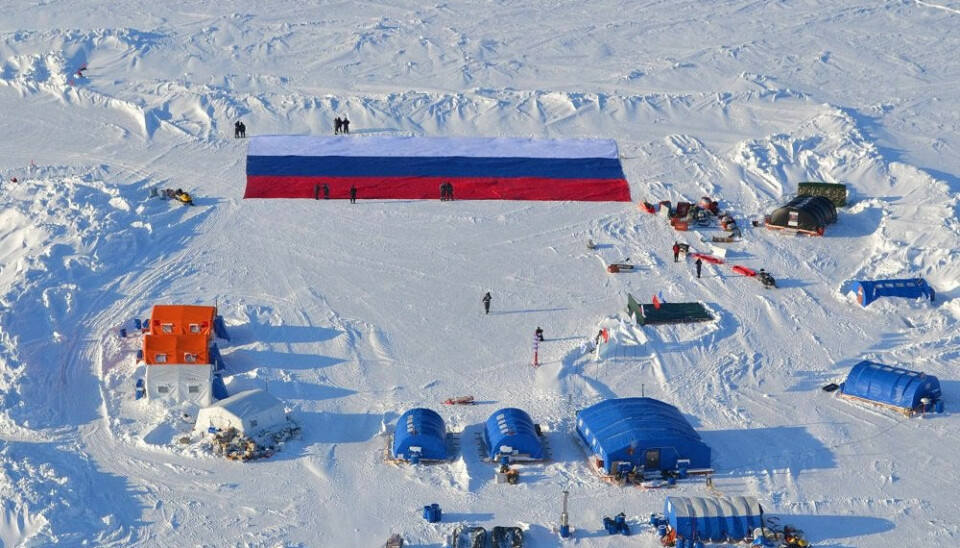
Dictator Putin commissions his government to participate in efforts to build an ice camp on the North Pole. Photo: Artur Chilingarov Ice Camp on Telegram
Atle Staalesen
16 December 2025
16 December 2025
BARENTS OBSERVER
The decree signed by the Russian dictator on December 15 orders the government to participate in the establishment of a North Pole base.
The base is to be developed in cooperation with the Russian Geographical Society and the Academy of Sciences. The decree follows Putin's participation in the Geographical Society's congress in October this year.
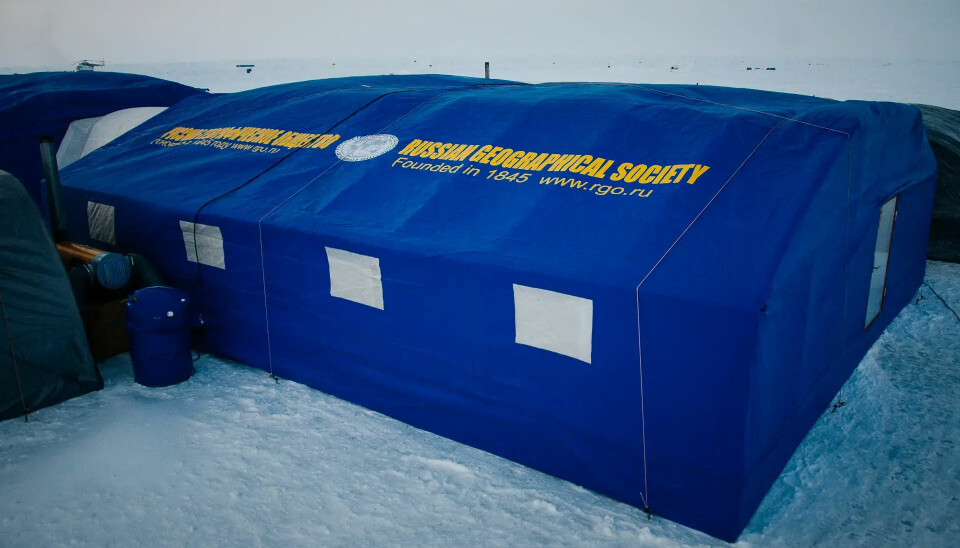
The Russian Geographical Society is one of the main organisers of the Artur Chilingarov Ice Base. Photo: northpolecamp.ru
Russia has a long tradition of organising research expeditions on drifting Arctic ice. However, it has become increasingly difficult to find ice floes solid enough to hold the research stations. The last “real” ice station, the “North Pole-40”, was established in October 2012, and had to be evacuated in May 2013, because the ice floe the base was placed on started to break apart.
For many years, a group of Russian businesspeople also organised the Barneo Ice Camp. The camp was built near the North Pole. Because of the unstable ice conditions, the last Barneo camp was held in 2018. Nevertheless, the organisers say that they intend to set up the camp in 2026.
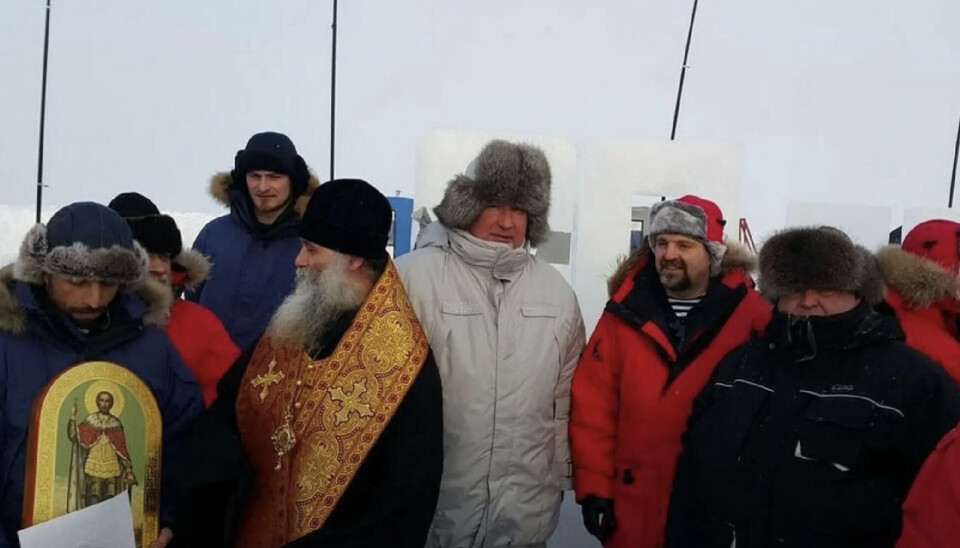
Visitors to the Barneo Ice Camp in April 2015: Russia's deputy prime minister Dmitri Rogozhin (in white jacket) and Bishop Iyakov of Naryan-Mar. Photo: From the archive
It is not clear whether the Artur Chilingarov Ice Base will interact with the Barneo Camp. It is also an open question whether it will be possible to build the camp at all because of the vanishing sea ice.
According to the Artur Chilingarov Ice Base website, a five-day visit costs a minimum of 3,7 million rubles (€40,000). All visits are due to take place in April 2026.
Artur Chilingarov was a famous Soviet-Russian explorer who died in 2024.
Putin's participation at this year's congress of the Russian Geographical Society showed a major level of Kremlin support to the expansionist efforts of the Society.
During the congress, prominent members of the Russian elite discussed initiatives aimed at the Arctic as well as the occupied parts of Ukraine.
In his address, the Russian dictator highlighted the role of the Geographical Society in territorial issues and said that 2027 would be declared the 'year of geography.'
“Given the contribution made by our geographers throughout history to strengthening the state and the paramount importance of geographical science, I ask the government to consider declaring 2027 the Year of Geography,” the Russian ruler said.
"This is important for us from a political point of view,” he explained, and emphasized that "the main event of the year will be consolidation of maps — new maps — of the Russian Federation.”
Putin: “I am confident that the new icebreaker Stalingrad will bear this proud name with dignity”
The keel-laying ceremony for the nuclear-powered icebreaker Stalingrad took place at the Baltic Shipyard in St. Petersburg

The Stalingrad will be painted in the colours of the Russian flag. On its front, the icebreaker will get a painting of the colossal war memorial sculpture Rodina-mat' zovyot! (The Motherland Calls) erected to commemorate the casualties of the battle of Stalingrad. Illustration: Rosatomflot
Thomas Nilsen
18 November 2025 -
Names from geography to mass murderers
When Russia in 2013 laid down the first of the new generation icebreakers, the Arktika, the decision was made to give all vessels geographical names from the northern regions.
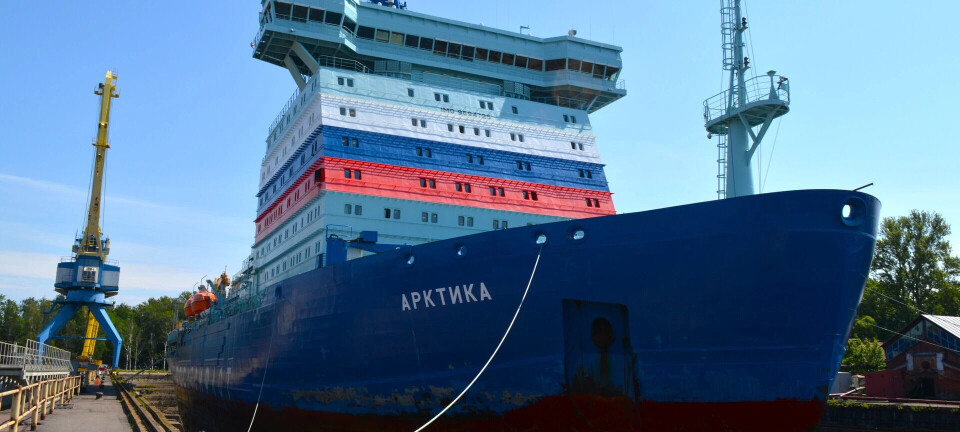
Nuclear icebreaker had to sail all to St. Petersburg for basic hull work as Russia's lacks northern dock
That policy changed with the full-scale war against Ukraine, and it was decided that the next two icebreakers to be built should carry the names of the Soviet Union's two dictators and mass-murderers.
The Kamchatka became Stalingrad, and the Sakhalin was renamed to Leningrad.
Also, the two last icebreakers with Soviet hero city names are to be painted differently than the previous vessels. The Leningrad and Stalingrad will be painted in the colours of the Russian flag, and both will have a huge image of a Soviet-style World-War II statue from the relevant city painted on its front.
Stalingrad was officially renamed Volgograd in 1961 as part of the Soviet Union's "de-Stalinization" campaign to distance itself from the dictator Joseph Stalin.
"I am confident that the new icebreaker Stalingrad will bear this proud name with dignity. Operating in the harsh Arctic conditions, blazing a path through the ice, it will become yet another symbol of the talent, strength, and creative energy of our people, their ability to set and implement the most daring plans, and to persevere in the most difficult times," Vladimir Putin said in his video-transmitted speech to the construction yard in St. Petersburg.
Year-round navigation
The new generation icebreakers are powered by two RITM-200 nuclear reactors (2 × 175 MWt). Capable of breaking ice that is 2,8 meters thick or more, the goal is for Russia to provide for year-around sailings from the Kara Sea in the west to the Bering Strait in the east.
All Russia's nuclear-powered icebreakers are based at Atomflot, the service base in Murmansk.

Rosatomflot's service base is located in the northern part of Murmansk on the shores of the Kola Bay. Photo: Thomas Nilsen
The keel-laying ceremony for the nuclear-powered icebreaker Stalingrad took place at the Baltic Shipyard in St. Petersburg
The Stalingrad will be painted in the colours of the Russian flag. On its front, the icebreaker will get a painting of the colossal war memorial sculpture Rodina-mat' zovyot! (The Motherland Calls) erected to commemorate the casualties of the battle of Stalingrad. Illustration: Rosatomflot
Thomas Nilsen
18 November 2025 -
THE BARENTS OBSEVER
The Stalingrad will be the seventh icebreaker in the Project 22220 series.
The Arktika, Ural, Sibir and Yakutia are already sailing in Arctic waters, breaking the ice for petroleum tankers and other vessels sailing along the Northern Sea Route. The two icebreakers Chukotka and Leningrad are under construction at the Baltic Shipyard and are expected to be delivered to Rosatomflot by the end of 2026 and 2028.
On November 18, Vladimir Putin attended the keel-laying ceremony for the Stalingrad, but only via video-link from one of his bunkers, likely in Moscow.
The icebreaker with the "glorious name of Stalingrad," Putin said, "is yet another tribute to the memory and unwavering courage of the defenders and residents of the Volga stronghold, the valour and bravery of the participants in the grand battle, which largely determined the outcome of not only the Great Patriotic War, but also the entire Second World War, and, without exaggeration, influenced the fate of humanity."
As a modern-day dictator, Putin plays on the collective memory of World War II to mobilise society to legitimise current policies by drawing parallels between WWII and present-day conflicts. In this way, the leader in the Kremlin aims to shape the young generation's understanding of sacrifice and war.
The Stalingrad will be the seventh icebreaker in the Project 22220 series.
The Arktika, Ural, Sibir and Yakutia are already sailing in Arctic waters, breaking the ice for petroleum tankers and other vessels sailing along the Northern Sea Route. The two icebreakers Chukotka and Leningrad are under construction at the Baltic Shipyard and are expected to be delivered to Rosatomflot by the end of 2026 and 2028.
On November 18, Vladimir Putin attended the keel-laying ceremony for the Stalingrad, but only via video-link from one of his bunkers, likely in Moscow.
The icebreaker with the "glorious name of Stalingrad," Putin said, "is yet another tribute to the memory and unwavering courage of the defenders and residents of the Volga stronghold, the valour and bravery of the participants in the grand battle, which largely determined the outcome of not only the Great Patriotic War, but also the entire Second World War, and, without exaggeration, influenced the fate of humanity."
As a modern-day dictator, Putin plays on the collective memory of World War II to mobilise society to legitimise current policies by drawing parallels between WWII and present-day conflicts. In this way, the leader in the Kremlin aims to shape the young generation's understanding of sacrifice and war.
Names from geography to mass murderers
When Russia in 2013 laid down the first of the new generation icebreakers, the Arktika, the decision was made to give all vessels geographical names from the northern regions.
Nuclear icebreaker had to sail all to St. Petersburg for basic hull work as Russia's lacks northern dock
That policy changed with the full-scale war against Ukraine, and it was decided that the next two icebreakers to be built should carry the names of the Soviet Union's two dictators and mass-murderers.
The Kamchatka became Stalingrad, and the Sakhalin was renamed to Leningrad.
Also, the two last icebreakers with Soviet hero city names are to be painted differently than the previous vessels. The Leningrad and Stalingrad will be painted in the colours of the Russian flag, and both will have a huge image of a Soviet-style World-War II statue from the relevant city painted on its front.
Stalingrad was officially renamed Volgograd in 1961 as part of the Soviet Union's "de-Stalinization" campaign to distance itself from the dictator Joseph Stalin.
"I am confident that the new icebreaker Stalingrad will bear this proud name with dignity. Operating in the harsh Arctic conditions, blazing a path through the ice, it will become yet another symbol of the talent, strength, and creative energy of our people, their ability to set and implement the most daring plans, and to persevere in the most difficult times," Vladimir Putin said in his video-transmitted speech to the construction yard in St. Petersburg.
Year-round navigation
The new generation icebreakers are powered by two RITM-200 nuclear reactors (2 × 175 MWt). Capable of breaking ice that is 2,8 meters thick or more, the goal is for Russia to provide for year-around sailings from the Kara Sea in the west to the Bering Strait in the east.
All Russia's nuclear-powered icebreakers are based at Atomflot, the service base in Murmansk.
Rosatomflot's service base is located in the northern part of Murmansk on the shores of the Kola Bay. Photo: Thomas Nilsen

No comments:
Post a Comment