Friday, December 26, 2025

A FAVOURITE XMAS SONG

MERRY CHRISTMAS MR. LAWRENCE 


While Bethlehem Holds First Full Christmas Since Genocide Began, Little to Celebrate in Gaza

“This year’s celebrations carry a message of hope and resilience for our people and a message to the world that the Palestinian people love peace and life.”


Children participate in a Christmas Mass at the Holy Family Parish in Gaza City, Gaza on December 21, 2025.
(Photo by Majdi Fathi/NurPhoto via Getty Images)

Julia Conley
Dec 24, 2025
COMMON DREAMS


With Gaza’s Christian population decimated by Israeli attacks and forced displacement over the past two years, those who remain are taking part in muted Christmas celebrations this week as the West Bank city of Bethlehem displays its tree and holds festivities for the first time since Israel began attacking both Palestinian territories in October 2023.

Middle East Eye reported that while Cardinal Pierbattista Pizzaballa, the Latin patriarch of Jerusalem, led a Christmas Mass at Holy Family Church in Gaza City on Sunday and baptized the newest young member of the exclave’s Christian community, churches in Gaza have been forced this year to keep their celebrations indoors as the Israel Defense Forces (IDF) have continued its attacks despite a “ceasefire” that Israel and Hamas agreed to in October.

“Churches have suspended all celebrations outside their walls because of the conditions Gaza is going through,” Youssef Tarazi, a 31-year-old Palestinian Christian, told MEE. “We are marking the birth of Jesus Christ through prayer inside the church only, but our joy remains incomplete.”

“This year, we cannot celebrate while we are still grieving for those killed, including during attacks on churches,” Tarazi said. “Nothing feels the same anymore. Many members of our community will not be with us this Christmas.”

The IDF, Israeli officials, and leaders in the US and other countries that have backed Israel’s assault on Gaza have insisted the military has targeted Hamas and its infrastructure, but Christian churches are among the places—along with schools, refugee camps, hospitals, and other civilian buildings—that have been attacked since 2023.

Our people-powered journalism cannot survive without you

Your support allows Common Dreams to continue covering the stories and amplifying the voices that the corporate media never will. Make a tax-deductible year-end gift to ensure we can sustain the reporting needed to meet the challenges of 2026.


At least 16 people were killed just days into the war when the IDF struck the Church of Saint Porphyrius, one of the oldest churches in the world. In July, Israel attacked the only Catholic church in Gaza, killing two women and injuring several other people.

Palestinian officials say at least 44 Christians are among more than 71,000 Palestinians who have been killed since Israel began its assault in retaliation for a Hamas-led attack. Some have been killed in airstrikes and sniper attacks while others are among those who have died of illnesses and malnutrition as Israel has enforced a blockade that continues to limit food and medical supplies that are allowed into Gaza.

United Nations experts, international and Israeli human rights groups, and Holocaust experts are among those who have called Israel’s assault a genocide, and the International Criminal Court issued a warrant last year for the arrest of Israeli officials including Prime Minister Benjamin Netanyahu for war crimes and crimes against humanity in Gaza.

George Anton, the director of operations for the Latin patriarchate in Gaza, estimated that the number of Christians killed so far is at least 53, with many dying “because we could not reach hospitals or provide medicine, especially elderly people with chronic illnesses.”

In the past, Muslims in Gaza have joined Christian neighbors for the annual lighting of Gaza City’s Christmas tree and other festivities, and churches have displayed elaborate lights and decorations in their courtyards for the Christmas season.

“We decorated our homes,” Anton told MEE. “Now, many homes are gone. We decorated the streets. Even the streets are gone... There is nothing to celebrate.”

“We cannot celebrate while Christians and Muslims alike are mourning devastating losses caused by the war,” he added. “For us, the war has not ended.”

Hilda Ayad, a volunteer who helped decorate Holy Family Church earlier this month, told Al Jazeera that “we don’t have the opportunity to do all the things here in the church, but something better than last year because last year, we didn’t celebrate.”

About 1,000 Christians, who were mainly Greek Orthodox or Catholic, lived in Gaza before Israel’s latest escalation in the exclave began in 2023.

Greek Orthodox Church member Elias al-Jilda and Archbishop Atallah Hanna, head of the church’s Sebastia diocese in Jerusalem, told the Washington Post that the population has been reduced by almost half. More than 400 Christians have fled Gaza in the last two years. Those who remain have often sheltered in churches, including the ones that have sustained attacks.

Al-Jilda told the Post that this year’s celebrations “will not be full of joy, but it is an attempt to renew life.”

In Bethlehem in the West Bank, officials have sought to send a message to the world this Christmas that “peace is the only path in the land of Palestine,” Mayor Hanna Hanania told Anadolu Agency.

“This year’s celebrations carry a message of hope and resilience for our people and a message to the world that the Palestinian people love peace and life,” he said.

At Al Jazeera, Palestinian pastor Rev. Dr. Munther Isaac wrote that “celebrating this season does not mean the war, the genocide, or the structures of apartheid have ended.”

“People are still being killed. We are still besieged,” he wrote. “Instead, our celebration is an act of resilience—a declaration that we are still here, that Bethlehem remains the capital of Christmas, and that the story this town tells must continue.”

“This Christmas, our invitation to the global church—and to Western Christians in particular—is to remember where the story began. To remember that Bethlehem is not a myth but a place where people still live,” Isaac continued. “If the Christian world is to honor the meaning of Christmas, it must turn its gaze to Bethlehem—not the imagined one, but the real one, a town whose people today still cry out for justice, dignity, and peace.”

Festive lights, security tight for Christmas in Damascus

By AFP
December 24, 2025


Syria's Christian community is believed to have shrunk from one million in 2011, when the war began, to around 300,000 today, with many seeking refuge abroad
 - Copyright TURKISH DEFENCE MINISTRY/AFP HANDOUT

Maher al-Mounes

Christmas lights illuminate Damascus’s Old City while government forces patrol its shadows as security fears haunt Syria’s Christian community.

They recall the shooting and suicide attack in June at the Saint Elias church in the Syrian capital that killed 25 people and wounded dozens more.

“People are going home early, and are afraid,” said Tala Shamoun, 26, a university student who was visiting a Christmas market with family and friends.

Damascus has seen crime including robberies and kidnappings, she said, but the attack on the church “was the biggest tragedy”, she told AFP.

Syria’s authorities blamed the Islamic State jihadist group, while a little-known Sunni Muslim extremist group claimed responsibility.

The Islamists that ousted ruler Bashar al-Assad last year have reaffirmed their commitment to coexistence among all of Syria’s religious groups, vowing to involve everyone in the transition.

But earlier this year, the country’s Alawite heartland saw sectarian massacres, while Druze-majority areas in the south were hit by major clashes.


– ‘Security plan’ –


Interior ministry forces searched some pedestrians or stopped people on motorbikes in the Old City.

At one of the district’s main entrances, an armed member of the government security forces was holding a walkie-talkie and a map of where his personnel were deployed.

“We’ve put a security plan in place that includes several districts and areas in the capital, in order to ensure the safety of all citizens,” he said on condition of anonymity.

“It is the state’s duty to protect all its people, Christian and Muslim, and today we are doing our duty to protect the churches and secure people’s celebrations,” he added.

Ousted ruler Assad, himself an Alawite, had long presented himself as a protector of minorities, who were the target of attacks during Syria’s war, some of which were claimed by jihadists.

Syria’s Christian community is believed to have shrunk from one million in 2011, when the war began, to around 300,000 today, with many seeking refuge abroad.

In the Old City, home to a small but vibrant Christian community and several important churches, red baubles hang from some trees, shopkeepers have put up Christmas decorations and street vendors peddle warm chestnuts.

So-called neighbourhood committees are also providing additional security, with dozens of local Christians protecting churches in coordination with government forces.


– ‘Syria deserves joy’ –


Fuad Farhat, 55, from the area’s Bab Touma district, was supervising the deployment of several unarmed, black-clad Christian men with walkie-talkies in front of the churches.

Many people fear that Christmas crowds could heighten security risks, but with the additional measures “they feel safer and are more comfortable going out”, he said.

“We have been taking steps to protect those celebrating in the Christian neighbourhoods” to avoid any problems, in coordination with the security forces, he said.

University student Loris Aasaf, 20, was soaking up the Christmas atmosphere with her friends.

“Syria deserves joy and for us to be happy, and to hope for a new future,” she said.

“All sects used to celebrate with us, and we hope to see this in the coming years, in order to rebuild Syria,” she added.

Near the Saint Elias church which saw June’s deadly attack, government security forces cordoned off entry and exit areas with metal barriers, while heavily armed personnel were searching anyone entering.

Church-goers lit up a tree decorated with stars bearing the image of those killed in June.

“Christmas this year is exceptional because of the pain and sorrow we went through,” said housewife Abeer Hanna, 44.

“The security measures are necessary because we are still afraid,” she said.

Nearby, Hanaa Masoud lit a candle for her husband Boutros Bashara and other relatives who were among those killed in the attack.

“If we go to church and get blown up, where can we find safety?” she said, choking back tears.
CHRISTIAN CRUSADER
Trump announces Christmas night strikes against ISIS in Nigeria

Robert Davis
December 25, 2025 
RAW STORY


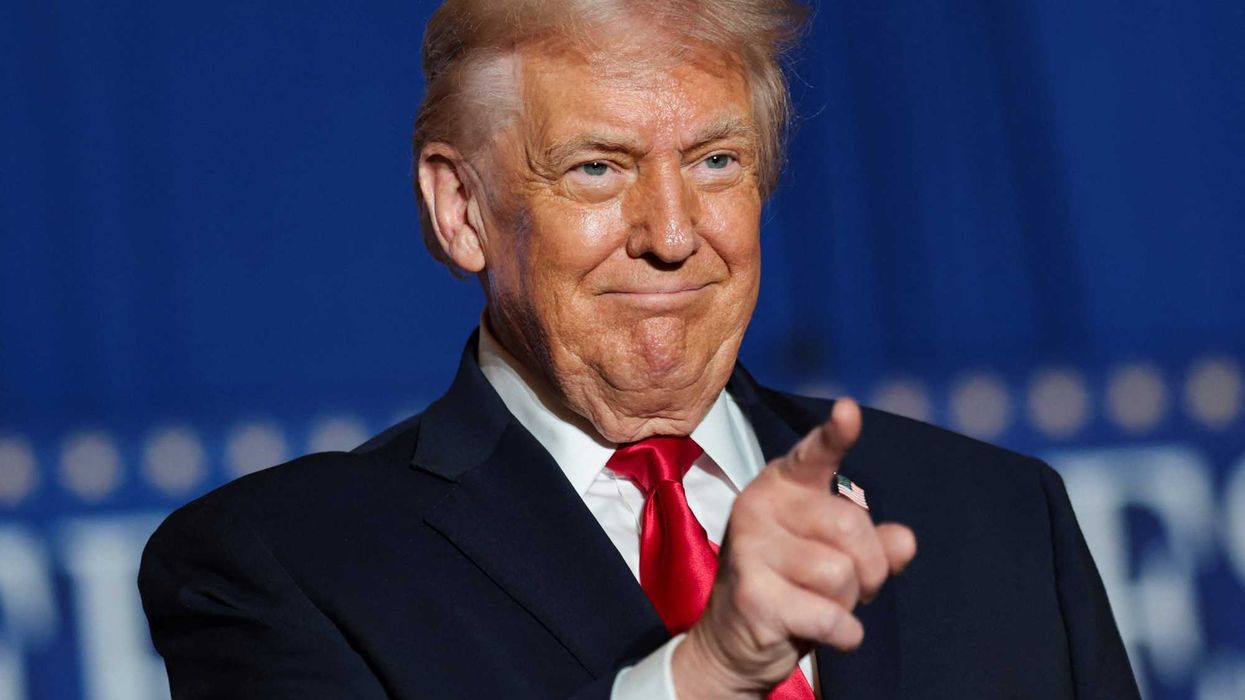
U.S. President Donald Trump takes part in a Christmas Eve dinner in the ballroom of his Mar-a-Lago club in Palm Beach, Florida, U.S., December 24, 2025. REUTERS/Jessica Koscielniak


President Donald Trump announced on social media that the U.S. conducted a strike against ISIS in Nigeria on Christmas night.

"Tonight, at my direction as Commander in Chief, the United States launched a powerful and deadly strike against ISIS Terrorist Scum in Northwest Nigeria, who have been targeting and viciously killing, primarily, innocent Christians, at levels not seen for many years, and even Centuries!" Trump wrote on Truth Social. "I have previously warned these Terrorists that if they did not stop the slaughtering of Christians, there would be hell to pay, and tonight, there was."

"The Department of War executed numerous perfect strikes, as only the United States is capable of doing," the post continued. "Under my leadership, our Country will not allow Radical Islamic Terrorism to prosper. May God Bless our Military, and MERRY CHRISTMAS to all, including the dead Terrorists, of which there will be many more if their slaughter of Christians continues."

The Christmas night strikes in Nigeria are just the latest in a long series of strikes the Trump administration has conducted. According to reports, the administration has struck 22 alleged drug boats in international waters and killed nearly 100 people. The administration has also bombed Iran's nuclear facilities, although experts questioned the premise for those strikes.


'We're being blindsided': Federal charity drive suffers historic losses under Trump


Alex Henderson
December 25, 2025
ALTERNET

A federal charity drive is reportedly facing hardship due to Trump's actions.

In 1961, President John F. Kennedy issued Executive Order 10927, which authorized the U.S. Civil Service Commission to authorize nonprofit solicitations from employees of the federal government. Then, in 1982, 10927 was replaced when President Ronald Reagan signed Executive Order 12353 and established the Combined Federal Campaign (CFC) — which would be overseen by the U.S. Office of Personnel Management (OPM).

The federal charity drive, according to Washington Post reporter Meryl Kornfield, has "raised more than $9 billion from federal government employees" over the years. But Kornfield, in an article published on Christmas Day 2025, reports that the program is "facing a steep decline in donations and other challenges just months after the Trump administration weighed canceling it altogether."

This year, according to Kornfield, the annual CFC "started later than expected because the Office of Personnel Management had paused planning in late August and for a time considered ending the initiative."

"OPM announced last week that it would extend the campaign through January," Kornfield explains, "but charities are worried that the drive won't be as effective — especially because the agency told its contracted organizers this week that their agreements would not be extended, according to two people familiar with the decision, who spoke on the condition of anonymity to share private discussions."


"The campaign is faring far worse than in previous years, buffeted not only by the loss of nearly 300,000 federal employees — part of the (Trump) Administration's government downsizing — but also, by this year's 43-day government shutdown," Kornfield added.

The Post reporter adds, "As of Saturday, [December 20], workers had contributed only $23 million. In each of the past three years, fundraising had topped $40.5 million by the same time, according to data obtained by The Washington Post."

Ann Hollingsworth, vice president of government affairs at the Nonprofit Alliance, is worried about what will happen with CFC in January.

Hollingsworth told the Post: "If the contractors in the final four weeks in January are not allowed to do their work, it's a question of how successful can we make the CFC campaign after we've already been hit with a delay because of the shutdown and are dealing with other constraints in the nonprofit community."

Retired federal worker and U.S. Air Force veteran Jennifer Ward, an organizer for the program, is also worried about CFC's well-being.

Ward told the Post: "The main concern that I have is that, come January, we can start off and have this great campaign for the next 31 days, but there's no outreach coordinator to ramp us up again. There’s no charity events that we can have. The resources are extremely limited, and if there’s no contracts, it's like we’re being blindsided.… and the charities can't do anything about it."

Read Meryl Kornfield's full Washington Post article at this link (subscription required).
ICYMI

'Impossible to take at face value': CBS's boss shredded for blocking '60 Minutes' story

Matthew Chapman
December 24, 2025 
RAW STORY


Bari Weiss (Photo via Michael Blake for Reuters)

The Atlantic's Jonathan Chait raked newly-installed CBS boss Bari Weiss over the coals for her controversial move to block the release of a "60 Minutes" report on horrific conditions at the foreign megaprison where President Donald Trump is shipping hundreds of migrants with no due process — and warned that her justifications for it are not credible in the slightest, given the context in which she was installed into the network in the first place.

"The year is 2029," wrote Chait. "President Alexandria Ocasio-Cortez, having spent years raging against Fox News as a propaganda organ whose very operation is illegal, has found a pressure point to control it. She enables its sale to owners who are friends of hers, and whose business depends on regulatory favors she has made a practice of doling out to allies. As the new editor in chief of Fox News, the owners installed Tim Miller, a skeptic of conservatism who has never previously worked in television news."

"But then AOC complains that her friends at Fox News aren’t moving fast enough, and the network is still running critical coverage of her. Days later, Miller kills a long-scheduled report showing how AOC may have flouted the Constitution in order to have people tortured," he continued. This, he argued, is exactly what happened here: the Trump administration fast-tracked a merger for CBS's parent company to put it in the hands of right-wing executives who are now interfering in their journalists' coverage.

And yet, he noted, even many Trump skeptics are giving Weiss the benefit of the doubt she does not deserve. For example, conservative commentator Noah Rothman defended the editorial decision in a lengthy write-up, without mentioning anywhere "the abuses of power — Trump’s insistence on favorable coverage from media-owning friends — that led to Weiss running the network. It focuses instead on the merits of her critique of the CECOT story."

"Weiss is following a long-standing instinct to turn every Trump abuse into a debate, a generosity she does not afford targets on the left," wrote Chait. "She herself has sometimes been a fierce and effective critic of Trump. Still, The Free Press, which she continues to edit while running CBS News, publishes obsessively and unremittingly negative coverage of New York Mayor-Elect Zohran Mamdani, but holds symposia on Donald Trump. In defending the administration’s actions as debatable, she has misrepresented just how heedless it has been with the Constitution."

"Even if Weiss’s objections were completely merited and followed procedure, it is impossible to take them at face value given the context in which she is operating," wrote Chait. "Weiss claims that the CECOT story fails to 'advance the ball' because many of its central facts have already been reported. This mania for insisting that every new story introduce breaking news was nowhere to be found when she was airing a town hall with Erika Kirk, Charlie Kirk’s widow, whose talking points have not exactly suffered from underexposure."

At the end of the day, Chait concluded, conservatives "may delight in the new editorial direction of CBS News, but they cannot defend the process that led to it. So they pretend it didn’t happen; offer narrow, pointillistic defenses of Weiss’s editorial pretext; and deftly dodge the authoritarianism that enabled it."
Pope's Christmas service includes 'unexpected gesture' seen as protest to key Trump policy

David McAfee
December 25, 2025 
RAW STORY

Pope Leo XIV conducts Mass in the Sistine Chapel at the Vatican, May 9, 2025. Vatican Media/Simone Risoluti ­Handout via REUTERS

Pope Leo XIV made an "unexpected gesture" at his Christmas service that is being taken as a dig at Trump's key policy.

The pope, who has been accused of making "pointed remarks" aimed at Trump in the past, gave a Christmas speech largely devoid of political references. But the issue of immigration crept in, as Reuters reports:

"Leo, celebrating his first Christmas after being elected in May by the world's cardinals to succeed the late Pope Francis, has a quieter, more diplomatic style than his predecessor and usually refrains from making political references in his sermons. In a later Christmas blessing, the pope, who has made care for immigrants a key theme of his early papacy, also lamented the situation for migrants and refugees who 'traverse the American continent'," the report states. "Leo, who has in the past criticized U.S. President Donald Trump's immigration crackdown, did not mention Trump. In a Christmas Eve sermon on Wednesday, the pope said refusing to help the poor and strangers was tantamount to rejecting God himself."

He also raised eyebrows when he reportedly stepped out of the church into bad weather to great those in attendance.

"Pope Leo’s Christmas celebrations began with an unexpected gesture of hospitality. Before the liturgy even started, the newly elected pontiff — the first American to lead the Church — walked out into St. Peter’s Square to welcome about 5,000 people standing under a cold downpour," according to another report. "The basilica was filled to its 6,000-person capacity, yet Leo made sure those stuck outside knew they weren’t forgotten. 'I admire and respect and thank you for your courage and your wanting to be here this evening,' he told them, praising their perseverance 'even in this weather'."


It continued:


"It was a small moment, but a telling one: the pope literally stepped beyond the comfortable confines of the church to be with people who had no room inside. That image set the stage for the message he would soon deliver in his homily."

Christopher Hale, a ’20 Democratic nominee for Congress, connected it to immigration.

"Midnight Mass at St. Peter’s Basilica was standing-room-only — and thousands stood outside in the cold rain. Before the liturgy began, Pope Leo stepped away from the altar and walked into the square to greet them. It wasn’t just an act of kindness. It was a visible sign of the homily to come: a society that shuts out migrants and the poor shuts out Christ," according to Hale.


That message was also shared by ex-GOP lawmaker and prominent Trump critic Barbara Comstock.


Italy fines Ryanair $300 mn for abuse of dominant position


By AFP
December 23, 2025


Ryanair said it would appeal the Italian fine, calling it 'bizarre' 
- Copyright AFP/File Jaime REINA

Italy’s competition authority said on Tuesday it had fined low-cost airline Ryanair more than 255 million euros ($300 million) for allegedly abusing its dominant position to block travel agencies’ access to its services.

Ryanair said in a statement that it would appeal the decision, calling it “bizarre” and “unsound”.

The move comes a day after the antitrust body fined US tech giant Apple 98 million euros, accusing it of abusing its dominant position in the mobile app market.

The AGCM said Irish carrier Ryanair used “an abusive strategy” that made it difficult for travel agencies to combine Ryanair flights with other services between 2023 and at least April 2025.

The strategy “aimed to block, hinder, complicate or make it more expensive (economically or technically) for travel agencies to purchase Ryanair flights on the ryanair.com website… whether in combination with flights offered by other airlines or other travel and insurance services,” the AGCM said.

“These practices compromised the ability of agencies to purchase Ryanair flights and combine them with flights from other airlines and/or additional travel services, thereby reducing direct and indirect competition between agencies.”

Ryanair is by far the biggest air carrier in Italy, with a market share of 31.7 percent according to Italy’s civil aviation agency — far ahead of Italian carrier ITA on 9.9 percent.

The company’s chief executive Michael O’Leary was quoted as saying that when Ryanair first started in 1985, 20 percent of ticket revenues went to travel agencies and distributors.

He said Ryanair “has passed on these 20 percent cost savings in the form of the lowest air fares in Italy and Europe”.

Italy fined Ryanair three million euros in 2019 for its policy of charging passengers for cabin baggage. The fine was eventually overturned by an administrative court.
World is ‘ready’ for a woman at helm of UN: Chile’s Bachelet tells AFP

By AFP
December 23, 2025


Chile's former president Michelle Bachelet believes it's time for a woman at the helm of the UN - Copyright AFP Raul BRAVO

Michelle Bachelet, a trailblazer for Latin America as its first woman to serve as defense minister and the first elected as Chilean president, now aims to become the UN’s first female secretary general, and says the world is “ready.”

The 74-year-old, who served two terms as Chile’s president, was nominated for the UN’s top job in September by her country’s outgoing leftist leader Gabriel Boric.

She is now seeking the backing of his elected successor, right-winger Jose Antonio Kast, who she met on Monday.

After that meeting, Bachelet told AFP “the world is ready” for a woman to take over and make “a different contribution through a different kind of leadership.”

If chosen, she said she would help the United Nations “modernize and become more efficient, more effective, and more transparent.”

The UN, 80 years old this year, has never had a woman at the helm and only one Latin American — Peruvian diplomat Javier Perez de Cuellar who served as secretary general from 1982 to 1991.

The post traditionally rotates between world regions, with Latin America next in line as Portuguese Antonio Guterres’s term comes to an end.

After serving her first term as Chilean president from 2006 to 2010, Bachelet became the first head of the then-newly created UN Women agency.

She served as Chile’s president again from 2014 to 2018, then as UN High Commissioner for Human Rights.

On the topic of growing tensions between Venezuela and the United States, which has deployed a massive naval force in the Caribbean, bombed alleged drug-smuggling boats and seized oil tankers, Bachelet said non-UN mediation may be the best option.

The presidents of Brazil and Mexico, Luiz Inacio Lula da Silva and Claudia Sheinbaum, have both offered to step in.

“It doesn’t always have to be the full General Assembly, the full Security Council. Probably when one of the countries involved in a conflict is a member of the Security Council and has veto power, that is often not the best place to seek a solution,” she said.

The United States is one of five permanent members of the council, with veto power.

“I think having such powerful mediators from the region… could be a solution, it could be a good response,” added Bachelet.

Three other Latin American women are in the running for the UN top job: Costa Rican Rebeca Grynspan, secretary-general of the UN Conference on Trade and Development; Mexican Environment Minister Alicia Barcena; and Barbados Prime Minister Mia Mottley.

The other candidate is International Atomic Energy Agency chief Rafael Grossi from Argentina.

UK Government waters down inheritance tax changes for farmers


Photo: Lois GoBe/Shutterstock:

Government plans to tax inherited farmland have been watered down following months of protests by farmers and concern from backbenchers.

The individual threshold for a 20% tax on inherited agricultural or business assets will be increased from £1 million to £2.5 million when introduced in April next year.

It comes after more than 20 Labour MPs from mostly rural constituencies abstained on the proposal in Parliament earlier this month, with Penrith and Solway MP Markus Campbell-Savours losing the party whip for voting against.

The increased threshold will halve the number of estates affected by the reform to the Agricultural Property Relief (APR), from 375 to 185.

Environment Secretary Emma Reynolds said: “Farmers are at the heart of our food security and environmental stewardship, and I am determined to work with them to secure a profitable future for British farming.

“We have listened closely to farmers across the country and we are making changes today to protect more ordinary family farms. We are increasing the individual threshold from £1 million to £2.5 million which means couples with estates of up to £5 million will now pay no inheritance tax on their estates.

“It’s only right that larger estates contribute more, while we back the farms and trading businesses that are the backbone of Britain’s rural communities.”

‘Reform will give peace of mind to farming families’

Chair of the Labour Rural Research Group and MP for Suffolk Coastal has welcomed the changes and said they represent a major boost for family farms and rural businesses.

She said: “This is a crucial reform that will give real peace of mind to farming families.

“By increasing the APR threshold to £2.5 million per person, we are recognising the true value of agricultural in rural Britain, and the importance of keeping farms in family ownership.

“For couples, the combined threshold of £5 million will make a transformative difference. It means fewer families facing impossible choices, and greater certainty that farms can continue to operate, invest, and contribute to our rural economy.

“This wouldn’t have been possible if the Government hadn’t listened to rural Labour MP colleagues in the Labour Rural Research Group, to farmers, and to industry. This move shows the government is fully committed to backing working farms and our countryside  – after years of successive failures under the Conservative government that brought farming to its knees.

“This is a big step that will go a huge way to back Britain’s working farms, whilst the government takes forward wider recommendations in Baroness Batters’ Farming Profitability Review.”

NFU President: ‘Common sense has prevailed’

The National Farmers’ Union (NFU), which fought a campaign against the changes to inheritance tax for farmers, said that the increase in thresholds would come as a “huge relief to many”.

NFU President Tom Bradshaw said: “While there is still tax to pay, this will greatly reduce that tax burden for many family farms, those working people of the countryside.

“I am thankful common sense has prevailed and government has listened. I have had two very constructive meetings with Prime Minister Sir Keir Starmer and dozens of conversations with Defra Secretary of State Emma Reynolds. She has played a key role underlining the human impact of this tax. These conversations have led to today’s changes which were so desperately needed. 

“From the start the government said it was trying to protect the family farm and the change announced today brings this much closer to reality for many. I’d like to thank the Prime Minister for recognising the policy needed amending and the Chancellor for bringing in the spousal transfer in the Budget. Combined this is a significant change.

“I would like to thank all those Labour backbench MPs that were contacted by farmers and growers and decided to stand by their constituents as demonstrated by the recent abstentions on the vote on Budget Resolution 50. 

“While small in number, it was a significant and brave move for many. We have spent the past year working with them and there’s no doubt their interventions behind the scenes have also played a huge role in securing today’s news. I would also like to thank all opposition parties for continuously raising the impacts of this proposed policy.”

Macron meets French farmers in bid to defuse anger over trade deal

By AFP
December 23, 2025


French farmers have been fuming over a litany of issues, including a trade deal under negotiation between the European Union and South American bloc Mercosur - Copyright AFP/File kena betancur

French President Emmanuel Macron on Tuesday met with farmers’ unions to discuss a controversial free trade deal and the government’s handling of a cow disease that has led to protests and roadblocks.

It was the first meeting between Macron and union leaders since the start of a protest movement against a mass cull of cows to contain the spread of nodular dermatitis, widely known as lumpy skin disease.

French farmers have been fuming over a litany of issues, including a trade deal under negotiation between the European Union and South American bloc Mercosur, with any further decisions postponed to January.

“The purpose of the meeting was to try to put out the fire that is raging across the countryside,” Stephane Galais of the Confederation Paysanne union told journalists after the meeting, calling for “strong structural measures.”

“We’ve passed the ball to them. It’s in their court,” said Pierrick Horel, head of the Young Farmers union.

“What was important for us was to convey to the head of state the extreme tension that is affecting the agricultural world,” said Arnaud Rousseau, head of the main FNSEA union. “We are opposed to Mercosur.”

The EU-Mercosur pact would create the world’s biggest free-trade area and help EU members export more vehicles, machinery, wines and spirits to Latin America at a time of global trade tensions.

Farmers, particularly in France, worry the Mercosur deal will see them undercut by a flow of cheaper goods from agricultural giant Brazil and its neighbours.

Meanwhile, the culls have divided the unions, with FNSEA supporting the government’s policy under which all animals in affected herds are slaughtered.

On Tuesday, the agriculture ministry confirmed a new case of the disease in southwestern France, bringing the total number of outbreaks recorded in the country since June to 115.

Protesting farmers have for days blocked roads, sprayed manure and dumped garbage in front of government offices to force the authorities to review their policy.

The protests eased ahead of the holiday season but some farmers refused to budge. On Tuesday, motorway blockades remained in place on the A63 south of the city of Bordeaux and on the A64 in the towns of Carbonne and Briscous.

The Petty Bourgeois Farmer


A prevalent phenomenon in the Americas


Anna López and Charles T.
Jul 04, 2024


Image from the Machinefinder Blog

Who is and isn’t the working class? When you get into the nitty gritty, this is a question that confuses many newcomer leftists who may not be well read on a variety of Marxist literature and subsequently do not fully grasp the philosophy. Some people believe that other service workers, like baristas, are not representatives of the working class, yet believe that the average American farmer, rural landholders, are some of the utmost representative of the working class. We’re here to shine a light on the reality, of whose interests aligns with who, and how labor and production is distributed in this regard.
The Historical Development of Land Ownership


In slave societies and especially feudalistic societies, land was characterized by servants and serfs bound to lands who would work to generate enough produce to subside themselves as well as their overlordship or community. This was characterized by urban communities and their leadership who would demand that the peoples working the lands around them would provide food for the community, in exchange for protection and security from other communities, as well as rudimentary public services guaranteeing more free and open trade, stable currency, charity, long-term storage of goods, as well as religious institutions and consistently scheduled holidays, among other things. The political control of these lands, their trade and security, and their division, was expressed through the demarcation of and establishment of lords who obtained their lordship out of being elected leaders of their urban community, through special religious institutions, through appointment by lords of a higher agglomerate of community, or through dynastic descent, in which case they often descended originally from highly respected chiefs and warriors/soldiers who took up leadership to protect the original community and as such divided land amongst themselves, or descend from respected patricians (who were also originally elected leaders of an urban community who often also had warrior origins). This leadership, regardless of their origin, employed many practically independent artisans, merchants, and soldiers, who would help craft tools, buildings, infrastructure, ships, and defend the land and community.

As technology, the means of production developed in quality, so too did the feudal class. Polities organized into larger confederations, a larger but more clear hierarchy, and a developing sense of nationality. Ownership of land became larger and more centralized. More positions of landlordship and community leadership became positions appointed by those higher up the chain of feudal lordship; enfeoffment. This is essentially the origin of “gentrification”, in particular the landed gentry who owned large swaths of lands who had many serfs, servants, farmworkers, or even slaves, work their lands, beginning to not only generate subsistence for their community, but for other communities as well, in essence, they began seeking to generate profit and expand their power and domain. Simultaneously, the urban merchants, tradesmen, artisans, crafters and whatnot, grew in importance, began banding together forming guilds, and employing free laborers to help with their craft. Inevitably some jurisdictions even began allotting land that a free farmer or serf worked on, to said farmer and former serf, letting them privately and freely own the land they work.

With the advent of colonialism, the demarcation of territory in the Americas soon began, and Western European powers began ruling over indigenous feudal polities, conquering indigenous nomadic tribes, assimilating them, such as New Spain, or pushing them away and replacing them entirely such as the coast of South America, North America, and the Caribbean. This prevalent replacement was prolific in these locations due to their ideal locations in growing large numbers of cash crops, that is crop that is highly profitable to the landholders. These areas were characterized by the leaderships of the various European powers allotting settlers large parcels of land, whether they were newcomers seeking economic opportunity, or political and religious exiles, or from merchant families back in Europe, they were allotted these lands as long as they agreed to subdue and/or assimilate the indigenous population, maintain allegiance to the crown, and proliferate their faith and system of governance, being allowed to exist as autonomous colonial communities . This is the beginning of what we shall call a form of para-enfoeffment, in the Americas.

As these colonial communities continued to expand over territory, they began forming a greater sense of autonomy, as well a larger sense of shared identity between each other, and began consciously and purposefully pushing for greater conglomeration and centralization, autonomy, and stronger efforts to subdue indigenous communities. With greater autonomy by the small gentry, gilded merchants and artisans, from the central nobility due to the English civil war, the Spanish war of succession and other similar nearby wars in Europe (especially France, Netherlands, and lower Germany), and with the increasing antagonisms between the crown and the merchants and artisans of the Americas, and between the crown and the increasingly autonomous new landed gentry of the Americas, as a result of the ruling class of the European powers seeking further control over their colonies, in the form of controlling trade through tariffs and taxation among other things, the merchant class (early bourgeoisie) and plantation, estate, and hacienda owners began banding together with a common goal of greater political autonomy from the crown.

Much of the world’s arable land today is split between large swaths of privately owned industrialized farmland, and collectivities of small plots of land for subsistence. The Americas themselves, are characterized by a dichotomy of large swaths of public or communal land, as well as large swaths of industrialized farmland. Much of this industrialized farmland is more contiguously present in temperate regions characterized by a more continental, predictable four seasons, and black, fertile soil, such as Las Pampas region in South America of Argentina, Uruguay, and southern Brazil, as well as North America, most especially the heartland, the Great Lakes, Great Plains, and the Mississippi River Basin of the United States and Canada. These countries also have large swaths of government owned land such as natural parks, as well as military bases, land owned by various governmental and academic institutions, and indigenous community reserve lands.

More countries around Central America, from the northern Andes to Mexico, is characterized by much larger amounts communally farmed common lands. This is characterized by a much higher and more widespread prevalence of tight-nit, more food subsistence based, more traditional, and more indigenous, communities. This is a result of various struggles of land-reform, indigenous rights, and farmworker representation which led to events such as the Mexican Revolution which was a response to excessively liberal reforms. This led to the establishment of the Ejido system (communal-use lands nominally owned by the government) and Comunidads (collectively-owned land by loose indigenous communities), largely preserving the pre-Colombian communal lands common to most of rural Mexico. Of course bourgeois-liberal capitalist forces have made efforts to privatize many lands and have to a degree. Currently however, the way it works is that it is up to the community owners of communal lands to auction off their land. So most land overall remains communal however large proportions of the most fertile lands, such as in Northeastern Mexico and central Jalisco, are private, many a result of recent privitization, and many a result of pre-existing private ownership since even the establishment of the Ejido system itself.

Other countries with a largely Mixed and Indigenous population, such as Guatemala, El Salvador, Ecuador, Peru, Bolivia, among some others, have similar systems in place. There is criticism of these systems from the left and indigenous as well, who argue that these systems do not go far enough in protecting communal lands and indigenous land rights. Of course that makes Bolivia the most ideal in this regard for other states to emulate, as Bolivia is a plurinational semi-socialistic civilization state which guarantees autonomy to all ethnic groups and the land they reside on.

Other countries in the Americas, primarly the U.S., Canada, Brazil, Argentina, Uruguay, and Chile, instead of having a history of liberal assimilation and Mestizaje (encouraged or forced race mixing), and indigenismo, they have a history of displacement, genocide, war campaigns, and mobilizing European immigrants to settle the land, pacify the indigenous, and contribute to the New Economy. This leads to vary organized and large grid-like swaths of land all privately owned by individuals and corporations. Now, every country in the Americas has various different and unique policies regarding indigenous people and the Amerindian race, however the historical generalization between these two paragraphs remains largely correct.


The Petty-Bourgeois Nature of Private Farmers


The first and most essential characteristic of their petty-bourgeois nature is their relations to the means of production. They own their own capital and control their own means of production, regardless of whether they work their land alone with their family, or hire farmworkers. Though, it is worth mentioning that those own large swaths of land and employ many farmworkers (illegal, legal or otherwise), are ostensibly bourgeoisie, likely beyond mere petty-bourgeoisie.

These modern farmers are distinguished from old farmers, or rather peasants by the fact they do not produce for their own means of food subsistence, but rather produce to provide to the market, which in return generates them income, profit, which in essence is their true means of actual subsistence, living off this income and using it to provide for all their own means of actual subsistence, shelter, clothing, ulilities, and a variety of food. Furthermore, they are distinguished by the proletariat by the fact they control their own means of production and make a living, their means of actual subsistence, off of selling their product to the market in general, rather than proletarians, including farmworkers, who make their living, their means of actual subsistence off of selling their labor, recieving an income, a wage from their employer, which they then use to purchase all their necessities to subside themselves; food, shelter, clothing, utilities and whatnot.

Now, some have the erroneous belief that farmers are not petty-bourgeois, but rather an independent, stratified and “free” section of the working-class. The primary reasoning behind this belief is generalized anecdotal thought that because farmers take out loans for their equipment, home, and storage among other things, and that because society is primarily governed by the big bourgeoisie who control industrial capital and finance capital, that the farmers don’t truly own their means of production and therefore are merely a free and independent working-class producing for the general bourgeoisie of society and being alloted a wage by that society in general of which their actual means of subsistence is sourced. Aside from the fact of this notion of the degree of legal and financial ownership by farmers of their means of production is a generalization and anecdotal not based on any particular statistics, it can still be regarded as factually true for many farmers. Regardless, however of the degree of legal and financial ownership of their means of production, it is still their means of production.

We as Marxists must remember we see things through the relations to the means of production, through general political and economic control of society, not merely a piece of legal paper that declares one’s ownership over something. The majority of farmers of America, Canada, Brazil, Argentina, Uruguay, Chile, and to varying degrees in the rest of the Americas and outside of it (especially Europe), who are petty-bourgeois, own, in the sense they control and utilize their own means of production. Ultimately going back to the point that their source of actual subsistence is the product they produce for the market, using their means of production, which includes their machinery and may or may not include farmworkers.

Another characteristic which makes them of a bourgeois nature, and is the source of their independentness (not some kind of independent and “free” working-class, but their nature as independent and petite, bourgeoisie), is their collective unification and shared interest across their industry, its profitability, and their ability to negotiate with big bourgeoisie and society at large guaranteeing being paid fairly for their labor and product. One may rationalize and reduce their negotiating ability as merely a result of the fact they produce food, which is essential to the continued proliferation of society; however this is not dialectical thinking. Ultimately, the petty-bourgeois farmers are a massive subsect of society and the bourgeoisie as a whole, and as such they are alotted by the big-bourgeois apparatus the ability to form networks of farmer cooperatives so that farmers can protect their individual interests and independent nature whilst negotiating and maintaining their rate of profit from society as a whole. On the flip side, this is also the source of their often reactionary nature and political stances, as ultimately they align with the big bourgeoisie to crush farmworker unions, to maintain their rate of profit and the proliferation of their product, as the petty-bourgeois farmer who produces the raw food, and the regular bourgeoisie who cuts it up, mixes it together and packages it (a form of light-industry), are ultimately aligned in holding onto their way of living, pushing their product, exploiting the proletariat, and subsequently maintaining their rates of profit.

These petty-bourgeois farmers are largely descendant of settlers, either literally or figuratively, in the sense that ultimately they are alotted land and independence by the bourgeois state and function as the civilian frontline of the settler-colonial and bourgeois state apparatus and the territorial integrity of such; para-enfeoffment. Subsequently they align with the bourgeois state, to maintain their way of living as strictly as possible, and that is the primary essence of their reactionary politics. The control over their land is largely disimilar from proletarian American homeowners, who continue to be pushed out of the housing market as property is bought up by big landlords and corporations. The petty-bourgeois farmers maintain their farmer cooperatives and ownership over their land, and continue to support reactionary policies to prevent the linear historical progress of capitalism and the centralization of rural production.

At most, private individual landowners, the farmers, due to employing farmworkers, and especially due to increasingly more efficient and automated equipment, buy and hold larger swaths of land. Yet they maintain their control and will continue to support reactionary policies to do so, to prevent the centralization of their rural production, by either corporations, or of course by the proletariat of society as a whole. The latter of which is fundamentally the goal of socialism, where food is not expected to be profitted off of and its price controlled, the proletarian state ultimately controls and owns all land, and remaining farmers become proletarianized, operating the machinery alloted to them by the proletarian state, and working, selling their labor and producing for their actual cooperative and for society as a whole, and not for profit.


Thanks for reading The Pan-American Journal! Subscribe for free to receive new posts and consider a paid-subscritpion to support our work.


Spotify says piracy activists hacked its music catalogue


By AFP
December 23, 2025


Spotify said the user accounts -- now disabled -- did 'unlawful scraping' - Copyright AFP/File STR

Music streaming service Spotify said Monday it had disabled accounts from a piracy activist hacker group that claimed to have “backed up” millions of Spotify’s music files and metadata.

The group Anna’s Archives said in a blog post it had backed up 86 million Spotify tracks and the metadata for 256 million tracks — a process known as “scraping” — in order to start an open “preservation archive” for music.

Anna’s Archives said the 86 million music files represented more than 99.6 percent of Spotify “listens”, while the metadata copies represented 99.9 percent of all tracks on Spotify.

The breach, which has no impact on Spotify users, means that in theory anyone could use the information to build their own free music archive, though in practice they would be swiftly pursued by rights holders.

“Spotify has identified and disabled the nefarious user accounts that engaged in unlawful scraping,” the company said in a statement sent to AFP.

“We’ve implemented new safeguards for these types of anti-copyright attacks and are actively monitoring for suspicious behaviour,” it said.

“Since day one, we have stood with the artist community against piracy, and we are actively working with our industry partners to protect creators and defend their rights.”


Chevron: the only foreign oil company left in Venezuela


By AFP
December 23, 2025


Chevron currently extract oil from four fields and offshore gas from another field in Venezuela - Copyright AFP Yuri CORTEZ

The US oil company Chevron is walking a tightrope amid tensions between Washington and Caracas to retain its fragile position as the only foreign company allowed to exploit Venezuela’s oil reserves —- the largest in the world.

Washington’s total blockade of oil tankers, added last week to punishing US sanctions, has put Chevron and its presence in Venezuela back in the spotlight.


– Why is Chevron in Venezuela? –


The Venezuelan Gulf Oil Company, Chevron’s predecessor in Venezuela, was founded in April 1923 and began operating its first well in August 1924.

Initially operating near Lake Maracaibo, it then moved on to new deposits such as Urumaco and Boscan. Most reserves are now in the Orinoco Belt.

Gulf Oil merged with Standard Oil of California in 1984, forming the giant now known as Chevron.

The group currently extracts oil from four fields and offshore gas from another field, covering a total area of nearly 30,000 hectares (115 square miles).

This is part of a partnership with the state-owned company PDVSA and its affiliates that employs around 3,000 people.

According to the International Energy Agency (IEA), in 2023, Venezuelan territory contained around 303 billion barrels, or about 17 percent of the world’s reserves.

The US embargo on Venezuelan crude oil, in place since 2019, was relaxed in 2023 with licenses to operate in the country.

But President Donald Trump revoked them all in the first half of 2025 before granting an exception to Chevron.

Yet, according to an industry expert, recent presidential decisions do not affect the group’s activities.

“We believe our presence continues to be a stabilizing force for the local economy, the region and US energy security,” the company told AFP, assuring that it operates in compliance with the law and “sanctions frameworks provided by the US government.”

Other foreign oil companies do not operate inside Venezuela because of the US embargo and a Venezuelan law that requires foreign firms to partner with PDVSA in majority state-owned ventures, a structure Chevron accepted when it was imposed.


– How many barrels? –


According to Stephen Schork, an analyst at the Schork Group consulting firm, Venezuela’s total production is around 800,000 to 900,000 barrels per day compared to more than 3 million at its peak.

With its license, Chevron generates around 10 percent of Venezuela’s production, although sources differ on the exact figure.

This currently represents around 150,000 to 200,000 barrels per day, 100 percent of which is exported to the United States.

But the oil is high-sulfur “sludge,” said Schork.

“It is heavy, nasty stuff. You can’t move this oil in a pipeline,” and it’s the hardest to refine, he explained.

Because of the embargo, Caracas is forced to sell its oil on the black market at heavy discounts, mainly to Asia.

But the new US blockade is expected to significantly reduce these illicit exports — by up to 50 percent according to experts.


– Does US need the oil? –


The United States has refineries around the Gulf of Mexico that were specifically designed decades ago to process this highly viscous Venezuelan oil.

Due to its lower quality, it is converted into diesel or by-products such as asphalt, rather than gasoline for cars.

“The United States does not need this oil,” noted Schork.

If they want it, he believes, it is for political reasons.

They want to “prevent the vacuum created by their departure from being filled by countries that do not share their values, such as China and Russia,” according to a source close to the matter.


Trump ‘Choosing From the War Crimes Menu’ With ‘Quarantine’ on Venezuela Oil Exports

“Economic strangulation is warfare and civilians always pay the price,” lamented CodePink.


Oil tankers are seen anchored in Lake Maracaibo, Venezuela on December 4, 2025.
(Photo by José Bula Urrutia/UCG/Universal Images Group via Getty Images)

Brett Wilkins
Dec 25, 2025
COMMON DREAMS


President Donald Trump has ordered US military forces to further escalate their aggression against Venezuela by enforcing a “quarantine” on the South American nation’s oil—by far its main export—in what one peace group called an attempted act of “economic strangulation.”

“While military options still exist, the focus is to first use economic pressure by enforcing sanctions to reach the outcome the White House is looking [for],” a US official, who spoke on condition of anonymity, told Reuters.

The move follows the deployment of an armada of US warships and thousands of troops to the region, threats to invade Venezuela, oil tanker seizures off the Venezuelan coast, Trump’s authorization of covert CIA action against the socialist government of Venezuelan President Nicolás Maduro, and airstrikes against boats allegedly running drugs in the Caribbean Sea and Pacific Ocean that have killed more than 100 people in what critics say are murders and likely war crimes.

This, atop existing economic sanctions that experts say have killed tens of thousands of Venezuelans since they were first imposed during the first Trump administration in 2017.

“The efforts so far have put tremendous pressure on Maduro, and the belief is that by late January, Venezuela will be facing an economic calamity unless it agrees to make significant concessions to the US,” the official told Reuters.


The official’s use of the word “quarantine” evoked the 1962 Cuban Missile Crisis, an existential standoff that occurred after the John F. Kennedy administration imposed a naval blockade around Cuba to prevent Soviet nuclear missiles from being deployed on the island, even as the US was surrounding the Soviet Union with nuclear weapons.

“This is an illegal blockade,” the women-led peace group CodePink said in response to the Reuters report. “Calling it a ‘quarantine’ doesn’t change the reality. The US regime is using hunger as a weapon of war to force regime change in Venezuela. Economic strangulation is warfare and civilians always pay the price. The US is a regime of terror.”

Critics have also compared Trump’s aggression to the George W. Bush administration’s buildup to the invasion and occupation of Iraq, initially referred to as Operation Iraqi Liberation (OIL). But unlike Bush, Trump—who derided Bush for not seizing Iraq’s petroleum resources as spoils of war—has openly acknowledged his desire to take Venezuela’s oil.

“Maybe we will sell it, maybe we will keep it,” he Trump said on Monday. “Maybe we’ll use it in the strategic reserves. We’re keeping the ships also.”

On Wednesday, a panel of United Nations experts said that the US blockade and boat strikes constitute “illegal armed aggression” against Venezuela.

Multiple efforts by US lawmakers—mostly Democrats, but also a handful of anti-war Republicans—to pass a war powers resolution blocking the Trump administration from bombing boats or attacking Venezuela have failed.

The blockade and vessel seizures have paralyzed Venezuela’s oil exports. Ports are clogged with full tankers whose operators are fearful of entering international waters. Venezuela-bound tankers have also turned back for fear of seizure. Although Venezuelan military vessels are accompanying tankers, the escorts stop once the ships reach international waters.

According to the New York Times, Venezuela is considering putting armed troops aboard tankers bound for China, which, along with Russia, has pledged its support—but little more—for Caracas.

David Sacks: Trump’s  Billionaire AI power broker

By AFP
December 24, 2025


AI and crypto czar David Sacks looks on before US President Donald Trump signs executive orders on AI - Copyright AFP Brendan SMIALOWSKI


Alex PIGMAN

From a total Washington novice, Silicon Valley investor David Sacks has against expectations emerged as one of the most successful members of the second Trump administration.

He is officially chair of President Donald Trump’s Council of Advisors on Science and Technology.

However, in the White House he is referred to as the AI and crypto tsar, there to guide the president through the technology revolutions in which the United States play a central role.

“I am grateful we have him,” OpenAI boss Sam Altman said in a post on X.

“While Americans bicker, our rivals are studying David’s every move,” billionaire Salesforce CEO Marc Benioff chimed in.

Those supportive posts responded to a New York Times investigation highlighting Sacks’s investments in technology companies benefiting from White House AI support.

Sacks dismissed the report as an “anti-truth” hit job by liberal media.

But the episode confirmed that this South African-born outsider has become a force in Trump’s Washington, outlasting his friend Elon Musk, whose White House career ended in acrimony after less than six months.

“Even among Silicon Valley allies, he has outperformed expectations,” said a former close associate, speaking anonymously to discuss the matter candidly.


– ‘Mafia’ member –


Unlike many Silicon Valley figures, the South African-born Sacks has been staunchly conservative since his Stanford University days in the 1990s.

There he met Peter Thiel, the self-styled philosopher king of the right-wing tech community.

In the early 1990s, the two men wrote for a campus publication, attacking what they saw as political correctness destroying American higher education.

After earning degrees from Stanford and the University of Chicago, Sacks initially took a conventional path as a management consultant at McKinsey & Company.

But Thiel lured his friend to his startup Confinity, which would eventually become PayPal, the legendary breeding ground for the “PayPal mafia” — a group of entrepreneurs including Musk and LinkedIn billionaire Reid Hoffman — whose influence now extends throughout the tech world.

After PayPal, Sacks founded a social media company, sold it to Microsoft, then made his fortune in venture capital.

A major turning point came during the COVID pandemic when Sacks and some right-wing friends launched the All-In podcast as a way to pass time, talk business and vent about Democrats in government.

The podcast rapidly gained influence, and the brand has since expanded to include major conferences and even a tequila line.

Sacks began his way to Trump’s inner circle through campaign contributions ahead of last year’s presidential election.

With Musk’s blessing, he was appointed as pointman for AI and cryptocurrency policy.

Before diving into AI, Sacks shepherded an ambitious cryptocurrency bill providing legal clarity for digital assets.

It’s a sector Trump has enthusiastically embraced, with his family now heavily invested in crypto companies and the president himself issuing a meme coin — activity that critics say amounts to an open door for potential corruption.

But AI has become the central focus of Trump’s second presidency with Sacks there to steer Trump toward industry-friendly policies.

However, Sacks faces mounting criticism for potential overreach.

According to his former associate, Sacks pursues his objectives with an obsessiveness that serves him well in Silicon Valley’s company-building culture. But that same intensity can create friction in Washington.

The main controversy centers on his push to prevent individual states from creating their own AI regulations. His vision calls for AI rules to originate exclusively from Washington.

When Congress twice failed to ban state regulations, Sacks took his case directly to the president, who signed an executive order threatening to cut federal funding to states passing AI laws.


– ‘Out of control’ –


Tech lobbyists worry that by going solo, Sacks torpedoed any chance of effective national regulation.

More troubling for Sacks is the growing public opposition to AI’s rapid deployment. Concerns about job losses, proliferating data centers, and rising electricity costs may become a major issue in the 2026 midterm elections.

“The tech bros are out of control,” warned Steve Bannon, the right-wing Trump movement’s strategic mastermind, worried about political fallout.

Rather than seeking common ground, Sacks calls criticism “a red herring” from AI doomers “who want all progress to stop.”


The European laws curbing big tech… and irking Trump  AND TECH BILLIONAIRES


By AFP
December 24, 2025


Tech giants have been targeted by the EU for a number of allegedly unfair practices - Copyright AFP/File Sebastien SALOM-GOMIS

The European Union is back in the crosshairs of the Trump administration over its tech rules, which Washington denounced as an attempt to “coerce” American social media platforms into censoring viewpoints they oppose.

The US State Department said Tuesday it would deny visas to a former EU commissioner and four others, saying they “have advanced censorship crackdowns by foreign states — in each case targeting American speakers and American companies”.

Trump has vowed to punish countries that seek to curb US big tech firms.

Brussels has adopted a powerful legal arsenal aimed at reining in tech giants — namely through its Digital Markets Act (DMA) which covers competition and the Digital Services Act (DSA) on content moderation.

The EU has already slapped heavy fines on US behemoths including Apple, Meta and X under the new rules.

Here is a look at the EU rules drawing Trump’s ire:


– Digital Services Act –


Rolled out in stages since 2023, the mammoth Digital Services Act forces online firms to aggressively police content in the 27 countries of the European Union — or face major fines.

Aimed at protecting consumers from disinformation and hate speech as well as counterfeit or dangerous goods, it obliges platforms to swiftly remove illegal content or make it inaccessible.

The law instructs platforms to suspend users who frequently share illegal content such as hate speech — a provision framed as “censorship” by detractors across the Atlantic.

Tougher rules apply to a designated list of “very large” platforms that include US giants Apple, Amazon, Facebook, Google, Instagram, Microsoft, Snapchat and X.

These giants must assess dangers linked to their services regarding illegal content and privacy, set up internal risk mitigation systems, and give regulators access to their data to verify compliance.

Violators can face fines of up to six percent of global turnover, and the EU has the power to ban offending platforms from Europe for repeated non-compliance.

Elon Musk’s X was hit with the first fine under the DSA on December 5, a 120-million-euro ($140 million) penalty for a lack of transparency over what the EU calls the deceptive design of its “blue checkmark” for supposedly verified accounts, and its failure to provide access to public data for researchers.


– Digital Markets Act –


Since March 2024, the world’s biggest digital companies have faced strict EU rules intended to limit abuses linked to market dominance, favour the emergence of start-ups in Europe and improve options for consumers.

Brussels has so far named seven so-called gatekeepers covered by the Digital Markets Act: Google’s Alphabet, Amazon, Apple, TikTok parent ByteDance, Facebook and Instagram parent Meta, Microsoft and travel giant Booking.

Gatekeepers can be fined for locking in customers to use pre-installed services, such as a web browser, mapping or weather information.

The DMA has forced Google to overhaul its search display to avoid favouring its own services — such as Google flights or shopping.

It requires that users be able to choose what app stores they use — without going via the dominant two players, Apple’s App Store and Google Play.

And it has forced Apple to allow developers to offer alternative payment options directly to consumers — outside of the App Store, hitting it with a fine of 500 million euros in April.

The DMA has also imposed interoperability between messaging apps WhatsApp and Messenger and competitors who request it.

The EU fined Meta 200 million euros in April over its “pay or consent” system after it violated rules on the use of personal data on Facebook and Instagram.

Failure to comply with the DMA can carry fines in the billions of dollars, reaching 20 percent of global turnover for repeat offenders.


– RGPD and AI –


The EU’s data protection rules (RGPD) have also tripped up US tech giants, with Brussels issuing numerous fines since they came into force in 2018.

The rules require firms to seek the consent of users to collect personal data and to explain what it will be used for, and gives users the right to ask firms to delete personal data.

Fines for violations can go as high as 20 million euros, or four percent of a company’s global turnover.

The EU has also adopted its AI act which will gradually bring in guardrails on using artificial intelligence in high-risk areas such as security, health and civic rights. In the face of pressure from the industry, the EU is considering weakening the measures and delaying their implementation.

burs-rl/gv