Trillionaire Cometh, Democracy Goeth

wrote my first post for Inequality.org, Our First Trillionaire: Only a Matter of Time, over twelve years ago. I hoped, at the time, that the post would age poorly. After all, the presence of a trillionaire on American soil would certify that we had unquestionably reached an oligarchic concentration of our nation’s wealth.
Unfortunately, that post has aged remarkably well. If anything, I now see my forecasting as too timid.
Elon Musk’s personal wealth now sits at about $750 billion. That total represents an annual average increase of 23 percent over the $60 billion Bill Gates fortune of 2013. At that rate of increase, America will boast its first trillionaire at least a decade before 2039, the year I gave CNBC writer Eric Rosenbaum in 2014 as the date our nation would most likely see its first trillionaire.
Back in 2013, I worried mightily that the absence of a reliable mechanism in America’s tax system to limit the growth rate of extreme fortunes would cause the wealth share of the richest Americans to rise to ever-higher levels. Wealth at America’s economic summit, I noted, was growing at a faster rate than the nation’s aggregate wealth, and that rapid growth was bringing a disturbing arithmetic into play.
“If the wealth of one group within a nation grows at a faster rate than the nation’s aggregate wealth,” I pointed out, “that group’s share of the aggregate wealth must increase over time. That’s a mathematical certainty. And the level of subsequent wealth concentration has no limit.”
Our country’s wealth concentration story has played out exactly that way over the past dozen years, as economist Gabriel Zucman has detailed. The nation’s top .00001 percent — a mere 19 households — has increased its share of America’s wealth from 0.1 percent in 1982 to 1.81 percent in 2024. Of the country’s $148 trillion total wealth in December 2024, those 19 households held $2.6 trillion. In the past year, their wealth total has increased to well over $3 trillion.
That increase has produced a stunning annual increase in the wealth share of that ultra-elite group, nearly 7 percent per year on average. To achieve that rate of wealth share growth, the wealth of our top .00001 percent — one ten-millionth of America’s households — has had to grow at an average rate nearly 7 percentage points above the average annual growth rate of the country’s wealth.
Over a decade ago, I told CNBC that America’s march to oligarchy would revolve around a considerable increase in the concentration of wealth within the billionaire class. Those 19 households in our top .00001 percent comprise 5 percent of America’s top .0002 percent (380 households, or roughly, the Forbes 400). Their share of the wealth of that larger group of billionaires now stands at about 50 percent today, a quadrupling since 1982.
What has generated America’s increasingly oligarchic wealth concentration? The worst culprit, I’d argue, continues to be a federal income tax system that not only lacks a reliable mechanism to rein in the growth of massive fortunes but does the exact opposite, exacerbating wealth inequality when we most need it contained.
Specifically, our tax system applies an extremely regressive tax rate to capital gains, the principal form of economic income flowing to our billionaire class. The effective annual income tax rate on the capital gains of our richest often runs less than 5 percent. That reality has baked into America’s cake a continuing concentration of our country’s wealth.
In 2013, with Mexico’s Carlos Slim then the world’s wealthiest person, I contemplated the concentration of power that would accompany the arrival of American trillionaires.
“Unless basic U.S. tax policy changes,” I noted, “the United States will be mathematically certain to reach Mexican-like levels of wealth concentration. The only questions: Who will be our Carlos Slim and how kindly will our trillionaires treat us.”
Indeed, the gap between America’s level of wealth concentration and Mexico’s has closed considerably over the past 12 years. Slim, still the wealthiest Mexican, has seen his share of Mexico’s total wealth fall since 2013. But the share of American wealth held by the wealthiest American — Gates in 2013 and Musk in 2025 — has tripled.
And we saw the accompanying concentration of power become vividly visible at Trump’s second inauguration. On the inaugural stand, Elon Musk, Jeff Bezos, and Mark Zuckerberg all sat center stage.
We see that same concentration in the funding of our politics. In the 2024 election, reports Americans for Tax Fairness, our billionaires collectively accounted for $2.6 billion of the $15.9 billion in total political spending, a total lopsidedly on the Republican side.
Musk alone spent about $277 million in 2024, a tiny one-thousandth of his net worth at the time, but nearly 2 percent of total political spending in a nation of 340 million people. At his current level of wealth, Musk could drop $1 billion by himself into the 2026 election without breaking much of a financial sweat.
But those numbers only hint at the political power our richest now wield. Billionaire control over our nation’s major media outlets far exceeds the influence of direct billionaire political spending.
The six billionaires with wealth over $200 billion all control either a major media outlet or a major social media platform. Musk, of course, owns Twitter. Zuckerberg, through Meta, controls Facebook and Instagram. Bezos owns the Washington Post. Larry Ellison’s son, David, holds a controlling interest in Paramount, the media giant that owns CBS and is seeking to acquire control of Warner Bros. Discovery. The Ellisons also have their eyes on the U.S. operations of TikTok. Larry Page and Sergey Brin remain the largest shareholders of Alphabet, the corporate colossus that controls Google and YouTube.
What does that billionaire lock-grip over our largest media translate into? Everything from a Washington Post editorial page that rails against wealth taxation to the placing of America’s most respected weekly network TV news show, 60 Minutes, in the censorious hands of the right-wing ideologue Bari Weiss.
America now finds itself in a democracy-destroying downward cycle. Extreme wealth begets a political power that begets policy choices that lead to even more extreme wealth concentration. The challenge of breaking that cycle could hardly be more daunting.
The arrival of our first trillionaire could well mark the date America’s oligarchy becomes unbreakable. Let’s not let that happen.
Fox host says AI race risks global market crash – and that it’s ‘worth it’ to ‘be on top’
December 27, 2025
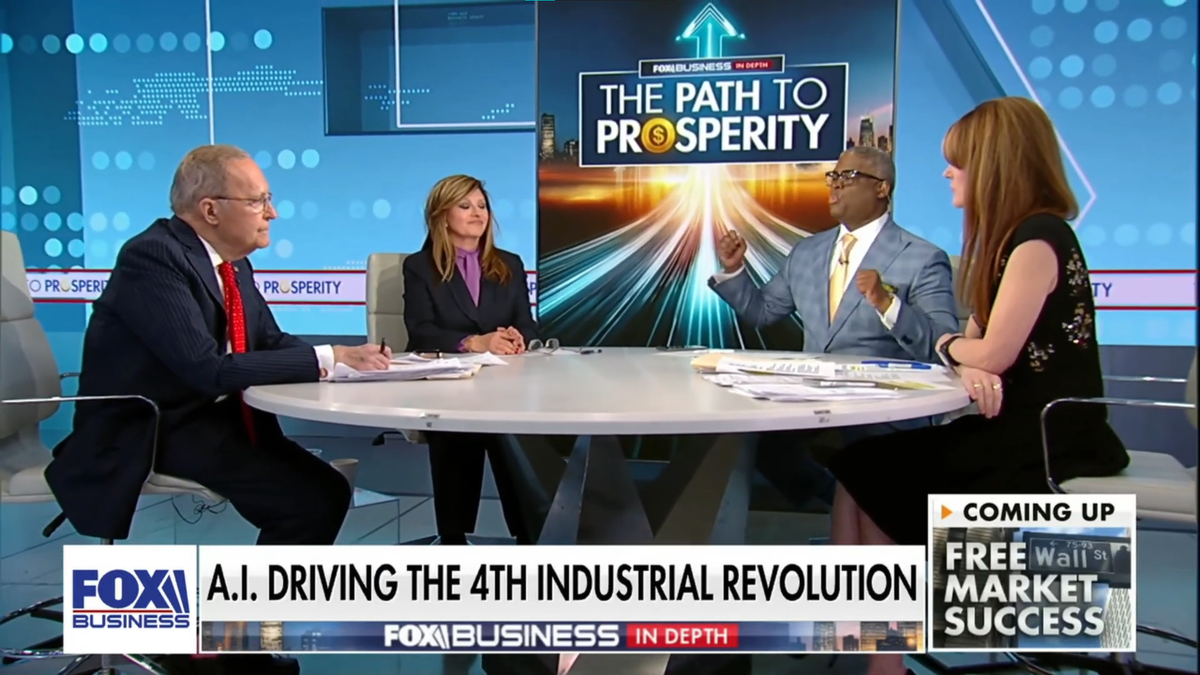
Conservative journalist Charles Payne (second from right) appears on Fox Business, Dec. 27, 2025. (Screengrab / Fox Business)
Fox Business host and conservative journalist Charles Payne said Saturday that the monumental investments into artificial intelligence risk sparking a Great Depression-level global market crash, but that it was “worth it” to see the United States come out “on top” and “stay in control.”
“The Second Industrial Revolution where America superseded everyone in the world from the very bottom was driven by railroad investing – guess what that gave us?” Payne said Saturday on Fox Business.
“Four crashes, four panics, the signs of the Great Depression, and it was worth it! It was worth it to supersede the rest of the world, and that's the risk we're taking right now to stay in control, to be on top because we must win this AI race!”
American companies have invested a staggering $364 billion into AI development this year alone, with AI investment making up about a third of the value of the entire stock market. The significant spending in AI has sparked fears that the U.S. economy may be entirely reliant on an AI “bubble,” which, were it to crash, could spark a major recession.
Fears of AI investment sparking a market crash have only been exacerbated by AI companies' inability to demonstrate a path toward profitability, and tech giants selling off large amounts of stock in AI-related tech companies such as Nvidia.
OpenAI CEO Sam Altman has also made a recent remark about the federal government being the “insurer of last resort” for AI companies, hinting that taxpayers might be expected to shoulder the losses should AI companies financially collapse.
Market recessions have an outweighed impact on those with lower incomes, with the overall suicide rate in the United States surging by nearly 23% during the Great Depression. The 2008 financial crisis caused “an estimated 4,884 excess suicides in 2009,” according to a study from the British Medical Journal.
“The fourth industrial revolution is coming like a tidal wave!” Payne continued. “We're talking artificial intelligence, robots, big data, the list goes on. And, it's changing the way we work and create opportunity, this despite gloom and doom predictions.”
‘I will miss them’: Pro-Trump billionaire mocked after threatening to move to avoid taxes
December 27, 2025

Billionaire Peter Thiel
“Peter Thiel is leaving California if we pass a 1% tax on billionaires for 5 years to pay for healthcare for the working class facing steep Medicaid cuts,” Khanna said Friday night in a social media post on X. “I echo what [former President Franklin D. Roosevelt] said with sarcasm of economic royalists when they threatened to leave, ‘I will miss them very much.’”
The ballot measure is known as the California Billionaire Tax Act, and would impose a one-time 5% tax on the net worth of residents and part-time residents worth more than $1 billion. To appear on next year’s ballot, it must receive just over 870,000 signatures, and is currently in the signature-gathering phase.
And, while it’s unclear whether the measure will receive enough signatures, some of the state’s billionaires – including Thiel – are already considering leaving the state entirely, The New York Times reported Friday.
The co-founder of PayPal and Palantir, Thiel has been an outspoken supporter of Trump. He contributed $1.25 million to Trump’s 2016 campaign and was named to Trump’s transition team executive committee. Thiel has also cozied up to the second Trump administration, scoring lucrative government contracts for his company Palantir.
Thiel has been a controversial figure in the tech industry, having frequently spoken about what he’s called “the Antichrist,” which he warned
is seeking to halt development of artificial intelligence. He's estimated to be worth around $27 billion, making him among the top-100 wealthiest people on earth.


No comments:
Post a Comment