It’s possible that I shall make an ass of myself. But in that case one can always get out of it with a little dialectic. I have, of course, so worded my proposition as to be right either way (K.Marx, Letter to F.Engels on the Indian Mutiny)
The Trump family is now directly investing in atomic energy. Its money-losing Truth Social company has become a part owner of a major fusion nuclear power project.
Among much more, the investments mean the Trump family stands to profit directly from White House attacks on wind, solar and other cheap, clean renewable energies which for decades have been driving fusion, fission and fossil fuels toward economic oblivion.
“A Trump-sponsored business is once again betting on an industry that the president has championed, further entwining his personal fortunes in sectors that his administration is both supporting and overseeing,” reported an article on the front page of the business section of the New York Times last week. “This one is in the nuclear power sector. TAE Technologies, which is developing fusion energy, said on Thursday that it planned to merge with Trump Media & Technology Group. President Trump is the largest shareholder of the money-losing social media and crypto investment firm that bears his name, and he will remain a major investor in the combined company.”
The headline of the piece: “Trump’s Push Into Nuclear Is Raising Questions.”
The primary asks have to do with economic conflicts of interest, and public safety.
“The deal, should it be completed,” the article continued, “would put Mr. Trump in competition with other energy companies over which his administration holds financial and regulatory sway. Already, the president has sought to gut safety oversight of nuclear power plants and lower thresholds for human radiation exposure.”
CNN reported: “Nuclear fusion companies are regulated by the federal government and will likely need Uncle Sam’s deep research and even deeper pockets to become commercially viable. The merger needs to be approved by federal regulators—some of whom were nominated by Trump.”
CNN quoted Richard Painter, chief White House ethics lawyer under President George W. Bush, as saying: “There is a clear conflict of interest here. Every other president since the Civil War has divested from business interests that would conflict with official duties. President Trump has done the opposite.” Painter is now a professor at the University of Minnesota Law School.
“Having the president and his family have a large stake in a particular energy source is very problematic,” said Peter A. Bradford, who previously served on the Nuclear Regulatory Commission, the agency meant to oversee the nuclear industry in the United States, in the Times article.
“The Trump administration has sought to accelerate nuclear power technology—including fusion, which remains unproven,” Bradford said. “That support has come in the form of federal loans and grants, as well as executive orders directing the NRC to review and approve applications more quickly.”
Still, the White House press secretary, Karoline Leavitt, said in a statement that “neither the president nor his family have ever engaged, or will ever engage, in conflicts of interest.” And the Times piece continued, “a spokeswoman for Trump Media” said the company was “scrupulously following all applicable rules and regulations, and any hypothetical speculation about ethics violations is wholly unsupported by the facts.”
It went on that “Trump’s stake in Trump Media, recently valued at $1.6 billion, is held in a trust managed by Donald Trump Jr., his eldest son. Trump Media is the parent company of Truth Social, the struggling social-media platform. The merger would set Trump Media in a new strategic direction, while giving TAE a stock market listing as it continues to develop its nuclear fusion technology.”
The Guardian quoted the CEO of Trump Media, Devin Nunes, the arch-conservative former member of the House of Representatives from California and close to Trump, who is currently chair of the President’s Intelligence Advisory Board, saying Trump Media has “built un-cancellable infrastructure to secure free expression online for Americans. And now we’re taking a big step forward toward a revolutionary technology that will cement America’s global energy dominance for generations.” Nunes is the would be co-CEO of the merged company.
A current member of the US House, Don Beyer, a Democrat from Virginia, said in a statement quoted in Politico that the deal raises “significant concerns” about conflicts of interest and avenues for potential corruption. “The President has consistently used both government powers and taxpayer money to benefit his own financial interests and those of his family and political allies. This merger will necessitate congressional oversight to ensure that the U.S. government and public funds are properly directed towards fusion research and development in ways that benefit the American people, as opposed to the Trump family and their corporate holdings.”
By federal law (the Price-Anderson Act of 1957) the US commercial atomic power industry has been shielded from liability in major accidents it might cause. The “Nuclear Clause” in every US homeowner’s insurance policy explicitly denies coverage for losses or damages caused, directly or indirectly, caused by a nuclear reactor accident.
As his company fuses with the atomic industry, Trump acquires a direct financial interest in gutting atomic oversight—which he has already been busy doing. In June Trump fired NRC Chairman Christopher T. Hanson. No other president has ever fired an NRC Commissioner.
. Earlier, more than 100 NRC staff were purged by Elon Musk’s DOGE operation. There has been a stream of Trump executive orders calling for a sharp reduction in radiation standards, expedited approval by the NRC of nuclear plant license applications, and a demand to quadruple nuke power in the United States—from the current 100 gigawatts to 400 gigawatts in 2050. Such a move would require huge federal subsidies and the virtual obliteration of safety regulations. Trump has essentially ordered the NRC to “rubber stamp” all requests from a nuclear industry in which he is now directly invested.
Trump’s Truth Social’s fusion ownership stake removes all doubt about any regulatory neutrality. No presently operating or proposed US atomic reactor can be considered certifiably safe.
Trump’s fusion investments are also bound to escalate Trump’s war against renewable energy and battery storage, the primary competitors facing the billionaire fossil/nuke army in which the Trump family is now formally enlisting. That membership blows to zero the credibility of any claim nuclear reactor backers might make that atomic energy can officially be considered safe.
The NRC has long served as a lapdog to the atomic power industry. The acronym NRC has often been said to stand for “No Real Chance” or “Nobody Really Cares.” The commission has been forever infamous for granting the industry whatever it might want, no matter the risk to public safety. It has employed some highly competent technical staff, lending some gravitas to the industry’s marginal claims to even a modicum of competence.
But the NRC is well known for trashing even its established staff. Most notable may be the case of Dr. Michael Peck, a long-standing site inspector at California’s Diablo Canyon twin-reactor nuclear power plant. In an extensive report, Peck warned that Diablo might be unable to withstand a likely earthquake. The NRC trashed his findings. Now he’s gone from the agency altogether. His warnings have been ignored at a reactor site surrounded by more than a dozen confirmed seismic faults.
The splitting of the atom, fission, is the way the atomic bomb and nuclear power plants up to now work. Fusion involves fusing light atoms. It’s how the hydrogen bomb works, and it comes with many extremely complex health, safety, economic and ecological demands.
In an article in the Bulletin of the Atomic Scientists, Dr. Daniel Jassby, for 25 years principal research physicist at the Princeton Plasma Physics Lab working on fusion energy research and development, concluded that fusion power “is something to be shunned.”
His piece was titled “Fusion reactor: Not what they’re cracked up to be.”
“Fusion reactors have long been touted as the ‘perfect’ energy source,” he wrote. And “humanity is moving much closer” to “achieving that breakthrough moment when the amount of energy coming out of a fusion reactor will sustainably exceed the amount going in, producing net energy.”
“As we move closer to our goal, however,” continued Jassby, “it is time to ask: Is fusion really a ‘perfect’ energy source? After having worked on nuclear fusion experiments for 25 years at the Princeton Plasma Physics Lab, I began to look at the fusion enterprise more dispassionately in my retirement. I concluded that a fusion reactor would be far from perfect, and in some ways close to the opposite.”
“Unlike what happens” when fusion occurs on the sun, “which uses ordinary hydrogen at enormous density and temperature,” on Earth “fusion reactors that burn neutron-rich isotopes have byproducts that are anything but harmless,” he said.
A key radioactive substance involved in the fusion process on Earth would be tritium, a radioactive variant of hydrogen. Thus, there would be “four regrettable problems”—“radiation damage to structures; radioactive waste; the need for biological shielding; and the potential for the production of weapons-grade plutonium 239—thus adding to the threat of nuclear weapons proliferation, not lessening it, as fusion proponents would have it,” wrote Jassby.
About nuclear weapons proliferation, “The open or clandestine production of plutonium 239 is possible in a fusion reactor simply by placing natural or depleted uranium oxide at any location where neutrons of any energy are flying about. The ocean of slowing-down neutrons that results from scattering of the streaming fusion neutrons on the reaction vessel permeates every nook and cranny of the reactor interior, including appendages to the reaction vessel.”
“In addition, there are the problems of coolant demands and poor water efficiency,” Jassby continues. “A fusion reactor is a thermal power plant that would place immense demands on water resources for the secondary cooling loop that generates steam, as well as for removing heat from other reactor subsystems such as cryogenic refrigerators and pumps….In fact, a fusion reactor would have the lowest water efficiency of any type of thermal power plant, whether fossil or nuclear. With drought conditions intensifying in sundry regions of the world, many countries could not physically sustain large fusion reactors.”
“And all of the above means that any fusion reactor will face outsized operating costs,” he wrote. “To sum up, fusion reactors face some unique problems: a lack of a natural fuel supply (tritium), and large and irreducible electrical energy drains….These impediments—together with the colossal capital outlay and several additional disadvantages shared with fission reactors—will make fusion reactors more demanding to construct and operate, or reach economic practicality, than any other type of electrical energy generator.”
“The harsh realities of fusion belie the claims of proponents like Trump of ‘unlimited, clean, safe and cheap energy.’ Terrestrial fusion energy is not the ideal energy source extolled by its boosters,” declared the scientist.
Of course, for Trump, whether it has to do with tariffs, health care, affordability, the democratic process…and on and on, reality is not a concern, especially when they involve public safety or legitimate profit.
Amidst his escalating attacks on renewable energy and atomic safety, the Trump family’s investments in nuclear fusion live under an ominous cloud that threatens us all.
Harvey Wasserman wrote the books Solartopia! Our Green-Powered Earth and The Peoples Spiral of US History. He helped coin the phrase “No Nukes.” He co-convenes the Grassroots Emergency Election Protection Coalition at www.electionprotection2024.org Karl Grossman is the author of Cover Up: What You Are Not Supposed to Know About Nuclear Power and Power Crazy. He the host of the nationally-aired TV program Enviro Close-Up with Karl Grossman (www.envirovideo.com)
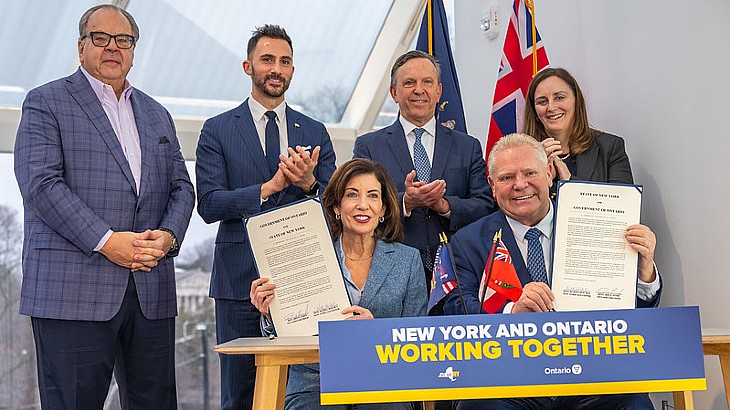
An agreement between Ontario Power Generation and the New York Power Authority establishes a framework for collaboration on the development of advanced nuclear energy technologies, while the leaders of New York and Ontario have signed a declaration of intent on cooperation to work together to advance the development nuclear power.
Hochul (seated, left) and Ford (seated, right) announce their 'landmark' agreement (Image: Darren McGee/ Office of Governor Kathy Hochul))
Under their memorandum of understanding, Ontario Power Generation (OPG) and the New York Power Authority (NYPA) will leverage Ontario's "global nuclear leadership" to advance the development and deployment of nuclear technologies, including large-scale reactors and small modular reactors (SMRs), to meet growing electricity demand and protect long-term energy security. NYPA and OPG will share information and use their respective expertise and resources to "advance technological innovation, enhance understanding of nuclear financing and economics, and support workforce development initiatives needed to enable the development of advanced nuclear facilities in New York and Ontario. They will also explore opportunities to enhance electricity trade between Ontario and New York to improve reliability and reduce emissions," the New York Power Authority said.
The declaration of intent signed by New York Governor Kathy Hochul and Ontario Premier Doug Ford recognises "the shared history, and values" of the US state and the Canadian province, which share an international border.
"New York and Ontario have a proud tradition of trade, cooperation and a bond that cannot be broken," Hochul said. "This first-of-its-kind agreement represents a bold step forward in our relationship and New York's pursuit of a clean energy future. By partnering with Ontario Power Generation and its extensive nuclear experience, New York is positioning itself at the forefront of advanced nuclear technology deployment, ensuring we have safe, reliable, affordable, and carbon-free energy that will help power the jobs of tomorrow."
"From building the first small modular reactors in the G7 to building the first large-scale nuclear facilities in decades, Ontario is proud to lead the world in nuclear innovation," said Ford. "By working together with New York, we're creating good-paying jobs, growing our economies and delivering clean, affordable power for families and businesses on both sides of the border for generations to come."
In June, Hochul directed the NYPA - the state's public electric utility - to develop at least 1 GWe of advanced nuclear capacity in Upstate New York, and in early December announced USD40 million of funding over the next four years to develop the workforce needed to support the planned deployment. Meanwhile, in Ontario, OPG is working towards the construction of four SMRs at the Darlington New Nuclear Project as well as the potential construction of new large-scale nuclear capacity.
"As we construct the G7's first grid-scale SMR and continue engagement on the potential for new large-scale generation at our Wesleyville site in Port Hope, we look forward to building on our long-standing relationship with NYPA. We and NYPA will share expertise and collaborate in ways that benefit both of our jurisdictions as we advance the development of nuclear technologies," OPG President and CEO Nicolle Butcher said.
Sweden's Vattenfall Seeks State Funding for New Nuclear Reactors
Sweden’s power giant Vattenfall announced on Tuesday it is applying for state aid for an investment in small modular reactors (SMRs) as part of a plan by industrial giants to bet on new nuclear power in the country.
Last month Sweden’s biggest industrial firms signed an agreement with Vattenfall to become shareholders in the power giant’s new company, Videberg Kraft AB, which plans to build SMRs in the country.
One of Europe’s top electric utilities, Vattenfall, created Videberg Kraft AB in April this year as a separate entity to be able to apply for government support.
Now the company and the industry organization, Industrikraft, plan joint investment and collaboration enabling the development of new nuclear power in Sweden.
Industrikraft, whose members include Volvo Group, Saab, Alfa Laval, and Hitachi Energy, will become a shareholder in Videberg Kraft with a 20-percent stake.
The government has previously announced that the state also intends to become a shareholder in the new company.
The Swedish government moved to phase out nuclear power completely in 1980, but that decision was reversed by Parliament in 2010. Five years later, four aging reactors were shut down. Six of 12 reactors remain in operation in Sweden today.
The country is now betting on SMRs to expand its nuclear fleet as Stockholm seeks to further reduce emissions with low-carbon 24/7 energy.
Sweden has tweaked its renewable energy policy, which had called for 100% renewable electricity by 2040, changing the terminology to “100% fossil-free” electricity, paving the way for the construction of more nuclear power plants.
Now Videberg Kraft’s CEO Desirée Comstedt has submitted an application for financing and risk-sharing to the Swedish Government.
When an agreement between the state and Videberg Kraft has been reached, the government may initiate a formal state aid process with the European Commission, Vattenfall said.
Videberg Kraft is planning a project with either five BWRX-300 reactors from GE Vernova Hitachi or three reactors from Rolls-Royce SMR, which will provide a total nuclear power output of about 1,500 MW. There is currently an intensive evaluation process of the two remaining suppliers, and a decision on the final supplier is planned for 2026.
The Swedish government has received an application for state aid to support proposals for either five GE Vernova Hitachi BWRX-300 reactors or three Rolls-Royce SMRs to provide about 1500 MW capacity at Ringhals on the Värö Peninsula.
Anna Borg, President and CEO of Vattenfall, and Tom Erixon, Chairman of Industrikraft, pictured last month (Image: Vattenfall)
The application has come from Videberg Kraft AB, a project company owned by Vattenfall AB and backed by a series of industrial firms via the Industrikraft i Sverige AB consortium.
Industrikraft was formed in June 2024 to support the expansion of the Swedish electricity supply. Last month it was announced that Industrikraft was to become a 20% shareholder in Videberg Kraft AB which was created for the new nuclear project. A separate project company is a prerequisite for applying for government support.
Industrikraft, which is aiming to be cleared to take up the 20% stake next month, includes ABB, Alfa Laval, Boliden, Hitachi Energy, Höganäs AB, SSAB, Saab, Stora Enso, and the Volvo Group.
It is the first application under the country's new legislation on state aid for investments in new nuclear power, which came into force in August.
According to the government briefing: "State aid will be provided in the form of government loans and two-way contracts for difference. The latter means that a contract is drawn up between a nuclear power plant operator and central government ensuring a minimum level of compensation protection by central government and setting an overcompensation cap for the company.
"Central government can provide loans for the construction and testing of new nuclear reactors, and for planning and other preparatory measures. Two-way contracts for difference may be entered into for routine operation of new nuclear reactors.
"The state aid is limited and is planned to include investments of up to a total installed capacity of approximately 5000 MW, which is equivalent to four large-scale reactors."
This application will now be processed by the Ministry of Finance with negotiations to take place between the government and the project proposers about the conditions and scope of support required.
There will also be "a continuous dialogue" with the European Commission ahead of the EC assessing whether any proposed funding is compatible with European Union state aid rules.
Vattenfall says that "there is currently an intensive evaluation process" taking place of the BWRX-300 and Rolls-Royce SMR options "and a decision on the final supplier is planned for 2026".
Minister for Financial Markets Niklas Wykman said: "The fact that we have received this first application confirms that Swedish industrial companies want to get involved in building nuclear power. This is a decisive step towards getting new reactors in place, and we are ready to receive more applications in the future."
Sweden's government says that, based on preliminary discussions with other parties, further applications for state aid for new nuclear projects are likely to follow.
In May this year, Sweden's parliament - the Riksdag - approved the government's proposals for providing state aid to companies that want to invest in new nuclear reactors in the country. The loans - aimed at lowering the cost of financing new nuclear - will be limited to the equivalent of four large-scale reactors (about 5000 MWe of capacity). The government noted that support may only be granted if the new reactors are located at the same location and have a total installed output of at least 300 MWe. Two-way Contracts for Difference may be entered into once a new reactor has become operational and has been licensed to produce electricity at full capacity. The new act on state aid entered into force on 1 August, since when interested companies have been able to apply for the aid.
U.S. Ready for Partnership in India’s Nuclear Energy Industry
The United States has expressed willingness to cooperate with India in the nuclear energy sector as Asia’s second-largest economy opens its civil nuclear industry to private investment and foreign participation.
“We welcome India’s new #SHANTIBill, a step towards a stronger energy security partnership and peaceful civil nuclear cooperation,” according to a post on X of the official account of the U.S. Embassy in India.
“The United States stands ready to undertake joint innovation and R&D in the energy sector,” the embassy said.
India’s Parliament last week passed the so-called Sustainable Harnessing and Advancement of Nuclear Energy for Transforming India (SHANTI) Bill, which opens the Indian nuclear energy sector to private investment and ends more than six decades of state monopoly.
Indian President Droupadi Murmu endorsed on Monday the bill, which repeals the Atomic Energy Act of 1962 and the Civil Liability for Nuclear Damage Act of 2010, which had hindered growth in India’s civil nuclear industry.
India expects the landmark legislation to drive investments from private companies in its nuclear energy sector.
India’s Nuclear Energy Mission targets 100 gigawatts (GW) of nuclear power capacity by 2047 “through deployment of existing and emerging advanced nuclear technologies, both indigenous & with foreign cooperation.”
Currently, India has just 8.8 GW of operating nuclear capacity, operated by state-owned Nuclear Power Corporation of India Limited (NPCIL).
Hiking nuclear power capacity tenfold by 2047 would need a lot of investment, including from private firms, the government and various experts say.
Earlier this year, a panel set up by India’s power ministry said in a report that India’s goal to have 100 GW nuclear power capacity by 2047 would require as much as 19.28 trillion Indian rupees, or $214 billion at current exchange rates, of cumulative capital.
“Substantial technical and financial resources will be required for accelerated deployment of 100 GW of nuclear capacity by 2047,” the panel said.
“The private sector has abundant capital, and inherent efficiency in timely construction and innovation adaption.”
One week after first being tabled, new unified legislation on nuclear energy has received presidential assent having been passed by both houses of the Indian parliament.
President Droupadi Murmu (Image: President of India)
The Sustainable Harnessing and Advancement of Nuclear Energy for Transforming India (SHANTI) Bill 2025 was tabled in the lower house, the Lok Sabha, on 15 December, and was approved on 17 December. The bill was then presented to the upper house, the Rajya Sabha, where it was approved on 18 December.
President Droupadi Murmu granted assent to the bill - the final stage in the legislative process - on 20 December.
Prime Minister Narendra Modi described the passage of the bill by both houses as transformational. Ahead of the presidential assent, the Prime Minister wrote on X: "The passing of the SHANTI Bill by both Houses of Parliament marks a transformational moment for our technology landscape. My gratitude to MPs who have supported its passage. From safely powering AI to enabling green manufacturing, it delivers a decisive boost to a clean-energy future for the country and the world. It also opens numerous opportunities for the private sector and our youth. This is the ideal time to invest, innovate and build in India!"
India's nuclear energy programme has up to now been covered by the Atomic Energy Act, 1962 and the Civil Liability for Nuclear Damage Act, 2010. The 1962 act set the stage for India’s nuclear programme, empowering the government to regulate atomic energy for peaceful purposes, ensuring strict control over research, development, and use of nuclear materials, but some of the restrictions it has imposed - particularly limitations on private sector participation in the nuclear industry - have stood in the way of Indian plans to reach its decarbonisation goals with a target of achieving 100 gigawatts of nuclear power capacity by 2047. Likewise, the 2010 Civil Liability act, while introducing a no-fault liability regime, has also been seen as problematic, giving nuclear operators extensive legal recourse to equipment suppliers in the event of a nuclear incident.
The new bill repeals the two earlier laws and consolidates and modernises India's nuclear legal framework, enabling limited private participation in the nuclear sector under regulatory oversight. It also, amongst other things, grants statutory recognition to India's nuclear regulator, the Atomic Energy Regulatory Board.
It permits private companies to participate in India’s nuclear sector, including in plant operations, power generation, equipment manufacturing, and selected activities such as nuclear fuel fabrication, including "conversion, refining and enrichment of uranium-235" - up to a threshold value to be set by the government, although "certain activities of sensitive nature" will remain exclusively under government control. The SHANTI Bill - unlike the existing law that imposes a single statutory cap on operator liability - establishes a graded liability framework.
According to World Nuclear Association information, India currently has 24 operable nuclear reactors totalling 7,943 MW of capacity, with six reactors - 4,768 MW - under construction. (The Indian government often classes two units at Gorakhpur where site works have begun as being under construction, although the first concrete for the reactor buildings has not yet been poured.) A further 10 units - some 7 GW of capacity - are in pre-project stages.
Earlier this year, the Indian government set out the key features of its two-pronged Nuclear Energy Mission to achieve 100 GWe of nuclear capacity by 2047, featuring plans for new large capacity reactors as well as small modular reactors.
A request for proposals from 'visionary Indian industries' to finance and build a proposed fleet of 220 MW Bharat Small Reactors issued at the start of this year by government-owned enterprises Nuclear Power Corporation of India Ltd (NPCIL) has been extended to 31 March 2026.
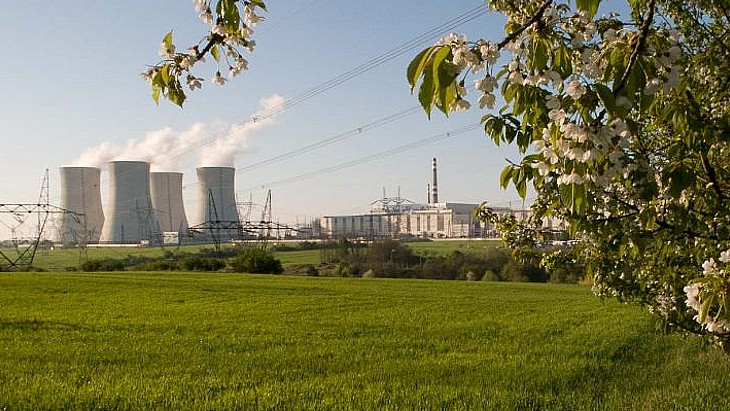
EU launches inquiry into Czech funding plan for new nuclear
The European Commission "has doubts" that the proposed Czech funding plan for its proposed new nuclear units "is fully in line with EU State aid rules".
(Image: CEZ)
In April last year the European Commission (EC), which is the executive arm of the European Union (EU), approved the funding plan for a single new nuclear reactor at the Dukovany nuclear power plant site in the Czech Republic.
In July last year Korea Hydro & Nuclear Power (KHNP) was selected for the project, and in October this year the Czech Republic officially notified the EC it had expanded its plans to two new nuclear units, each with a capacity of 976 MWe.
What is the funding plan?
The EC says: "Czechia plans to support the construction of the new nuclear units through three measures: a low-interest repayable State loan of an initial amount currently estimated between EUR23 billion (USD27.1 billion) and EUR30 billion, which will cover the full construction costs; a two-way contract for difference with a proposed duration of 40 years to ensure stable revenues for the nuclear power plant; and a mechanism to protect EDU II in case of policy changes and adverse impacts, to address the risk arising from the longevity of exposure to policy changes."
EDU II is Elektrárna Dukovany II, a company set up to develop and operate the new nuclear units, which is owned by the Czech state (80%) and the Czech Republic's nuclear power plant operator ČEZ (20%).
The contract for difference effectively means that if electricity prices are below the agreed level, the nuclear project will receive a subsidy to make it up to the agreed price, and if electricity prices are above the agreed price, the nuclear project would pay money back to the government.
Is that different to the previously approved financing plan for one unit?
It sounds similar to the previously approved funding and the Czech government said it had "requested an extension of the already approved support (to the fifth unit) to the two-unit construction". When the two-year inquiry into the funding proposed for the one unit plan was completed in 2024 the EC said: "The Czech Republic plans to grant direct price support in the form of a power purchasing contract with a state-owned special purpose vehicle, ensuring stable revenues for the planned new nuclear unit at Dukovany for 40 years, with a subsidised state loan to cover a majority of construction costs as well as a protection mechanism against unforeseen events or policy changes."
One thing which has changed since the original approval is that the EC has updated its approved two-way contracts for difference (CfD) guidelines - set out in Article 19D on this page.
What issues has the EC now raised?
It says that, based on its preliminary assessment, "the project is necessary and considers that the aid facilitates the development of an economic activity" which will help decarbonise the energy sector and diversify the Czech energy mix.
But it has doubts about whether it is fully in line with EU State aid rules and wants to ensure that "no more aid than necessary is ultimately granted. In particular, the Commission has doubts on whether the proposed package achieves an appropriate balance between reducing risks to enable the investment and maintaining incentives for efficient behaviour, while avoiding excessive risk transfer to the State".
It also wants to look at the impact of the State aid measures on competition in the market "in particular, the Commission has concerns that several essential design elements of the CfD remain insufficiently specified, preventing the Commission from fully assessing whether the mechanism maintains efficient operational and maintenance incentives".
What happens now?
The EC says that it "will investigate further to determine whether its initial concerns are confirmed". It says that the opening of an in-depth inquiry "does not prejudge the outcome of the investigation" and it provides "Czechia and interested third parties the opportunity to submit comments". The previous inquiry took two years and included modifications to the Czech funding plan in its approved form.
What are the State aid rules?
European Union member states are free to determine their energy mix and the decision to use nuclear energy is one for each member state to take for themselves. State aid rules allow member states "to facilitate the development of certain economic activities under specific conditions. The support must be necessary and proportionate and must not adversely affect trading conditions to an extent contrary to the common interest".
What has the Czech government said?
The Czech Republic's Ministry of Industry and Trade says that the launch of the formal investigation is a "standard step and an important milestone" and it expects "approval to be obtained in approximately the first quarter of 2027". It says that the inquiry means "public consultation and negotiations between the Czech Republic and the Commission" can take place "regarding the doubts raised". It adds "this is how all previous notifications of public support for new nuclear sources in the EU were carried out as standard". The ministry adds that "in the meantime, the project is financed on commercial terms, so there is no risk of any delay".
What is the Czech Republic planning?
The Czech Republic currently gets about one-third of its electricity from the four VVER-440 units at Dukovany, which began operating between 1985 and 1987, and the two VVER-1000 units in operation at Temelín, which came into operation in 2000 and 2002. In July 2024 it selected KHNP for the planned project to build the two new units at Dukovany, with scheduled start dates of 2036 and 2037.
Further challenges to the decision?
The KHNP bid was said to be for around CZK200 billion (USD9.7 billion, EUR8.21 billion) per unit, if two were contracted. The Czech competition authority dismissed an EDF challenge to the decision in April this year and a subsequent court process concluded with a Czech Supreme Administrative Court decision which led to the contract being signed in June.
EDF's objections to the tender process included the belief that the KHNP offer price and the inclusion of a guarantee that the construction would not be delayed or become more expensive, would be "unfeasible without illegal state aid given the prices in the nuclear industry". EDF said that if their rival bidder had state support - from South Korea - it would breach European Union rules.
KHNP rejected EDF's case and in a statement to World Nuclear News in May it added that it "affirms that it has participated in the Czech new nuclear power plant project in strict compliance with all international regulations, including those of the European Union. We emphasise that we have not received any subsidies that could damage or distort fair competition in relation to the project".
Asked about the status of any investigation into foreign state aid, a European Commission spokesperson told World Nuclear News on Tuesday: "The Commission's assessment of a complaint by EDF under the Foreign Subsidies Regulation regarding the award of a tender to KNHP is ongoing. We do not comment on ongoing investigations."
Kazakh-Japanese nuclear cooperation highlighted during presidential visit
An agreement between Kazatomprom and Japanese utility Kansai to supply Kazakh uranium products for Japanese nuclear power plants and a raft of nuclear-related bilaterals were signed during the visit to Japan by Kazakhstan's President Kassym-Jomart Tokayev.
(Image: Kazatomprom)
The agreement between the National Atomic Company Kazatomprom JSC group of companies and the Kansai Electric Power Co marks a significant milestone in establishing a sustainable supply chain for the Japanese nuclear industry, as the country continues the gradual restart of its nuclear fleet and its integration into the national energy balance, Kazatomprom said.
"Our cooperation with Kansai contributes to the sustainability of the Japanese power grid as the country gradually returns to nuclear energy, and underscores Kazatomprom's recognition as a reliable uranium supplier in the global market," Kazatomprom CEO Meirzhan Yussupov said. "Through joint efforts with our customers worldwide, we continue to make a significant contribution to achieving global decarbonisation goals."
Kansai operates seven nuclear reactors at the Mihama, Takahama, and Ohi power stations. It is considering the possibility of building a new reactor at the Mihama site in Fukui Prefecture as a replacement for unit 1, which was declared permanently shut down in 2015. The Japanese company has been in partnership with Kazatomprom since 2006 through the Kazakh-Japanese uranium production joint venture APPAK LLP in which it holds 10% (with Sumitomo holding 25% and Kazatomprom 65%).
Favourable opportunities
The combination of Kazakhstan's resource potential and Japan's advanced nuclear technologies "opens up favourable opportunities for successful cooperation", Kazakh President Kassym-Jomart Tokayev said in an address to the First Central Asia-Japan Dialogue Summit during his visit to Tokyo. Of particular interest are projects in the areas of nuclear waste management, nuclear safety, and the training of highly qualified personnel, including in the field of civil protection, he said.
The president's official visit to Japan saw nuclear energy feature in several bilateral agreements worth a total of some USD3.72 billion signed by Japanese and Kazakh entities, according to the Kazakh presidency.
These include:
A Memorandum of Cooperation on research and development of high-temperature gas-cooled reactors, between Kazakhstan's Atomic Energy Agency and the Japan Atomic Energy Agency (JAEA);
A Memorandum on strengthening cooperation in the field of applied research, also between the Atomic Energy Agency and JAEA;
A Memorandum of Cooperation on expanding scientific ties, between Kazakhstan's National Nuclear Center (NNC) and Marubeni Utility Services Ltd;
A Memorandum of Understanding on spent nuclear fuel and radioactive waste management, between the NNC and Muroosystems Corporation;
A Memorandum of Understanding on research and development in the peaceful use of nuclear energy, between the NNC and the Nuclear Engineering Research Institute of the University of Fukui);
A commercial contract for conducting a feasibility study of irradiation testing of fuel for a high-temperature gas-cooled reactor, between Kazakhstan's Institute of Nuclear Physics, the JAEA and Marubeni Utility Services Ltd.
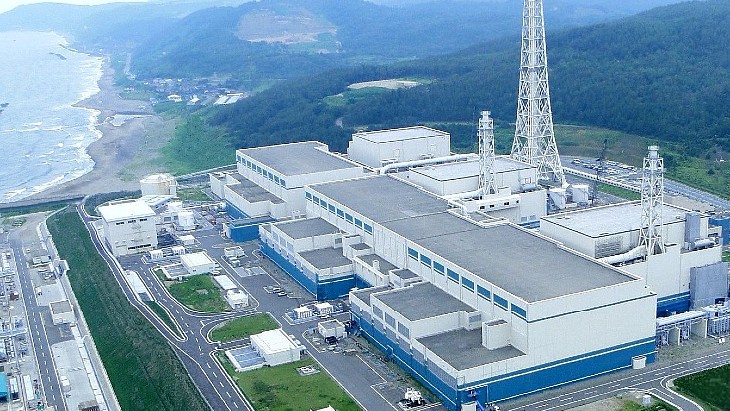
Restart of Kashiwazaki-Kariwa reactors approved by regional assembly
The Niigata Prefectural Assembly has backed Niigata Governor Hideyo Hanazumi's decision to approve the restart of units 6 and 7 at Tokyo Electric Power Company's Kashiwazaki-Kariwa nuclear power plant.
Units 5-7 at Kashiwazaki-Kariwa (Image: Tepco)
The approval came via a vote of confidence in the governor during the session on Monday, and means that the process of obtaining local consent is completed and Tokyo Electric Power Company (Tepco) can advance plans to restart the units.
The seven-unit Kashiwazaki-Kariwa plant was unaffected by the March 2011 earthquake and tsunami which damaged Tepco's Fukushima Daiichi plant, although the plant's reactors were previously all offline for up to three years following the 2007 Niigata-Chuetsu earthquake, which caused damage to the site but did not damage the reactors themselves. While the units were offline, work was carried out to improve the plant's earthquake resistance. All units have remained offline since the Fukushima Daiichi accident.
Although it has worked on the other units at the Kashiwazaki-Kariwa site, Tepco is concentrating its resources on units 6 and 7 while it deals with the clean-up at Fukushima Daiichi. These 1356 MWe Advanced Boiling Water Reactors began commercial operation in 1996 and 1997, respectively, and were the first Japanese boiling water reactors to be put forward for restart. Tepco received permission from the Nuclear Regulation Authority to restart units 6 and 7 in December 2017. Restarting those two Kashiwazaki-Kariwa units - which have been offline for periodic inspections since March 2012 and August 2011, respectively - would increase the company's earnings by an estimated JPY100 billion (USD638 million) per year.
Tepco is prioritising restarting Kashiwazaki-Kariwa unit 6, where fuel loading was completed in June. The company has until September 2029 to implement anti-terrorism safety measures at unit 6, and it could operate until that time now it has local approval. Kashiwazaki-Kariwa 6 would become the first reactor owned by Tepco to restart following the Fukushima Daiichi accident.
According to Japan’s public broadcaster NHK, sources have told it that Tepco has been discussing plans to put unit 6 back online around 20 January with the aim, subject to checks and tests, of putting it back in service by the end of March.
In his published statement to the meeting of the prefectural assembly, Governor Hanazumi said: "How to deal with the Kashiwazaki-Kariwa Nuclear Power Plant has long been a major issue for the people of Niigata Prefecture. While opinions regarding the restart of the Kashiwazaki-Kariwa Nuclear Power Plant are currently divided among the public, we believe that by continuing to provide accurate information about nuclear power generation and to raise awareness of safety and disaster prevention measures, we can increase public understanding of the plant's resumption."
He said that a public opinion survey conducted this year suggested that the more people were aware of the disaster prevention and safety measures at the plant "the more likely people are to support restarting the plant. Furthermore, the survey also revealed that people in their 20s and 30s tend to be more favourable toward restarting the plant than older generations".
He added: "I take seriously the concerns of the people of the prefecture who are worried about the restart of the reactors, and if I receive the confidence of the prefectural assembly to continue in my duties as governor, I will make every effort to revitalise the economy and society of the host region and the entire prefecture, as well as to improve the safety and security of the people of the prefecture."
In October Tomoaki Kobayakawa, president of Tepco, informed the Niigata Prefectural Assembly that the utility was considering decommissioning units 1 and 2 at the plant.
Prior to the March 2011 accident at the Fukushima Daiichi plant, Japan's 54 reactors had provided around 30% of the country's electricity. All were shut down following the accident, pending regulatory change. So far, of 33 operable reactors, 14 have restarted and 11 are currently in the process of restart approval.
Podcast: What happened with nuclear energy at COP30?
What was achieved at COP30 - the 30th UN Climate Change Conference, held in Belém, Brazil - and what role did nuclear energy play? Here's an assessment from Jonathan Cobb, World Nuclear Association Senior Programme Lead, Climate.
Also in this episode - you can listen using the link above - Thomas Lamb from Myriad Uranium talks about the Copper Mountain project, the general outlook for future uranium demand and supply, and the potential benefits of artificial intelligence.
Here's an edited transcript of Jonathan Cobb's COP30 interview:
What was agreed at COP30 - and what wasn't?
The new text calls for efforts to triple adaptation finance. This has been a focus of COPs in recent years, where countries are focusing on receiving finance to adapt to the impacts of climate change, rather than actually taking action to mitigate climate change. But even on this, there's been some stepping back. In the new agreement, deadlines have been pushed back from 2030 to 2035. One of the major absences in the presidency agreement was any statement on fossil fuels. A large group of countries had pushed very forcefully for there to be some text on pushing forward the agenda on fossil fuels, on phasing down, reducing, the amount of fossil fuels used. This has been a sticking point for COPs for some time. This was a COP held in the Amazon and while a fund for future forests was announced early on in the COP process, this was a voluntary measure and it didn't attract all the funding that it might have. There was also controversy over the final process of gavelling through the many sub-agreements that had been negotiated over the two weeks. All that said, there was an overall positive attitude, defending and celebrating the Paris Agreement. This is an agreement that's now 10 years old which aims to keep the global increase in temperatures well below 2 degrees Celsius. At the same time, many countries were late in their submissions of nationally determined contribution documents, NDCs, which set out national policies aimed at tackling climate change. Overall, I think there is a question of how much more COPs can agree in the current format, and seeing how that's going to work going forward will be one of the main questions for the COP process.
What did the COP talks have to say about nuclear energy?
With the focus on adaptation and greater efforts on protecting forests, and the failure to get any substantive texts on roadmaps away from fossil fuels, there was little in the decision documents themselves emerging from COP30 that had much impact on energy, let alone nuclear energy in particular. But to an extent, nuclear energy is now embedded into the COP process, following its inclusion in the Global Stocktake Outcome document that was agreed at COP28. That document did recognise the need for deep, rapid and sustained reductions in greenhouse gas emissions, and critically, it acknowledged nuclear energy as one of the technologies that countries could accelerate to achieve that goal. That decision was recognised in a number of the nationally determined contribution submissions.
How significant are nationally determined contributions - NDCs?
These are submissions made by governments setting out how they plan to take action, in this case through to 2035, to tackle climate change so that their national policies and ambitions are in line with the goals set in the Paris Agreement. While the proposals within the NDCs submitted for COP30 would reduce greenhouse gas emissions, they wouldn't be sufficient to achieve the Paris Agreement goals, so further action is necessary. It's estimated that the actions that have been proposed would help limit temperatures to a rise of around 2.6 degrees Celsius instead of that 2 degree or 1.5 degree target set out in the Paris Agreements. Overall, despite the fact that a third of countries have yet to submit their latest NDCs, the number of submissions including nuclear as part of their plans has increased in this NDC cycle, with 12 individual nations and the collective NDC of the European Union - representing 27 nations - making positive reference to nuclear energy. And we can expect that number to grow when countries that have previously supported nuclear but have yet to make their submissions, for example India, do make their final submissions.
What else was achieved at COP 30 for nuclear?
One very welcome development was that both Rwanda and Senegal announced that they were joining the declaration to triple nuclear capacity, bringing the number of nations endorsing the goal of at least a global tripling of nuclear energy by 2050 to 33. The joining of the two countries was announced at a joint World Nuclear Association-UK government event at the UK's own National Pavilion. Rwanda and Senegal joining is important, not just to build the tripling declaration coalition itself, but also to strengthen the coalition of countries at COP when energy issues are being discussed, to ensure that nuclear-supporting countries are present in all the different regional groups debating climate action. We also saw two new financial institutions, Stifel and CIBC, sign up to the financial statement of support. And Equinix, Fermi America and Circularity joined the large energy users pledge. On top of that, Kazatomprom, which is the world's largest uranium producer, and Nuclearis Energy signed up to the nuclear industry tripling pledge. World Nuclear Association had its own pavilion at COP, representing the global nuclear industry. We held events there, as well as engaging with the many delegates that visited the pavilion. But we also participated in a number of events at the International Atomic Energy Agency's pavilion, as well as events at the Nuclear for Climate and the International Youth Nuclear Congress stands. And as we mentioned, we had a special event at the UK pavilion, as well as holding our own side events.
How did COP30 feel compared with COP29 and COP28?
A lot depends on where we are in the COP process. So governments are at the stage of proposing their NDCs and there's now a process over a couple of years of assessing them, and then there will be a similar global stocktake to that which took place at COP28 in Dubai. And that will be of particular interest to us because that global stocktake was where nuclear was first mentioned in an official UNFCCC document in a positive way. But more generally, it will be making an assessment, a more detailed assessment of the strength of the NDCs that have been proposed and what more needs to be done. I think also that something which changed the tone of the event was the fact that the high-level segment at the very beginning, where prime ministers and other senior members of government attend the COP, was shifted to the week before. So there was much coverage of visits by prime ministers, but also the Prince of Wales was presenting events at Sao Paulo and there were events taking place in Rio de Janeiro. To an extent, that took some of the focus off the COP itself, because previously what's happened at COPs is that that high-level segment forms part of the first three days of the COP. And with that additional high-level representation, it brings more media focus to what's taking place at the COP itself. It'll be interesting to see whether, going ahead towards COP31, they decide to keep that model or whether that high-level segment is brought back into the main body of the COP negotiations itself.
What can we look forward to at next year's COP?
COP31 is going to be held in Turkey, a really interesting location for nuclear energy, with Turkey's first nuclear reactor nearing completion and plans in place to expand nuclear generation capacity further. So when we arrive in Turkey, I think there's going to be a lot to focus on in terms of the role of nuclear energy in new nuclear countries, like Turkey, and how it can also play a role elsewhere. As for the negotiations overall, I think there's a lot of pressure building for the COP meetings to demonstrate that they can make tangible process, not just on adapting to the impacts of climate change, but also returning to the fundamentals of accelerating progress on reducing greenhouse gas emissions themselves.
Is there a particular deadline for NDCs or is it a moveable feast?
It certainly has been a moveable feast in terms of submitting the NDC documents. They were actually meant to be submitted much earlier this year, so the UNFCCC Secretariat would have time to assess them and come out with a fuller and comprehensive assessment of what kind of impact on climate change the proposed NDCs would have. They've had to make a partial assessment based on only around two-thirds of the NDCs being submitted. So all those countries yet to submit NDCs have got to do so. And then that will then lead into the process, culminating at COP33 to be held in 2028, where those NDCs will be assessed and the global stocktake document will be agreed, the second global stocktake, setting out agreed actions that should be taken to address climate change.
Do we know where COP33 is going to be held?
We know it's going to be held somewhere in the Southeast Asia region - the COPs move around from region to region. I think it's a good thing they do as it gives them different perspectives, different focuses of different regions. India has indicated that they would like to host the COP. That's not confirmed yet, but that is an initial offer. Another interesting location will be the one that has been agreed already for COP32, which is to be held in Addis Ababa in Ethiopia. And that's the first time that a least developed country, as termed by the COP process, will have been the host of a COP.
Episode credit: Presenter Alex Hunt. Co-produced and mixed by Pixelkisser Production Cover Picture Credit: COP30
Podcast: Nuclear energy’s key moments in 2025
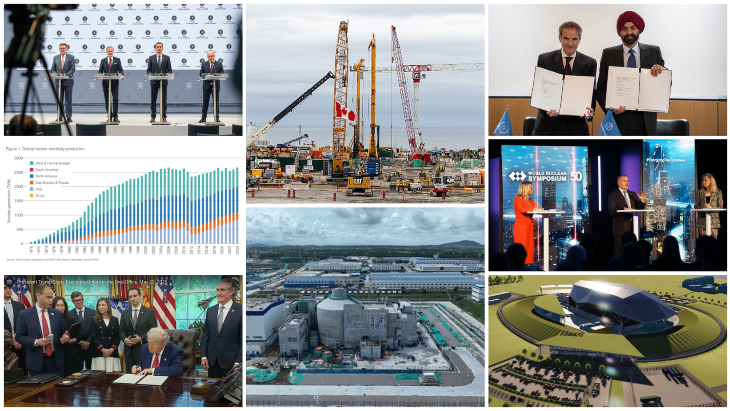
What were the most-read World Nuclear News stories, and what has World Nuclear Association Director General Sama Bilbao y León picked out as her key moments of 2025? Read a month-by-month summary, and listen to the full podcast episode.
But the most-read article was our report from an event at the IAEA General Conference which set out in detail the damage to Chernobyl's giant shelter, and experts' views that it might not ever be possible to restore it to its full original design purposes.

_53514_33880.jpg)
_91467.jpg)
_22394.jpg)

No comments:
Post a Comment