
Venezuela, Executive Defiance, and the Last Chance to Restore Congressional War Powers
Members of the House and Senate must act to ensure the US does not go to war without the people’s consent.
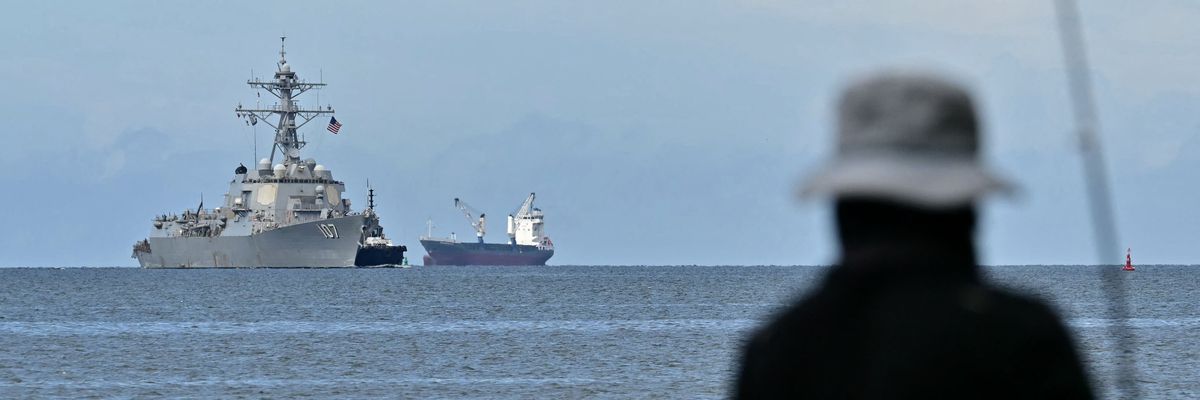
The USS Gravely warship is seen at a distance off the coast of Port of Spain on October 26, 2025, as fishermen look from the Trinidadian capital.
(Photo by Martin Bernetti/ AFP via Getty Images)
Angel Gomez
Dec 17, 2025
This is not a call for spectacle. It is not a public declaration. It is a sober appeal, written for those among you who still recognize the fragile architecture of our Republic and the danger that comes when its foundation is ignored. It is written for those who remember why Congress—not the Executive—is entrusted with the solemn power to send this nation to war.
Today, the United States Navy maintains a forward-deployed combat fleet off the coast of Venezuela. At least 12 warships now patrol waters once governed by diplomacy, now steered by executive will alone. And still, Congress has issued no declaration of war. No authorization of force. No public debate. No roll-call vote. The War Powers Resolution lies dormant—its reporting mandates ignored, its withdrawal timeline untriggered, its constraints publicly mocked.
RECOMMENDED...
Congressmen Unveil Bipartisan War Powers Resolution to Block Trump War on Venezuela
Progressives Urge Passage of Bills to Stop Trump From Launching ‘Forever War’ in Venezuela
This is no abstract concern. The precedent is Syria.
For over a decade, US troops have operated in Syria under the shifting pretexts of counterterrorism, chemical weapons enforcement, and later, oil field protection. All of it unfolded without a single Syria-specific authorization from Congress. The executive claimed continuity under the 2001 Authorization for the Use of Military Force, invoked Article II powers, and redefined “hostilities” so narrowly that armed conflict somehow ceased to qualify as war. Congress, through passivity or political caution, allowed this to become precedent. That precedent now extends to the Caribbean.
This is not just about Venezuela, or Syria, or this presidency. It is about whether Congress still holds the power the Constitution gave it—or whether that power has already been quietly surrendered.
The danger off Venezuela’s coast is not theoretical. Intelligence assessments confirm that anti-ship missile systems have already been deployed by foreign actors in response to US naval activity. We are, at this moment, one miscalculation away from open conflict. And we are there without legal cover, without strategic necessity, and, most concerningly, without your consent.
Some of you may be asking—why now? Why Venezuela? The official answer is narcotics. But the record speaks otherwise. The 2025 National Drug Threat Assessment does not list Venezuela as a major conduit for fentanyl or cocaine. Expert testimony, including from senior Drug Enforcement Administration officials, confirms that the overwhelming flow of narcotics originates elsewhere—Mexico, Colombia, China. The rationale, in short, does not withstand scrutiny.
So what then is the real purpose of this deployment?
The answer many of you already suspect—but may hesitate to say aloud—is political theater. A projection of military might as domestic performance. A maneuver meant not to protect the homeland, but to flex power unbound by law. This is war making as messaging, and that messaging is not to foreign governments—it is to political opponents here at home. The weaponization of the military for electoral ends is no longer a distant fear. It is present, palpable, and accelerating.
This moment bears a dangerous resemblance to the final phases of past democratic declines elsewhere—when legislatures abdicated their constitutional duties in the face of strongman rule, often for fear of public reprisal, partisan division, or political cost. But no cost compares to the one history will impose if this is allowed to proceed unchecked.
The truth is stark. The president has refused to honor a submission of a War Powers report as required by §4(a)(1). He has dismissed the 60-day withdrawal trigger under §5(b), where such a dismissal is deemed unconstitutional by the Justice Department’s Office of Legal Counsel since 1980. He has redefined “hostilities” to exclude the use of lethal force against targets unable to return fire—effectively nullifying the Resolution itself. He has removed independent legal advisers within the military who might challenge unconstitutional orders. He has promoted false pretexts for war. And he has called for the execution of members of Congress who questioned these actions.
These are not simply impeachable acts—they are an attempt to reorder the structure of government itself.
To those among you who still believe in deliberation, in institutional balance, in constitutional restraint—this is your moment. Congress must compel the executive to honor any submitted legal reports, as required. Failing that, it must move to demand withdrawal of US forces from Venezuelan waters absent a new authorization. This will require bipartisan courage, legislative resolve, and leadership that can transcend factionalism. But it can be done—quietly if necessary, firmly if unavoidable.
And if the president continues to deploy the military in open defiance of congressional authority, uses force under fabricated pretexts, retaliates against lawmakers for performing oversight, and purges legal constraints on command—then impeachment is not optional. It is the only lawful recourse left.
Neither path is easy. Both carry risk. But continued inaction carries more.
Consider the cascading consequences if this is not addressed now: a lethal escalation with foreign adversaries in the Caribbean, the collapse of US deterrence credibility, the internal fracturing of civil-military relations, and a precedent that may outlive us all—a presidency that may wage war without ever seeking the people’s consent.
Some of you may hope the moment will pass, that the ships will eventually turn around, that the next crisis will distract. But this time, the moment must not pass. The gravity is too great. The erosion has gone too far. This is not just about Venezuela, or Syria, or this presidency. It is about whether Congress still holds the power the Constitution gave it—or whether that power has already been quietly surrendered.
The decisive moment is before us. Once crossed, it cannot be undone. But there is still time.
Stand together. Speak through action. Enforce the law you swore to uphold. The Constitution does not protect itself. It relies on you.
Angel Gomez
Mr. Angel Gomez is a researcher specializing in the societal impact of government policies. He has a background in psychoanalytical anthropology and general sciences.
Full Bio >
The Trump administration is rolling out a new imperial logic that harbingers chaos and violence.

US President Donald Trump and Secretary of Defense Pete Hegseth announced that they bombed another boat in the Caribbean on October 3, 2025.
(Photo: screenshot/Donald Trump/Truth Social)
Edward Hunt
Dec 17, 2025
The Trump administration’s National Security Strategy, or NSS, creates a basis for a more chaotic and violent American empire.
Already coming under heavy criticism, with Foreign Policy in Focus publishing warnings about its implications for global development and grand strategy, the strategy remains perhaps most dangerous for its imperious dictates to the world. Behind platitudes of peace and prosperity, it provides a crude imperial logic for violence and aggression, even gesturing at a need for military interventions.
“For a country whose interests are as numerous and diverse as ours, rigid adherence to non-interventionism is not possible,” the strategy notes.
The Trump administration tries to distinguish itself from previous administrations by criticizing foreign policy elites for seeking “permanent American domination of the entire world,” but it displays similar ambitions, even if framing them differently. Rather than making serious commitments to peace and democracy, the Trump administration is prioritizing national power, economic expansion, and military domination, going so far as to glorify its ability to kill people across the world.
“President Trump is hell-bent on maintaining and accelerating the most powerful military the world has ever seen, the most powerful, the most lethal and American-made,” Secretary of War Pete Hegseth said earlier this month.
Imperial Logics
In the 21st century, the United States has presented multiple imperial logics to the world. Despite the fact that US officials have largely refrained from associating the United States with empire and imperialism, they have developed national security strategies that have rationalized the exercise of US imperial power.
After the terrorist attacks against the United States on 9/11, the administration of George W. Bush developed a NSS that provided a basis for the United States to wage wars across the world. Under a framework of a global war on terrorism, the Bush administration claimed a need to act unilaterally and preemptively against alleged terrorists anywhere on the planet, even in violation of international law.
For two decades, the United States carried out the Bush administration’s approach, wreaking havoc across the world, especially the Middle East. The United States directed major wars against Iraq and Afghanistan, spreading devastation and destruction. According to the Costs of War project at Brown University, the United States spent about $8 trillion on wars that destabilized multiple countries and killed millions of people.
The Trump administration is trying to shift the focus away from great-power competition to sell the public on a new imperial logic that rationalizes national power, economic expansion, and military domination.
Leaders across multiple administrations defended the approach, even when facing criticisms about endless war, but US strategists eventually began turning to a new logic. Calling attention to rising powers, such as China and Russia, US strategists started to argue that the United States must exercise its military might to defend a rules-based international order against rising powers.
During the 2010s, officials in Washington began embracing the new logic, gradually rolling it out to the public. They introduced it during the final years of the administration of Barack Obama and then formalized it during the initial years of the first administration of Donald Trump.
When the first Trump administration released its NSS in 2017, it declared that the United States was competing with China and Russia in a new era of great-power competition.
“This strategy recognizes that, whether we like it or not, we are engaged in a new era of competition,” Trump announced. “We accept that vigorous military, economic, and political contests are now playing out all around the world.”
The new logic marked a shift away from the global war on terrorism, but it presented new dangers. By adopting a logic of great-power competition, the United States positioned itself for confrontations with China and Russia, two nuclear powers with growing influence across their peripheries and the world.
The new approach increased tensions with China in the Asia Pacific and rationalized conflict with Russia in Europe, particularly over Ukraine. Perhaps the greatest victim of the new logic has been Ukraine, which has suffered tremendously since Russia’s invasion in 2022.
For years, the United States and its European allies have been exploiting the war in Ukraine for the purpose of weakening Russia. They have been providing Ukraine with just enough support to defend itself but not enough to expel Russia. Their approach has kept Russian forces “bogged down in Ukraine—at enormous cost,” as Jake Sullivan noted earlier this year, when he was still national security adviser in the outgoing administration of Joe Biden.
The war in Ukraine may have resulted in enormous casualties for Russia, but it has also been devastating for Ukraine, leading current Secretary of State Marco Rubio to describe the war as a “meat grinder.”
“On the Russian side, they’ve lost 100,000 soldiers—dead—not injured—dead,” Rubio stated earlier this year. “On the Ukrainian side, the numbers are less but still very significant.”
Now that a second Trump administration is in power, it is shifting to yet another imperial logic. Facing concerns about the war in Ukraine, including the US role, the Trump administration is trying to shift the focus away from great-power competition to sell the public on a new imperial logic that rationalizes national power, economic expansion, and military domination.
Following the thinking of President Trump, who prioritizes wealth, power, and domination, the second Trump administration is embracing a cruder imperial logic that revives classical imperialism, or the use of force to open markets, seize resources, and maintain spheres of influence.
The Trump administration’s new logic takes aim at Latin America, where the United States is directing a military buildup and threatening a military intervention in Venezuela.
The NSS cites the Monroe Doctrine of 1823 to provide a justification for the Trump administration’s actions. Introducing what it calls a Trump corollary, it calls for a reassertion of US military power, the control of key geographies, and the exclusion of competitors from the hemisphere.
“The United States will restore US military dominance in the Western Hemisphere,” Hegseth declared.
Critiques
Now that the Trump administration has introduced its NSS, it is facing strong pushback from multiple directions. Not only are people across Latin America condemning the United States, particularly its unlawful killings of alleged drug traffickers in the Pacific and Caribbean, but the Trump administration is fielding a great deal of criticism from establishment figures, both in the United States and around the world.
Several European leaders have been highly critical of the NSS, especially its plans for US interference in European affairs. They have expressed shock over the administration’s call for “cultivating resistance” to European leaders.
Another source of pushback has been the US foreign policy establishment. Although the foreign policy establishment shares many of the Trump administration’s imperial commitments, especially to the Monroe Doctrine and military domination, it fears that the administration is not showing enough appreciation for great-power competition.
At its core, the Trump administration is preparing the world for future exercises of American military power.
Earlier this month, former Secretary of State Hillary Clinton expressed displeasure with the new strategy. She criticized Trump for going easy on Russian President Vladimir Putin and questioned why he is pressuring Ukrainian President Volodymyr Zelenskyy into accepting a deal that would leave Ukraine vulnerable to future Russian aggression.
“I think that there’s a lot that needs to be reviewed and looked at from the perspective of what are the long-term consequences,” Clinton said.
But these establishment figures’ preferred framework of great-power competition has led to significant tensions with China and Russia, including great-power conflict. Several experts have argued that the expansion of NATO provoked Russia, an interpretation that President Trump has used to explain the war in Ukraine.
Another problem for the foreign policy establishment is that there is little agreement over how to characterize China and Russia. Although some analysts warn that Russia remains a rising power, making gains on the battlefield in Ukraine, others insist that Russia is a country in decline, as indicated by its inability to conquer Ukraine.
“I don’t think there’s any doubt that from a conventional military capability the Russians could not take on the United States or frankly many of the countries in Europe, for that matter,” Rubio said earlier this year.
Within the foreign policy establishment, there is just as much disagreement over China. Many analysts repeatedly sound the alarm over China, warning that the country is seeking global domination. Others dismiss these warnings, however, claiming that Chinese leaders are not seeking hegemony, despite their aspirations for world leadership.
“They really don’t seem to have an interest in being the hegemonic force that actually the United States has been in trying to maintain and enforce the rules-based order,” former Director of National Intelligence Avril Haines said earlier this month.
Perhaps most awkward for the foreign policy establishment, however, is that the second Trump administration remains focused on great-power competition. Although its National Security Strategy does not define great-power competition as the definitive feature of international relations, as the foreign policy establishment prefers, the Trump administration is making hostile moves toward both China and Russia.
The Trump administration is keeping pressure on Russia, even while the president signals his willingness to sacrifice Ukraine as part of his vainglorious quest for a Nobel Peace Prize. Perhaps most significant, the Trump administration is intensifying its economic war against Russia while pushing European countries to embrace militarization.
This past June, NATO members pledged at the Hague Summit to increase their military spending to 5% of GDP, despite Trump’s acknowledgments that Russia feels threatened by the military alliance.
“We just need to continue to get stronger and to make sure that we don’t demonstrate an inch of weakness, because we’re not weak,” US Ambassador to NATO Matthew Whitaker said earlier this month. “As we continue to implement the 5% commitment from the Hague, I think we’re going to be, you know, really not only the strongest alliance in the history of the planet, but really a dramatic force to be reckoned with.”
Meanwhile, the Trump administration is making aggressive moves against China. Although the administration insists that it is not seeking conflict with China, it is overseeing a military buildup that poses a major threat to the country.
Earlier this month, Secretary of War Pete Hegseth declared that China must respect US interests in the Asia Pacific, including the ability of the United States to project military power across the region. He explained the Trump administration’s approach by quoting a well-known imperial aphorism of former US President Theodore Roosevelt.
“We will speak softly and carry a big stick,” Hegseth said.
The Fundamental Problem
The fundamental problem, of course, is that the Trump administration is rolling out a new imperial logic that harbingers chaos and violence. Given all the harm the administration is already causing around the world, such as its crackdowns on immigrants, killings of alleged drug traffickers, and facilitation of genocide in Gaza, the new NSS indicates that the administration is just getting started in a new age of American carnage.
At its core, the Trump administration is preparing the world for future exercises of American military power. It is glorifying military domination, even preparing for military interventions for the purposes of seizing resources and maintaining spheres of influence.
At the same time, the administration is upending popular forms of politics and international relations. Its NSS displays contempt for democracy. Not only does it confirm the administration’s preference for monarchy in the Middle East, but it signals ongoing support for right-wing movements in Europe, which are positioning themselves to revive fascism.
Perhaps most dangerous, the strategy disregards existential threats to the planet. It embraces fossil fuels, the primary cause of the climate crisis. It even defends nuclear weapons, despite the extraordinary danger of nuclear war.
What the Trump administration is doing, in short, is laying the groundwork for a more volatile American empire. Rather than making genuine commitments to peace and democracy, it is introducing a crude imperial logic that makes the United States into a greater menace to the planet, with more horrors to come.
© 2023 Foreign Policy In Focus
Edward Hunt
Edward Hunt writes about war and empire. He has a PhD in American Studies from the College of William & Mary.
Full Bio >

Lawless Strikes off Venezuela Threaten Justice at Home
We are drifting from a system based on legal principles to one in which the will of a single leader determines who is guilty and who is innocent, and who lives and who dies.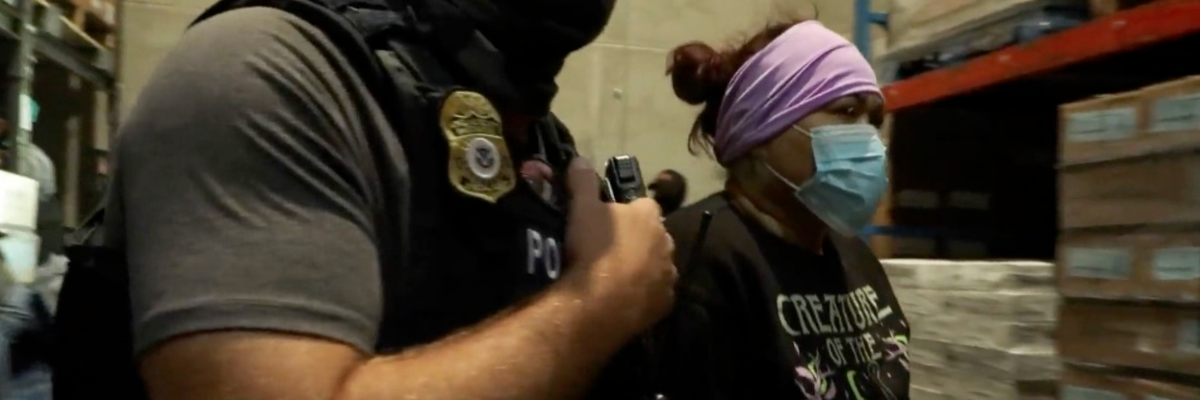
A masked US Immigration and Customs Enforcement agent arrests a woman during a raid on a Nebraska food processing plant amid the Trump administration’s mass deportation campaign.
(Photo by US Immigration and Customs Enforcement)
Brian Garvey
Dec 17, 2025
The “double-tap” attacks on Caribbean vessels paired with the pardon of a top-level convicted Honduran trafficker reveal a disturbing drift, where presidential will determines justice, not the rule of law. Precedents like these are already influencing domestic law enforcement, from Immigration and Custom Enforcement raids to threats against members of Congress.
The killing of helpless injured people in the Caribbean is horrifying. US forces reportedly launched a second missile at survivors clinging to debris—after the first strike destroyed their vessel. This incident should prompt congressional hearings and investigations, military resignations, and a national debate about who we are as a country.
RECOMMENDED...
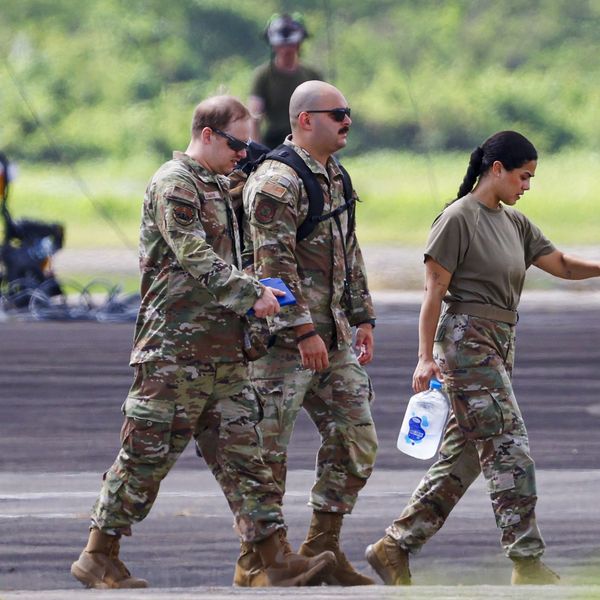
US Troops Near Venezuela Reportedly Denied Holiday Leave as Fears Grow of Unpopular and Lengthy Trump War

Leaders Across EU Deliver Unified Message to the US: ‘No War on Venezuela’
We should all be troubled by how easily our government now resorts to violence without law—and how familiar that pattern has become. This is not just a series of isolated decisions. It indicates a major shift in the American system of justice. We are drifting from a system based on legal principles to one in which the will of a single leader determines who is guilty and who is innocent, and who lives and who dies. When justice no longer comes from the rule of law but instead from the laws of one ruler, the republic itself is at risk.
A Pattern of Violence Without Accountability
The strikes on alleged drug boats in the Caribbean and Pacific—including the alleged “double-tap” attack in September—are justified by the administration as part of an expanded war on narcotics. But at the same time President Donald Trump orders executions at sea based solely on suspicion, he pardons an actual, convicted narcotrafficker: former Honduran President Juan Orlando Hernández, who was found guilty in a US court. That contradiction tells us everything we need to know. These policies are not about drugs. They are about unrestrained executive power.
We have seen this pattern before. In March, the administration launched unauthorized strikes in Yemen on “terrorists” based on reasoning that no one outside a small inner circle had reviewed, except of course for the journalist accidentally added to a secret chat—the incident now known as “Signalgate.” In November, the White House welcomed the new president of Syria: a man once wanted by the US government for leading both al-Qaeda and ISIS factions during the Syrian civil war. If a president can target one alleged wrongdoer with missiles while inviting another to the Oval Office, then “justice” is no longer about law. It’s about convenience.
Despite Threats, Lawmakers and Military Leaders Dissent
The erosion of constitutional principle is no longer limited to distant battlefields. It is now being directed at members of Congress themselves. When Sen. Mark Kelly (D-Ariz.) and several colleagues reminded US service members that they are legally obligated to refuse unlawful orders—quoting the Uniform Code of Military Justice—the president did not argue the law or dispute their interpretation. He threatened them with prosecution for sedition, going so far as to post “HANG THEM,” (his caps).
A government that decides the law abroad by whim will eventually do the same within its own borders.
Think about that. A president threatening to criminalize lawmakers for telling the truth about the rule of law to the troops they oversee. In any healthy republic, that would be a red line. In a system sliding toward executive supremacy, it becomes one more headline in a relentless procession.
Admiral Alvin Holsey, the former leader of the US Southern Command responsible for the Caribbean, resigned his post abruptly after questioning the legality of US strikes. Official statements insist the resignation was routine. But recent reporting from The Hill found the Secretary of War Pete Hegseth essentially fired the admiral for expressing doubts, saying, “You’re either on the team or you’re not,” and, “When you get an order, you move out fast and don’t ask questions.”
What Happens Abroad Eventually Comes Home
If we accept these absurdities and atrocities overseas, we should expect them to follow us home. Because they already have. The same disregard for due process that allowed missiles to fall on survivors in the Caribbean is visible in ICE’s warrantless raids, forced disappearances into detention centers, and the aggressive machinery of mass deportation. Agents show up without judicial warrants, seize people without probable cause, and remove them from their communities with no meaningful legal review. A government that decides the law abroad by whim will eventually do the same within its own borders.
The common thread is an executive branch increasingly operating without constitutional constraint. Whether it’s a missile strike justified by secret intelligence, a deportation justified by an agent’s suspicion, or a threat against a senator for quoting military law, the message is the same: The president decides what is legal.
Congress Must Reassert Its Constitutional Role
But that is not how a republic works. In our constitutional order, justice flows not from an individual but from the law, and the law is made not by one branch but by three. The framers designed the separation of powers to prevent exactly this concentration of authority: a president who wages war without authorization, punishes enemies without trial, and rewrites criminal law through selective pardons.
If Congress does not reassert its authority—through war-powers enforcement, oversight, and actual legislation that binds the executive—then we will slowly, quietly, and perhaps irrevocably transition into a different system altogether. One where the president’s will, not the public’s law, defines justice.
A democratic republic cannot survive that transformation. It is time to confront, clearly and honestly, the danger of normalizing violence without law and power without limit. The stakes are not only the victims of strikes abroad or raids at home. The stakes are the Constitution itself. And whether we still intend to live under it.In the United States, Reps. Jim McGovern (D-Mass.), Joaquin Castro (D-Texas) and Thomas Massie (R-Ky.) have introduced a bipartisan War Powers Resolution (House Concurrent Resolution 64) to block the Trump administration from engaging in hostilities inside Venezuela or against Venezuela without approval from Congress. Sens. Tim Kaine (D-Va.), Rand Paul (R-Ky.) and Adam Schiff (D-Calif.) have introduced another War Powers Resolution in the Senate (Senate Joint Resolution 98). We each have an opportunity now to educate representatives from every state to sign on to this resolution.
‘Unquestionably an Act of War’: Trump Declares Naval Blockade Against Venezuela
“This is the Iraq War 2.0 with a South American flavor to it,” warned one Democratic senator.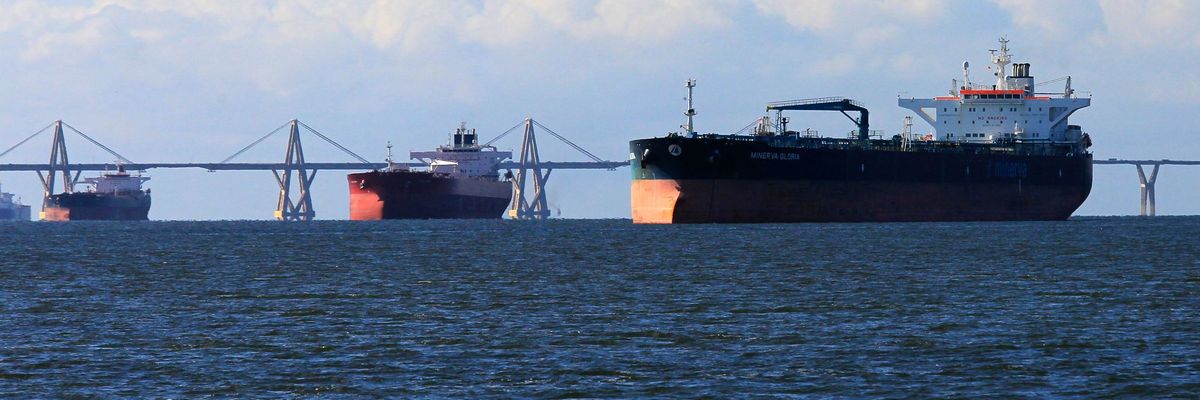
Oil tankers are seen anchored in Lake Maracaibo after loading crude oil at Venezuela’s Bajo Grande Refinery port on December 4, 2025.
(Photo by Jose Bula Urrutia/UCG/Universal Images Group via Getty Images)
Jake Johnson
Dec 17, 2025
COMMON DREAMS
US President Donald Trump late Tuesday declared a blockade on “all sanctioned oil tankers” approaching and leaving Venezuela, a major escalation in what’s widely seen as an accelerating march to war with the South American country.
The “total and complete blockade,” Trump wrote on his social media platform, will only be lifted when Venezuela returns to the US “all of the Oil, Land, and other Assets that they previously stole from us.”
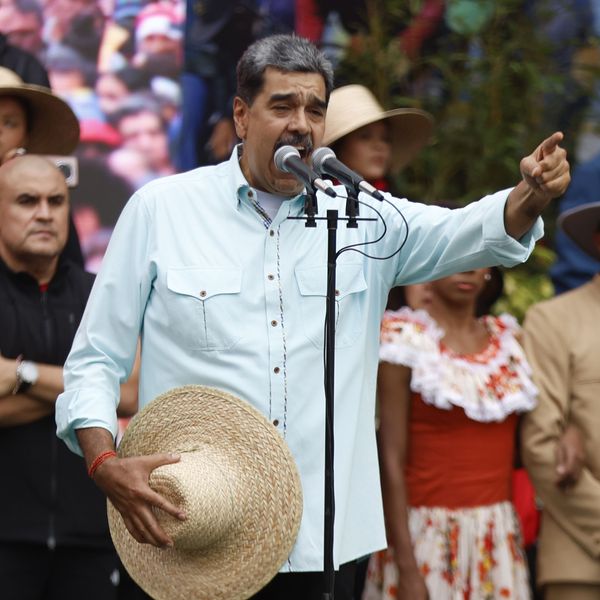
“Venezuela is completely surrounded by the largest Armada ever assembled in the History of South America,” Trump wrote, referring to the massive US military buildup in the Caribbean. “It will only get bigger, and the shock to them will be like nothing they have ever seen before.”
The government of Venezuelan President Nicolás Maduro, which has mobilized its military in response to the US president’s warmongering, denounced Trump’s comments as a “grotesque threat” aimed at “stealing the riches that belong to our homeland.”
The US-based anti-war group CodePink said in a statement that “Trump’s assertion that Venezuela must ‘return’ oil, land, and other assets to the United States exposes the true objective” of his military campaign.
“Venezuela did not steal anything from the United States. What Trump describes as ‘theft’ is Venezuela’s lawful assertion of sovereignty over its own natural resources and its refusal to allow US corporations to control its economy,” said CodePink. “A blockade, a terrorist designation, and a military buildup are steps toward war. Congress must act immediately to stop this escalation, and the international community must reject this lawless threat.”
The announced naval blockade—an act of aggression under international law—came a week after the Trump administration seized an oil tanker off the coast of Venezuela and made clear that it intends to intercept more.
US Rep. Joaquin Castro (D-Texas), one of the leaders of a war powers resolution aimed at preventing the Trump administration from launching a war on Venezuela without congressional approval, said Tuesday that “a naval blockade is unquestionably an act of war.”
“A war that the Congress never authorized and the American people do not want,” Castro added, noting that a vote on his resolution is set for Thursday. “Every member of the House of Representatives will have the opportunity to decide if they support sending Americans into yet another regime change war.”
“This is absolutely an effort to get us involved in a war in Venezuela.”
Human rights organizations have accused the Republican-controlled Congress of abdicating its responsibilities as the Trump administration takes belligerent and illegal actions in international waters and against Venezuela directly, claiming without evidence to be combating drug trafficking.
Last month, Senate Republicans—some of whom are publicly clamoring for the US military to overthrow Maduro’s government—voted down a Venezuela war powers resolution. Two GOP senators, Rand Paul of Kentucky and Lisa Murkowski of Alaska, joined Democrats in supporting the resolution.
Dylan Williams, vice president for government affairs at the Center for International Policy, wrote Tuesday that “the White House minimized Republican ‘yes’ votes by promising that Trump would seek Congress’ authorization before initiating hostilities against Venezuela itself.”
“Trump today broke that promise to his own party’s lawmakers by ordering a partial blockade on Venezuelan ships,” wrote Williams. “A blockade, including a partial one, definitively constitutes an act of war. Trump is starting a war against Venezuela without congressional authorization.”
Sen. Ruben Gallego (D-Ariz.) warned in a television appearance late Monday that members of the Trump administration are “going to do everything they can to get us into this war.”
“This is the Iraq War 2.0 with a South American flavor to it,” he added. “This is absolutely an effort to get us involved in a war in Venezuela.”
Trump Seizes Venezuelan Oil Tanker, Threatens Colombia “Could Be Next” Target For Regime Change
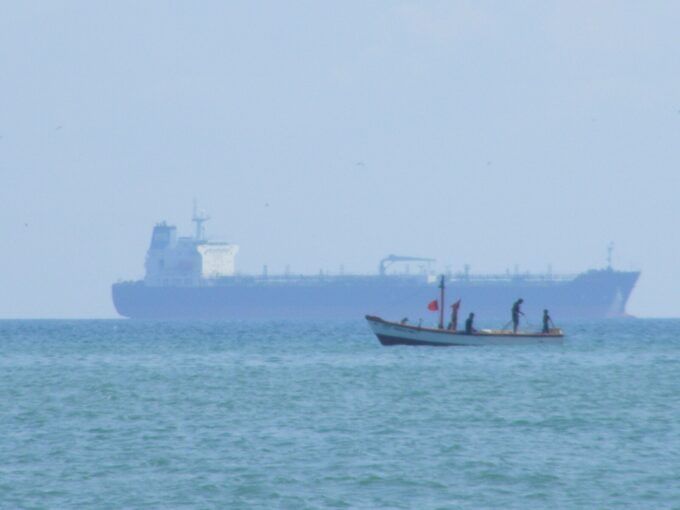
Photograph Source: Jujovar2010 – CC BY-SA 3.0
“It will make a big difference to the United States economically if we could have American oil companies invest in and produce the oil capabilities in Venezuela.”
– Former U.S. National Security Adviser John Bolton, Trish Regan Prime Time, Fox Business Report, January 28, 2019
President Donald Trump triumphantly announced on November 10 that the U.S. Coast Guard had seized a large oil tanker off the coast of Venezuela, while failing to identify it by name or specify where it had been intercepted, typical omissions for the “very stable genius.” This is but the latest news accompanying the massive U.S. military build-up in the Caribbean, which includes aircraft carriers, fighter jets, landing ships, and thousands of U.S. troops. At the same time, Trump threatened Colombian President Gustavo Petro that he “could be next”–presumably a threat of regime change–after Washington launches a military attack on the Venezuelan government, which Trump says is imminent.
The attack against Venezuela’s principal revenue source has nothing to do with drug trafficking–military operations abroad are the least effective method of combating drugs–but rather, reflects an imperial desire acted on by the last five U.S. administrations to expel the Bolivarian Revolution from power and install a puppet regime in Caracas that will hand over the largest oil reserves on the planet to Western corporations.
This lust for hydrocarbons, which should have been subdued some time ago in order to deal with growing climate breakdown, has gone full force with the second coming of Trump and his determination to extract and burn off as much oil as possible while eliminating even the most modest efforts to ameliorate the climate crisis. In July, for example, the Trump administration eliminated a regulation limiting toxic emissions from cars and power plants, and a week ago rolled back automobile fuel efficiency standards. This will aggravate the ecological crisis by increasing fuel consumption and carbon-dioxide production.
One can reasonably wonder whether the ongoing attacks on Bogota and Caracas are actually part of a Washington plan to take possession of existing cocaine-trafficking routes and open up new ones, for example, through “liberated” Venezuela. After all, the White House and its intelligence agencies have a well-established record of working with governments that publicly take a hard rhetorical line against drug-trafficking in order to hide their own criminal involvement in it, as occurred with Felipe Calderon in Mexico and with the Colombian paramilitaries under Alvaro Uribe (when Colombia enjoyed lavish U.S. support). In the Calderon case, even the U.S. concedes that strongman Genaro Garcia Luna (secretary of public security under Calderon) was directing narco-trafficking while also heading the agencies tasked with combating it.
As noted by Luis Hernandez Navarro in the Mexican daily La Jornada, the rising prospects of Uribe governing Colombia again through a figure-head following next year’s elections give the Trump administration an incentive to close the noose around Venezuela, the last untoppled domino Washington needs to achieve complete control of the narcotics trade in Central and South America.
At the same time, Hernandez notes, the open contempt for Latin American and Caribbean sovereignty reflects Trumpian confidence in being able to perpetrate whatever atrocities Washington needs to with impunity, a self-assurance that appears to be grounded in reality given the lack of consequences to more than two years of wholesale slaughter in Palestine by Israel with full U.S. support.
Furthermore, Hernandez goes on to point out, the presence of right-wing and extremely right-wing governments allied with Washington in Argentina, Bolivia, Costa Rica, Ecuador, Panama, Peru, the Dominican Republic, El Salvador, Trinidad, and Tobago smooths the probable path to power of a Pinochet-aligned group in Chile, as well as the threat of resurgent Uribe-ism in Colombia, all of which emboldens Trump to indulge calculated imperial abuse of a divided region unable to overtly resist it, whether it takes the form of illegal sanctions, acts of piracy like the recent seizure of the oil tanker, or bombardments and massacres.
Such policies are hardly the recent invention of an aberrant Trump regime, but rather, trace back to the unsuccessful 2002 U.S.-sponsored coup d’etat against Hugo Chavez, an effort that was aborted (but never renounced) when masses of poor people (the Bolivarian base) surrounded the presidential palace and successfully demanded Chavez’s release from captivity. Since then, and always in the name of freedom, democracy and human rights, the U.S. has unleashed sanctions, media slander campaigns, color revolutions, oil embargoes, assassination attempts (against president Maduro), robbery of currency reserves and infrastructure, threats of invasion, and attempted military coups against Bolivarian rule, including armed clashes between Colombian and Venezuelan forces, and once even recognizing a puppet government of its own choosing (Juan Guaido).
These actions have caused great damage to Venezuela and immense suffering to its people, taking the form of millions of dollars in lost oil income and the displacement of millions of Venezuelans, who have migrated to other countries in order to survive. Meanwhile, the oligarchs of old live the high life in great palaces in Miami and Madrid waiting for Washington to restore their lost privileges.
They may have a long wait. All prior efforts to effect regime change in Caracas have run up against what appears to be an immovable object: the unity of the National Bolivarian Armed Forces, which has emerged from twenty-seven years of revolutionary effort designed to make Venezuelan sovereignty invulnerable to compromise, whether by manipulation or outright conquest. To date there isn’t the slightest indication of an internal fissure anywhere in its considerable armor.
An important part of this unity has been the development of a new military doctrine known as Comprehensive National Defense, which confronts the U.S. military threat with three unyielding components: (1) strengthened military power; (2) deepened civilian-military union (people and army); and (3) increased popular participation in national defense tasks.
The pre-revolutionary Venezuelan armed forces were fragmented in divisions and brigades. Hugo Chavez organized the country in regions, and insured that in each region there was a military structure with all the necessary components: Army, Navy, National Guard, popular militias, and the people. If one region comes under attack, it now has the capacity to defend itself alone. There is no need for Caracas to move in units from somewhere else.
In addition to this redundant self-sufficiency, Venezuela enjoys complete unity of purpose and frequent contact between the government and the troops. President Maduro visits all the barracks personally, showing up at dawn. He freely shares with the troops, runs with them, and does military exercises with them. Many militia members have been Chavistas since childhood, forming unbreakable bonds of loyalty to each other and the Bolivarian Revolution. They will not be easily dealt with. As Venezuelan Interior Minister Diosdado Cabello observes: “For the friends of Chavismo the popular militias are a diamond; for the enemies they’re the worst possible news.”
Foreign military intervention in Venezuela is enormously complicated, and not just because of civilian-military unity. Venezuela is a large country of nearly thirty million people. It has weapons, manpower, determination, and land capable of sustaining prolonged popular resistance. It has modernized its weaponry, buying from China, Russia, and Iran, while also forging an alliance with those countries. In addition, it is blessed with geographical diversity measuring almost a million square kilometers, including extensive mountain ranges, dense jungles, and the long Orinoco River basin. It has 4208 kilometers of coastline, a 2341 kilometer border with Colombia, and a 2199 kilometer border with Brazil. And the popular barrios of Caracas are rat-holes.
None of Venezuela’s neighbors will lend themselves to being platforms for imperial war exploding in their midst.
Obviously, U.S. firepower can inflict enormous damage, but power without legitimacy is just another name for impotence.
Sources.
Luis Hernandez Navarro, “Venezuela, the Day After,” La Jornada (Spanish), December 9, 2025
Luis Hernandez Navarro, “Trump: the Context of the Aggressions,” La Jornada (Spanish), December 11, 2025
'Shock like they've never seen': Trump threatens foreign nation with 'largest armada ever'
Daniel Hampton
December 16, 2025
Trump wrote on his Truth Social platform, "Venezuela is completely surrounded by the largest Armada ever assembled in the History of South America."
He characterized the military show of force as a prelude to a more ominous action.
"It will only get bigger, and the shock to them will be like nothing they have ever seen before — Until such time as they return to the United States of America all of the Oil, Land, and other Assets that they previously stole from us," said Trump.
Trump called the regime of Nicolás Maduro "illegitimate," and accused the government of using oil from "stolen Oil Fields to finance themselves, Drug Terrorism, Human Trafficking, Murder, and Kidnapping."
In his announcement, Trump vowed a "TOTAL AND COMPLETE BLOCKADE OF ALL SANCTIONED OIL TANKERS going into, and out of, Venezuela."
Additionally, Trump asserted that any illegal immigrants sent to America by the regime would be returned at a "rapid pace."
His rant concluded with a demand for the immediate return of "our Oil, Land, or any other Assets."
In the past few weeks, Trump has repeatedly issued explicit threats against Venezuela, including promising imminent land strikes. He has also declared that Maduro’s "days are numbered."
UK
Richard Burgon MP: No to Trump’s war in Venezuela – Hands of Latin America

By Richard Burgon MP
We are in a very dangerous moment – one that requires us all to speak out loudly against a new era of Trump-led wars in Latin America.
Donald Trump has amassed the largest US military build-up in the Caribbean in decades, just off the coast of Venezuela.
This includes the largest warship ever constructed and fifteen thousand US troops deployed in the region. We have seen illicit US killings with the bombing of small boats. We have seen the seizure of a Venezuelan oil tanker – and Trump imposing a blockade on Venezuela. Trump is now threatening land attacks. It could not be more serious.
The threat against Venezuela is clearly very real — but we also need to see this as just the first step in Trump’s wider strategy in the region.
Trump’s National Security Strategy, published last week, has sparked real alarm across the world. In Europe, he made clear that the plan is to install far-right parties in power.
But one region is more clearly in his crosshairs than any other: Latin America.
Trump’s Strategy is explicit — Latin America will once again become the United States’ backyard. For Trump, a region of 700 million people will be treated as nothing more than a US colony. The Strategy states that the US will “reassert and enforce the Monroe Doctrine to restore American pre-eminence” in the region. Let’s be clear, that means US control over Latin America’s geography, resources and security.
Venezuela has the largest oil reserves in the world. But this is not just an oil grab. It is also a power grab to control the entire region.
Trump’s plans would represent a total reversal of the last quarter-century of Latin American history.
In the 21st century, a series of progressive governments — known as the Pink Tide — were elected with a focus on sovereignty over national resources and using those resources to invest in healthcare, education and public services.
Those Governments have prioritised regional integration, trading with one another for mutual benefit rather than being dominated by the United States, and they have expanded trade relations with the wider world, from Europe to Africa to China.
None of this is acceptable to Trump. That is what he wants to bring to an end. He wants to remove every single barrier to US domination and control of Latin America.
But the people of Latin America — like people everywhere — do not want to be controlled in the interests of a superpower. So, when Trump openly states that domination is his aim, we must be extremely alarmed about what could follow.
Trump’s agenda would have to be imposed through military interventions, through the installation of puppet governments, the rolling back of democratic freedoms, and the restriction of basic human rights.
We must remember what the United States did in the 1970s and 1980s under Operation Condor. US-backed military dictatorships in South America oversaw the torture and murder of many tens of thousands of political opponents.
Likewise, US-backed death squads in Central America carried out massacres and forced disappearances that left over 200,000 people killed or missing.
All of that was a key step in imposing economic control and carrying out the neoliberal experiments that Thatcher and Reagan later brought here.
Already this century the US has carried out a military coup (later defeated) in Venezuela and imposed sanctions responsible for tens of thousands of deaths, according to independent figures there. Now they are escalating further.
So, the danger is real, and we must say clearly: no to war on Venezuela, and no to a new era of US wars in Latin America.
Our task now is to build the widest possible movement — in our trade unions, our communities, and in our Parliament — to stop any military intervention in the region. I have tabled a parliamentary motion on this, and you can count on me to join you in building the broadest possible movement for peace, for sovereignty, and for the right of all peoples in Latin America to determine their own future.
- This article is a published version of the speech given by Richard Burgon MP at the Emergency Online Rally: No to Trump’s War on Venezuela hosted by the Venezuela Solidarity Campaign on 15 December 2025. You can watch it here.
- Richard Burgon is the MP for Leeds East, the Secretary of the Socialist Campaign Group of MPs and a regular contributor to Labour Outlook. You can follow him on Facebook, Twitter, Instagram and TikTok.
- You can read and add your name to the Emergency Statement: No to Trump’s war on Venezuela here.
- If you support Labour Outlook’s work amplifying the voices of left movements and struggles here and internationally, please consider becoming a supporter on Patreon.
Party for Socialism and Liberation
Download PDF flyer
In his administration’s latest act of war, Donald Trump has ordered a naval blockade of Venezuela. Its stated goal is to cut off all oil revenue to force the illegal overthrow of an independent government. This is a siege designed to cause economic collapse and a humanitarian crisis as a precursor to all-out war by the United States.
This aggression is about controlling Venezuela’s oil and reversing its political independence. It follows a pattern of U.S. intervention in Latin America, where governments that resist U.S. control are targeted for regime change. The recent killing of more than 83 fishermen by the U.S naval flotilla in the Caribbean and the illegal seizure of a Venezuelan oil tanker already show the Trump administration is violently escalating this conflict. Trump has made his colonial intentions clear by stating U.S. plans to steal Venezuelan land, oil, and minerals.
The people of the United States have overwhelmingly opposed military intervention in Venezuela. This war, like the war on Iraq, is built on false pretenses and imperial ambition. We must organize and mobilize to stop this blockade and prevent a wider war. No war on Venezuela!

No comments:
Post a Comment