When Muslims save lives, the Islamophobia machine looks the other way
(RNS) — The far-right response to a Muslim’s heroism in the Bondi Beach attack shows how Islamophobia depends on distortion and dehumanization.
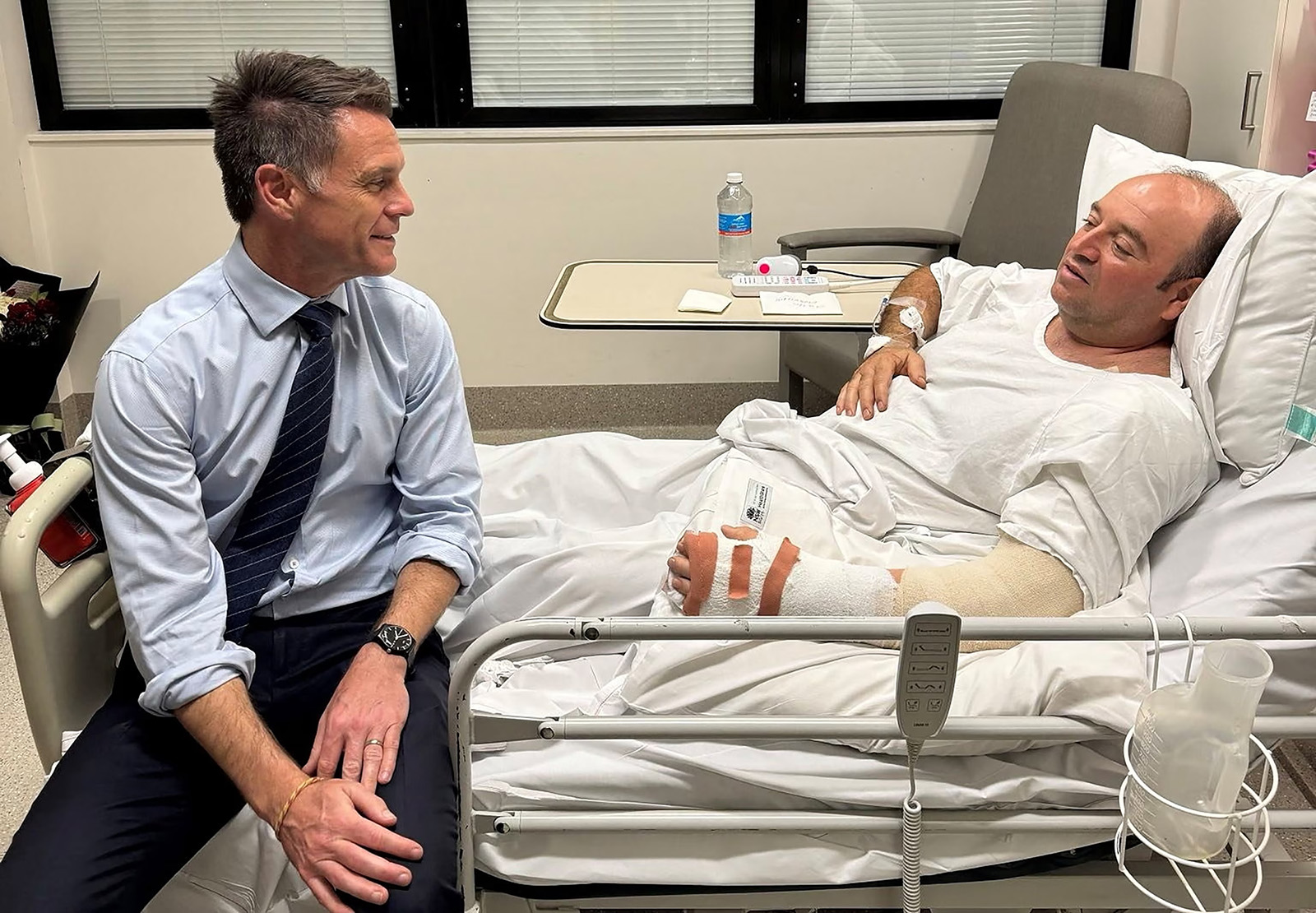
New South Wales Premier Chris Minns visits Ahmed al Ahmed, who was identified as the bystander who seized a rifle from one of the gunmen during the deadly shooting at Bondi Beach on Sunday, at a hospital in Sydney, Dec. 15, 2025. (Photo via X/@ChrisMinnsMP)
Omar Suleiman
December 16, 2025
RNS
(RNS) — The truth about a society often reveals itself in moments of crisis, in the unscripted actions of ordinary people. On Sunday (Dec. 14) in Sydney, when gunmen opened fire on a Hanukkah celebration at Bondi Beach, it was Ahmed al Ahmed, a 43-year-old Syrian-born Muslim and Australian immigrant, who ran toward danger. He tackled and disarmed one of the attackers, likely saving countless lives, and was lauded by Australian leaders and global onlookers as a hero.
Almost immediately, parts of the far-right internet went to work erasing that reality. Influencers and commentators fond of Islamophobic narratives began insisting, without evidence, that Ahmed must be a Christian. Laura Loomer, one of MAGA’s boundary guardians, wrote on X: “Credible reports suggest the man is actually a Lebanese or Coptic Christian. Don’t fall for the propaganda.”
These influencers could not tolerate the simple fact that a Muslim man risked his life to protect Jewish lives. It was too inconvenient for their worldview.
On the same day, two students were shot at Brown University. As speculation swirled online, some voices expressed open hope that the shooter would turn out to be Muslim. They needed the tragedy to fit their narrative; proving that he was shouting “Allahu Akbar” would allow them to spin it their way. Yet Mukhammad Aziz Umurzokov, one of the two students who were killed, was a Muslim himself. The fact received little attention from those who had been so eager to assign blame.
This is the dangerous core of Islamophobia today: The prejudice is so entrenched that reality must bend around it. Heroes must be stripped of their Muslim identity. Victims must be reframed as perpetrators. Truth becomes secondary to usefulness.
I have experienced this dynamic firsthand. A short, heavily edited clip of me continues to circulate on right-wing accounts designed to misrepresent my stance and inflame anti-Muslim sentiment. This is how manufactured outrage works. The few seconds shown in the clip are divorced from their context, allowing the confected narrative to take hold.

Video screen grab of Ahmed al Ahmed, white shirt, wrestling a rifle from one of the gunmen during the deadly shooting at Bondi Beach. (Video screen grab)
This is not accidental. Islamophobia is a political industry that depends on constant fear, distortion and dehumanization. Nor is it only a domestic political weapon, but a global information strategy. In the United Kingdom, Tommy Robinson, founder of the English Defense League, continues to build a movement around portraying Muslims as incompatible with Western society, using exaggeration, fabrication and selective storytelling.
Multiple investigations and analyses show how anti-Muslim sentiment is deliberately amplified to distract from mass violence and suppress criticism. One exposé found that the Israeli Ministry of Diaspora Affairs funded online influence campaigns that pushed pro-Israel messaging alongside anti-Muslim content. The goal was to shape public opinion by portraying Muslims as inherently threatening, making it easier to deflect attention from atrocities in Gaza.
Scholars analyzing the rhetoric around Gaza argue that Islamophobia is central to rhetoric attempting to justify or minimize Palestinian suffering by reframing the structural realities of occupation and mass death as natural responses to an inherently barbaric people. Civil rights advocates have warned that some pro-Israel political actors are using Islamophobia to discredit critics, distract from documented war crimes and frame solidarity with Palestinians as extremism.
Western media outlets, in addition, often rely on Islamophobic framing when covering Gaza, sidelining Palestinian voices while centering narratives that serve power rather than truth, according to reporting by the Bridge Initiative at Georgetown University.
These studies show that Islamophobia is not a byproduct of confusion or lack of education about Islam. It is driven and amplified by a recognizable cast of figures and platforms. Far-right provocateurs such as Loomer make conspiratorial claims about Muslims, painting an entire faith community as a national security threat and pushing false narratives to millions of followers.
These figures cultivate an audience conditioned to believe Muslims are uniquely violent or suspect. So when someone like Ahmed al Ahmed acts like a hero in Sydney, the system malfunctions. The narrative must be rewritten.
Once a community is dehumanized digitally, it becomes easier to continue to marginalize, exclude or harm that community physically. But the truth must break through.
Ahmed al Ahmed did not stop to ask the religion of the people he shielded. He acted on faith, courage and conscience. He has been rightfully recognized widely for the hero he is despite constant attempts to vilify his community.
This is the crisis of our moment: When a Muslim is a victim, their humanity is erased; when a Muslim is a hero, their identity is erased.
Islamophobia thrives on erasure. It thrives on fear. It thrives on distortion and distraction. But narratives built on fear are brittle when confronted with truth. Muslims today are part of the social fabric of every place they call home. They are students, caregivers, neighbors and, yes, heroes. Their courage and compassion defy bigotry’s attempts to confine them tocaricature.
If we want a society worth living in, then truth must matter more than fear. Heroism must matter more than narrative convenience. And human dignity must matter more than political utility.
The Islamophobia machine is in full swing, but the truth keeps clogging its system.
Using the Slain: Israel Exploits the Bondi
Beach Shootings
Israeli Prime Minister Benjamin Netanyahu rarely passes an opportunity to comment upon the way Jews in other countries are treated. While the manic hatred directed against Jews remains one of history’s grotesque legacies, opportunism in the Netanyahu government is a ready instinct. With a customary sense of perversion, Netanyahu has managed to mangle Israeli policy, his own political destiny and the interests of Jews in a terrible, terrifying mix. The broad stroke charge of antisemitism is the front name of this venture, and it conveniently presents itself whenever Israeli policy requires an alibi when pursuing particularly unsavoury policies: massacre, starvation and dispossession of Gazans; the continued destruction and intended eradication of a functional Palestinian entity; efforts to prevent criticism of its settler policies in other countries.
The slaughter of 15 people enjoying the festivities of Hanukkah on Sydney’s famed Bondi Beach by the father-son duo of Sajid and Naveed Akram, presented a political opportunity. Having already accused Australian Prime Minister Anthony Albanese of being a “weak politician who betrayed Israel and abandoned Australia’s Jews” earlier in the year, Netanyahu readied another verbal lashing. In prickly remarks made at a government meeting in Dimona, the Israeli PM accused his Australian counterpart of being a leader who had “replaced weakness and appeasement with more appeasement.” His “call for a Palestinian state pours fuel on the antisemitic fire.” It had rewarded “Hamas terrorists” and emboldened “those who menace Australian Jews and encourages the Jew hatred now stalking your streets.”
Other Israeli politicians also decided that an unmeasured though monstrous antisemitism stalked the island continent, spawning the Bondi killings. “We felt and experienced the intense antisemitism directed against the Jewish community in Australia,” claimed Aliyah and Integration Minister Ofir Sofer. Diaspora Affairs Minister Amichai Chikli thought it appropriate to send “a delegation of experts in emergency response” to Australia, promising to “stand with the Jewish community in this difficult time and to ensure that we, as the State of Israel, are giving them everything within our ability.”
Israeli Foreign Minister Gideon Sa’ar had a list of lecturing points for his Australian counterpart, Penny Wong. There had to be, he stated with a teacherly certitude, “a real change in the public atmosphere.” This required culling phrases and expressions that had been expressed on behalf of the Palestinian cause in public debate and protest. “Call such as ‘Globalize the Intifada,’ ‘From the River to the Sea Palestine Will be Free,’ and ‘Death to the IDF’ are not legitimate, are not part of the freedom of speech, inevitably lead to what we witnessed today.”
In Australia, the acceptance of such positions, and the watering down of the Palestinian cause, was rapidly normalised. A procession line of commentators proceeded to state begrudgingly that Israeli government policy could be criticised only to demonstrate how slim such latitude was. This firm, excruciating delineation was offered by Jeremy Leibler of the Zionist Federation of Australia: “Australians can criticise Israeli government policy, Israelis do it loudly and fiercely themselves. But delegitimising Israel’s right to exist, or slipping into a moral equivalence between a liberal democracy defending its citizens and a terrorist organisation that targets civilians, is something else entirely.”
Leibler’s semantic technique is important here, forcibly linking those who claim Israel has no right to exist to critics of Israel’s policy of self-defence after October 7, 2023 that has left 68,000 Palestinians dead, Gaza pulverised and an enclave on life support. At the instigation of South Africa, it is a policy that is being scrutinised by the International Court of Justice as being potentially genocidal. It is a policy that has been deemed genocidal by the UN Independent International Commission of Inquiry on the Occupied Palestinian Territory along with a clutch of notable human rights organisations, including the Israeli outfit B’Tselem. Arrest warrants have also been issued by the International Criminal Court for Netanyahu and his former Defence Minister Yoav Gallant, citing alleged war crimes and crimes against humanity.
Establishment voices from a long moribund press class are also of the view that not enough has been done by the Albanese government to combat a supposedly mad blight of antisemitism, seemingly unique from the other jostling hatreds. (Islamophobia, anyone?) The massacre, according to the unevidenced observation of veteran journalist Michelle Grattan, was “the horrific culmination of the antisemitism epidemic that has spread like wildfire in Australia.”
She noted, with grave disapproval, the failure to “formally” respond to the combative strategy proposed by the antisemitism envoy Jillian Segal, one that openly accepts the International Holocaust Remembrance Alliance’s stifling definition of antisemitism. Any official embrace of that definition – a point made by that definition’s originator, Kenneth Stern – would be a fashioned spear against free speech, censoring genuine criticism of Israeli policies. The Jerusalem Declaration, by way of contrast, notes that hostility to the Israeli state “could be an expression of an antisemitic animus, or it could be a reaction to a human rights violation, or it could be the emotion that a Palestinian feels on account of their experience at the hands of the state.”
Like most journalists wedded to the holy writ press brief and arid political interview, Grattan shows no sign of having been to a single protest condemning the murderous death toll in Gaza, or any gathering advancing the validity of Palestinian self-determination. Woolly-headed, she freely speculates. “Most of us did not recognise this fact, but this anti-Jewish sentiment must have been embedded in sections of the Australian community – the Hamas attack on Israel in October 2023 was the spark that lit the conflagration.” Her travesty of an effort to understand the attacks in Bondi becomes evident in cod assessments of various protest marches and demonstrations across Australian university campuses. Without even a suggestion of evidence, she claims that “university encampments” proved “intimidating for Jewish students and staff.” Those Jewish students and staff more than willing to engage in those encampments mysteriously warrant no mention. Efforts on the part of cloddish university managers to harass, suspend and censor students expressing pro-Palestinian causes don’t seem to interest Grattan either.
With laziness, she snacks on the propagandistic samples provided by Israel’s publicity relations buffet, referring to unspecified “others” who believed that the Albanese government’s recognition of a Palestinian state stoked local antisemitism. Foreign Minister Wong’s failure to “visit the sites of the 2023 atrocities when she went to Israel early last year was much criticised in the Jewish community.”
Thus far, Israeli propagandists have shamelessly badgered their opponents down under into accepting a streaky narrative that would fail to survive judicial, let alone historical scrutiny. The agenda is clear enough: the inoculation of Israel against international opprobrium. Much will now depend on Albanese’s fortitude, if he, and his ministers, can find it.

No comments:
Post a Comment