Showing posts sorted by date for query ARBEIT MACHT FREI. Sort by relevance Show all posts

Monday, January 20, 2025

‘Our mission’: Auschwitz museum staff recount their everyday jobs


By AFP
January 19, 2025


'It's impossible to leave all the history behind and not take it home with you,' says guide Jacek Paluch - Copyright the Hostages Families Forum Headquarters/AFP -, Ahmad GHARABLI

Bernard OSSER

Barbed wire lines the road to work for Pawel Sawicki, deputy spokesman of the Auschwitz museum at the site of the former Nazi death camp that was liberated 80 years ago this month.

More than one million people died at the Auschwitz-Birkenau camp built by Nazi Germany when it occupied Poland in World War II — most of them Jews, but also non-Jewish Poles, Roma and Soviet soldiers.

Around 850 people work at the museum to preserve their memory, a job with more emotional baggage than your usual nine-to-five.

“They say that when you start working here, either you leave very quickly because the history is too much or you stay for a long time,” said Sawicki, who is in charge of social media at the museum and has worked there for 17 years.

“It helps if you find some meaning to the mission,” the 44-year-old told AFP.

Sawicki’s office is located inside a former hospital for the Nazis’ notorious SS.

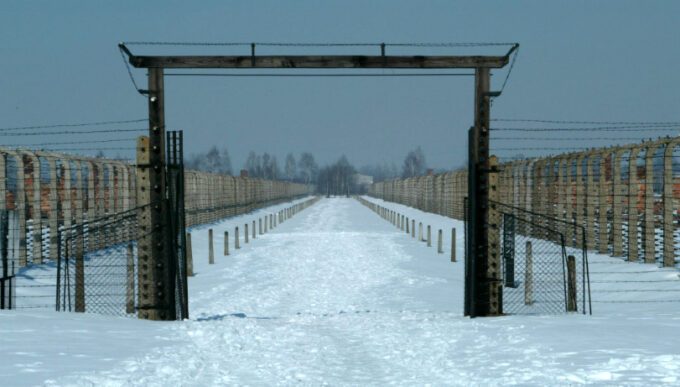
Behind the building there is an old gas chamber and farther on stands the camp’s “Arbeit Macht Frei” (Work Will Set You Free) gate.

To cope with the heavy emotional toll of working at Auschwitz, Sawicki said he has put up “a sort of professional barrier” that keeps him sane, even if it cracks from time to time.


– Not a word –


Jacek Paluch, a longtime Auschwitz tour guide, said he makes sure to leave his “work at work” to avoid going crazy.

“But it’s a special job, and a special place. It’s impossible to leave all the history behind and not take it home with you,” he told AFP.

The 60-year-old said he leads up to 400 groups of visitors each year around the former death factory.

More than 1.8 million people from across the world visited Auschwitz last year.

The museum offers tours of the site in more than 20 languages, led by around 350 guides.

The hardest, most emotional moments for Paluch are his encounters with former prisoners.

Once, Paluch came across a man sitting silently — and unresponsive to questions — on a bench, his arm tattooed with his former inmate number.

“His whole life, he never spoke a word to his family about what had happened here. Then, suddenly, at one Sunday breakfast, he began to talk,” Paluch said.

“They stopped him and took him here so that he could tell his story where it happened,” he continued.

“But when he walked through the ‘Arbeit Macht Frei’ gate, the memories came back. He went quiet again and no longer wanted to talk about any of it.”


– ‘Importance as evidence’ –


Paluch said he knows when the job has taken its toll.

“A sign of fatigue, not necessarily physical but more mental, is when I have dreams at night that I’m leading groups,” he said.

“That’s when I realise I need to take some time off.”

Wanda Witek-Malicka, a historian at the museum’s research centre, had for years focused on child inmates of Auschwitz. But she had to abandon the difficult subject when she became a mother.

“At that moment, this particular aspect of Auschwitz history — children, pregnant women, newborns — I was in no state to handle it,” she told AFP.

“The emotional weight of the site and the history was too much for me,” the 38-year-old added.

Were the museum staff to reflect on the site’s history round the clock “we’d probably be unable to get any work done”.

Elsewhere at the site, conservator Andrzej Jastrzebiowski examined some metal containers once filled with Zyklon B, the poison gas used to kill inmates at Auschwitz.

He recalled his anger early on — he has worked at the museum for 17 years — when he had to conserve objects that had belonged to the Nazis.

“Later, I realised these objects had importance as evidence of the crimes committed here, and maintaining them is also part of our mission here,” the 47-year-old told AFP.


– ‘Give them a voice’ –


Jastrzebiowski and his colleagues at the high-tech conservation department are responsible for preserving hundreds of thousands of items, including shoes, suitcases, metal pots, toothbrushes, letters and documents.

Most of the items had belonged to inmates before being confiscated upon arrival.

The conservators are also responsible for preserving the camp barracks, the barbed wire, and the remnants of the blown up crematoriums and gas chambers and other ruins at the site.

It is work of utmost importance, especially at a time when the number of living former inmates is dwindling fast.

“Soon there will be no more direct witnesses to testify and all that will remain are these items, and they will have to tell the history,” said Jastrzebiowski.

“Our job is to give them a voice.”

When he works on an item, he tries to discover the object’s peculiarities to keep the job from becoming a mindless routine.

“It helps me to think of the items’ owners, their stories,” he told AFP.

“Most of all, it’s the opposite of what the Nazis had wanted — that their memory vanish, that they disappear forever.”


Tuesday, December 31, 2024

Auschwitz to Gaza: The War Against International Law


 December 31, 2024
Facebook

Gate in Auschwitz II-Birkenau – CC BY 3.0

At Home and Abroad

Police in America need a great deal of reform, a project that translates to freeing them from the racist nature of U.S. culture while tying them more firmly to the culture of civil and human rights. Not easy, but certainly a worthwhile task compared to maintaining the present situation. Here is another perspective: what would happen if all the police in the country just disappeared or were “defunded”?  Almost certainly the result would be a breakdown of order. Actually, according to the philosopher Thomas Hobbes, this would be an absolutely worse case scenario, because just about anything is better than anarchy, which he likens to a war of all against all. Putting a deeper analysis of Hobbes aside, I am going to assume that most readers would agree with him—though perhaps not with his soft spot for dictatorial substitutes (see his seminal work, Leviathan).

Ok. Let’s now transfer that second perspective—anarchy in one society—to the international order. Actually, we are close to this very situation. What rules and regulations that exist to, supposedly, put limits on the behavior of states have been eroding for at least the last fifty years. Indeed, the U.S., acting out in places as disparate as Vietnam and Iraq has shown how “great powers” can thumb their virtual noses at the legal foundations of civilization. Just as an aside, the U.S. is also the Dorian Grey of “great powers.” This is because while behaving barbarically, the United States claims to represent the very model of enlightened behavior. Other “great powers” such as Russia and China have played their own roles in this plague of barbarism, but the U.S. displays the most hypocrisy.

This being the case, is it any surprise that it is Washington’s primary client state—namely Israel—that is now pulling down the whole fragile structure of international law and order—and doing so with the steadfast help of America and other Western states?

Irony

There is much irony here, for the nature of Israeli behavior that is presently threatening international law reflects anarchistic Nazi behavior in the 1930s and 1940s. We remember Nazi Germany for two main reasons: (1) The waging of war not in self-defense but for the sake of territorial expansion. The Nazis justified this aggression mainly with the concept of “Lebensraum”, the acquisition of territory for colonization by an expanding, racially superior, German population. And what of the native populations of these conquered areas? (2) The answer to this question constitutes the second reason we remember the Nazis. These populations were slaughtered—partially through the massive aerial bombardment and executions of civilians within occupied territories. Unique, as of yet, to the Nazis was the institution of the mechanized mass murder in concentration camps. Of course, the main, but not only, victims of these camps were Europe’s Jews.

So how does today’s behavior of Israel, backed by its patron the United States, remind us of the Nazi disruption of international order? (1) Israel has evolved—driven by the very logic of Zionist ideology—to proclaim itself a state of Jewish supremacy. As described by B’Tselem, Israel’s own human rights organization, Israel seeks “Jewish supremacy from the Jordan River to the Mediterranean Sea.” Today, we call this apartheid which international law and convention has designated a “crime against humanity.” (2) Since its inception, Israel has coveted “all the land of Biblical Israel, i.e. Gaza, the West Bank and other parcels of territory, as divinely designated “lebensraum” for the Jewish people. Presently, the ethnic cleansing of the Gaza Strip is being done in preparation for Israeli colonization. (3) That ethnic cleansing is perpetuated primarily by massive bombardment from the air and artillery barrages that reenact both the Nazi tactic of blitzkrieg and the U.S. tactic of “shock and awe.” (4) While there has not been a literal replication of the Nazi concentration camps, Israel did transform the Gaza Strip into the “world’s biggest open air prison.” And then, following the October 7, 2023 Palestinian act of resistance, they transformed the Strip one more time into a simulation of the last days of the Warsaw Ghetto—also destroyed (in 1943) by the Nazis for an act of resistance. (5) Finally, please note that all of the above are acts of the Israeli state and its Zionist supporters, and not of the Jewish people as a whole. The effort by Israel to identify all Jews with both its ideology and its crimes is the equivalent to the Nazis going to war in the name of all Germans. Neither claim is true.

“On a Knife’s Edge”

There are plenty of authoritative statements as to the consequences of Israeli actions on international law and order. For instance, the 20 November 2024 comments of Francesca Albanese, the UN special rapporteur on the situation of human rights in the Palestinian territories occupied since 1967. Albanese said, “The failure of the world’s states to stop Israel’s ‘colonial erasure’ of the Palestinian people is putting international justice on the edge. We might lose what we have, what we have built .… International law is on a knife’s edge.” On 3 December 2024, Ramzy Baroud, a well respected American-Palestinian journalist and writer, observed that until the recent behavior of Israel made clear that state’s true nature, the West had accepted “the entire Israeli political discourse [that] situated [the Zionist state] within western priorities and supposed values: civilization, democracy, enlightenment, human rights and the like.” As a consequence “the international legal system has historically failed to hold Israel … accountable to international law.” This includes “the utter failure of the international community to stop the grisly genocide in the [Gaza] Strip.” UN Secretary General Guterres has concluded that “the catastrophe in Gaza is nothing less than a complete collapse of our shared humanity.”

Baroud did note that belatedly, “it turned out that the international system has a pulse, after all, though faint, but is enough to rekindle hope that legal and moral accountability are still possible.” He was speaking here of the judgments rendered by the International Court of Justice (ICJ) and International Criminal Court (ICC). The former laid down the high probability that Israel was committing genocide in Gaza—a conclusion supported by evidence brought to the court by South Africa and others, as well as by almost every reputable human rights organization on the planet. The ICC citing this evidence, has issued arrest warrants for the responsible Israeli leaders. Thousands of their soldiers are also under investigation. It will be a long time before any of these folks enjoys a vacation abroad (except perhaps to the U.S. or Hungary) without risking arrest.

Nonetheless, no state is militarily seeking to stop Israel’s ongoing slaughter. If the Israelis rein in their hubris and stay home, their leaders and soldiers may never be brought to justice. The Israelis are betting that time will erase their sins. As David Ben Gurion said (yes, he really did say this), “the old [Palestinians] will die and the young will forget.” It is a silly assumption. Just ask young Jews worldwide if they have forgotten the Holocaust. The U.S. government may be hoping for the same pseudo remedy.

Corrosive Blowback

There is another consequence to be considered, particularly as regards Israel’s patron, the United States. As we know, again quoting Ramzy Baroud, the U.S. itself is an “unrepentant violator of human rights” and that is perhaps why the American government finds it easy to “maintain a strong position in defense of Israel, shaming the ICC for the warrants.” You will remember the observation that this position entails an enormous level of hypocrisy. It turns out that such hypocrisy can be domestically corrosive.

There is such a thing as the Leahy Law, named after former Vermont Democratic Senator Patrick Leahy. Passed in 1997, it “prohibits the U.S. Government from using funds for assistance to units of foreign security forces where there is credible information implicating that unit in the commission of gross violations of human rights.” This law restricts both the State Department and the Department of Defense. Thus, Washington’s material support of Israel while its military simultaneously carries out genocide in Gaza, violates federal law. And, they are doing this under orders of an imperial presidency.

There are corrosive consequences of this obvious hypocrisy and flagrant official disregard of U.S. law. Now, federal and local governments seem perfectly willing to abrogate the Constitution on the urging of Christian fundamentalists and Zionist ideologues. As a consequence the Constitutional rights of free speech and assembly are being selectively suppressed. Authorities are shutting down the non-violent protests and arresting young idealists (mostly students), faculty, and many others dedicated to civil and human rights, as well as those who are personally impacted by Israel’s slaughter: Palestinian Americans and American Jews who are horrified at what the Israelis are doing in the name of their religion. And, just as shamefully, university administrators have sold out their educational principles for the donors’ modern equivalent of thirty pieces of silver. More generally, it would seem there is a steady move worldwide to the authoritarian right, including in the United States. This movement tends to align with Israel and the Zionists and therefore, the corrosive effects are likely to get worse before it gets better.

Conclusion

Let’s give the final word to an Israeli journalist, one of the very few who sees and understands what the “Zionist state” has really wrought: Gideon Levy, writing in Haaretz (23 December 2024).

Levy notes that this year marks the 80th anniversary of the liberation of the Nazi concentration/death camp at Auschwitz, situated in today’s Poland. He then informs us that the Israeli Prime Minister, Benjamin Netanyahu, will not be attending because there is an ICC warrant for his arrest for perpetrating war crimes. Levy contextualizes this ironic situation as follows: “The distance between Auschwitz and Gaza, with a stopover in The Hague [where the ICC holds court], is still enormous, but it can no longer be argued that the comparison is preposterous …. [In fact] one realizes that this distance is shrinking by the day …. And when ethnic cleansing is carried out in northern Gaza, followed by clear signs of genocide throughout the Strip, the memory of the Holocaust is already roaring.”

Levy’s conclusion is that this is a result of a decision Israeli leaders made long ago. With the defeat of the Nazis and the liberation of death camps such as Auschwitz, the “Jews were given a choice between two legacies: Never again, the Jews will never face a similar danger, or – Never again, no one in the world will ever face a similar danger. Israel clearly chose the former option, with a fatal addition: After Auschwitz, Jews are permitted to do anything.” And they have done so by a Zionist inspired 75 years of harassment and persecution of the Palestinian people. As a consequence, Israel is now a “pariah state,” its Prime Minister is a war criminal, and “one realizes that the distance” that divides the practices of the Nazis from those of Netanyahu’s Israel “is shrinking by the day.”

Levy’s observations can stand as an epitaph for the illusions of Zionist Israel and its American patrons. It may also introduce us into another historical era of barbarism such as the 1930s and 1940s and thus be an epitaph for international law and order and human rights as well.

Lawrence Davidson is a retired professor of history at West Chester University in West Chester, PA.


From Auschwitz to Gaza, With a Stopover in 

The Hague


Benjamin Netanyahu will not travel to Poland next month for the main ceremony marking the 80th anniversary of the liberation of the Auschwitz death camp, over concern that he could be arrested on the basis of the warrant issued against him by the International Criminal Court in The Hague.

December 29, 2024
HAARETZ


This bitter and not-so-subtle irony of history supplies a surreal confluence that was nearly unimaginable before now : merely to imagine the prime minister landing in Krakow, arriving at the main entrance of Auschwitz and being arrested by Polish police at the gate, under the slogan « Arbeit macht frei » (« Work sets you free ») ; merely to consider that of all the figures and countries, it is the prime minister of Israel who is prevented from attending the memorial for members of his people on account of the threat of international law hovering over his head. The German chancellor, yes ; Netanyahu, no.

Eighty years ago, when Auschwitz was liberated, it would have sounded like the most insane development imaginable. Not anymore. Eighty years ago, Jews were given a choice between two legacies : Never again, the Jews will never face a similar danger, or – Never again, no one in the world will ever face a similar danger. Israel clearly chose the former option, with a fatal addition : After Auschwitz, Jews are permitted to do anything.

Israel has implemented this doctrine in the past year as it never has before. A prime minister who dodged a ceremony in Auschwitz is perhaps the grossest illustration of this. The fact that of all the places in the world, Auschwitz is the first that Netanyahu fears going to, shouts symbolism as well as historical justice.

Other heads of state will attend the ceremony, but not Netanyahu. He is wanted by the tribunal – which was established in the wake of what happened at Auschwitz – on suspicion of war crimes that, with alarming speed, increasingly resemble the crimes of Auschwitz.

The distance between Auschwitz and Gaza, with a stopover in The Hague, is still enormous, but it can no longer be argued that the comparison is preposterous.

After reading Yaniv Kubovich’s nightmare report on what is taking place on the corridor of death in Netzarim, one realizes that this distance is shrinking by the day.

It has always been taboo to compare anything to the Holocaust, and rightly so. There has never been anything like it. The worst crimes of the occupation pale in comparison to the crimes of Auschwitz.

Moreover, this comparison always left Israel white as snow and its accusers as antisemites : After all, there are no death camps in Gaza, so every accusation can easily be rebuffed. There are no death camps, therefore the IDF is the most moral army in the world. There will never be death camps in Gaza, and nevertheless the comparisons are beginning to cry out from beneath the rubble and the mass graves.

When Palestinians in Gaza know that where packs of stray dogs prowl, there are human corpses eaten by the dogs, Holocaust memories begin to surface.

When in occupied Gaza there is an imaginary line of death, and anyone who crosses it is doomed to death, even a hungry or disabled child, the memory of the Holocaust begins to whisper.

And when ethnic cleansing is carried out in northern Gaza, followed by clear signs of genocide throughout the Strip, the memory of the Holocaust is already roaring.

October 7, 2023 is increasingly emerging as a fateful turning point for Israel, much more than it seems at present, similar only to its previous calamity, the 1967 war, which was also not diagnosed in time. In the Six-Day War, Israel lost its humility, and on October 7 it lost its humanity. In both cases, there is irreversible damage.

Meanwhile, we must consider the historical occasion and absorb its significance : a ceremony commemorating the 80th anniversary of the liberation of Auschwitz, world leaders march in silence, the last living survivors march alongside them, and the place of the prime minister of the state that rose from the ashes of the Holocaust is vacant.

It is vacant because his state has become a pariah, and because he is wanted by the most respected court that tries war criminals. It bears raising our heads for a moment from the Hanni Bleiweiss scandal and the Feldstein affair : Netanyahu will not be at Auschwitz, because he is wanted for war crimes.


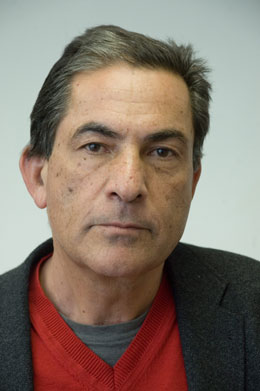
Gideon Levy is a Haaretz columnist and a member of the newspaper's editorial board. Levy joined Haaretz in 1982, and spent four years as the newspaper's deputy editor. He is the author of the weekly Twilight Zone feature, which covers the Israeli occupation in the West Bank and Gaza over the last 25 years, as well as the writer of political editorials for the newspaper. Levy was the recipient of the Euro-Med Journalist Prize for 2008; the Leipzig Freedom Prize in 2001; the Israeli Journalists’ Union Prize in 1997; and The Association of Human Rights in Israel Award for 1996. His new book, The Punishment of Gaza, has just been published by Verso Publishing House in London and New York.

Tuesday, October 15, 2024

What Does Fascism Look Like? A Brief Introduction


 October 11, 2024
Facebook
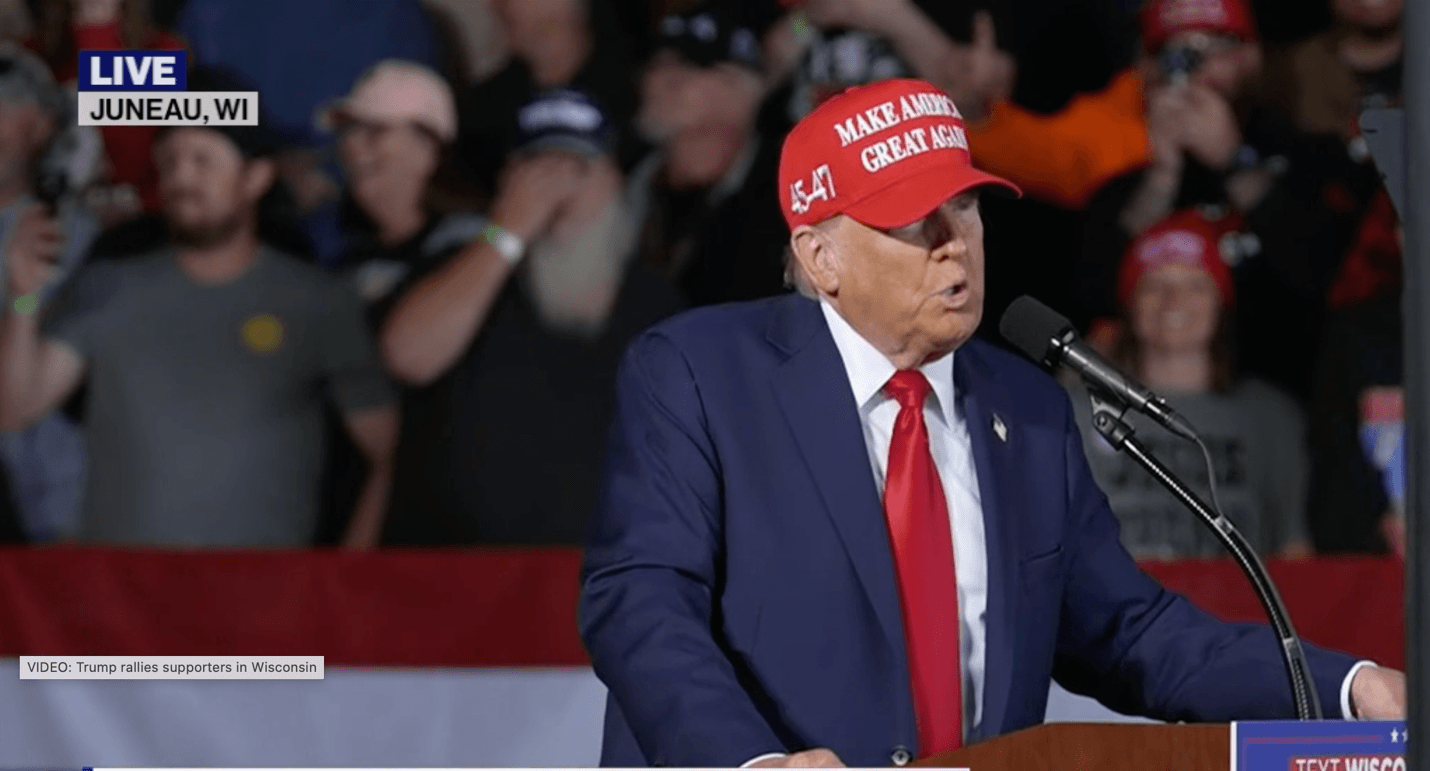
A person in a suit and red tie speaking into a microphoneDescription automatically generated

Trump Rally, Juneau, Wisconsin, Oct. 6, 2024. ABC News (Screenshot).

The ideology of fascism

It would be good to be able to recognize fascism when you see it. Sight is our dominant sense (light travels faster than sound) and provides us warning. In addition, because “fascist” is an epithet as well as political term, it must be used carefully. In 1942, a New Hampshire Jehovah’s Witness named Chaplinsky was arrested after calling a Rochester city marshal a “damned fascist.” The U.S. Supreme Court upheld the arrest on the grounds that the expression constituted “fighting words,” excluded from constitutional protection. Recent court decisions in the U.S. have widened speech freedoms, but the word “fascist” remains highly charged, underlining the need for historical and political discretion.

Because of Hitler and Mussolini, it’s relatively easy to recognize fascism retrospectively. Though Hitler preferred the term “National Socialism” and Mussolini “fascism”, their regimes had enough in common that we can use the single word, fascism, to describe them both. They were violent, imperialist, racist, anti-Semitic, anti-individualist, and nationalist. “Palingenetic ultranationalism,” a phrase coined by Roger Griffin in 1991, describes their shared, underlying ideology: interwar fascists believed they were spurring the revolutionary rebirth and modernization of a decadent nation for the benefit of racially superior citizens. Fascism is hierarchical and corporatist; it endorses existing aristocracies of birth and wealth; it is capitalism in its desperate, parasitical phase.

Fascist iconography

While the Germans worshipped ancient Norsemen and Aryans, the Italian fascists venerated the Roman Empire. They embraced its symbols – the fasces (a bundle of sticks with an ax in the middle) and she-wolf. That the legendary founders of Rome, Romulus and Remus, were suckled by a wolf, allowed the Italian fascists to proclaim their own decent from a fierce and ruthless beast. Like the Roman emperors, Caesar Augustus and Marcus Aurelius, Mussolini and his followers were bent on imperial conquest. Mussolini was Il Duce, the name derived from the Latin dux, or Roman military commander.

The attainment of national and racial destiny, according to the fascist idea, is the result of individual will. Both Italian and German regimes were premised upon the “leadership principle” — in German Führerprinzip — the idea that power and wisdom reside in a single, great leader and that the people owe him loyalty and obedience. In 1936, Hitler and Mussolini quietly agreed to support each other politically and militarily; two years later, they openly formalized the relationship in a “Pact of Steel.” By the Spring of 1945, both were dead – the one by suicide, the other killed by a mob of ordinary Italians.
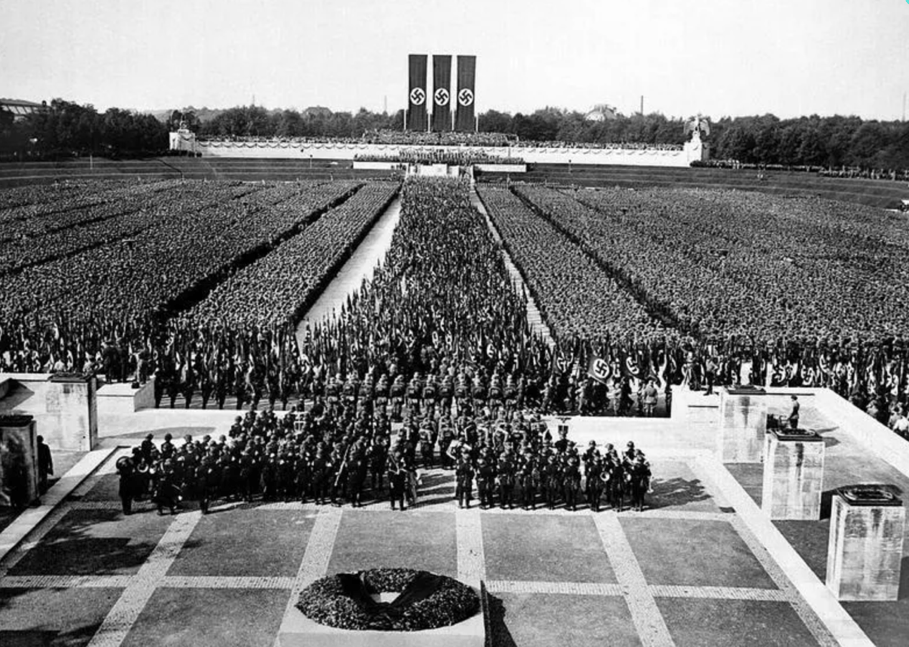
A large group of people standing in front of a large crowd Description automatically generated
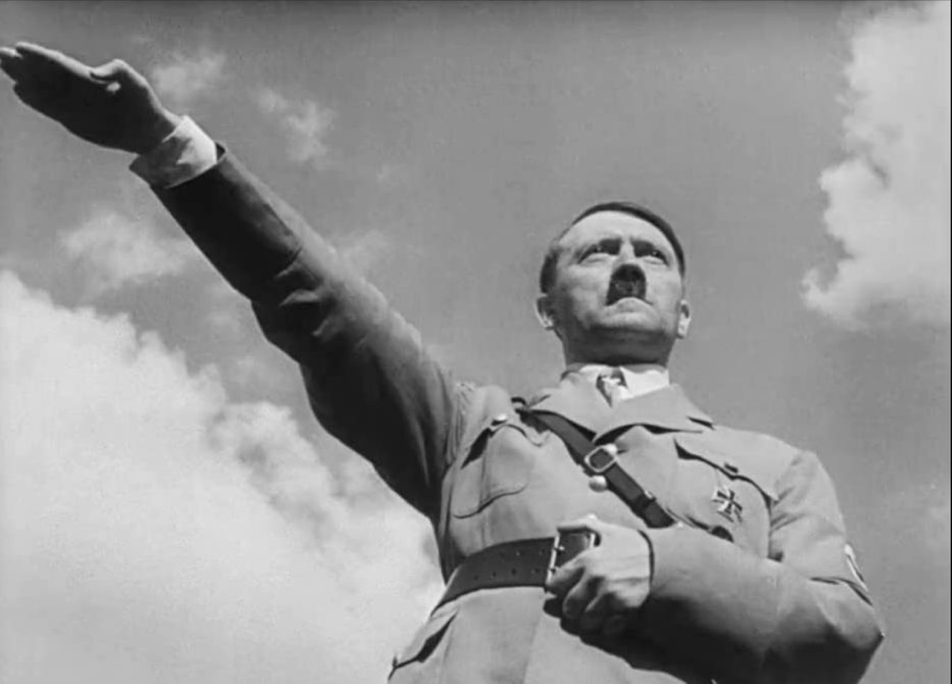
A person in a military uniform with his arm raised Description automatically generated

Leni Riefenstahl, Triumph of the Will, 1935.

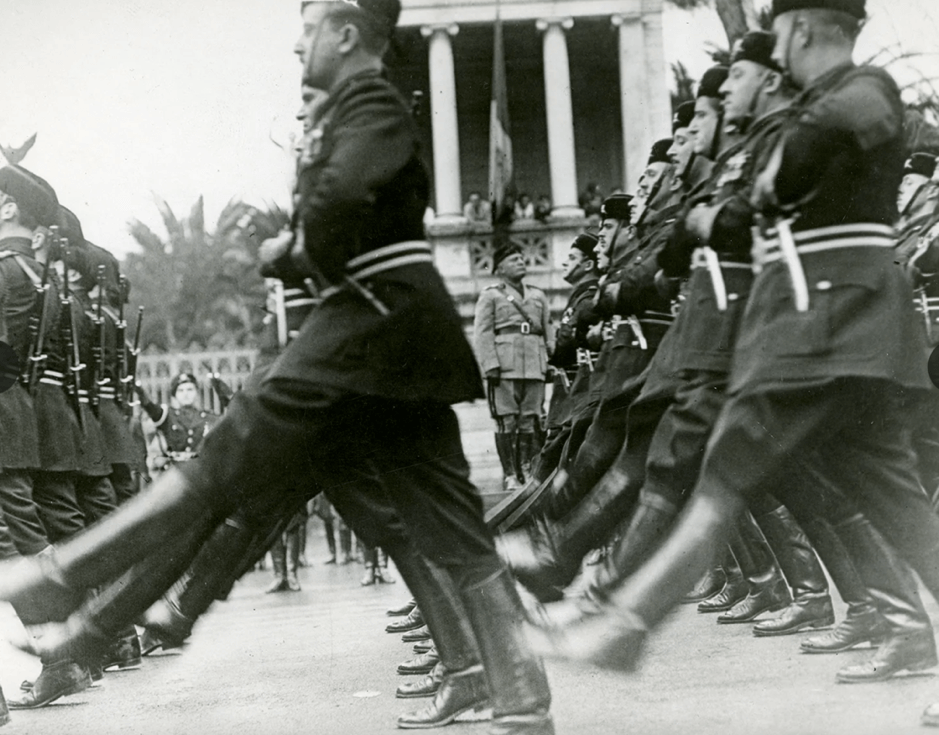
Because of the indelible stain it left, fascist iconography is memorable: the toothbrush moustache and stiff salute, swastikas, goose-stepping troops, the SS symbol, black shirts, and the ancient fascist emblem itself. Here are two stills from Leni Riefenstahl’s documentary/propaganda film Triumph of the Will, about the 1934 Nazi Party Congress in Nuremberg; And here are two propaganda photos of Mussolini reviewing his troops. Together, they represent militarism, masculinism, elitism, nationalism and the Führerprinzip,

A person in a uniform holding a lantern Description automatically generated
A group of men marching in a parade Description automatically generated

Photographers unknown, Mussolini speaking (Rome, 1940) and Reviewing Troops (Rome, c. 1938).

This iconography was so well known that it could be satirized by Charlie Chaplin in his popular, 1940 film, The Great Dictator. The story concerns a Jewish barber (no name given) who bears an uncanny resemblance to the dictator of Tomania, Adenoid Hynkel. Both roles are played by Chaplin. (Rather than Führer, he’s called the “phooey” of Tomania.) Hynkel is allied with, but also in comic competition with Benzio Napaloni, the dictator of Bacteria, played by Jack Oakie.

The movie is vague on the details of Nazi politics and ideology. But the best three minutes of the movie – Hynkel’s ballet with a giant balloon-globe — effectively suggests the imperial ambitions of fascist leaders. It includes many of the icons of Nazism: Hitler’s moustache, uniforms, jackboots, eagle, and swastikas (the latter so well-known they can be changed into doubled x’s). The balloon/globe — which bursts at the end — suggests both Hitler’s violence and self-destructiveness.
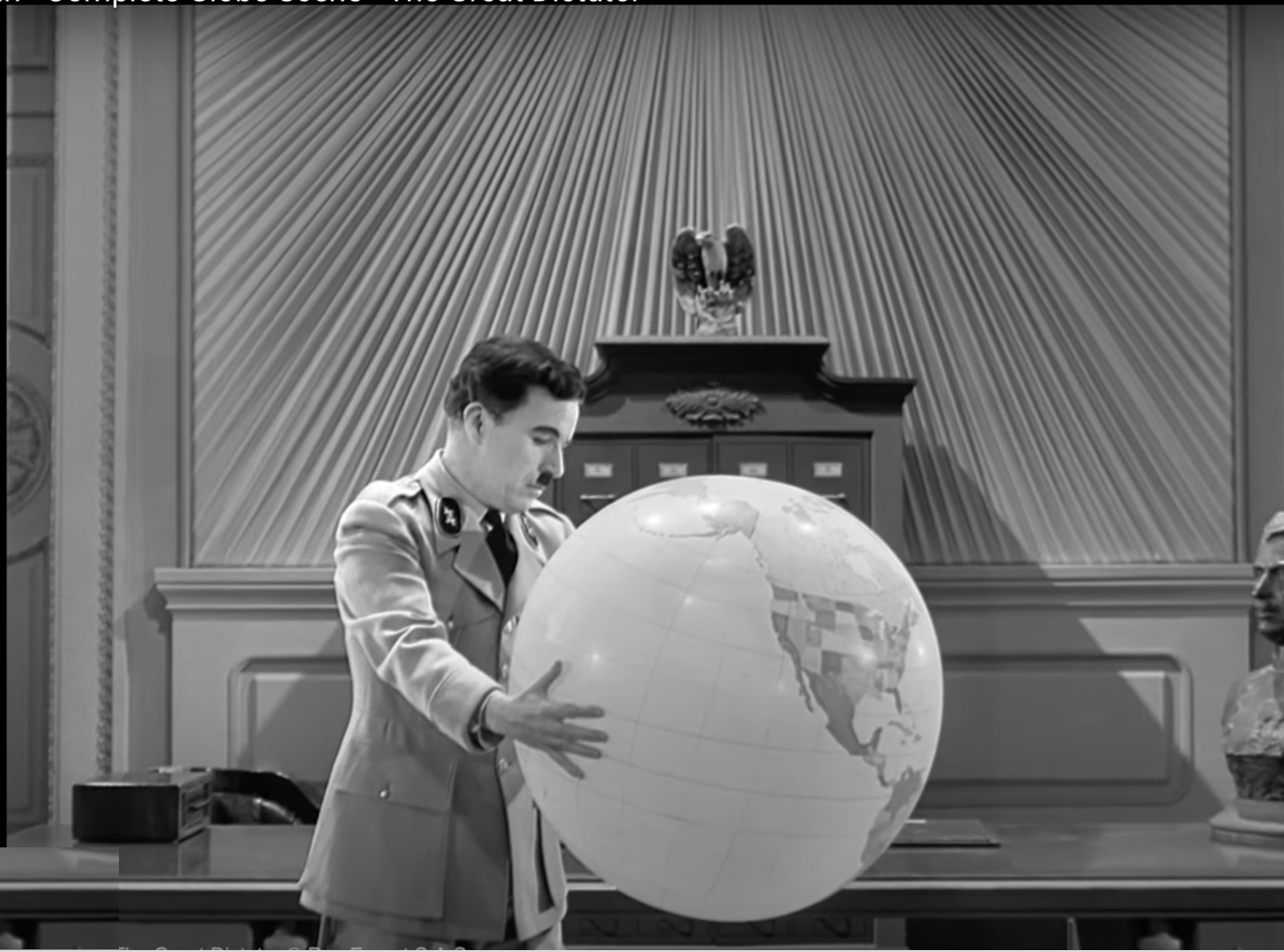
A person holding a globe Description automatically generated

Still from The Great Dictator.

Not until the end of the war, did Chaplin fully learn about another Nazi iconography: piles of emaciated dead bodies, hollow-eyed survivors, showers that sprayed poison gas instead of water, industrial-sized crematoria, and the slogan, Arbeit Macht Frei (“work sets you free”), above the entrance to the forced-labor/death camp at Auschwitz. During the Nuremberg trials (1945-47), documentary films played in court showing these icons of genocide. They were edited and replayed as newsreels all over the world.
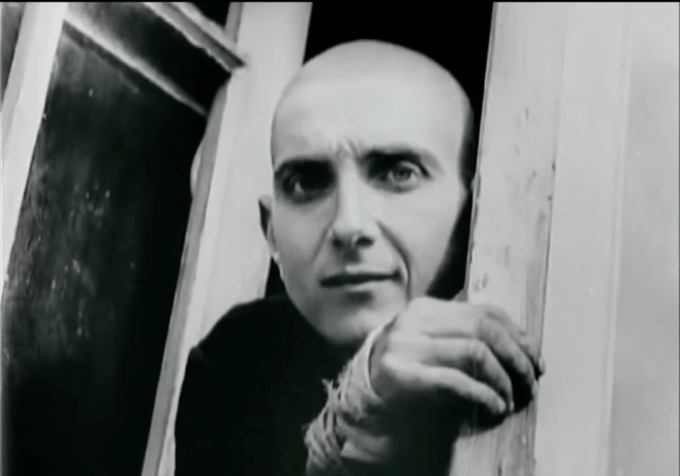

A shower head on a white wall Description automatically generated

From concentration camp films, shown at Nuremberg Trials, Nov. 29, 1945.

Fascist architecture and art in Italy and Germany

If that were all there was to the visuality of fascism, the question in my title would be answered. Look for swastikas, goosesteps, stiff arm salutes, jackboots, or the sign Arbeit Macht Frei, and there you’ll find fascism. But the visual culture of interwar fascism is obviously much more extensive than that, encompassing fine art, architecture, and design. And it’s quite varied — up to a point.
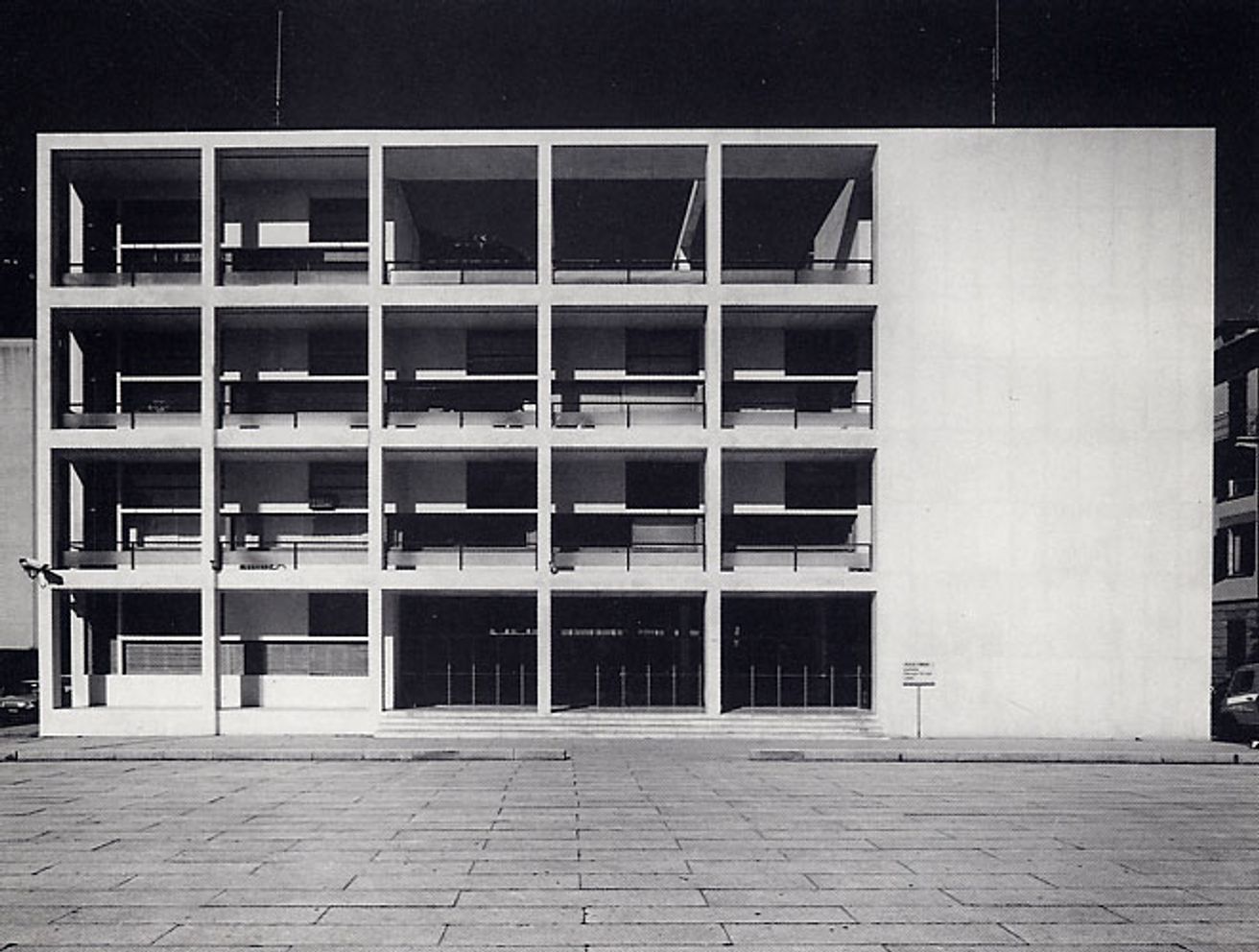
Casa del Fascio with many balconies Description automatically generated

Giuseppe Terragni, Casa del Fascio, Como,1932–36. (Photographer unknown).

During their first decade in power, fascist authorities in Italy allowed a wide variety of artistic and architectural styles to co-exist and even flourish. Avant-garde modernism, with its focus on structure and function, appealed to a state striving to develop or modernize its infrastructure. Many civic buildings, schools and railway stations — such as the Santa Maria Novella (1932-35) by Giovanni Michelucci and others — present an austere, modernist aspect. The archetypal example of fascist modernism however, is Giuseppe Terragni’s Casa del Fascio, in Como (1932–36). The building, with its planarity, grid, and lack of ornament, draws upon Walter Gropius’s innovations at the Bauhaus in Dessau, Le Corbusier’s Villa Savoye, and Gerrit Rietveld’s Schroeder House, among other buildings. Tarragni was part of Gruppo Sette, a coalition of Italian rationalists. In their 1926 manifesto, they rejected Expressionism and Futurism in favor of “logic and rationality.”

A yellow tram on a street Description automatically generated

Marcello Piacentini, Palace of Justice, in Milan,1932-40. (Photographer unknown).

Mussolini himself in 1933 proclaimed rationalism the correct architectural style for fascist Italy, but internal and external competition forced a change, and by the middle 1930s, a more traditional and ostentatious architecture – an architecture of power — was favored. An example is Marcello Piacentini’s colossal Palace of Justice, in Milan (1932-40). It speaks the language and rhythm of classicism – tripartite horizontal and vertical division of the main facade, rusticated lower level, tripartite central portals, half columns between the windows, plus cornices and entablature. But ornamentation (capitals, fluted columns, pediments and decorative moldings) is reduced or eliminated. Classical antiquity is recalled not by detailing, but sheer monumentality — it has 1200 rooms — and lavish materials, chiefly marble and bronze.

In Nazi Germany, the modern movement in architecture – meaning the Bauhaus and its planning and design offshoots — was cast aside as soon as Hitler came to power in 1933, though no theory or program of art and architecture ever took its place. Instead, modern artists and designers and more traditional ones were forced into competitions which the former could not possibly win. Thus, classicism – at once buffed-up and stripped down –was the chosen idiom for major architectural commissions such as the Haus der Deutschen Kunst in Munich (1936) by Paul Troost, and the New Reich Chancellery in Berlin by Albert Speer (1939).
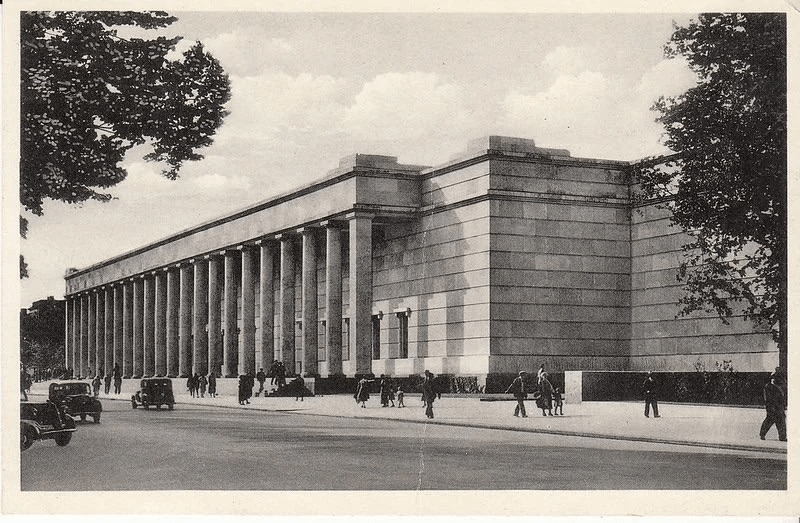
A black and white photo of a building Description automatically generated

Postcard of Haus der Deutschen Kunst, Munich, 1936.
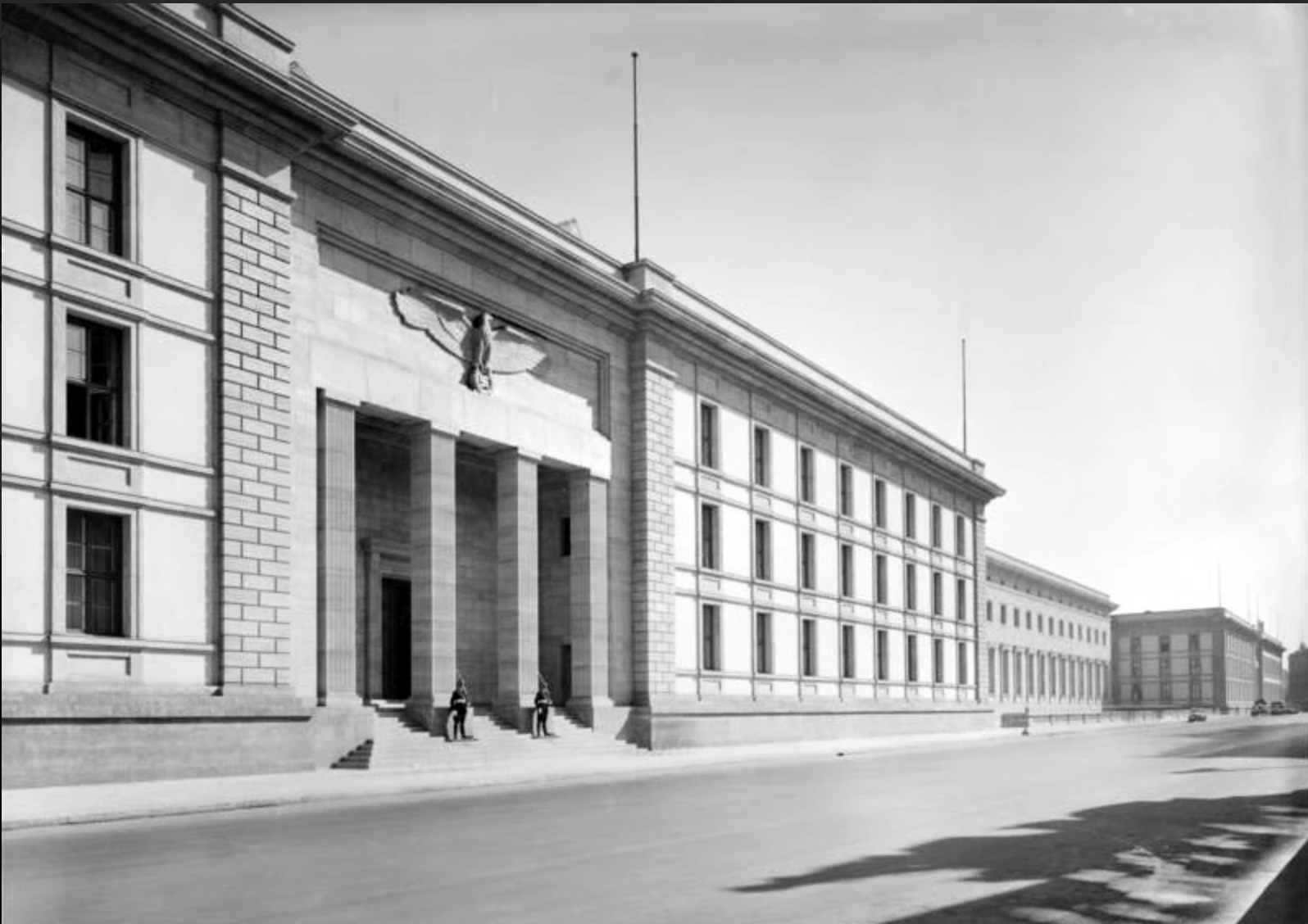
Reich Chancellery with columns and a statue on the front Description automatically generated

Albert Speer, New Reich Chancellery, 1939. (Photographer unknown).

Speer was of course the kingpin of Nazi architecture. He was Hitler’s favorite and later named Minister for Armament and War Production, in which post he commanded hundreds of thousands of slave laborers. Speer claimed to have no architectural program or theory, only a desire to tailor his plans to the Fuhrer’s will. Indeed, his buildings, and Nazi public architecture in general, are not programmatic expressions of Nazi ideas about race, Lebensraum, Judeo-Bolshevism or the Führerprinzip. In both architectural and symbolic terms, they are banal in the extreme. They are however, effective instruments of political strategy, in particular, war planning. Parade grounds, Zeppelin fields, stadiums, party headquarters, the Chancellery and more were built with a speed and scale intended to drum up enthusiasm for war. They were public demonstrations that Germany was a powerful and ambitious nation. Only a state with a legitimate claim on empire would build on such an imperial scale and at such expense. “On the long walk from the entrance to the reception hall,” Hitler said of the Chancellery, “they’ll get a taste of the power and grandeur of the German Reich!” Two over life-sized figures by Arno Breker, Hitler’s favorite sculptor, flank the entrance court; on the left is Partei and on the right, Wehrmacht. They are roughly derived from the famous ancient Greek bronze figure of Zeus, hurling a thunderbolt.

Long room with marble walls and a large table Description automatically generated with medium confidence

Albert Speer, New Reich Chancellery, grand gallery, 1939. (Photographer unknown.)

Arno Breker, Partei and Wehrmacht, outside, New Reich Chancellery, 1939. (Photographer unknown.)

As in architecture, so in art. There was no single aesthetic criteria guiding Nazi or fascist painting and sculpture, except the consistent preference for traditional over modern art. That, however, was not unusual. Representational art was the preference across Europe, Russa, and the Americas. It could be used for indoctrination, persuasion or entertainment, and was deployed by progressive as well as regressive institutions and states. Despite the inroads of modernism, traditional art retained its popular appeal. It was familiar – available to be seen in churches, newspapers, advertising, and movies – and therefore comforting. The great modernists on the other hand — Picasso, Matisse, Kandinsky, Mondrian, Klee, etc – despite their considerable success, were little understood by the broad public.

Where fascist or totalitarian states differed from capitalist democracies, was in their enforcement of the preference for traditional art. In Nazi Germany, this was most clearly manifested in the contest between the annual Great German Art Exhibitions, inaugurated in 1937, and the Degenerate Art exhibition of 1937-38. The former arose from an open
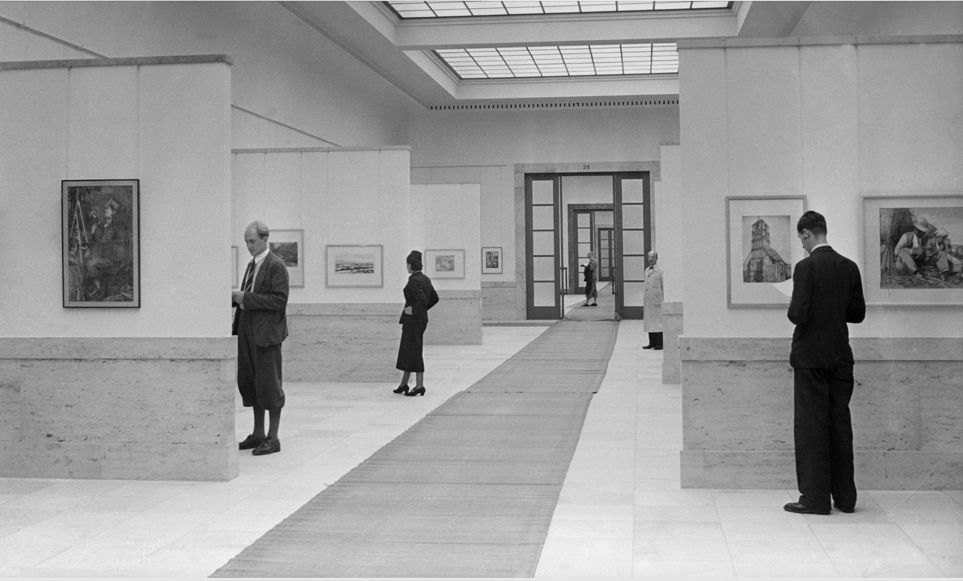
People in a museum looking at art Description automatically generated

Great German Art Exhibition, Haus der Deutschen Kunst, 1937 (photographer unknown).

Catalogue for Great German Art Exhibition, 1937; Adolf Ziegler, The Four Elements, 1934.

invitation to artists in 1937 to submit works for national exhibition at the new, Haus der Deutschen Kunst in Munich. After seeing the submissions, which included some modern and expressionist works, Hitler was furious. A few years before, he had called modern artists “incompetents, cheats and madmen.” He thereupon fired the jurors (who had been chosen by propaganda minister, Joseph Goebbels) and appointed his personal photographer, Heinrich Hoffman to curate the selection. In addition, he endorsed

A person looking at a piece of art Description automatically generated

Visitor at Degenerate Art exhibition, Munich, 1937.

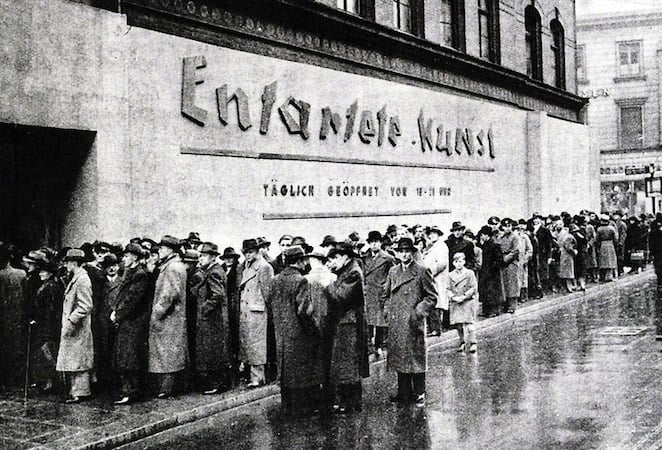
Goebbels’ proposal to mount a didactic exhibition of the rejected artists and many others, under the rubric “Entartete Kunst”. The “degenerate artists” included much-derided German expressionists such as Grosz, Dix, Kirchner, Marc, and Nolde, as well as dozens of others, including Impressionists, Post-Impressionists (including Van Gogh), Cubists, Dadaists, Surrealists and more. The works were hung helter-skelter among wall texts that read, for example: “nature, as seen by sick minds”, “madness becomes method”, “revelation of the Jewish racial soul” and “deliberate sabotage of national defense” (the latter displayed anti-war imagery by Dix, Grosz and others). And while the Great German exhibition was lauded in the Nazi-controlled press and the Degenerate exhibition mocked, the former was little visited while the latter attracted nearly 3 million total viewers. It was probably the most visited art exhibition of all time. Whether that represents widespread embrace of the Nazi derision of modern art, or broad endorsement of the works is unclear.
A group of people standing in front of a building Description automatically generated

Crowd awaiting entry to Degenerate Art exhibition, Berlin 1938 (photographer unknown).

What does fascism look like today?

Fascism doesn’t have a light switch with an on/off setting. It may be found in capitalist democracy, just as democracy may be discovered in the recesses of fascist states. Maybe it’s better to say fascism is controlled by a dimmer switch. Under Donald Trump, turned up quite high. Under Biden it has been dialed down, but still glows in the background and sometimes flares up, like in the current U.S. president’s growing anti-immigrant rhetoric, or his consistent support for Israel’s genocidal campaign in Gaza and now Lebanon. That’s fascism by proxy.

An aerial view of the Pentagon.

George Bergstrom, The Pentagon, Arlington, VA, 1941-43.

However, it’s difficult to speak of fascist art and architecture in the U.S. The amount of public patronage of art is tiny, and what exists is extremely diverse in form and style. There are certainly municipal, state and federal buildings that serve deeply oppressive, even fascistic, purposes: prisons, psychiatric hospitals, military bases, and some schools. And a few buildings, like the U.S. Pentagon resemble in monumentality and style, buildings by Speer. (It was built just two years after the completion of The New Reich Chancellery, and may have been influenced by it.) But these are outliers and marked by contradiction. For example, when the Pentagon was completed in between 1943, it was the only public building in the state that had integrated lunchrooms and toilet facilities. In that respect, it may have been the least fascist building in Virginia!
A black and white cover with a red background Description automatically generated

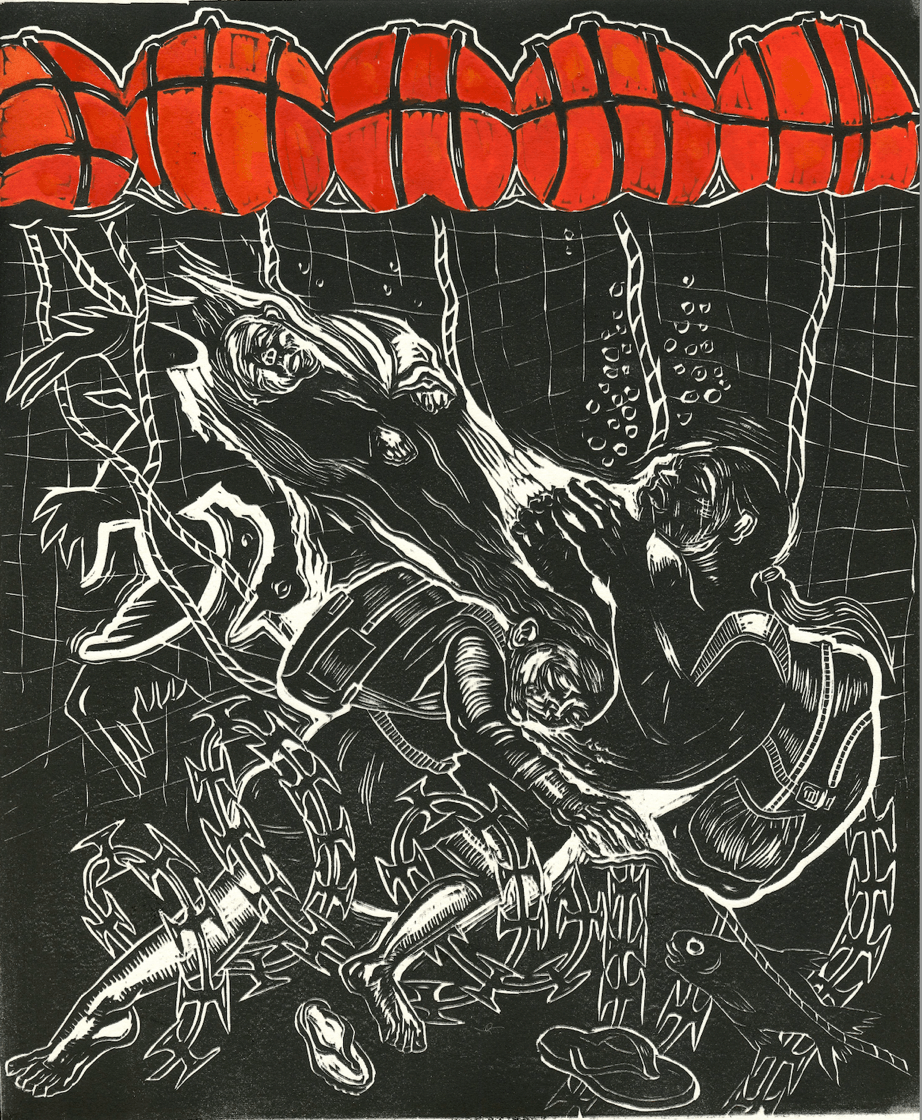
Sue Coe, Rio Grande, 2023. (Courtesy the artist).

Today, the U.S. the border wall with Mexico – actually, dozens of different and colliding walls, fences, and natural barriers – is an icon of fascism. So are the concentration camps (detention centers) that temporarily house immigrants. But the image of these facilities — in photographs and memory — have also made them a resource of anti-fascism, as apparent in drawings and linocuts by British-born, U.S. artist Sue Coe. For example her linocut titled Rio Grande, depicts immigrants caught up in razor wire and drowned on the Texas/Mexico border. This actually happened on Jan. 14, 2023. (For more such images, please see our new bookThe Young Person’s Illustrated Guide to American Fascism.)

A more clear-cut diagnostic of fascism is the MAGA hat. Trump often wears one when he gives speeches, and regularly repeats the phrase “make America great again.” Here’s a few lines from a speech he gave in 2023, that has since become standard at rallies: “Illegal immigration is poisoning the blood of our nation. They’re coming from prisons, from mental institutions, from all over the world. Without borders and fair elections, you don’t have a country. Make America great again.”

MAGA is today emblazoned on millions of caps, T-shirts, yard-signs, flags and more, It’s an expression of palingenetic ultranationalism — almost. By proposing the revival of an earlier time, it’s more conservative than revolutionary; and the “greatness” it promises is not imperialist. There is no discussion of “lebensraum”. Indeed, Trump’s other major slogan, “America First” is isolationist, dating back to Charles Lindberg’s America First movement, which aimed to head off U.S. participation in World War II. But given Trump’s rhetoric about Iran and China, as well as his proposals to increase military spending and massively update and expand the nation’s nuclear arsenal, I’d argue that his policies are in fact expansionist – in that sense, fully consonant with fascist militarism and imperialism. Trump’s rallies suggest he has a war strategy. They are intended to mobilize thousands of followers who will, if needed, storm U.S. voting stations, state capitals and the capital in Washington to overturn an unwelcome election outcome.

As we have seen, fascism has no settled or essential iconography. It can’t. Wherever it appears, it draws from motifs and ideologies that are distinctive to that particular nation. In 1939, a Yale professor and Methodist minister named Halford Luccock gave a lecture at Riverside Church in New York City. Observing the growing strength of Nazism and fascism abroad and a rising fascist movement in the U.S., he warned his audience:

“When and if fascism comes to America it will not be labeled ‘made in Germany’; it will not be marked with a swastika; it will not even be called fascism; it will be called, of course, ‘Americanism.’…The high-sounding phrase ‘the American way’ will be used by interested groups, intent on profit, to cover a multitude of sins against the American and Christian tradition, such sins as lawless violence, tear gas and shotguns, denial of civil liberties.”

Huey Long, governor of Louisiana from 1928-32, himself often called a fascist, said: “American Fascism would never emerge as Fascist, but as a 100 percent American movement; it would not duplicate the German method of coming to power but would only have to get the right President and Cabinet.”  Fascism, as I said at the beginning of this brief survey, is easy to see in retrospect, but not in prospect. However, when it appears right in front of you, identification becomes simple – signs and symbols appear everywhere. As we approach the U.S. election, we can clearly witness one political party’s tight embrace of fascism – but seeing it doesn’t mean we can easily stop it.

Stephen F. Eisenman is emeritus professor at Northwestern University. His latest book, with Sue Coe, is titled “The Young Person’s Guide to American Fascism,” and is forthcoming from OR Books. He can be reached at s-eisenman@northwestern.edu  

NDP LEADER TOMMY DOUGLAS  'THE GREATEST CANADIAN'