Tuesday, April 01, 2025


The Real Reason Putin’s Offer Was Too Good

 for Trump To Refuse


By Robert Berke - Apr 01, 2025, 


An understanding between Trump and Putin behind the scenes has already been reached.

The understanding between Putin and Trump involves U.S. recognition of Russian territorial gains in exchange for economic incentives and peace.

Trump’s alignment with U.S. oil interests and Putin’s resource offerings—including Arctic oil and Russian lithium—form the foundation of a proposed U.S.–Russia energy partnership.


The Western news media on the US/Russia relations is almost always so far behind the curve, that it’s a miracle they’re still in the game.

Anyone who follows the issue closely knows that the deal between the US and Russia to end the war in Ukraine has already been struck, the rest is rhetoric.

Putin knows that the mere mention of money makes Trump salivate, as shown by Netanyahu’s offer to the US of Gaza as a new gilded seaside resort.


Not surprisingly, Putin followed up with an offer of another gilded seaside resort in Crimea, on the Black Sea coastline, favored by Russian oligarchs and Putin himself.

The truth is that Russia has far more to offer than either Israel or Ukraine could ever imagine, including allowing the return of US energy companies to the huge energy reserves in Russia, that they were forced to leave because of US sanctions.

While Putin’s  FASCIST  philosopher friend, Alexander Dugan, maintains that Trump and Putin see eye to eye on traditional values, their connection has nothing to do with values, tradition or otherwise.

Instead, it’s all about oil. Trump has always been in the pocket of the US oil industry, while Russia is the world’s third-largest producer of fossil fuels. Russia is also the largest block of land in the Arctic, and it is known to hold vast and mostly untapped mineral wealth.

Recall that in his first term in office, he appointed Rex Tillerson, former CEO of ExxonMobil as his choice for Secretary of State.

That would have put him in good stead with the Rockefeller family, who still own a large stake in the giant oil company. It would also have answered Trump’s dream of riding to reelection on the back of big oil, had Tillerson not split on bad terms with the 

Currently, Trump has issued an executive order, opening Alaska Federal Reserves to oil industries, that were formerly banned by the Obama and Biden Administrations.

The world has yet to realize that changing the name of the Gulf of Mexico to the Gulf of America is not merely word play or symbolism.

The Gulf is a rich reservoir of energy, which both US, in the north, and Mexico, in the south, have exploited for decades. Trump intends to not only own the Panama Canal, Canada, and Greenland, he also intends to own the entire Gulf, Mexico be damned.

Further gifts to big oil include Trump’s all-out assault on green policies, as his Executive Order to end the Environmental Protection Agency clearly illustrated.

Trump's often repeated theme of ‘drill baby drill,’ says it all.

Russia offered a ‘welcome back’ to US oil companies to resume their large-scale work and huge investments in Russia, which they were forced to leave because of US sanctions. Also, Russia has offered the US joint ventures to exploit the Arctic.

In addition, Russia is also offering to joint venture in the development of its own lithium reserves, many times larger than Ukraine’s.

All this in return for recognizing Russia’s conquered territories, while dropping US sanctions against Russia.

Trump has also attempted to negotiate a partial cease-fire between the two warring countries, aimed at halting attacks on their energy facilities, and Black Sea shipping.

If accepted, this would enable both countries, that are world class exporters of agriculture, including grains and fertilizer, to resume exports, that were largely interrupted because of the ongoing combat.

The proposal offers the promise of substantially reduced energy and food prices, while also significantly reducing the rate of world inflation far more than any other issue on the President’s agenda.

Except for one other item. Trump has gone much further than anyone expected, publicly offering a major disarmament program between the two nations, with a proposal to halve the military budgets of both countries. If allowed to proceed, that could result in enormous savings on both sides.

There are widespread suspicions that Trump’s gutting of the US military and CIA leadership by replacing them with far less experience ‘yes men,’ may also be politically suspect.

It’s well known that the US military and intelligence personnel, along with that of their British and NATO partners, all steeped in cold war ideology, are directly involved in the defense of Ukraine.

It’s hard to believe that their replacement with far less qualified people would not find favor in the Kremlin.

Also on the political agenda, the US wants to breach Russia’s alliance with China, considered to be America’s chief rival. For this author, that seems a much dicier proposition.

For similar economic and political reasons, the US is also offering peace to Iran, which would include dropping sanctions in exchange for a new nuke deal. If sanctions were dropped, Iran could become one of the world’s largest producers of oil and gas.

Sidelining Trump’s European allies, and adding insult to injury, clearly shows Trump’s animosity towards NATO, Russia’s top adversary.


Canceling of the Voice of America broadcast outlet and Radio Free Europe/Radio Liberty, whose programming confronts authoritarianism and promotes democracy, is clearly in the same vein.

This entire scenario will certainly be viewed in Moscow as the largest peace offering ever from any US Administration.

With all this, why wouldn’t Russia agree to end the war, gaining a much larger buffer zone with Ukraine, while annexing some twenty percent of Ukraine’s most productive territory, and adding 5 million new Russian speaking citizens?

As important to Russia is the US recognition of it as an economic partner, along with the dropping of US sanctions.

This will certainly not be Europe’s or Ukraine’s preferred ending to the war. Their demands for security for Ukraine will have to be met, or they will almost certainly refuse to drop their own sanctions on Russia.

But the fact is that Ukraine could never hope to defeat its much larger opponent, even when supplied with the West’s most advanced military technology, communications, and billions in finance. The proof is on the battlefield.

Russia's strategy has always been to use its larger size to its advantage, as it did against Napoleon and the Nazi armies. Long battlelines severely disadvantage smaller countries, thinning out their defense against a widening battlefield and much larger opponent.

The current battleline is estimated to be some 1,250 miles, the approximate distance between San Francisco and Indianapolis.

As the lines grow, the strategy is aimed at gradually moving to rout an opponent that can no longer defend itself. In that sense, time is on the Russian side.

Our guess is that Trump/Putin negotiated end to the war will likely have to be accepted by the West, however reluctantly, because the benefits to the world, in terms of loss of life, treasure, and further destruction far outweigh its continuation.

By Robert Berke for Oilprice.com


Ukraine Cease-Fire Efforts Stumble Amid Competing Priorities


  • A deal to halt fighting between Ukraine and Russia is struggling due to conflicting
  •  priorities of the US, Russia, and Ukraine, with ongoing attacks and air strikes continuing in the region.

  • Russia's conditions for the Black Sea deal, including lifting sanctions on Russian banks and ships, have complicated negotiations and led to tension with the US.

  • The US is seeking access to Ukraine's mineral resources as part of its military aid, creating further friction and concerns about Ukraine's economic future.


One week after the Kremlin and the White House announced a deal that aimed to halt fighting between Ukraine and Russia in the Black Sea region and pave the way for a wider cease-fire, the effort is stumbling.

In fact, the wider attempt to pause Europe's largest land war since World War II is also under severe strain, pulled in three different directions by three different presidents with three competing priorities.

On the battlefield and across Ukraine, meanwhile, fighting and air attacks continue, as Russia pounded Ukraine's second-largest city for a second day with drones and ballistic missiles on March 31. Ukrainian forces have reportedly made another cross-border raid into Russia's Belgorod region in what could be a repeat of last summer's invasion of the Kursk region.

"Talks between Moscow and Washington in Saudi Arabia not only did not result in any breakthrough; they appear to have been an overall failure," Aleksandra Prokopenko, an analyst with the Carnegie Russia Eurasia Center, said in an analysis. "The agreements do not look like a real prologue to peace."

"Russia's strategy is to stall the negotiations as long as possible to achieve its maximalist goals by nonmilitary means," said Maria Shagina, a sanctions expert at the International Institute for Strategic Studies, a London-based think-tank.

"At the same time, Moscow is wary of testing [US President Donald] Trump's patience," she told RFE/RL. "The ball is really in Trump's court on whether to believe that Russia is negotiating in good faith or ramp up pressure to force it to the negotiating table."

Here's where things stand at the negotiating table and on the front lines.

Who Agreed On What And When?

On March 11, Ukraine and the United States announced a breakthrough agreement paving the way for a 30-day cease-fire contingent on Russia's signing on. A major foreign policy priority for Trump, it was the first concrete proposal on the negotiating table since the early weeks after Russia's all-out assault on Ukraine in February 2022.

Putin balked, saying he agreed in principle but there were "nuances" that would have to be addressed and attaching conditions including a halt to Western supplies of weapons to Kyiv.

A week after the US-Ukrainian agreement on a full cease-fire, the White House and the Kremlin announced a narrower deal that focused on limiting attacks on Russia's and Ukraine's energy infrastructure: power plants, transmission lines, and substations.

Taking energy facilities off targeting lists has a key priority for Kyiv, which has struggled to keep the lights -- and heating -- on as Russia has pummeled its energy targets since at least November 2022. For its part, Ukraine has ramped up its homegrown industry of drones, and even cruise missiles, to target Russia's oil refineries and pipelines, not to mention military facilities.

That's unnerved Moscow, though has yet to cause major disruptions or price spikes.

Despite the deal, Kyiv and Moscow continued to batter one another. It later turned out that Russian drones were in fact in the air, en route to Ukrainian targets, even as Trump and Putin were speaking on the phone.

Moscow has insisted it has upheld the energy cease-fire, something Ukrainian officials say is nonsense.

On March 25, after separate US talks with Ukraine and Russia in Saudi Arabia, the White House announced agreements with Kyiv and Moscow to limit military action on the Black Sea. If implemented, that would give Ukraine more latitude to export its grain and agriculture products to the global markets and bring in desperately needed hard currency.

The White House agreed to help Russia restore access to the global market for agricultural products and fertilizers, reduce the cost of insurance for maritime transportation, and expand access to ports, as well as to payment systems for necessary transactions.

Sounds Good. What's The Catch?

One of the biggest land mines, however, was the conditions that the Kremlin included in its announcement released shortly after the White House statements.

Those conditions included the demand that the West lift sanctions on Russian banks that have been involved in trading agriculture products, as well as on Russian ships. Rosselkhozbank, a major state-owned lender for Russian agrobusiness, was mentioned specifically, including connecting it and other Russian entities to the global SWIFT system of bank transfers.

For experts who have followed the negotiations, that appeared to be either a "poison pill" or even a Kremlin test of the White House's negotiating tactics.

That's for several reasons: Reconnecting Rosselkhozbank to the global SWIFT system requires European consent; the United States can't do it on its own.

Lifting Western sanctions on agricultural product companies, and related things like cargo ships and ports, would allow Moscow to not only tap another revenue stream, it would also represent a small step toward unwinding the larger sanctions regime.

So The Kremlin Is Playing Smart, Then?

If the Kremlin's intention is indeed to test the White House, then judging by Trump's comments on March 30, it's struck a chord. And not in a good way.

"If Russia and I are unable to make a deal on stopping the bloodshed in Ukraine, and if I think it was Russia's fault -- which it might not be -- but if I think it was Russia's fault, I am going to put secondary tariffs on oil, on all oil coming out of Russia," Trump told NBC News.

Secondary tariffs are essentially restrictions or levies on other countries that purchase oil from Russia. That would be a significant escalation of the Western sanctions regime on Russia, which derives the bulk of its hard currency imports from oil and gas sold on global markets to places like India and China.

Trump also responded to Putin's comments on March 28 calling for a "transitional administration" in Ukraine. Those remarks echoed previous ones from Putin and other Kremlin officials who have suggested Zelenskyy was not a legitimate leader because Ukraine had been unable to hold a new presidential election due to wartime martial law.

Trump said he was "very angry, pissed off" at Putin for questioning Zelenskyy's credibility, and he said negotiations were "not going in the right location."

Those were some of the most critical comments Trump has had for Putin. In the past, he has suggested Russia was not to blame for instigating the war, and accused Zelenskyy of being a "dictator."

"The Kremlin is smart enough to give an impression that it's making concessions without actually conceding anything," Shagina told RFE/RL. "Moscow's priority is to secure sanctions relief ahead of the negotiations and to test how far the US can pressure the EU and UK to tag along. A significant divergence of the transatlantic sanctions regime is very likely, which will drastically undermine the effectiveness of sanctions."

"This is both an attempt to put pressure on the Kremlin and also is an obvious expression of dissatisfaction," Ukrainian political analyst Oleksandra Filippenko told Current Time. "This is an indication of how Donald Trump perceives Vladimir Putin. He does not perceive Vladimir Putin as an equal partner or negotiator, or perhaps as a rival in negotiations. Donald Trump believes that he should really solve all major international issues and issues related to negotiations."

What About Ukraine's Minerals?

There's another variable at work.

Ukraine's successes in its defense against the Russian invasion have been powered overwhelming by US weaponry.

But back in February, the Trump administration indicated it would partly condition future US military aid on a deal to give US companies access to Ukraine's mineral resources: so-called rare earth minerals, as well as other valuable resources like lithium, titanium, uranium, and even oil and gas.

The White House's initial proposal landed with a thud in Kyiv, where Ukrainian officials saw it as a lopsided deal that would hobble Ukraine's future economic development.

An updated proposal seen by Bloomberg News would give the United States "right of first offer" on investments in all infrastructure and natural resources projects: "an unprecedented expansion of US economic influence in Europe's largest country by area just at the time when it's attempting to align with the EU."

In comments to reporters later on March 30Trump charged that Zelenskyy was looking to back out of the minerals deal and warned that he would face "big, big problems" if he did.

"I don't think [Trump] is going to impose sanctions," Serhiy Harmash, a former Ukrainian negotiator, told Current Time. "Trump is more interested in a partnership with Russia than with Ukraine. Ukraine is not a player for Trump. He believes Ukraine can be dictated to and controlled."

By RFE/RL 


Ukraine pushes ahead on US deal after Trump renews criticism

Bloomberg News | April 1, 2025 |


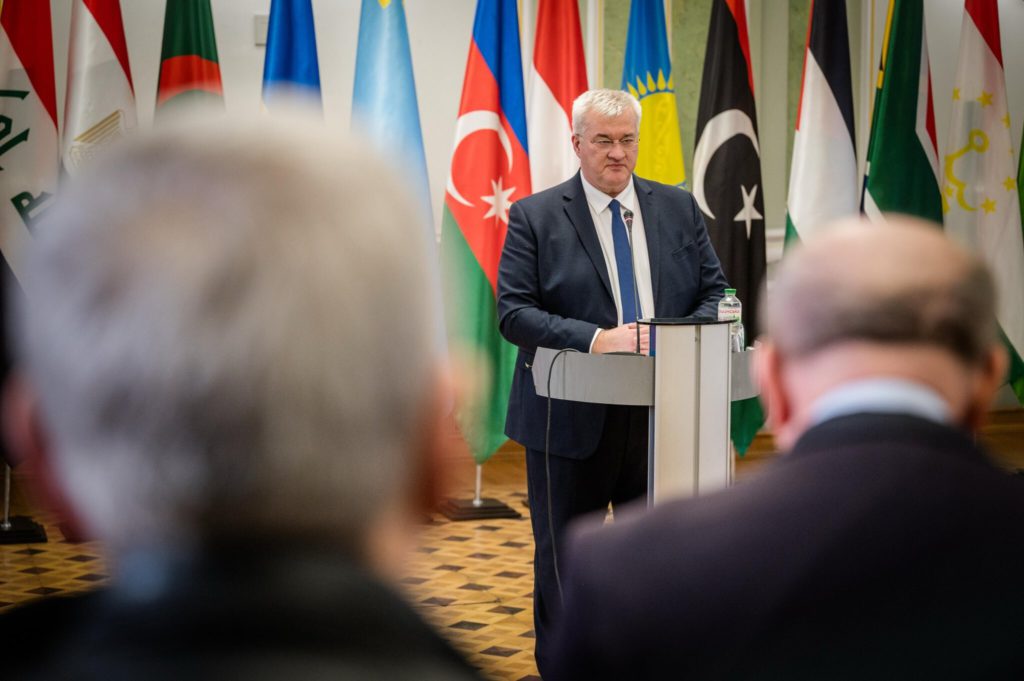
Ukraine Foreign Minister Andrii Sybiha.
 Credit: Andrii Sybiha’s official X page


Ukraine’s top diplomat said officials are pressing ahead with the US toward an “acceptable” economic accord hours after President Donald Trump accused Kyiv of trying to renegotiate the deal.


Foreign Minister Andrii Sybiha said Ukrainian officials were poring over the latest draft of an infrastructure and natural resources deal sent by the US last week as talks with negotiators in Washington moved ahead. Kyiv is prepared to endorse an agreement that provides security with a significant US business presence in Ukraine, the cabinet minister said.

“The process will continue,” Sybiha told reporters in Kyiv Tuesday as he met with his counterpart from Lithuania. “We will be working with our American colleagues in order to achieve a text that would be mutually acceptable.”


Days after Trump expressed frustration with Russian President Vladimir Putin, the US leader on Monday turned his ire back to Ukraine’s Volodymyr Zelenskiy, blaming the Ukrainian president for seeking new terms for the accord.

The comments amount to geopolitical whiplash during a week in which Trump plans to unleash global tariffs — and exposes impatience in the White House with efforts to end Russia’s war in Ukraine. Trump on Monday signaled he thought Putin will “follow through” on a ceasefire, while reinforcing his anger at Zelenskiy over what he called new conditions from Kyiv for the pending accord.

“I heard that they’re now saying, well, I’ll only do that deal if we get into NATO or something to that effect,” Trump said in the Oval Office.

While Zelenskiy has repeatedly said joining NATO would be the preferred and the most efficient option to ensure peace and security, he has expressed openness to other security guarantees.
Fears in Kyiv

Instead, the latest draft of the resources agreement — which would grant the US control over all major future infrastructure and mineral investments in the war-battered country — raised concerns in Kyiv that a deal could undermine its bid to join the European Union, Bloomberg News reported last week. Officials also feared that it could require Ukraine to repay all US military and economic support since the start of the war.

Still, Sybiha said that an agreement could pave the way for the presence of “powerful, large American business,” which on its own would provide a security guarantee.

“This is always important — strengthening the presence of American business,” the minister said.

Ukrainian officials are scrutinizing the text and may ask for changes, a person familiar with the talks said late last week. Ukrainian and US negotiators held a video call on Friday, which included legal experts, to seek clarification about the nearly 60-page draft agreement, according to the person, who spoke on the condition of anonymity as the talks are private.

As Trump rushes toward securing a ceasefire between the warring parties in time to mark his 100 days in power, even the limited truce on energy strikes mediated by American negotiators last month isn’t holding. Both sides trade accusations of violating it.

A fresh Russian strike damaged an energy facility in the southern region of Kherson early Tuesday, leaving 45,000 civilians without electricity, Sybiha said. The attack followed similar strikes against the regions of Kharkiv and Poltava, according to the minister.

A Ukrainian drone strike meanwhile left some 1,200 people without electricity in Russia’s Belgorod region, the Defense Ministry in Moscow said on Telegram on Tuesday.

(By Olesia Safronova and Aliaksandr Kudrytski)

Russia, US discussing rare earth metals projects, Putin envoy says

By Guy Faulconbridge and Lidia Kelly
March 31, 2025
REUTERS


The head of Russia's sovereign wealth fund Kirill Dmitriev speaks to members of the delegation and journalists after the U.S.-Russia talks in Riyadh, Saudi Arabia, February 18, 2025. REUTERS/Maxim Shemetov/File Photo


Summary
Russia and US discussing rare earths, Putin envoy
Some companies have expressed an interest, envoy says
Putin offered to work with the United States on rare earths
Trump: Zelenskiy wants to back out of minerals deal

MOSCOW, March 31 (Reuters) - Russia and the United States have started talks on joint rare earth metals and other projects in Russia, and some companies have already expressed an interest in them, President Vladimir Putin's investment envoy said in remarks published on Monday.

Amid efforts by U.S. President Donald Trump to end the war in Ukraine, minerals cooperation has been floated by both Kyiv and Moscow, though Trump said on Sunday that Ukrainian President Volodymyr Zelenskiy wants to back out of a proposed deal.

Putin in February suggested that the United States might be interested in exploring joint exploration for rare earth metals deposits in Russia, which has the world's fifth-largest reserves of the metals used in lasers and military equipment.

Kirill Dmitriev, Kremlin special envoy on international economic and investment cooperation, told the Izvestia newspaper in remarks published on Monday that talks had already begun.
"Rare earth metals are an important area for cooperation, and, of course, we have begun discussions on various rare earth metals and (other) projects in Russia," said Kirill Dmitriev, who is also the CEO of the Russian Direct Investment Fund.

Dmitriev, who was part of Russia's negotiating team at talks with U.S. officials in Saudi Arabia in February, said some companies have already shown interest in the projects. He did not name any companies and did not reveal further details.

Trump said on Sunday he was "pissed off" at Putin and will impose secondary tariffs of 25% to 50% on buyers of Russian oil if he feels Moscow is blocking his efforts to end the war in Ukraine.

Trump told NBC News he was very angry after Putin last week criticised the credibility of Zelenskiy's leadership, the television network reported. Trump later reiterated to reporters he was disappointed with Putin but added: "I think we are making progress, step by step."

The video player is currently playing an ad. You can skip the ad in 5 sec with a mouse or keyboard
China's control of 95% of global production and supplies of rare earth metals, crucial for industries such as defence and consumer electronics, has focused the rest of the world on trying to develop their own supplies.

The U.S. Geological Survey estimates Russia's reserves of rare earth metals at 3.8 million metric tons but Moscow has far higher estimates.

According to the Natural Resources Ministry, Russia has reserves of 15 rare earth metals totalling 28.7 million tons as of January 1, 2023 and that 3.8 million tons is the amount of reserves under development or ready for development.

Izvestia reported the cooperation may be further discussed at the next round of Russia-U.S. talks that may take place in mid-April in Saudi Arabia.

Russian Arctic LNG 2 Project Resumes Gas Processing

Arctic LNG 2, the processing and export facility that was billed as Russia’s flagship LNG project, has gradually resumed gas processing after months of hiatus, Reuters reported on Tuesday, citing industry sources and satellite images.

Arctic LNG 2 has been under U.S. and EU sanctions since last year, and the project hasn’t been able to sell any cargo because of the sanctions.

The first production train at the plant was shut in early October over the project developers’ inability to secure buyers amid the Western sanctions on Arctic LNG 2, according to one of Reuters’ sources.

The plant continues has now slowly resumed gas processing and keeps it at low rates as Russia expects what the Trump Administration would do with the sanctions.

Russian LNG developer and exporter Novatek, the majority owner of Arctic LNG 2, is looking to rebuild relations with the U.S. with the help of lobbyists, sources with knowledge of the matter told Reuters in December.

Hit heavily by sanctions, Arctic LNG 2 was put on ice last year and Novatek has struggled to sell any cargo to a buyer.

Located in the Gydan Peninsula, Arctic LNG 2 was considered key to Russia’s efforts to boost its global LNG market share from 8% to 20% by 2030-2035.

But the project has come under intensifying sanctions from the United States, which have put off any buyers that were previously considering buying cargoes from Arctic LNG 2.

The project has seen months of delays after the initial U.S. sanctions in November 2023 upended the company’s plans for production start-up and export timelines.

In August 2024, the U.S. State Department intensified efforts to derail Arctic LNG 2 exports by targeting companies involved in the development of the project and vessels found to have loaded LNG from the facility.

The U.S. designated multiple companies related to Arctic LNG 2 to further disrupt the project’s ability to produce and export LNG, as well as the project’s ability to procure critical LNG carriers.

By Charles Kennedy for Oilprice.com


Resource Limits Push World Economy Towards Shrinkage

  • The world economy is facing resource limits, especially in oil, coal, and nuclear energy, which is forcing a shrinkage and potentially leading to financial collapse in advanced economies.

  • Increased debt levels, used to mask energy problems, are now unsustainable, leading to inflation and higher interest rates, making debt repayment challenging in a shrinking economy.

  • Shifting energy consumption patterns and resource distribution may lead to conflicts between advanced economies and other nations, while also necessitating a restructuring of industrial production closer to home.

I have said in recent posts that the world economy is hitting resource limits of many kindsThese limits include oil, coal, and other sources of energy, including uranium, used as a fuel for nuclear power generation. Because of these limits, the world economy is being forced to shrink back. In my opinion, the direction it is headed in is toward smaller, mostly less-advanced, more independent, economies. This change is also likely to lead to various types of financial collapse for many of today’s Advanced Economies.

Per-capita consumption of these early used energy sources has shrunk since peaking in 2007.

Figure 1. World per-capita consumption of oil, coal, electricity from nuclear power plants, based on data from the 2024 Statistical Review of World Energy, published by the Energy Institute.

Most of us remember the Great Recession of 2007 to 2009. With a declining supply of what used to be inexpensive energy resources, many economies have done poorly. Many of the wealthier countries have papered over their problems with an increasing amount of debt, but the limits to this added-debt approach are now being hit. It is the debt problem that leads to financial collapse.

In this post, I will elaborate on these ideas.

[1] Countries that are today’s Advanced Economies (members of the Organization for Economic Cooperation and Development (OECD)) are likely to fare poorly in this coming contraction.

The Advanced Economies include the US, most of Europe, Japan, Australia, and a few other countries. Their per-capita consumption of oil, coal and nuclear electricity resources has been shrinking significantly since about 2005. The year 2005 was approximately the peak of “conventional” oil supplies. More oil has become available since this date, but this oil is generally more expensive to extract.

Figure 2. Energy consumption per capita for the combination of oil, coal, and electricity from uranium, separately for the Advanced Economies and the Other than Advanced Economies, based on data from the 2024 Statistical Review of World Energy, published by the Energy Institute.

[2] Energy consumption for the Other than Advanced Economies is hitting limits, too.

The Other than Advanced Economies were able to grow in their per-capita use of these three types of fuels between 2001 and about 2013, but since then, their per-capita quantity of these fuels has leveled off. The big impetus for growth was China joining the World Trade Organization in 2001. World demand for inexpensive finished goods empowered China to start extracting coal and other minerals in quantity. But coal mines deplete, just as oil fields deplete, leading to the flat per-capita availability of energy supply for the Other than Advanced Economies since about 2013.

[3] With these changing patterns for the two groups, one potential problem is conflict.

The Other than Advanced Economies have figured out that they are creating a huge share of the world’s goods, but their per-capita use of energy is much lower than that of the Advanced Economies. Why should the Advanced Economies get so much of the finished products available from the world’s resources, when most of the work (and the pollution) has taken place in the Other than Advanced Economies? I would expect this type of thinking to take place in China, Russia, India, Iran and other countries in this group. These countries believe that they could get along perfectly well without the Advanced Economies and their high usage of energy.

[4] With these changing patterns, a second potential problem is financial collapse, especially for the Advanced Economies.

Each economy can be encouraged to grow in two different ways: (1) Through more debt, indirectly adding to more “demand” for finished goods, or (2) Through added supply of inexpensive energy products. Adding debt to pull the economy forward seems to work well if there is not a problem with hitting resource extraction limits. Once an economy starts hitting resource extraction limits, however, the added debt partly adds inflation, rather than finished goods and services, to the output mix. Thus, the debt approach no longer works well.

The world as a whole is now hitting resource extraction limits. Not only do individual citizens become unhappy with the higher inflation level, but investors demand higher interest rates for lending. This higher interest cost becomes a huge problem for the Advanced Economies that already have very high debt levels.

recently issued report by the US Congressional Budget Office (CBO) shows what is happening in the US.

Figure 3. Figure from page 10 of The Long-Term Budget Outlook 2025 to 2055, published in March 2025 by the CBO.

In a sense, the reports that the CBO publishes are “Best Case” scenarios. The reports are optimistic in two different ways: (1) They assume that no more added-debt bail-out programs will be needed, as were used several times in recent years, and (2) They assume that inflation will quickly fall to 2%, so that interest rates can fall quickly and stay lower from now on.

Even with these assumptions, the results are disturbing. Note that on Figure 3 (in both charts shown), the especially significant increase in debt starts around 2008. This is when the US, and likely most of the other Advanced Economies, started to hide their energy problems by using more debt stimulus.

Even when the most optimistic possible estimate of the future “primary deficit” is made, and when the most optimistic possible forecast of future “net interest” outlays is made, there is still a huge build-up of debt. The implication is that very large tax increases will be needed to maintain current programs. Even with these huge tax increases, the problem will get worse and worse, year after year. There is a need to cut back on existing government programs to avoid adding the need to pay even more interest on debt in the future.

[5] If an economy is forced to shrink back, debts of all kinds become more difficult to repay with interest.

Any economy needs to grow, in order to repay debt with interest. A growing economy has a surplus with which to pay interest.

Figure 4. Repaying debt is easy in a growing economy because the promises that are made can be repaid later, when the economy is larger in terms of goods and services produced. Obviously, repaying a loan in a shrinking economy becomes a problem. Chart made by Gail Tverberg in 2012.

On the other hand, a shrinking economy tends to lead to major debt defaults. Leveraged debt is especially likely to cause problems.

The CBO is now forecasting that the US government could run into debt limit problems as soon as July 2025. Perhaps the US government will find ways around the current apparent shortfall, but the issue of the government not being able to meet its debt obligations without major tax increases or reductions in programs still looms in the background.

I expect that within the next three months, we will start to see loan defaults of some type, such as defaults by hedge funds. Governments will want to step in, but they will be limited by their own financial problems. Defaults on many other kinds of debts are likely to start taking place, as well. If inflation rates rise, and interest rates rise with them, defaults on many kinds of debt could start taking place.

[6] It seems likely that nearly all the Advanced Economies will have similar problems.

The Advanced Economies have tended to offer their citizens many benefits, including pensions for the elderly and some type of healthcare coverage. Many of them have financially supported what they are hoping will be energy types that will take the place of the energy types they seem to be losing.

If an economic system is not growing as fast as it has in the past (because of low energy consumption growth, and lack of debt stimulus), or is actually shrinking, these economies are likely to face a choice between either cutting back on promised programs or raising taxes. Governments will find themselves needing to cut back on programs that they have promised to their citizens, or, alternatively, they will need to default on their debt.

[7] Adding to the problems of the Advanced Economies will be the issue of goods and services needing to be made closer to home.

Without enough oil for all purposes, a logical way to cut back is to use less oil for international shipping. This would tend to reverse the trend toward globalization that started many years ago.

Figure 4 shows that the US started shifting heavy industry to other countries with better supplies of oil as early as 1974. The Kyoto Protocol of 1997 gave another reason (or excuse?) for shifting heavy industry to countries with less expensive, more abundant, energy supplies.

Figure 4. US industrial energy consumption per capita through 2023, based on data of the EIA.

I expect that in the next few years, the Advanced Economies are likely to need to move industrial production back closer to home, to save on limited world oil supplies. This will be difficult to do, especially in a timeframe of less than 20 to 30 years. New mines will be needed for minerals, but the lead times on these are very long, typically 13 years or more. New processing plants for these minerals will likely be needed as well, potentially adding to the lead time. Whole new, short supply chains will be required. Finally, goods and services manufactured closer to home will need to be transported to citizens, sometimes in new ways.

Many of today’s manufactured goods require imports of minerals from China or Russia. To the extent that specific minerals from these countries can no longer be imported, additional closer sources will be needed. This will further add to manufacturing difficulties.

[8] It will not be surprising if governments, or parts of governments, collapse.

History indicates that when civilizations reach resource limits, governments tend to fail. A recent example of this was the collapse of the central government of the Soviet Union in 1991, after an extended period of low oil prices. The Soviet Union was a major exporter of oil, and the low oil prices (plus other internal problems) led to the inability to repay promised debt. The separate republics within the Soviet Union remained, so the people were not left completely without a government. I expect something similar may happen elsewhere in the future.

[9] History suggests that even in a financial collapse, the entire economy will not fall apart, all at once.

Incremental changes are likely to take place. Governments are likely to try to make cutbacks. Financial investments are likely to do especially poorly in the next several years, and high-paying jobs seem likely to disproportionately disappear. The economy will no longer be able support as many specialists as are working today, in many industries.

The electricity supply likely won’t fall off all at once; instead, electricity will become increasingly intermittent, with some areas having more outages than others. Diesel and gasoline will perhaps be available, at least part of the time.

New car sales in the Advanced Economies are likely to fall very soon, leaving citizens mostly dealing with used cars, and the difficulty of finding appropriate replacement parts for used cars. The problem of “empty shelves” in stores is likely to return and get worse.

There will likely be an increasing divide between the relative handful of citizens who are doing well, and the many others. In fact, we are already seeing a trend in this direction in the US. But many of today’s big spenders are likely to be knocked down in any coming economic contraction.

Figure 5. Chart showing spending by income bracket in Bloomberg articleThe Richest Americans Kept the Economy Booming. What Happens When They Stop Spending?

[10] Perhaps the good news in this contraction is that major international wars may not be a problem.

Instead, civil wars and local skirmishes may be the order of the day. There may not be resources available to fight long-distance wars, even if many citizens might favor this approach. Wars give an excuse for more debt and more income for soldiers, so they are always popular in troubled economic times. But a lack of materials for making military supplies (including insufficient sources of antimony) and the inability to raise debt financing may impede efforts.

[11] What should we expect in the future?

The US and many other Advanced Economies are likely heading into a worse and longer lasting financial crisis than the 2008 crisis, starting as soon as this summer. The problem will likely not start out as a full financial collapse. Instead, various leveraged borrowers will encounter difficulties. Gradually, the finances and very structures of many government organizations are likely to be threatened. Some government structures that we currently depend upon may disappear.

How the long term will unfold is unclear. We know that ecosystems often operate in wide cycles, and that economic systems are a kind of ecosystem. This relationship suggests the possibility of a later renewal.

Furthermore, Eric Chaisson, in Cosmic Evolution: The Rise of Complexity in Nature, points out that there is a very long term trend in the universe toward more complex and more energy-dense structures. His analysis seems to suggest the possibility of evolution toward a different kind of more complex, energy-dense economy ahead.

In this ever-changing world, there may very well be opportunities for personal success. It will likely be a time of major readjustment, however. Perhaps quite a few people will be able to do well if they can keep their eyes open for opportunities to prosper, making the best possible use (or reuse) of resources that are available.

Appendix: Background on Oil, Coal and Electricity from Uranium

Appendix: Figure 1. Energy consumption per capita, separately, for oil, coal, and nuclear based on data of the 2024 Statistical Review of World Energy, published by the Energy Institute.

Oil Background

Oil was at one time a very inexpensive fuel, even when adjusted for inflation to 2023’s price level.

Appendix: Figure 2. Brent equivalent world oil prices, adjusted to 2023 price level, based on data from the 2024 Statistical Review of World Energy, published by the Energy Institute.

With the low prices that were available before 1970, oil could be used widely. It could be used to create electricity, and roads could be paved. Many people could afford cars who could not afford them previously.

In 1973, oil prices soared (Appendix: Exhibit 2). Appendix: Figure 3 shows that between 1981 and 2021, falling interest rates helped to make higher oil prices more tolerable. More debt could be added, and with lower interest rates, monthly payments could stay low.

Appendix: Figure 3. Three-month and ten-year US Treasury interest rates, in chart by the Federal Reserve of St. Louis.

Appendix: Exhibit 2 also shows that a big part of the problem since 2021 is that while debt levels are now high, interest rates will not stay down. This means that the cost of drilling new wells is now higher, and the general cost of investment in the economy is higher.

Appendix: Exhibit 1, indicates that, since 1991, the greatest per-capita quantity of oil that customers were able to afford occurred in the 2004 to 2007 period. This was a time in which home mortgage debt stimulus was used to keep the US economy growing; it was the time of Alan Greenspan and the NINJA (No Income, No Jobs, No Assets) home loans. The resulting sub-prime US housing bubble is reported to have lasted from 2003 to 2007. This sub-prime debt bubble is at least part of what led to the 2008 financial crisis.

The high US demand for oil as a result of the home mortgage debt bubble of 2003 to 2007 helped world oil prices to rise and consumption to rise. More recently, per-capita world oil consumption has been down, especially in 2020. Oil supply has not regained the 2004 to 2007 level, or even the 2018 level, in the most recent estimates.

Oil extraction has traditionally been a huge source of tax dollars, especially for oil exporters, even when oil was sold at relatively low prices. Anything that replaces oil needs to fill this role as well, because the economy needs energy (and taxes from energy) to operate. This tax revenue is a way to share what is sometimes called the “surplus energy” of the oil with the government of a country. At currently high extraction costs, this surplus energy benefit is largely disappearing.

Coal Background

Appendix: Figure 1 shows that the fuel in second largest supply has been coal. Its supply grew greatly after 2001, when China joined the World Trade Organization. This growth in coal supply did not last long because coal that was cheapest-to-extract and closest-to-markets quickly depleted. Appendix: Figure 1 shows the peak in per capita coal supply was hit in 2011. 

Coal helped start the industrial revolution. By 1700, it grew to be the dominant fuel in England. Coal gradually replaced firewood and was used in many new ways.

Appendix: Figure 4. Annual energy consumption per person (megajoules) in England and Wales 1561-70 to 1850-9 and in Italy 1861-70. Figure by Wrigley

Appendix: Figure 5 shows the ways coal has recently been used. It is used directly in industry, besides being burned for electricity.

Appendix: Figure 5. Chart showing “first users” of coal, based on an IEA analysis.

Nuclear Background

Appendix: Figure 1 shows that the peak in per-capita nuclear energy production occurred in 2001. But at one time there had been great hope for nuclear power.

It was known as early as the 1950s that fossil fuel supplies were likely to face depletion issues as soon as 2050. Physicist M. King Hubbert was of the belief that electricity from uranium would be too cheap to meter. He also believed that the quantity of electricity produced could be very high. Neither of these things has come to pass.

Appendix: Figure 6. Figure by M. King Hubbert in his paper, Nuclear Energy and the Fossil Fuels

Early nuclear reactors were built to avoid problems that engineers could see needed to be avoided. This approach led to accidents: Three Mile Island (1979), Chernobyl (1986), and Fukushima (2011). It became clear that design upgrades were needed, raising costs and lengthening timelines for building reactors.

In theory, there is quite a bit of uranium to be extracted, but getting the price up high enough, for long enough, has been a problem. The World Nuclear Association shows this chart of production through 2022. Production in recent years has been lower than consumption.

Appendix: Figure 7. World uranium production and reactor requirements (metric tons of uranium) in a chart by the World Nuclear Association.

Fortunately, there has been a supply of nuclear warheads which could be down blended to provide uranium for nuclear reactors. This supply of nuclear warheads is now close to being exhausted. If nuclear power is to be expanded, more uranium will be needed.

Appendix: Figure 8. Chart from ArmsControl.org showing estimated global nuclear warhead inventories, 1945 to 2023.

Other details have proven problematic as well. In theory, the spent fuel can be reprocessed and used as fuel for reactors, but in practice, this process seems to be costly and time-consuming to set up.

Another issue is the high cost of building new nuclear reactors, and the need for debt to fund this cost. Clearly, the higher the interest rate, the higher the cost. Not many organizations can fund these high costs, in advance of actually getting electricity out and delivered to customers.

In general, to keep costs low for customers, the sale of electricity is priced at the margin. In many places, electricity from wind turbines and solar panels is given “priority.” As a result, wholesale electricity prices tend to be too low for electricity from nuclear power plants, driving them out of business. The price level is certainly not high enough to pay high taxes to governments. Such a margin would be needed if nuclear were to have a chance of truly replacing the benefits we have had in the past from inexpensive-to-produce oil.

By Gail Tverberg via Our Finite World