Saturday, April 12, 2025

The Best Response to Tariff Wars? Declare Economic Independence
April 11, 2025
Source: The Main Street Journal


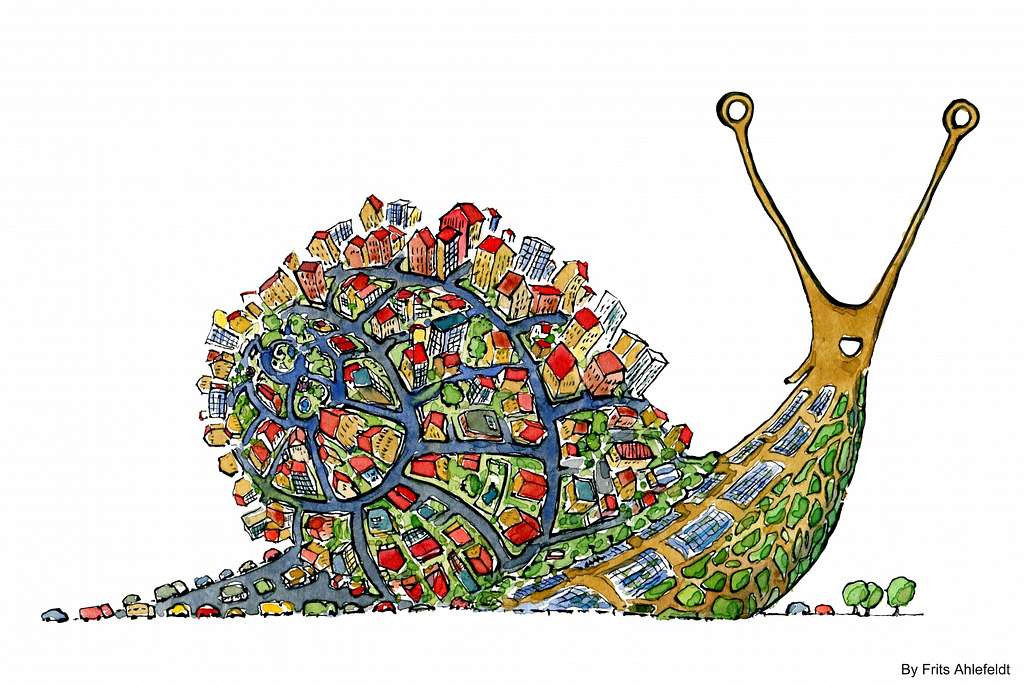
Slow City Snail by Frits Ahlefeldt | Public Domain image via itoldya420.getarchive.net


Where I live, in Palm Springs, California, Canadian snowbirds are selling off their properties and angrily vowing never to return to the United States. Once back home, our northern neighbors are pulling Kentucky bourbon and other US goods from the shelves and liberating themselves from the tariff-obsessed lunatic in the Oval Office. The same story is playing out across the globe, including with close friends in Europe, the United Kingdom, and Australia, where the most immediate result of our self-inflicted trade wars is the collapse of Tesla sales. The poet Robert Frost once wrote that “good fences make good neighbors,” but he should have added that bad trade policies make friends into enemies.

I’ve already written about why tariffs are a form of dumb localization. Today, I want to focus on how communities, both inside the United States and around the world, should respond to the escalating global trade wars. My recommendation is simple: Inoculate your community from the increasing unpredictability of the global economy by becoming as local as possible, as fast as possible. The more you can produce your own goods and services from your own resource base, the less vulnerable you’ll be.

In case you haven’t been paying attention (or you’ve been reading too much Tom Friedman), localization is already sweeping the planet, at least in developed countries. Some 70-80% of US households spend money on services, which are almost always competitive and inexpensive locally. That percentage has steadily expanded over the past fifty years and is one of the principal drivers of localization. (It’s also a driver of the shrinking importance of manufacturing, but that’s another essay.)

The remaining goods we purchase are primarily nondurable goods like food, lumber, and building materials. Nondurable means that they don’t last. Most of the nondurable goods we consume every year tend to be heavy and have a low dollar value per unit weight (compared to, say, microchips). Food, for example, our biggest nondurable good purchase, is mostly water, and it doesn’t make sense to ship water in the form of soybeans halfway around the planet if you can produce the same item yourself. Only highly specialized water, like scotch whiskey, is worth the shipping and transaction costs. This helps explain why local food movements are thriving in every country. It’s increasingly cost-effective for communities to produce their own food for local consumption.

Let’s just pause on the surprising bottom line: About 90% of what we spend is on services and nondurable goods and can easily be produced locally (or regionally, if you live in a small town). If your community is not 90% self-reliant now, tariffs are your invitation to get started—yesterday.

The only things that are really hard to produce locally are durable goods, like cars, phones, and refrigerators. This is only about ten percent of our spending. Where these items are made will be dramatically affected by the tariff wars, and localization strategies for these items are more challenging. I’ll focus a future essay on durable goods, but for now, let’s just concede that these items still must be imported.

A realistic action goal for a community trying to survive tariffs is this: How can we move our economy more quickly toward the 90% self-reliance that’s economic, practical, and already happening? Here are ten distinct strategies your community can and should deploy to achieve this goal:

(1) Leakage Analysis – Look systematically at where money is leaving your economy right now, and calculate which nonlocal purchases are leading to the greatest job losses. Maybe it’s professional services? Or fresh vegetables? Whatever you find, these should become the focus of economic development efforts to grow new businesses or expand existing businesses to provide these goods and services locally. Shockingly, almost no economic development agency follows this very simple methodology for setting priorities. They instead waste their time, staff, and your money trying to attract outside companies—a strategy that’s a proven loser for economic development.

(2) Asset Analysis – Your community should make a thorough inventory of all underused assets. Do you have farmland with nothing growing on it? Public properties with zero economic activity? Is a large segment of your workforce unemployed, underemployed, or unhappily employed? Copenhagen created a City & Port Development Corporation to develop its municipal land into huge new sources of wealth. Its development projects, such as the North Harbor (Nordhavn), have created space for 40,000 residents and 40,000 workers. Revenue generated from the land development funded major infrastructure projects, including an expanded metro system, further boosting economic activity and connectivity.

(3) Circular Economies – A very specific kind of asset foolishly overlooked by most economic developers is what we mistakenly call waste—garbage, pollution, excess heat, and so forth. These waste products are potentially valuable inputs for new industries. South Australia has grown its regional economy and improved the state’s fiscal health by charging fees on all waste products. This has incentivized industries to clean up and become more efficient, which has created more jobs. Funds collected from waste producers are then used to promote technologies and business designs that accelerate circular practices.

(4) Vertical Integration – Leakage analysis should be performed not only by the community but also by its local companies. Zingerman’s Community of Businesses in Ann Arbor, Michigan, dramatically expanded its deli business by creating other local businesses—a bakery, a creamery, a farm, a coffee roastery—that supply goods to the deli. It now employs more than 700 people. Economic development should help every business in the community expand in this way. Nudging your businesses to vertically integrate—a few jobs here, a few jobs there—is a much more reliable way to grow the economy than bringing in an outside factory.

(5) Anchor Institutions – Vertical integration is particularly powerful if it is deployed by anchor institutions, the largest companies in your community that might be publicly owned or nonprofits. These could include public schools, universities, sports teams, and hospitals. These institutions, however, are often uninterested in vertically integrating, so Plan B is to get them to focus their purchasing power on local goods and services, which is a powerful lever of change. Push the local hospital to buy food from local farmers, or public schools to purchase desks from local furniture producers. In Preston, in the United Kingdom, local procurement led by anchor institutions created more than 1,600 jobs.

(6) Business Partnerships – Local businesses can strengthen themselves by establishing partnerships with other businesses. Local restaurants, for example, can market themselves collectively and leverage their collective buying power to get better deals from wholesalers. Business partnerships can also enable small businesses to achieve better economies of scale. Local hardware stores, which might not be able to compete on their own, have been able to succeed by being part of the global Ace Hardware Producer Cooperative. (These global networks of local businesses, by the way, offer clues on how local companies can cost-effectively produce durable goods.)

(7) Local Credit Networks – Strengthening local banks can strengthen local businesses that borrow from them. Most cities take surplus revenues from taxes, transfer payments from the national authorities, and put them into global financial instruments that do no good at home. The Bank of North Dakota, for more than 100 years, has taken these revenues and put them on deposit in local banks and credit unions, enhancing credit available to local businesses. It receives interest from the deposits, and now clears more than $100 million in annual profits, which it uses for various economic development initiatives. The population of North Dakota is under 800,000, which suggests that hundreds of cities in the world of similar or greater size could benefit from this strategy.

(8) Local Investment – This is what we promote every week at The Main Street Journal. Shifting the investment of residents from global companies to local ones can powerfully stimulate the local economy. And cost-effectively! In Nova Scotia, local pension funds called Community Economic Development Investment Funds (CEDIF) are enabling residents to reinvest in various local businesses. My favorite CEDIF, called FarmWorks, invests in local farms and food businesses. Residents receive tax credits, and, true, this costs the provincial government some lost revenue. But a recent study found that the per-job cost of these programs was just over $500—about a thousand-fold cheaper than the cost of paying incentives to attract a large outside company.

(9) Innovation Centers – Key to a successful local economy is innovation, which doesn’t happen naturally. It happens when economic developers mindfully connect entrepreneurs with capital, mentors, technical assistance, support networks, courses, incubators, and accelerators. These efforts do best when they focus on locally owned companies, because nonlocal companies will happily take the assistance and run. A great example of the virtues of localizing innovation support is the Mondragon Cooperatives in the Basque Region of Spain. Started in 1956, Mondragon has grown into the largest network of worker cooperatives in the world, now employing more than 70,000 people. Central to Mondragon’s early success was a school offering support services that helped transform talented workers into entrepreneurs, all within the cooperative system.

(10) Global Partnerships – Finally, consider the strategy of global learning. The new mantra for localization should be “innovate locally, share globally.” Every business design that helps a city become a little more self-reliant, whether in food, energy, or bicycles, should be shared and spread with every other community around the world. As this sharing network expands, communities will benefit from best practices across the world. This is already happening informally and formally through organizations like the International Council for Local Environmental Initiatives and COPx. These networks should be deepened and integrated with local economic development policy.

As my examples suggest, these ten localization strategies are not hypothetical. They are already being implemented somewhere on the planet and showing impressive results. They are generating income, wealth, and jobs far more cost-effectively than current economic development strategies to “attract and retain” outside global businesses. Unfortunately, no community is implementing even two or three of these strategies, let alone all ten.

So I say to my friends in Canada, in Australia, in France, in Japan, and everywhere else in the world: Don’t succumb to our Mad King’s trade wars. Use this crisis as an impetus to accelerate localization in your economy. The same advice applies to communities inside the United States. Let’s work together to find the business designs and strategies that collectively reduce our vulnerability. The faster we can take our local economies out of the line of international fire, the more secure we will be—and the more our peoples will prosper.


Michael Shuman is director of research for Cutting Edge Capital, director of research and economic development at the Business Alliance for Local Living Economies (BALLE), and a Fellow of Post Carbon Institute. He holds an AB with distinction in economics and international relations from Stanford University and a JD from Stanford Law School. He has led community-based economic-development efforts across the country and has authored or edited seven previous books, including The Small Mart Revolution: How Local Businesses Are Beating the Global Competition (2006) and Going Local: Creating Self-Reliant Communities in the Global Age (1998). In recent years, Michael has led community-based economic-development efforts in St. Lawrence County (NY), Hudson Valley (NY), Katahdin Region (ME), Martha’s Vineyard (MA), and Carbondale (CO), and served as a senior editor for the recently published Encyclopedia of Community. He has given an average of more than one invited talk per week for 25 years throughout the United States and the world.

 

European travelers avoid US, impacting tourism

chinadaily.com.cn | Updated: 2025-04-12 16:38


A tourist walks through the US Capitol Rotunda on Capitol Hill
 in Washington, DC, US, March 11, 2025. [Photo Agencies]

European travelers are shying away from visiting the US due to concerns over political and economic tensions, leading to a significant decline in international visitors and threatening lucrative air routes, according to a report by Financial Times.

In March, the number of western European visitors who spent at least one night in the US dropped by 17 percent compared to the previous year, said the report, quoting the International Trade Administration.

Specifically, travel from countries like Ireland, Norway and Germany witnessed a decline of over 20 percent, according to the report.

This downward trend is alarming for the US tourism sector, which contributes 2.5 percent to the nation's GDP.

Overall, the total count of overseas visitors to the US experienced a 12 percent year-on-year decrease in March, marking the most significant drop since March 2021.

"In just two months [Trump] has destroyed the reputation of the US, shown one way by diminished travel from the EU to the US," said the report, quoting Paul English, co-founder of travel website Kayak. "This is not only one more terrible blow to the US economy, it also represents a reputation damage that could take generations to repair."

Tariffs, Trump, and the Global South

Trump’s trade war is framed as a battle with China—but its fallout is exposing just how little power African economies have in a rigged global system.
April 11, 2025
Source: Africa is a Country


Image credit: wefaceforward.org


As of April 9, 2025, US President Donald Trump announced a 90-day pause on higher tariffs for over 75 countries, reducing them to a baseline 10% rate, while excluding China, which now faces a sharply increased tariff of 125%. This pause, set to expire on July 4, 2025, offers a temporary reprieve for many nations, allowing for negotiations and potentially stabilizing global markets, although the long-term implications and outcomes remain uncertain.

“Liberation Day” was how US President Donald Trump described it as he gleefully waved a bill introducing sweeping tariffs against his country’s global trading partners. “Taxpayers have been ripped off for more than 50 years,” he added, characterizing himself as America’s solemn defender. “But it is not going to happen anymore.” Despite widespread attempts to explain to Trump that it is American consumers who will have to absorb the cost of these new measures, the President has resolutely pressed ahead. One EU official said it is more an “inflation day” than a “liberation day.” Trump’s goal is ostensibly to restore manufacturing to the US, but as pointed out by the celebrated South Korean economist Ha-Joon Chang, you need a strategy to build an industry, not just punitive taxes for companies that want to sell things in your market. In just a few days, the tariffs have triggered instability in global stocks and sent the dollar plunging.

The measure has been met with widespread criticism from both friends and foes alike, neither of whom has been spared. David Lammy, the UK foreign secretary, suggested that Trump’s policy has taken the US back a century. The French President, Emmanuel Macron, described the tariffs as “brutal and unfounded.” Beijing, which exports a large number of goods to the US and faces a 104% tariff, warned that there would be no winners in a trade war and called on the US to stop “unilateral bullying.”

Even the world’s most important financial papers haven’t spared Trump. The Financial Times called it an “astonishing act of self-harm,” while the Wall Street Journal said the only real winner would be China’s leader, Xi Jinping, describing the tariffs as a “strategic gift.”

In Africa, the picture is somewhat more complex. Most countries have been hit with the lower end of the tariff spectrum, facing a 10% levy, but the highest have been borne by Lesotho (50%), Madagascar (47%), Mauritius (40%), and Botswana (38%). The measures also imperil the US’s existing preferential trade arrangements with select African countries through the African Growth and Opportunity Act (Agoa), which allows them to export goods to the US market on favorable terms. However, energy imports and key commodities have been exempted, which are Africa’s main contributions to the global economy. Agriculture has been more mixed.

Theoretically, that should shield these countries from the impact of these measures, but it isn’t that clear, argues Aboulaye Ndiaye, a professor at New York University, Stern School of Business. Ndiaye, a former US Federal Reserve economist, speaks to Geeska about the impact he expects the tariffs will have, what African countries can do to mitigate them, and why we need to rekindle more organic trade routes that can help support intra-African trade.

FA

When I went through the list of tariffs on Africa, I wondered whether it would have any impact on the continent, given that the US introduced exemptions on a long list of metals, oil, and gas—Africa’s primary exports. Libya, for example, got 31% but only really exports oil. Are we being too complacent if we say that the impact on African trade, for the most part, is somewhat exaggerated at this stage?

AN

That is a great question. So, if we look at it by looking at each country and say their primary exports are not affected, so that the practical impact is limited, that would definitely be a risky view. So, yes, it is likely that the immediate impact might not be that large in many places, but there will be secondary impacts because we face the world, and it will respond and retaliate, as we’re in a global trade war now. We know, for example, that stock markets are affected, and when capital gets scarce, Africa is one of the places where people pull the trigger first. There are also large oil exporters, like Angola, Nigeria, and Algeria, who rely a lot on oil, so the drop in global oil prices will have an impact on their businesses and budgets. But even this will help others who are energy importers—like Kenya and even Senegal.

As Africans, we need to think about how we will align and what our responses will be.

FA

Trump is basically complaining that the US has a negative trade balance with many countries around the world, which is one of the things he believes these tariffs will remedy. This means most of us sell more stuff to Americans than we buy and he thinks that is linked to the punitive tariffs many countries have on American goods. Will this help the US rebalance its trade with its African partners?

AN

It’s like me going to my barber with whom I have a negative trade balance because I basically import a service from him. And if, someday, I wanted to have a positive trade balance, I would add a tax on him cutting my hair and try to begin cutting his. That logic basically doesn’t make sense. So, the bottom line is we need to think about the long-term impact here. And I don’t mean a few months, but over the course of years. We shouldn’t take too drastic measures then, but we do need to seek alternatives.

FA

Most African countries also carry out the majority of their trade with China today, not the US. I think there are a handful of exceptions where the US is the main trade partner. But how much will that dampen the impact of these tariffs in your view across the continent?

AN

It will dampen the impact because it means they’ve diversified their trade partners, but they need to go further. Some commentators are now thinking about how we will do more trade among ourselves—among Africans, I mean—and increase intra-African trade. But we need to negotiate more bilateral trade agreements, country-specific ones, inside and outside Africa to help explore more alternatives. This includes the US, so they need to pick up the phone.

FA

Two countries have managed to avoid the tariffs altogether. Those being Somalia and Burkina Faso. Why were they able to dodge this bullet?

AN

Well, do you know which other country managed to dodge this? Russia. Most people got at least 10%. So, I think part of it is that these countries don’t have that large a trade volume with the US.

FA

Lesotho was flagged as a country facing a huge challenge because of Trump’s measure. They face a 50% tariff on a sector that accounts for around 20% of their trade. The country’s trade minister, Mokhethi Shelile, has said he’s worried about job loss and factory closures. How should other cases like Lesotho, of which there aren’t many, deal with this problem?

AN

For Lesotho 50% is huge. Factory closures are a major concern. But let me give an example from the first Trump term, where there was a trade war. Many Chinese companies just took their machines and factories from China, unscrewed everything, moved their equipment to Vietnam, where there were lower tariffs, and continued exporting to the US. Right? So, there are alternatives for these companies, they can shift their production. Lesotho, and countries like it, can also consider third countries where they might reroute their production.

Overall, the major concern for me is the cumulative impact of these tariffs and their repercussions at a time when the US has also cut foreign aid to African countries. The budgets of these countries are quite strained, and it is difficult for them to raise money through private markets. These are the vulnerabilities, cumulatively, that are currently the most challenging.

FA

Intra-African trade has long been a challenge across the continent. Almost all countries, with a few exceptions of those that export to South Africa, have extra-continental trade partners. Some efforts have been made in this regard, such as a continent-wide free trade area and regional free trade blocs like the East African Community. Why haven’t these efforts moved forward more quickly and altered the trade structure for African economies?

AN

As you’ve pointed out, there have been some ambitious initiatives. You have the East African bloc, the West African bloc, and the Southern African bloc, and they all have their own trade agreements. And now, you have the African Continental Free Trade Area. But, unfortunately, these are all paper tigers. They don’t contribute much. There are still many barriers to trade. The infrastructure that facilitates it isn’t well developed, there are cumbersome customs procedures, regulations are not consistent, and finally, there is still considerable political resistance to further integration.

We need a better understanding of history over its long durĂ©e to solve some of these issues, instead of just thinking about ourselves in terms of colonization or post-colonization. If we look at the trade agreements that make the most sense for African countries they are not the ones that have been constructed over the last 60 years in the postcolonial period. Rather, you would see more natural links. For example, me having this conversation with you, I’m from Senegal and you’re from Somalia—the link is closer than you think. Take Saudi Arabia, which is an important trade partner for your country; that path is also a well-travelled one for West Africans, like Mansa Musa, the most famous, who went from Mali to Hajj. There were many trans-Saharan and trans-Sahelian trade routes.

I don’t know if you’ve seen the film Io Capitano, which depicts this. It’s a movie about migration but it isn’t just a film showing people leaving Africa and arriving in Europe, it also shows the path. They go from Dakar in Senegal, passing through Mali, Niger, N’Djamena and end up in Libya where they face many difficulties. So all these parts of the world have become embroiled in terrorism and conflict, but if you look at the longer history, this path was one that was rich with trade and exchange, which was organic trade, that has been well-documented by historians. The point I’m making here is that if we apply the economic concept of persistence, which considers how existing patterns tend to become endogenous, these blocs we now have are not really grounded in these longer, more persistent patterns, these trade paths that have existed for years. People have traded gold, salt, and other things from the shores of Senegal along these migration routes, north to the Mediterranean and across the Sahel to the Red Sea.

The geographies where African affinities and trade patterns lie are different from these blocs we’ve established based on language and other considerations. These longer historical trade paths need more infrastructure and other things to support them and we need to re-think that.


Abdoulaye Ndiaye
Abdoulaye Ndiaye is Assistant Professor of Economics at NYU Stern.
New York Times concerned about trade war


Washington, Apr 11 (Prensa Latina) The New York Times today expressed in an extensive article its concern about the possible Monumental rupture that could emanate from the tariffs imposed by the United States on China.

April 11, 2025 | 

He sent the message that these discrepancies put the world economy on edge, and could further weaken the ties between the superpowers, with effects everywhere.

A dizzying escalation of tariffs unravels a decades-long trade relationship between the United States and China, jeopardizing the fate of the two superpowers and threatening to drag down the world economy.

The brinkmanship deployed by both countries already far exceeds the battles they fought during U.S. President Donald Trump's first term.

In 2018 and 2019, Trump raised tariffs on China for 14 months. Mostly, the most recent escalation unfolds in a matter of days, with levies that are much higher and apply to a wider group of goods.

On Wednesday, Trump responded to China's decision to match its 50 percent levy — a penalty for Beijing's countermeasure to an earlier U.S. tariff — with an additional levy, raising the rate on Chinese imports to at least 145 percent.

"We are approaching a monumental and disastrous rupture," said Arthur Ross director of the Asia Society in New York's Center for U.S.-China Relations. The fabric that we have so carefully woven over the past few decades is tearing apart.

A relationship that shaped the world economy in the 21st century is in jeopardy, he added.

For years, both sides benefited. The widespread use of Chinese factories by U.S. companies kept prices in check for U.S. consumers and boosted profits for the country's largest companies.

China obtained jobs and investments that lifted millions of families out of poverty. And as China's purchasing power grew, a gigantic and lucrative market opened up for American brands.

Economists predict that the split could tip the U.S. economy into recession.

At the same time, the Chinese economy is facing the prospect of a painful divorce from its largest trading partner, which buys more than $400 billion a year worth of goods from it.

MEM/RFC

How prepared is China for the tariff clash with the US?


Beijing (Prensa Latina) The trade war with the United States in 2018, Donald Trump's first term, took China by surprise, but now that tariffs have reached 145 percent, what is the outlook for the Asian giant?

April 11, 2025
By Isaura Diez
Chief China Correspondent
Prensa Latina


Premier Li Qiang stressed that Beijing is prepared to face uncertainties, while acknowledging that external shocks have put some pressure on the smooth functioning of the national economy.

The escalation in the tariff war unleashed by Trump has China in its sights, the Asian giant responded with similar tariffs to the United States and the phrase: "China does not want confrontations, but it is not afraid to fight".

Here's the current picture: Chinese goods imported from the U.S. are subject to up to 145 percent tariffs (125 percent added in recent days and 20 percent under the fentanyl excuse), while all goods from the U.S. face 125 percent upon arrival here.

The Asian giant's Customs has already notified that if the White House insists on the tariff game and raises these levies again, Beijing will not pay any more attention to it.

China's Commerce Ministry added 12 more U.S. companies to the export control list and filed a lawsuit under the World Trade Organization's (WTO) dispute settlement mechanism over the latest tariff measures.

"There are no winners in a trade war, protectionism has no future," the Chinese government said.

But he also stressed that if Washington insists on its hegemonic approach and wishes to wage a tariff war "or any kind of war," China "will accompany it to the end."

According to President Xi Jinping, it is normal for there to be differences between two different systems, however, he pointed out that there is a high complementarity between the two economies and that the successes of one should not be seen as a threat to the other.

The Ministry of Commerce of the Asian giant assured that the door is open to dialogue, but if the United States really wants to negotiate it must do so with respect and equal treatment.


WHILE THE NEGOTIATIONS ARE COMING IN...

In a meeting with business leaders and experts from the Asian giant, the prime minister stressed the importance of strengthening trust, working in unity and focusing on internal issues to turn crises into opportunities.

He said that this will promote constant and long-term economic development in the country.

In view of the changes in the environment, he stressed the need to implement more active and effective macroeconomic policies to address external uncertainties.

The head of government pointed out that it is essential to expand and strengthen the internal cycle and prioritize the expansion of domestic demand as a long-term strategy.

He proposed increasing efforts to stabilize employment, boost income growth and unlock the potential for services consumption.

In addition, he stressed the importance of promoting the integration of scientific and technological innovation with industrial innovation, with the aim of leading demand with a high-quality offer.

Li Qiang also stressed the need to boost the vitality of all business entities, implement supportive policies to solve problems such as payment delays, difficult access to financing and high costs.

"We must help companies overcome difficulties and provide them with a better development environment," he said.

Indeed, China is focused on expanding domestic demand, which is set to be the true locomotive of the national economy, but challenges such as the real estate crisis and a decline in consumer confidence remain.

On the other hand, while the United States is a leader in protectionism, Beijing underscored its commitment to comprehensive reform and the country's increasing opening-up.

The idea is to create a unified, fair and optimized business environment with international standards and tariff flexibilities to attract foreign investment.

According to Li, the country's economic operation during the first quarter continued its rebound and the national economy stands out for its many advantages, strong resilience and great potential.

Analysts point out among the advantages of the Asian giant that it has a complete industrial system and a large market made up of an expanding middle class.

CHINA LOOKS AROUND

The Foreign Ministry confirmed Xi's trip to Vietnam, Malaysia and Cambodia next week on state visits that will include meetings at the highest level.

The president's tour, scheduled to begin next Monday and conclude next Thursday, will be focused on strengthening Beijing's already excellent political, economic and social relations with its neighbors and occurs in the midst of the escalation of tariffs by the United States against those nations.

In fact, these three countries are part of the Association of Southeast Asian Nations (ASEAN), a bloc that has become the Asian giant's main trading partner.

What is remarkable is that just this week Xi Jinping called for strengthening and opening another chapter in regional relations: "We must focus on building a community of shared destiny with our neighbors," he emphasized at a high-level meeting.

The conference stressed that the countries around China are fundamental to China's development, national security and global diplomacy.

In addition, the meeting stressed that, although relations with neighboring countries are at their best since the modern era, they also face challenges arising from profound global changes.

To address them, the meeting proposed to work under the principles of the community of shared destiny and the Asian values of peace, cooperation and openness.

He also stressed that the Belt and Road Initiative will continue to be a key platform for boosting regional economic integration and development.

The attendees emphasized the need to consolidate strategic mutual trust, manage differences and deepen economic and security cooperation.

Asia is the natural area of greatest influence of the world's second economy and many of its experts point out the importance that Beijing attaches to its environment.

China recently underscored the potential for economic development in the region, which is forecast to grow by 4.5 percent by 2025 and increase its weight in the world economy to 48.6 percent.

EUROPE AND LATIN AMERICA ARE WELCOME

It is not only about Asia, the rapprochement with Europe is also notable these days, despite the fact that both sides have their own trade differences.

In fact, the official visit of the head of the Spanish government, Pedro SĂ¡nchez, to the Asian giant and his meeting with Xi is another step in the expansion of these ties.

During a meeting at the Diaoyutai guesthouse in the capital, the Asian leader stressed that the friendship between the two countries is based on common interests and long-term benefits.

In this regard, he urged both sides to consolidate mutual support on sovereignty issues and key concerns, and seize the opportunities offered by sectors such as renewable energy, high-tech manufacturing and smart cities.

On relations with the European Union (EU), Xi said China regards the bloc as an important pillar in a multipolar world.

He proposed working together to celebrate the 50th anniversary of diplomatic relations between Beijing and the EU with the aim of promoting a partnership based on peace, growth, reform and civilization, which he said was more relevant in the current circumstances.

Xi Jinping stressed that there is no winner in the tariff war and that going against the world is isolating oneself.

"For more than 70 years, China's development has always been based on self-reliance and hard work, never relying on anyone's gifts, let alone fearing any unreasonable repression," he stressed.

According to the president, regardless of how the external environment changes, the Asian giant will strengthen its confidence, maintain its resolve and focus on managing its own affairs well.

On the other hand, the president sent a letter of congratulations to the IX Summit of the Community of Latin American and Caribbean States (CELAC), recently held in Honduras, in which he ponders the ties between Beijing and that region.

The president stressed that these relations have withstood changes in the international scenario and are now in a new stage characterized by equality, innovation, openness and shared benefits.

According to Xi, both sides deepened political trust, expanded practical cooperation and strengthened cultural ties, which benefited the two peoples and established a model of South-South cooperation.

In addition, he reiterated the invitation to the member countries of the bloc to participate in the next China-CELAC Ministerial Forum, scheduled to be held in Beijing in the first half of the year.

The president urged to take advantage of this event to discuss development plans, strengthen joint cooperation and thus contribute to facing global challenges, reforming world governance and maintaining international peace and stability.

ARC/IDM


Xi: No winner in a tariff war

By CAO DESHENG | chinadaily.com.cn | Updated: 2025-04-11 


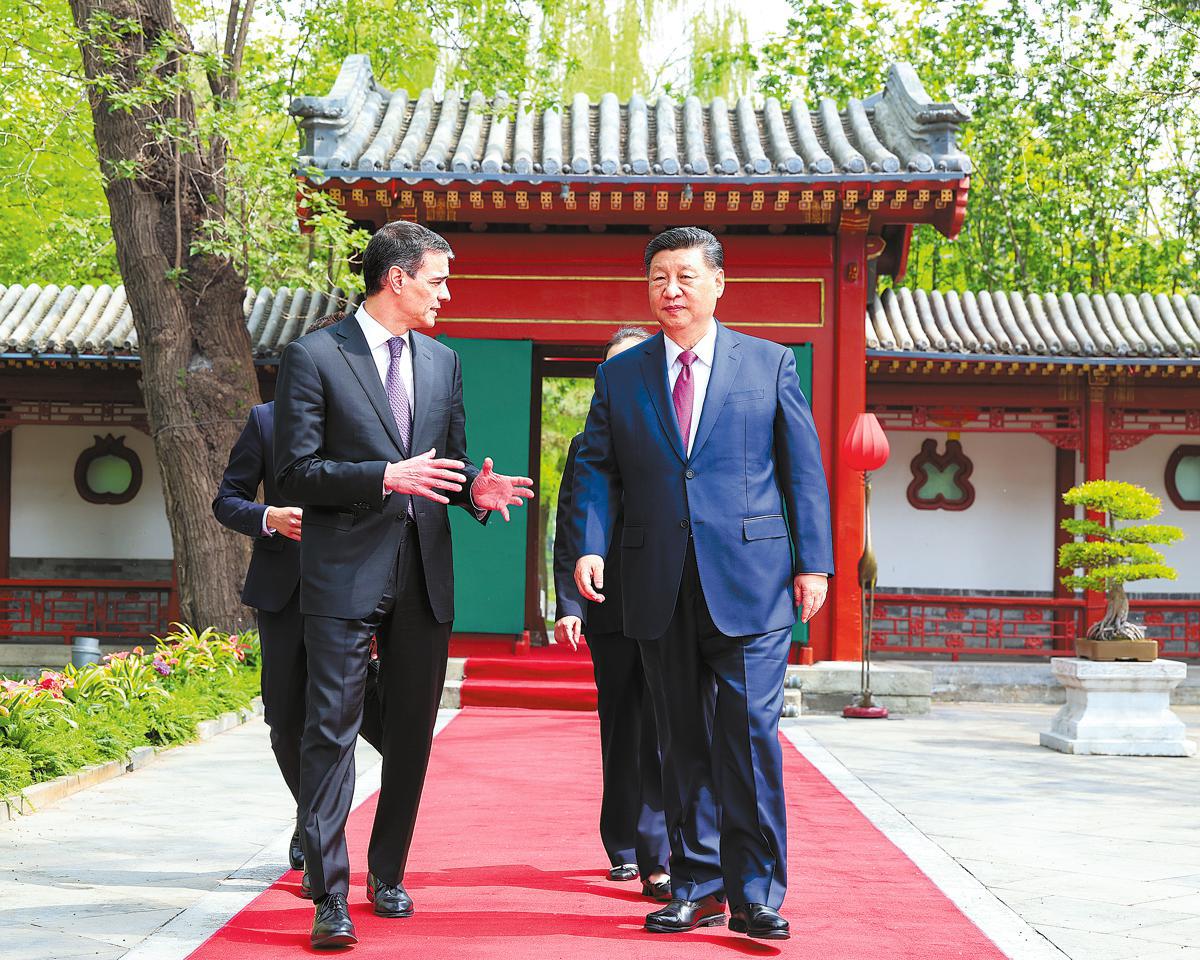
President Xi Jinping meets with Spanish Prime Minister Pedro Sanchez at the Diaoyutai State Guesthouse in Beijing on Friday. Liu bin / Xinhua

There are no winners in a tariff war and China is not afraid of unreasonable suppression, President Xi Jinping said on Friday, calling on the European Union to work with China to jointly resist unilateral bullying.

Xi made the remarks during a meeting in Beijing with Spanish Prime Minister Pedro Sanchez, the first time the Chinese leader has spoken in public on the tariff war launched by the United States on April 2.

There is no winner in a tariff war and going against the world ultimately results in self-isolation, Xi said.

He emphasized that China's development over the past 70 years and more has been through self-reliance and hard work, never on others' mercies, and it certainly does not fear unreasonable suppression.

Whatever changes may take place in the external environment, China will remain confident, resolute and focused on running its own affairs effectively, Xi said.

The president noted that both China and the EU are major world economies and staunch supporters of economic globalization and free trade, with their combined economic output accounting for over one-third of the global total, forming a deep economic interdependence.

China and the EU should fulfill their international responsibilities, jointly uphold the trend of economic globalization and the international trading environment, and resist unilateral bullying in order to safeguard their legitimate rights and interests, while upholding international fairness and justice and maintaining international rules and order, Xi said.

Xi's remarks came as the US tariff war with China escalates. The White House clarified on Thursday the 125 percent tariffs on Chinese imports announced on Wednesday were on top of a previous 20 percent, adding up to a whopping levy of 145 percent against China.

In response to a question about the US tariff hike, Foreign Ministry spokesman Lin Jian said on Friday that China's countermeasures are not only aimed at safeguarding its legitimate rights and interests, but also at upholding international rules and order. "In the face of US bullying and arrogance, there is no way forward through compromise and concession," Lin said at a regular news conference.

Sanchez was the first European leader to visit China following the US announcement of sweeping tariffs. The two-day official visit, starting on Thursday, marks his third trip to China within three years.

He told Xi that China is an important partner for the EU, and Spain consistently supports the stable development of EU-China relations.

The EU remains committed to open and free trade, is dedicated to upholding multilateralism and opposes unilateral tariff increases, Sanchez said, adding there are no winners in a trade war.

Faced with a complex and challenging international situation, Spain and the EU are willing to strengthen communication and cooperation with China, uphold the international trade order, and jointly cope with the challenges of climate change and poverty to safeguard the common interests of the international community, he said.

On Friday, Premier Li Qiang held talks with Sanchez. They witnessed the signing of an array of cooperation agreements in the economy, trade, and science and technology.

Both sides issued an action plan (2025-28) on strengthening their comprehensive strategic partnership. They agreed to enhance cooperation on the economy, trade, investment and technological innovation, and jointly support free trade and open cooperation and uphold multilateralism.

China and the EU have been closely coordinating on trade issues over the past few days.

Premier Li held a phone call with European Commission President Ursula von der Leyen on Tuesday, with both sides pledging to promote bilateral ties and uphold the multilateral trading system.

Commerce Minister Wang Wentao held a video meeting with European Commissioner for Trade and Economic Security Maros Sefcovic on Tuesday, during which the two sides agreed to promptly initiate consultations to thoroughly discuss market access-related issues.

Observers said that the US tariff war may provide an opportunity to bring Brussels and Beijing closer together and has given China the opportunity to position itself as a potentially more reliable partner for the EU.

Cui Hongjian, professor of the Academy of Regional and Global Governance at Beijing Foreign Studies University, said that it is imperative for China and the EU to jointly confront this challenge, as US unilateral policies would severely damage globalization and the multilateral trading system that underpins China-EU cooperation.

Trade wars to cost US dearly, warns Peterson Institute researcher

chinadaily.com.cn | Updated: 2025-04-11


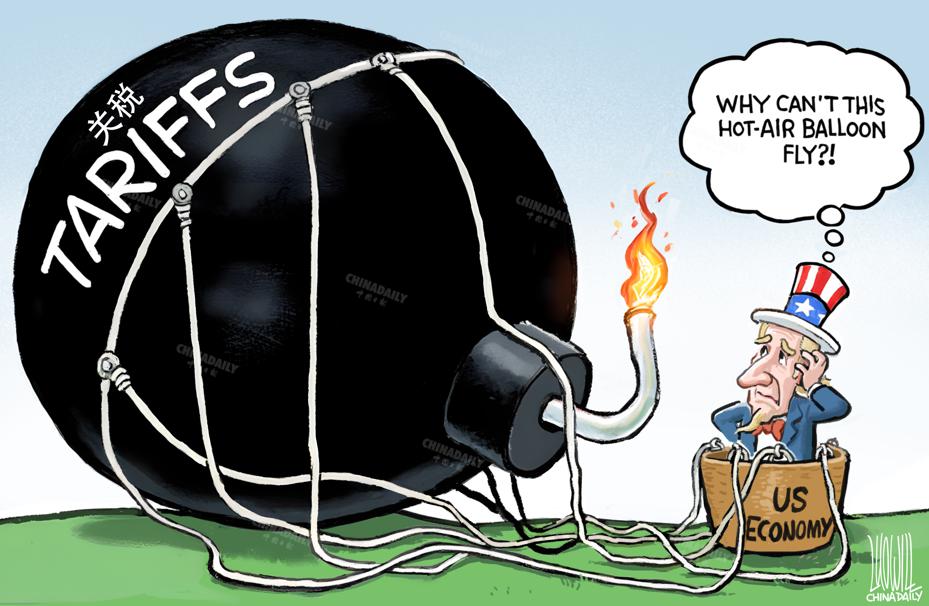
Luo Jie/China Daily

The US economy will suffer significantly — more than China's— and in the event of a large-scale trade war between the two countries, the damage would only intensify if the United States continues to escalate tensions, warns Adam S. Posen, President of the Peterson Institute for International Economics, in an article published on Foreign Affairs on April 9.

According to Posen, the Trump administration believes it holds "what game theorists call escalation dominance over China and any other economy," with which it maintains a bilateral trade deficit.

However, he argues that this logic is fundamentally flawed: it is China, not the US, which holds escalation dominance in this trade war.

Posen explains that, to the extent that bilateral trade balances matter in determining the outcome of a trade war, the advantage lies with the surplus country, not the deficit one. China, the surplus country, is sacrificing sales, which amounts to lost revenue; the United States, the deficit country, is giving up access to goods and services it does not produce competitively—or in some cases, at all—domestically.

Given the US dependence on Chinese imports for vital goods (pharmaceutical stocks, cheap electronic chips, critical minerals), Posen cautions that it is "wildly reckless" to cut off trade before securing reliable alternatives. Doing so, he warns will result in the very kind of damage the administration claims to want to avoid. A severe supply shock from slashing or eliminating imports from China would trigger stagflation, Posen said.

Posen further criticizes the administration for making erratic policy decisions that effectively amount to massive tax increases and heightened uncertainty for manufacturers' supply chains. The likely result, he contends, will be reduced investment into the US and increased interest rates on national debt.

US should reflect on its flawed tariff policies

By Colin Speakman | chinadaily.com.cn | Updated: 2025-04-11 

Luo Jie/China Daily

Faced with an onslaught of tariffs from the US, nations are deliberating on their responses. The situation is complex because Trump's accusation of unfair treatment of the US by trading partners evidenced by other nations' trade surpluses is false.

Economists have asserted that trade imbalances often result from structural differences between countries and not from trade barriers. Consider two large economies of similar GDP with free trade - there should be no trade imbalances. Completely wrong. Say, in one, households have a high propensity to consume out of income and low savings - this is a fair description of the US where many homeowners use equity from rising property prices to refinance, making their home into an ATM. According to the US Federal Reserve, the personal savings rate was under 4 percent of income in 2024.

Assume on the other, citizens choose to save much more out of caution and are less happy to take on debt - they would consume much less of all goods including imports and run a trade surplus with the consumption-hungry country. No malicious treatment is involved. China is a good example of such a country with official household savings rates estimated at around 45 percent - hence highly likely to be a net exporter.

Trump has used the medical analogy of a sick patient enduring nasty medicine in order to be healthy in the future. The problem is that if the doctor has made an incorrect diagnosis, the wrong medicine will be given and the patient won't do well. This is the difficulty of responding to "reciprocal" tariffs which bear no relationship to real situations.

Trump has vigorously attacked the EU as "set up to harm the US", but in fact that large grouping of European nations may well have reduced the desire of individual members to seek export growth to America because there is a barrier-free large market locally that they can export to. It is true that the EU is a Customs Union that has a Common External Tariff but how often do we hear the true data on this, listening to Trump one would imagine it runs at 20 percent - official recent European Commission data shows that the true figure on average was just 1 percent tariff rates by both sides. Trump has made a huge distortion and fair-trading nations need to join together to support the true value of free trade.

Regional trading groups will need to enhance cooperation both within members and between them in order to reduce the importance of US exports to their economies - this will take time and will be constrained if a global recession results in the short term. Hence nations need to decide now how to de-rail Trump's tariff train.

China and the EU can lead the way and Chinese Premier Li Qiang earlier this week reached out to the European Commission President, Ursula von der Leyden, to urge both sides to maintain free and open trade. There is clearly an opportunity for more collaboration between these large trading entities.

There seem to be two main options, one of which Trump will likely present as a victory - the many smaller nations he claims are calling him to do a deal. It may make sense for a nation like Malaysia or Vietnam to offer to eliminate their limited tariffs that probably won't lead to large increases in US imports, reflecting the size of their economies, but equally, this won't reduce the balance of trade issue. Governments cannot make their citizens buy more from America, especially when its own citizens may now have a negative view of that country.

Governments can of course redirect their own spending, so possibly a country might re-equip its national airline with new Boeing jet orders - although these would be unfair to Airbus without competitive tendering. It would be a risky step as it is likely to alienate other, more reliable trading partners.

Trump's latest development is an offer to such nations that have not retaliated to pause and lower tariffs against them as a reward, but it remains to be seen what deals can be done.

For large economies and trading blocs, standing up to and the US with counter-measures sends a message that they will not be bullied by the US for baseless reasons. China has already done this and stated they will not hesitate to go further if needed. The US has not paused tariffs on China, nor on Canada and Mexico who have been retaliating.

On Wednesday the EU announced its members have agreed to impose retaliatory tariffs of Euro 21 billion on US imports with 25 percent tariffs on many selected goods. The European Commission stated that US tariffs are unjustified and damaging, causing economic harm to both sides as well as the global economy. This is entirely correct.

More needs to be done and it may be a forlorn hope, but we need to see other actors in the US, including opposition politicians, business leaders, respected academics and even some of Trump's own supporters, stand up and communicate to the American people that his policy is flawed, a false diagnosis and harmful to the US. It is too early to tell if Trump's sudden, temporary rollback of some tariffs is a sign of greater understanding.

Colin Speakman is an economist from the UK and an international educator specializing in China. The opinions expressed here are those of the writer and do not necessarily represent the views of China Daily and China Daily website.


Washington's trade policy fails basic math

By MASSOUD AMIN | China Daily | Updated: 2025-04-12 09


LI MIN/CHINA DAILY

US President Donald Trump has increased additional tariffs on Chinese goods up to 125 percent, with the total rate to 145 percent, while China has taken countermeasures including additional 125 percent duties on American imports.

The US' policy shift reflects a deeper abandonment of strategic tradecraft. The new tariff regime is not based on credible economic modeling, enforcement of fair trade rules, or reciprocity. Instead, it is built on a formula that converts bilateral trade deficits into tariff percentages. The logic is: the bigger the deficit, the bigger the punishment.

But this framework ignores the real causes of trade imbalance — currency flows, global sourcing, labor specialization, and consumer demand. Trade deficits are not acts of aggression. They are the consequence of structural choices and market dynamics.

The US has had trade deficits for decades. But trade deficits have not weakened the US economy — deficits have coexisted with strong job growth, innovation and investment. The US dollar's global reserve currency status and high domestic consumption ensure persistent imbalances in goods trade. Tariffs cannot rewrite these fundamentals. They can only distort prices, disrupt supply chains, and strain diplomatic relations.

The latest wave of tariffs is also incoherent in its application. Vietnam, which levies on average less than 10 percent tariffs on US goods, has been hit with a 46 percent US tariff. The European Union, whose trade barriers are comparable to or lower than the US', received a flat 20 percent tariff penalty. Even the remote, uninhabited Australian external territory of Heard and McDonald Islands — home only to penguins, seals and seabirds, with no permanent human settlement or meaningful exports — was slapped with a 10 percent tariff. These actions are not strategic; they are algorithmic and devoid of context or logic.

Markets have responded accordingly. Bond yields have surged as investors brace for inflation, instability and retaliation. Multinational companies are freezing investment, delaying orders, and seeking ways to circumvent US customs. Far from reinvigorating domestic manufacturing, this policy has increased uncertainty and capital flight.

The impact of the tariffs on American consumers will be swift and severe. Analysts estimate the tariffs will raise average household costs by $3,800 a year. The products affected include daily necessities: smartphones, laptops, HVAC systems, clothing, medical equipment, and baby formula. Some small businesses are already shutting down. A solar panel enterprise in Arizona and a clothing start-up in Pennsylvania have warned they cannot absorb the price shocks. These are not isolated cases but early signs of a broad contraction.

Diplomatically, the consequences are equally severe. China's retaliatory tariffs will apply to all US exports, including aircraft parts, energy products, semiconductors and agricultural products. Canada and Mexico have imposed 25 percent tariffs on US goods in response. The European Commission is weighing slapping digital taxes on US tech companies.

Thanks to the tariffs, key allies now view Washington as unpredictable and vindictive. The tariffs have not isolated Beijing. They are isolating the US.

The 2018 trade war showed the limits of broad tariffs. While US steel enjoyed temporary protection, the wider US economy suffered. Many jobs were lost in the US due to the tariffs and retaliatory barriers. Most companies that left China did not return to the US; instead, they shifted to Vietnam, Mexico or other lower-labor cost countries. Prices rose. Supply chains broke. The promised manufacturing revival never materialized.

History has another warning. The Smoot-Hawley Tariff Act of 1930 raised duties on more than 20,000 goods, and many countries responded by imposing tariffs on US goods. Between 1929 and 1934, global trade declined by 66 percent, deepening the Great Depression. While Smoot-Hawley did not directly cause World War II, it weakened the global economy and fueled the rise of authoritarian regimes. Trade wars do not stabilize, rather they destabilize, the economy. They do not solve, but create more, problems.

There is a better path. A true industrial strategy means investing in automation, skilled labor, resilient infrastructure and regional supply chains. It means targeting critical sectors — semiconductors, clean energy and biotechnology — through coordinated public-private partnerships. It means working with allies to enforce rules and raise standards, not acting alone in ways that provoke retaliation and undermine trust.

The economic frustrations behind tariff populism are legitimate. But the tools now being used are blunt, ineffective and destructive. Tariffs of this scale are not precision instruments. They are political theatrics imposed without strategic clarity.

If the US wishes to remain a global leader, it must act like one. For that, it needs consistency, coordination, and credibility. None of these can be achieved through news conference ultimatums or spreadsheet-driven punishment. The US needs a policy grounded in facts, not fury.

It's time to abandon the politics of pain. The world is too interconnected, and the stakes too high, to make improvization to masquerade as strategy. The US must stop turning trade deficits into targets and turn shared challenges into solutions.

The world does not need more math. It needs leadership. Let's get the mission right.

The author is an IEEE and ASME fellow, chairman and president of Energy Policy and Security Associates, and a professor emeritus at the University of Minnesota. The views don't necessarily reflect those of China Daily. 

US barbarism on international trade rules

China Daily | Updated: 2025-04-09 


Viral Chinese AI video of US sweatshop workers mocks Trump’s tariffs

Dawn.com Published April 10, 2025

A Chinese AI generated video mocking downcast American workers has been circulating on Chinese and US social media amid a growing tariff war between both countries.

The video shows overweight and over-worked, employees in a textiles factory, appearing exhausted and depressed as they stitch clothing on sewing machines.

Depicting the type of clothing manufacturing jobs that have been outsourced overseas in the past decades, the 32-second clip paints a dystopian picture of what the US working world might look like as a result of Donald Trump’s sweeping tariffs, according to The Independent.


The video depicting a depressed worker in a textile factory. — @axiang67 on TikTok

With the traditional Chinese music playing in the background of the video which ends with Trump’s campaign slogan, ’Make America Great Again, seems to be a direct swipe at the US president.

Much of the low-skilled workers’ jobs had been moved to China and other countries where labour is cheaper with the advent of mass globalisation over the past few decades.

Trump’s tariffs are based on an argument of encouraging American-based goods and returning to low-skilled jobs in the US to expand the job market for Americans and strengthen the country’s own businesses.

On Wednesday, Trump announced retaliatory tariffs on China to 125 per cent, after China imposed 84pc tariffs on US goods.

With more than a million views, the video has sparked further debate on social media about Trump’s ultimate goal in imposing stiff tariffs on China —and what the impact will be, The Independent reports.

“The goal is not to bring these low skilled jobs back to the US, but have China buy more US goods to offset a 300 billion [dollar trade deficit] and counting yearly trade imbalance,” said one.

“Low skilled manufacturing will never come back to the US. Highly skilled manufacturing won’t come to the US because we gutted education and don’t have the highly skilled workforce,” said another.

A third added: “America will become the poorest country in the world under Trump’s rule,” while a fourth mused: “iPhones are about to cost $5,000 and come with no charger.”

The TikTok video was reposted to X by user Damon Chen, who punctuated the video with a laughing-crying emoji, according to New York Post.

Howard Lutnick, Trump’s commerce secretary, during an interview, told CBS that “trillions” of dollars would flow into the US in the form of new investments in America’s manufacturing sector.

Pointing out that the construction of new factories “takes years” and would not reduce high costs for Americans in the short term, host Margaret Brennan asked: “You said that robots are going to fill those jobs. So those aren’t union worker jobs.”

“It’s automated factories,” Lutnick conceded, while promising that “Great American workers” would build and “operate” the factories brought to US shores in the coming months and years.


TRADE WAR SOUTH ASIA VIEWS

Beyond globalisation
Published April 12, 2025
DAWN


The writer is a development policy thought leader and former investment minister.


FINALLY, it is happening through the US president’s executive orders — closure of USAID, the start of a tariff war to balance the trade deficit, challenging of trade liberalisation and breaking away from global value chains.

The US has managed to disrupt global markets by unilaterally altering the terms of trade in the name of reciprocity for the world’s largest consumer market.

In disrespect to the governing rules of the WTO and internal Congressional processes, this executive order is based on a so-called economic emergency in the US. It has not only signalled an uncertain future for economic engagement but has also announced the beginning of an era of popular protectionism.

At the end of the day, it seems all about curtailing China, opening up spaces for US companes in the global marketplace and balancing US trade deficit. Evidence suggests, though, that protection through tariffs does not lead to achieving medium-term goals of investment, competitiveness and job creation.

Various economies are left with no choice but to come up with a short-term response to adjust to the new ways of engagement with the US administration. The top five suppliers of US imports in 2022 were: China ($536.3 billion), Mexico ($454.8bn), Canada ($436.6bn), Japan ($148.1bn), and Germany ($146.6bn), while Vietnam, India, Bangladesh and Pakistan exported $120bn, 90bn, 8.3bn and 5.2bn respectively to the US.

So, the higher tariffs could be a massive downward impact on the GDP of economies that largely depend on their exports to the US, and global financial markets are negatively responding to this development. From the other side, the top five purchasers of US goods in 2022 included Canada ($356.5bn), Mexico ($324.3bn), China ($150.4bn), Japan ($80.2bn), and the UK ($76.2bn).

The China factor remains one of the key driving forces behind this US presidential order. China, the country the US has its largest trade deficit with, has been hit with the highest 125 per cent tariff, prompting Beijing to respond with similar countermeasures. The escalation has marked the beginning of a new global trade war between the world’s two largest economies.

The total US-China bilateral trade in goods was $582bn in 2024, down from $661.5bn in 2018 — the US share of Chinese exports dropped from 19.2pc to 14.7pc. The general perception is that China will emerge as a winner in the medium term due to its dominance in technology and market diversification under the Belt & Road Initiative.

The other major change for developing countries is the closure of USAID. Historically, bilateral aid, multilateral loans and market access have remained visible foreign policy tools for fostering economic diplomacy and geopolitical influencing. Since World War II, the model of delivering aid and concessional loans have undergone several adjustments — from building infrastructure to military aid and from food and medicines to building climate resilience.

The real shock hit the so-called international development sector when on the day of his inauguration, President Trump issued an executive order for “re-evaluating and realigning United States foreign aid” that said the US “foreign aid industry and bureaucracy are not aligned with American interests and in many cases antithetical to American values” and that they “serve to destabilise world peace”.

What do the current economic shocks mean for Pakistan?

Since that order, which froze almost $72bn of US foreign development assistance, the Trump administration has moved to shut down the 65-year-old USAID. While foreign aid has always been aligned with the political priorities of donor countries, it has also helped poor countries deal with natural disasters, displaced populations due to conflicts and other economic shocks like Covid-19.

The US began providing economic assistance and military aid to Pakistan shortly after the latter’s creation in 1947. In total, the US obligated nearly $67bn (in constant 2011 dollars) to Pakistan between 1951 and 2011. In 2009, in an attempt to signal America’s renewed commitment to Pakistan, the US Congress approved the Enhanced Partnership for Pakistan Act (aka Kerry-Lugar-Berman bill).

KLB’s intention was to put security and development on two separate tracks. The Act authorised a tripling of US economic and development-related assistance to Pakistan, or $7.5bn over five years (FY2010 to FY2014) to improve Pakistan’s governance, support its economic growth, and invest in its people. Between FY2002 and FY2009, only 30pc of US foreign assistance to Pakistan was appropriated for economic-related needs; the remaining was allocated to security-related assistance.

For the past three decades, Pakistan has failed to bring a change to the structure of its economy which remains largely dependent on non-exportable services. Under the emerging scenario of US-Pakistan trade, our exports are expected to take a hit due to a potential dip in consumer demand in the US. The opportunity arising from the pressures on our competitors is unlikely to materialise in the short term as the investment climate remains unfavourable for the expansion of export-led industry, knowledge products or relocation of industry from China and East Asia.

The best Pakistan can do in the short term is to control the potential damage through trade and strategic diplomacy with the US. Pakistan’s trade deficit with China is huge and the US may ask for shifting some imports towards itself under the argument of reciprocity. This will lead to making some difficult choices as maintaining a balance between relations with the US and China will get more difficult. It is yet to be seen if China will consider giving more market access to Pakistan to make up the potential trade losses with the US.

For Pakistan, transitioning from using geopolitics and diplomacy as tools for economic gains in the shape of aid, market access or investment is inevitable. There is an urgent need to develop an economic value proposition based on the competitiveness and diversification of the economy. This can only be done if institutional changes are carried out to delegate economic transactions to the private sector.

The current uncertainties might open up space for trade with India and other regional countries. Pakistan’s failure to leverage the connectivity infrastructure needs to be revisited under the tariff war. There are a number of markets in East Asia, Southeast Asia and the Middle East that will be looking for diversification from the US and China.

Can Pakistan offer an attractive economic value proposition to partner with these countries? At the end of the day, Trump’s tariffs have only served to accelerate moves to a new global economic order that will shape the contours of future globalisation and global politics.

Published in Dawn, April 12th, 2025


Tariff turmoil

Rafia Zakaria 
Published April 12, 2025 
DAWN

The writer is an attorney teaching constitutional law and political philosophy

IT was a week of turnarounds. The Trump White House, eager to remain on the warpath with the rest of the world, came down with ridiculous and enormous tariffs for other countries. On April 2, 2025, President Donald Trump imposed a universal tariff on most nations, sending the US stock market into a tailspin, with trillions of dollars wiped out within days. For his part, President Donald Trump acted nonchalant and went off to play golf with the visiting Saudis. Then on April 9, even more draconian reciprocal tariffs were imposed on another slew of countries — allegedly based on a formula that assessed trade deficits and existing tariffs on American goods. Amid the mess, Trump officials advised targeted countries not to retaliate.

China, however, did not listen. After the April 2 tariffs, it decided to retaliate with an 84 per cent tariff on US goods, hiked later to 125pc in response to a further increase by Trump. Unsurprisingly, this turmoil rattled investors everywhere, and nearly all markets took a hit. Economists and analysts began sounding the alarm about a global recession. The White House’s belligerence didn’t suggest that the president — who is using emergency powers to enact these tariffs — was about to capitulate.

It might have gone on — had the US bond market, one of the world’s safest and most stable investments, not suddenly started to tank. The bond market — essentially the channel through which countries buy US debt in 10- and 30-year increments — reflects global confidence in America’s ability to repay its dues. That confidence has traditionally remained high, given the size and strength of the US economy. Unlike stocks, which are known for their volatility, the bond market is supposed to be steady. But not this time.

The current situation may present an opening.

The sudden volatility there is likely what forced Trump’s hand, when he recently announced a 90-day pause in tariffs on all countries — except China. Stock markets around the world exhaled. The NASDAQ posted its biggest single-day gain since 2008. China, however, now faces 125pc tariffs.

The world’s two strongest economies have locked horns — and this will affect everyone, including Pakistan. While Pakistan was among the countries hit with a 29pc tariff (now paused for 90 days), the current situation may present an opening. One of the things the US is pursuing is to negotiate entirely new trade agreements with the rest of the world. The tariffs, in this sense, are a strange sort of invitation to close a ‘deal’ with the Trump administration. Countries that do so may find themselves in a better position than those that don’t. All they need is to propose something the Trump team can spin as a win.

The countries that dominated in the pre-Trump 2.0 world are no longer favourites. The US turn away from China and, to some extent, India means it will need to rely on smaller suppliers to fill the gaps left behind. The aim is to decimate China’s monopoly by diversifying who gets access to the US consumer market. Pakistan could play a role in this diversification. It cannot replace China or India, but may be able to find niche areas that serve unmet demand in the US.

This task would have been easier had the US objectives around these tariffs been clearer. Take the case of Vietnam, slammed with a 45pc tariff before the 90-day pause. Exports to the US make up nearly a quarter of Vietnam’s GDP, so it was no surprise the latter country quickly arrived at the negotiating table. The Trump administration’s response was unexpected. Trump adviser Peter Navarro dismissed Vietnam’s 0pc tariff offer as “not enough”. The reason? Navarro accused Vietnam of “non-tariff cheating” — routing Chinese goods through its ports to bypass US restrictions. The message was blunt: Vietnam must choose between the US and China. In Trump’s world, there is no room for divided loyalties. Vietnam, it seems, has made its choice. Reports now suggest the country has agreed to purchase expensive defence equipment — including warplanes — to help reduce the trade deficit and show goodwill.

Adept diplomats negotiating on Pakistan’s behalf could learn a lot from this. Pakistan desperately needs better trade agreements to lift itself out of economic stagnation and reduce its dependence on IMF lifelines. The country has the capacity to supply textile-based goods to the US consumer market — and with China out of the picture those products could fare better if Pakistan secures more favourable trade terms.

China’s loss could be Pakistan’s gain — if Pakistan is bold enough to seize the mo­­m­ent and clinch a deal with the Trump adm­inistration that can be packaged as a win. For a country that has waited a long time for an opportunity, this might be one.

rafia.zakaria@gmail.com


Published in Dawn, April 12th, 2025


The new Trump order

Published April 11, 2025 
DAWN
The writer is former deputy governor of the State Bank of Pakistan.


WITH one stroke of his pen, a day after April Fool’s Day, Trump left the entire world bewildered at his tariff policy. He made the entire secretariat of the World Trade Organisation redundant, on the one hand, and all other countries engage in technical exercises with regard to the impact of his new tariffs on their economies, on the other.

The proponents of free trade (as if it really existed before Donald Trump’s order) are now trying to find new ammunition to attack Trump’s tariff plan. New phrases had been coined much before Trump assumed his second presidency. A popular phrase is ‘the transactional nature of his approach to dealing with international geopolitical relations’ (as if pre-Trump relations were based on ‘benevolence’!). While, as an economist, I am a proponent of free trade, I must admit that I am having trouble understanding the doomsday nature of predictions about the consequences of Trump’s tariffs in the US and the rest of the world. More on this later.

In writing the above, I run the risk of being labelled a proponent of Trump’s economic policies. I don’t want to make disclaimers such as are now common in the writings of many persons of science and knowledge who when agreeing with one point of Trump, start with a paragraph dissociating themselves with Trump’s utterings or actions.

For example, scientist Richard Dawkins recently wrote: “In my opinion Donald Trump is a loathsome individual, utterly unfit to be president, but his statement that ‘sex is determined at conception and is based on the size of the gamete that the resulting individual will produce’ is accurate in every particular, perhaps the only true statement he ever made.” When Trump and his vice president gave a dressing down to Volodymyr Zelensky in the Oval Office, the best analysis came from Jawed Naqvi in this paper: “The point we may have missed was Trump’s sound advice to Zelensky showing him the door: ‘You are gambling with World War III.’ It’s hard to remember an American president confessing to an ally he had been arming in a brutal war to be wary of the conflict turning into a nuclear war.”


Trump’s order was an invitation to negotiate; that’s probably why he tweeted that China got it wrong by retaliating.

Have we missed something in the Trump order? From my reading of the fact sheet released by the White House on April 2, 2025, it looked like an invitation to all affected countries to negotiate bilaterally with the US to move in the direction of pre-Trump free trade to the extent acceptable to him. Commentators have stated that the tariff numbers in the order are based on an allegedly erroneous formula. But what actually matters is that almost all countries have imposed higher tariffs on American goods compared to what the US has imposed on theirs. If tariffs are bad, why are these much higher in all other countries?

All countries other than the US suddenly seem to have become champions of free trade. If so, they all can and should reduce their tariffs. If not, then it means that their actions are not consistent with what they propose to champion. It is almost impossible to find fault with the principle ‘treat us like we treat you’. Trump has left the door open for free trade (relative to what it will be if no country negotiates with the US to seek concessions by somewhat lowering their tariffs) in his order. Retaliation is not a good option for any country, at least, for one like ours, that is always at the mercy of other countries. China has retaliated; it is not like us and is already a superpower and well on its way to dominating the world.

Trump’s order was an invitation to negotiate; that’s probably why Trump tweeted that China got it wrong by retaliating. Only time will tell who was right or wrong. Whichever way the tariffs have been crafted in Trump’s order, they induce uncertainty regarding future levels of the actual tariff, except baseline tariff which is 10 per cent for all countries. The formula for the level of additional tariff will be debated in negotiation. The correct level imposed by a country should be clearly known by that country’s officials. If that is lower than what Trump’s order imposed, the order has the flexibility to reduce it in future. But this process will take months, if not years, to complete. Until that process is kick-started and ends, uncertainty over America’s tariff policy will continue. This will be bad for the US and the world economy. It seems that an international recession, including in the US, is likely to occur soon. Strangely, when this uncertainty is pointing towards greater certainty about a US trade policy-induced recession, interest rate cuts by the Fed are likely to come soon, notwithstanding the Fed chair Jerome Powell’s recent talk about maintaining interest rates under heightened uncertainty. Trump seems to have visualised a recession much earlier and hence is demanding rate cuts notwithstanding the Fed’s autonomy.

The international media’s ‘doomsday’ reaction is entertaining. The Economist blurted out that Trump’s “mindless tariffs will cause economic havoc”. The Wall Street Journal chided: “Blowing up the world trading system has consequences that the president isn’t advertising.” The Financial Times warned: “Trump takes world to brink of full-blown trade war.” But why is Trump risking a recession in his own country with tariffs? It is because he wants to transfer resources from US consumers to producers and his government (through tariff revenues). This is consistent with what he was campaigning before he won the trust of the majority of Americans. One has to admire the tenacity of his actions, consistent with his words, and the speed with which he is moving to deliver his agenda. No matter how loathsome he might be to Dawkins and others in the US and abroad, Trump is convinced that he will restore manufacturing supremacy in America. He does not care if prices of cars rise in his country and admits this with impunity. People like me wonder when did the US actually lose its manufacturing prowess!

rriazuddin@gmail.com

Published in Dawn, April 11th, 2025


Tariff crossfire

Khurram Husain 
Published April 10, 2025 
DAWN


The writer is a business and economy journalist.


BY all accounts a world is ending and we don’t know what is going to replace it. For Pakistan this is particularly troubling because despite what we like to tell ourselves, this country has always been deeply dependent on this world to keep itself afloat.

Rarely has the bigger picture mattered more than it does now. To focus only on the short-term impacts would be a mistake. The bigger picture here is brutal in its simplicity, and critical in its importance. For almost half a century now, Pakistan has been kept afloat as a country via bailouts arranged by the institutions of a multilateral world order, chief among them the IMF, followed by the World Bank. The sun is now setting on this world. The day is coming when Pakistan runs into one of its traditional balance of payments crises and runs out of foreign exchange reserves, like it has on more than a dozen occasions over the past four or five decades, and there is nobody around to come to its rescue.

As of this writing, the trade war between the United States and China is escalating with dizzying speed. Within hours both these countries announced massive tariffs against each other’s products, and another round of tariffs was expected from the European Union. Something highly unusual was happening in the financial markets too, as stock and bond markets both started to collapse simultaneously. Usually these two move in opposite directions, because money pulled out of one goes into the other. A simultaneous plunge in both shows far deeper chaos gripping world markets.

Here are some things to note in order to get a handle on a fast-moving situation.


The bigger picture here is brutal in its simplicity, and critical in its importance.

First, the tariffs are not the result of lobbying by industry, agriculture or any other powerful vested interest in America, and they are almost universally denounced by the community of economists in American academia. You will be hard-pressed to find any voice outside of the Trump administration which thinks these tariffs are a good idea.

This is important, because it tells us that this is a madman’s gambit. All earlier tariffs, including those brought by the famous Smoot-Hawley Act in 1930, came into being because of fierce industry lobbying for protection. This time it’s the opposite. Industry, financial markets and academia are united in denouncing these tariffs as reckless. And with their actions, the markets are signaling their displeasure. The sell-offs in the stock and bond markets, the upgrading of the likelihood of a global recession, the closure of factories and layoffs of workers, all are expressions of deep disapproval and apprehension regarding the impact these tariffs are likely to have.

Second, if these tariffs, and the resultant trade war, are being pushed against the will of all-powerful vested interests in America, then what exactly is the big idea here? What do the architects of this policy hope to achieve?

There is a paper titled ‘A User’s Guide to Restructuring the Global Trading System’ written by a relatively unknown individual by the name of Stephen Miran. Published in November 2024, it lays all this out. Miran was subsequently picked by Trump to be the chairman of the President’s Council of Economic Advisors and whereas he disagrees with the pace and intensity with which Trump is pursuing the tariffs, he lays out clearly in the paper why the policy is necessary.

In a nutshell, Miran argues that America is carrying a huge burden in providing a security umbrella to the world as well as its reserve asset, the US dollar. While the US had a dominant position in the world economy (back in the 1960s its share of global GDP was 40 per cent, he says, which has now shrunk to 26pc), the dollar as reserve currency helped America because they could print any amount of money to pay for their bills. But today as the rest of the world has powered on and America’s share of global trade as well as global GDP has shrunk, the dollar as reserve asset has become a burden because other countries can devalue their currencies to cheapen their products in global markets but the US cannot.

To arrest this trend, the US can either take monetary measures (like attaching user fees to dollars held as reserves by other countries) or it can take trade measures through tariffs. He advocates for the latter, argues this is in opposition to what industry and academia wish, that it will be accompanied by a short-term asset price collapse, but eventually could bring America to a position where it can regain some of the ground it has lost to other countries.

Most importantly, he argues for intertwining security and trade relations. Since America provides the security and the reserve asset which underpins the global trade system, it is in a position to use both to arrest the erosion of its own position within this world. “Countries that want to be inside the defense umbrella must also be inside the fair trade umbrella,” he argues.

“Such a tool can be used to pressure other nations to join our tariffs against China, creating a multilateral approach toward tariffs. Forced to choose between facing a tariff on their exports to the American consumer or applying tariffs to their imports from China, which will they choose? … The attempt to create a global tariff wall around China would increase the pressure on China to reform its economic system.”

The key takeaway here is that the tariffs are not about to go away soon, that the institutions which bailed Pakistan out historically could be on their way to disappearing, and that Pakistan could, in the near future, be forced to choose between the US and China. This calls for a comprehensive revamp of our economic strategy altogether. The new world dawning before us will admit neither import substitution orthodoxies nor faith in liberalisation and export-driven growth.

Published in Dawn, April 10th, 2025


Rethinking the Indian Response to Trump’s Tariff War


A bold policy shift aimed at recovering national sovereignty, economic justice, and strategic autonomy is needed.

The conspicuous silence in Indian mainstream media and policy discourse on viable responses to Trump’s tariff war reveals deeper dynamics of India’s position within the international political economy. Despite the far-reaching implications of the U.S. administration’s protectionist measures, there has been little substantive debate on potential retaliatory options available to India. This stands in stark contrast to China’s assertive and multi-pronged response, which has included reciprocal tariffs, export controls, formal complaints lodged with the World Trade Organisation, and targeted investigations into American firms operating within its territory. The divergence in response between the two countries offers critical insights into the ideological, institutional, and geopolitical constraints that shape India’s engagement with global economic power structures.

The Indian government’s response to Trump’s tariff war has been, at best, muted. A recent meeting between the U.S. President and the Indian Prime Minister epitomised this submissiveness. Even as the U.S. government was forcibly deporting Indian nationals; shackled, blindfolded, and transported in military aircraft in a manner starkly violative of human dignity. The Indian government chose denial over protest, publicly insisting that the deportees had not been ill-treated. Further, when Ananda Vikatan, a Tamil-language magazine, published a satirical cartoon critiquing the government’s silence on these humiliations, it was summarily censored under India’s draconian information technology legislation.

Such episodes highlight a broader incapacity to mount even a symbolic defence of Indian sovereignty when affronts originate from hegemonic global powers like the United States. This inability to respond meaningfully to external provocations, whether on trade, diplomacy, or the treatment of Indian citizens, raises important questions about the ideological and structural orientation of the Indian state.

Two interrelated factors underlie this posture of passivity. First, India’s ruling classes and their political apparatus remain deeply beholden to international finance capital, which is largely centred in the United States. Second, this dependency is compounded by a fundamental misreading of contemporary global political economy. These material realities are expressed ideologically through two distinct, yet convergent, wings of India’s neoliberal project: the neo-fascists and the cosmopolitan neoliberals. While the former deploy a pseudo-nationalist rhetoric and the latter a pseudo-internationalist one, both ultimately converge in their reluctance to challenge U.S. imperialist hegemony. Their divergence lies only in the rhetorical justifications they offer for this subservience. These arguments merit closer scrutiny.

One strand of cosmopolitan neoliberal thought argues, somewhat brazenly, that Trump’s tariff war offers India an opportunity to unilaterally reduce its own tariffs. They claim that such a reduction would boost domestic competition and thereby improve economic efficiency. However, this argument is logically inconsistent: if lowering tariffs unconditionally leads to better outcomes, why does the U.S., the world’s most powerful economy, choose to increase them?

Other cosmopolitan neoliberals argue that India is a small open economy while the US is a large open economy, implying that world prices are given as far as the Indian economy is concerned while the US is capable of at least partially influencing world prices. Therefore, it would be unwise for India to engage in retaliation vis-Ă -vis the the imposition of tariffs by the US. On the face of it, this argument seems somewhat logical and therefore let us examine this further. While it is true that the Indian economy is smaller than the U.S. economy in terms of share of world income, for a number of commodities that India does import and export, the respective share of India's imports and exports in the total world trade is non-negligible. Therefore, the ability of India to partially determine the pricing of its imports and exports can be an element in its trade policy including tariff retaliation.

Moreover, the very structure of Trump's tariff war, which involves differential tariffs on different countries, is a tactic designed to try and prevent coordinated opposition to Trump's trade policy. Therefore, it would be relevant for India to work in multilateral forums such as the BRICS to prepare strong and coordinated responses to Trump's tariff war. However, whenever there emerges a debate around working in multilateral forums such as BRICS to counter Trump's tariff force, both cosmopolitan neoliberals as well as the neo-fascists might immediately argue that BRICS is dominated by China and that the interests of China and India diverge. Therefore, joint action against US hegemonic actions such as Trump's trade war is not possible. However, this is a self-defeating argument and actually amounts to creating non-tariff barriers in the trade between China and India which weakens India's bargaining power with respect to US imperialist hegemony.

For example, cosmopolitan neoliberals as well as neo-fascists often claim that software semiconductor chips made in China could be hacked by the Chinese government and therefore would be inappropriate for use in the Indian economy.  Let us assume for the sake of argument that this claim is true. Is there any reason to claim, on the contrary, that semiconductor chips that are designed or produced using US technology cannot be or will not be hacked by the US government? After Edward Snowden's revelations even those working outside governments know the facts about global surveillance by the US government. Under these circumstances, a prudent option available to India would to diversify its chip demand between two or more sources so that no one foreign government can exercise undue leverage in matters of security vis-Ă -vis India. While this would be the short-run course that would be appropriate in the case of countries like India, over the long run, efforts should be made to develop an indigenous semiconductor industry. 

Another common claim by both ideological segments of the Indian neoliberal project is that U.S. tariffs on Chinese goods provide Indian industry with a relative advantage, potentially encouraging multinational corporations to shift production from China to India. However, this argument too is completely disconnected from the concrete situation concerning global production networks. China exercises a leading position in almost all reaches of the technological ladder that pertains to global production networks due to its advantages in infrastructure, skilled labour with respect to wages, domestic demand, the role of the public sector, state support to innovation, and industrial policy (which involves among other things a euthanising of finance capital and the political neutering of enterprise capital). Most of these conditions are incompatible with contemporary Indian political economy and therefore cannot be replicated here without relevant political changes. Therefore, multinational corporations are unlikely to significantly relocate production capacity to India due to Trump's trade war.

Moreover, any process of industrialisation in any country of the world would require for its continuance some Chinese inputs and/or some access to Chinese markets to be sustainable. Under these circumstances, the question before any country, including India, is not whether to engage or disengage from China, but how best to engage with China. The Economic Survey of 2023-2024 had pointed out that India should explore the option of involving itself in global production networks centered in China. However, progress in this respect has been slow and expectedly subject to counter-pressures from cosmopolitan neoliberals as well as sections of the neo-fascist dispensation in India.

Vietnam offers a valuable lesson in strategic diplomacy. Its ability to maintain productive relationships with multiple great powers, without being beholden to any, demonstrates an autonomous balancing strategy. For India, the path to greater sovereignty lies in rejecting the binary of alignment with either the U.S. or China, and instead adopting a policy framework driven by authentic national interests (which is centred around the working people). In order to understand this proposition, let us examine the actual leverage that foreign countries exercise over India.

The fundamental leverage that U.S. monopoly capital exercises over India is through the hegemony of international finance capital that is centered in the U.S. Since India does not have effective capital controls, this allows U.S. monopoly capital to exercise effective power over Indian policymaking. One exception to this trend was when the Biden administration tried to pressure Indian government to cut relations with Russia. The Indian government could not accede to this US demand because the Chinese-Russian strategic concord that would have emerged may have been directed against India. This strategic concord could not have been counterbalanced by the strategic proximity that may have emerged between India and the USA. But in most other matters, the U.S. monopoly capital has been able to influence, to a very significant extent, the contours of policymaking in India. Consider, for instance the examples of India's relations with Iran, with Venezuela, on the question of the conflict in Palestine, and so on. The contrast with US attempts to exercise similar leverage over China or Russia is readily evident.

In the absence of effective capital controls, international finance capital, primarily centred in the United States, continues to serve as a conduit through which U.S. monopoly capital exercises considerable influence over Indian economic policymaking. This structural dependence finds its ideological expression in the distinct yet convergent narratives of cosmopolitan neoliberals and the neo-fascist dispensation.

On the one hand, neo-fascists have intensified a differential squeeze on the socially oppressed (such as Indian Muslims) under the guise of cultural nationalism and security. This project is part of a broader attempt to erase what remains of India’s anti-imperialist legacy from the freedom struggle. On the other hand, cosmopolitan neoliberals, while cloaked in liberal internationalism, contribute to the same erasure by sanitising colonial history and glorifying imperialist globalisation. Though their methods differ, both ideological strands ultimately function to sustain the hegemony of metropolitan capital.

At the core of any meaningful anti-imperialist position lies the understanding that broad-based economic progress in the Global South is not possible without directly confronting the hegemony of metropolitan capital. The recent efforts of U.S. monopoly capital and its state apparatus to drive a wedge between China and Russia is a tactic aimed at forestalling the emergence of a multipolar economic order indicating the waning strength of U.S. imperialist dominance. Against this backdrop, restoring policy autonomy for India must begin with the imposition of robust capital controls on international finance. Once this critical step is taken, several policy options become viable to counter the effects of Trump’s tariff war:

One, India must reduce its excessive reliance on the U.S. market for specific commodity exports. While the U.S. may currently offer higher returns for certain export goods, this concentration increases India’s vulnerability to external leverage. A geographically diversified export strategy will enhance India’s bargaining position across all markets. Such a strategic reorientation, especially one that considers long-term national interest is best undertaken through initiatives involving the public sector, which operates with a longer policy horizon than private actors driven by short-term profitability.

Two, India should actively attract greenfield foreign direct investment (FDI), from both the U.S. and China, in carefully selected sectors and regions. These choices must be guided by a coherent industrial policy aimed at enabling India to appropriately ascend the technological ladder of global production networks while not compromising the objective of full employment. Simultaneously, this policy should aim to reduce regional disparities within India by dispersing industrial development beyond existing hubs.

Three, Resist Pressure to Reduce Import Tariffs, Especially in Agriculture and Key Inputs as succumbing to U.S. demands for reducing import tariffs, particularly on agricultural products would further pauperise India’s already vulnerable peasantry and agricultural labour force. A related argument advanced by cosmopolitan neoliberals claims that high-priced inputs supplied by large domestic firms disadvantage micro, small, and medium enterprises (MSMEs), and that reducing import tariffs would level the playing field and boost MSME exports. However, such logic is deeply flawed. Lowering tariffs on critical inputs may indeed reduce costs for MSMEs in the short run, but it is likely to trigger an import surge that undermines domestic production, employment, profits, and investment in import-competing sectors.

In the current global environment, where export prospects are weakening this would have contractionary effects across the economy. Furthermore, once domestic competitors are displaced, foreign suppliers may increase input prices, thereby nullifying any temporary advantage gained by MSMEs. The structural disadvantage faced by Indian MSMEs in relation to monopoly capital cannot be addressed by import liberalisation. Instead, it demands active policy intervention that redistributes resources away from monopoly capital towards MSMEs. This may include public sector production of essential inputs at regulated prices to mitigate cost pressures faced by MSMEs.

Reviving the Anti-Imperialist Legacy

The ideological currents that dominate Indian policy discourse, be they cosmopolitan neoliberals or neo-fascists, seek to suppress the anti-imperialist ethos that once animated India’s freedom movement. The former sanitise colonial history; the latter attack marginalised communities within the country. Both ultimately serve the interests of metropolitan capital. Genuine anti-imperialism today must recognise that sustainable development in the Global South requires breaking free from the grip of metropolitan capital. The growing strategic anxieties of U.S. monopoly capital, exemplified by attempts to isolate China and Russia signal a waning imperialist order. For India, this moment demands bold and thoughtful policy shifts aimed at recovering national sovereignty, economic justice, and strategic autonomy.

Shirin Akhter is Associate Professor at Zakir Husain Delhi College, University of Delhi. C Saratchand is Professor, Department of Economics, Satyawati College, University of Delhi. The views are personal.


The Strategic Myopia of Trump’s Trade War


The ‘Liberation Day’ tariff war will fail to spur the anticipated resurgence in US manufacturing, and is more likely to hasten the decline of the US empire.


The so-called Liberation Day tariffs imposed by US President Donald Trump ostensibly aim to reduce the US trade deficit and revive manufacturing in the economy. However, these measures reflect a fundamental misunderstanding of the international political economy and the United States’ position within it. Let us examine why. 

To begin with, the US government has imposed a 10% tariff on all imports, alongside higher tariffs on specific countries, purportedly to reduce its trade deficit with them. The ideological transmission of this tariff war is furthered by the usage of the phrase “reciprocal tariffs” whereby the US is ostensibly responding to tariffs on the part of other countries. But this is unlikely to have much purchase at present.

However, given the concrete array of forces in the contemporary international political economy, the differential tariff war seems to be effectively a tactic to prevent the emergence of a multilateral opposition. Instead, the Trump administration seeks to induce other countries, especially those on whom relatively low tariff rates have been imposed, to engage in bilateral negotiations, which it is hoped will weaken any multilateral opposition. 

Therefore, it is not surprising that the US Treasury Secretary has disingenuously argued that other countries should refrain from retaliating against these tariffs, warning that retaliation would provoke further escalation from the Trump administration. 

What makes this tariff war even more questionable is the fabricated methodology used to calculate these so-called “tariff rates.” Interestingly, these figures were not derived from actual data on tariff and non-tariff barriers. Instead, the Trump administration simply divided the US trade deficit with each country by the value of that country’s exports to the US, producing inflated and misleading numbers.

This approach gave the impression that countries like South Korea and the European Union (EU) were imposing tariffs of 50% or more on US exports—despite existing trade agreements that clearly contradict such claims. These misleading figures were then used to justify the imposition of punitive tariffs, further demonstrating the rhetorical rather than empirical basis of the administration’s strategy. 

Assuming other countries do not retaliate initially, how are these tariffs expected to function? Basic political economy reasoning suggests that tariffs raise the price of imported goods in the US, incentivising  domestic producers who were previously unable to compete with foreign rivals to initiate or expand production of these commodities. 

Yet this expectation is flawed for several reasons. 

First, the assumption that US firms can produce goods at competitive prices post-tariffs, relies on dubious premises. The US imports numerous production inputs, and tariffs on these inputs will raise domestic production costs. Consequently, the ability of US firms to achieve profit rates deemed sufficient to justify new or expanded production may not improve. Instead, domestic firms may exploit higher import prices by raising their own prices, boosting profit margins but reducing the wage share in the economy. The resultant decline in capacity utilisation could offset any positive impact that higher profit margins may have on private domestic investment. 

Second, tariffs elevate the domestic price level. With wages stagnant, the wage share would fall, further depressing capacity utilisation and private investment. Private investment tends to depend on two principal factors: (1) capacity utilisation and (2) the gap between the profit rate and the financial rate of return.  A higher price level could prompt the US Federal Reserve to raise interest rates, increasing borrowing costs for firms and raising the floor for financial returns. Both effects would discourage private investment. 

Third, US production is deeply integrated with supply chains in Canada and Mexico. Tariffs on these nations would raise costs for US firms, explaining why the current “Liberation Day” tariffs largely exempt them. Notably, the US Senate recently voted to reverse Trump’s tariffs on Canada, with support from four Republican senators. 

Fourth, any attempt to use tariff revenue to extend or enhance corporate tax cuts for a given level of the budget deficit in the US will involve a regressive redistribution of income from the working people to monopoly capital in the US. This will have an adverse impact on aggregate consumption and, therefore, on capacity utilisation and private investment. 

Retaliation by other countries poses additional risks. Anticipating US tariffs, many nations have prepared retaliatory measures. Such retaliation would reduce US exports, negating any import declines caused by Trump’s tariffs. Moreover, tariffs on imported inputs into the US economy would further reduce the competitiveness of US exports. The net effect on the US trade deficit might thus be negligible or even adverse. Countries with near-monopoly control over certain exports could even impose export duties on goods bound for the US. 

Broader implications include threats to the US dollar’s reserve currency status. Reduced use of the dollar in trade (due to tariffs) could undermine its role as a store of value. This is likely to be the case, since the store-of-value role of money and the medium-of-exchange role of money are two sides of the same coin. 

Moreover, global production networks may reorganise to further marginalise the US. China’s expanding exports to Global South countries and emerging global production networks, excluding the US, exemplify this trend. Coordination among China, South Korea, and Japan in responding to Trump’s tariffs likely signals a shift toward such an alternative. 

Underlying causes of US manufacturing decline stem from neoliberalism’s dual focus on domestic labour precarity (through a differential squeeze on working people) and global production relocation (in activities at the lower and lower-middle reaches of the technological ladder within global production networks), particularly to China and countries in its neighbourhood. China has comprehensively ascended the technological ladder within global production networks, surpassing the US in innovation and emerging as at least a peer rival in invention. 

Financialisation, driven by US-centric international finance, exacerbated manufacturing’s decline, enriching US monopoly capital while differentially squeezing working people. The gargantuan levels of profiteering by US monopoly capital in private health and private education involve wages for skilled workers capable of coping with this profiteering too high to ensure an adequate rate of return for enterprise capital in the US. 

Infrastructure gaps, wage share disparities, and demand patterns between the US and China have further disadvantaged domestic production. The demolition job by Elon Musk’s DOGE (Department of Government Efficiency), bent on dismantling what is left of the social wage in the US, will further adversely impact efforts to revive US manufacturing. 

The Trump administration’s expectation of a manufacturing revival presumes that domestic returns on enterprise will exceed those in finance globally for at least some segments of US monopoly capital. However, measures to boost enterprise returns (e.g., tariffs) simultaneously elevate financial returns via higher interest rates that an inflation-targeting central bank must adhere to. Eschewing inflation targeting by the US Federal Reserve will accelerate the undermining of the dollar’s reserve currency status. 

The Trump administration hopes to resolve this conundrum through a Mar-a-Lago Accords, which it envisions as a repeat of the 1980s Plaza Accords, where German and Japanese enterprises were short-circuited by currency appreciation to reduce the US current account deficit without undermining the dollar’s attractiveness as a principal medium of wealth-holding for international finance. However, unlike Germany and Japan in the 1980s, China exercises effective strategic autonomy, ruling out a repeat of the Plaza Accords. 

Therefore, Trump’s ‘Liberation Day’ tariff war will fail to spur the anticipated resurgence in US manufacturing. It is more likely to accelerate the ongoing relative decline of the US.


Shirin Akhter is Associate Professor at Zakir Husain Delhi College, University of Delhi. C Saratchand is Professor, Department of Economics, Satyawati College, University of Delhi. The views are personal.