Showing posts sorted by relevance for query FREEMASONS. Sort by date Show all posts

Wednesday, March 08, 2023

UK
Leather-clad biker Freemasons accelerate membership drive


Patrick Sawer
Sat, 4 March 2023
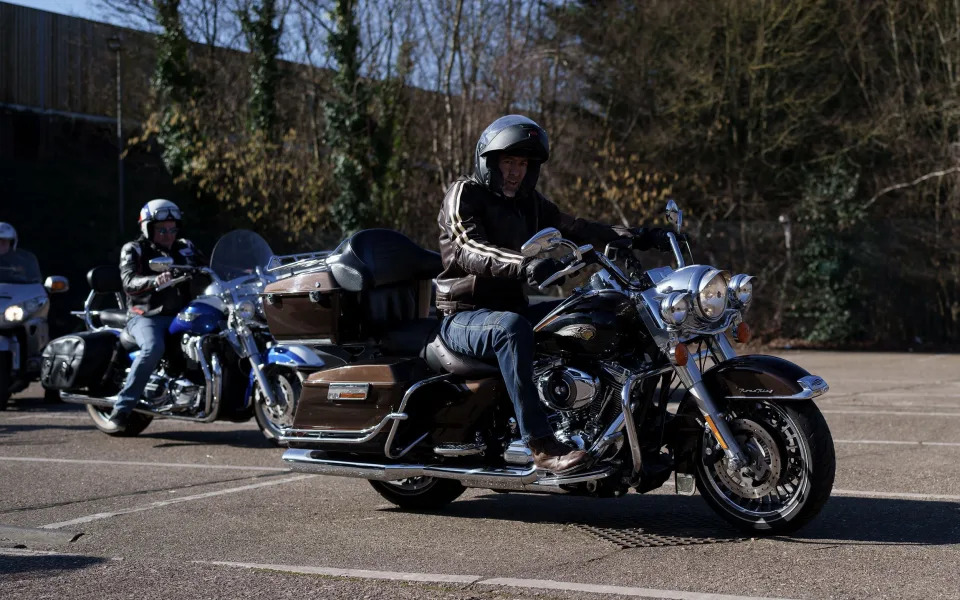
Members of the Buckinghamshire Motorcycle Lodge, a branch of the Freemasons, gather with their bikes - Christopher Pledger/Telegraph

For centuries the Freemasons have been regarded as a secretive society with ancient and arcane initiation ceremonies, whose adherents rarely discuss their membership.

But a surge in enquiries from people hoping to become initiated into the order is being spearheaded by a very unexpected group of Masons – leather-clad bikers.

Among the most high-profile and colourful of the Freemason’s specialised lodges are those on two wheels. Their powerful machines and dramatic appearance along Britain’s roads have helped drive up the number of enquiries about joining the Masons from 12,000 in 2020 to 18,000 in 2021.

There has also been a significant hike in the number of visitors to the website of The United Grand Lodge of England (UGLE), up from 65,000 in 2020 to 83,000 in 2021 – a rise of almost 30 per cent.
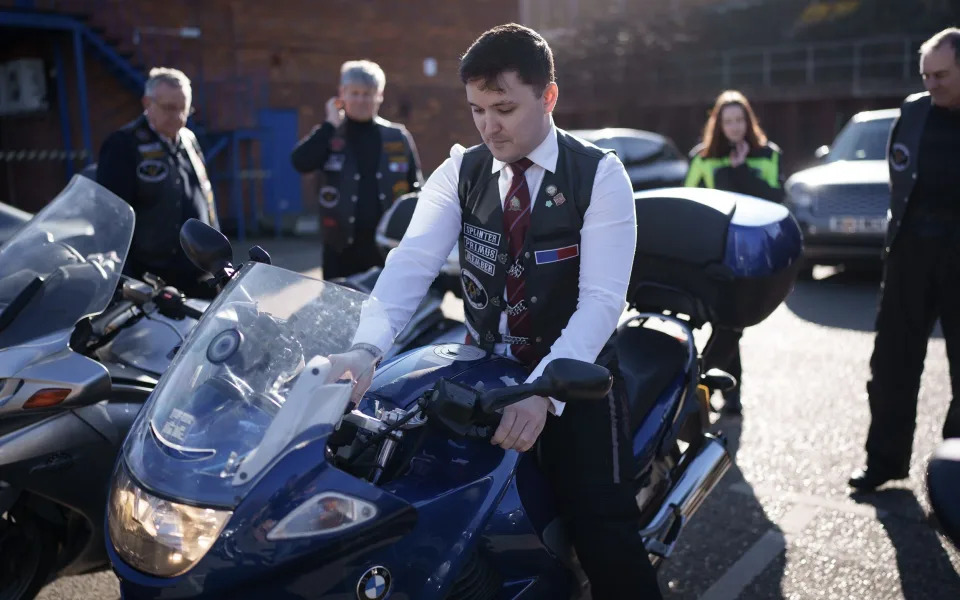

Among the most high-profile and colourful of the Freemason’s specialised lodges are those on two wheels like the Buckinghamshire Motorcycle Lodge - Christopher Pledger/Telegraph

The Widows Sons Masonic Bikers Association (WSMBA) said: “Our chapters have helped to increase Masonic membership through our presence and visibility during public motorcycle events and rallies.”

There are nearly a dozen motorbike lodges, gathering together to support charitable causes and raise awareness of the order among other bikers.

These include the Mike Hailwood Lodge in Warwickshire, named after the world champion Grand Prix motorcyclist and racing car driver killed in a road traffic accident in 1981; the Freewheelers Lodge in Lincolnshire; and the Chevaliers de Fer in Leicestershire and Rutland.

Their initiatives included distributing food to vulnerable members of the community during the Covid pandemic.

But the motorcycling Masons are at pains to point out that although they wear patches and other identifying regalia on their leathers they are not biker gangs.

“They are bound by the Masonic Book of Constitutions and are expected to represent the fraternity positively at all times,” said the UGLE, the governing Masonic lodge for the majority of Freemasons in England, Wales and the Commonwealth.

Ian Chandler, a former police detective and now provincial grandmaster of the Surrey Lodge, told The Telegraph: “Motorcycle lodges might be a long way from people’s idea of the Freemasons, but it’s the reality now.”

Other specialised, trade- or hobby-based lodges include those for the armed forces, classic-car enthusiasts, farmers, golfers and rugby players.


Biking leathers have been added to the traditional garb of Freemasons - Christopher Pledger/Telegraph

The growing interest in membership comes as the organisation urges existing Masons to be open about their affiliation and encourage others to join.

Jonathan Spence, pro grand master of the UGLE, said: “We want to be a thriving membership organisation that people aspire to join.

“We have only recently been recording the number of enquiries given our new use of social media and this year was higher than last year, and we are extremely pleased with the volume we have received.”

There is a waiting list of 6,000 people expecting to become members of UGLE, with more than 8,800 membership enquiries received in less than three months.

Mr Spence added: “We have been experiencing, post-Covid, an increasing trend of new joiners. We are certainly seeing the positive impact of converting enquiries into actual memberships.

Today’s Freemasons insist the organisation’s reputation for secrecy is far from the truth and is simply a hangover from the 1930s, when Freemasons were persecuted under the Nazis and maintained a low profile for self-preservation.

“We are not a secret society. We are about getting the best out of yourself as a human being while at the same time contributing to society at large,” said Mr Spence.

Thursday, January 02, 2020

A family bought a 20,000-square-foot Freemason temple in Indiana for $89,000, and they're now turning it into their home. Take a look inside.


The Masonic temple. Courtesy of Theresa Cannizzaro

Theresa and Atom Cannizzaro bought a former Masonic temple and are converting it into a home.
The second floor, their living space, has a large open-floor concept with five bedrooms, a kitchen, and a dining room.
When the Freemasons operated in the building, the basement was used for events, but the Cannizzaros are making it into an event space for the community.
The great room on the third floor, the largest room in the house, is now used as a movie theater.
Theresa said she thinks the house is haunted because she has heard what sounds like a janitor's keys jangling in the basement.
Visit Insider's homepage for more stories.

Older homes almost always come with a unique and charming history, but one family in Indiana moved into a house that has a particularly strange past.


Two years ago, Theresa and Atom Cannizzaro bought a former Masonic temple in the Midwest that acted as a meeting place for one of the world's most secretive organizations for almost 100 years. Now the couple and their three children — a 12-year-old boy, a 10-year-old boy, and a 6-year-old girl — are renovating the building and turning it into their home.

From large open spaces to a haunted library, here's what it's like inside the Masonic temple that the Cannizzaro family now calls home.


In 2016, Theresa and Atom Cannizzaro were living in San Diego with their three children when they decided they wanted to move to the Midwest.


Atom and Theresa. Courtesy of Theresa Cannizzaro

Theresa and Atom had lived in San Diego their entire lives and planned on raising their children there, but they soon realized that they wanted something different: a big farm in the Midwest.

"We wanted to try a new place to raise our kids — somewhere where my husband wouldn't have to work 80 hours a week," Theresa said. " We wanted to spend more time with our kids."

After a family reunion in Indiana, Theresa and Atom drove around the state looking at farms for sale when they came across something that surprised them.


While driving around Indiana, they stumbled across a Masonic temple that was for sale.

The temple. Courtesy of Theresa Cannizzaro

"We turned the corner, and there was the building, right in front of us, with a for-sale sign out front," Theresa said.

As someone who loves history and architecture, Theresa was fascinated, so they called the realtor just to see how much something like that would cost. Instead, the realtor offered to give the couple a tour of the 20,000-square-foot building.

"We spent two hours inside the building and absolutely fell in love with it," she said, adding that "slowly but surely" they realized that "there's so much we could do with this space."


They ended up buying the temple for $89,000 and moved in six months later, in 2017.

The temple. Courtesy of Theresa Cannizzaro

"We went back to California, but it was still on our minds," Theresa said. "We started talking through it more and did a lot of research and crunching numbers. Every single thing we talked about and every single 'what if' worked out, so we put in an offer on the building."

They bought it in full for $89,000, so they do not have a mortgage and are debt-free after using the money they got from selling their San Diego home. The equity they earned from that sale funded most of the up-front remodel costs at the temple.

Theresa is a full-time respiratory specialist, while Atom stays at home to watch the children and work on remodeling the building. So far, they have spent an additional $40,000 on renovations. Since they refuse to take out loans, the remodeling process has been "slow going," Theresa said.


The first step in the renovation was going through the items left behind in the temple when the Freemasons moved locations.

An old photo of the temple. Courtesy of Theresa Cannizzaro

Freemasonry dates back to medieval times and is considered the oldest male fraternity and social organization. Famous members included George Washington, Benjamin Franklin, Winston Churchill, and Gerald Ford.

Through the years, Freemasons earned a reputation as being part of a secret organization, leading to conspiracy theories that the group is behind many of the world's biggest historical events.

The Masonic lodge in Indiana that Theresa and Atom bought was built in 1926 and remained the local headquarters for several years. When the Freemasons decided to move, they cleaned out most of the building but left behind a few relics.

"I knew nothing really about Freemasonry other than that it was a secret organization," Theresa said.


Upon entering the building, you walk into a foyer with a large Masonic symbol on the floor.

The crest in the foyer. Courtesy of Theresa Cannizzaro

The front door opens into a foyer with a large crest imprinted on the floor. The crest is a common Masonic symbol, and Theresa said she planned to keep it there.

"It's really cool," Theresa said. "You walk in and it's right there on the floor."

The symbol can be seen throughout the house.

From the main entrance, you can go downstairs into the basement, where the Freemasons held large events.

The basement before the remodel. Courtesy of Theresa Cannizzaro

"You can easily fit several hundred people down there," Theresa said. She added that there is a large stage in the back of the basement, where the organization would put on shows or speeches.


Theresa said her children often ride their bikes down in the basement when it's too cold to go outside.


The basement during the remodel. Courtesy of Theresa Cannizzaro

They plan to turn the basement into a community space that people can rent for events and weddings.

"We would like to eventually have a business out of the building that can benefit us financially, but we are uncertain about when that will happen," Theresa said.

Behind the stage in the basement is a large commercial kitchen with six ovens, a 10-burner stove, and a deep fryer.


The commercial kitchen after it was restored. Courtesy of Theresa Cannizzaro

Theresa said they used this kitchen when they first moved into the building before they renovated the second floor. It will become useful again when they turn the basement into a community space for events, she said.


The second floor of the building was renovated to become the Cannizzaro family's main living space.


The doors that lead into the living space. Courtesy of Theresa Cannizzaro

This is the space the Cannizzaros have renovated the most, and it's where they spend most of their time. There are five bedrooms on this floor.


In the second-floor foyer, before you enter the living space, you can see a mural on the ceiling.


The mural on the ceiling. Courtesy of Theresa Cannizzaro

Theresa and her husband have tried to preserve the mural on the crossbeams of the ceiling.

"Unfortunately, a lot of the paint on the crossbeams is starting to peel and come off, so we have to figure out how to save it," she said.


Inside the living space is a large open area that the family uses as a living room.


The living space. Courtesy of Theresa Cannizzaro

Theresa described this space as an "open concept" and said they planned to fully remodel this room sometime in the future.


In one corner of the large open space, they built a kitchen.


The newly built kitchen. Courtesy of Theresa Cannizzaro

"We built the kitchen from scratch," Theresa said. "We custom-built everything."

The kitchen has pull-out cabinets that move around on rollers, as well as a large island that has a concrete countertop with semiprecious stones inside.

"It's one of my favorite spaces that we've done so far," she added.


On this floor they installed a full bathroom with a bathtub.


The bathroom. Courtesy of Theresa Cannizzaro

Before the Cannizzaros moved in, the six bathrooms in the building had no place to shower or bathe.

"Our first priority when we moved into the building was to put in the shower," Theresa said. "It was our very first project."

Meanwhile, the Freemasons' offices have been turned into the family's bedrooms.


The children's bedroom. Courtesy of Theresa Cannizzaro

"These rooms are big," Theresa said. "They are very, very, very large."


On the second floor, there's also a billiards room.


The billiards room. Courtesy of Theresa Cannizzaro

Inside are two pool tables that were built in the 1800s, Theresa said.

"They're absolutely gorgeous, and they were left with the building," she said.

The last room on this floor is the library — Theresa's favorite room in the entire house.


The library. Courtesy of Theresa Cannizzaro

"The entire wall is beautiful bookcases with glass fronts," she said. The glass has the Masonic symbol etched into the surface, and the cases are filled with books that date back to the 1800s.


The third floor has a large empty room that the family calls the Egyptian room.


The Egyptian room. Courtesy of Theresa Cannizzaro

There is another small mural that wraps around the entire space. If you look closely, there are symbols that Theresa said remind her of Egypt, hence the name of the room.

She said this is the room where the Freemasons would store their clothing and garb that they would wear during their meetings.

The Cannizzaros, however, plan to turn this room into an Airbnb.

Also on this floor are five cedar-lined dressing rooms.


The hallway of dressing rooms. Courtesy of Theresa Cannizzaro

Theresa said these small closets were where the Freemasons would change into their clothing for meetings and events.


Double doors at the end of the hall lead to the Great Room, where the Freemasons held most of their meetings.


The Great Room. Courtesy of Theresa Cannizzaro

The room has 24-foot ceilings, a wrap-around mezzanine, stadium seating, an organ, and a stage.

"It is quite the magnificent space," Theresa said.


For now, the Cannizzaros use this space as a home movie theater.


The Great Room is now a movie theater. Courtesy of Theresa Cannizzaro

After painting one wall white, they set up a projector and now have movie nights in the Great Room. Other times, the children use the room to play hide and seek, and sometimes they invite the 15 to 20 other kids in the neighborhood over to have a Nerf-gun fight.

The family isn't sure what to do with the room in the future. Theresa said they would most likely turn it into another rental space.


Outside the Great Room is a secret staircase that leads to the fourth floor.


The secret staircase. Courtesy of Theresa Cannizzaro

On the fourth floor you can find storage and a room that stores the organ's pipes.


Along with the secret staircase, there are other parts of the house that some may find creepy. Theresa said she thinks the building is haunted.


The main staircase. Courtesy of Theresa Cannizzaro

"There are things that have happened that we just cannot explain," she said. "We've had stuff fly off shelves."

Theresa said the library seemed to be the place with the most paranormal activity. She said she often walks into the room and notices the cabinets are wide open even though they are very heavy. Sometimes she can hear what sounds like a janitor's keys jingling in the basement.

"I'm never scared in the building, and my kids are never scared," Theresa said. "I don't think it's anything really bad that's here."


Despite the paranormal activity, Theresa said her family is focused on turning the building into a home and preserving its Masonic history.


The temple. Courtesy of Theresa Cannizzaro

"Taking on a building this size, it's not a quick-snap decision, because it very well could be a lifelong project for us," Theresa said. "I just hope that we continue on our path and with the goals that we set to turn this building into what it was originally built to be."

Monday, August 14, 2023

QAnon's weirdest obsession: Why does the radical far right fear the Masons?

BECAUSE THEY CONFUSE THE AFAM WITH THE GRANDE ORIENTE

Robert Guffey
SALON
Sun, August 13, 2023 

QAnon Sean Gallup/Getty Images

In my most recent nonfiction book, "Operation Mindf**k: QAnon & the Cult of Donald Trump," I focused extensively on a "QTuber" named Rick Rene, because I viewed him then and now as the perfectly imperfect microcosm of the entire messed-up QAnon universe, which perceives the Democratic Party as an elaborate cover for Satanic/Masonic pedophiles seeking to transform the Earth into a "one-world government."

In an email he sends out to all new subscribers, Rene relates his superhero origin story: "I'm a dad and a Christian and love the Bible. I used to fill my time teaching Bible classes at my church and coaching my kids in sports." Then his son, he says, started sending him links to various online right-wing conspiracy theorists. They "seemed pretty out there," Rene writes, definitely not material he was seeing "from the Mainstream Media or the News Apps on my phone." But the more he listened, Rene says, the more he "became intrigued enough to research these 'crazy theories,'" or, in the now-familiar phrase, to do his own research. Rene claims he didn't vote for Trump in the 2016 Republican primary (another familiar theme) but soon had "taken 'the red pill,'" which in QAnon speak means choosing to believe that everything Donald Trump says is true, along with a lot of other implausible things Trump doesn't quite say.

Rene no longer teaches Bible classes at his church. Instead, he advocates for the destruction of American intelligence agencies. In his Sept. 30, 2021, episode, Rene casually said of the FBI that we need to "blow it up and start over again from scratch!" On July 6, 2021, he waxed poetic about what he hoped would be the imminent destruction of the Washington Monument and the Statue of Liberty.

Why would a purportedly churchgoing, God-fearing Texas patriot pray for the violent destruction of such American landmarks? Because he and thousands of other evangelicals believe they were secretly constructed by Freemasons, who are essentially Satanists, and therefore must be obliterated.

This rhetoric has led not just to increased threats against such landmarks but to actual acts of destruction. On July 6, 2022, a curious monument known as the Georgia Guidestones (often referred to as "America's Stonehenge"), one of that state's most popular tourist attractions, was largely destroyed in a late-night bombing under the cover of night. That came just a few weeks after Republican gubernatorial candidate Kandiss Taylor (whose red, white and blue campaign bus was emblazoned with the slogan "JESUS GUNS BABIES") had announced that destroying the "Satanic" guidestones was a key element of her platform.

An AP news report on the Georgia bombing quoted Katie McCarthy of the Anti-Defamation League observing that conspiracy theories "do and can have a real-world impact. These ideas can lead somebody to try to take action in furtherance of these beliefs. They can attempt to try and target the people and institutions that are at the center of these false beliefs."

Rene could barely contain his exuberance while commenting on the Georgia bombing in his podcast the next day. It was "exciting," "amazing" and "awesome," he declared, and despite security camera footage showing a man placing an object at the base of one of the stones, it might not have been a bombing at all.

Guys, this is, to me, just awesome, particularly if this ends up being lightning or something natural versus a bombing to show that God is not putting up with this. He told us he's going to take these down, and He is going to. … This is the blessing, guys. We see these [prophetic] words coming true. … I believe the Stonehenge of Europe will be on the horizon as well, the Washington Monument, the Statue of Liberty, and many, many other things in the D.C. area will be destroyed.

Let's try to untangle the logic here, if that's even the word for it. Stonehenge was built by pagans; therefore, it's Satanic and needs to be destroyed.

The Washington Monument was built by Freemasons; therefore, it's Satanic and needs to be destroyed.

The Statue of Liberty was built by the French; therefore, it's Satanic and needs to be destroyed.

Ironically enough, the Georgia Guidestones were apparently conceived by an Iowa doctor with far-right beliefs about race and religion. QAnon folks like Rick Rene and Kandiss Taylor either don't know that, don't believe it or don't care. No one has ever accused extreme right-wing conspiracy theorists of being good at understanding actual history.

* * *

Rick Rene's obsession with eliminating "Masonic monuments" is by no means unique. I'm not exaggerating for effect or trying to be funny when I say that people who believe as Rene does think that Freemasons are perhaps the most destructive and poisonous influence infecting America today. Anti-Masonic prejudice, while a 19th-century hangover in many ways, is still common among certain strata of evangelical Christians, and this fear is being actively stoked by the QAnon movement. Those who hold antisemitic beliefs are often anti-Masonic as well, since they believe that Kabbalism, or Jewish mysticism, is a central pillar of Freemasonry.

Adolf Hitler explicitly attacked "Jewish Freemasonry" in his infamous manifesto "Mein Kampf," and according to the U.S. Holocaust Memorial Museum, Nazi policy toward the Freemasons moved rapidly from discrimination to outright elimination. It was at first limited to merely excluding those who refused to sever their Masonic connections but soon ramped up to far more aggressive measures. By 1935, even conservative Masonic lodges that had promised loyalty to the regime had been dissolved and had their assets confiscated.

Nazi propaganda continued to link Jews and Freemasons; Julius Streicher's virulent publication Der Stürmer (The Assault Trooper) repeatedly printed cartoons and articles that attempted to portray a "Jewish-Masonic" conspiracy. Freemasonry also became a particular obsession of the chief of Security Police and SD, Reinhard Heydrich, who counted the Masons, along with the Jews and the political clergy, as the "most implacable enemies of the German race." In 1935 Heydrich argued for the need to eliminate not only the visible manifestations of these "enemies," but to root out from every German the "indirect influence of the Jewish spirit" — "a Jewish, liberal, and Masonic infectious residue that remains in the unconscious of many, above all in the academic and intellectual world."

The Nazis mounted anti-Masonic exhibitions in Paris, Brussels and elsewhere in occupied Europe. Wartime Nazi propaganda claimed that a Jewish-Masonic conspiracy had provoked World War II and was behind the policies of Franklin D. Roosevelt.

To this day, conspiracy theorists such as Holocaust denier Michael A. Hoffman essentially believe that the Freemasons are the puppet masters of the New World Order, the Jews are the puppet masters of the Freemasons, and both groups worship Satan. Satanism is, of course, running rampant in the modern world.

More than 20 years ago, I ordered one of Hoffman's self-published pamphlets about a series of alleged assassinations he blames on the Masons. The supposed victims were Capt. James Morgan, an anti-Masonic writer who disappeared under mysterious circumstances in 1826; Joseph Smith, founding prophet of the Church of Jesus Christ of Latter-day Saints (aka the Mormons); and Edgar Allan Poe. I was somewhat able to follow Hoffman's fractured account of the first two alleged murders, but his accusations regarding Poe's death are another story. His central evidence seemed to be Poe's famous story, "The Cask of Amontillado," in which a man named Montresor bricks up a drunken man named Fortunato, evidently an old friend, behind a wall of masonry. According to Hoffman, the Freemasons interpreted this parable as an affront and decided to get back at Poe by murdering him three years after the story was published.

I wrote Hoffman a letter asking him to explain this evidently unhinged notion, claiming that I was a professor at Cal State Long Beach and that my academic colleagues were skeptical about his claims. That wasn't true. I wasn't even a student at the school then — but ironically enough, I actually am a professor there now. I suppose I shouldn't have bothered, but Hoffman's response was instructive: He wrote back an extended rant about the stupidity of college professors and claimed he had adequately explained the whole thing and no further elaboration was necessary. He did not, of course, offer any concrete evidence that the Masons had murdered Poe.

If you're thinking that someone like Hoffman is a fringe character at the outermost edge of the far right, well, sure. But the fact of the matter is, such people are not as fringe as they used to be. Once upon a time, this kind of quasi-Nazi paranoia was only found in DIY 'zines and on the dark web. QAnon changed all that, galvanizing the lunatic fringe and propelling its views into the mainstream of the Republican Party. Threats of violence against Freemasons, and acts of vandalism against their lodges, have increased considerably all over the world during the last few years. Consider these examples, all drawn from an eight-month period:

On July 10, 2022, a Tennessee firefighter set a Masonic lodge on fire. Two weeks earlier, on June 27, a man broke into the Scottish Rite Masonic Center in Houston and held two men hostage, claiming, according to a local news report, that "he wanted to talk to them [the Freemasons] about their belief system."

Less than a month before that, on June 2 or 3, two large sphinx sculptures located at the entrance of the Scottish Rite Temple in Washington, D.C., were "severely damaged" and smeared with "filth."

The Masonic temple in San Bernardino, California, was heavily damaged in an arson fire on March 13, 2022 — after nearly being destroyed in another arson attack just over a year earlier. A few weeks earlier, on Feb. 18, a man was arrested for vandalizing Masonic lodges across central Illinois, causing "massive damage."

In an especially instructive example across the Atlantic, on New Year's Eve of 2021, someone tried to burn down the Grand Lodge of Ireland. Anti-vaccination graffiti was spray-painted on the sidewalk directly outside. According to the Irish Times, "The graffiti is understood to be a reference to mRNA, the technology used in some Covid-19 vaccines." Philip Daley, grand secretary of the lodge, told the newspaper that there had been previous demonstrations by anti-vaccination activists outside his hall and other Masonic halls in Ireland. "The view is that we created the virus and we are part of the new world order and we have to be stopped," he said.

* * *

Christopher Hodapp, author of "Heritage Endures" and other books about Masonic history, has expended considerable effort on tracking perpetrators of anti-Masonic crimes as well as professional agitators who spread anti-Masonic propaganda. In a Feb. 15, 2022, blog post, Hodapp wrote about Pastor Greg Locke of Tennessee, "who regularly urges his audiences to 'destroy everything Masonic,'" and had recently held a book-burning event in Florida, "consigning 'Harry Potter' and 'Twilight' books to the flames (along with, by the way, 'Fahrenheit 451,' with absolutely no sense of irony whatsoever). Declaring Freemasonry to be Satanic … his anti-Masonic rant from that event has been endlessly forwarded" on social media.

As a Religion News article explains in depth, Locke also claimed he had identified a group of "full-blown, spell-casting" witches within his church, two of them members of his wife's Bible study group. "In recent years Locke has used his sermons to attack LGBTQ people, accuse Democratic politicians of child abuse, spread claims about election fraud, denounce vaccines and claim that the COVID-19 pandemic is a hoax," the article continued.

Want a daily wrap-up of all the news and commentary Salon has to offer? Subscribe to our morning newsletter, Crash Course.

All of this brings us to perhaps the main reason Freemasons and Democrats are so often accused of being pedophiles by these unhinged conspiracy theorists. As I wrote in "Operation Mindf**k," "Among corporations and intelligence agencies — not to mention certain high-profile political figures — it's standard operating procedure to accuse your opponents of offenses you yourself are committing." For the sake of completism, I should have added "churches" to the list.

Considering the massive scale of the sexual abuse scandals within the Roman Catholic Church and the Southern Baptist Convention — by far America's two largest religious denominations — I find it strange that thousands of supposedly devout Christians are so concerned about Freemasons and Shriners and "the Illuminati" molesting their children. How many documented cases of child abuse involving Freemasons are there, and how does that compare to the documented cases of child molestation among the Protestant and Catholic clergy? If you're one of those God-fearing, churchgoing "digital warriors" who yearns to help Q and his cohorts wipe out all the demonic pedophiles behind the U.S. government, you are statistically far more likely to find a pedophile abuser preaching the gospel behind a pulpit on Sunday morning than among the modest crowd eating potato salad in a Masonic Lodge on a random Monday night.

To be fair, not all the anti-Masonic perpetrators and agitators mentioned above can be identified as white racists or Christian nationalists. That's part of the genius of QAnon, from a propaganda standpoint. This particular conspiracy theory has successfully repackaged hundreds of years of antisemitic and anti-Masonic disinformation into a secular religion that extends its influence among all sorts of people who would never spend 10 seconds listening to a religious fanatic like Pastor Locke.

In a recent interview with the Times Union of Albany, New York, historian Mitch Horowitz, author of "Occult America" and "Uncertain Places," observed that "with the advent of QAnon, we may be a whisker away from a new Satanic Panic":


That movement swept the United States and Britain in the 1980s and early '90s on account of a cultural myth and canard that child-sacrificing Satanic cults were at work. In time, and after some really tragic and disruptive criminal trials and false accusations, media coverage exposed the Satanic Panic as a widespread hoax and a kind of cultural spasm. It may have been a reaction against changes in the workforce and the economy, in particular women entering the workforce en masse, and people turning to childcare centers and other alternative forms of daycare.

This theme has reasserted itself through the work of Alex Jones and people adjacent to the QAnon movement, and it's now commonly encountered online. And despite the news coverage and the widespread debunking of the Satanic Panic, we seem to be going through this cultural amnesia in which we're revisiting it.

* * *

Every weekday afternoon, on the Los Angeles talk-radio station KFI, a pair of conservative hosts named "John and Ken" take to the air to berate what they perceive to be the ultra-liberal views of "hack, snowflake Democrats." I've listened to John and Ken intermittently for the past 20 years, and I've never heard John admit to being wrong about anything.

Sometime in August of 2020, when my five-part series about the madness of QAnon began appearing on Salon, John expressed frustration and confusion as to why anyone would waste time writing about the subject. The people who had burrowed deep into QAnon conspiracy theories, he said, were basement-dwelling "morons" who couldn't have any effect on the real world and certainly not on national politics.

On Jan. 7, 2021, I heard John admit that he had been badly wrong about that one.

In the months before the 2020 election, pundits on both the left and the right were encouraging "reasonable" people to ignore QAnon. Among the many comments posted by Salon's readers in response to my initial articles were numerous pleas that I should stop drawing attention to all this silly, right-wing gooney-bird nonsense. Didn't I know I was just giving voice to a despicable cause?

Not long ago, I received a message via my website directed to "the dude who wrote 'Cryptoscatology: Conspiracy Theory as Art Form,'" which would be me. The correspondent was concerned that "the PTSD of the Trump Admin sure seems to have driven you into the arms of DNC group-think conformity" and went on to claim that Q followers were "victims of state abuse, their good intentions weaponized against them, and they should be pitied for their gullibility and lack of media sophistication. The belief that they represent our national demons, or god forbid a domestic terror threat, is a divisive tool that distracts from the actual powers that threaten the Bill of Rights, among many other things."

While I agree with this person's concluding claim that "sh*t is not normal," the message was accompanied by a link to a nonsensical 20-minute video that attempted to convince its viewers that Ashli Babbitt's death during the Jan. 6 Capitol riots was "a charade staged by law enforcement actors." The windows of the Capitol building, according to the video, were made of "Hollywood glass" — they broke far too easily after being smashed by hordes of enraged Christian patriots! — and the blood seen on Babbitt's face after she was shot could only have been the result of "a Hollywood squib."

This was very likely another example of a conspiracy theorist getting lost in the ethereal hall of mirrors known to many students of the genre as "Chapel Perilous," a hazard I warned my readers about in the introduction to "Cryptoscatology," the same book this correspondent had apparently enjoyed. Had this person trapped themselves in a labyrinth with no exit? I wouldn't be surprised. QAnon has been a dead end for many "digital soldiers," the five-star roach motel of embittered conspiracy buffs.

* * *

Full disclosure: I became a Freemason in 2002 and a 32nd Degree Scottish Rite Freemason in 2004. Ever since, I've been amused and bemused by the emotions that people display when the subject comes up. First of all, most people have never heard of Freemasonry, but those who have generally react as if they've just discovered I was a member of House Slytherin. Either they know almost nothing about the subject, or what they think they know has been so distorted by misinformation and disinformation that it might as well be fantasy.

According to Jay Kinney, co-author of "Hidden Wisdom: A Guide to the Western Inner Traditions," "Freemasonry as it evolved in the 18th century was influenced by the Enlightenment and … incorporated the emerging ideas of brotherhood, freedom of thought, and freedom of association." Maybe that's a simple explanation as to why so many authoritarians and outright fascists have been so hostile toward Freemasonry and its traditions throughout the years.

Several years ago, a woman asked me with complete sincerity if Freemasons really controlled the world from behind the scenes. One of my students told me that he'd always assumed Freemasonry was connected to white supremacy. I told him that well over 90 percent of my lodge were people of color. I don't think he believed me. But after Donald Trump was elected president, I began to notice a radical tonal shift in these anti-Masonic attitudes.

In 2015, I interviewed my friend Richard Schowengerdt, a longtime Mason who was a Defense Department engineer for more than 50 years. Where did the intense bigotry against Masons come from, I asked him? After all, the supposed "secrets" of Freemasonry haven't been secrets for a long time; you can read about them in any number of books and online sources. Richard told me that


The governments of many countries were afraid of Masonry because it openly taught freedom and the concepts of the Renaissance, freedom of thought and all of this, and I'd say more than 50 percent of it was political. The leaders of these countries were afraid of Masonry, that it would take away their power and eventually they would crumble, you know? Through the Renaissance and the upheaval of Protestantism, through Martin Luther and all that, Freemasonry changed the world. Masonry and a lot of the esoteric groups were associated with people like Martin Luther and anyone who might upset the Roman Catholic hierarchy. … [T]he other half of it was, there were some fears such as you've mentioned: the occult and practices that were considered to be devilish, but almost all of this was fabricated by people who were dead set against Masonry and wanted to discredit it in any way they could find.

The most paranoid anti-Masons I've encountered, either online or in the real world, have never bothered to speak to a Freemason. Their attitudes are based on misinformation they've absorbed through the internet thanks to extremist platforms like 4chan and 8kun, where QAnon and other 21st-century right-wing ideologies were born.

One of my creative writing students at CSU Long Beach — who admitted that he spent much of his free time burrowing into internet rabbit holes devoted to dubious conspiracy theories — told me that he and two friends had attempted to attend a Masonic Lodge meeting despite not being members. They had even rented tuxedos in hopes of slipping past the imaginary dragons at the gate, but even so their infiltration was not well planned. When they arrived, they were informed by the sole Mason in the building that monthly meetings were still being held remotely. He then gave them the code for the Zoom meetings, so they could follow along from home.

"So we went home and managed to enter the Zoom meeting," my student told me in hushed tones. "It was incredible! These Masons kept talking about a 'chili cookout' they were planning in some remote park out in the middle of nowhere. We knew 'chili cookout' had to be code for something else, but we couldn't figure out what. That's why that old Mason guy gave us the code to crash the meeting. He knew we couldn't figure it out! We think it had something to do with Pizzagate, like maybe 'chili cookout' was code for some weird pedophilia ritual. What do you think?"

I didn't even bother to tell him that I was a Mason, and that sometimes — in fact almost always — a chili cookout is only a chili cookout. He wouldn't have believed me anyway.

Read more

from Robert Guffey on the secrets of QAnon

The deep, twisted roots of QAnon: From 1940s sci-fi to 19th-century anti-Masonic agitprop


Making sense of QAnon: What lies behind the conspiracy theory that's eating America?


Decoding QAnon: From Pizzagate to Kanye to Marina Abramovic, this conspiracy covers everything


What are the true goals of QAnon? It's the 21st century's ultimate catfish scheme


CATHOLIC ANTI MASONRY


SEE


Tuesday, December 30, 2025

MET officers to declare if they are Freemasons

'Two thirds of officers and staff surveyed agree that this policy is needed. We think the majority of the public would also agree,' says Metropolitan Police

WATCHING TO MANY JACK THE RIPPER MOVIES

Burak Bir |30.12.2025 - 


LONDON

The London police vowed to robustly defend its decision requiring staff and police officers to declare their Freemasonry membership, according to a statement on Monday.

The Metropolitan Police (Met) statement came in response to the United Grand Lodge of England (UGLE) seeking an injunction blocking implementation of the new policy.

The lodge, representing the secretive group in England, Wales, the Isle of Man, and the Channel Islands, has pushed back against plans, announced earlier this month, to make Freemasonry membership a "declarable" association.

The Freemasons filed papers in London last week claiming the policy amounts to "religious discrimination" against Freemasons who are also police officers, The Guardian reported.

On Dec. 17, the lodge said in a statement that the Met decision cast an "aura of mistrust" over the entire organization.

The group also said it was "extremely disappointed" that the police had reached this decision without a "fair consultation process, or any direct engagement with it."

However, the Met said that the majority of British people agree with the new policy, stressing that they must prioritize the maintenance of vital trust and confidence over any organization’s desire to maintain secrecy.

"Two thirds of officers and staff surveyed agree that this policy is needed. We think the majority of the public would also agree," said the Met in response to the lodge’s injunction.

The Met statement also cited a recommendation in a 2021 report saying police membership in the Freemasons had been "a source of recurring suspicion and mistrust."

"We strongly believe that failing to act on these calls would further damage trust not only among the public but also other officers and staff," said the Daniel Morgan Independent Panel report.

The panel examined the force’s handling of the unsolved 1987 murder of private detective Daniel Morgan, a father of two who was killed with an axe in a London parking lot.

"Victims should be able to know that when they report allegations to us, the officers investigating have been transparent about any potential conflicts of interest," added the statement.


Thursday, July 06, 2023

East Lancashire Freemasons make £62k donation to help youngsters


Harriet Heywood
Sun, 2 July 2023 

Robert Frankl meeting service providers from the Railway Children (Image: Public)

A £62,000 grant has been given to help vulnerable children at risk thanks to the East Lancashire Freemasons.

More than 400 vulnerable children found at risk across the railways in the North West could be helped after a large grant was given to a charity, the Railway Children.

Robert Frankl from the East Lancashire Freemasons said: “I’m very pleased we’ve been able to help Railway Children with their hugely important project to support vulnerable children at risk across the region’s railways.

“By stepping in to help children and their families at the earliest possible stage, the charity offers the best chance of a successful outcome.”

Railway Children and British Transport Police partner to help children at risk across Northwest rail stations.

The charity provides one-to-one sessions with a project worker, sometimes working alongside schools and social workers, as well as providing information and advice for their families.

UK programme director at Railway Children, Jacqui Highfield, said: “We’re very grateful to East Lancashire Freemasons for their generous grant which will allow us to help hundreds of children and young people who are vulnerable and alone across the UK rail network.

“Feedback from young people, parents and carers is that the regularity of contact and the time spent building relationships are crucial factors in helping young people find solutions to their problems and look forward to a brighter future.”

Last year, working with British Transport Police, Railway Children supported 587 vulnerable young people and their families.

Interventions ranged from providing essential information to ensuring long-term one-to-one support for as long as a young person needed.

As a result, 86 per cent of children reported improved wellbeing, 77 per cent experienced improved personal safety and 86 per cent benefitted from better family relationships.

Sunday, January 09, 2022

Archive Amassed By Nazis Sheds Light On Masonic History

By Stanislaw WASZAK
01/09/22

Curators combing through a vast historic archive of Freemasonry in Europe amassed by the Nazis in their wartime anti-Masonic purge say they believe there are still secrets to be unearthed.
Poland has a vast archive of items that shed light on the history of Freemasonry in Europe Photo: AFP / JANEK SKARZYNSKI

From insight into women's Masonic lodges to the musical scores used in closed ceremonies, the trove -- housed in an old university library in western Poland -- has already shed light on a little known history.

But more work remains to be done to fully examine all the 80,000 items that date from the 17th century to the pre-World War II period.

'It is one of the biggest Masonic archives in Europe,' says curator Iuliana Grazynska Photo: AFP / JANEK SKARZYNSKI

"It is one of the biggest Masonic archives in Europe," said curator Iuliana Grazynska, who has just started working on dozens of boxes of papers within it that have not yet been properly categorised.

"It still holds mysteries," she told AFP, of the collection which curators began going through decades ago and is held at the UAM library in the city of Poznan.

The collection was amassed by the Nazis during their wartime anti-Masonic purge Photo: AFP / JANEK SKARZYNSKI

Initially tolerated by the Nazis, Freemasons became the subject of regime conspiracy theories in the 1930s, seen as liberal intellectuals whose secretive circles could become centres of opposition.

Lodges were broken up and their members imprisoned and killed both in Germany and elsewhere as Nazi troops advanced during WWII.

Fine prints, copies of speeches and membership lists of Masonic lodges in Germany and beyond feature among the collection's 80,000 items 
Photo: AFP / JANEK SKARZYNSKI

The collection was put together under the orders of top Nazi henchman and SS chief Heinrich Himmler and is composed of many smaller archives from European Masonic lodges that were seized by the Nazis.

It is seen by researchers as a precious repository of the history of the day-to-day activities of lodges across Europe, ranging from the menus for celebrations to educational texts.

The first edition of the earliest Masonic constitution written in 1723, six years after the first lodge was created in England, is one of the gems of the collection 
Photo: AFP / JANEK SKARZYNSKI


The collection was put together under the orders of SS chief Heinrich Himmler and some documents still bear Nazi stamps 
Photo: AFP / JANEK SKARZYNSKI

Fine prints, copies of speeches and membership lists of Masonic lodges in Germany and beyond feature in the archive. Some documents still bear Nazi stamps.

"The Nazis hated the Freemasons," Andrzej Karpowicz, who managed the collection for three decades, told AFP.

Nazi ideology, he said, was inherently "anti-Masonic" because of its anti-intellectual, anti-elite tendencies.

The library puts some select items on show, including the first edition of the earliest Masonic constitution written in 1723, six years after the first lodge was created in England.

"It's one of our proudest possessions," Grazynska said.

The oldest documents in the collection are prints from the 17th century relating to the Rosicrucians -- an esoteric spiritual movement seen as a precursor to the Freemasons whose symbol was a crucifix with a rose at its centre.

During the war as Allied bombing intensified, the collection was moved from Germany for safekeeping and broken up into three parts -- two were taken to what is now Poland and one to the Czech Republic.

The section left in the town of Slawa Slaska in Poland was seized by Polish authorities in 1945, while the others were taken by the Red Army.

In 1959, the Polish Masonic collection was formally established as an archive and curators began studying it -- at that time, Freemasonry was banned in the country under Communism.

The collection is open to researchers and other visitors, who have included representatives of German Masonic lodges wanting to recover their pre-war history.

It is "a mine of information in which you can dig at will," said Karpowicz.
Copyright AFP. All rights reserved.

Tuesday, June 26, 2007

Quebec Fete Nationale is Pagan

How pagan rites are revised to fit political purposes.

The reporter assumes that the Roman Catholic establishment in Quebec was not being political when it changed this ancient rite of Summer Solstice to a celebration of John the Baptist. Ironically a major festival for Freemasons, the political opposition to the RC establishment in Quebec.

Fete nationale began as a religious holiday back in 1615 to mark the summer solstice and the birth of John the Baptist.

But in years since, particularly with the waning of the influence of the Roman Catholic church in Quebec, it became more political. In recent years, efforts have been made to make it more inclusive and less political.

Quebecers celebrate Fete nationale more enthusiastically than Canada Day but one of the main reasons for that is because July 1 is the province's annual moving day and people are busy hauling boxes and furniture to new homes.


How to make Canada irrelevant, millions of dollars spent by Sheila Copps to supply Quebecers with Canadian flags, they can wave as they move with all their belongings festooned with Canadian
decals, stamps, bumberstickers, etc.

While Quebec and its Roman Catholic Aristocracy adopted St. Jean de Baptiste as their patron saint for their Nation State the Freemasons did the same but for the promotion of the brotherhood of man.

On June 24th, we observe the festival of summer sun and on December 27th, we observe the festival of the winter sun. The June festival commemorates John the Baptist and the December festival honors John the Evangelist.

These two festivals bear the names of Christian Saints, but ages ago, before the Christian era they bore other names. Masonry adopted these festivals and the Christian names, but has taken away Christian dogma, and made their observance universal for all men of all beliefs.


The Baptist is patron of tailors (because he made his own garments in the desert), of shepherds (because he spoke of the "Lamb of God"), and of masons. This patronage over masons is traced to his words:

Make ready the way of the Lord, make straight all his paths. Every valley shall be filled, and every mountain and hill shall be brought low, And the crooked shall be made straight, and the rough ways smooth. (Luke 3, 4-6.)
All over Europe, from Scandinavia to Spain, and from Ireland to Russia, Saint John's Day festivities are closely associated with the ancient nature lore of the great summer festival of pre-Christian times. Fires are lighted on mountains and hilltops on the eve of his feast. These "Saint John's fires" burn brightly and quietly along the fiords of Norway, on the peaks of the Alps, on the slopes of the Pyrenees, and on the mountains of Spain (where they are called Hogueras). They were an ancient symbol of the warmth and light of the sun which the forefathers greeted at the beginning of summer. In many places, great celebrations are held with dances, games, and outdoor meals.

Many of these same fire festivals are also practiced on Walpurgisnacht and Beltane; May Day. Another pagan festival of great social importance.


See:

Fete Accompli


Find blog posts, photos, events and more off-site about:
, , , , , , , , , , , , , ,
, , , , , , , , , , <, ,

Tuesday, July 28, 2020

Black soldiers monument faces scrutiny amid racial reckoning

THE FIRST BLACK REGIMENT IN THE US UNION ARMY, PROMOTED BY FREDERICK DOUGLAS AT THE TIME , MANY OF THE NON COM OFFICERS WERE ALSO PRINCE HALL FREEMASONS, THE BLACK AMERICAN FREEMASONS. 

y

In this March 26, 2011, file photo, people walk past the memorial to Union Col. Robert Gould Shaw and the 54th Massachusetts Volunteer Infantry Regiment, near the Statehouse in Boston. Amid the national reckoning on racism in July 2020, the memorial to the first Black regiment of the Union Army, the Civil War unit popularized in the movie "Glory," is facing scrutiny. (AP Photo/Michael Dwyer, File)


Workers inspect the top cornice stone as it is lifted from the Shaw 54th Regiment memorial opposite the Statehouse, Friday, July 17, 2020, in Boston. Amid the national reckoning on racism, the memorial to the first Black regiment of the Union Army, the Civil War unit popularized in the movie "Glory,” is facing scrutiny. (AP Photo/Michael Dwyer)


BOSTON (AP) — The white Union Army commander sits rigid atop an imposing horse. His Black men, rifles to their shoulders, march resolutely alongside on their way to battle.

For L’Merchie Frazier, the towering bronze relief in downtown Boston captures the stirring call to arms answered by Black soldiers who served in the state’s famed Civil War fighting unit, which was popularized in the 1989 Oscar-winning movie “Glory.”

But the longtime Boston artist says she understands how the imagery of the Robert Gould Shaw and Massachusetts 54th Regiment Memorial can conjure mixed feelings as the nation takes another hard look at its monuments and memorials in the wake of the killing of George Floyd by Minneapolis police.

“Whose story is being told with this monument?” said Frazier, who is the education director at the nearby Museum of African American History. “The hierarchy is very evident. White commander out front; Black soldiers in the background. It’s the first thing you see.”
mid the national reckoning on racism, the Shaw memorial is the latest and, perhaps, one of the more curious to receive scrutiny.

Unlike other felled monuments, the work by American sculptor Augustus Saint-Gaudens isn’t a paean to the Confederacy. It doesn’t have explicit ties to colonialism, such as the Christopher Columbus monuments that have been toppled in Boston and elsewhere.

Instead, the creation of the memorial in the aftermath of the Civil War was championed by prominent Black Bostonians of the day.

It was originally envisioned as a traditional equestrian monument to Shaw, but the colonel’s family, a wealthy Boston clan strongly opposed to slavery, requested that it also honor the Black men who served and died alongside him during their famed charge on Fort Wagner in Charleston, South Carolina, in 1863.

The monument is also significant because it’s the nation’s first honoring Black soldiers, said Elizabeth Vizza, executive director of the Friends of the Public Garden, a group helping pay for a $3 million restoration of the monument, which started in earnest in May.

Saint-Gaudens spent 14 years creating a richly detailed bas relief, using Black men of different ages as models for his realistic soldiers. After it was unveiled to fanfare in 1897, American author Henry James declared the work “real perfection,” according to the National Park Service.

“This was a radical piece of art,” Vizza said. “It was not lost on people back then.”

The work, which sits across from the Massachusetts Statehouse, has been vandalized over the years, mostly by people snapping off Shaw’s broadsword. But during the unrest that followed Floyd’s killing in May, the monument was tagged with anti-police slogans, expletives and other graffiti, along with about a dozen others in and around the Common.


Kevin Peterson, founder of the New Democracy Coalition that’s calling on Boston to rename Faneuil Hall after Crispus Attucks, said the Shaw monument should be moved to a museum because it casts Blacks as “subservient” to whites.

Similar complaints have prompted the removal of other ostensibly well-meaning monuments in recent weeks, including a statue of Theodore Roosevelt in front of the American Museum of Natural History in New York and a statue of Abraham Lincoln depicting a freed slave kneeling at his feet in Boston.

The Rev. Vernon Walker, a board member with Massachusetts Peace Action, which has called for changing the state seal’s controversial depiction of a Native American man, suggests the Shaw memorial could better recognize the achievements of the Black soldiers themselves.

Roughly half the regiment’s 600 soldiers were killed, wounded, captured or presumed dead following the failed assault on Fort Wagner, and their heroism inspired tens of thousands of Black men and others to sign up for the Union Army, helping turn the tide of the war.

Sgt. William Carney became the first Black man awarded the Medal of Honor for saving the regiment’s flag from capture. Two sons of prominent Black abolitionist Frederick Douglass, who had pushed Lincoln to allow Blacks to serve in the war, also fought at Fort Wagner.

But while the names of Shaw and other fallen white commanding officers were etched in the monument from its unveiling, those of the Black soldiers weren’t added until the 1980s, during its last major facelift.
The film “Glory” features shots of the restored monument in its end credits. Director Edward Zwick and leading cast members, including Matthew Broderick, Denzel Washington and Morgan Freeman, declined to comment through their representatives.

For now, the Shaw memorial is not among the public works that have come up as Boston continues to review public concerns about city monuments in the wake of the national debate on racism, said Mark Pasnik, who chairs the city’s Art Commission overseeing the process.

But Vizza, of the park group, doesn’t think the memorial, which is expected to be restored by November, should be changed or moved.

She believes people will have a greater appreciation for the work if they simply learn more about it, something her organization, the mayor’s office, and the National Park Service have taken pains to do.

Ahead of the restoration, which included disassembling parts of the memorial last week, officials hosted forums on public monuments that included prominent Black scholars and civil rights activists.

A temporary exhibit also has been installed on the fencing around the construction site detailing the 54th regiment’s exploits. And a new “augmented reality” app leads people on a virtual tour of the monument where they can learn more about its significance and ongoing restoration.

Frazier, of the Museum of African American History, says those are all laudable steps, and agrees the monument should remain where it is.

“It’s not enough to just see the piece. You have to go deeper,” she said. “There’s so much not told, but the monument is so moving that it can lead you to those things, if you’re curious.”


Sunday, February 23, 2020

PHOTO ESSAY

A nondescript New York City building hides a secretive Freemason meeting space, complete with fake windows and elaborate architecture. Take a look inside.


Frank Olito


Slide 1-4 of 24: The Grand Lodge of New York is located in the Flatiron neighborhood of New York City and it is the headquarters for all Freemasons in the state. Although the building looks like a normal structure from the outside, inside there are elaborate rooms and lodges that hint at what goes on behind the scenes at this secretive organization. Insider recently took a tour of the building, getting a glimpse at rooms like the Grand Lodge Room, which can seat 1,000 people for state-wide meetings. The building is also filled with smaller "lodges" that are themed, like the Gothic Room and the Colonial Room. Visit Insider's homepage for more stories. There are six million Freemasons living in the world right now. With a number that high, it should be easy to find out what exactly a Mason is and what they believe, but the organization has a reputation for keeping tight-lipped about what goes on behind closed doors. Freemasonry can be traced back to the medieval ages, but there are still lodges all over the world that host meetings. In fact, New York City is home to the Grand Lodge of New York, the headquarters for the state. Incredibly, despite being one of the most secretive organizations in the world, they welcome guests into the building every day for tours. Insider took one of these tours and saw firsthand where all their meetings take place. Keep reading to find out what it's like inside.

Wednesday, December 25, 2024


Freemasons, homosexuals and corrupt elites in Cameroon: Inside an African conspiracy theory
December 25, 2024

An unusual and fascinating new book has been written by two anthropologists, called Conspiracy Narratives from Postcolonial Africa: Freemasonry, Homosexuality, and Illicit Enrichment. It explores an ongoing conspiracy theory in Cameroon and neighbouring Gabon that corrupt elites spread homosexuality through their connections to secret orders like the Freemasons. They trace the origins of the conspiracy theory to a moral panic in Cameroon in 2005. They then move back in time to understand what it all means. We asked the authors to tell us more.

What sparked the moral panic in Cameroon?

On Christmas day in 2005 the archbishop of Yaoundé, Cameroon’s capital, the famously homophobic Victor Tonye Bakot, surprised the nation with a sermon attacking the national elite. He accused them of spreading homosexuality by forcing anal sex on young men eager to get a job.

The sermon was all the more surprising since the archbishop spoke in the Yaoundé cathedral with the nation’s leaders right in front of him, including then president Paul Biya. It offered a new variation of the Catholic church’s attacks on Freemasonry.

Freemasonry is a male-only organisation that engages in secretive rituals and promotes a moral order but is not a religion. It emerged around 1700 in Scotland when liberal thinkers joined old guilds of masons. A Grand Lodge was established in London in 1717. Freemasonry then spread to France and French colonies.

In France, Freemasonry was fiercely attacked by the Catholic church, worried by the increasingly secular tendencies of the brotherhood and its supposedly central role in the French Revolution. So, even though the 2005 attack by the Cameroonian archbishop was nothing new, it hit like a wave in this specific context and created a conspiracy theory that lives on today.

Only a month after the sermon, several newspapers started publishing lists of “supposed” or even “prominent” homosexuals. (The so-called Affaire des listes – the list affair).

They named ministers and other politicians, sports and music stars, and even some senior religious leaders. Denouncing the elite as homosexuals corrupting the nation had become an outlet for people’s dissatisfaction with the regime.

The elite did not know how to defend itself against this attack. At first Biya asked for respect for people’s privacy. But when new rumours and hints were published, the government launched a witch-hunt against supposed homosexuals.

Same-sex practices had been criminalised by presidential decree in Cameroon in 1972. But until 2005 this was seldom applied. Since then, however, people suspected of such “criminal” behaviour have been harassed by arbitrary arrests and imprisonment.

Since 2000 homophobia has been on the rise on the African continent but, as Cameroonian sociologist Patrick Awondo emphasised, its “politicisation” takes different forms in each country. In Cameroon – and to a lesser extent Gabon – the homosexual targeted by popular outrage is politicians and the elite. The supposed omnipresence of Freemasonry and other global associations in higher circles is a key factor here.

You view this as a conspiracy theory?

Our analysis of this powerful attack as a conspiracy narrative addresses what might be one of the major challenges for academics today: how to deal with the tsunami of conspiracy theories that haunt politics globally.

These range from Trump and QAnon to the “street parliaments” in the early 2000s in Côte d’Ivoire (well-known public spaces used to defend the rule of President Laurent Gbagbo).

Academics used to see it as their first task to refute such conspiracy theories, but there is an increasing realisation of the futility of such an approach. Supporters may resent claims of scientific knowledge as superior and stick all the more to their convictions. Sociologists have noted it might be more urgent to first try to understand why these often improbable stories can gain such power.

We propose in our book that historicising conspiracy theories might be an answer. That is, studying them as products of specific historical settings.
So what is the historical background of the panic?

The first chapters of our book deal with the histories of masonism and anti-masonism in European and African settings. We try to understand why views that Freemasonry is tied to same-sex practices remained particularly resistant in French-speaking Africa.

We also consider the changing balance between the secrecy of the brotherhood and public display in post-colonial Africa. A good example is the leaked 2009 video showing the inauguration of Gabon’s president Ali Bongo as the Grand Master of the Grand Lodge of Gabon.

Going public like this is quite exceptional for a Freemason. Bongo probably hoped to impress his numerous adversaries by boasting of his access to special forms of power. But it also showed him as a neocolonial stooge as he was being led by representatives of the Grand Lodge Nationale de France.

 
The leaked video of Gabon’s President Ali Bongo.

Of course, linking homosexuality to Freemasonry strengthens the claim – now made by many in the continent – that homosexuality is un-African and imposed by colonialism. But for Cameroon and Gabon, there are hard-to-ignore signals that this was not the case.

Take, for example, the work of German ethnographer Günther Tessmann. He worked among the Fang people on the border between Cameroon and Gabon just after 1900, before the establishment of colonial authority. A recurring concept is biang akuma (the “medicine” of riches), which to Tessmann’s surprise was associated with sex between men. He highlighted in 1913 already two dimensions of popular perceptions of homosexuality in many African contexts: the association with “witchcraft” and also with enrichment.

This last element came out strongly from our comparisons with Côte d'Ivoire, Senegal and Nigeria. The idea of the anus as a source of enrichment has a long history in Africa. This puts the complaints of present-day Cameroonians that they live under anusocratie (rule of the anus) in a broader perspective.

It also helped us to contribute further to debates about the need for further decolonising queer studies.

Clearly, to understand the complexities of the puzzling links between Freemasonry, homosexuality and illicit enrichment, we must move beyond ideas of fixed identities.

A crucial contribution to the debate on homosexuality that exploded after 2005 came from Cameroonian anthropologist Sévérin Abega. He insisted that to understand the perceptions of it one has to take into account a local belief among some communities in Cameroon that every person has a double.

Thus Abega foreshadowed recent debates by Cameroonian scholars like Francis Nyamnjoh on African personhood as incomplete and Achille Mbembe on the return of animism.

Another decisive factor in understanding why linking Freemasonry to homosexuality became such a hot political issue after 2000 is the internet. Internet access was a watershed, bringing relief for LGBTIQ+ people in Cameroon and Gabon. But it also strengthened a backlash against ideas of a gay identity associated with the west. (In a twist to these developments, Biya’s daughter, Brenda Biya, caused fierce debate by coming out as lesbian in July 2024.)

What do you hope readers will take away?

The book offers insight into the role – as omnipresent as it is understudied – of Freemasonry and similar global orders in Africa. It adds to studies of the association of same-sex unions with “witchcraft” and illicit enrichment in west Africa.

Such aspects are mostly absent from activist-oriented studies – no doubt for good reasons – but essential for understanding the popular debates and struggles over same-sex issues in Africa today.

But the main contribution of the book might be in our attempt to analyse a powerful conspiracy narrative, not by trying to refute it but by historicising it. The question is whether African visions of the person as fluid and frontiers as porous – also when it comes to sexuality – can overcome the tendency to think of identities as fixed.

Peter Geschiere, Professor Emeritus of African Anthropology, University of Amsterdam and Rogers Orock, Assistant Professor of Africana Studies, Lafayette College

This article is republished from The Conversation under a Creative Commons license. Read the original article.