Mamdani’s Brilliant Campaign
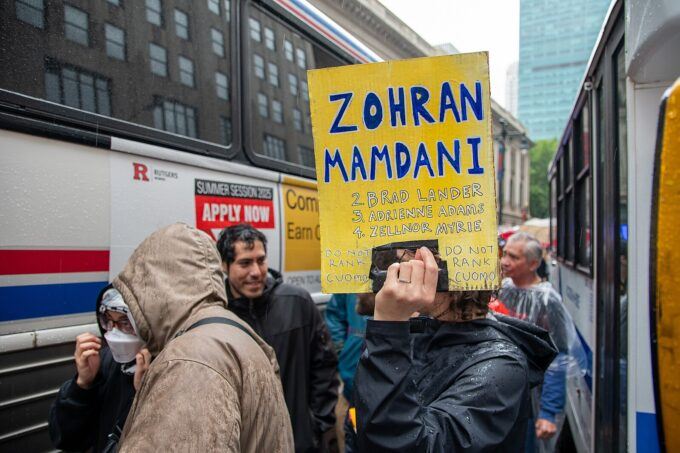
Photograph Source: Moonlightonasnowynight – CC0
There were many reasons for those of us living outside the Big Apple to celebrate the victory of Zohran Mamdani over Andrew Cuomo in the Democratic mayoral primary. First, it was great to see that large numbers of people in New York, including many Jews, were prepared to vote for a Muslim candidate for mayor.
Mamdani made a big point of recognizing antisemitism in the United States as a serious problem, while at the same time criticizing the policies of the Netanyahu government. The win was especially good to see since the “criticism of Israel IS antisemitism” crowd moved into high gear to defeat Mamdani. It looks like fewer people are willing to buy this tired lie these days.
It was also good to see Mamdani win despite the efforts of the old guard Democrats to rally the troops behind Andrew Cuomo. “Old” is certainly appropriate in this context since Cuomo’s group of big-name endorsers including people like former president Bill Clinton, former NYC Mayor Mike Bloomberg, and South Carolina Congressman Jim Clyburn. These are all people in their late 70s or 80s. The Dems desperately need some new younger faces and Andrew Cuomo and these folks do not fit the bill. (The situation was made worse by the fact that many of Cuomo’s endorsers were last seen demanding that he step down as governor over allegations of sexual harassment.)
But it was also great to see that Mamdani was elected pushing an explicitly progressive economic agenda. He wants to increase taxes on the rich and corporations, and to use the money for items like free buses and affordable housing. He also wants stronger rent control. He proposes to set up public supermarkets which can compete with the existing chains. Mamdani also recognizes the need for more housing in general and has endorsed the abundance gang’s agenda of removing zoning and other obstacles to building.
While I am happy to see Mamdani run and win on this platform, I do worry about the limits on the ability of a single city, even a huge one like NYC, to pursue some of the items on his agenda. This is especially the case with tax and transfer policies. I have long felt that even at the national level tax and transfer policy has limits. Rich people are very creative at finding ways to avoid or evade taxes.
At the state and local level, they have even more options, since all they have to do is to move across a city or state line, or at least claim they have. Remember, the people we are most interested in taxing almost all have two or three or even more homes. Proving that their home in New York City is in fact their primary residence, and should be the basis for taxation, is not an easy task.
This is why I have focused much of my efforts on changing the structure of the market so that we don’t have so many people getting ridiculously rich. The most obvious issue here is government-granted patent and copyright monopolies. (There are more efficient mechanisms for financing innovation and creative work.) These monopolies likely transfer over $1 trillion a year from the rest of us to those in a position to benefit them and make some people incredibly rich. If Microsoft could not get the government to arrest people for making unauthorized copies of its software, Bill Gates would probably still be working for a living instead of being one of the richest people on the planet.
We also have created structures that have allowed for the growth of an incredibly bloated financial sector, which has also made some people incredibly rich at the expense of the economy. Applying a sales tax to financial transactions, similar to the tax that most of us pay when we buy clothes or food, would go far towards downsizing the industry. Similarly, ending the policy of costless bailouts for big banks, whose incompetence led them to bankruptcy, would also be a big step forward. Changing the laws to make the bankruptcy gaming practiced by private equity less profitable would also be a great move toward increasing economic efficiency and reducing inequality.
But this is all my story, the question is what progressive steps Mamdani can take as mayor. Starting with increasing taxes on the rich, I don’t know at what point raising taxes on the rich ends up being a money loser, but that point clearly does exist. Rich people care about money.
The New York State income tax is 9.65 % on income over $1 million and 10.9% on income over $25 million. The city’s tax rate on is already at 4.5%, which makes for a 14.15 percent tax on the rich and 15.4 percent tax on the very rich. In 2012, California raised its top tax rate from 9.3 percent to 12.3 percent. People with income above $1 million pay an additional 1.0 percentage point tax for mental health programs, bringing the total to 13.3 percent. A recent study found that migration and changed behavior by the rich substantially reduced the amount of revenue gained from this tax hike compared with what had been expected, although there was still a revenue gain.
It is important to realize that the impact of rich people responding to higher taxes will mostly not be seen overnight. Rich people will not immediately get out the moving van. The problem is that over time rich people will move out of the city and fewer rich people will move in. A city with fewer rich people might be a good thing, but it will get less tax revenue from them.
It is worth noting there is a fix that can reduce some of the impact on the rich. If an employer-side payroll tax is substituted for a portion of the income tax (ironically a route Cuomo pursued as governor), then rich people can still effectively deduct a portion of their state and local income tax from their federal income tax, as was allowed before the Trump tax bill in 2017. To be clear, the goal is not to reduce the tax burden on the rich, rather the point is to give rich people less incentive to live in a lower tax state.
Mamdani also proposed raising the corporate income tax. Undoubtedly it is possible to get some more money out of corporations, but the big problem here is tax gaming. Corporations spend huge amounts of money on lawyers and accountants who make their profits appear to come in low-tax jurisdictions. A way to get around this problem is to require that companies turn over an amount of non-voting stock equal to the targeted tax rate.
This means that if the tax rate is 5 percent, corporations would be required to turn over an amount of non-voting stock equal to 5 percent of its outstanding shares. This stock would get the same dividends as other shares and could be sold like other shares, so that their market price should track the price of other shares. (This can be done with a bookkeeping entry rather than actual shares.)
Mandani has also proposed rent control, which would put a bigger check on rent increases than the current system of rent stabilization. The success of this will depend on the details, but for my part I would be worried that controls could go too far in keeping the rents of controlled units well below the rent of new units, which typically would be set at market rates.
The issue to my mind is vacancy decontrol. If rents are controlled for as long as a tenant is in a unit, it gives them the same protection against housing inflation as if they were an owner. However, if the control remains in place when tenants change, then the people who are likely to get controlled units will be those who already know people in these units.
A newcomer to the city would effectively be locked out and have to pay far more for renting an apartment. It’s hard to see this as a desirable outcome. Vacancy decontrol gets around this problem, although there will still be people who find ways to game the system and claim they continue to occupy a place even when a friend or relative has taken over the apartment.
One policy that could reduce inequality and at least modestly increase available housing would be a progressive property tax. This could mean, for example, having an extra 0.5 percentage point property tax on the value of a home in excess of $1 million and an extra 1.0 percentage point on value in excess of $2 million. This would be relatively simple to implement, since there are already assessed values on the books. It would also provide a small disincentive for rich people to have large expensive properties. However, the state may not give the city leeway to structure its property tax this way.
The bottom line with NYC’s housing costs is the city does need more housing. Zoning and other restrictions are at least part of this problem. If Mamdani can remove these obstacles it will be a big step towards making housing more affordable.
Anyhow, I’m just stating the obvious in saying that a progressive mayor will face huge obstacles in any city in the country. Trump and the Republicans in Washington will do everything possible to sabotage their efforts. Many Democrats will help them and we can count on major news outlets to join the game, highlighting every setback and downplaying any success.
Mamdani is a sharp and energetic politician. And he should have valuable assistance from Brad Lander, the current city comptroller and third place finisher in the mayoral race. Lander and Mamdani campaigned together and cross-endorsed in the city’s system of rank-choice voting. He presumably will play a major role in a Mamdani administration.
There is a long way between now and November, and the moneyed types will do everything in their power to keep Mamdani from winning. They could succeed, but for now we have a big victory to celebrate.
This first appeared on Dean Baker’s Beat the Press blog.
Mamdani’s Win in NYC Transforms America’s Mid-Term Political Contests
A typical initial take on the totally unexpected landslide win, by the self-declared socialist Zohran Mamdani, of the Democratic nomination for (and thus almost certainly) the Mayoralty of NYC, was Eric Levitz’s June 25 Vox News article “What Democrats can (and can’t) learn from Zohran Mamdani’s triumph,” which said that
Some on the left have suggested that Mamdani’s victory proves Democrats do not need to moderate their party’s image to compete for national power. This argument does not make much sense. To secure a Senate majority in 2026, Democrats will need to win multiple states that backed Donald Trump over Kamala Harris by double digits. And even if Democrats give up on winning Senate control next year and shoot for doing so in 2028, they will still need to win in states that voted for Trump all three times he was on the ballot.
According to some political scientists, pollsters, and pundits, doing this will require Democrats to moderate their national reputation, since modern voters tend to judge candidates less by their own idiosyncratic positions than by their party’s general image. In this analysis, acquiring the power necessary for advancing even incremental progressive change federally requires the Democratic leadership to observe strict ideological discipline. So long as the party’s brand is toxic to the median voter in Ohio — who backed Trump every single time he’s been on the ballot — Democrats will have no prayer of passing ambitious federal legislation or confirming liberal Supreme Court justices.
This theory could very well be wrong. But a socialist winning 43.5 percent of the vote in a Democratic primary in New York City does not tell us much about its validity one way or another.
However, that was 43.5% of the voters in a four-candidate race, in which 36.4% went to the overwhelming favorite by ‘the experts’, Andrew Cuomo, 11.3% went to another candidate, and 4.3% went to the corruption-scandal-plagued current incumbent Mr. Adrienne Adams. So, even if Mr. Mamdani won’t receive the donations or endorsements of ANY of NYC’s billionaires and their media, New York City is going to have its first socialist and anti-Wall-Street Mayor in 2025, and all of those “political scientists, pollsters, and pundits” will be proven wrong; and here is why:
All indicators are that currently Americans are very dissatisfied with both Parties; the public sentiment in favor of a new Third political Party to become formed is at an all-time-high; and the public’s polled trust in America’s institutions and especially in its governmental and media institutions is at an all-time low.
Nonetheless the ‘experts’ overwhelmingly predict upon the basis of the assumptions that worked for them in the past. When voters have been asked by pollsters what their POLICY-preferences are, their answers are remarkably as they were in the past. However, this does NOT say anything about the public’s policy-PRIORITIES, which have recently changed RADICALLY. I have several times stated this, but it is the most-meaningful polling result so far this year, and is extremely relevant to the Mayoralty contest in NYC, so I shall repeat it again:
 On February 14, the AP headlined “Where US adults think the government is spending too much, according to AP-NORC polling,” and listed in rank-order according to the opposite (“spending too little”) the following 8 Government functions: 1. Social Security; 2. Medicare; 3. Education; 4. Assistance to the poor; 5. Medicaid; 6. Border security; 7. Federal law enforcement; 8. The Military. That’s right: the American public (and by an overwhelming margin) are THE LEAST SUPPORTIVE of spending more money on the military, and the MOST SUPPORTIVE of spending more money on Social Security, Medicare, Education, Assistance to the poor, and Medicaid (those latter five being the functions the Republican Party has always been the most vocal to call “waste, fraud, and abuse” and try to cut — but those 5 were the most-favored by the American public). Meanwhile, The Military, which actually receives 53% (and in the latest year far more than that) of the money that the Congress allocates each year and gets signed into law by the President, keeps getting, each year, over 50% of the annually appropriated federal funds. Furthermore, the U.S. Defense Department is the only Department of the federal Government so corrupt, so intensely corrupt, that it has never been audited.
Trump is increasing the military and border security, and decreasing education, assistance to the poor, Medicaid, federal law enforcement, and even Social Security and Medicare (the latter two by laying off many of the people who staff those bureaucracies). This Government’s policy-priorities are like the public’s turned upside-down — in other words: are the REVERSE of the public’s — and therefore the U.S. Government right now is a perfect example of a dictatorship. One might say that this is so in only the Executive branch, but it’s not necessarily true: As always when one political faction (regardless whether it it is one Party or a coalition of Parties) has control over both the Executive and the Legislative branches of the Government — as now the case in the U.S. — these two branches (Executive and Legislative) function as one, and there then will even be a totalitarian dictatorship if they can get the Judicial branch or Supreme Court to call it “Constitutional.” Currently, the U.S. is slipping from a dictatorship towards a totalitarian dictatorship; but America has been a dictatorship ever since at least 1980. And that is a dictatorship by the super-rich.
As the liberal (Democratic Party) wing of America’s aristocracy said, in the person of its Warren Buffett, “There’s class warfare, all right, but it’s my class, the rich class, that’s making war, and we’re winning.” (He told this to the conservative Ben Stein, reporting in the aristocracy’s New York Times, under the headline “In Class Warfare, Guess Which Class Is Winning”.)
To see the empirical evidences proving that there IS class-warfare in America, and that the billionaire-class is ruling this country and (behind the scenes) writing and executing its laws, click here. That’s the situation as it had been since at least 1980, but the current trend away from that is toward even more of a dictatorship (by the super-rich) in America.
Between now and November 4 — the upcoming NYC Mayoralty election — there is plenty of time for a rip-roaring campaign that will either rip the Democrat to pieces, or else rip the Republican nominee to pieces. The likelihood that Mamdani will get ripped to pieces by the Republicans seems low to me because he is the son of academic Mahmood Mamdani and filmmaker Mira Nair. Click on those and you will see a personal background that explains his politics; and, so, the likelihood of scandal being found by Republican opposition researchers against him is just about as low as it can go, though freakish exceptions do exist to contradict any generality.
The BIG issue in politics, which will be coming increasingly to the fore during all of the political contests throughout Trump’s second term, will be TRUST (honesty). Levitz’s article misses this fact entirely when he says “4) The odds of Alexandria Ocasio-Cortez winning in 2028 look higher. Finally, it is easier to picture Rep. Alexandria Ocasio-Cortez winning the Democratic Party’s 2028 presidential nomination today than it was yesterday.” She has been enough of a disappointment to progressive voters (such as on the the U.S.-funded Israeli genocide against Gazans, regarding which, she has continued to speak only in platitudes, knowing that she can climb her way up ONLY if she can get the Party’s billionaires to back her), as to make Levitz’s analogy of Cortez to Mamdani an unintended and false insult to Mamadani. So, Levitz’s comparing her to Mamdani is so very far off-base that Levitz’s throw there might as well have been into the stands, as to the baseman, trying to stop the base-runner.
Mamdani’s win of the Democratic nomination will probably turn out to have been a major turning-point in American politics. The Democratic Party’s billionaires will have lots of difficulty dealing with it, and might even lose their grip-hold of the Party. All of them turning toward the Republican Party would end the hoax of their saying we have a democracy because we give you the choice: it’s between arsenic and cyanide. That’s what they’ve done to our ‘democracy’.

No comments:
Post a Comment